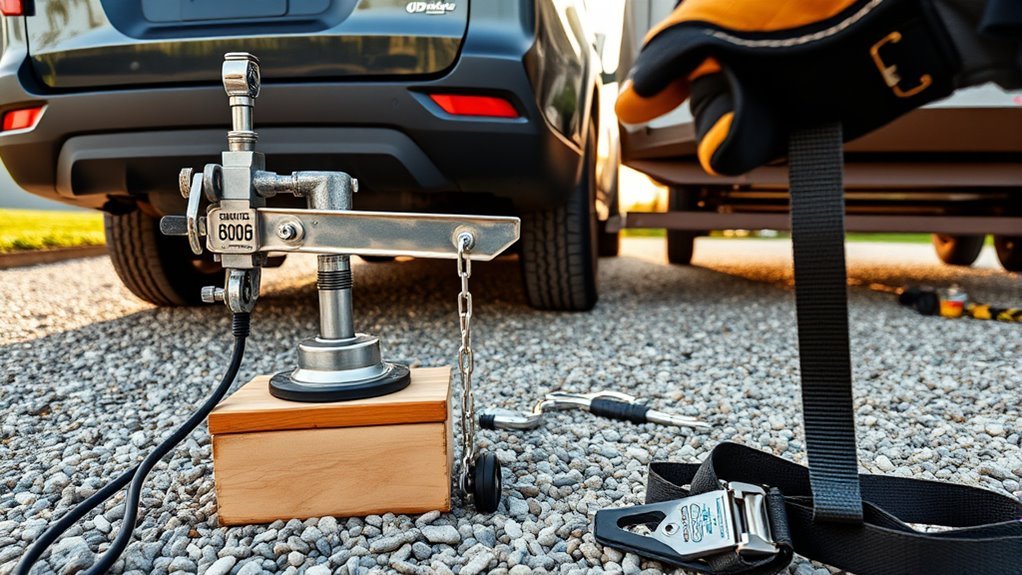
Getting trailer tongue weight right is one of the most important parts of towing safely with an SUV. For a conventional ball-pull trailer, a useful starting guideline is about 10–15% of the trailer’s actual loaded weight, but that percentage is only part of the job. You must also stay within your SUV’s payload, GVWR, rear GAWR, GCWR, hitch-receiver rating, trailer rating, and tire limits. Measure the trailer in the same loaded condition you will tow, then adjust cargo and recheck the result before traveling.
Quick Answer
For a conventional ball-pull trailer, start with tongue weight around 10–15% of the trailer’s actual loaded weight, then confirm the SUV, hitch receiver, rear axle, payload, and trailer ratings are not exceeded. Measure on level ground with the trailer loaded for travel, and recheck after any cargo or fluid change.
Key Takeaways
- Use the trailer manufacturer’s specified tongue-weight range first; about 10–15% of loaded trailer weight is a common guideline for conventional trailers.
- A 5,000-lb loaded trailer at 10–15% would have about 500–750 lb of tongue weight.
- Tongue weight counts against the SUV’s carrying capacity, so passengers, luggage, accessories, and roof cargo can reduce the tongue load the SUV can safely carry.
- Measure with the trailer loaded exactly as it will travel, including batteries, propane, water, bikes, generators, and other cargo.
- A weight-distribution hitch redistributes load among the axles; it does not make an improperly balanced trailer safe or override vehicle ratings.
At a Glance
| Time Required | About 15–30 minutes once the trailer is loaded |
| Difficulty | Easy to moderate |
| Tools Needed | Tongue-weight scale, public vehicle scale, or suitable bathroom-scale lever setup; wheel chocks; tire-pressure gauge |
| Cost | May be free with equipment you already own; public scales may charge a weighing fee, while dedicated tongue-weight scales cost more |
Warning: The 10–15% guideline does not override your SUV owner’s manual, trailer manual, hitch-receiver label, tire limits, or any vehicle-specific towing instructions. Never exceed the lowest applicable weight or axle rating in your complete towing setup.
What Tongue Weight Means for SUV Towing
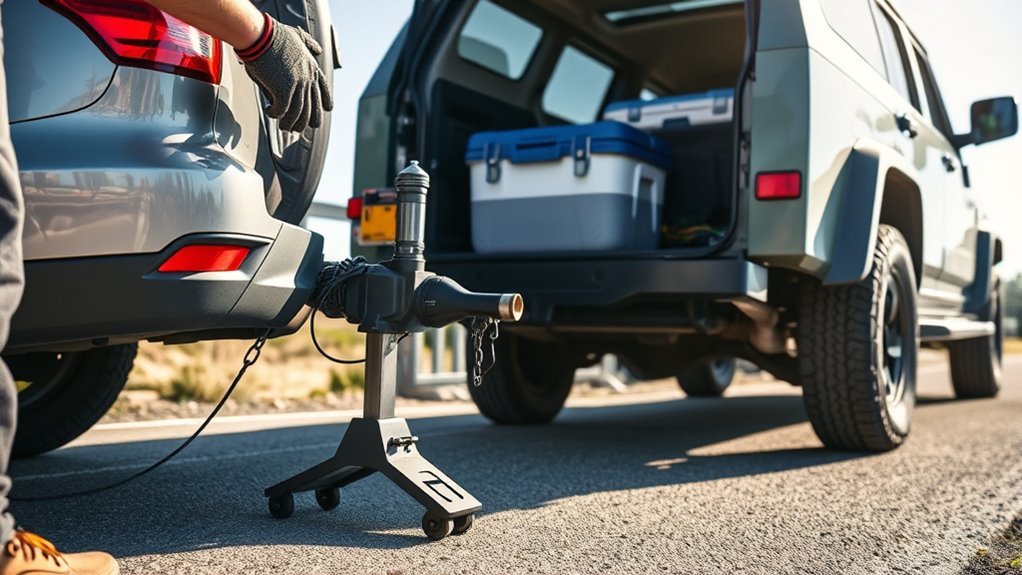
Tongue weight is the downward force a conventional trailer places on the hitch ball or coupling point. It is different from the trailer’s total weight, and it is also different from the amount of load carried specifically by your SUV’s rear axle.
For many conventional ball-pull trailers, about 10–15% of the actual loaded trailer weight is a useful target. For example, a trailer that actually weighs 4,000 lb when packed for travel would generally fall in a range of about 400–600 lb at the tongue. Always use a different percentage if the trailer or tow-vehicle manufacturer specifies one.
A 4,000-lb loaded conventional trailer at 10–15% tongue weight would place about 400–600 lb on the hitch.
Too little tongue weight can make a conventional trailer more prone to sway because too much mass is concentrated at or behind the trailer axle. Excessive tongue weight can overload the SUV’s hitch, rear axle, suspension, tires, or payload capacity and can reduce front-axle loading enough to hurt steering and braking response.
A higher advertised towing capacity does not automatically mean an SUV can carry a proportionally higher tongue load. Maximum trailer weight, hitch tongue rating, payload, GVWR, GAWR, GCWR, and tire ratings are separate limits. The safe setup is the one that stays below all of them.
Note: The 10–15% figure discussed here applies as a general rule to conventional ball-pull trailers. Boat trailers and fifth-wheel or gooseneck setups may use different manufacturer-specified percentages.
Check Your SUV, Hitch, and Trailer Ratings First
Before chasing a particular tongue-weight percentage, confirm the limits for the entire towing combination. Current GM trailering guidance stresses that the vehicle, trailer, hitch, passengers, and cargo all need to be considered together.
| Rating | What It Limits |
| SUV payload | Passengers, luggage, accessories, hitch equipment, and trailer tongue load carried by the SUV |
| GVWR | Maximum allowable loaded weight of the SUV |
| GAWR | Maximum allowable load on each vehicle axle |
| GCWR | Maximum allowable combined weight of the loaded SUV and trailer |
| Receiver tongue rating | Maximum downward tongue load the receiver is rated to carry in the specified hitch configuration |
| Trailer GVWR | Maximum permitted total loaded weight of the trailer |
Your usable limit is determined by the lowest applicable rating. For example, installing a receiver with a higher stamped capacity does not automatically increase what the SUV itself is allowed to tow or carry.
Quick Safety Checklist Before You Measure Tongue Weight
Measure tongue weight only after the trailer is loaded as it will be on the road. Secure all cargo, set tire pressures according to the applicable vehicle/trailer instructions, inspect the hitch and chains, and include permanent or trip-specific loads such as batteries, propane cylinders, water, generators, tools, bicycles, and luggage.
Inspect Hitch And Chains
Before weighing, inspect the receiver, ball mount, hitch ball, coupler, hitch pin, safety chains, electrical connector, breakaway system, and trailer brakes where fitted. Confirm the coupler is fully seated and locked and that the hardware is rated for the planned load.
Look for loose fasteners, excessive corrosion, cracks, deformation, damaged chain links, or worn components. Many vehicle manufacturers instruct owners to cross safety chains beneath the trailer tongue while leaving enough slack for full turns, but follow the exact routing instructions for your vehicle and trailer.
If a weight-distribution hitch is installed, inspect its head, brackets, spring bars, chains or trunnions, and fasteners. Use the manufacturer’s procedure for setup and torque values rather than estimating adjustment by appearance.
Check Tire Pressure
Check the tow vehicle and trailer tires when cold with an accurate pressure gauge. Use the SUV’s tire placard and owner’s manual plus the trailer or tire manufacturer’s instructions. Towing recommendations may differ from everyday unloaded driving recommendations on some vehicles.
Inspect tread and sidewalls for cuts, cracking, bulges, abnormal wear, or other damage. Proper inflation is essential for load capacity, heat control, handling, and stability. GM’s current towing guidance also recommends checking both vehicle and trailer tires before departure.
Secure Trailer Load
Load the trailer exactly as it will travel. A commonly used starting point is to place roughly 60% of cargo toward the front half of a conventional trailer and keep the load balanced side to side. That is only a starting point—the final tongue-weight measurement and the trailer manufacturer’s instructions determine whether the load is actually balanced correctly.
Use rated straps, tie-downs, or built-in restraints so the cargo cannot move during braking, cornering, or rough-road travel. A heavy object that shifts several feet can materially change tongue weight and trailer handling.
How Much Tongue Weight Your SUV Needs (10–15% Rule)
For a conventional trailer whose manufacturer does not specify another figure, calculate the initial target using the trailer’s actual loaded weight, not simply its advertised empty weight.
Formula: loaded trailer weight × 0.10 to loaded trailer weight × 0.15.
| Loaded Trailer Weight | 10% Tongue Weight | 15% Tongue Weight |
| 2,000 lb | 200 lb | 300 lb |
| 3,000 lb | 300 lb | 450 lb |
| 4,000 lb | 400 lb | 600 lb |
| 5,000 lb | 500 lb | 750 lb |
| 6,000 lb | 600 lb | 900 lb |
Reaching the percentage target is not enough if the resulting tongue weight exceeds the SUV’s available payload, receiver rating, rear GAWR, GVWR, or another limit. Check both the percentage and the vehicle ratings.
Measure Tongue Weight Fast With a Drive-On Scale
A public or commercial vehicle scale can measure tongue weight without putting the trailer tongue directly on a small scale. CURT’s tongue-weight guide describes this method.
- Load the SUV and trailer exactly as they will be during towing.
- Keep the SUV occupants, luggage, and other onboard cargo the same for both weighings.
- For a raw tongue-weight measurement, disengage the weight-distribution spring bars unless your hitch manufacturer specifically instructs you to measure with them engaged.
- Weigh the SUV by itself and record the total weight on its axles.
- Connect the loaded trailer.
- Put all SUV wheels on the scale while keeping the trailer tires completely off the scale.
- Record the SUV axle total again.
- Subtract the SUV-alone reading from the hitched SUV reading.
Tongue weight = hitched tow-vehicle axle total − tow-vehicle-alone axle total.
For example, if the SUV weighs 5,200 lb alone and its axles total 5,800 lb with the trailer connected and the trailer tires off the platform, the measured tongue load is approximately 600 lb.
Pro Tip: Use the same fuel level, passengers, luggage, and accessory load for both vehicle-scale readings. Otherwise the difference may include changes that have nothing to do with the trailer tongue.
[Products Worth Considering]
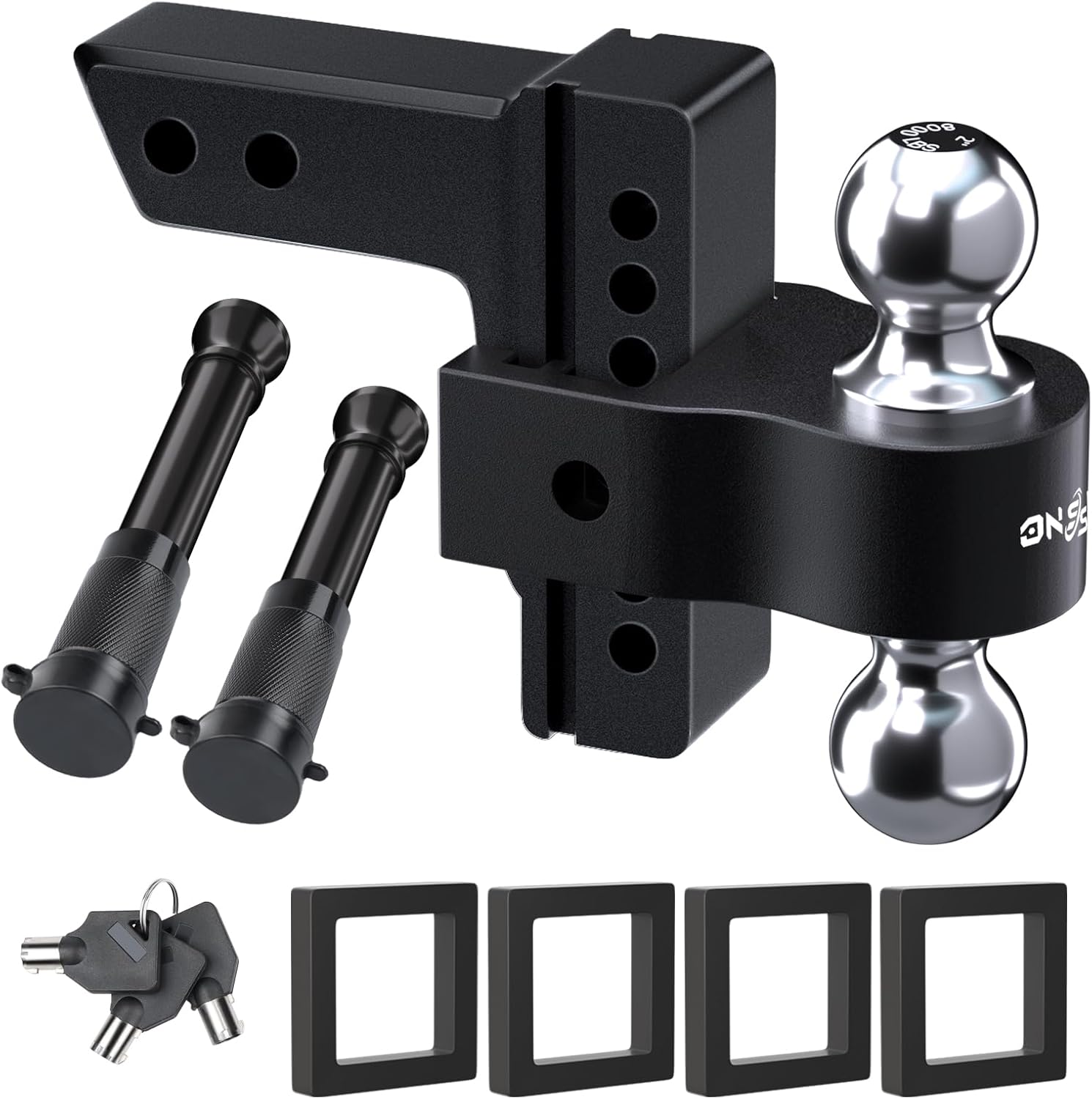
This adjustable trailer hitch is designed for 2-inch receivers and offers flexible towing with a 6-inch drop and rise range. Dual ball sizes help support different trailer setups, while the high-strength aluminum construction is built for dependable performance on tough jobs. Included hitch locks and silencers add security and help reduce noise for a smoother towing experience.

This trailer tongue weight scale helps you check hitch weight quickly and accurately before towing, reducing sway and improving overall safety. Built with durable steel and a spring mechanism, it works without batteries and includes a recalibration feature to maintain true-zero accuracy over time. It is designed for RVs, campers, and utility trailers, with a top plate that helps protect your coupler during use.

These replacement support brackets are designed to secure the spring bars on a trailer frame for CURT TruTrack weight distribution hitches. Their adjustable mounting holes help achieve precise leveling while the rigid construction supports integrated sway control for a steadier towing experience. A durable powder coat finish adds long-lasting protection, and the package includes two replacement brackets.
Measure Tongue Weight With a Bathroom Scale
A bathroom scale can work for a light trailer if the expected tongue weight is safely within the scale’s rated capacity. If the expected load is higher, a properly built lever arrangement can reduce the load seen by the scale.
Warning: Do not place more weight directly on a bathroom scale than it is rated to support. Chock the trailer wheels, work on firm level ground, use structurally sound boards and supports, and never put any part of your body beneath an unsupported trailer tongue.
[Products Worth Considering]

This adjustable tri-ball trailer hitch gives you flexible towing support with three hitch ball sizes and a 4.5-inch rise and drop for level hauling across different vehicles and trailers. Built for durability and convenience, it includes a tow hook, D-ring shackle, and a secure locking system for dependable towing, recovery, and off-road versatility.
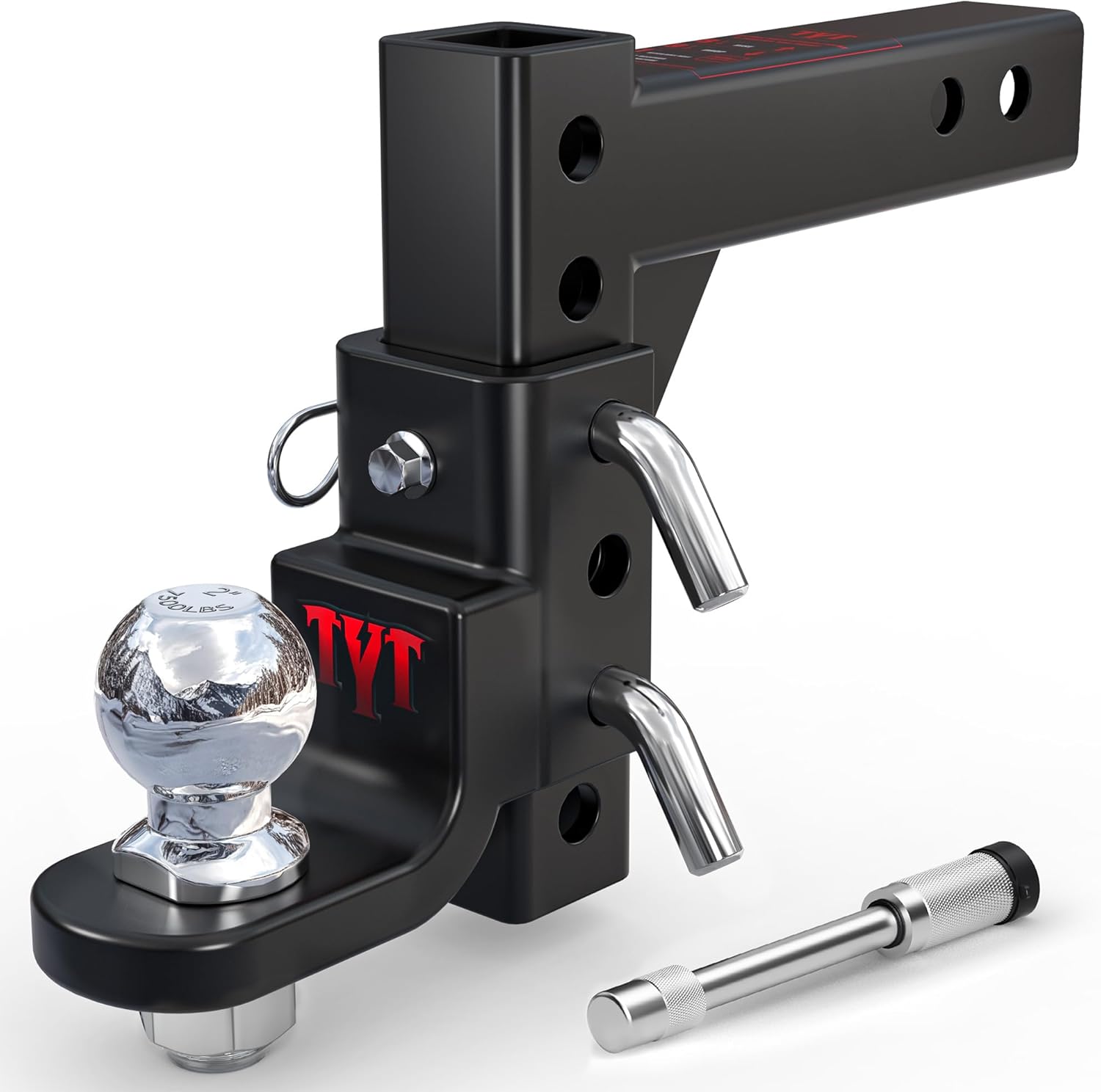
This adjustable trailer hitch ball mount is built for dependable towing with a standard 2-inch receiver and a high-capacity design suited for trucks, campers, boats, and utility trailers. Its adjustable rise and drop settings help you achieve a level tow, while the anti-rattle design supports a smoother, quieter ride. Complete with pins, clips, and a premium pin lock, it offers an easy installation and secure connection for everyday hauling needs.
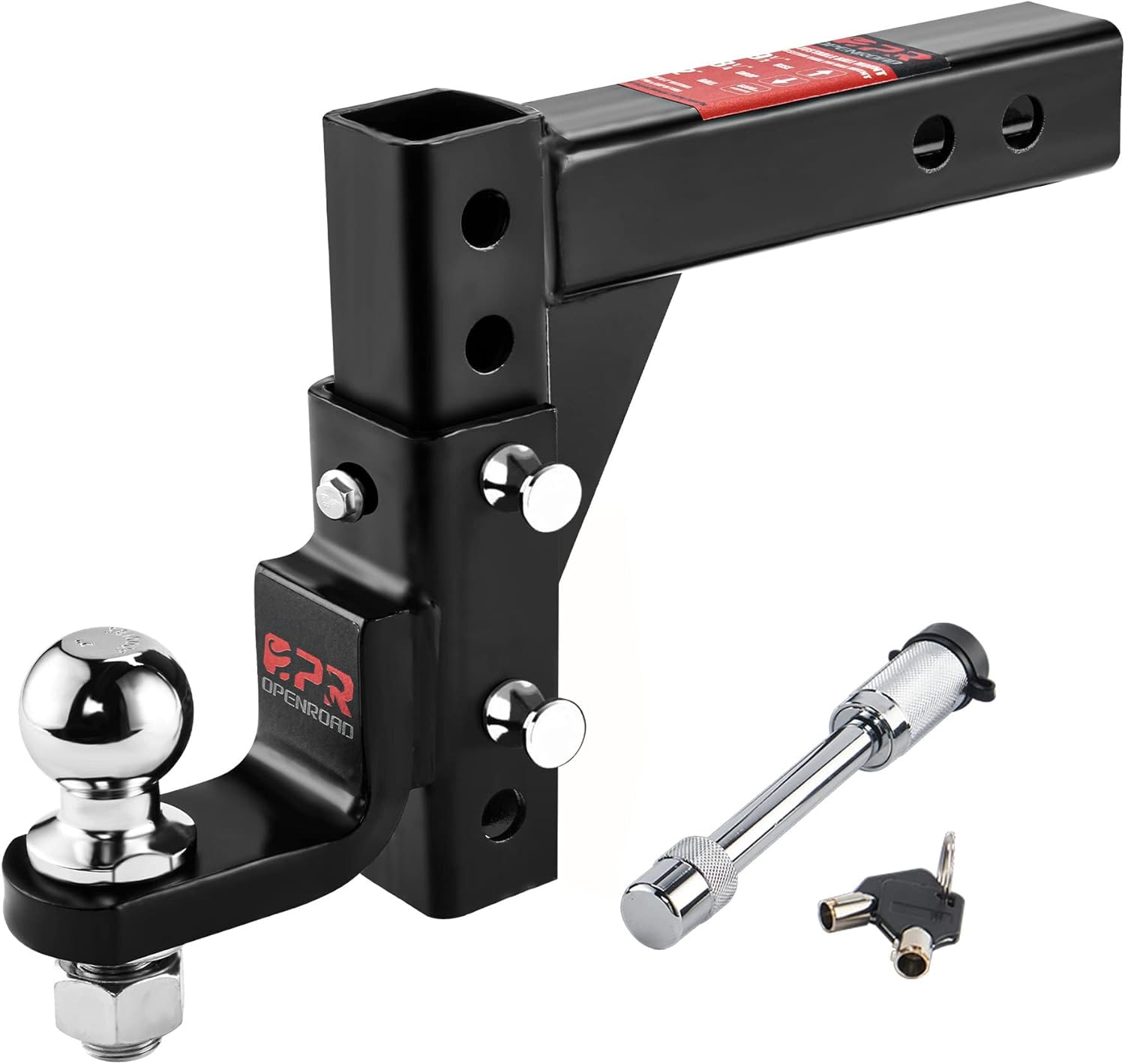
This adjustable trailer hitch ball mount is built for dependable towing with a strong steel construction and a versatile fit for 2-inch receivers. Its adjustable drop and rise settings help you dial in the right towing height, while the lock and keyed anti-theft design add security. A black powder-coated finish helps resist rust and wear for lasting performance on trucks and other towing setups.
Prepare Scale And Board
For a direct measurement, raise the bathroom scale to approximately the trailer’s normal hitch-ball height and place the tongue or coupler directly over the scale using a secure support. If the expected tongue weight is within the scale’s capacity, the scale reading is the tongue load—there is no multiplication factor.
For tongue weights above the scale’s capacity, CURT describes a 3:1 lever arrangement using a sturdy board at least about 3½ ft long, a bathroom scale, pipes or round supports, and a solid block. In that arrangement, the support over the scale is positioned about 2 ft from the trailer tongue, while the support on the opposite side is about 1 ft from the tongue.
Center The Trailer Tongue
Keep the trailer level or at the attitude specified for normal towing and place the measurement point close to the coupler’s actual towing height. Changing the trailer angle can alter load distribution, especially on multi-axle trailers.
Center the tongue securely on the measuring support so it cannot slip sideways. If you measure beneath a tongue jack located some distance behind the coupler, the reading may differ slightly from the force at the ball because the jack and coupler are at different points along the trailer frame. Measuring at the coupler gives the clearest representation of actual hitch load.
Read And Adjust Load
If the tongue is resting directly on a scale, use the scale reading directly. If you have built the specific 3:1 lever arrangement described above, multiply the bathroom-scale reading by three.
- Direct scale: 200-lb reading = approximately 200 lb of tongue load.
- Correct 3:1 lever: 200-lb scale reading × 3 = approximately 600 lb of tongue load.
- Compare the result with the trailer manufacturer’s target and the general 10–15% guideline where applicable.
- Shift cargo in small increments and remeasure after every meaningful change.
Do not use an arbitrary multiplier. The multiplication factor comes from the exact lever geometry.
Best Tools: Tongue-Weight Scales and Weigh Safe Hitches
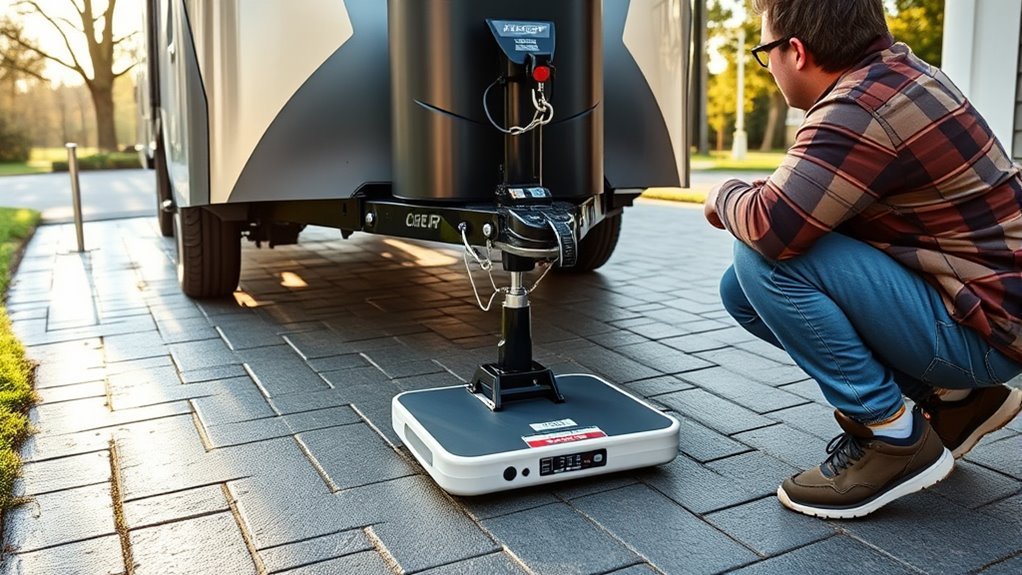
A dedicated tongue-weight scale is often the simplest home method because it is designed to support the expected vertical load. Verify that the scale’s capacity exceeds your anticipated tongue weight and use it according to the manufacturer’s instructions.
Another option is a ball mount or hitch with an integrated gauge. Weigh Safe, for example, offers products designed to display tongue load at the hitch. A built-in gauge can make repeated checks convenient when cargo changes frequently.
A public vehicle scale remains useful when you also want to check axle loads and the overall weight of the towing combination. For heavier trailers, a suitable commercial scale or purpose-built tongue scale is generally preferable to improvising with household equipment.
Whichever tool you use, remember that a measurement device cannot make an overloaded setup safe. Compare the result with the SUV, trailer, receiver, axle, and tire ratings.
[Products Worth Considering]

This Andersen Hitches weight distribution hitch kit is designed to improve towing stability with a grease-free friction cone and tension chain system that helps reduce sway and bounce. It features a universal setup with a 2-inch ball and 4-inch drop/rise to suit many bumper-pull trailer applications, while making hitching and unhitching faster and easier than traditional spring bar systems. Built in the USA, it offers dependable performance for travelers, workers, and outdoor enthusiasts who need confident towing control.

The CURT 17200 Trailer Sway Control Kit helps limit lateral trailer movement to improve towing stability and control. It is designed to work with most weight distribution hitches or a sway tab mount, and includes a weld-on tab, spacer plate, and adjustable hardware for flexible installation. Built for smoother, straighter towing, it helps reduce sway and makes towing more confident on the road.

This adjustable trailer hitch ball mount is designed for 2-inch receivers and provides a versatile towing solution for heavy-duty trucks. Its high-strength steel construction supports reliable performance, while the adjustable drop and rise settings help achieve the right towing height. A black powder-coated finish adds corrosion resistance and helps protect against rust, scuffs, and scratches for lasting use.
Interpret Tongue-Weight Readings and When to Retest
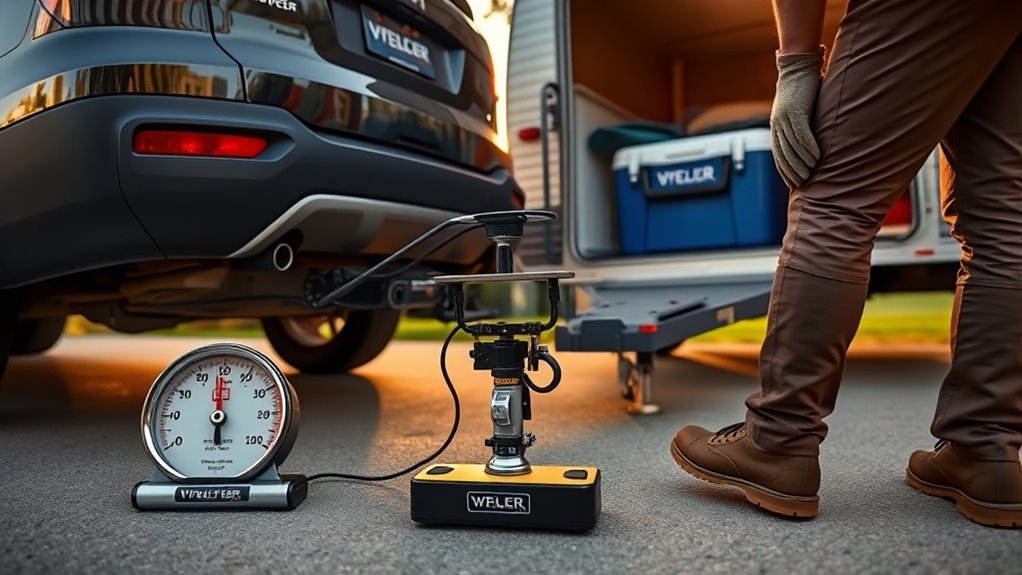
Start with the tongue-weight range specified by the trailer manufacturer. If none is given and you have a conventional ball-pull trailer, use about 10–15% of actual loaded trailer weight as a general starting range.
For a 5,000-lb loaded conventional trailer, that general range is approximately 500–750 lb. If the measurement is below the appropriate target, move suitable cargo forward in small increments. If it is above the target, move appropriate cargo slightly rearward or reduce load while maintaining stable overall distribution.
Retest after:
- Adding or removing substantial cargo
- Moving heavy cargo
- Filling or draining fresh-water, waste, fuel, or other trailer tanks
- Adding or removing batteries, propane cylinders, generators, bicycles, or cargo carriers
- Changing hitch height or major hitch components
- Making significant changes to the trailer’s permanent equipment
- Any setup change followed by noticeably different handling or vehicle attitude
You do not normally need to remeasure tongue weight merely because you fueled the SUV. Fuel, passengers, and SUV cargo affect the tow vehicle’s payload and axle loading, but they do not ordinarily change the trailer’s own static tongue weight.
Simple Load Moves to Increase or Reduce Tongue Weight
Trailer cargo placement can change tongue weight quickly because the trailer axle acts as a pivot. Moving mass forward generally raises tongue weight; moving mass rearward generally lowers it. Make adjustments gradually rather than moving one very heavy item from one extreme end of the trailer to the other.
Move Heavy Items Forward
If tongue weight is below the trailer’s appropriate range, move dense cargo forward, preferably low in the trailer and reasonably close to the axle rather than stacked high at the nose. Keep left-to-right weight distribution balanced.
- Move one or two heavy items forward at a time.
- Secure every item so it cannot slide during travel.
- Remeasure after each meaningful change.
- Stop when the tongue weight is within the applicable range and all vehicle/hitch limits remain satisfied.
Do not simply keep adding weight to the front. Excessive tongue load can overload the SUV even if the trailer remains below its own GVWR.
Shift Cargo Toward Rear
If tongue weight is too high, move suitable cargo rearward in small increments while keeping the trailer balanced side to side. For a 5,000-lb loaded conventional trailer using the general 10–15% range, the example target would be approximately 500–750 lb.
Avoid concentrating heavy cargo at the extreme rear because this can reduce tongue weight too far and increase sway risk. Keep the trailer’s center of mass appropriately forward of the axle group and verify the result with a scale rather than relying on appearance.
When to Use a Weight-Distribution Hitch for SUVs
There is no universal rule saying every SUV needs a weight-distribution hitch at exactly 5,000 lb. Use one when the SUV manufacturer, hitch-receiver manufacturer, or trailer manufacturer requires or recommends it for your particular weight and configuration.
A weight-distribution hitch uses spring bars or a similar mechanism to redistribute some of the hitch-induced axle loading between the tow vehicle’s front and rear axles and the trailer axle or axles. That can restore front-axle loading and improve vehicle attitude when the system is correctly specified and adjusted.
The Ford RV & Trailer Towing Guide, for example, shows that receiver capacities and weight-distribution requirements vary by vehicle and towing configuration. Your own SUV’s manual and receiver label are therefore more important than a generic trailer-weight threshold.
Consider or use a weight-distribution system when:
- Your SUV or receiver instructions require one above a specified trailer or tongue weight.
- The receiver has separate weight-carrying and weight-distributing ratings and your intended setup requires the higher configuration.
- The manufacturer specifies a front-axle-load-restoration procedure.
- You need an approved system with integrated sway-control features for your particular trailer.
A weight-distribution hitch does not correct an improperly balanced trailer. If raw tongue weight is too low because the trailer is rear-heavy, correct the cargo distribution first. It also does not automatically increase the SUV’s GVWR, GAWR, payload, GCWR, or other manufacturer ratings.
Note: When measuring raw trailer tongue weight, weight-distribution spring bars are normally disengaged unless your scale or hitch manufacturer specifically provides a procedure for measuring distributed load.
Common Mistakes, Troubleshooting, and Final Safety Checks
Most tongue-weight problems come from measuring the wrong trailer condition, using the wrong calculation, or concentrating too much weight at one end of the trailer.
- Using dry or empty trailer weight: Tongue weight must be checked with the trailer loaded for travel.
- Using trailer GVWR as though it were actual weight: GVWR is a maximum rating, not necessarily what the trailer currently weighs.
- Forgetting water or permanent equipment: Tanks, batteries, propane, generators, bikes, and toolboxes can move the center of mass significantly.
- Multiplying a direct bathroom-scale reading by three: Only the specified 3:1 lever setup uses that multiplier.
- Trying to fix sway only with sway-control hardware: First verify tongue weight, cargo placement, tires, hitch setup, and trailer condition.
- Assuming the advertised tow rating is the only limit: Payload, rear GAWR, hitch rating, GVWR, GCWR, and tire limits also matter.
- Using a stronger aftermarket receiver to justify more trailer weight: The receiver cannot override the SUV manufacturer’s limits.
Before departure, confirm the coupler latch, hitch pin, safety chains, breakaway cable, electrical plug, lights, trailer brakes where required, tire pressures, wheel condition, cargo restraints, mirrors, and any weight-distribution components. GM’s current towing guidance specifically recommends checking limits, tires, lights, brakes, chains, and cargo before traveling.
If a trailer repeatedly sways or the SUV feels unusually light in the steering, stop towing as soon as it is safe to do so and inspect the loading and hitch setup. Do not continue at highway speed hoping the problem will disappear.
Frequently Asked Questions
Will Roof Cargo Affect Tongue Weight Calculations?
Roof cargo on the SUV does not normally change the trailer’s actual static tongue weight. However, it adds to the SUV’s load, consumes available payload, raises the vehicle’s center of gravity, and can affect axle loading and handling. Include roof cargo when checking SUV GVWR, payload, and other vehicle limits.
Can Trailer Jack Position Change Tongue Weight Readings?
Yes. The trailer’s actual balance has not changed, but measuring at a jack positioned behind the coupler can give a slightly different force reading because the measurement point is different. For the clearest hitch-load measurement, support the trailer at or very near the coupler and at its normal towing height.
How Does Passenger Loading in the SUV Alter Tongue Weight?
Passengers in the SUV do not normally change the trailer’s actual tongue weight. They do consume vehicle payload and change axle loading, which means less capacity may remain for the trailer tongue. Always count passengers and SUV cargo when checking payload, GVWR, and axle ratings.
Are Electronic Trailer Brakes Affected by Tongue Weight?
Tongue weight is not normally a direct brake-controller setting. Total trailer weight and loading affect how much braking the trailer needs, while electric brake-controller gain should be adjusted according to the controller, trailer, and tow-vehicle manufacturer’s procedure. Correct tongue weight remains important for stability during braking.
Can Aftermarket Hitch Receivers Change Required Tongue Weight?
An aftermarket receiver can have a different maximum tongue-load rating, but it does not change the trailer’s basic balance requirement. The SUV manufacturer’s towing, payload, GVWR, GAWR, and GCWR limits still apply. Use the lowest applicable rating in the entire towing system.
Does a Weight-Distribution Hitch Reduce Actual Tongue Weight?
Not in the sense of fixing trailer balance. A weight-distribution hitch redistributes the forces created by tongue load among the tow vehicle and trailer axles. The trailer still needs proper raw tongue weight before the weight-distribution system is adjusted.
Is the 10–15% Tongue-Weight Rule Always Correct?
No. It is a common guideline for conventional ball-pull trailers, not a universal specification for every trailer type. Boat trailers, fifth-wheel trailers, gooseneck trailers, and individual manufacturers may specify different ranges. Follow your trailer and tow-vehicle documentation first.
Should I Measure Tongue Weight With the Trailer Fully Loaded?
Yes. Load the trailer as it will be towed, including normal cargo, batteries, propane, fluids, generators, bicycles, tools, and other equipment. Measuring an empty trailer may give a number that changes substantially once the trailer is prepared for a trip.
Conclusion
Safe SUV towing depends on more than hitting one percentage. For a conventional trailer, about 10–15% of actual loaded trailer weight is a useful starting guideline, but the final setup must also stay within the SUV’s payload, GVWR, rear GAWR, GCWR, hitch-receiver rating, trailer rating, and tire limits.
Measure the trailer in its real travel configuration, use the correct procedure for your scale, move cargo only in small controlled increments, and remeasure after meaningful load changes. If a weight-distribution hitch is required, set it up according to the vehicle and hitch manufacturer rather than relying on a generic trailer-weight threshold. Accurate measurements and manufacturer-specific limits are what turn a guess into a safe towing setup.
Sources
- General Motors — 2026 Trailering Technology and Smart Towing Guidance — vehicle-specific limits, passengers and cargo, tires, lights, brakes, and pre-trip checks.
- Ford RV & Trailer Towing Guide — tongue load, payload, axle limits, receiver ratings, and weight-distribution guidance.
- CURT — How to Measure Tongue Weight — dedicated scale, bathroom-scale lever, and vehicle-scale procedures.
- Weigh Safe — How to Measure Tongue Weight — tongue-weight measurement methods and built-in gauge systems.