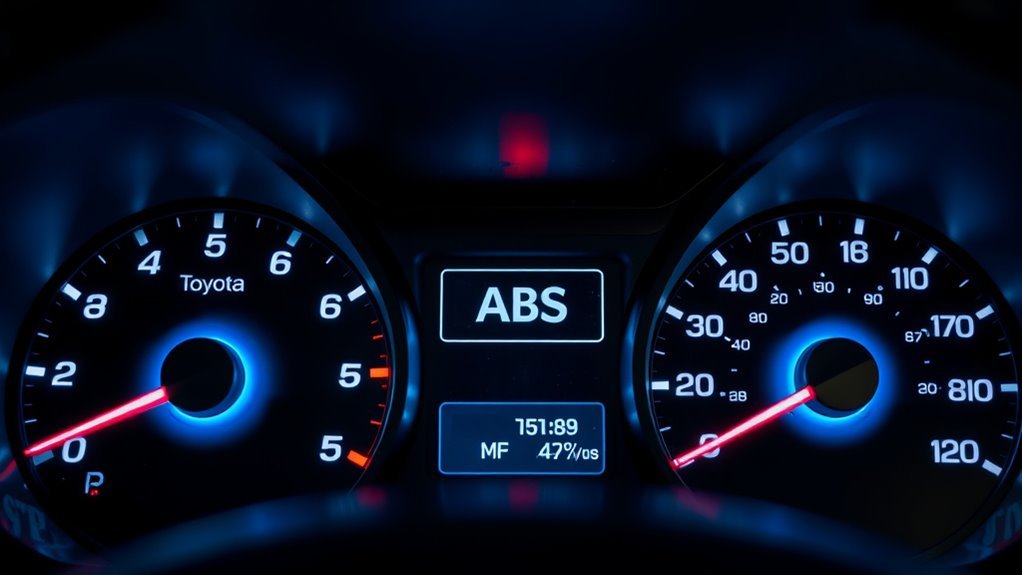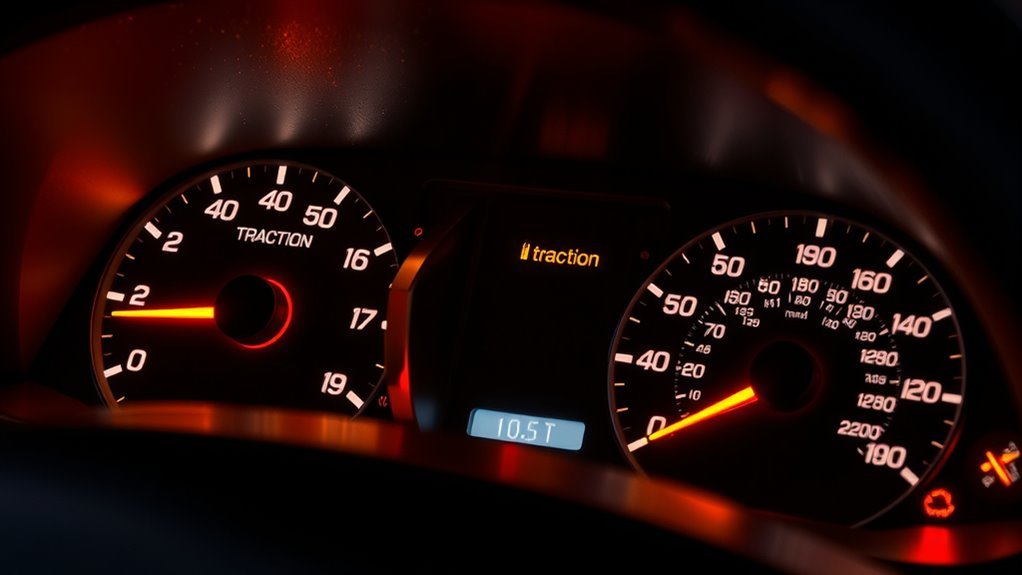
A Toyota Land Cruiser TRAC light does not have one universal meaning across every model year. On the 2025 U.S. Land Cruiser, a flashing slip indicator means Active TRAC, VSC, ABS, or Trailer Sway Control is operating, while VSC OFF indicates that related stability functions have been switched off. Older Land Cruisers can use different combinations: for example, some 100-series models use a VSC/TRAC warning together with VSC OFF when a fault is present. If a warning stays on unexpectedly, returns after restart, or appears with a red brake warning, abnormal braking, or unusual handling, diagnose the exact model-year system before normal driving.
Last updated: September 16, 2026
How this guide was prepared: This guide was reviewed against Toyota’s current 2025 U.S. Land Cruiser documentation, Toyota’s 2019 Land Cruiser quick reference guide, Toyota’s archived 2004 U.S. Land Cruiser owner manual, Toyota’s dashboard-warning definitions, 49 CFR § 571.126, and NHTSA braking-system research. It is a source-based troubleshooting guide and does not claim hands-on diagnosis of a specific vehicle.
Quick Answer
First identify the exact light and model year. On the 2025 U.S. Land Cruiser, a flashing slip indicator shows that Active TRAC, VSC, ABS, or Trailer Sway Control is operating; VSC OFF shows that related stability functions are switched off. Older Land Cruisers can display different combinations, including VSC/TRAC plus VSC OFF for a malfunction on some 100-series models. If a warning stays on unexpectedly, check other warning lights, brake feel, drivetrain settings, tire condition, brake-fluid level, and stored ABS/VSC and engine codes before replacing parts.
Key Takeaways
- A flashing slip indicator usually shows normal traction, stability, or ABS intervention; a warning that stays on after the startup check needs a different response.
- TRAC OFF and VSC OFF can indicate a driver-selected or mode-dependent OFF state, but older Land Cruisers may also show VSC OFF with a VSC/TRAC malfunction warning. Read the full warning combination, not one label in isolation.
- TRAC, VSC, ABS, brake, and Check Engine warnings can overlap because braking, wheel-speed, stability, and engine-torque controls share information.
- Stop driving if the brake pedal feels soft or sinks, the red brake warning remains on with the parking brake released, brake fluid is leaking, or the vehicle handles abnormally.
- A basic OBD-II scanner may miss ABS/VSC faults; use a scanner that reads Toyota ABS/VSC as well as engine codes.
At a Glance
| Time Required | A few minutes for no-tool checks; longer for code scanning and inspection, depending on the equipment and fault |
| Difficulty | Easy for basic checks; moderate to advanced for ABS/VSC diagnostics |
| Tools Needed | Owner’s manual, flashlight, tire-pressure gauge, ABS-capable scan tool; multimeter only for advanced testing |
| Cost | Free for basic checks; diagnostic and repair costs vary widely by model year, fault, parts, and shop labor rate |
| Model-Year Scope | Broad Land Cruiser guidance, with verified U.S.-market examples from 2004, 2019, and 2025; confirm the exact procedure in the owner’s manual for your year and market |
How Does a Toyota Land Cruiser TRAC Light Differ by Model Year?
Land Cruiser warning logic changed across generations, so a light that means “system switched off” on one model can appear beside a malfunction warning on another. The safest shortcut is to match the complete warning combination to the exact owner’s manual before clearing codes or replacing parts.
| Verified U.S. Example | Documented Behavior | What It Changes for Diagnosis |
|---|---|---|
| 2004 Land Cruiser | Toyota’s archived manual says the VSC/TRAC warning and VSC OFF indicator together mean the stability and/or Active TRAC systems are not operating and directs the owner to have the vehicle checked. The same manual says ABS, VSC/TRAC, and VSC OFF indicators can remain on for about 60 seconds after ignition and still be normal if they then go out. | On this 100-series example, VSC OFF is not automatically proof that the driver intentionally disabled stability control. Read it with the VSC/TRAC, ABS, brake, and slip indicators. |
| 2019 Land Cruiser | Toyota’s quick reference guide identifies separate TRAC OFF and VSC OFF indicators. It also shows the VSC/TRAC OFF switch: a brief press can disable TRAC, while holding the switch for at least 3 seconds while stopped disables both VSC and TRAC. | A deliberate switch action can explain an OFF indicator, but an indicator that appears unexpectedly still needs the model-year warning logic and stored codes checked. |
| 2025 Land Cruiser | Toyota’s 2025 U.S. Land Cruiser warning-light guidance says the slip indicator flashes when Active TRAC, VSC, ABS, or Trailer Sway Control is operating, and identifies VSC OFF when related stability functions are turned off. | A flashing slip light by itself can be a normal operating indication. A steady warning or an unexpected OFF state should be matched to the current manual and scanned if it persists. |
Source check: See Toyota’s 2004 Land Cruiser owner manual, 2019 Land Cruiser quick reference guide, and 2025 Land Cruiser warning-light guidance.
Who This Guide Is For and How to Use It

This guide is for Land Cruiser owners deciding whether a TRAC, TRAC OFF, VSC, ABS, or slip indicator shows normal system operation, an intentionally disabled function, or a fault that needs diagnosis. It applies broadly to Land Cruiser models, but the exact light names, buttons, and off-road modes vary by model year and market.
Use it in order. First, identify whether the indicator is flashing, steady, or showing an OFF state. Then check for other warning lights, brake symptoms, tire issues, brake-fluid level, drivetrain settings, and stored diagnostic trouble codes. Traction and stability systems help support vehicle control, but they do not replace careful driving or proper repair when a fault is present.
Model-year check: Toyota’s 2025 Land Cruiser warning-light guidance identifies a flashing slip indicator when Active TRAC, VSC, ABS, or Trailer Sway Control is operating and identifies VSC OFF when related functions are turned off. Other Land Cruiser generations can use different combinations of icons and messages, so match the display to the manual for your exact vehicle before diagnosing it.
What Do the TRAC, VSC, ABS, and Slip Lights Mean on a Land Cruiser?
Traction control helps limit excessive wheel spin. Vehicle Stability Control helps the vehicle follow the driver’s intended direction. ABS helps manage wheel slip during braking. These functions are different, but they can share wheel-speed information, brake-system inputs, vehicle-dynamics data, and engine-torque control.
That shared architecture is why one underlying problem can produce more than one warning. A wheel-speed signal fault, brake-system problem, low system voltage, or another control fault can affect several functions. The warning combination tells you where to start; it does not identify the failed part by itself.
| Light or Message | What It Usually Means | What to Do |
|---|---|---|
| Slip indicator flashing | On the 2025 U.S. Land Cruiser, Active TRAC, VSC, ABS, or Trailer Sway Control is operating. | Ease off the throttle, steer smoothly, and reduce speed for the available traction. |
| TRAC OFF or VSC OFF | The related function may be switched off by the driver or vehicle mode. On older models, VSC OFF can also appear with a VSC/TRAC fault warning. | Check the switch and drivetrain mode. If you did not expect the system to be off, check the model-year manual and scan stored codes. |
| Slip or stability warning stays on | The system may have detected a malfunction or may not be available normally. | Confirm the exact icon in the owner’s manual and scan the ABS/VSC system if it remains on after the startup check. |
| ABS light | The ABS or related brake-assist system has detected a malfunction. | If braking feels normal and no red brake warning is present, reduce speed and arrange prompt diagnosis. Stop if braking feels abnormal. |
| Check Engine plus TRAC/VSC-related warning | An engine-side fault may coexist with or limit functions that rely on engine-torque control, depending on the Land Cruiser generation. | Scan both the engine and ABS/VSC systems before replacing traction-control parts. |
| Red brake warning plus ABS/TRAC/VSC | Possible parking-brake, fluid-level, hydraulic, or other brake-system concern. | Release the parking brake fully. If the red warning remains, the pedal feels abnormal, or fluid is leaking, stop safely and inspect before continuing. |
Note: Toyota’s wording varies. Depending on year and trim, you may see TRAC, Active TRAC, TRAC OFF, VSC, VSC OFF, ABS, a car-with-skid-marks icon, or a combination of these indicators. Do not diagnose the vehicle from the words “TRAC light” alone.
[Products Worth Considering]

This universal brake bleeder kit makes one-person brake and clutch line bleeding simple by using compressed air to create stable vacuum-assisted fluid flow. Its extra-large 3L tank helps complete full-system flushes with fewer interruptions, while the included refill bottle, flexible hose, and universal adapter support clean, efficient use on standard and ABS brake systems.

The FOXWELL NT301 is a plug-and-play OBD2 code reader designed to help drivers and home mechanics diagnose check engine light issues with ease. It reads fault codes, clears emissions-related warnings, displays live sensor data in graph form, and shows I/M readiness so you can quickly check vehicle status before an emissions test. With broad compatibility across many OBD2 vehicles and a clear color screen, it offers a practical, user-friendly way to monitor and troubleshoot engine performance.

This set of four ignition coils is designed to restore smooth engine performance and reliable starting for compatible Toyota, Scion, and Lexus applications. Built to meet or exceed OE specifications, these coil packs help reduce misfires, hesitation, and check engine light issues while supporting stronger ignition output. The direct-fit design makes installation straightforward, and the package includes a warranty for added peace of mind.
Is It Safe to Drive With the TRAC/VSC Light On?
Whether you should drive depends on the exact indicator and how the Land Cruiser feels. A flashing slip light during a low-traction event is normally an operating indication. An unexpected warning that stays on is different. If braking and handling remain normal, you may be able to move the vehicle cautiously to a safe location or repair facility, but reduced ABS, traction, or stability support matters most during rain, ice, gravel, hard braking, and emergency steering.
| Situation | Typical Interpretation | Immediate Action |
|---|---|---|
| Slip light flashes briefly while accelerating, braking, or cornering on a low-traction surface | Normal intervention if it happens only while the system is responding to low traction | Reduce speed and demand; the system is likely responding to wheel slip. |
| TRAC/VSC-related warning stays on after the startup check or returns after restart | Possible fault or temporary system unavailability | Avoid poor conditions and scan the appropriate control modules. |
| ABS light is also on | ABS or related brake-assist function may be unavailable | Reduce speed and arrange prompt service if braking feels normal; stop if braking becomes abnormal. |
| Brake warning light remains on, fluid leaks, or pedal is soft/sinking | Possible brake-system fault; treat the brake symptoms as the priority | Stop safely and do not continue driving until the brake system is inspected. |
| TRAC/VSC is intentionally off because of a selected vehicle or off-road setting | Driver-selected or drivetrain-mode-dependent state | Follow the exact owner-manual procedure and return to the normal road setting when the special operating condition ends. |
Warning: Do not keep driving if the brake pedal sinks, the red brake warning remains on after the parking brake is fully released, brake fluid is visibly leaking, the vehicle pulls hard while braking, or stopping behavior suddenly changes. Those symptoms can point to a brake-system problem, not merely a traction-control warning.
Quick Checks You Can Do Now: No Tools Needed

Before replacing parts, rule out simple causes and operating states. These checks take only a few minutes and help you avoid diagnosing an intentionally disabled system as a failure.
- Restart the vehicle once in a safe place. Some indicator states change after a new ignition cycle. If the warning returns, do not treat the restart as a repair.
- Look for other warning lights. Check Engine, ABS, brake, battery/charging, and tire-pressure warnings can help narrow the next test.
- Check whether TRAC or VSC was intentionally turned off. If your Land Cruiser has a VSC/TRAC control and it was pressed accidentally, restore the normal setting using the procedure in your exact owner’s manual.
- Confirm the drivetrain mode. Low range, center or rear differential locks, Crawl Control, Multi-Terrain Select, and other off-road settings can change traction/stability behavior. The exact effect varies by generation.
- Check brake fluid level. Compare the reservoir level with its marks. If it is below the specified range or keeps dropping, do not simply top it off and ignore the cause. Inspect for brake wear or leakage.
- Check tire pressure and tire consistency. Correct very low pressure and confirm the installed tires are appropriate and reasonably matched in size and rolling circumference.
- If the Check Engine light is also on, scan the engine module as well. Do not assume the traction hardware failed or guess from a single engine-side symptom. Record the powertrain and ABS/VSC codes before clearing either system.
- Look behind each wheel with a flashlight. Check for torn wheel-speed sensor wiring, loose clips, damaged connectors, heavy mud or ice buildup, or obvious damage after brake, bearing, axle, or suspension work.
Pro Tip: Write down exactly when the light appeared: startup, rain, off-roading, braking, tire or brake service, a jump-start, suspension work, or a pothole impact. The timing often tells you which test has the highest value first.
Use When the Warning Appeared to Narrow the Cause
The event immediately before the warning is diagnostic evidence, not proof. Use it to choose the first inspection or scan-data check rather than replacing the part that seems most obvious.
| When the Warning Started | What to Check First | Best Next Test |
|---|---|---|
| Right after tire, brake, wheel-bearing, or axle work | Wheel-speed sensor wiring, connector seating, harness routing, and the serviced wheel area | Read ABS codes and compare live wheel-speed data |
| After mud, water, snow, or rough off-road use | Exposed wiring, connectors, debris, impact damage, and drivetrain-mode status | Visual inspection followed by an ABS/VSC code scan |
| After a weak battery, jump-start, or electrical work | Battery terminals, charging voltage, and low-voltage or communication codes | Battery/charging test plus a complete code scan before clearing anything |
| After steering, alignment, suspension, or control-module work | Stored calibration or sensor-related codes and any disturbed wiring | Follow Toyota service information and calibrate only when the procedure or fault requires it |
| Only while tires are slipping; indicator flashes and then goes out | Road surface, tire grip, throttle input, and vehicle speed | Usually no repair test is needed unless another warning remains |
| Warning stays on from startup or returns every drive | Exact warning icon, switch/mode status, and stored codes | Scan ABS/VSC and other affected modules before replacing parts |
Diagnostics to Run Next: DIY Steps and Tech-Level Tests
If an unexpected warning stays on, move from visual checks to code-based diagnosis. Do not rely only on a generic parts-store engine-code scan. A basic OBD-II scanner may read Check Engine codes while missing Toyota ABS/VSC diagnostic trouble codes and live data.
[Products Worth Considering]

The ANCEL AD410 PRO combines engine diagnostics and 12V battery testing in one easy-to-use tool, helping you read and clear check engine codes while checking battery health, cranking, and charging performance. It also provides live data, freeze frame details, and I/M readiness checks to help you diagnose issues faster and prepare for emissions testing. With plug-and-play operation, a clear screen, and broad vehicle compatibility, it is a practical solution for home mechanics and everyday drivers.

The GEARWRENCH Professional Bi-Directional Diagnostic Scan Tool brings OE-level diagnostics to your smart device for efficient troubleshooting and repair. It offers full bi-directional control, live actuation testing, live data mapping, freeze frame capture, and support for 23 reset and relearn functions to help technicians complete complex jobs with confidence. With software updates included, broad vehicle coverage, and a two-year warranty, it delivers powerful shop-ready capability without ongoing fees.

This plug-and-play OBD2 scanner helps drivers quickly read and clear engine error codes while providing live data, freeze frame information, I/M readiness, and MIL status for more confident troubleshooting. It adds a built-in voltage test and clear status indicators to support electrical checks and faster diagnostics, making it a practical choice for home users, car enthusiasts, and repair professionals. Compatible with most OBDII vehicles since 1996 and designed with an easy-to-use interface, it offers broad coverage and simple operation in one compact tool.
Step 1: Scan the Right Control Modules
Use a scan tool that can access the Toyota ABS/VSC system and the engine module. Read additional modules when the stored codes or symptoms point there. Record every code before clearing anything. A wheel-speed, hydraulic, steering/yaw, voltage, communication, or engine-control code is a starting point for testing, not permission to replace the named component immediately.
Step 2: Check Live Wheel-Speed Data
With an ABS-capable scanner, compare all four wheel-speed readings while the vehicle moves slowly in a safe area. A reading that repeatedly drops out, reads zero, spikes, or disagrees with the others can direct the inspection toward that wheel’s sensor, wiring, connector, bearing/encoder area, or related circuit.
Step 3: Inspect Sensors, Wiring, and Connectors
Wheel-speed sensor wiring sits close to water, mud, road debris, suspension movement, and service work. Look for stretched harnesses, broken clips, corrosion, damaged insulation, rodent damage, and connectors disturbed during brake, bearing, axle, or suspension repairs.
Step 4: Check Brake and Battery Health
Check brake-fluid level, hydraulic condition, battery connections, and charging health before blaming a control module. As a general architecture reference, NHTSA’s functional-safety assessment of a generic hydraulic braking system with ABS, traction control, and ESC shows how these functions can share braking hardware, control logic, and sensor inputs such as wheel speed. That is why one shared-signal or brake-control problem can affect several functions, although the exact Land Cruiser architecture still depends on model year.
Step 5: Calibrate Only When Needed
Some repairs require calibration or initialization, but the requirement depends on the Land Cruiser generation and the work performed. Steering/yaw sensors, brake-control components, and certain related repairs may require Toyota-capable procedures. Do not perform a zero-point calibration simply because a warning is present. Read the codes and follow the service procedure that applies to the exact vehicle and repair.
How Can ABS and Brake-System Faults Trigger TRAC/VSC Warnings?
TRAC and VSC depend on the braking system because stability and traction functions may reduce engine torque and apply brake force at individual wheels. If the control system cannot trust wheel-speed information, brake-system inputs, or actuator operation, related traction and stability functions may be limited or disabled.
- Low brake fluid can point to a brake-system problem. Do not simply top it off and ignore why the level is low. Inspect for brake wear or a leak.
- A wheel-speed signal fault can disrupt several control functions. ABS, TRAC, and VSC rely on accurate information about wheel rotation.
- An ABS actuator or hydraulic-control fault can affect several warnings at once. Some Land Cruiser generations use integrated brake-control assemblies, so prove the failure before authorizing an expensive replacement.
- An engine-side fault can affect traction logic on systems that depend on engine-torque control. When Check Engine and TRAC/VSC-related warnings appear together, scan both sides of the system instead of assuming the traction hardware failed.
A TRAC light is not a part diagnosis. First decide whether the indicator shows active intervention, a deliberately switched-off function, or a persistent warning. Then use stored codes and test data to find the cause.
Common Causes and How to Confirm Them
| Possible Cause | Clues | Best Confirmation |
|---|---|---|
| System manually turned off | TRAC OFF or VSC OFF appears after using the control | Check switch status and the exact owner-manual procedure |
| Selected off-road or differential-lock setting | Indicator changes after selecting low range, Crawl Control, MTS, or a differential lock | Compare the displayed state with the model-year owner’s manual and return to the normal setting when appropriate |
| Wheel-speed sensor, encoder, connector, or wiring issue | ABS/TRAC/VSC warnings, especially after wheel, brake, bearing, or axle work | ABS codes, live wheel-speed comparison, and circuit inspection |
| Low brake fluid or brake hydraulic issue | Brake warning, soft or sinking pedal, visible leak, or low reservoir | Brake inspection and appropriate hydraulic/leak testing |
| Engine or emissions fault | Check Engine plus a TRAC/VSC-related warning | Engine-code scan plus ABS/VSC scan where supported |
| Low voltage, weak connection, or charging problem | Recent jump-start/battery work, slow starting, low-voltage codes, or several electrical warnings | Battery, connection, and charging-system test followed by code review |
| Calibration or initialization issue after relevant repair | Warning follows steering, suspension, brake-control, sensor, or module work and the stored code/service procedure calls for calibration | Toyota-capable service information and the required calibration procedure |
Note: A scan code can identify a circuit or system without proving which part failed. A wheel-speed code, for example, can result from the sensor, wiring, connector, encoder/tone-ring area, bearing-related damage, or another circuit problem. Confirm the failure before ordering parts.
Common Repairs, Required Calibrations, and Why Costs Vary

There is no reliable single “TRAC light repair cost” across Land Cruiser generations. The final bill depends on whether the cause is a switch setting, damaged wire, wheel-speed sensor circuit, brake repair, calibration, wheel-bearing/encoder problem, or a major hydraulic-control assembly. Parts availability and labor rates also vary. Pay for diagnosis first and ask for an itemized estimate tied to the confirmed fault.
- Simple corrections can include restoring the correct system setting, cleaning or reconnecting a connector, repairing damaged wiring, correcting tire pressure, or securing a poor battery connection.
- Intermediate repairs can include wheel-speed sensor or harness work, brake service, wheel-bearing/encoder repair, or a required calibration after a related repair.
- Major repairs can include an ABS actuator, brake booster/master-cylinder-related assembly, hydraulic unit, or control module. These jobs may also require specific bleeding, initialization, and calibration procedures.
Before approving a major repair: Ask which codes were stored, what live-data or circuit test confirmed the failure, and what simpler causes were ruled out. A parts estimate without a documented diagnosis is not enough.
[Products Worth Considering]

FOXWELL NT201 is an easy-to-use OBD2 scanner designed to help drivers quickly read and clear check engine codes, view live engine data, and check emissions readiness. Its color screen, one-key I/M readiness test, and broad compatibility with most gasoline vehicles since 1996 make it a practical tool for everyday diagnostics and maintenance. With plug-and-play operation and lifetime free updates, it offers a simple way to understand vehicle issues without expensive shop visits.

These custom floor mats are designed to fit the Toyota Land Cruiser GX550 with a 5-seat layout for a precise, secure install. Made from durable TPE, they help shield your interior from spills, mud, snow, dirt, sand, pet hair, and everyday debris while making cleanup quick and easy.

Custom-fit floor mats and cargo liner designed to provide edge-to-edge protection for the Toyota Land Cruiser Prado. Made from durable TPE material, they offer all-weather defense against rain, slush, snow, mud, and everyday dirt while remaining easy to install, clean, and maintain. The odorless, non-slip design helps keep your interior safer, cleaner, and more comfortable in every season.
When to Stop Driving and When to Get Professional Help
Stop driving when the warning is accompanied by abnormal braking or handling. Reduced electronic assistance is important, but a hydraulic brake symptom is more urgent than the dashboard label itself.
- Stop immediately if braking feels abnormal. A soft or sinking pedal, fluid leak, severe pulling, or a red brake warning that remains on with the parking brake released needs prompt inspection.
- Get prompt diagnostics when ABS is on with TRAC/VSC-related warnings. Do not assume normal pedal feel proves the ABS system is healthy.
- Do not ignore repeated warnings after off-road use. Mud, water, impacts, and suspension movement can affect exposed sensors, connectors, and wiring.
- Schedule service if the warning returns after codes are cleared. Clearing a code without repairing its cause only removes diagnostic information temporarily.
Choosing a Shop and What to Bring to the Appointment
Choose a Toyota/Lexus specialist or another shop with Toyota-capable ABS/VSC diagnostic equipment. Ask whether the technician can read chassis codes, view live wheel-speed data, perform the calibration procedures required for your model, and document the test results before replacing major parts.
Bring a clear symptom timeline. Include when the warning appeared, whether it flashed or stayed on, road conditions, recent tire/brake/suspension/battery work, off-road use, water or mud exposure, selected drivetrain modes, and any codes already recorded.
Pro Tip: Before authorizing an expensive ABS or hydraulic-control assembly, ask the shop to show the stored codes, relevant live data or circuit test, and the evidence that ruled out wiring, wheel-speed inputs, low voltage, and required calibration.
Frequently Asked Questions
Can I drive with my TRAC OFF light on?
If TRAC was intentionally turned off and the brakes and vehicle otherwise feel normal, follow the operating limits in your model-year owner’s manual and restore the normal setting when the special condition ends. If TRAC OFF appears unexpectedly or will not clear, avoid poor traction and scan the vehicle for faults.
What causes the TRAC OFF light to come on?
On current Toyota guidance, TRAC OFF means traction control has been turned off, usually by the VSC/TRAC control or another permitted operating state. Older Land Cruisers can use different warning combinations, and VSC OFF can accompany a VSC/TRAC fault warning on some 100-series models. If an OFF indicator appears unexpectedly, check the switch and drivetrain mode, then read the model-year manual and scan stored ABS/VSC and related codes.
Is a flashing slip light the same as a fault?
Not usually. Toyota’s current Land Cruiser guidance identifies a flashing slip indicator when Active TRAC, VSC, ABS, or a related system is operating. A slip or stability warning that remains on after the normal startup check is different and should be matched to the exact owner’s manual and diagnosed if necessary.
Why did the Check Engine light come on with TRAC or VSC?
Some traction and stability functions depend on engine-torque control, so an engine-side fault can coexist with or limit those functions on some Toyota systems. Do not assume the traction hardware failed. Scan the engine and ABS/VSC systems and diagnose the stored codes first.
Can low brake fluid turn on TRAC, VSC, or ABS lights?
A low brake-fluid level or hydraulic brake problem can accompany brake-system warnings and can affect systems that depend on brake control. If the fluid is low, find out why instead of repeatedly topping it off. Stop driving if the pedal feels soft or sinks, fluid is leaking, or the red brake warning remains on.
How much does it cost to fix TRAC OFF issues?
There is no reliable single cost across Land Cruiser generations. The cause can range from an operating setting or wiring repair to a sensor, brake repair, calibration, wheel-bearing/encoder problem, or major hydraulic-control assembly. Get a diagnosis and an itemized estimate before approving parts.
How do I reset the TRAC or VSC light on a Land Cruiser?
Do not start by clearing the light. Record the stored codes first, confirm whether the system was intentionally switched off, and repair the underlying fault if one exists. After the cause is corrected, the warning may clear through the normal system check or may require an appropriate scan-tool procedure, depending on the model and repair. Do not disconnect the battery or perform a calibration simply to hide a warning.
Why are the ABS, VSC, and TRAC lights on at the same time?
ABS, traction control, and stability control share wheel-speed and brake-system information, so one failed signal or control problem can affect several functions at once. Read the ABS/VSC codes and compare live data before assuming that several unrelated parts failed simultaneously.
Conclusion
A Land Cruiser TRAC-related light is a system-status clue, not a part number. First match the full indicator pattern to the exact model-year manual because 100-series, 200-series, and current Land Cruiser warning behavior is not identical. If the slip indicator flashes only while traction or stability control is working, reduce speed and driving demand. If TRAC OFF or VSC OFF appears unexpectedly, check the switch and drivetrain mode. If an ABS, slip, brake, or related warning stays on, record the codes and diagnose the system instead of repeatedly resetting it. Stop driving whenever braking or handling feels unsafe.
Sources
- Toyota Owners: Dashboard Warning Lights — Toyota definitions for ABS, slip, TRAC OFF, VSC OFF, and other dashboard indicators.
- Toyota Owners: 2025 Land Cruiser Warning Lights and Indicators — model-specific warning and indicator behavior, including the flashing slip indicator and VSC OFF indicator.
- 49 CFR § 571.126: Electronic Stability Control Systems — U.S. ESC operation, malfunction-telltale, and off-control requirements.
- NHTSA: Functional Safety Assessment of Hydraulic Braking Systems with ABS, Traction Control, and ESC — technical background on shared wheel-speed, braking, traction-control, and stability-control architecture.
- Toyota: 2004 Land Cruiser Owner’s Manual — archived U.S. guidance for VSC/TRAC plus VSC OFF warning behavior and startup self-check timing.
- Toyota: 2019 Land Cruiser Quick Reference Guide — U.S. TRAC OFF/VSC OFF indicators and VSC/TRAC OFF switch guidance.