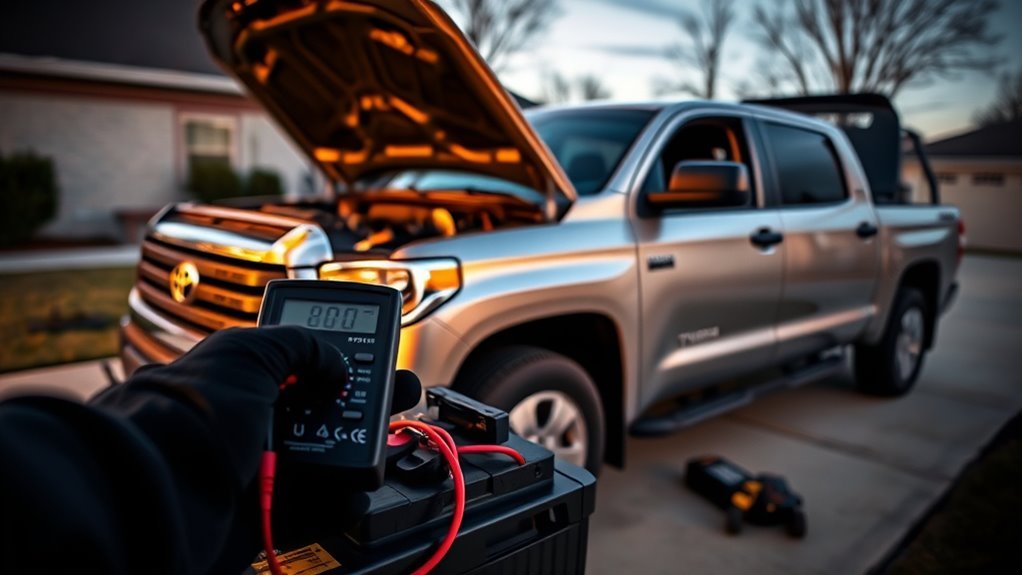
If your Tundra won’t start, first check the battery voltage, terminals and ground connections, and listen for starter clicks; full voltage with no crank points to the starter. Confirm the ECU is powered by watching the CEL and tach during cranking, then test the crankshaft position sensor if the tach stays dead. Listen for the fuel pump at key‑on, verify pump power/ground and fuel flow, and inspect lines and the pump module—keep going to get step‑by‑step test and repair guidance.
Tundra Won’t Start? Quick Battery, Starter & Ground Checklist
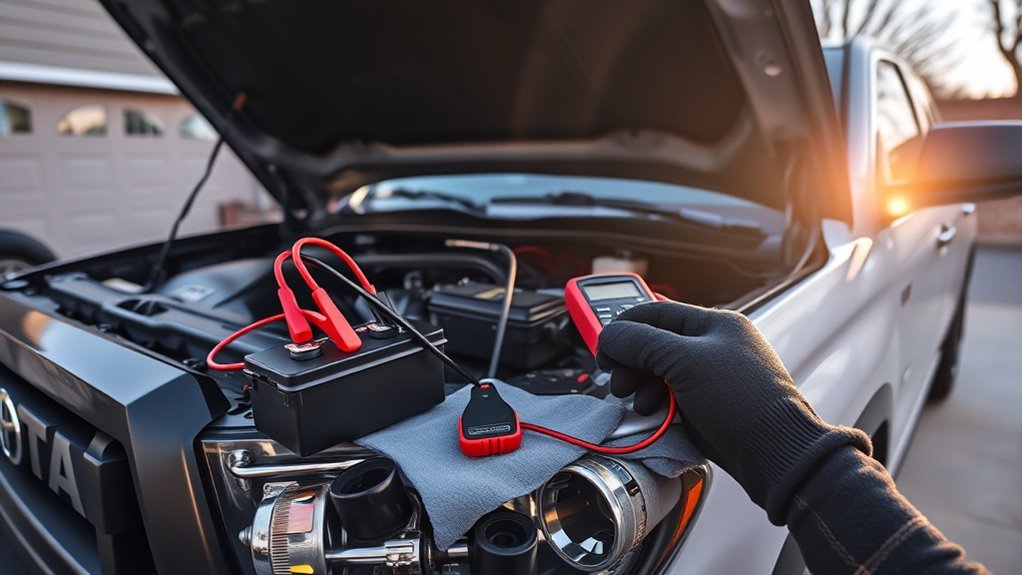
If your Tundra won’t start, begin with the basics: check the battery voltage (12.6V is full, anything under ~12.4V can mean a weak battery), inspect the terminals for corrosion or looseness, and confirm the negative cable has a solid ground to the frame or engine block. You’ll measure battery health with a multimeter and look for voltage drop under load; a steady reading below 12.4V or major sag when cranking signals a weak battery that limits starter performance. Clean and tighten terminals to restore reliable contact; even small corrosion layers block current. Listen for clicks when you turn the key—one click often points to starter issues, while repeated rapid clicks usually mean low voltage. Probe the starter solenoid: if you see full battery voltage at the solenoid while cranking and the starter doesn’t turn, you’re facing a failed starter that needs replacement. Secure grounds and solid connections first; liberation comes from decisive, accurate fixes.
Confirm ECU Communication and What Zero Codes Mean
After you’ve ruled out battery, starter and grounds, confirm the ECU is actually talking to the vehicle by checking the check engine lamp and watching for tach movement during cranking—an illuminated CEL shows the ECU powered up, and a non‑moving tach can point to a crankshaft position sensor or signal loss that prevents the ECU from seeing engine speed. If the CEL lights and tach responds, you’ve got baseline ECU communication; if the CEL is dark or scan tool reads nothing, you’ve got communication issues to chase.
Use these focused checks to free yourself from guesswork:
- Verify ECU power and ground integrity at the connector; intermittent supply gives zero codes despite faults.
- Connect a known-good scan tool; zero codes can mean the ECU sees no faults or has no input—differentiate by testing live data.
- Inspect wiring for open circuits or corrosion that block sensor signals before condemning components.
Good ECU diagnostics narrow the problem to electrical or mechanical causes, not default sensor failure.
Engine Cranks But Won’t Run: Check the Crankshaft Position Sensor
If your Tundra cranks but won’t start, check the crankshaft position sensor (CKP) because it supplies timing data for ignition and injection. Look for symptoms like a dead tachometer during cranking or intermittent stalls, then test the CKP with a multimeter for correct resistance and signal output while cranking. Remember DTCs may not appear, so do a visual inspection, bench/functional tests, and replace the sensor if readings or behavior are out of spec.
Crank Sensor Symptoms
A failing crankshaft position sensor will often let the starter turn the engine but prevent it from firing, so you’ll want to check this sensor early when the truck cranks but won’t run. The crank sensor tells the ECU crank position so engine timing is set; without that signal the ECU won’t command fuel or spark, which frees you from confusion and gets you to the fix.
- Engine cranks but won’t start, intermittent stalling, or a steady check engine light.
- Tachometer not moving during cranking, indicating no crank signal to the ECU.
- Inconsistent or no voltage/resistance readings when the engine is cranked, matching erratic symptoms.
Recognize these signs quickly to reclaim control and restore reliable starting.
Testing And Replacement
Because the crank sensor directly tells the ECU when the engine’s at top dead center, you’ll want to verify its wiring and output before chasing other causes when the engine cranks but won’t run. Start with sensor diagnostics: inspect the connector for corrosion, damaged pins, or loose clips. Use a multimeter to measure resistance and crankshaft position sensor voltage while cranking; a dead or erratic signal and a non-moving tachometer point to failure. If readings fall outside spec or you see physical damage, the sensor likely isn’t sending correct signals to the ECM and causes the no-start. Replacement tips: unplug, unbolt, swap with minimal tools, then clear codes and retest. Replacing a bad sensor often restores starting and frees you from needless troubleshooting.
Hear the Fuel Pump? How to Listen and Test Pump at Key‑On/Crank
When you turn the key to the On position, listen near the fuel tank for a faint humming that indicates the pump is priming. If you don’t hear it, use a scan tool to command the pump on and confirm an audible response. No sound with the active test means you need to check the fuse/relay and power/ground at the pump.
Listen At Key‑On
Curious if the pump’s alive? Listen at key‑on for a faint humming sound — that tells you the fuel pump is priming. If you don’t hear it, don’t panic: you can systematically free yourself from guesswork.
- Check the fuel pump fuse and relay first; replace or swap a known-good relay to rule them out.
- Inspect the pump control module and connectors for corrosion, damage, or loose pins that cut power or ground.
- If still silent during key‑on/crank, test power and ground at the pump with a multimeter; absence means trace wiring or module faults.
You’re reclaiming control: follow these practical steps, isolate the faulty element, and decide the right repair or replacement without unnecessary delays.
Activate With Scan Tool
Use your scan tool to command the pump and listen for it at key‑on and during crank — the tool’s fuel‑pump actuation lets you verify electrical control without guesswork. You’ll connect the scan tool, select the fuel pump control function, and command the pump to run while listening for fuel pump operation both at key‑on (a brief prime) and while cranking. If you don’t hear the pump, check the fuel pump relay and fuses for power. Use a power probe at the pump connector while commanding the pump to confirm voltage and proper ground. If voltage is present but the pump stays silent, the pump or ground is likely bad and needs further inspection or replacement. Scan tool usage isolates electrical from mechanical failure.
Check Fuel Delivery: Tank Level, Line Disconnects, and Pressure Access
Although it might seem basic, start by confirming the truck actually has fuel — a low tank can mimic delivery failures — then disconnect the feed line to check for flow; weak or intermittent output points to pump, filter, or line restrictions. Check the fuel gauge first; a misreading still requires a flow test. If fuel spurts steadily, the supply path is likely clear. If your rail lacks a service port, use alternative pressure checks or observe flow duration from the disconnected feed to infer pressure.
Confirm there’s fuel, inspect lines, then safely disconnect the feed—steady flow rules out major supply or filter issues.
- Verify the fuel gauge reading and visually inspect fuel lines for kinks, leaks, or detachment.
- Disconnect the feed line safely; steady, robust flow rules out major supply blockages.
- When you can’t attach a gauge, use timed flow or scan-tool active pump commands to assess pressure indirectly.
Confirm the pump receives proper power and ground. If control signals are present but flow is weak, replace the pump or filter to restore reliable ignition freedom.
Test Fuel Pump Fuses and Relay (Step‑By‑Step)
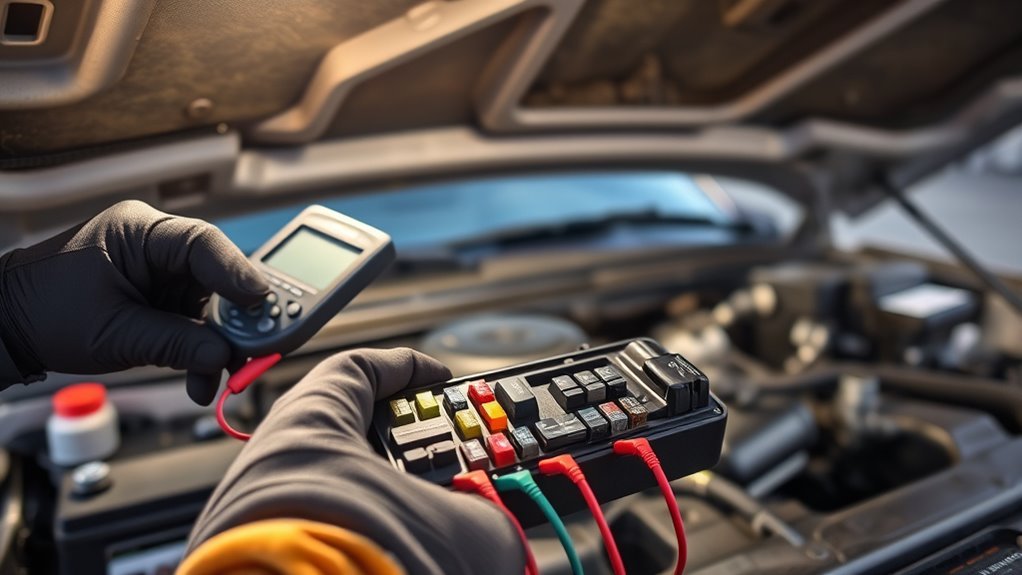
Now that you’ve checked fuel level and confirmed flow or lack thereof, narrow the fault to electrical control by testing the fuel pump fuse and relay. Begin fuel pump maintenance by inspecting the fuse: pull it, check for continuity and visually confirm the element. With the fuse seated, probe both sides while a helper cycles the key or you use a scan tool; you should see battery voltage on both terminals when the pump should be powered.
Next, locate and remove the fuel pump relay from the relay panel. Verify the leg arrangement matches the relay diagram—control coil and power contacts—since relay types vary; correct orientation matters. Use a power probe on the relay output terminal to confirm it supplies voltage to the pump circuit when activated. Then perform an active test with a scan tool: command the pump, listen for engagement, and watch the probe for steady output. If fuse and relay read good but the pump stays silent, you’ll need to trace power and ground further.
Diagnose Pump Module, Harness, Power and Ground at the Sock/Filter
Often the best place to isolate a stubborn fuel issue is at the tank: jack the truck safely, remove the access cover near the driver‑side rear tire, and inspect the pump module and its connector for corrosion, broken pins, or melted plastic. You’ll perform focused fuel pump diagnostics at the sock/filter to separate wiring and pump failures. Probe the blue lead for constant battery power and the red (or ground) when the key cycles; use piercing probes to avoid cutting factory wiring. Confirm the relay and PCM are commanding the pump by checking relay output with a power probe.
- Verify wiring integrity: trace the harness for bends, chafing, or repairs that could hide shorts.
- Test power/ground under load: watch voltage during crank to rule out voltage drop.
- Inspect connector fit and sock/filter condition; debris can mask a good pump.
If power and ground are correct yet the pump won’t run, the pump itself is likely defective and needs replacement.
When to Drop the Tank : Fuel Pump Replacement Steps (2018 Tundra)
If your sock/filter checks good but the pump still won’t run, drop the tank so you can replace the pump module directly — jack and support the truck securely, drain or relieve as much fuel as practical, then disconnect the filler hose, vent lines, and electrical connectors before loosening the straps and lowering the tank. Work deliberately: this step exposes the pump assembly and wiring so you can remove the access ring and swap the module without guessing.
Follow fuel system safety precautions: ventilate the area, keep sparks and open flames away, and wear gloves and eye protection. Label or photograph connectors to restore correct routing. Install the new pump, reseal the access ring, and lift the tank back into position, torqueing straps and clamps evenly. Reconnect hoses and electricals, checking for pinched lines. Afterward, verify there are no leaks and that components sit correctly. This method frees you from recurring failures by addressing a faulty module directly and safely.
Priming, First‑Start Procedure and Common Post‑Repair Hiccups
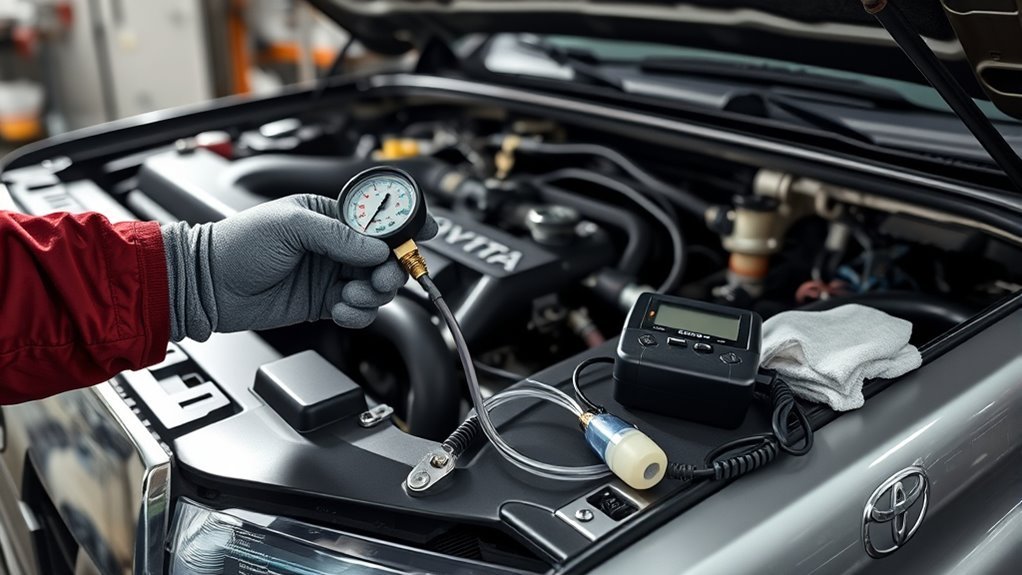
After installing the new pump, prime the fuel system by cranking the engine several times without starting so the rail pressure builds and any air pockets get pushed out. For the first start you may need extended cranks—hold the key in the start position in short bursts while monitoring for fuel smell, leaks, and throttle response. If it won’t fire, immediately recheck power and ground at the pump module and confirm all hoses and connectors are securely seated.
Prime The Fuel System
1 simple procedure you should do after replacing the fuel pump is to prime the system so fuel reaches the injectors before you try to start the engine. You’ll avoid air locks and give the pump a chance to build pressure; treat this as essential fuel system maintenance. Turn the key to ON several times, listening for the pump and allowing brief pauses so the system pressurizes. Perform fuel pressure checks if the engine hesitates after initial cranks.
- Cycle the ignition 3–5 times, pausing 2–3 seconds between attempts.
- Watch for steady fuel rail pressure or a smooth initial start.
- If it struggles, repeat priming cycles and recheck for air in lines.
This keeps you free from needless dead-ends and gets the Tundra running reliably.
Extended Crank Procedure
Priming the pump sets you up for the extended crank procedure, which you’ll use when a fresh pump needs extra time to fill lines and get fuel to the injectors. After fuel pump priming by cycling the ignition, crank the engine in controlled bursts—10–15 seconds on, 10 seconds off—so the pump builds pressure without overheating. Watch fuel pressure with a gauge; stable pressure shows the pump is delivering fuel. If it won’t hold pressure, recheck connections and filter. Be alert for air bubbles in the return or feed lines; trapped air delays delivery and causes long cranks or no-starts. If the truck starts rough, keep it idling and monitor for stumbles. Persistent issues after this procedure mean inspect injectors, pressure regulator, or vacuum leaks.
Quick Troubleshooting Flowchart: Causes, Tests, and Next Actions
When your Tundra won’t start, follow a focused flow: check for a check-engine light and pull codes, confirm there’s fuel in the tank, verify the fuel pump fuse and relay are getting and passing power, and probe the fuel pump control module’s power and ground with piercing leads; if the module and wiring test good but the pump doesn’t run, plan a pump replacement and prime the system during installation. Use this quick troubleshooting flowchart to liberate yourself from uncertainty: identify cause, run tests, act.
- Check computer codes and fuel level first — basic fuel system troubleshooting tips that save time.
- Inspect fuse/relay and confirm voltage at the pump module; use piercing probes for power and ground integrity.
- If wiring and module read correctly but the pump is dead, replace the pump and prime the system during install.
Follow the steps in order, document what you find, and choose the next action that restores control — repair, replace, or seek help.
Frequently Asked Questions
What Would Cause a Toyota Tundra Not to Start?
You’ll face causes like Dead Battery, Fuel Issues, Ignition Problems, Starter Failure, Electrical System faults, Faulty Sensors, Security System lockout, or a Bad Ground; you’ll diagnose, free yourself from constraints, and fix what’s stopping it.
Conclusion
You’ve got a clear path: check battery, grounds, starter, then confirm ECU comms and crank/CPS signals before chasing fuel delivery. If you hear the pump but still have no pressure, test harness power/grounds at the sock and consider dropping the tank for module replacement on 2018 models. Follow priming and first‑start steps after repairs. If you worry it’s expensive, note that systematic testing often reveals a simple, inexpensive fix rather than a full replacement.