Your Toyota Tundra VIN is a 17-character identifier that encodes manufacturer origin (WMI, positions 1–3), vehicle attributes (VDS, positions 4–8), a check digit (position 9), model year (position 10; e.g., “P” = 2023), assembly plant (position 11) and a unique serial (positions 12–17). You’ll use it to verify origin, engine, body, safety features, recalls, and parts compatibility; check for tampering and theft; and confirm history—keep going to see exact decoding and validation steps.
What a Tundra VIN Is and Why It Matters
A Toyota Tundra’s Vehicle Identification Number (VIN) is a unique 17-character code that encodes the truck’s manufacturer, model, body style, engine, safety equipment, and production details, and you’ll use it to verify identity and history. You’ll read the VIN to determine WMI, VDS, model year and production specifics. The first three digits (WMI) show manufacturer origin—if it begins with 5, it’s Toyota built in the United States—making VIN significance immediate for provenance and regulatory compliance. Digits four through eight (VDS) describe body style, engine type, and safety features, enabling precise specification checks against seller claims. The tenth digit designates model year; “P” corresponds to 2023, which you’ll use to align parts, recalls, and registration. Understanding VIN structure lets you confirm vehicle history, verify recalls, and detect tampering or misrepresentation before acquisition. You’ll rely on this technical code to assert control over purchase decisions and secure liberated ownership.
Where to Find Your Tundra VIN (Truck and Documents)
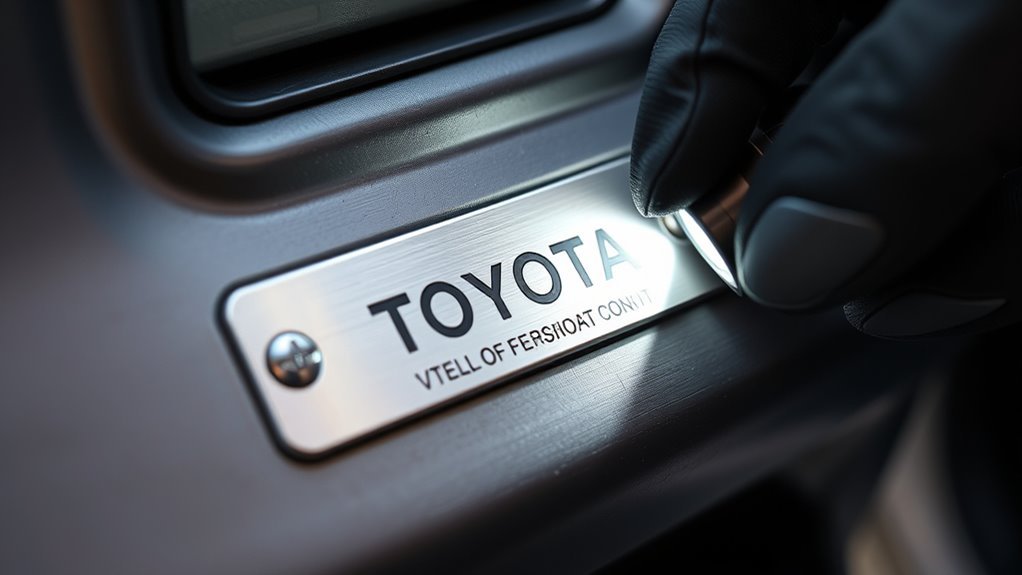
After you know how a VIN encodes a Tundra’s specs and history, you’ll need to locate that code on the truck and its paperwork to confirm identity. Use VIN location tips: check the dashboard at the base of the windshield on the driver’s side where the plate is visible from outside. Open the driver’s door and inspect the doorjamb sticker or plate near the latch. If not there, examine the frame sill, glove compartment, under the spare tire, and the engine bay for stamped or labeled VINs.
For Document verification, compare the VIN on the truck to your registration, title, and insurance papers. Record the full 17 characters exactly—no substitutions—and verify consistency across all sources. Discrepancies indicate a need for deeper inspection or official intervention. These steps give you direct control over vehicle identity and the freedom to act decisively when inconsistencies arise.
Tundra WMI: What the First 3 VIN Characters Mean
When you read a Tundra’s VIN, the first three characters form the World Manufacturer Identifier (WMI), which tells you the region, country, and manufacturer of assembly; for example, a VIN beginning with “5” indicates North America/United States assembly while one starting with “J” denotes Japan. You use the WMI for clear regional identification: the first character marks the manufacturing region (e.g., “5” = North America), the second denotes country or automaker headquarters, and the third identifies the manufacturer—Toyota in this scenario. WMI significance lies in provenance verification, which supports targeted recalls, service procedures, and parts sourcing tied to the assembly location. By checking the WMI you assert control over your vehicle’s history and maintenance pathway, reducing dependence on incomplete records. Read the WMI to confirm origin before purchasing, scheduling service, or interpreting safety notices; it’s a concise, authoritative code that connects the VIN to specific manufacturing data you can act on.
VDS (Positions 4–8): Body, Series, Engine and Options
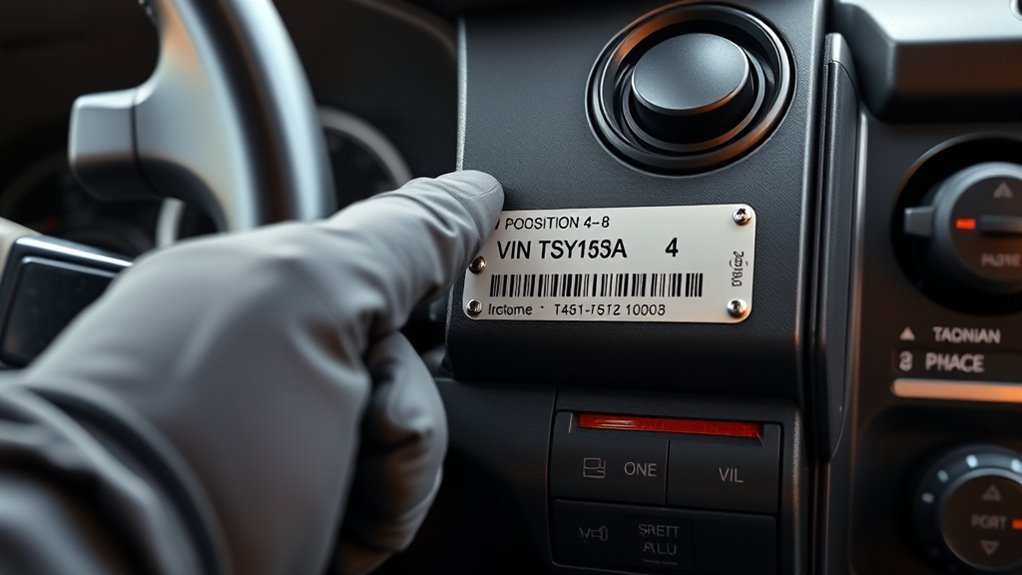
Although the WMI tells you who built the truck and where, the VIN’s Vehicle Description Section (positions 4–8) encodes the Tundra’s body style, series, engine and option package, using manufacturer-specific characters that technicians and parts specialists decode to confirm configuration. You’ll use VDS codes to read body styles, engine types, series level and option bundles quickly. Those five characters also flag safety features — seat belt configurations, airbag types — essential for repairs and legal compliance. Because manufacturer differences matter, you’ll cross-reference Toyota tables rather than assume code meanings from other brands. Correct decoding supports accurate vehicle identification, parts ordering and modification planning, freeing you from costly mismatches.
- Decode VDS codes to confirm body styles and series.
- Verify engine types before ordering powertrain parts.
- Check safety features encoded for compliant repairs.
- Account for manufacturer differences in reference lookups.
- Use VDS for precise vehicle identification and modification scope.
Check Digit & Model Year: How Position 9 and “P” = 2023 Work
You’ll use the 9th VIN digit as a check digit to validate the VIN’s accuracy and catch transcription errors. The check digit is computed with a standardized algorithm that weights each character and produces a verification value for North American 17-character VINs. The 10th digit encodes the model year, so when you see “P” in that position it designates a 2023 Toyota Tundra.
Check Digit Purpose
Anyone checking a VIN should note that the ninth character is the check digit, a mandatory North American field used in a standardized algorithm to detect transcription errors and tampering. You rely on the check digit importance for VIN verification; it gives you a rapid integrity check before deeper history pulls. The tenth-character model year (e.g., “P” = 2023) pairs with the check digit to flag mismatches that suggest cloning, alteration, or recording errors. You’ll use these elements to assert control over vehicle provenance and resist fraudulent transfers.
- Confirms VIN structure integrity
- Flags transcription or plate-swapping attempts
- Works with model-year code for quick validation
- Reduces risk in private purchases
- Empowers you to demand full documentation
How Check Calculated
When you validate a Toyota Tundra’s VIN, the ninth character functions as a calculated check digit that’s derived from the numeric equivalents and weighted positions of the other 16 characters. You apply the standardized check digit algorithm: assign numeric values to letters, multiply each character by its position-specific weight, sum the products, and compute the remainder modulo 11; a remainder of 10 maps to an “X” as the check digit. This check digit algorithm is central to the VIN validation process used in North America to detect transcription errors and deter fraud. You’ll also note the tenth position encodes model year; together, these calculated elements let you assert VIN integrity, identify model year coding, and claim informed autonomy over vehicle verification.
“P” As Year Code
One key element to check is the ninth VIN character, which functions as a calculated check digit to verify the VIN’s integrity, while the tenth character encodes the model year—so when you see “P” in position ten on a Toyota Tundra, it designates the 2023 model year. You should verify the check digit to ascertain the VIN hasn’t been mistyped or tampered with, then read the tenth position for model identification. Post‑2000 VINs mix numbers and letters (excluding I, O, Q); letters returned in 2010, enabling “P” = 2023. Knowing year significance supports accurate registration, recall checks, and historical research, empowering you to claim full control over vehicle provenance.
- Confirms VIN accuracy via check digit
- “P” maps to 2023 model year
- Letters/numbers system post‑2000
- Aids registration and recalls
- Enables confident model identification
Positions 11–17: Plant Code and the Tundra Serial Number
Although it sits near the end of the VIN, positions 11–17 carry critical production identifiers: digit 11 specifies the plant code indicating the assembly facility, and digits 12–17 form the Tundra’s unique serial number used to track production details, ownership history, and parts compatibility. You use plant identification to confirm where your vehicle was built; the single plant code links the VIN to a specific assembly line. Positions 12–17 establish serial uniqueness: each Tundra has a distinct serial number that prevents duplication and enables precise recordkeeping.
| Field | Purpose |
|---|---|
| Digit 11 | Plant identification |
| Digits 12–13 | Production batch reference |
| Digits 14–15 | Sequential assembly marker |
| Digits 16–17 | Final serial digits |
You’ll rely on these positions to verify authenticity and to trace manufacturing lineage. The data is terse, factual, and empowers you to assert control over vehicle provenance.
What You Can Do With a Tundra VIN: Recalls, Parts, History, Theft

Use your Tundra’s VIN to check manufacturer recall and safety notices so you can confirm any required repairs or outstanding campaigns. Enter the VIN into parts databases to identify exact-compatible components by model year, engine, and trim. The same VIN query also supports history checks and theft verification to validate a vehicle before purchase.
Recall And Safety Checks
When you enter a Tundra’s VIN into a manufacturer’s portal or a VIN lookup tool, you get immediate access to recalls, safety campaigns, and applicable service bulletins so you can confirm the vehicle has received required fixes. You’ll verify recall importance and safety compliance quickly, empowering you to demand corrective action or walk away from unsafe purchases. The VIN also reveals theft records and full vehicle history, reducing information asymmetry. Use verified portals or dealer services to guarantee data integrity.
- Confirm open recalls and completed repairs
- Check theft reports and title branding
- Review accident history and prior ownership
- Access emissions and safety rating compliance
- Retrieve applicable service bulletins and campaigns
Parts And Compatibility
The Tundra’s VIN lets you verify exact parts compatibility and specs so you can order correct replacement components and accessories without guesswork; use it to confirm engine codes, transmission types, trim levels, and options. VIN advantages include precise identification for dealerships and service centers, reducing Compatibility issues and installation errors. You can enter the VIN into manufacturer and third-party databases to pull recall records, service history, accident reports, and theft reports, informing repair priorities and resale decisions. With verified VIN data you’ll source parts that match factory tolerances and software calibrations, maintain safety-related updates, and avoid wasted purchases. Treat the VIN as a control point: verify before buying parts, scheduling work, or transferring ownership to secure reliability and autonomy.
Quick VIN Validation Steps and Best Free/Paid Tundra Tools
Because a correct VIN is foundational to any Tundra check, start by confirming it’s 17 characters long and contains no I, O, or Q, then verify the 9th digit as a valid check digit to catch transcription errors. You’ll use VIN validation as your first filter; it prevents wasted effort chasing incorrect records. Next, run the VIN through reputable online tools for immediate data: basic specs, recalls, and manufacturing details. For deeper liberation from uncertainty, combine free lookups with paid reports that reveal accident history, title issues, and market value. Maintain a routine of re-checking Tundra decoder outputs when buying, selling, or servicing.
- Use free VIN lookup sites for recall and spec confirmation.
- Validate the 9th digit check sum to detect transcription errors.
- Cross-reference Toyota Tundra decoders for model-specific updates.
- Purchase detailed reports (e.g., iVIN Reports) for accident and title history.
- Archive validated VIN results to preserve transactional transparency.
Frequently Asked Questions
What Does My Toyota VIN Tell Me?
Your VIN decodes manufacturer, assembly country, body/engine/safety specs, model year, plant, check digit and unique serial; you’ll use VIN decoding to verify authenticity and pull vehicle history, freeing you to make informed ownership decisions.
How to Check Toyota Car Manufacturing Date by VIN Number?
Check the tenth VIN digit to decode the model year: use VIN decoding tools or manual manufacturing codes tables; find the VIN on the windshield or driver’s door, then interpret the tenth character to determine the manufacturing date.
Conclusion
You’ll now know how each Tundra VIN piece maps to build details, so you can decode recalls, parts fitment, or theft history fast. Use the VIN on the door jamb or paperwork, check WMI, VDS, model year code (P = 2023) and serial for plant and sequence. Run a registry or OEM parts lookup to confirm. It’s surprisingly powerful—like a mechanic’s super-sleuth tool—and saves you time, money, and headaches.