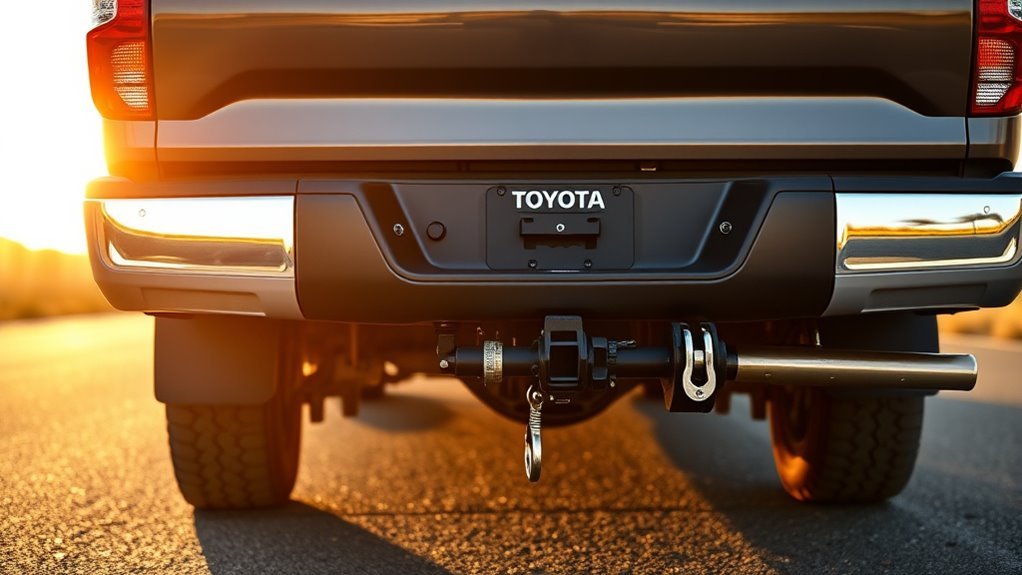
The Toyota Tundra Tow Package combines heavy‑duty hardware, sensors, and control systems to raise towing capacity and improve safety. You get an Integrated Trailer Brake Controller for proportional trailer braking, Tow/Haul mode to optimize shift points and engine response, Trailer Sway Control that senses yaw and applies targeted braking, a transmission cooler, multi‑angle cameras, and tow mirrors plus correctly rated hitch options. These features shorten stopping distance, limit thermal stress, and stabilize loads — keep going to see specifics and setup tips.
What’s in the Toyota Tundra Tow Package : And Why It Matters
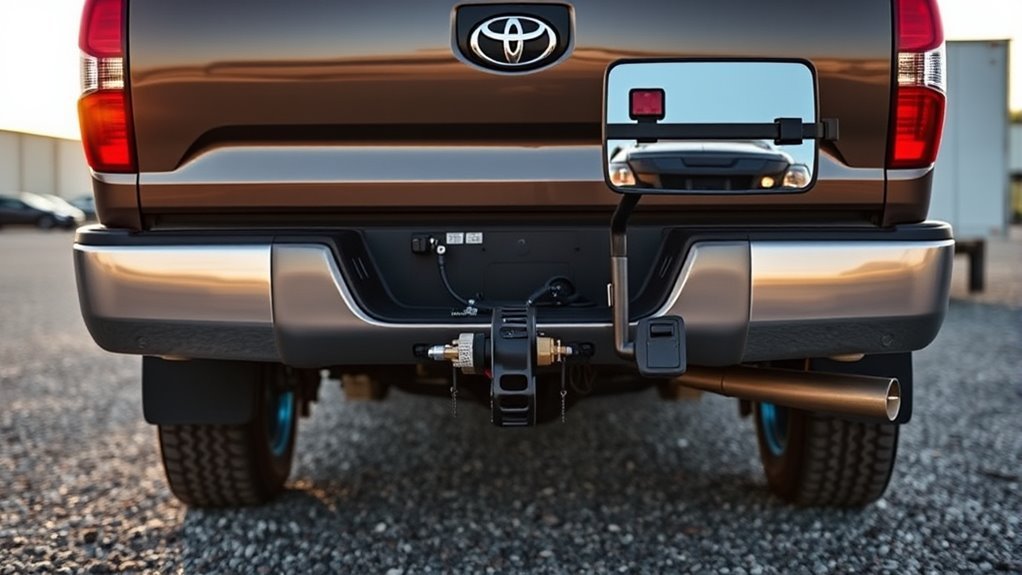
Because towing performance depends on both control systems and hardware, the Toyota Tundra Tow Package combines an integrated trailer brake controller, Tow/Haul transmission mode, Trailer Sway Control, a multi-angle rearview camera, and heavy-duty components so you can safely and predictably tow up to 12,000 pounds when the truck is properly equipped. You get precise, adjustable trailer braking to modulate deceleration across tractor and trailer, which directly improves towing safety and reduces stopping distance variance under load. Tow/Haul mode recalibrates shift points and torque delivery so you retain control during acceleration, grade descent, and maneuvering. Trailer Sway Control monitors lateral motion and intervenes via selective braking to regain stability, supporting correct load distribution behavior. The multi-angle rearview camera enhances hitching accuracy and situational awareness, minimizing guesswork. Heavy-duty chassis and drivetrain elements sustain structural integrity and thermal limits at rated capacity. Together these systems let you tow with confidence, asserting autonomy over heavy loads while minimizing systemic risk.
How the Integrated Trailer Brake Controller Works
When you engage the Integrated Trailer Brake Controller (ITBC), it lets the truck apply and modulate the trailer’s brakes from the dash, giving you direct control over trailer deceleration and improving stability. You’ll use a dashboard interface to set braking sensitivity and perform trailer brake adjustments quickly; the controller translates your input into proportional electric braking force at the trailer. The system senses trailer load and adjusts output automatically, smoothing stops and reducing wear on both tow vehicle and trailer. It integrates with Trailer Sway Control to counteract oscillations from wind or sudden maneuvers, intervening via coordinated brake and engine controls. For drivers seeking autonomy and safety, the ITBC centralizes essential functions so you can command precise deceleration without external devices. Follow standard towing safety tips: confirm controller settings match trailer weight before departure, test brake response during low-speed trials, and monitor for overheating or abnormal resistance to preserve braking performance and maintain control under load.
Tow/Haul Mode: When to Use It and How to Activate
If you’re towing a heavy load or descending long grades, engage Tow/Haul Mode to optimize transmission shift points and engine response for improved control and additional engine braking. You’ll use this mode when hauling heavy trailers or maneuvering through long, steep grades; it holds lower gears longer, delivers stronger engine response, and increases engine braking for controlled deceleration. Tow/Haul Benefits include reduced gear hunting and improved stability under strain.
| Condition | Action |
|---|---|
| Heavy trailer | Press Tow/Haul button |
| Long grades | Engage for engine braking |
| Normal driving | Deactivate to resume economy |
Activation Tips: press the Tow/Haul button located right of the steering column or on the shift-lever end; confirm visual cue on the speedometer. To return to standard performance, press the button again. You’ll appreciate the direct, mechanical control this mode provides—designed for autonomy when burden and terrain demand precise drivetrain management.
How Trailer Sway Control Keeps Your Load Stable
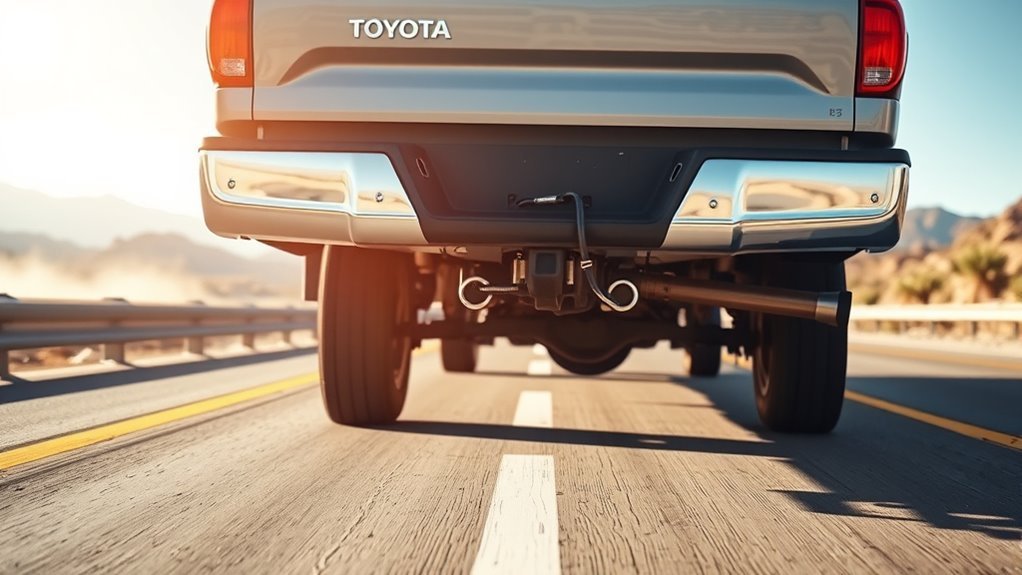
Although trailer sway can start subtly, Trailer Sway Control detects unstable trailer movement and immediately intervenes to stabilize the rig. You get continuous sway detection via integrated sensors that monitor yaw, lateral acceleration, and wheel speeds to identify oscillation patterns early. When the system registers instability, it applies targeted braking to individual wheels and modulates engine torque, delivering precise stability enhancement without abrupt driver inputs.
Trailer Sway Control senses instability early and gently corrects it with targeted braking and torque modulation for smooth, secure towing
- Sensors and algorithms: they quantify trailer motion and predict escalation, enabling timely corrective action.
- Brake intervention: selective wheel braking dampens oscillation, restoring directional control while minimizing load shift.
- System integration: Trailer Sway Control works with the integrated braking system and Tow Package calibration to guarantee coordinated responses in high winds or sudden maneuvers.
You retain ultimate control; the system augments your inputs to free you from reactive corrections, protect the towing platform, and extend both vehicle and trailer service life through consistent stability enhancement.
Multi‑Angle Camera & Trailer‑Visibility Features
Visibility aids play a critical role in safe towing, and the Tundra’s multi-angle camera suite gives you precise, real-time perspectives to reduce blind spots and improve trailer alignment. You get configurable camera angles — including a top-down rear view — that let you confirm hitch engagement, monitor trailer position, and detect obstacles during low-speed maneuvers. The Panoramic View Monitor supplies a stitched 360-degree image, enabling you to plan clearances and approach paths with minimal guesswork. These visibility enhancements integrate with vehicle systems: Tow/Haul mode adjusts powertrain response to maintain steady control, Trailer Sway Control counters oscillations detected by sensors, and the optional integrated trailer brake controller coordinates deceleration between truck and trailer. Together, the suite delivers actionable visual data and automated corrections so you can tow with autonomy and confidence. Use the displays and system alerts proactively; they’re designed to expand your situational awareness and reduce human error during complex towing tasks.
Tundra Tow Mirrors, Hitch Options, and Proper Hitch Setup
You’ll evaluate Tundra tow mirrors—fixed, manually extending, and power‑extendable—to confirm the field of view and blind‑spot coverage for your trailer profile. Compare hitch receiver options and ratings to match your truck’s towing capacity and the trailer’s tongue weight. Set the correct hitch ball height, shank size, and, for loads over 5,000 lb, use a weight‑distributing hitch and integrated brake controller as specified in the Owner’s Manual.
Tundra Tow Mirror Types
When you equip a Tundra for towing, choosing the right tow mirrors and hitch setup lets you maintain clear sightlines and safe weight distribution; extended tow mirrors offer increased lateral visibility for wide loads while the standard mirrors work for lighter trailers. You’ll value extended visibility and precise mirror adjustments to eliminate blind spots and confidently monitor trailer behavior. Match mirror choice to load width and towing dynamics, and use the integrated trailer brake controller to complement visual control.
- Extended tow mirrors: maximize lateral field, retractable or fixed, ideal for boats and wide trailers.
- Standard mirrors: compact, sufficient for small trailers, reduce wind drag.
- Adjustment protocol: set mirrors at curb height, verify tow and cab alignment before departure.
Hitch Receiver Options
1 key decision for outfitting your Tundra is the hitch receiver choice, since it dictates compatible ball mounts, weight capacity, and how you’ll set trailer ball height for level towing. You’ll typically find a standard 2-inch receiver on the Tundra that covers most towing needs; higher-duty receiver types may be available for increased capacity. Verify the hitch weight rating matches your trailer’s tongue load and overall towing specifications. Use the integrated trailer brake controller and Tow Package systems, including Trailer Sway Control, to manage dynamic loads and stability under varying hitch weight conditions. Tundra tow mirrors increase lateral visibility so you can monitor trailer behavior. Choose a receiver type that liberates you—maximizing capability while matching rated limits.
Correct Hitch Ball Setup
Start by matching the hitch ball size and height to your trailer coupler and loaded truck stance: select the correct ball diameter (common sizes are 1-7/8″, 2″, or 2-5/16″). You’ll verify trailer coupler sizes, set the ball about 1″ higher than the coupler with the Tundra loaded, and secure fasteners to spec. Use Tundra tow mirrors to confirm lateral clearance and reduce blind spots during hookup.
- Check correct ball diameter against coupler; torque nut to manufacturer spec and attach safety chains.
- Use a level or gauge for hitch alignment tips; adjust ball mount or use a weight-distributing hitch to restore level stance.
- Reinspect hitch pin, clip, and mirror position before every departure.
How Each Tow‑Package Component Affects Towing Capacity and Payload
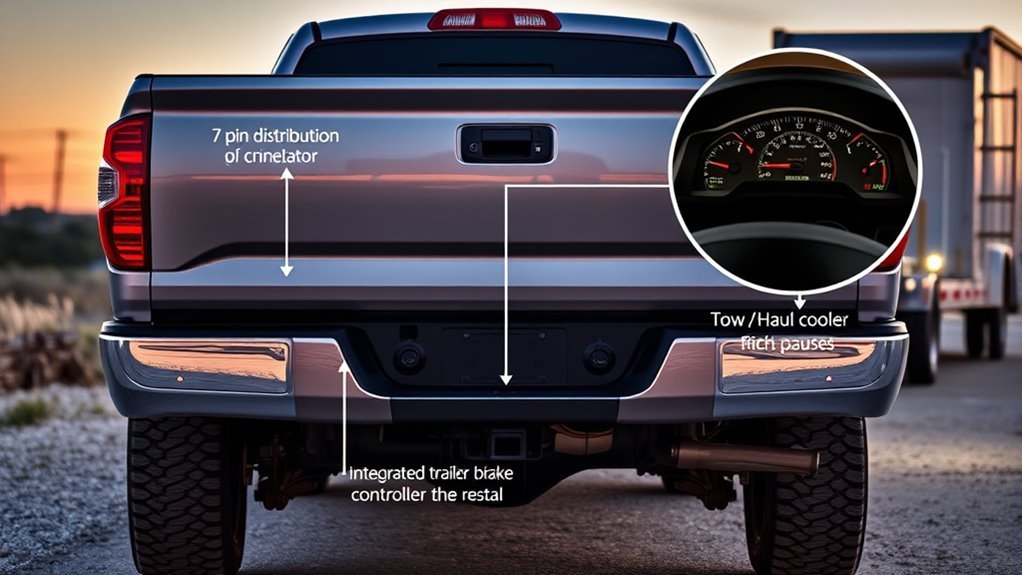
Although each component in the Tundra’s Tow Package serves a specific function, together they let you safely increase towing capacity and better manage payload by addressing braking, stability, drivetrain load, and thermal stress. You gain direct control via the integrated trailer brake controller and Haul/Tow button, which let you apply precise braking and adjust drivetrain response for varied towing techniques and safety measures. Trailer Sway Control actively counters oscillation, preserving directional stability and permitting higher safe towing limits. Tow/Haul mode optimizes shift logic and engine output, reducing transmission strain during acceleration and descent. The external transmission cooler removes excess heat, preventing thermal degradation under sustained load and protecting payload-bearing capability.
| Component | Primary Effect | Operational Benefit |
|---|---|---|
| Trailer Brake Controller | Increased braking force | Shorter stop distance, controlled trailer load |
| Trailer Sway Control | Lateral stability | Maintain course, raise safe tow limit |
| Transmission Cooler | Thermal management | Sustained performance, preserve payload capacity |
Pre‑Tow Checklist for Tundra Owners (Step‑By‑Step)
Before you hitch up, confirm your Tundra’s gross vehicle weight ratings and payload limits so the combined trailer and cargo weight stays within the specified 8,300–12,000 lb towing range and up to 1,940 lb payload for applicable SR/SR5 configurations. Inspect the hitch to guarantee it’s the correct class, properly torqued, and rated for the trailer’s tongue weight, and verify the electrical connector, trailer lights, turn signals, and integrated brake controller are functioning. Only proceed when weight ratings, hitch installation, and all electrical/brake systems meet the Owner’s Manual requirements.
Vehicle Weight & Ratings
When preparing to tow with your Toyota Tundra, verify the vehicle’s Gross Vehicle Weight Rating (GVWR) and confirm that the combined weight of the truck, passengers, cargo, and any added towing equipment stays within that limit. You’ll also check your Tundra’s specific towing capacity (8,300–12,000 lb range depending on trim/engine) and payload limits (up to 1,940 lb on some SR/SR5). Follow the Owner’s Manual for exact limitations to preserve towing safety and legal compliance.
- Confirm Tundra GVWR and guarantee combined curb load plus added equipment ≤ GVWR to maintain safe weight distribution.
- Verify trailer GVWR ≤ truck towing capacity; don’t assume margins.
- Cross‑check payload capacity before loading passengers/cargo to avoid overload.
Hitch And Electrical Checks
1. You’ll perform hitch security and electrical integrity checks before every tow. Verify the hitch is rated for the trailer weight (Tundra max up to 12,000 lb depending on config), latched, and pinned. Inspect safety chains and attachment points for wear; connect chains crosswise. Confirm load distribution and gross trailer weight are within Tundra limits.
| Check | Criteria | Action |
|---|---|---|
| Hitch | Rated & locked | Verify rating plate, secure pin |
| Chains | No damage | Cross-attach, correct length |
| Lights | Brake/turn/tail | Test function, replace bulbs |
| Brakes | Trailer controller | Adjust gain, confirm response |
Test electrical connections for continuity and lamp function. Use the integrated trailer brake controller on equipped trims to tune braking. Conduct these steps deliberately to preserve control and freedom on the road.
Troubleshooting Common Trailer‑Brake, Sway‑Control, and Camera Issues
Although towing systems are engineered for reliability, you should routinely verify the trailer‑brake controller, sway‑control inputs, and rearview camera to diagnose faults quickly and safely. You’ll ascertain the integrated trailer brake controller delivers proportional braking and adjust brake controller settings if pull or lag occurs. Verify trailer wiring and pin connections to eliminate voltage loss. For sway control, test the vehicle’s stability system by inducing controlled corrective inputs at low speed to guarantee the algorithm intervenes and reduces oscillation. The rearview camera aids positioning; perform a camera wiring inspection if the feed is intermittent or absent, checking connectors, ground continuity, and cable chafing.
Regularly check trailer brake controllers, sway-control response, and camera wiring to catch faults and ensure safe towing.
- Inspect electrical: measure trailer connector voltage, check grounds, verify brake controller settings match trailer weight.
- Validate sway control: run low‑speed steering corrections, monitor ESC intervention, clear fault codes.
- Confirm camera: bench test camera, trace harness, secure mount and seals to prevent water ingress.
Frequently Asked Questions
Can I Add the Tow Package to a Used Tundra Aftermarket?
Yes — you can add it aftermarket, but verify tow package compatibility, inspect frame, electrical, hitch ratings, and brake controller options. For used Tundra modifications, document upgrades, follow OEM torque specs, and retain service records.
Does the Tow Package Affect Fuel Economy Significantly?
Yes — modestly: improved towing efficiency can raise fuel consumption when hauling, yet when not towing the package’s added weight and drag slightly reduce mpg; you’ll notice marginally higher fuel consumption during heavy towing scenarios.
Are There Smartphone Apps for Monitoring Trailer Brake Controller Status?
Yes — you can use apps that link to smart trailer brake controllers and telematics modules to monitor trailer safety and brake performance in real time, letting you diagnose faults, adjust gain, and maintain liberated control.
Can I Tow With the Spare Tire Installed Instead of a Full‑Size Spare?
You can, but you shouldn’t: spare tire towing with a compact spare limits speed, load capacity and handling. Follow vehicle and trailer manuals, replace with a full‑size ASAP, and prioritize towing safety to avoid instability and failures.
Does the Tow Package Change Warranty or Maintenance Intervals?
No, the tow package generally won’t alter factory warranties or maintenance intervals, but you should review tow package benefits and warranty considerations in your owner’s manual; you’ll need to follow specified service schedules and load limits to protect coverage.
Conclusion
You’ve seen how each tow-package element — from the integrated brake controller and sway control to tow/haul mode, cameras, mirrors and hitch choices — fits a precise role in safe, legal towing. Test the theory that “systems working together beat raw power” by verifying settings, inspecting connections, and running controlled trials before a trip. If components respond predictably, your rhythm with the rig becomes reliable; if not, fix the fault until the system performs objectively.