What’s in This Article
- How Tundra Ball Joints Work
- Top Signs Your Tundra’s Ball Joints Are Failing
- Quick DIY Checks for Tundra Ball Joints
- Why Front-End Clunks Often Mean Worn Ball Joints
- Loose or Wandering Steering: Diagnosing Ball-Joint Play
- Cabin and Steering Vibrations: What They Reveal
- Uneven Tire Wear: Spotting Upper vs. Lower Ball-Joint Issues
- When to Stop Driving and What Shops Inspect for Ball Joints
- Repair Options and Costs: OEM vs. Aftermarket Ball Joints
- Frequently Asked Questions
- Conclusion
- References
Last updated: May 28, 2026
A bad Tundra ball joint can turn a small front-end noise into a serious steering risk. You may notice clunks, wandering steering, extra steering effort, cabin vibration, or uneven front tire wear before the joint reaches a dangerous point. This guide shows you what those signs mean, how to check them safely, and when you should stop driving. The safety history described below is strongest on 2000–2007 first-generation Tundra models — check your VIN if you’re unsure which generation you own.
Quick Answer
Failing Tundra ball joints often cause front-end clunks, loose or wandering steering, vibration, extra steering effort, and uneven front tire wear. Check for torn boots, grease loss, and wheel play with the truck safely supported. If you feel clear play, hear loud clunks, or notice steering drift, stop driving and get a professional inspection. This is most urgent on 2000–2007 first-generation Tundras, which had documented lower ball joint safety recalls.
Key Takeaways
- Listen for front-end clunks or rattles that get worse over bumps or during turns.
- Check the rubber dust boots for tears, grease leaks, cracks, or loose clamps.
- Use the 12 and 6 o’clock wheel test to screen for ball joint play safely.
- Treat steering wander, vibration, and visible wheel play as urgent safety signs.
- Check your VIN through Toyota or NHTSA — the documented lower ball joint recalls apply mainly to 2000–2007 first-generation Tundra models; later generations use a different front suspension design.
How Tundra Ball Joints Work
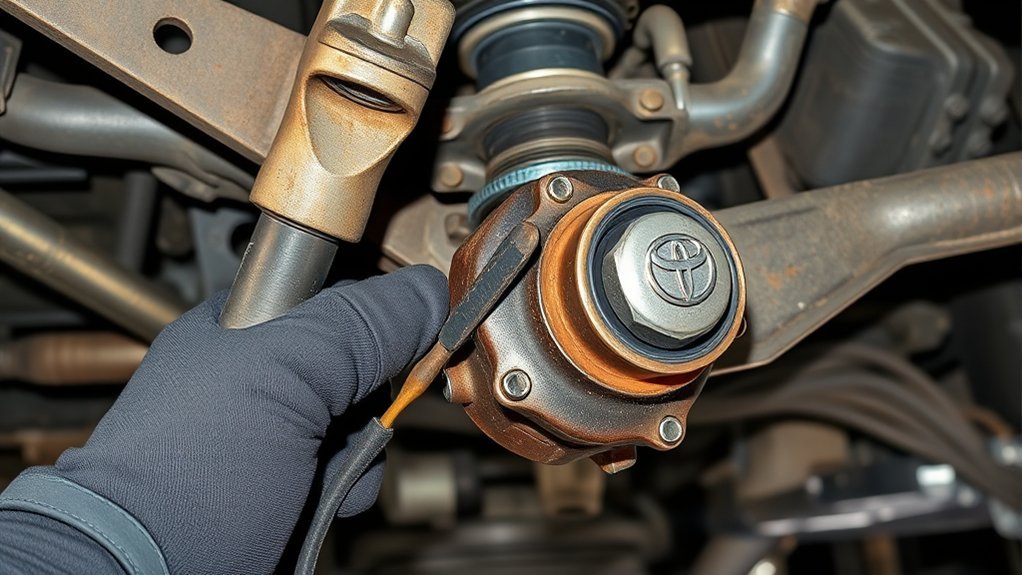
Think of your Tundra’s ball joints as strong pivots between the steering knuckle and the control arms. They let the wheels steer while the suspension moves up and down over bumps.
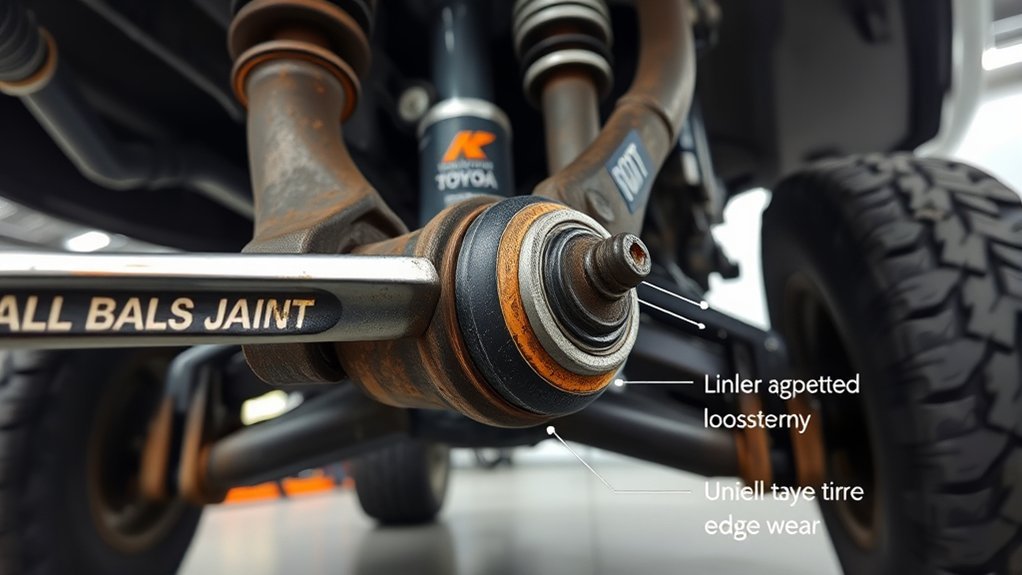
Each joint uses a metal ball inside a greased socket. A rubber dust boot keeps grease in and keeps dirt, water, and road grit out. Once the boot tears, grime can enter the joint and wear the socket faster.
Ball joints carry heavy vertical loads from the truck and side loads from turning. Toyota also calls the front lower ball joint a wear item that needs periodic inspection in the vehicle’s maintenance schedule. Toyota’s documented lower ball joint recalls (Special Service Campaigns 50J and 70B) covered certain 2002 through early 2004 and 2004 through late 2006 first-generation Tundra models specifically, in part because that generation’s suspension design keeps the lower ball joint under constant tension. Later Tundra generations use a different front suspension design, so confirm your model year before applying recall-specific guidance. Don’t rely on mileage alone because towing, rough roads, larger tires, and poor lubrication can shorten service life.
Top Signs Your Tundra’s Ball Joints Are Failing
You’ll usually notice a mix of noise, loose steering, vibration, and tire wear. One symptom can point to several parts, but several symptoms together make ball joint wear more likely.
According to Toyota recall documents filed with the National Highway Traffic Safety Administration (NHTSA), lower ball joint wear can cause increased steering effort, reduced vehicle self-centering, and front suspension noise. In severe cases, the lower ball joint can separate and cause a loss of steering control.
Clunking Or Rattling
A sharp clunk from the front suspension over bumps often points to looseness in a ball joint, control arm, sway bar link, or tie rod end. Ball joint clunks often grow louder as socket play increases.
Boot failure, grease loss, rust, and grit can all speed up wear. Don’t ignore a clunk that appears with loose steering, vibration, or visible wheel movement.
| Symptom | What it may mean |
|---|---|
| Single clunk over bump | Possible joint or linkage play |
| Repeated rattling | Worsening suspension looseness |
| Noise under load | Joint, bushing, or bearing wear |
| Noise plus loose steering | Urgent inspection needed |
| Intermittent sound | Early wear or another loose part |
If a shop confirms ball joint play, replacement gives you the safest repair path. A loose safety-critical ball joint should not receive a simple clean-and-grease repair.
Wandering, Loose Steering
When ball joints wear, they can add slack at the steering knuckle. You may feel the truck drift from lane center or require constant steering corrections.
You may also feel extra steering effort or a delay between steering input and tire response. MOOG notes that worn ball joints can cause sloppy steering, vibration, drifting over bumps, and uneven tire wear.
Check tire pressure and alignment before you blame the ball joints. If those items check out and the wheel shows play, schedule repair before the truck becomes harder to control.
Quick DIY Checks for Tundra Ball Joints
Start with a visual boot inspection. Then check wheel play with the truck safely lifted and supported. Finish by matching road symptoms with what you saw during the inspection.
Warning: Never work under a Tundra supported only by a jack. Use rated jack stands on solid ground before you touch a wheel or suspension part.
[Products Worth Considering]

These low profile jack stands provide secure vehicle support for routine garage and repair work on most cars and small vehicles. Built with a welded steel frame, adjustable ratchet design, and wide base for stability, they offer dependable lifting support with a concave saddle for safer contact. The low minimum height and compact design make them a practical choice for many automotive maintenance tasks.

This click torque wrench delivers accurate, repeatable tightening for automotive and home repair tasks, helping prevent over-tightening and fastener damage. Its dual-range scale, knurled non-slip grip, and durable ratchet head make it easy to use, while the included extension bar and storage case add extra convenience.

This hydraulic floor jack combines aluminum and steel construction for dependable strength, smooth mobility, and easier lifting in garage or roadside use. Its dual-pump design helps raise vehicles faster, while the low-profile build works well with lower-clearance cars, SUVs, and trucks. Safety-focused details like a rubber saddle, handle bumper, and overload protection add confidence during operation.
Visual Boot Inspection
Visual inspection gives you quick clues about ball joint health. Check the rubber boot for splits, tears, cracks, or loose edges that let grease escape and dirt enter.
Look for wet grease trails, dried grease, rust, and damaged boot clamps. Do this during tire rotations or anytime you hear new front-end noise.
| Item | What to look for |
|---|---|
| Boot integrity | Splits, tears, cracks |
| Grease escape | Wet trails, missing grease |
| Attachment | Secure clamp fit |
| Deformity | Wrinkles, bulges |
| Inspection timing | Every tire rotation |
Wheel Play Test
After you check the boot, perform a careful wheel play test. Lift the front end, support the truck on jack stands, and keep your hands clear of pinch points.
Grab the tire at 12 and 6 o’clock and rock it in and out. Movement can point to ball joint play, wheel bearing looseness, or another suspension fault, so watch the joint while you move the tire.
Grab the tire at 3 and 9 o’clock next. Movement in that direction can also point to tie rod, steering rack, or wheel bearing play, so don’t diagnose from hand position alone.
Use a helper if possible. One person can rock the tire while the other watches the joint, control arm, and steering linkage for visible movement.
Road Feel Assessment
Road feel can support your diagnosis, but it can’t replace a physical inspection. Note when the noise happens, how the steering feels, and whether vibration changes with speed.
Drive a smooth, straight road only if the truck still feels safe and predictable. If the wheel wanders, clunks loudly, or vibrates hard, stop the test and arrange inspection.
Document symptoms before you visit a shop. Clear notes help the technician reproduce the problem and avoid replacing good parts.
Why Front-End Clunks Often Mean Worn Ball Joints
When you hear a distinct clunk or rattle from the front end, a loose joint may allow the steering knuckle or control arm to shift under load. That movement can send a sharp impact through the chassis.
Clunks often get worse over dips, driveways, potholes, and uneven pavement. A single sound does not prove ball joint failure, but it gives you a strong reason to inspect the suspension.
- Audible signature: Rhythmic clunks over bumps can point to joint or linkage play.
- Steering feel: Looseness can create a disconnected steering response.
- Tire evidence: Edge wear can show alignment change from worn suspension parts.
- Speed clues: Vibration at speed may involve ball joints, wheel balance, tires, or bearings.
Replace a confirmed loose ball joint promptly. Waiting can damage tires, alignment parts, brakes, and steering components.
Loose or Wandering Steering: Diagnosing Ball-Joint Play
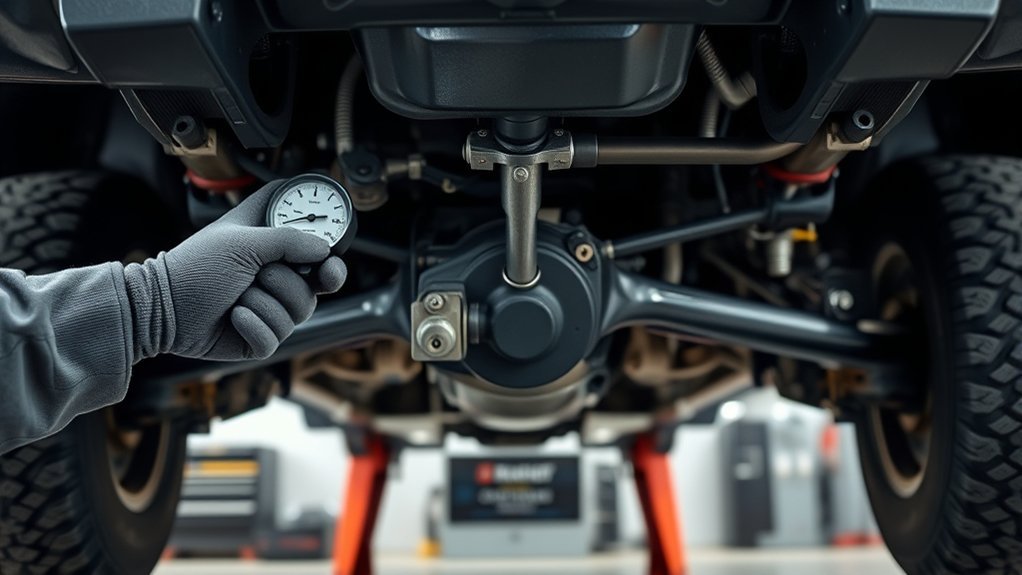
Loose steering often points to slack somewhere in the front end. Ball joints, tie rods, control arm bushings, wheel bearings, tires, and alignment can all create similar road feel.
Start with simple checks. Confirm tire pressure, inspect tire condition, and look for uneven tread wear before you blame the ball joints.
Next, lift the front end safely and check for play. If you see movement at the ball joint while the tire rocks, schedule replacement and alignment service.
Cabin and Steering Vibrations: What They Reveal
Worn ball joints can let suspension parts move beyond normal limits. You may feel that movement through the steering wheel, seat, floor, or cabin.
Vibration can also come from wheel balance, tire damage, bent wheels, brake issues, or wheel bearings. Match the vibration with other signs before you decide what failed.
You can screen likely vibration sources with these checks:
- Road-speed change: Vibration that grows with speed may involve tires, wheels, bearings, or joint play.
- Steering input: Vibration that changes while turning can point toward a front-end part.
- Static inspection: A torn boot or grease loss supports a ball joint diagnosis.
- Wheel play: Visible looseness at the joint confirms urgent repair needs.
Treat persistent steering vibration as a safety concern. A shop can isolate the part and help you avoid guessing.
Uneven Tire Wear: Spotting Upper vs. Lower Ball-Joint Issues
Check your front tires often because uneven edge wear can reveal alignment or suspension trouble. Inner or outer tread wear can happen when a worn part changes camber or toe while you drive.
Tire wear alone cannot prove whether the upper or lower ball joint failed. It can only show that the tire no longer meets the road correctly.
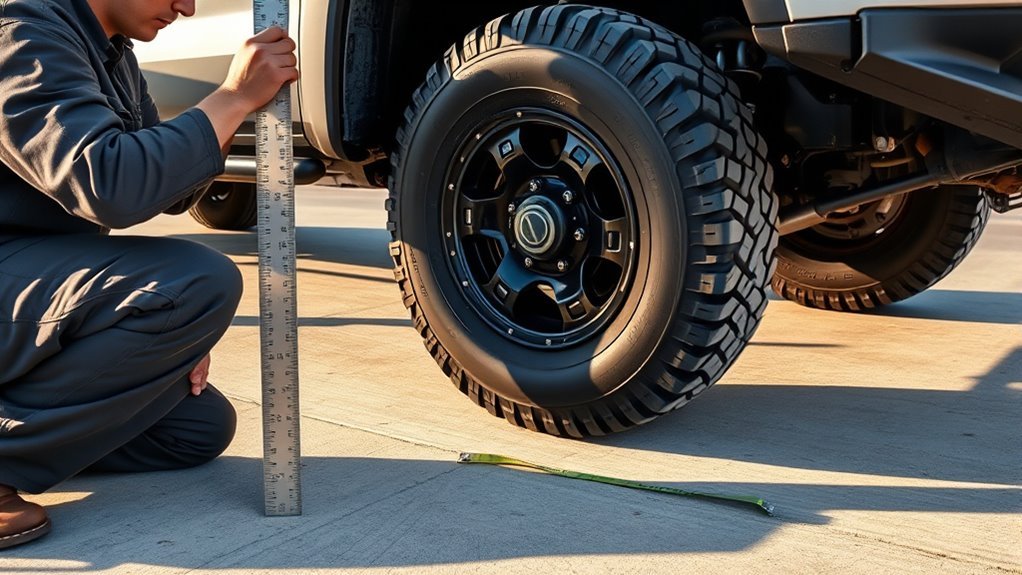
Measure tread depth across the tire at several points. Compare inner, center, and outer tread depth, then match the wear pattern with steering looseness, clunks, and wheel play.
If both front tires show similar wear, suspect alignment, tire pressure, or broad suspension wear. If one front tire wears fast on one edge, inspect that corner first.
When to Stop Driving and What Shops Inspect for Ball Joints
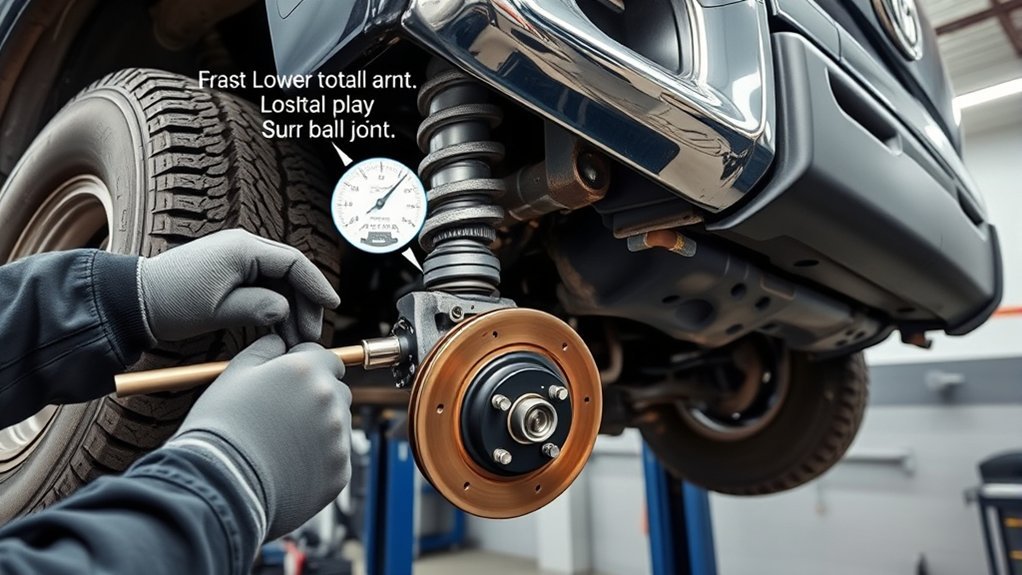
Stop driving if you hear loud front-end clunks, feel sudden steering looseness, notice wheel wobble, or see severe tire tilt. These signs can point to advanced wear and possible loss of control.
A shop should perform a targeted inspection before it replaces parts. Ask the technician to show you the failed joint movement if the truck can stay safely on the lift.
Expect checks that include:
- Visual inspection for torn boots, grease loss, corrosion, and damaged mounting points.
- Wheel play test with the suspension loaded or unloaded as the repair manual requires.
- Steering and suspension check for tie rod, bearing, bushing, and control arm wear.
- Alignment check after repair because ball joint replacement can change front-end geometry.
- Road test only when the truck remains safe enough to drive.
Prefer a technician who knows Toyota truck suspension. A careful diagnosis saves money and reduces the chance of repeat repairs.
[Products Worth Considering]

This low profile hydraulic trolley jack is built for fast, reliable lifting in garage and service environments. With a 2 ton capacity, it helps raise most cars with a compact profile that fits lower-clearance vehicles, while the swivel casters and large saddle support smooth positioning and added stability. A built-in overload protection valve adds an extra layer of safety during use.

This scissor car jack kit provides a dependable solution for emergency tire changes and roadside repairs. With a lifting range suited for low sedans and higher-body SUVs, it comes with essential tools like a ratchet wrench, lug wrench, gloves, tire pressure gauge, and storage bag for convenient use and transport. Built for stability and ease of operation, it is a practical all-in-one kit for cars, SUVs, and MPVs.
Repair Options and Costs: OEM vs. Aftermarket Ball Joints
Ball joint replacement choices come down to fit, quality, warranty, and how you use the truck. Original equipment manufacturer (OEM) parts usually give you predictable fit and factory-backed quality. For the recall-affected lower ball joint specifically, many owners and installers favor factory Toyota (or equivalent OEM-grade) parts given the documented failure history, though reputable aftermarket brands exist. `[VERIFY: confirm current OEM/aftermarket brand recommendation before publishing]`
Aftermarket parts can cost less, and some reputable brands build heavy-duty options for towing, hauling, or rough roads. Low-cost parts can vary in quality, so match the part to your driving demands.
RepairPal estimates Toyota Tundra suspension ball joint replacement at roughly $368–$549 on average, with year-specific estimates ranging from about $322 to $679 depending on model year, parts, labor rate, taxes, and related repairs. Local quotes can differ, so compare the full job cost instead of the part price alone.
Ask whether the estimate includes both sides, alignment, shop supplies, taxes, and any seized hardware. After the repair, get an alignment check to protect tires and steering feel.
Frequently Asked Questions
How long do Toyota Tundra ball joints last?
Ball joint life depends on road conditions, tire size, load, maintenance, and part quality. Toyota treats the front lower ball joint as a wear item, so you should inspect it on a schedule instead of waiting for a fixed mileage number. Owners of 2000–2007 first-generation Tundras should also confirm whether their VIN falls under the lower ball joint recall.
How do you check ball joints on a Tundra?
Support the truck safely, inspect the dust boots, then rock the tire at 12 and 6 o’clock while watching the joint. If you see play at the ball joint, hear a clunk, or see grease loss with loose movement, schedule repair.
What is the most common symptom of a worn Tundra ball joint?
A front-end clunk over bumps often gives you the first warning. Loose steering, wandering, vibration, and uneven tire wear can appear as the joint wears more.
Is there a recall on Toyota Tundra ball joints?
Yes, Toyota issued lower ball joint safety recall campaigns for certain 2002 through early 2004 Tundra models and certain 2004 through late 2006 Tundra models — both first-generation trucks. Check your 17-character vehicle identification number (VIN) through Toyota or NHTSA to see whether your truck has an open recall.
Safety Disclaimer: This article is for informational purposes only and does not replace a professional vehicle inspection. Always consult a qualified mechanic before driving a vehicle with suspected steering or suspension failure.
Conclusion
Your Tundra’s ball joints help keep the front wheels controlled, aligned, and responsive. Clunks, wandering steering, vibration, torn boots, grease loss, and uneven tire wear all deserve quick attention.
Start with safe visual checks, then confirm wheel play with the truck properly supported. If you find clear looseness or the steering feels unsafe, stop driving and schedule a professional inspection.
Act early, and you can protect your tires, steering parts, and safety before a small symptom becomes a major failure.
References
- Special Service Campaign 50J, Front Suspension Lower Ball Joint – Toyota via NHTSA, 2005
- Special Service Campaign 70B, Front Suspension Lower Ball Joints – Toyota via NHTSA, 2007
- Check for Recalls – National Highway Traffic Safety Administration
- Lookup Safety Recalls and Service Campaigns – Toyota
- Symptoms of Bad Ball Joints – MOOG Parts
- Toyota Tundra Suspension Ball Joint Replacement Cost Estimate – RepairPal