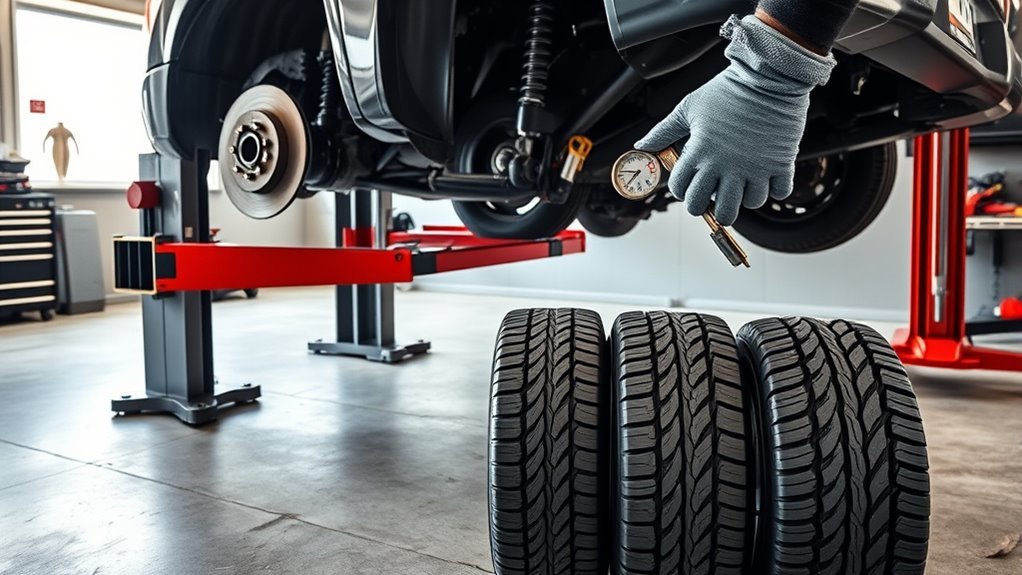
You should rotate your Toyota Tundra’s tires every 5,000 miles to guarantee even wear, maintain handling, and preserve warranty coverage. Use a straight front-to-back swap on the same side to retain directional stability unless the manual allows cross-side moves. Increase frequency to about 3,000–5,000 miles for towing or off-road use, track pressure and tread depth at each service, and follow torque specs when reinstalling wheels — continue for patterns, tools, and wear diagnostics.
How Often to Rotate Tundra Tires : 5,000 Miles (Short Answer)

Rotate your Tundra’s tires every 5,000 miles; Toyota specifies this interval to promote even wear and maximize tire life. You’ll align tire maintenance with oil changes, making it a predictable, actionable task that preserves performance and comfort. Rotating at this cadence distributes load and wear across all tires, preventing the rear or front set from fatiguing prematurely. You’ll monitor tread longevity by measuring remaining depth at each service and noting uneven patterns that signal alignment or suspension issues. If you skip rotations, you’ll face asymmetric wear and earlier replacements, reducing your vehicle’s freedom to travel without constraint. Execute a front-to-back swap for non-directional tires to maintain balanced contact patches and consistent handling. Keep a log of rotations and tread readings so you can defend against unnecessary replacements and optimize tire selection. This disciplined approach to tire maintenance gives you control, lowers long-term cost, and sustains the Tundra’s capability.
Which Rotation Pattern to Use for a Tundra
When you follow Toyota’s guidance for the 2018 Tundra with OEM Michelin LTX tires, use a straight front-to-back and back-to-front swap—no crossover—because that pattern preserves even wear and complies with the owner’s manual. You’ll protect warranty status and get clear rotation benefits by sticking to the prescribed pattern. It’s a controlled, predictable method that limits uneven wear and extends usable tread life.
- Swap front to rear on the same side to maintain directional stability.
- Avoid crossover unless the manual explicitly permits side-to-side moves.
- Rotate every 5,000 miles or with each oil change to execute consistent tire maintenance.
- Monitor tires; uneven wear (e.g., rear-right after 16,000 miles) signals missed rotations.
- Remember towing may tempt cross patterns, but standard practice favors straight swaps for longevity.
You want freedom from premature replacements; follow the manual, perform scheduled tire maintenance, and use the straight swap to maximize safety, performance, and liberation from avoidable wear.
When to Rotate More Often: Towing, Driving & Tire Type
If you regularly tow heavy loads, drive off‑road, or push the truck hard, you should rotate your Tundra’s tires more frequently—aim for every 3,000–5,000 miles—because those conditions accelerate rear and outer‑shoulder wear and shorten tread life. You’ll reduce uneven wear by matching rotation frequency to use: towing shifts load bias rearward; off‑road and aggressive inputs concentrate stress on outer shoulders and bead areas. Know your tire type—non‑directional OEM Michelins allow side‑to‑side swaps that help equalize wear under variable driving, while directional or specialty tires may limit pattern options and require different intervals. Track pressure and tread depth at each rotation; adjust inflation to spec before swapping. Use these tire maintenance tips to force freedom from premature replacements: monitor wear rates, document mileage between rotations, and adapt schedule when load or terrain changes. Understanding driving conditions impact lets you extend tread life and maintain predictable handling under real‑world demands.
DIY Rotation Checklist (Tools, Steps, Torque)
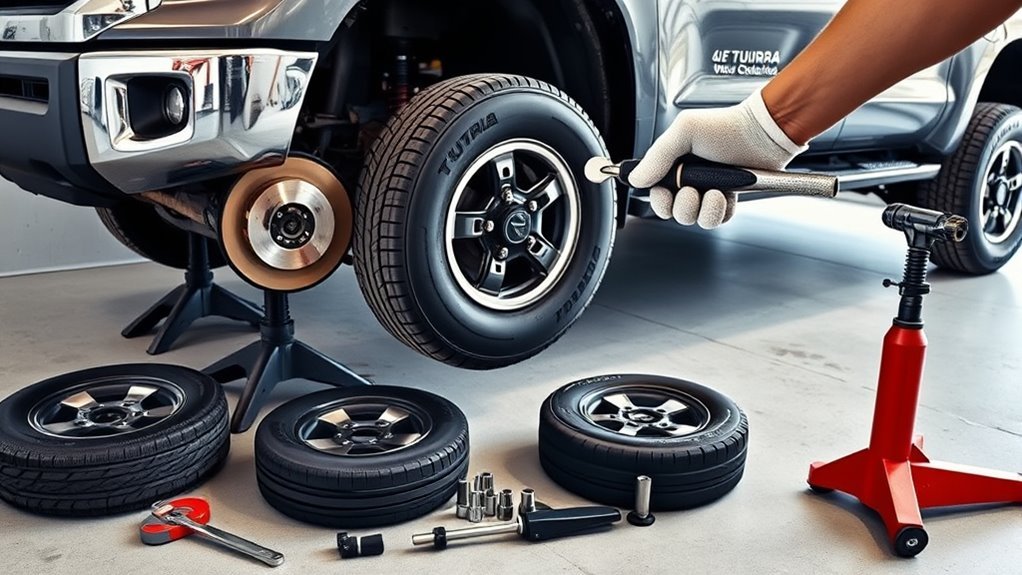
After adjusting your rotation schedule for heavy towing or off‑road use, gather the tools and follow a methodical checklist so the job’s safe and repeatable. You’ll free yourself from dependency on shops by preparing properly: jack, jack stands, lug wrench, torque wrench, and a pressure gauge. Check tire pressure front and rear, and correct to spec before lifting.
- Confirm wheel lug nut pattern and loose-fit before jacking.
- Raise vehicle, secure on stands, remove wheels following front-to-back non-directional pattern.
- Inspect tread and sidewall for damage or uneven wear after each removal.
- Reinstall wheels, finger-tighten lug nuts, lower vehicle to ground.
- Use torque wrench to tighten lug nut to manufacturer spec (generally 80–100 ft-lbs), in a star pattern.
Work deliberately, keep tools organized, and document torque values. This precise routine preserves handling, extends tire life, and gives you practical control over your Tundra’s safety and performance.
Spotting Uneven Wear and When to Replace All Four
How can you tell whether uneven wear on your Tundra’s tires is a rotation issue or a deeper problem? Inspect tread patterns and wear indicators first. Even wear across all tires after 16,000 miles suggests rotations were inconsistent but not catastrophic. Localized wear—one side or rear right—points to rotation neglect, weight distribution, or driving habits. Significant single-tire deterioration or exposed wear indicators implies immediate action.
| Sign | Likely Cause |
|---|---|
| Uniform low tread | Normal wear; rotation schedule needed |
| One-side wear | Driving/load bias; increase rotation frequency |
| Cupping/feathering | Possible tire alignment or suspension fault |
Rotate every 5,000 miles to equalize exposure. If tread depth varies beyond safe limits or multiple tires show pronounced uneven wear, replace all four to restore balanced handling and safety. Address tire alignment and suspension faults before fitting new rubber to avoid repeating inequality. You’re reclaiming control—preventive rotations and precise diagnosis free you from premature replacements.
Frequently Asked Questions
How Often Should You Rotate Tires on a Toyota Tundra?
You should rotate your Tundra’s tires every 5,000 miles or with each oil change to control tire wear. Follow front-to-back pattern, use maintenance tips, and you’ll preserve traction, warranty, and liberated driving confidence.
Is It Okay to Rotate Tires Every 10,000 Miles on a Toyota?
No — you shouldn’t rotate every 10,000 miles. You’ll risk uneven tire wear, void warranties, and harm handling. Follow manufacturer maintenance tips, rotate ~5,000 miles, check pressure and tread, and reclaim safer, more reliable driving freedom.
Is It Okay to Rotate Tires Every 7500 Miles?
Yes — rotating every 7,500 miles fits the recommendation, and it balances tire wear against service frequency. You’ll extend tread life, preserve handling, follow maintenance tips, and keep control while refusing needless overmaintenance.
Conclusion
Rotate your Tundra’s tires every 5,000 miles to keep wear even and handling predictable; use a cross pattern for non-directional tires and a front-to-rear swap for directional or staggered setups. If you tow, carry heavy loads, or run aggressive tires, shorten the interval. Follow the DIY checklist for proper lift, jack stands, torque specs, and tightening sequence. Watch for cupping, feathering, or shoulder wear—replace all four if wear is uneven, like a clock out of sync.