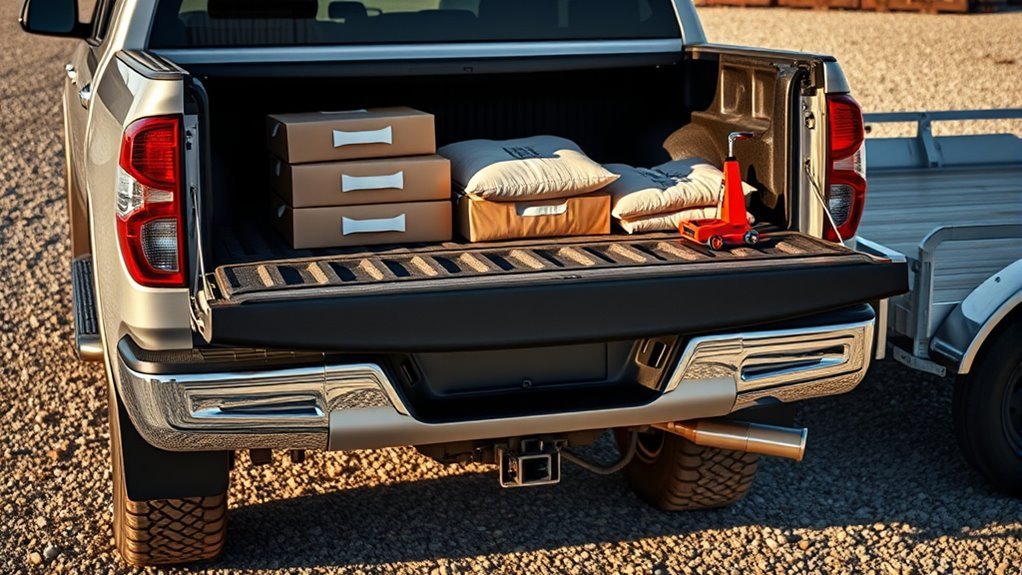
Find the GVWR on your Tundra’s door‑jamb sticker, note the truck’s curb weight, then subtract curb weight from GVWR to get base payload. Subtract fixed items and aftermarket gear to find your usable payload. Determine available tongue allowance by removing passenger and cargo weight, target tongue at 9–15% for bumper‑pull (about 22.5% for fifth‑wheel/gooseneck), and verify with calibrated scales for axle and tongue loads. Continue for step‑by‑step calculations and checks.
Find Your Toyota Tundra’s Exact Payload
Want to know your Tundra’s exact payload? Start with payload essentials: locate the GVWR on the door jamb sticker — that’s your authoritative number — and note your model’s listed curb weight. You’ll compare those figures to determine the usable payload specific to your truck. Remember trims differ: SR/SR5 properly equipped can reach about 1,940 pounds, while a Capstone may be nearer 1,485 pounds due to added features. Don’t rely on memory or generic specs; the sticker reflects manufacturer calibration for your VIN and options.
Next, maintain proper weight balance by accounting for passengers, cargo, and aftermarket equipment before you load. Tally individual weights and keep a margin for safety; your payload isn’t just cargo weight, it’s the vehicle’s total permissible additional mass. This disciplined approach gives you control and freedom to use the truck without compromising safety or performance.
Calculate Payload: GVWR − Curb Weight − Mods (Step-by-Step)
Start by reading the GVWR on your door jamb sticker—this is the maximum total weight your Tundra can carry—then subtract the truck’s curb weight to find the base payload; finally subtract the exact weight of any aftermarket mods or accessories to arrive at your usable payload. Do this step-by-step: note GVWR, record curb weight, list each mod and measure its weight. Compute: GVWR − curb weight = available payload; available payload − total mods = final payload.
Treat payload factors systematically: include passengers, fuel, tools, and gear when tallying load. Document each item so you won’t exceed capacity. Consider weight distribution when placing cargo—keep heavy items low and forward of the rear axle to maintain control and avoid overstressing axles. Use the example calculation as verification: for a GVWR of 11,500 lbs, curb weight 7,500 lbs, and 200 lbs of mods, final payload = 3,800 lbs. Stay precise; your freedom on the road depends on accurate numbers.
Convert Payload to Safe Tongue & Trailer Limits
Now that you’ve nailed down your Tundra’s usable payload, convert that number into safe tongue and trailer limits so your rig tow safely and legally. First, subtract passengers and cargo from your payload (up to 1,940 lb for properly equipped SR/SR5) to find available tongue allowance. For conventional trailers, target tongue weight at 9–15% of trailer mass to preserve trailer stability; for fifth-wheel/gooseneck aim ~22.5%. Calculate maximum trailer mass by dividing your available tongue allowance by the target percentage (e.g., available tongue ÷ 0.12). Always verify the combined trailer mass plus tongue weight won’t push the truck past its 11,500 lb GVWR. Use a calibrated scale at the hitch to confirm actual tongue weight before departure. Adjust load distribution if tongue weight falls outside recommended bands—shift cargo forward or aft, or trim trailer load. You’re freeing yourself to tow with confidence: measured numbers, legal limits, and predictable handling.
Sticker Discrepancies: Door-Jamb vs. Advertised Numbers
Although brochure figures can look appealing, always trust the door-jamb sticker because it reflects GVWR minus the vehicle’s actual curb weight and gives you the payload you can safely use. You’ll find sticker accuracy beats marketing: the sticker is the manufacturer’s formal specification based on the vehicle as produced, not idealized estimates. When your calculated payload and the sticker disagree, prioritize the door-jamb number; manufacturer estimates in brochures can omit typical equipment, fluids, or optional packages.
You’ll act deliberately:
- Inspect the door-jamb sticker for GVWR and curb weight to determine true payload.
- Compare brochure claims to sticker values, noting any variance caused by manufacturer estimates.
- Account for added equipment or modifications that reduce available payload.
- Use a scale when precise verification is required; sticker sets the legal and safe limit.
This keeps you free from marketing hype and guarantees you operate within legal, safe payload limits for liberation on the road.
Pre-Trip Weight Checklist (Scales, Hitch, Load Distribution)
If you’re towing or loading heavy gear, weigh the Tundra on CAT scales to get precise front- and rear-axle and total-vehicle numbers before you add cargo or hitch a trailer. Use that weighing procedure every time payload or passengers change. Record axle loads and curb weight, then subtract from the GVWR to confirm remaining payload capacity. Cross-check combined weight against the 25,300 lb GCVWR when towing.
Apply load balancing: position cargo to keep tongue weight within trailer and hitch specifications and avoid overloading the rear axle. Use a weight distribution hitch when axle loads or trailer dynamics demand it; it’ll redistribute forces and improve steering and braking feel. Verify hitch class and ball rating match the measured loads. Re-weigh after adjustments to confirm compliance. Don’t guess—measure. This disciplined, liberated approach gives you control, prevents failures, and keeps you within legal and safe limits.
Frequently Asked Questions
How Much Payload Can a Toyota Tundra Carry?
You can carry up to about 1,940 pounds in properly configured SR/SR5 Tundras; check your door jamb sticker. Balance payload versus towing capacity, consider off road performance impacts, and configure equipment to maximize safe hauling.
How Do I Calculate Payload Capacity?
You calculate payload capacity by subtracting curb weight from GVWR, then add payload factors like passengers, cargo, and equipment; account for proper weight distribution so you’ll stay within limits and retain control and safety.
How Much Weight Can a 2026 Toyota Tundra Carry in Bed?
You can carry up to about 1,850 pounds in the bed on properly equipped 2026 Tundra models. Check door-jamb GVWR/curb weight, factor passengers/cargo, and balance truck features with towing capacity to stay safe and free.
Conclusion
You now hold the compass to your Tundra’s safe payload. When you subtract GVWR, curb weight, and mods, you’ll reveal the true carrying capacity—your vehicle’s backbone. Convert that number into tongue and trailer limits, check door-jamb stickers against ads, and use scales and proper hitch/load distribution before every trip. Treat these steps like a preflight checklist: follow them precisely, and your truck will carry its burden like a steady keel through any road’s sea.