The P0171 code in your Toyota Camry means the engine computer has detected a lean air-fuel mixture on Bank 1. In plain English, the engine is seeing too much air, not enough fuel, or a sensor reading that makes it look that way. The right fix depends on the data, so start with scan-tool readings before replacing parts.
Quick Answer
A Toyota Camry P0171 code means “System Too Lean Bank 1.” Common causes include vacuum leaks, a dirty or faulty MAF sensor, cracked intake hoses, a stuck-open purge valve, low fuel pressure, clogged injectors, or an exhaust leak near the upstream air-fuel sensor. Diagnose it with fuel-trim data before replacing parts.
Key Takeaways
- P0171 is usually caused by unmetered air, incorrect airflow measurement, or restricted fuel delivery.
- On most 4-cylinder Camrys, Bank 1 is the only bank. On V6 Camrys, Bank 1 is the side of the engine with cylinder No. 1.
- If fuel trims are high at idle but improve around 2,500 RPM, suspect a vacuum leak. If trims stay high at all RPMs, suspect the MAF sensor or fuel delivery.
- Do not keep driving if the check engine light is flashing, the engine is misfiring, or the car has poor acceleration.
At a Glance
| Time Required | 30 minutes to 2 hours for basic diagnosis |
| Difficulty | Easy to moderate, depending on the root cause |
| Tools Needed | OBD-II scanner with live data, flashlight, basic hand tools, MAF cleaner, smoke tester or shop leak test |
| Typical Cost | $10–$80 for simple DIY fixes; $150–$600+ if shop diagnosis or parts replacement is needed |
What Causes the P0171 Code in Your Toyota Camry?
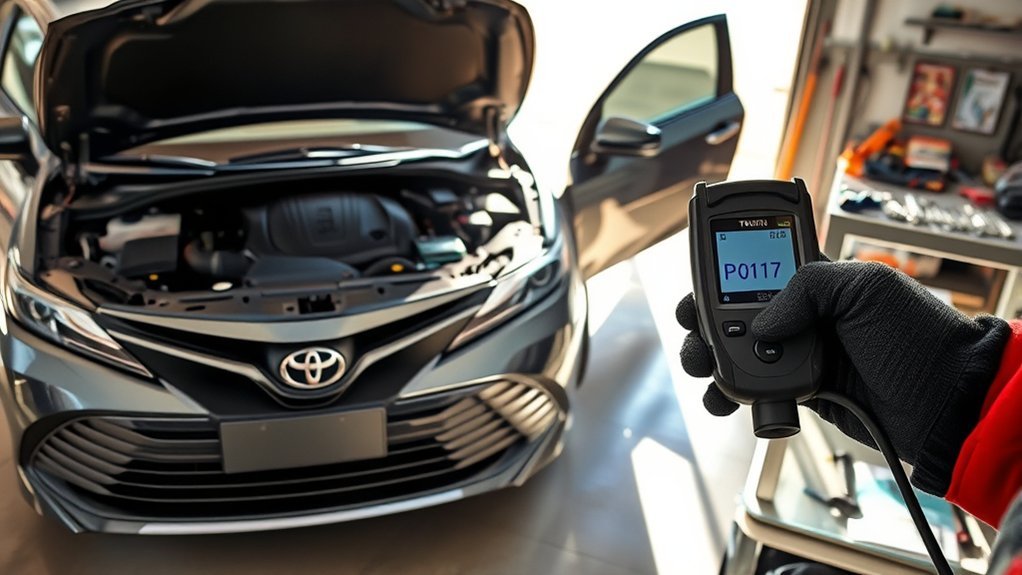
The Toyota owner manual explains that the OBD system monitors emission-control operation and turns on the malfunction indicator lamp when a problem is detected. With P0171, the engine computer is trying to correct a lean mixture but has reached the limit of its fuel correction.
A lean condition usually comes from one of three categories:
| Cause Category | Common Camry Examples | Clue |
|---|---|---|
| Unmetered air | Cracked vacuum hose, intake boot leak, PCV hose leak, intake manifold gasket leak, brake booster hose leak | Fuel trims high at idle and improve at higher RPM |
| Incorrect airflow reading | Dirty MAF sensor, contaminated MAF element, loose air intake tube after air filter service | Fuel trims stay high at idle and while revving |
| Not enough fuel | Weak fuel pump, restricted filter or strainer, clogged injector, fuel pressure problem | Lean condition worsens under load or acceleration |
| False lean signal | Exhaust leak before the upstream A/F sensor, failing air-fuel ratio sensor, active misfire | Other codes, ticking exhaust leak, rough running, or inconsistent sensor data |
Note: A 4-cylinder Camry has only Bank 1. A V6 Camry can have Bank 1 and Bank 2, so P0171 alone may point to one side of the engine, while P0171 with P0174 often points to something that affects both banks, such as the MAF sensor or fuel pressure.
Common Symptoms of P0171 in a Toyota Camry
Some Camrys run almost normally with P0171, especially early on. Others show obvious driveability problems. Watch for:
- Check engine light or stored P0171 code
- Rough idle, especially when cold
- Hesitation or weak acceleration
- Stalling at stops
- Poor fuel economy
- Whistling or hissing from the intake area
- Misfire codes such as P0300, P0301, P0302, P0303, or P0304
Warning: If the check engine light is flashing, the engine is shaking badly, or the car has severe power loss, stop driving and have it diagnosed. A flashing light usually means an active misfire, which can damage the catalytic converter.
How to Diagnose P0171 Before Replacing Parts
The fastest way to waste money on a P0171 repair is to replace the oxygen sensor first without checking the data. The upstream air-fuel or oxygen sensor often reports the lean condition; it is not always the cause. Use this order instead.
[Products Worth Considering]

The ANCEL AD410 PRO combines engine diagnostics and 12V battery testing in one easy-to-use tool, helping you read and clear check engine codes while checking battery health, cranking, and charging performance. It also provides live data, freeze frame details, and I/M readiness checks to help you diagnose issues faster and prepare for emissions testing. With plug-and-play operation, a clear screen, and broad vehicle compatibility, it is a practical solution for home mechanics and everyday drivers.

The ANCEL AD410 helps drivers quickly read and clear engine-related fault codes, view live data, and understand why the check engine light is on before heading to a repair shop. With built-in code definitions, readiness checks, and support for common OBD2 functions, it makes basic diagnostics straightforward for beginners and DIY users. Powered directly from the vehicle and easy to use with no app required, it offers practical value for everyday vehicle troubleshooting.

This heavy-duty cargo net helps keep truck bed loads secure and organized during transport. Its expandable bungee mesh design offers flexible coverage for a range of cargo sizes, while the included metal carabiners make installation quick and dependable. Built for pickup owners who need reliable load containment, it is suitable for many popular truck models.
Step 1: Scan for All Codes and Freeze-Frame Data
Use an OBD-II scanner that can show live data, not just read and erase codes. Write down all stored and pending codes. Also check the freeze-frame data to see when the code set: idle, cruising, accelerating, cold start, or warmed up.
If you see misfire codes, fix those first. A misfire can leave extra oxygen in the exhaust and make the computer think the mixture is lean.
Step 2: Check Short-Term and Long-Term Fuel Trim
Fuel trim shows how much fuel the engine computer is adding or subtracting. Positive numbers mean the computer is adding fuel. A small amount of correction is normal, but consistently high positive trim points toward a lean condition.
- STFT is short-term fuel trim. It changes quickly.
- LTFT is long-term fuel trim. It shows what the computer has learned over time.
- STFT + LTFT gives you the clearest picture of how hard the computer is correcting.
Step 3: Compare Idle and 2,500 RPM
Warm up the engine, watch fuel trims at idle, then hold the engine around 2,500 RPM in Park or Neutral for a short period.
| Fuel Trim Pattern | Most Likely Direction | Why |
|---|---|---|
| High positive trims at idle, lower trims at 2,500 RPM | Vacuum leak or intake leak | A small leak has a bigger effect at idle than at higher airflow |
| High positive trims at idle and 2,500 RPM | MAF sensor, intake measurement issue, or fuel delivery problem | The problem affects the engine across operating ranges |
| Lean mostly under load | Fuel pressure, pump, injector, or restriction issue | Fuel demand rises during acceleration |
Pro Tip: Check for recent work. If the air filter, battery, throttle body, or intake tube was recently serviced, a loose intake clamp or unplugged MAF connector can trigger P0171 quickly.
Identifying Vacuum Leaks in Your Engine
Vacuum leaks are one of the most common reasons a Toyota Camry runs lean. A leak lets air enter the intake after the MAF sensor, so the computer does not add enough fuel for the extra air.
Common Leak Sources
Start with the simple visual checks before using advanced tools:
- Cracked or disconnected vacuum hoses
- Loose intake tube clamps
- Split rubber intake boot between the MAF sensor and throttle body
- PCV hose or PCV valve leaks
- Brake booster vacuum hose leak
- Intake manifold gasket leak
- Oil filler cap or dipstick not sealing properly
- Purge valve stuck open or purge hose leak
Inspection Techniques Explained
Use a flashlight and inspect each hose by hand. Old rubber may look fine until you bend it and see cracks. Listen for hissing near the intake manifold, throttle body, and vacuum hose connections.
A smoke test is the best way to find small leaks. A shop or a DIY smoke tester pushes low-pressure smoke into the intake system so leaks become visible. This is usually safer and more accurate than spraying flammable chemicals around a running engine.
Warning: Avoid using propane, carburetor cleaner, or brake cleaner around a hot or running engine unless you are trained and prepared for fire risk. Also, never spray MAF cleaner, brake cleaner, or carb cleaner into electrical connectors or onto hot exhaust parts.
How to Fix Vacuum Leaks
Once you find a leak, the repair is usually straightforward:
- Replace cracked hoses. Use the correct inside diameter and heat-rated vacuum hose.
- Tighten loose clamps. Pay close attention to the intake tube after the MAF sensor.
- Replace brittle PCV hoses. A collapsed or cracked PCV hose can act like a hidden intake leak.
- Check the purge valve. If it is stuck open, it can pull unwanted vapor or air into the intake.
- Repair gasket leaks. Intake manifold gasket leaks usually require more labor and may be better handled by a shop.
After the repair, clear the code and recheck fuel trims. Do not assume the fix worked just because the light turns off temporarily.
Checking the MAF Sensor and Air Intake System
The mass air flow sensor measures the amount of air entering the engine and sends that information to the ECU so it can calculate fuel delivery. If the MAF sensor under-reports airflow, the ECU may command too little fuel and set P0171.
Inspect the MAF sensor and intake system in this order:
- Make sure the MAF electrical connector is fully seated.
- Check the air filter box for loose clips or a poor seal.
- Inspect the intake tube for cracks after the MAF sensor.
- Remove the MAF sensor only if needed and clean it with dedicated MAF sensor cleaner.
- Let the sensor dry completely before reinstalling it.
Note: Do not touch the MAF sensing element with your fingers, a towel, or a brush. Use only MAF sensor cleaner. Brake cleaner and carburetor cleaner can damage sensitive sensor parts.
[Products Worth Considering]

Protect your vehicle’s backseat from dirt, hair, fur, and liquid messes with this waterproof dog seat cover. Made from durable 600D oxford material with a PVC coating, it helps keep seats clean while providing a secure, nonslip fit for safer pet travel. The side flaps, seat anchors, and included seat belt opening make installation simple and help the cover stay in place in cars, trucks, and SUVs.

Bosch 6029C HEPA cabin air filter is designed to help keep your vehicle’s passenger compartment filled with clean, fresh, odor-free air. Its dense HEPA media and electrostatic layer are engineered to capture fine particles while the added cotton layer supports higher filtration capacity. Built with structural ribs for stability, it helps maintain filter shape and airflow performance over time.
Fuel System Issues That Can Trigger P0171
If vacuum leaks and MAF problems check out, look at fuel delivery. A lean code can set when the engine cannot get enough fuel for the air entering the cylinders.
Possible fuel-related causes include:
- Weak fuel pump
- Restricted fuel filter or in-tank strainer, depending on model year
- Clogged or restricted fuel injectors
- Poor fuel injector spray pattern
- Electrical issue affecting injector operation
- Low fuel level causing fuel starvation during turns or acceleration
Fuel pressure testing can confirm whether the pump and fuel supply are within specification. Use the correct service procedure for your Camry’s year and engine. If you are not comfortable working around pressurized fuel, have a shop perform the test.
Key Components to Inspect for P0171 Issues
Use this checklist to avoid replacing parts randomly:
| Component | What to Check | Fix |
|---|---|---|
| Vacuum hoses | Cracks, loose ends, brittle rubber | Replace damaged hose |
| Intake tube | Splits after MAF sensor, loose clamps | Tighten or replace tube |
| MAF sensor | Dirty element, loose connector, wrong reading | Clean, test, or replace if confirmed faulty |
| PCV system | Cracked hose, stuck valve | Replace PCV valve or hose |
| Purge valve | Stuck open or leaking when closed | Replace valve if it fails testing |
| Fuel system | Low pressure, restricted flow, clogged injector | Repair after pressure or injector testing |
| Upstream A/F or O2 sensor | Slow, biased, or inconsistent readings | Replace only after confirming airflow and fuel delivery are good |
| Exhaust system | Leak before upstream sensor | Repair leak so sensor reads accurately |
The oxygen or air-fuel ratio sensor helps the ECU monitor the mixture, but it should not be blamed automatically. Many P0171 repairs fail because the sensor was replaced when it was only reporting the lean condition accurately.
[Products Worth Considering]


【Vehicle Fitment】Compatible with Toyota Camry Base CE LE SE XLE 2004 2005 2006 2007 2008 2009, Camry Hybrid 2007 2008 2009 2010 2011; RAV4 Base Limited Sport 2006 2007 2008, Only fit for 2.4L L4 2362cc engines.

🚗【Wide Compatibility】Compatible with Toyota Models: 2005-2009 Toyota Camry Base 2.4L, 2007-2008 Toyota Camry CE 2.4L, 2007-2011 Toyota Camry Hybrid 2.4L, 2004-2009 Toyota Camry LE 2.4L, 2004-2009 Toyota Camry SE 2.4L, 2004-2009 Toyota Camry XLE 2.4L; 2006-2008 Toyota RAV4 Base 2.4L, 2006-2008 Toyota RAV4 Limited 2.4L, 2006-2008 Toyota RAV4 Sport 2.4L(Please browse the product description to confirm model year before purchasing)
How to Clear the Code and Confirm the Repair
After fixing the root cause, clear the code with your scanner. Then warm the engine and recheck live fuel trims. The goal is not just to turn off the check engine light; the goal is to confirm the engine no longer needs excessive positive fuel correction.
Use this confirmation checklist:
- No new pending P0171 code after the engine warms up
- Idle is smooth
- Fuel trims are much closer to normal than before
- No hissing or intake leak remains
- No misfire codes return
- The readiness monitors complete before emissions inspection
Federal OBD rules describe onboard diagnostic systems as systems that detect emission-control malfunctions, store trouble codes, and alert the operator. That is why clearing the code without fixing the cause is only a temporary reset, not a repair.
Preventing Future P0171 Issues

Preventing future P0171 problems is mostly about keeping the air intake sealed and the fuel system healthy. Add these checks to routine maintenance:
- Inspect intake hoses whenever the air filter is changed.
- Make sure the air filter box closes fully.
- Replace brittle vacuum and PCV hoses before they split.
- Use the correct air filter and avoid over-oiled filters that can contaminate the MAF sensor.
- Keep the fuel level from staying extremely low for long periods.
- Address rough idle or misfire symptoms early instead of waiting for more codes.
The best P0171 fix is the one confirmed by data: inspect for unmetered air, verify MAF readings, then test fuel delivery before replacing sensors.
When to Seek Professional Help for P0171 Diagnostics
Seek professional help if the code returns after basic checks, if fuel trims remain high after cleaning the MAF sensor, or if you suspect an intake manifold gasket leak, fuel pressure issue, injector problem, or exhaust leak near the upstream sensor.
A shop can perform a smoke test, fuel pressure test, injector balance test, and deeper scan-tool analysis. That is usually cheaper than replacing a MAF sensor, oxygen sensor, fuel pump, and injectors by guesswork.
You should also visit a professional if:
- The check engine light flashes
- The car stalls or has severe hesitation
- You smell raw fuel
- You are not comfortable working near fuel pressure or hot engine parts
- The vehicle must pass an emissions inspection soon
Frequently Asked Questions
How do I fix the code P0171 on my Toyota Camry?
Start by scanning all codes and checking live fuel trims. Inspect the intake tube, vacuum hoses, PCV system, purge valve, and MAF sensor. Clean the MAF sensor only with MAF cleaner. If trims stay high, test fuel pressure, injectors, exhaust leaks, and upstream air-fuel sensor data before replacing parts.
What is the most common fix for code P0171?
The most common simple fixes are repairing a vacuum or intake leak and cleaning a dirty MAF sensor. The correct fix depends on fuel-trim behavior. If trims improve at higher RPM, look for a vacuum leak. If trims stay high at all RPMs, check the MAF sensor and fuel delivery.
How much does it cost to fix a P0171 code?
A simple DIY repair, such as replacing a cracked vacuum hose or cleaning the MAF sensor, may cost $10–$80. Shop diagnosis and repair often runs $150–$600 or more, depending on whether the cause is a hose, MAF sensor, purge valve, fuel pump, injector, intake gasket, or sensor issue.
How long can you drive with a P0171 code?
You may be able to drive briefly if the car runs smoothly and the check engine light is steady, but you should diagnose it soon. Do not keep driving for weeks. Stop driving if the light flashes, the engine misfires, acceleration is weak, or the car stalls.
Does P0171 always mean the oxygen sensor is bad?
No. The upstream oxygen or air-fuel ratio sensor may be reporting the lean condition correctly. Vacuum leaks, MAF problems, intake leaks, low fuel pressure, clogged injectors, exhaust leaks, and misfires are often more likely than a bad sensor.
Can a loose gas cap cause P0171 on a Camry?
A loose gas cap usually triggers EVAP-related codes, not P0171 by itself. However, EVAP purge valve problems can contribute to a lean condition if the valve is stuck open and allows unwanted air or vapor flow into the intake.
Conclusion
A P0171 code on a Toyota Camry means the engine is running lean on Bank 1 or the computer is receiving data that makes it appear lean. Start with the basics: scan all codes, read fuel trims, inspect the intake and vacuum hoses, clean or test the MAF sensor, and verify fuel delivery before replacing expensive parts. If the code returns or the car runs poorly, a professional smoke test and fuel-pressure diagnosis can save time and prevent unnecessary repairs.
Sources
- Toyota Owner Manual: OBD system and malfunction indicator lamp — supports Toyota OBD/MIL context.
- eCFR 40 CFR § 86.1806-27: Onboard diagnostics — supports OBD code storage and operator-alert context.
- DENSO Mass Air Flow Sensors — supports MAF sensor function and ECU fuel-calculation role.
- NGK/NTK Oxygen Sensors — supports oxygen sensor role in mixture feedback.
- OBDadvisor P0171 Expert-Reviewed Guide — supports fuel-trim diagnosis, common causes, and repair workflow.
- APEX Tech Nation P0171 Diagnostic Guide — supports data-first diagnosis and fuel-trim interpretation.