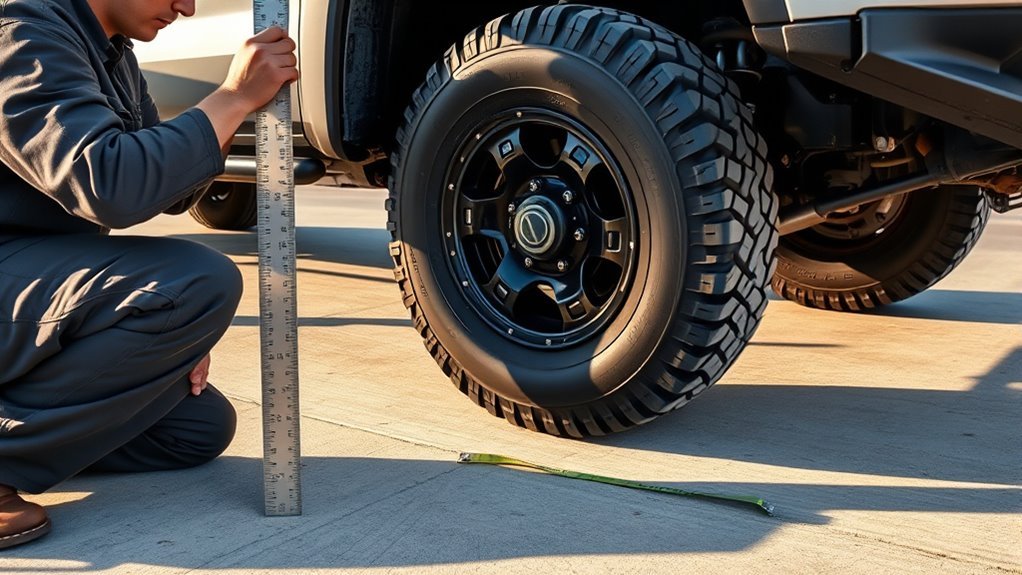
You’ll find Toyota quotes Tundra ground clearance as the minimum vertical distance from the lowest factory-mounted underbody point to the ground—about 10.4 in for SR/SR5 and up to 10.6 in for TRD Pro, with 2022 models ranging roughly 9.4–10.6 in depending on trim and measurement method. Reviewer measurements can differ by excluding skid plates or adding tire bulge. This number predicts obstacle clearance, and if you keep going you’ll see measurements, angles, and upgrade impacts.
Quick Answer: Tundra Ground Clearance and What It Means
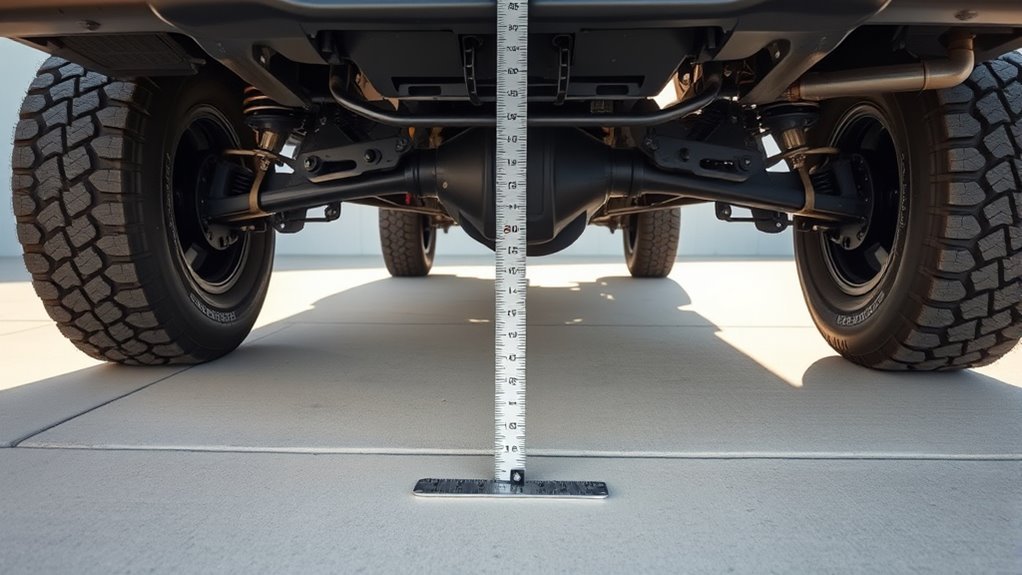
Ground clearance on the Toyota Tundra—typically about 10.4 inches depending on model and configuration—defines the minimum vertical distance between the truck’s lowest underbody point and the ground, and it directly determines how well you can clear rocks, logs, and uneven terrain without underside contact. You’ll use that baseline to judge ground clearance implications: a 10.4-inch figure reduces the chance of impact on moderate trails and supports confident routing over common obstacles, improving off road performance. You can elevate that baseline with lift kits or suspension changes when you need greater obstacle clearance or more aggressive angles. When you modify, measure front and rear pinch points, skid plate locations, and approach/departure angles to quantify gains. Keep in mind higher clearance can change center of gravity and steering geometry, so plan alignment and braking adjustments. In short, the Tundra’s stock clearance frees you for many routes, and targeted upgrades extend that freedom into harder terrain.
Tundra Stock Ground Clearance by Trim & Year
You’ll compare stock ground clearance across trims—from the SR’s ~10.4 in to TRD Pro’s ~10.6 in—and note how off-road packages (TRD Off‑Road/Pro) raise ride height. You’ll flag year-to-year shifts, especially the 2022 platform change that produced a wider 9.4–10.6 in spread. You’ll also explain measurement-method differences (manufacturer spec vs. curb measurement) since they affect reported values.
Trim-Level Ground Clearance
When comparing Tundra trims, you’ll find factory ground clearance generally ranges from about 10.4 inches on standard SR/SR5 models to roughly 10.6 inches on the TRD Pro, with TRD Off‑Road variants sitting between those figures; manufacturers sometimes tweak these numbers by model year as suspension and underbody designs evolve. You’ll use trim comparisons to identify clearance benefits relevant to your mission: SR/SR5 target everyday utility and lower ride height for stability, TRD Off‑Road balances approach/departure angles and articulation, TRD Pro maximizes obstacle negotiation. Knowing each trim’s stock clearance lets you choose the platform that best supports lift kits or aftermarket suspension upgrades without compromising load capacity, steering geometry, or legal compliance for off‑grid freedom.
Year-to-Year Variations
Although Tundra ground clearance is often quoted as a static spec, it actually varies by trim and model year—ranging roughly from 10.4 inches on base SR/SR5 models up to about 11.8 inches on TRD Pro—and these year-to-year changes affect off-road capability, approach/departure angles, and suspension tuning. You should use yearly comparisons to track how incremental redesigns and suspension calibrations shift clearance across trims. The 2022 redesign raised baseline clearance and altered geometry, improving obstacle negotiation and load stability. Lower SR/SR5 heights constrain off-road margin; TRD Pro maximizes it. Design impacts include altered tire-to-body relationships, revised spring rates, and changed underbody protection. Use exact year/trim specs when choosing a Tundra to guarantee the clearance meets your liberated objectives for terrain and modification potential.
Measurement Method Differences
Because manufacturers and reviewers don’t always use the same reference points, you’ll see small but important differences in reported Tundra ground clearance by trim and year. You need to understand two dominant measurement techniques: factory clearance standards that measure from the lowest factory-mounted point to the ground, and reviewer methods that may exclude skid plates or include tire bulge and dynamic ride height. The Tundra ranges roughly 9.1 inches on base trims to about 10.6 inches on TRD Off-Road/TRD Pro; 2022 models sit near 9.4 inches for most trims. When you compare model years, confirm which technique and which clearance standards were applied. That lets you choose, modify, or liberate your Tundra confidently for off-road use.
Why Approach and Departure Angles Matter for Your Tundra
If you plan to take your Tundra off-road, knowing its approach and departure angles lets you predict whether the nose or tail will strike terrain before tires lose contact. You’ll assess off road obstacles and terrain types to decide if a route is feasible without bottoming out. Approach angle defines the maximum incline you can climb before the front bumper or skid plate contacts an obstacle; departure angle defines the maximum decline you can exit without rear interference. Both are functions of bumper geometry, wheelbase and ground clearance; raising the truck with a lift kit increases those angles and reduces risk of damage. Understanding these parameters lets you choose modifications strategically and maintain mobility across varied terrain types while preserving vehicle integrity. Use angle data to plan lines, not guesswork: measure slopes, compare to factory or modified angles, and only commit when margins are sufficient. That disciplined approach frees you to push capability without sacrificing safety.
Measuring Ground Clearance: Step‑by‑Step
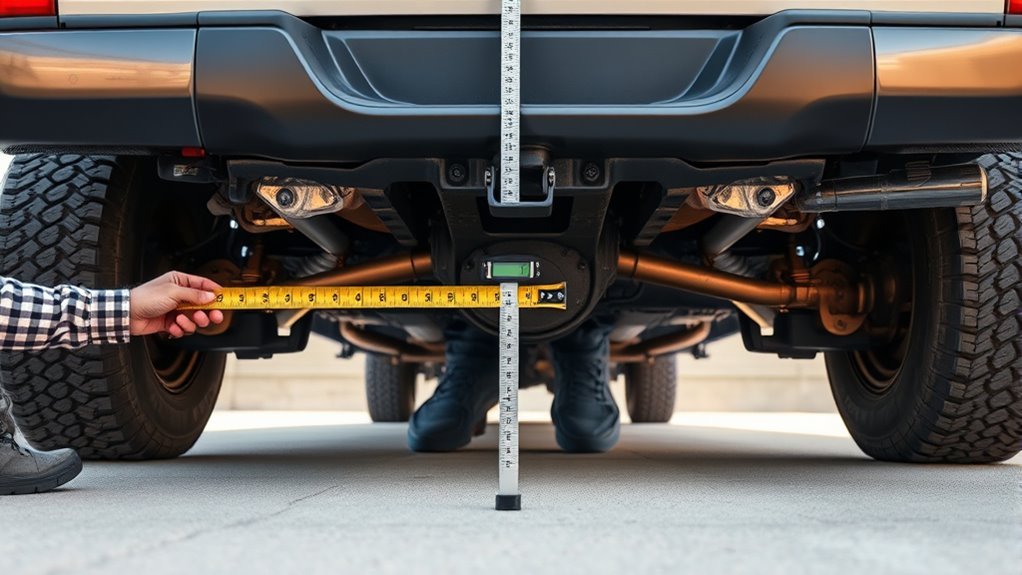
Knowing your Tundra’s approach and departure angles only tells part of the picture; ground clearance is the concrete number you’ll measure to predict underbody contact. You’ll work on a flat, level surface and locate the lowest point under the truck—often the differential or skid plate. Use simple measurement tools (ruler or tape) and keep the tape perpendicular to the ground to avoid parallax error. Record in inches or centimeters; higher values mean better obstacle negotiation. Check clearance after modifications like lifts, tires, or skid plates.
- Park on a verified flat surface and engage parking brake; confirm load reflects typical use.
- Identify the lowest underbody point visually and with a probing stick if needed.
- Place measurement tools vertically from ground to that point; read value where tool meets part.
- Log the measurement, note units, and recheck after any suspension or tire changes.
Regular checks liberate you from surprises—measure precisely, repeat, and act on deviations.
What Obstacles a Stock Tundra Can Clear (Real Examples)
With roughly 10.4 inches of ground clearance and approach/departure angles near 29°/24°, you can reliably traverse low curbs and medium-sized rocks—objects up to about 22 inches in height. You’ll also negotiate moderate driveway ramps and steep changes without bumper contact, and cross shallow streams or water up to roughly 2 feet deep. Use these baseline limits to assess logs and uneven trail features before committing to a line.
Low-Curb And Rock Traversal
One clear advantage of the stock Toyota Tundra is its roughly 10.4-inch ground clearance, which lets you clear common curbs and small rocks without underbody contact. You can plan routes knowing curb height and rock size limits: clearance supports obstacles up to ~13 inches. Use approach (≈29°) and departure (≈24°) angles to predict contact points on steep edges. Practical, liberating capability means you won’t be constrained by minor trail features.
- Curbs — typical urban curb height under control; approach angle prevents nose strikes.
- Small rocks — rock size up to ~6–8 inches handled without belly contact at slow speed.
- Larger root balls — manageable if centered and traversed at angle with momentum control.
- Trail ruts — clearance plus angles reduces rear and front scraping risk.
Moderate-Ramp And Driveway
Having covered curb and rock clearance, we’ll now examine how a stock Tundra handles moderate ramps and driveways. You’ll find its 10.6-inch ground clearance, 28° approach, and 24° departure provide reliable driveway navigation and ramp accessibility without underbody or bumper contact. In practice, the Tundra clears steep residential driveways, angled entry ramps, and moderate gravel inclines while maintaining tire contact and traction. You can approach slopes slowly, align wheels to minimize scraping, and descend with confidence given the departure angle. This balance of geometry and clearance suits mixed urban/off-road use, empowering independent movement across common obstacles.
| Parameter | Capability |
|---|---|
| Ground clearance | 10.6 in |
| Approach angle | 28° |
| Departure angle | 24° |
| Typical obstacles | Driveways, ramps |
Stream Crossings And Logs
A stock Toyota Tundra can reliably negotiate moderate stream crossings and fallen logs thanks to roughly 10.4 inches of ground clearance, a ~25° approach angle, and a ~23° departure angle, which together let you wade water up to about 28 inches (depending on bank slope) and pass timber up to roughly 14 inches in diameter without underbody contact.
You’ll use those specs for confident stream navigation and controlled log clearance. Assess bank slope, flow, and log orientation before committing. Maintain momentum entering water; avoid spinning wheels. Approach logs squarely when possible; use throttle modulation to lift over trunks. Keep tire pressures appropriate for grip and flotation. If unsure, scout on foot.
- Inspect bank slope and depth before entry.
- Enter streams at low RPM steady throttle.
- Align approach to logs; avoid angled strikes.
- Monitor underbody and recovery gear readiness.
How Lift Kits Change Clearance and Angles : Typical Gains
When you install a lift kit, expect ground clearance to rise roughly 2–6 inches, which directly reduces underbody contact and lets you clear larger obstacles like rocks and logs. You’ll gain lift kit benefits that translate to measurable off road performance: approach angle can improve up to ~10°, and departure angle often rises 5–8°. The raised ride height also shifts suspension geometry, helping distribute weight more effectively over uneven terrain and improving traction consistency.
| Parameter | Typical Gain |
|---|---|
| Ground clearance | 2–6 in |
| Approach angle | up to +10° |
| Departure angle | +5–8° |
| Obstacle clearance | larger rocks/logs |
| Weight distribution | improved on uneven ground |
You’ll use these gains to push farther, freer lines with less fear of belly hits. Apply this data when choosing a kit: match target gains to terrain and tire size to retain predictable handling and maximum liberation on technical trails.
Trade‑Offs of Lifting a Tundra: Stability, MPG, Suspension
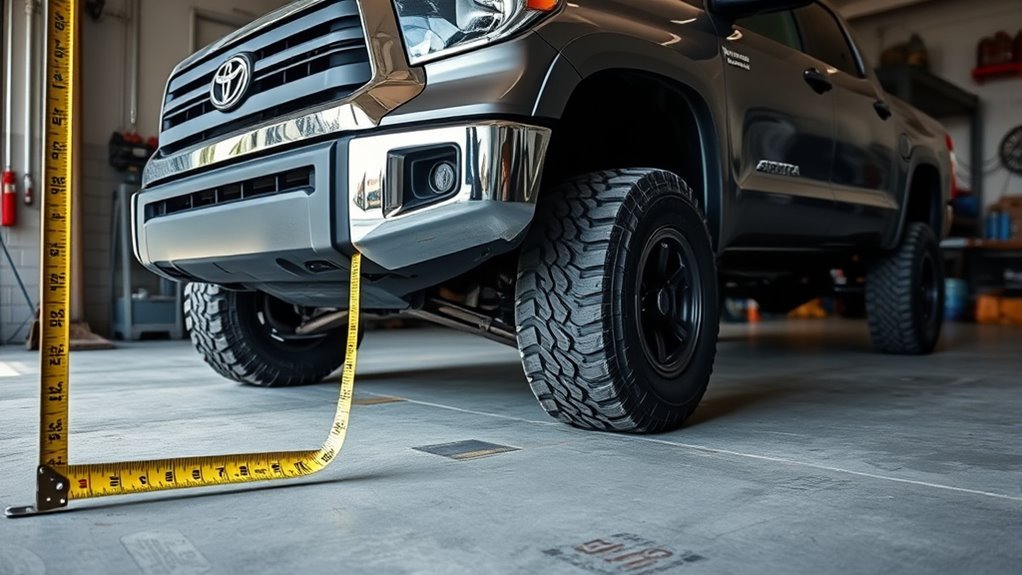
When you lift a Tundra you raise the center of gravity, so expect measurable changes in stability and cornering limits that may require revised driving inputs or roll-control upgrades. You’ll also see a quantifiable drop in MPG from larger tires and increased drag, which should be factored into range and fuel-cost calculations. Finally, upgraded suspension components and tuning are usually necessary to preserve ride quality and will alter wear patterns and maintenance intervals.
Stability And Handling
Although lifting your Tundra raises ground clearance and improves approach and departure angles for off‑road work, it also raises the center of gravity and alters suspension geometry, which can degrade high‑speed stability and steering response. You’ll confront clear stability concerns and altered handling dynamics that demand technical mitigation to retain control and freedom of movement.
- Recenter mass: lower heavy loads and use wheel/tire combinations that minimize unsprung weight to restore predictable roll characteristics.
- Recalibrate suspension: adjust spring rates, dampers, and anti‑roll bars to balance articulation with on‑road composure.
- Fine‑tune steering: correct alignment and steering ratio changes to recover crisp response in tight maneuvers.
- Test and iterate: perform controlled high‑speed and emergency maneuvers to validate setup before unrestricted driving.
Fuel Economy Impact
Because lifting a Tundra raises frontal area and adds rotating mass, you’ll usually see a measurable MPG penalty—commonly around 1–2 mpg for 2–6 inch lifts—driven by increased aerodynamic drag, higher rolling resistance from larger tires, and added drivetrain load. You should expect degraded fuel efficiency on highway and mixed driving: the aerodynamic impact scales with height and tire profile, increasing drag coefficient and reducing cruise economy. Weight and larger-diameter tires increase inertial losses and parasitic drivetrain drag, so acceleration and hill climbs consume more fuel. Balance your desire for off-road freedom against daily consumption: modest lifts and low-rolling-resistance tires minimize losses, while aggressive setups maximize them. Quantify trade-offs with before-and-after MPG logs to make an informed decision.
Suspension Wear And Tuning
Having covered how lifts hit fuel economy, let’s look at what they do to the suspension itself: raising a Tundra changes load paths and geometry, increasing stress on shocks, springs, control arms, bushings, and ball joints, which speeds wear and can alter handling.
You’ll need precise tuning to retain control and freedom on varied terrain. Address suspension geometry shifts, select components rated for added leverage, and confirm lift kit compatibility with steering and driveline angles. Consider adjustable shocks or struts and stiffer springs to restore damping and ride height control.
- Reindex suspension geometry: correct caster, camber, and toe to prevent rapid tire and joint wear.
- Upgrade damping: use adjustable shocks matched to lift height and load.
- Reinforce linkages: replace worn control arms and bushings.
- Validate lift kit compatibility with brakes, CVs, and steering.
Simple Checks to Measure Your Tundra at Home
When you measure your Tundra’s ground clearance at home, park it on a flat, level surface and use a tape measure to record the vertical distance from the ground to the lowest point of the chassis or frame; start at the designated lowest frame member and hold the tape perpendicular to the ground for consistent readings. Use simple home tools — tape measure, chalk or marker, a second person to steady the tape — to improve measurement accuracy. Take readings at multiple points along the underside: center, front and rear axles, and any low-mounted drivetrain components, then record each value. Compare your averaged result to the manufacturer spec (approximately 10.4 inches for standard models) to assess deviations. Note modifications like lift kits or worn suspension that will change clearance; log changes and dates. These checks give you an actionable baseline for freedom to modify or maintain your Tundra with confidence, ensuring your off-road intentions align with actual vehicle geometry.
Best Suspension and Tire Upgrades for More Clearance (Tundra‑Specific)
If you want measurable clearance gains for your Tundra, prioritize component choices that match your vehicle’s model year, intended tire size, and planned use: you’ll avoid fitment issues and compromise. Choose upgrades that deliver predictable, reversible results and preserve reliability.
Prioritize upgrades tailored to your Tundra’s year, tire size, and use—ensure fit, reversibility, and long-term reliability.
- Coilover kits optimized for Tundra frames — coilover benefits include up to ~3″ of controlled lift, improved damping, and precise ride-height repeatability for aggressive terrain.
- Lift kits engineered for Tundra suspension geometry — they raise approach/departure angles and maintain steering and driveline alignment when combined with correct components.
- 33–35″ all-terrain tires with aggressive tread — these increase clearance and enhance tire performance for traction, self-cleaning, and obstacle negotiation.
- Adjustable air suspension — gives on-demand raise/lower capability so you can lower for highway efficiency and raise for off-road clearance without permanent compromises.
Match tire diameter, wheel offset, and suspension travel; validate brake and speedometer calibration after any change.
Choosing the Right Clearance Setup for Your Off‑Road Needs
Because your off‑road goals dictate the hardware you need, pick a clearance setup that matches terrain, tire size, and expected impacts rather than chasing maximum lift. Start from the Tundra’s baseline ~10.4 inches ground clearance and define objective metrics: obstacle height, approach/departure angle targets, and required wheel travel. Use lift kit considerations to calculate net gain versus changes in center of gravity, driveline angles, and suspension geometry. Match tire diameter to wheel well and gearing to preserve performance. For heavy rock trails, target higher clearance and reinforced components; for desert or sand, prioritize suspension compliance and lower center of gravity. Verify terrain compatibility: rock, mud, sand, and trail each impose distinct clearance and protection needs. Factor in skid plates, differential drop kits, and brake line length. Finalize a setup that achieves your measured objectives while maintaining safe handling and legal compliance—liberate your Tundra to go farther without compromising control.
Frequently Asked Questions
What’s the Ground Clearance of a Toyota Tundra?
You’ll find Toyota Tundra ground clearance typically ranges from about 10.4 to 11.8 inches. You’ll use Tundra specifications to gauge Off road capabilities, and you can modify clearance with lift kits for bolder freedom.
How Is Ground Clearance Measured on a Truck?
You measure ground clearance by placing the truck on level ground and vertically measuring from the lowest chassis point to the ground; don’t worry about variability—account for suspension design, tire size, weight distribution to predict off road performance.
Conclusion
You’ve learned how to quantify Tundra ground clearance, why approach/departure angles matter, and the real-world obstacles a stock truck can handle. You’ve also seen how lifts, tires, and suspension upgrades change clearance—and their trade-offs for stability, fuel economy, and ride quality. Ready to pick a setup that balances off‑road capability with daily drivability? Use precise measurements, test clearances on typical terrain, and choose mods that meet your specific clearance and handling requirements.