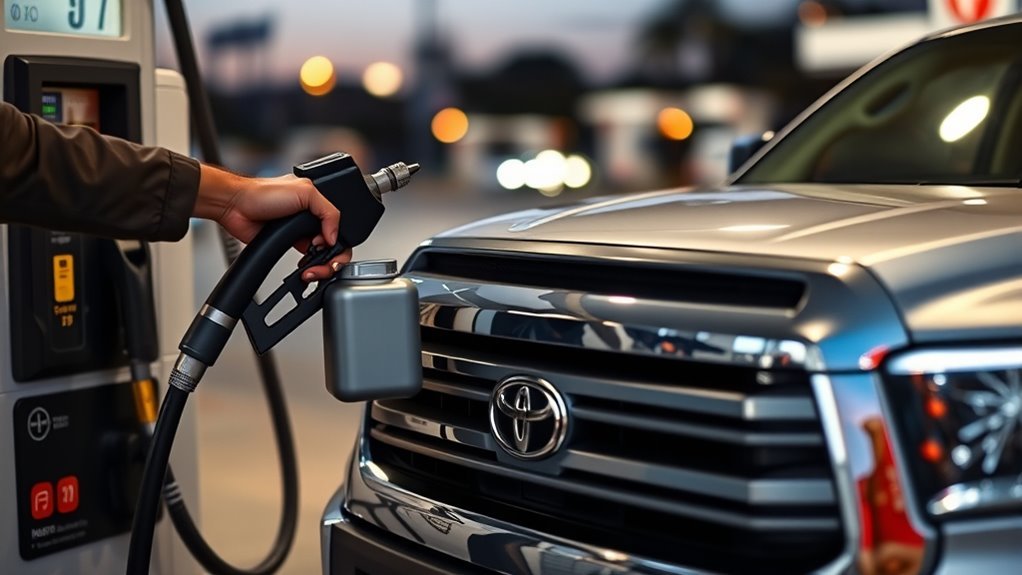
You should use 87 octane in most Toyota Tundra models because it supplies the required knock resistance for normal compression and delivers designed power, efficiency, and durability; using lower octane raises knock risk and wear. Higher octane (91–93) only helps under sustained high thermal loads, heavy towing, or confirmed knock diagnostics. Save money unless you experience pinging or test results show MPG or drivability gains, and continue for details on testing and maintenance.
Toyota’s Fuel Recommendation (Why 87 Octane)
Toyota recommends 87 octane for most Tundra models because that grade provides the required knock resistance for the engine’s compression ratio and calibration, delivering peak power, efficiency, and durability without the cost premium of higher-octane fuels. You’ll follow that guidance to preserve engine performance and fuel efficiency while avoiding unnecessary expense. Using lower octane risks detonation, which reduces power output, impairs combustion control, and shortens component life; the vehicle’s knock sensors and timing strategies can only compensate so much. Higher octane won’t materially improve output on standard Tundra engines because their design and ECU calibration don’t extract additional benefit. You should pair the correct fuel with routine maintenance—clean air and fuel filters, correct spark timing, and oil changes—to sustain performance and long-term reliability. Choosing 87 octane aligns economic freedom with technical prudence: you’ll avoid extra cost, maintain peak operation, and protect the engine’s longevity without sacrificing capability.
What Octane Numbers Actually Mean (87 Vs 91–93)
Now that you know why your Tundra runs on 87 octane, let’s look at what those numbers actually measure: octane rating quantifies a gasoline’s resistance to knock (premature detonation) under standardized test conditions. You should read octane as a knock-resistance metric, not a power guarantee. For an engine calibrated to 87 octane, like most Tundras, the combustion timing, compression, and ignition advance are set so higher octane yields no extra power.
- 87 octane: engineered balance for typical compression; maintains reliable octane performance and expected fuel efficiency.
- 89–90 (mid-grade): marginally greater knock resistance; usually unnecessary for Tundra calibration.
- 91–93 (premium): formulated for high-compression, high-boost engines; offers no additive power in an 87-tuned Tundra.
- Below 87: raises risk of knock, degrades performance, and reduces fuel efficiency; avoid compromise.
Choose fuel to match engine design; liberation here is using only what delivers consistent, efficient operation.
When Premium Helps a Tundra: Symptoms & Use Cases
If you tow heavy loads, climb steep grades, or run an older/high‑mileage Tundra that’s showing knock or sluggish throttle response, try 93 octane; the higher knock resistance can smooth combustion and reduce pinging under sustained load. You’ll notice tangible performance improvement when the engine is under stress: reduced detonation, crisper throttle, and steadier power delivery. Use 93 octane selectively—during long climbs, full‑payload runs, or when diagnostics show timing retard or knock events. For modified Tundras with increased compression or boost, premium often mitigates transient knock that 87 octane can’t. Older engines can regain efficiency as cleaner combustion from premium helps reduce carbon build‑up, potentially improving fuel economy over time. Evaluate benefits against roughly $9 extra per fill-up; choose premium when your mission prioritizes towing efficiency, engine longevity, and consistent performance. Don’t treat premium as routine unless you regularly impose high thermal and mechanical loads that exceed what regular fuel can manage.
Should You Pay for Premium? A Quick Decision Rule
If your Tundra shows no knock and runs normally, you don’t need premium—stick with 87 octane. Compare the per-fill cost differential (about $9) against any measurable performance gain from controlled tests; most owners report negligible improvement. Quick rule: only pay for premium if you detect consistent knock or a clear, repeatable efficiency/power increase in your own trials.
When Premium Helps
Although premium fuel can reduce knocking in high-compression or heavily loaded engines, you shouldn’t pay extra on principle—use it only when your engine or tuning requires the higher 91–94 octane resistance. You want clear guidance: choose premium only if your engine performance suffers or your engine is explicitly tuned or specified for higher octane. Most Toyota Tundras and regular engines show no measurable gains with premium; regular fuel keeps them efficient and reliable. Older or modified engines tuned for higher boost or advanced timing can benefit, reducing knock and protecting components. Use this practical decision rule to reclaim control over fuel choices and expenses.
- Check manufacturer specification first.
- Monitor knock or ping under load.
- Consider ECU tune or modifications.
- Avoid habitual premium use.
Cost Versus Benefit
You’ve seen when premium helps; now weigh that against cost to decide if it’s worth paying for higher octane. Do a simple cost analysis: 93 octane typically adds about $9 per fill-up versus 87. Compare that incremental expense to measured performance expectations for your Tundra. The truck is engineered to run efficiently on 87; real-world gains from 93 are usually marginal—slightly smoother operation or minute power upticks in experimental conditions, not consistent, measurable returns for daily use. If you seek liberation from wasteful spending, prioritize fuel choices that align with factory tuning and documented efficiency. Pay extra only when specific conditions or diagnostics show tangible benefits; otherwise, the added cost rarely justifies the modest, uncertain performance upside.
Quick Practical Rule
Start with this simple rule: stick with 87 octane for everyday driving unless you observe knocking, get a dealer or scan-tool recommendation for higher octane, or you’re testing performance gains that clearly offset the roughly $9 per fill-up premium. You conserve resources and retain control by defaulting to regular fuel; premium rarely improves power or economy in a naturally aspirated Tundra. Only escalate when diagnostics, sustained knock, or controlled experiments with consistent driving habits prove benefit.
- Monitor for knock, then verify with a scan tool or dealer guidance.
- Log mileage and cost during fuel-additives or octane trials.
- Prioritize maintenance before octane changes; tune matters more.
- If premium shows clear, repeatable gains, adopt selectively.
Risks, Costs, and What Wrong Octane Does to Your Tundra
If you run lower-than-recommended octane in your Tundra, you risk engine knock that can damage pistons, bearings, and sensors over time. That misuse also lowers power and fuel economy, and can trigger the check engine light requiring diagnostics. We’ll quantify repair/maintenance exposures versus the modest added cost of top-tier fuel so you can make an evidence-based choice.
Engine Knock Damage
Although modern Tundra engines use knock sensors and timing adjustments to compensate, running lower-than-recommended octane still causes pre-ignition and knock that stress pistons, bearings, and valves; over time this increases wear, reduces fuel efficiency, and can lead to costly repairs such as piston damage, bent valves, or failed head gaskets. You rely on knock detection to alert the ECU, but detection only mitigates—doesn’t eliminate—mechanical shock from repeated detonation. If you want liberation from unexpected repairs, use the specified octane to preserve engine longevity and maintain predictable performance. Ignoring octane specifications trades short-term savings for long-term component failure risk.
- Persistent knock accelerates fatigue in pistons and bearings
- Pre-ignition scars cylinder walls
- Valve seating and guides wear faster
- Head gasket integrity degrades
Fuel Economy Impact
Beyond mechanical wear from knock, the octane you choose directly affects how your Tundra uses fuel and what you pay at the pump. You’ll see that 87 octane is OEM-specified; lower octane risks knock, reduced efficiency, and lost fuel savings. Tests show 93 rarely boosts mpg or power for most Tundra setups, so paying ~ $9 extra per fill-up often isn’t justified. Consistent wrong-octane use stresses components and can degrade economy over time. Track fuel economy across fills to quantify effects and reject octane myths. Liberate yourself with data: measure, compare, decide.
| Scenario | Fuel Used | Expected Outcome |
|---|---|---|
| OEM | 87 | Best economy |
| Premium | 93 | Minimal change |
| Low | <87 | Knock, lower mpg |
Repair And Maintenance
Because your Tundra’s engine is calibrated for 87 octane, running lower-grade fuel raises the likelihood of knock and pre‑ignition, which stresses pistons, bearings, and knock sensors and can accelerate wear or cause premature component failure. You’ll see reduced fuel efficiency, degraded performance, and mounting repair bills if you ignore fuel quality. Monitor knock codes and periodic compression tests; address abnormal sounds immediately to protect engine longevity. Use recommended octane to preserve your freedom to drive without expensive maintenance.
- Chronic knock can warp pistons and damage bearings.
- Repeated pre‑ignition raises head gasket and valve failure risk.
- Lower fuel quality often means poorer combustion and economy.
- Timely diagnostics and proper fuel choice limit repair costs.
Choose correct octane to reclaim control.
How to Test Higher-Octane Fuel in Your Tundra (Step‑by‑Step)
Start by filling your Tundra’s tank with 93 octane and reset the trip computer so you have a precise baseline (current MPG: 12.5). For rigorous fuel testing, record trip start fuel level, odometer, and ambient conditions. Drive a representative mix of city and highway routes; maintain consistent loads and speeds to isolate variables affecting engine performance. After three to five fill-ups with 93, log MPG, throttle response times, and any audible knock or misfire. Compare these metrics to prior runs on 87 octane: calculate percent change in MPG and note qualitative shifts in acceleration smoothness. If you detect reduced knock and a measurable MPG improvement, the higher octane yields net benefit; if differences are negligible, revert to manufacturer-recommended octane. Preserve your data in a simple spreadsheet with timestamps and conditions so you can reclaim control over fuel choice decisions. This methodical, repeatable approach frees you from guesswork and grounds decisions in empirical results.
Tundra Maintenance & Tuning to Avoid Knock and Maximize MPG
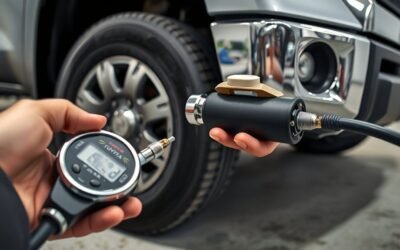
If you want to prevent knock and get the best MPG from your Tundra, prioritize routine maintenance and targeted tuning: You’ll keep the stock engine calibration optimized for 87 octane while minimizing detonation risk and waste. Follow maintenance tips like on‑schedule oil changes and fresh air filters to maintain combustion stability. Monitor tire pressure and alignment to reduce rolling resistance and engine load. Use community feedback to evaluate sensible tuning options—avoid aggressive timing advances or unnecessary octane changes that the ECU won’t exploit.
- Change oil and air filter per Toyota intervals to reduce deposits and knock risk.
- Keep tires inflated and aligned to maximize MPG and lower engine strain.
- Consult the Tundra community for verified tuning options that respect factory maps.
- Avoid routine use of 93 octane unless diagnostics show persistent knock corrected only by higher octane.
You’ll protect engine longevity, sustain efficiency, and retain freedom from costly, ineffective modifications.
Frequently Asked Questions
What Octane Gas Does a Toyota Tundra Take?
You should use 87 octane; it preserves Tundra performance and maximizes fuel efficiency. Don’t waste money on 93 unless manufacturer specifies otherwise, and maintain proper service to keep power, efficiency, and long-term freedom.
Should I Put Premium Gas in My 2025 Toyota Tundra?
No — you won’t summon rocket power: premium gas benefits are minimal for your 2025 Tundra, and it won’t improve engine performance noticeably. You’ll pay more; stick with 87 octane for efficient, liberated driving.
What’s the Benefit of Using High Octane Gas on a Toyota?
You’ll rarely gain noticeable engine performance or fuel efficiency using high octane in a Toyota; modern engines prevent knocking, so any improvements are minimal, costly, and don’t justify deviating from the manufacturer’s recommended 87 octane.
Is It Better to Use 87 or 89 Gas?
Use 87; don’t worship premium. You’ll preserve fuel efficiency and intended engine performance, avoid needless cost, and liberate yourself from overpaying for marginal or nonexistent gains—87 matches design, 89 rarely improves results.
Conclusion
So your Tundra says 87’s fine — and no, it won’t spontaneously morph into a pricey, high‑octane diva. Use 91–93 only if you hear knock, run forced induction, or the ECU tells you to, otherwise you’re flushing money for a placebo. Avoid detonation with proper maintenance and correct timing, not octane fetishism. Run the recommended fuel, monitor symptoms, and only upgrade for measurable performance or knock mitigation — not to impress the gas station crowd.