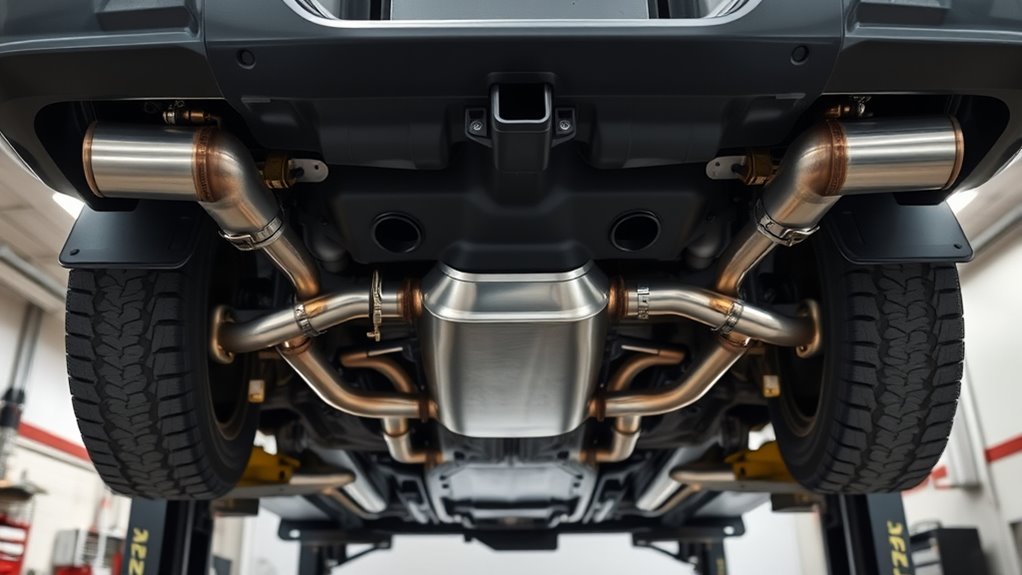
You’ll learn which Tundra exhaust parts change sound, durability, and cost so you can pick the right setup. Choose mufflers (chambered, straight‑through, turbo) for tone and flow; pick packing (fiberglass or stainless wool) for decay and longevity; and select materials (409 vs 304 stainless) for corrosion resistance and lifespan. Exit layout (single, dual, mid‑side) alters cabin and external noise. Prices run from ≈$500 to $800+, and the next sections cover fitment, installation, and maintenance details.
What This Guide Covers : Quick Tundra Exhaust Answer
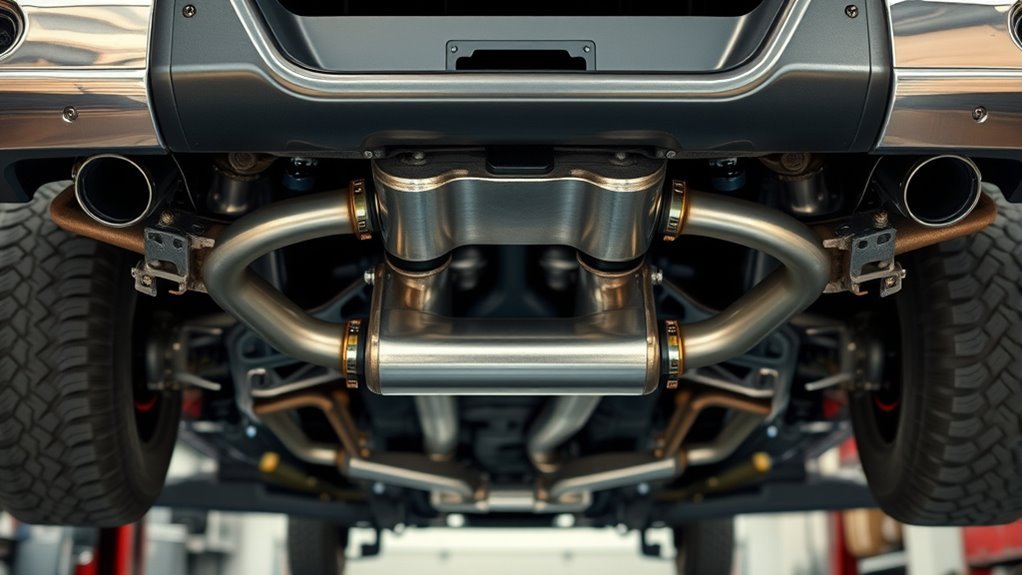
This guide gives you a concise overview of exhaust options for the 5.7L Toyota Tundra, covering sound levels (mild to loud), common materials (aluminized, 409 and 304 stainless), typical exit configurations (middle, single, dual side), and expected pricing ranges tied to material and design. You’ll get a direct frame for exhaust performance: mild systems (≈2/5) like Flowmaster FlowFX prioritize low drone and street manners; loud systems (≈4/5) such as Carven maximize volume and aggression. Material choices trade cost for longevity—aluminized is economical, 409 stainless resists rust better, 304 stainless endures harsh climates. Configuration affects tone, backpressure, and installation complexity: middle, single, and dual side exits change routing and tip placement. Expect entry single-side setups near $500, 409 stainless ≈ $700, and 304 stainless starting ≈ $800. You’ll also find clear installation tips for hanger alignment, gasket torque, and weld-vs-clamp decisions so you can choose and fit a system that frees your driving experience.
Tundra Mufflers: Types, Internals, and How They Shape Sound
You’ll choose between straight-through and chambered muffler constructions to set baseline flow and resonance. Pay attention to internal packing materials—fiberglass or steel wool dampens highs while lighter or missing packing raises volume. Muffler size and internals together determine tone and can affect exhaust flow and engine efficiency.
Muffler Construction Types
When choosing a muffler for your Tundra, understand that chambered, straight-through, and turbo designs each shape sound and flow in distinct ways. You’ll evaluate muffler design for trade-offs: chambered units use baffles to create a deep, throaty tone; straight-through cores use perforated tubes for minimal restriction and maximum sound amplification and power gains; turbo styles blend both, keeping low-speed quiet yet delivering a growl under load. Pick the one that releases your vehicle’s character and performance without compromise.
| Emotion | Reaction |
|---|---|
| Liberation | Roaring control |
| Confidence | Tuned performance |
| Pride | Distinctive tone |
| Resolve | Mechanical clarity |
| Joy | Released drive |
Internal Packing Materials
After picking a muffler type that matches the tone and flow you want, internal packing becomes the next performance variable to evaluate: materials like fiberglass or stainless steel wool absorb and dissipate sound energy differently, altering both in-cabin quietness and the aggressiveness of the exhaust note under load. You’ll choose packing to balance muffler performance and durability: fiberglass offers high initial acoustic absorption and packing efficiency, while stainless steel wool resists breakdown and maintains characteristics longer. Less packing yields a more pronounced note and freer flow, favored if you prioritize audible authority during acceleration. More dense, high-quality packing tames cabin noise at cruise without killing character under load. Select materials that free you from constant maintenance while meeting your sound and longevity goals.
Muffler Impact On Tone
Mufflers are a primary determinant of your Tundra’s exhaust character, with design choices—chambered vs straight-through, packed vs unpacked, and internal baffle geometry—directly controlling sound pressure, resonance, and perceived loudness. You’ll choose based on intended presence: straight-through designs (e.g., Flowmaster FlowFX) reduce restriction and elevate volume during throttle, producing aggressive harmonics and pronounced muffler resonance. Packed mufflers use noise-dampening material to attenuate mid/high frequencies, preserving a controlled cabin while still communicating power under acceleration. Unpacked, smaller units (as with some Carven setups) leave frequencies exposed, maximizing external projection for attention-seeking drivers. Match component selection to your sound preferences and lifestyle: prioritize quieter, refined operation for daily freedom or opt for open-flow units when you want liberated, assertive tone and track-ready feedback.
409 Vs 304 Stainless: Corrosion, Durability, and Cost
You’ll compare 304 and 409 stainless by looking at corrosion resistance, noting 304’s higher chromium and nickel content gives it markedly better protection in harsh conditions. Then assess long-term durability: 304 holds finish and structural integrity longer while 409 can develop surface rust despite being tougher than plain steel. Finally, weigh cost versus value—304 systems typically start near $800 versus about $700 for 409, so you’ll decide if the extended life and appearance justify the premium.
Corrosion Resistance Comparison
While both 409 and 304 stainless steels are common in Tundra exhausts, 304 delivers noticeably better corrosion resistance and longer service life due to its higher chromium and nickel content. You’ll choose exhaust materials knowing 304 resists rust in harsh environments, so you spend less time on maintenance tips and reactive repairs. 409 offers a cost advantage (around $700) and beats aluminized steel on baseline durability, but it’s prone to surface rust over time. 304 starts near $800, reflecting superior alloying and sustained appearance. If you want freedom from frequent replacements, 304 reduces interventions and corrosion-driven failures. Make choices that liberate you from upkeep: accept slightly higher initial cost for reduced long-term exposure to rust and expense.
Long-Term Durability Differences
Because 304 stainless contains higher chromium and nickel, it resists pitting and surface oxidation far better than 409, so you’ll see fewer rust spots and less structural degradation over the truck’s service life. You’ll get improved exhaust longevity and lower upkeep—304 keeps a polished look and structural integrity longer, especially in harsh climates. 409 is durable but may show surface rust and requires more attention.
| Property | Effect |
|---|---|
| Corrosion resistance | 304 superior |
| Durability | 304 maintains structure longer |
| Maintenance | 304 needs less |
| Environmental tolerance | 304 better in salt/wet climates |
| Service lifespan | 304 often outlasts 409 |
This material comparison frames 304 as the liberating choice for long-term reliability and reduced intervention.
Cost And Value Tradeoffs
When weighing cost versus long-term value, consider that 409 stainless systems start around $700 and give reasonable rust resistance, while 304 systems begin near $800 and deliver superior corrosion protection and longevity due to higher chromium and nickel content. You’ll choose 409 if initial budget and basic durability matter; you’ll pick 304 if you want a longer-lasting, polished finish that resists harsh environments. For liberation-minded owners, that extra $100 is an investment in fewer replacements and cleaner resale. If you pursue performance upgrades, factor material choice into thermal and backpressure behavior. Follow installation tips: maintain proper hangers, avoid stress points, and use high-temp clamps or welds to preserve seals. The decision is a pragmatic tradeoff between upfront cost and lifecycle value.
Tundra Exhaust Configurations: Single, Dual, and Mid‑Side Exits
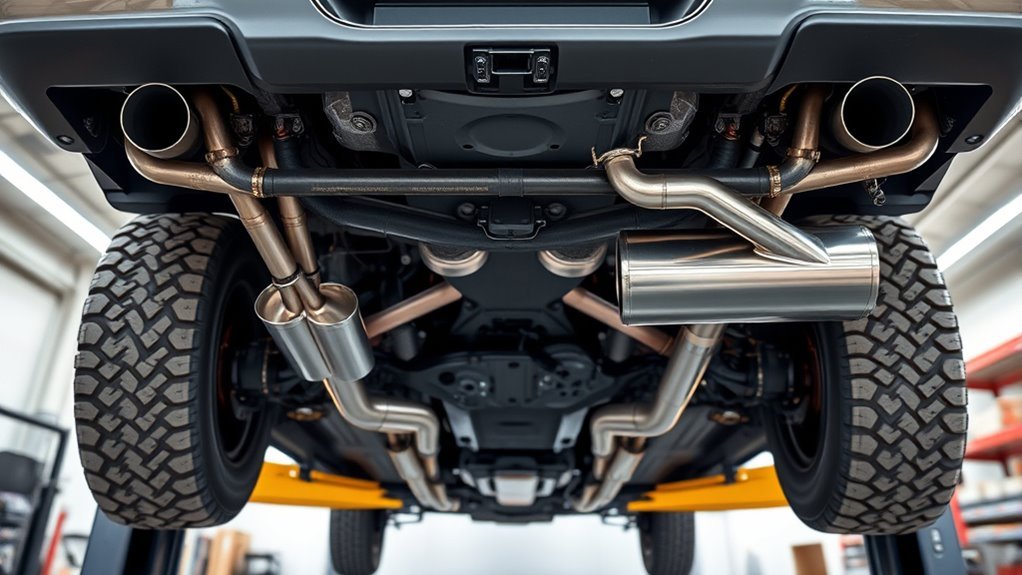
Choosing the right Tundra exhaust configuration—single side, dual side, or mid‑side—means balancing sound, appearance, cost, and off‑road durability to match how you use the truck. You’ll weigh performance enhancement and sound customization against budget and practical needs. Single side exits mirror factory setups: quieter, cost-effective (around $500), and straightforward to install; they suit drivers seeking subtle aesthetic upgrades and predictable NVH. Dual side exits amplify tone and visual impact, delivering a louder, more aggressive note and a bolder stance; expect higher cost and a more complex installation. Mid‑side exits provide a sporty, protected routing that reduces risk of damage off road and appeals to liberated drivers who push terrain limits; they can raise interior sound due to proximity to the cab. Use available sound clips to audition each option before committing. For any choice, follow installation tips: verify fitment, use quality gaskets/hardware, and torque to spec to guarantee longevity and proper performance.
Configuration Impacts on Cabin and Exterior Noise
You’ll notice cabin noise increases noticeably with mid‑side exit layouts because the outlet sits closer to the cab, raising interior sound pressure levels. Exterior sound projection also changes by configuration: single side exits yield a more controlled footprint while dual side exits project a louder, more aggressive signature. Use available sound clips to compare exit‑location effects and pick the balance of interior quiet versus exterior presence that matches your driving needs.
Cabin Noise Increase
Because exhaust outlet placement changes how sound routes into the cabin, you should expect different interior noise levels from each configuration: middle side exits, being closest to the cab, transmit more sound and rate highest on loudness meters; dual side exits increase overall flow and produce a louder, more aggressive note; while single side exits generally yield the quietest cabin for daily driving, though exact levels depend on muffler design and tuning.
- Middle-side: highest cabin intrusion; direct sound coupling increases perceived volume.
- Dual-side: enhanced exhaust flow raises mid/high-frequency content and aggressive tone.
- Single-side: lower cabin levels; better for commuting and focused concentration.
- Tuning/muffler: final authority on sound perception and usable comfort.
Choose configuration to match your liberation through controlled sound.
Exterior Sound Projection
While the exhaust layout won’t change engine output, it directly shapes how sound projects both into the cabin and into the surrounding environment: you’ll perceive clear differences in interior and exterior signatures based on configuration. A middle side exit routes pulses close to the cab, increasing cabin sound due to direct coupling and pronounced exhaust resonance effects; expect higher interior SPL and richer low-frequency presence. Single side exits attenuate energy toward the cabin, producing a quieter, controlled note while still revealing sound frequency variations during load shifts. Dual side systems split flow, increasing external radiation and street presence by reinforcing mid-to-high frequencies and broadening the spectral output. Choose configuration deliberately—you’re balancing personal comfort, public impact, and liberated expression through acoustic design.
Exit Location Effects
When you choose an exit location, it materially changes how noise reaches both the cabin and the outside world. You’ll assess exit sound dynamics and aesthetic considerations together: location alters interior levels, exterior projection, and perceived personality. Use sound clips to compare configurations before committing.
- Middle side exit: closer to the cab, increases interior noise during acceleration and cruise; vivid, intrusive midrange.
- Single side exit: routes exhaust away, yields quieter cabin and lower overall levels; conservative, stealthy aesthetic.
- Dual side exit: enables freer flow, higher exhaust volume and a more aggressive profile; bold, liberated stance.
- Selection trade-offs: balance cabin comfort, exterior projection, legal limits, and visual style to match your intent.
Pick the Right Sound for Your Tundra: Mild, Medium, Loud
Curious which exhaust tone matches your Tundra’s personality and use? You’ll choose between mild, medium, and loud based on sound preferences and exhaust aesthetics. Mild setups (Flowmaster FlowFX Dual) rate 2/5: they keep the cabin quiet, reveal a restrained note under acceleration, and suit daily-driving freedom without drawing attention. Medium systems (Rough Country Dual) rate 3/5: they deliver an assertive street presence, balance interior comfort with exterior character, and fit drivers who want audible feedback without constant intrusion. Loud options (Carven Single Side Exit) rate 4/5: they produce a pronounced note that commands attention and underscores a liberated, expressive stance. When selecting, weigh noise tolerance, local regulations, and the behavioral shift in perceived vehicle character—each level alters how you and others experience the truck. Pick the level that aligns with your desire for presence versus discretion; the right sound amplifies your Tundra’s role rather than merely increasing volume.
Tundra Exhaust Tips: Styles, Materials, and Visual Impact
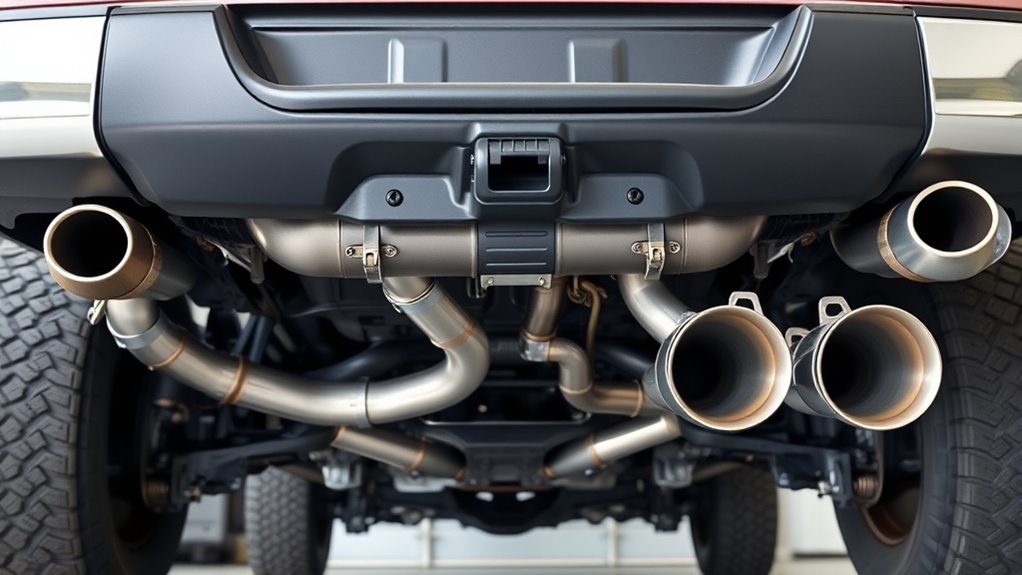
Although a simple bolt-on, an exhaust tip changes both the look and acoustic behavior of your Tundra, so choose deliberately: you control exhaust aesthetics and can gain a modest performance enhancement. Tips come in single, dual, and angled designs; each alters backpressure and tone while defining visual posture. Materials and finishes matter for durability and appearance.
- Styles — single for subtlety, dual for aggression, angled for flow-directed visuals and sound.
- Materials — stainless steel variants resist corrosion; 304 stainless polishes cleaner and lasts longer than basic grades.
- Finishes — chrome or black options let you match or contrast body color, asserting individual freedom over factory restraint.
- Function — a precision-fit, high-quality tip refines exhaust flow slightly, contributing to performance enhancement and a sharper exit velocity.
You’ll pick a tip that balances form and function, freeing your Tundra’s expression without unnecessary compromise.
Cost & Longevity: Price Ranges for 409 Vs 304 Systems
Because you’ll pay for what you get, choose 409 or 304 stainless based on your budget and service environment: 409 systems typically cost around $700, delivering a pragmatic balance of durability and affordability, while 304 systems start near $800, reflecting higher corrosion resistance and longer visual life. You’ll accept modest surface rust with 409 over years, yet it outperforms aluminized steel; 304 resists rust in salt, humidity, and extreme climates, so the upfront premium often returns through extended service life.
When you plan performance upgrades, factor material longevity into total cost of ownership: cheaper 409 lets you allocate funds to tuning or muffler changes, whereas 304 reduces replacement frequency. For installation tips, prioritize secure hangers and corrosion-resistant clamps regardless of alloy, and document welds for future inspection. If you seek liberation from recurring maintenance, invest in 304; if you need cost-effective functionality now, 409 is a defensible choice.
Fitment & Installation by Tundra Generation (What to Check)
Fitment starts with your Tundra’s generation—each model year can change hanger locations, frame clearance, and outlet placement, so confirm exact compatibility before buying. You’ll verify Exhaust compatibility with your specific year, checking mounting points, hanger positions, and clearance to avoid interference with suspension or bed components. Confirm exit style—single, dual, or mid—so it matches body design and use.
- Inspect hanger alignment and frame brackets against your Tundra’s factory points.
- Match outlet placement (side vs. rear) to avoid bumper or step overlap.
- Determine required labor: bolt-on, clamp-fit, or welded; choose accordingly.
- Review generation-specific sound clips and install guides for expected tone and routing.
Prepare correct Installation tools—ratchets, torque wrench, penetrant, and welding gear if needed. If you want freedom from unexpected mods, pick a system engineered for your generation and plan for potential minor bracket fabrication.
Final Checklist: Choose Based on Lifestyle, Budget, and Rust Resistance
When choosing a Tundra exhaust, weigh your daily needs, budget, and corrosion risk to make a targeted selection: pick a milder, quieter setup if you commute daily or want cabin comfort, or a louder, freer-flowing layout for off-road and performance use. Decide by lifestyle: commute-focused drivers favor single-side exits and 409 stainless for cost-efficiency; adventurers pick 304 stainless for rust resistance and louder tone. Balance budget: 409 systems ~ $700, 304 starts ~ $800. Factor aesthetics and installation complexity; middle-side exits increase interior noise. Maintain liberation: choose what frees you to drive how you want.
| Consideration | Recommendation |
|---|---|
| Lifestyle | Commute vs off-road |
| Material | 409 (cost) / 304 (rust resistance) |
| Sound | Mild (single-side) / Loud (middle-side) |
| Budget | $700 (409) / $800+ (304) |
| Care | Follow exhaust maintenance tips; plan performance upgrades |
Follow this checklist, plan upgrades, and schedule routine maintenance for durable results.
Frequently Asked Questions
What Components Are Parts of the Exhaust System?
You get manifold, catalytic converter, muffler and exhaust pipes; they’ll control exhaust noise, emissions and flow, and enable a performance upgrade when swapped or tuned, freeing you to optimize sound, efficiency and driving liberty.
What Are the Components of the Exhaust Section?
You’ve got manifold, catalytic converter, muffler, resonator and exhaust pipes; they manage exhaust flow, cut emissions and provide sound enhancement. You’ll choose configurations that free performance, optimize flow and amplify the ride’s voice.
What Is the Most Common Problem of the Exhaust System?
Rust and corrosion are the most common problem; they cause exhaust leaks that reduce engine efficiency and compromise noise reduction. You’ll inspect joints, hangers, and catalytic function regularly to maintain performance and freedom on the road.
What Is Included in a Full Exhaust System?
A full exhaust system includes headers, mid-pipes (X/H-pipes), mufflers and tailpipes; you’ll get improved exhaust sound and a measurable performance upgrade, freeing your truck’s power while you control tone and flow.
Conclusion
You’ll pick an exhaust by balancing sound, weight, and rust resistance — because nothing says “I love off‑road freedom” like worrying about corrosion on your driveway. Choose 304 if you want long life and less noise drift; 409 if you want cheap, loud, and replaceable tattoos on your frame. Match muffler internals and exit layout to cabin comfort goals, then verify fitment for your Tundra generation before you spend anything.