
Last updated: July 31, 2026 · Rechecked against Toyota’s 2016 and 2023 specifications, EPA ratings, and fourth-generation powertrain information.
For a used 2016–2023 Toyota Tacoma, the 3.5L V6 is the better engine for most buyers. It produces 278 horsepower and can tow up to 6,800 pounds in a properly configured 2023 4×2 model. The extra power is useful for highway merging, hills, passengers, cargo, and trailers. The 2.7L inline 4-cylinder is the better fit mainly for light local driving, basic work-truck use, and shoppers who find a meaningfully cheaper or better-maintained truck.
The MPG difference is smaller than many buyers expect. Comparable 2023 automatic 2WD versions of both engines are EPA-rated at 21 mpg combined, while comparable 4WD automatic versions are rated at 20 mpg combined. Payload is also configuration-specific: Toyota lists up to 1,685 pounds for select 2023 Access Cab 4×2 versions with either engine. Verify the exact model year, cab, bed, drivetrain, and door-jamb load label before buying.
Quick Answer
Choose the V6 Tacoma if you tow, drive on highways or hills, carry passengers or cargo regularly, or want broader trim availability. Choose the 4-cylinder when use will stay light, towing is rare, and the specific truck wins on price, condition, or service history. Do not choose by engine badge alone: towing and payload vary by cab, bed, drivetrain, transmission, and installed equipment. The figures below use the 2023 model as a final-year benchmark for the 2016–2023 generation.
Key Takeaways
- Toyota rates the 2.7L inline-four at 159 hp and 180 lb-ft of torque.
- Toyota rates the 3.5L V6 at 278 hp and 265 lb-ft, giving it 119 more horsepower and 85 more lb-ft.
- For 2023, the four-cylinder automatic is rated to tow up to 3,500 pounds. V6 automatic ratings reach 6,800 pounds in select 4×2 configurations and 6,500 pounds in select 4×4 configurations.
- Comparable 2023 automatic models have the same EPA combined MPG rating when drivetrain is matched.
- A V6 does not automatically have a higher payload rating. Select 2023 Access Cab 4×2 configurations with either engine are listed at up to 1,685 pounds.
- Condition, maintenance history, cab, trim, drivetrain, modifications, and installed towing equipment can matter as much as the engine.
- The older V6-versus-2.7L comparison does not apply to the redesigned fourth-generation Tacoma powertrains introduced for 2024.
In This Guide
Editorial method: This is a document-based used-truck comparison built from Toyota specifications, EPA fuel-economy data, Toyota maintenance information, and NHTSA recall tools. It does not claim instrumented acceleration, towing, or long-term durability testing.
Toyota Tacoma V6 vs. 4-Cylinder at a Glance
This table uses official 2023 specifications as a final-year benchmark. Availability and ratings can differ across the 2016–2023 model years and individual configurations.
| Category | 2.7L Inline 4-Cylinder | 3.5L V6 |
|---|---|---|
| Horsepower | 159 hp | 278 hp |
| Torque | 180 lb-ft | 265 lb-ft |
| 2023 transmission | 6-speed automatic | 6-speed automatic; 6-speed manual on select models |
| 2023 maximum towing rating | Up to 3,500 lb in listed 4×2 and 4×4 automatic configurations | Up to 6,800 lb in select 4×2 automatic configurations; up to 6,500 lb in select 4×4 automatic configurations |
| 2023 maximum listed payload | Up to 1,685 lb in select Access Cab 4×2 configurations | Up to 1,685 lb in select Access Cab 4×2 configurations |
| 2023 EPA combined MPG, 2WD automatic | 21 mpg | 21 mpg |
| 2023 EPA combined MPG, 4WD automatic | 20 mpg | 20 mpg |
| Typical fit | Local driving, basic work use, light loads | Highways, hills, towing, passengers, cargo, off-road builds |
Understanding the Toyota Tacoma Engine Options

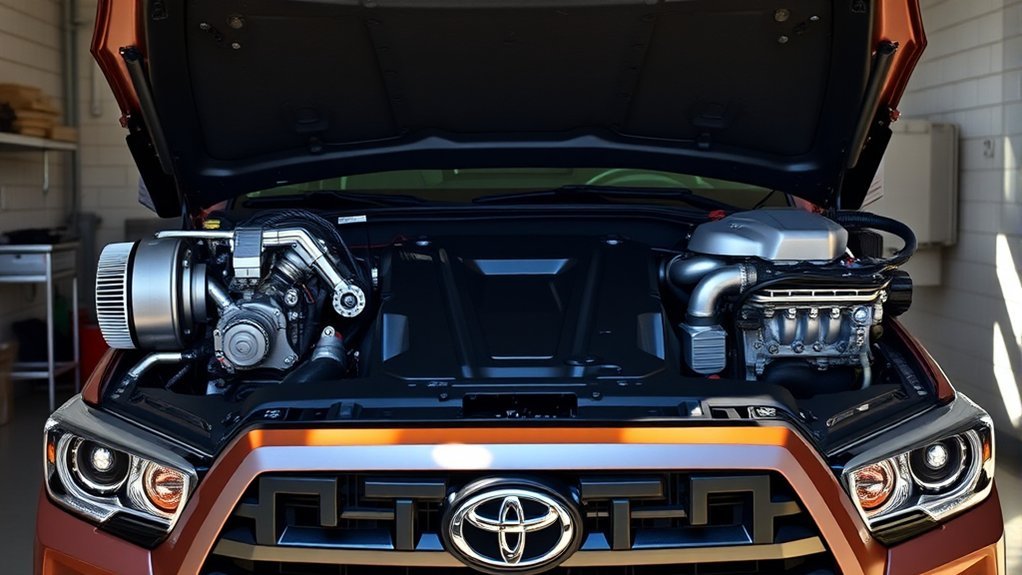
For the 2023 Tacoma, Toyota lists a 2.7-liter DOHC inline-four producing 159 horsepower and 180 lb-ft of torque. The available 3.5-liter V6 produces 278 horsepower and 265 lb-ft of torque.
The four-cylinder can handle commuting, local service work, and light hauling, but its power reserve is limited. The V6 responds better when you merge, pass, climb a grade, add passengers, load the bed, or connect a trailer.
Toyota published the same 159-hp four-cylinder and 278-hp V6 outputs when the third-generation Tacoma launched for 2016. Engine availability was not identical across every 2016–2023 model year, trim, cab, and drivetrain. Use the specifications in this guide as a 2023 benchmark, then confirm the brochure and installed equipment for the exact truck you are considering.
Note: This comparison applies to the previous-generation 2016–2023 Tacoma. Toyota introduced turbocharged 2.4L powertrains with the redesigned 2024 Tacoma, replacing the older 2.7L inline-four and 3.5L V6 choice.
How Do Tacoma V6 and 4-Cylinder Power, MPG, and Cost Compare?
The V6 provides a large performance advantage without a corresponding drop in the official combined MPG rating for comparable 2023 automatic configurations. The four-cylinder’s clearest financial advantage is that it appears in basic, lower-equipment configurations rather than offering a dramatic fuel-economy gain.
[Products Worth Considering]

This ignition coil and spark plug set is designed to restore reliable starting, smooth acceleration, and consistent engine performance for a wide range of GM vehicles. It...
How Much More Power Does the V6 Have?
The V6 produces 119 more horsepower and 85 more lb-ft of torque than the four-cylinder. You are most likely to notice that difference during highway merging, passing, hill climbs, and driving with passengers or cargo.
An empty four-cylinder Tacoma may feel adequate on flat local roads. The same truck can feel much busier when you add larger tires, a lift, camping equipment, tools, or a trailer.
What Does the Power Difference Mean in a Similar Truck?
Toyota lists a 2023 Access Cab SR 4×2 automatic at 3,915 pounds with the four-cylinder and 4,075 pounds with the V6. Using those published curb weights, the four-cylinder has about 40.6 horsepower per 1,000 pounds, while the V6 has about 68.2 horsepower per 1,000 pounds. That is roughly 68% more horsepower per 1,000 pounds for the V6 in this like-for-like example.
This calculation is not an acceleration test and does not account for gearing, tires, altitude, or load. It does explain why the V6 has substantially more reserve even though the truck itself is slightly heavier.
Pro Tip: Test-drive both engines on the type of road you use most. Include a highway ramp or grade instead of judging them only on a slow dealership route.
Does the 4-Cylinder Tacoma Get Better Gas Mileage?
Not by much in comparable 2023 automatic configurations. EPA records rate the 2WD four-cylinder automatic at 20 city / 23 highway / 21 combined mpg. The 2WD V6 automatic is rated at 19 city / 24 highway / 21 combined mpg.
For 4WD automatic models, the four-cylinder is rated at 19 city / 22 highway / 20 combined mpg. The V6 automatic is rated at 18 city / 22 highway / 20 combined mpg.
Manual V6 versions have lower ratings. Tires, speed, terrain, modifications, weather, payload, and driving style can also change your actual fuel use.
The four-cylinder does not deliver a major combined-MPG advantage in comparable 2023 automatic configurations, but the V6 delivers substantially more usable power.
Which Engine Costs Less to Buy?
The four-cylinder often appears in basic SR and SR5 configurations, which can make those trucks less expensive than highly equipped V6 models. However, engine choice is only one part of the price difference.
Compare trucks with similar model years, cab styles, drivetrains, trims, mileage, condition, service history, and modifications. A well-maintained four-cylinder may be a better purchase than a neglected V6, while a clean V6 may offer better value than a modified four-cylinder with an uncertain history.
How Do Fuel Economy, Towing, and Payload Affect the Choice?

Towing is the clearest reason to choose the V6. Toyota’s 2023 specifications rate listed four-cylinder automatic configurations at up to 3,500 pounds. Select V6 automatic configurations reach 6,800 pounds in 4×2 form or 6,500 pounds in 4×4 form.
Those are maximum ratings, not universal ratings for every Tacoma with that engine. Cab, bed, drivetrain, transmission, curb weight, equipment, passengers, cargo, accessories, and trailer tongue weight all affect what a specific truck can handle. For a deeper explanation of these limits, see the Tacoma GVWR, GCWR, payload, and tongue-weight guide.
2023 Configuration Reality Check
- Four-cylinder automatic: up to 3,500 lb towing and a 350-lb listed tongue-load limit in the brochure’s available configurations.
- V6 automatic: up to 6,800 lb towing and 680 lb tongue load in select 4×2 versions; select 4×4 versions reach 6,500 lb towing and 650 lb tongue load.
- Payload: select Access Cab 4×2 versions with either engine are listed at up to 1,685 lb, proving that engine size alone does not determine payload.
Payload can become the practical limit before the advertised tow rating. Passengers, cargo, tools, bed accessories, hitch hardware, and trailer tongue weight all use part of the truck’s available carrying capacity. Check the load label on the driver’s door jamb and the owner’s manual for the exact truck.
Warning: Never select a towing limit from the engine badge alone. Confirm the truck’s configuration, payload label, hitch equipment, trailer brakes, tongue weight, and Toyota’s instructions before towing.
Choose the 4-Cylinder If
- You mainly drive short local routes or commute on flat roads.
- You rarely tow, and your trailer stays comfortably within the truck’s verified limits.
- You want a basic SR or SR5 work truck.
- You carry light loads and do not expect to add substantial accessories.
- You accept slower acceleration in exchange for a simpler purchase decision.
Choose the V6 If
- You tow a boat, camper, utility trailer, or recreational equipment.
- You drive on highways, hills, or mountain roads regularly.
- You carry passengers, tools, gear, or bed cargo often.
- You expect to add larger tires, armor, racks, or camping equipment.
- You want access to a wider range of TRD configurations or a manual transmission.
Which Tacoma Engine Is More Reliable?
Neither engine has a Toyota-specified service life, and cylinder count alone does not prove which used truck will be more dependable. Maintenance history, operating conditions, modifications, corrosion, leaks, and prior towing are more useful buying evidence than an unsupported mileage promise.
The 2.7L four-cylinder uses conventional port fuel injection, while Toyota’s 3.5L V6 uses D-4S direct and port fuel injection. The four-cylinder is simpler in this area, but that design difference by itself does not establish a measurable reliability winner. Compare cold-start behavior, fluid leaks, service records, transmission operation, and the results of an independent inspection.
Toyota’s 2023 scheduled-maintenance guide does not list a routine timing-belt replacement for these engines. Follow the maintenance guide for the exact model year instead of assuming a universal 60,000-mile timing-belt service. The site’s Tacoma engine-life and maintenance guide covers broader high-mileage checks without treating a mileage estimate as a guarantee.
Used Tacoma Reliability Checklist
- Check the VIN for open recalls before purchase.
- Review dated service records for oil changes and scheduled maintenance.
- Inspect for engine oil, coolant, transmission, transfer-case, and differential leaks.
- Start the engine cold and listen for persistent abnormal noise.
- Test the transmission cold and warm for harsh shifts, flares, or hesitation.
- Look for oversized tires, lift kits, tuners, skid plates, winches, or heavy towing equipment.
- Confirm that 4WD engages and disengages correctly on 4WD models.
- Inspect the frame, suspension, brakes, hitch area, and underbody for rust or damage.
- Arrange an independent pre-purchase inspection before committing to the truck.
What Should You Check on a Tacoma Test Drive?
Use the same route and similar conditions when comparing engines. A short, low-speed drive around a dealership may hide the differences that matter during ownership.
- Cold start: Check warning lights, idle quality, exhaust smoke, leaks, and unusual sounds.
- Low-speed response: Note how smoothly the truck moves away from a stop and responds in traffic.
- Highway ramp: Test whether it reaches traffic speed without excessive effort.
- Grade performance: Use a safe hill to compare downshifting and throttle demand.
- Transmission behavior: Watch for delayed engagement, harsh shifts, hunting, or slipping.
- Braking and steering: Check for vibration, pulling, looseness, or warning lights.
- 4WD system: Follow the owner’s instructions and confirm correct engagement where conditions permit.
- Modifications: Ask who installed them, whether factory parts are included, and whether alignment or calibration records exist.
If possible, bring the passengers or typical cargo you expect to carry. Added weight can make the four-cylinder’s performance limits much easier to identify.
Is the Tacoma V6 Worth the Extra Cost?

For most buyers, the V6 is worth considering because it provides much stronger acceleration and nearly doubles the maximum 2023 towing rating in the right configuration. Comparable automatic models also have the same EPA combined-MPG rating when drivetrain is matched.
The four-cylinder remains the more sensible choice when your use is genuinely light and the truck’s condition and price are clearly better. Do not pay for capability you will never use, but do not buy too little truck simply to reduce the purchase price.
Will Your Needs Change Over Time?
Think beyond your current commute. A future camper, utility trailer, larger tire package, bed rack, rooftop tent, tools, or additional passengers can increase the demand on the engine and available payload.
The V6 gives you more operating margin for those changes. The four-cylinder works best when you are confident the truck will remain lightly loaded.
How Should You Compare Long-Term Costs?
Do not assume the four-cylinder will automatically cost less to insure or maintain. Request VIN-specific insurance quotes and compare maintenance records, tire condition, brakes, fluids, leaks, corrosion, and required repairs.
A cheaper truck can become the more expensive purchase if it immediately needs tires, suspension work, leak repairs, neglected maintenance, or modification corrections.
Which Engine Is Better for Towing?
The V6 is the clear towing choice. The four-cylinder’s 3,500-pound 2023 rating can suit a small utility trailer or light recreational trailer, while certain V6 automatic configurations reach 6,800 pounds.
Use the rating for the exact truck and trailer combination. Include occupants, bed cargo, accessories, hitch equipment, and tongue weight in your calculations.
Which Tacoma Engine Fits Your Driving Needs?
Choose from your actual workload rather than the engine’s reputation alone.
| Your Situation | Better Starting Point | Why |
|---|---|---|
| Flat local commuting | 4-cylinder | Adequate for light use when price and condition are favorable |
| Frequent highway driving | V6 | More confident merging and passing power |
| Hills or mountain roads | V6 | Greater power and torque reserve |
| Frequent towing | V6 | Much higher maximum towing capability |
| Basic light-duty work truck | 4-cylinder | Lower-output configuration may meet simple local needs |
| Passengers and bed cargo | V6 | Handles added demand with less effort |
| Larger tires or an off-road build | V6 | Better suited to added rotating mass and accessory weight |
| Two trucks with very different maintenance histories | Better-maintained truck | Condition can outweigh engine preference in a used purchase |
What Changed With the 2024 Tacoma?
The Tacoma redesign introduced for 2024 replaced the previous 2.7L inline-four and 3.5L V6 choices with turbocharged 2.4L powertrains. Toyota also added the available i-FORCE MAX hybrid system.
Toyota rates the i-FORCE MAX system at up to 326 horsepower and 465 lb-ft of torque. Those trucks require a separate comparison based on trim, transmission, hybrid availability, towing, payload, and price.
Use this article when shopping for a previous-generation 2016–2023 Tacoma. Do not apply its V6-versus-2.7L verdict to the redesigned fourth-generation truck. For the newer truck’s load limits, use the separate 2024 Tacoma towing and payload guide.
Final Tacoma Engine Decision Checklist
- Choose the V6 when towing, highway performance, hills, cargo, or future modifications matter.
- Choose the four-cylinder when the truck will remain lightly loaded and local use is the priority.
- Compare similar trims, cabs, drivetrains, mileage, condition, and service history.
- Verify towing and payload from the exact truck rather than a general engine rating.
- Test both engines on a representative route before deciding.
- Prioritize a clean inspection and documented maintenance over a preferred engine in poor condition.
Frequently Asked Questions
Is the V6 or 4-cylinder Tacoma better?
The V6 is better for most 2016–2023 Tacoma buyers because it provides much more power and substantially more towing capability. The four-cylinder is best for light local driving, basic work use, and buyers who do not need strong acceleration.
Is the 4-cylinder Tacoma a V4?
No. The Tacoma’s 2.7L engine is an inline four-cylinder. Its four cylinders sit in one line rather than in two angled banks like a V-shaped engine.
Does the 4-cylinder Tacoma get much better gas mileage?
No major combined-MPG advantage appears in comparable 2023 automatic models. Both 2WD versions are rated at 21 mpg combined, while both 4WD automatic versions are rated at 20 mpg combined.
How much can a 4-cylinder Tacoma tow?
Toyota rates 2023 four-cylinder automatic Tacoma configurations at up to 3,500 pounds. Confirm the exact truck’s rating, payload label, hitch equipment, and owner’s manual before towing.
How much can a V6 Tacoma tow?
Certain properly configured 2023 V6 automatic Tacomas can tow up to 6,800 pounds. Other V6 configurations are rated lower, so verify the exact cab, bed, drivetrain, transmission, payload, and towing equipment.
Is a 4-cylinder Tacoma good for highway driving?
It can handle highway driving, especially when lightly loaded, but acceleration and passing performance are limited compared with the V6. Test it on a highway ramp and grade before buying.
Which Tacoma engine is more reliable?
Maintenance history and condition matter more than choosing four or six cylinders. Inspect service records, leaks, transmission behavior, modifications, 4WD operation, corrosion, and recall status before purchase.
Does the V6 Tacoma have more payload than the 4-cylinder?
Not always. Toyota’s 2023 brochure lists up to 1,685 pounds of payload for select Access Cab 4×2 configurations with either engine. Many other configurations are lower, so use the driver-side door-jamb load label for the exact truck.
Can a 4-cylinder Tacoma tow a camper?
A 2023 four-cylinder Tacoma can tow a small camper only when the camper’s loaded weight, tongue weight, hitch setup, passengers, cargo, and accessories stay within the truck’s verified 3,500-pound tow rating and payload limits. Do not use the camper’s dry weight as the only check.
Did Toyota discontinue the Tacoma V6?
Toyota replaced the previous-generation 3.5L V6 when it introduced the redesigned 2024 Tacoma. The fourth-generation truck uses turbocharged 2.4L powertrains, including an available i-FORCE MAX hybrid.
Conclusion
For most used 2016–2023 Tacoma shoppers, the 3.5L V6 is the better all-around choice. Its stronger acceleration and higher towing capability make it more suitable for highways, hills, passengers, cargo, trailers, and future upgrades.
Choose the 2.7L inline-four when your use will stay light and the actual truck offers a meaningful advantage in price, condition, or maintenance history. Whichever engine you choose, verify the configuration, inspect the truck independently, and base the decision on your real workload.
Sources
- Toyota USA Newsroom: 2023 Toyota Tacoma Adds New SR5 SX and Chrome Packages — official 2.7L four-cylinder and 3.5L V6 output, transmission, and towing information.
- Toyota USA Newsroom: 2016 Toyota Tacoma — launch-year engine output and EPA-estimated fuel-economy context for the third generation.
- Toyota 2023 Tacoma eBrochure — configuration-specific towing, payload, engine, transmission, and mileage specifications.
- FuelEconomy.gov: 2023 Toyota Tacoma — EPA ratings for 2WD, 4WD, automatic, and manual configurations.
- Toyota USA Newsroom: 2024 Toyota Tacoma i-FORCE MAX — fourth-generation Tacoma powertrain context.
- Toyota 2023 Tacoma Warranty & Maintenance Guide — scheduled maintenance and ownership-record guidance.
- NHTSA Recalls Lookup — VIN-based open-recall checks.


[…] from the maximum figures alone. See Toyota’s 2026 Tacoma specifications and this site’s Tacoma V6 versus four-cylinder guide for the generation […]
[…] For a deeper comparison of the engines offered within the third-generation truck, see the Tacoma V6 versus four-cylinder engine guide. […]