Toyota Tacoma Turbo Problems: Symptoms, Diagnosis, and Maintenance
By: Vance Ashford
Last updated: July 31, 2026
How this guide was checked: This article was reviewed against Toyota’s U.S. specifications for the 2023 through 2026 Tacoma, the 2024 Tacoma owner’s and maintenance documents, and Garrett Motion’s turbocharger diagnostic guidance. It does not claim hands-on testing of a specific truck, and vehicle-specific failures must be confirmed with Toyota repair information for the exact VIN.
If a 2024 through 2026 Toyota Tacoma loses power, develops a new hiss or whine, shows a boost-related warning, smokes, or starts using oil, do not approve a turbocharger replacement from the symptom or code alone. Loose charge-air plumbing, a restricted filter, a sensor or wiring fault, wastegate-control trouble, oil-drain restriction, or an engine problem can produce similar signs. Record the codes and freeze-frame data, check the oil level, and inspect the cold intake and charge-air path first. Stop driving and arrange a tow for heavy smoke, rapid oil loss, grinding, siren-like noise, an oil-pressure warning, overheating, or severe power loss.
Quick Answer
All factory U.S.-market 2024 through 2026 Tacomas use a 2.4L turbocharged engine, including i-FORCE MAX hybrid models. Power loss, an underboost-related code, a new hiss, smoke, oil loss, or abnormal turbo noise calls for diagnosis, but none proves the turbo itself has failed. Check the air filter, charge pipes, clamps, intercooler connections, oil level, wiring connectors, stored codes, and wastegate-control response before approving a turbo replacement.
Key Takeaways
- Factory U.S. Tacomas from 2023 and earlier did not use a turbocharger; the redesigned 2024 through 2026 models use 2.4L turbocharged powertrains.
- A boost leak, air restriction, sensor fault, wiring fault, or wastegate-control issue can mimic a failed turbo.
- Heavy smoke, rapid oil loss, grinding, siren-like noise, overheating, an oil-pressure warning, or severe power loss are stop-driving symptoms.
- The 2024 owner’s manual calls for about one minute of idling only after steep hill driving or continuous driving at 62 mph (100 km/h) or more; normal city driving and a constant 50 mph (80 km/h) do not require added idle time.
- Ask the shop to document the failed test, root cause, warranty status, parts, fluids, calibration work, and post-repair verification before you approve replacement.
Safety: Let the engine and exhaust system cool before touching intake or charge-air parts. Do not reach near belts, fans, the turbocharger, or hot exhaust parts while the engine runs. On an i-FORCE MAX Tacoma, do not touch or disconnect orange high-voltage cables, connectors, or hybrid components. A pressure test, actuator test, wheel inspection, oil-line repair, or hybrid-system procedure belongs with a qualified technician unless you have the correct Toyota service information and equipment.
What’s in This Article
- Which Tacomas This Turbo Guide Covers
- Does Every Tacoma Have a Turbocharger?
- Can You Keep Driving With Tacoma Turbo Symptoms?
- Tacoma Turbo Symptoms and First Checks
- What Evidence Should Prove a Turbo Failure?
- How the Tacoma Turbocharger Works
- Tacoma Turbo Parts You Must Know
- Routine Inspection and Maintenance Checklist
- How Long Should You Let a Tacoma Turbo Cool Down?
- Repair Options, Cost Drivers, and Timeline
- What Should Be Verified After a Turbo Repair?
- Frequently Asked Questions
- Conclusion
Which Tacomas This Turbo Guide Covers
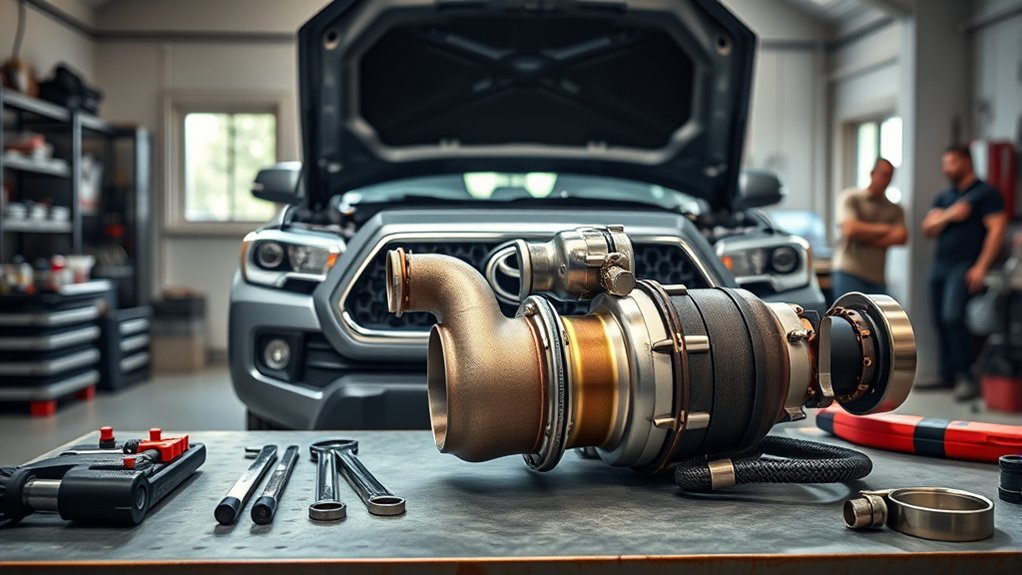
This guide covers factory-turbocharged U.S.-market Tacomas from the redesigned 2024 model year through 2026. It applies to the 2.4L i-FORCE gas engine and the 2.4L i-FORCE MAX hybrid powertrain, although parts, access, software, and test procedures can differ by trim, transmission, model year, and VIN.
It does not provide a universal procedure for an older Tacoma with an aftermarket turbo kit. Those trucks depend on the kit maker’s hardware, calibration, oil routing, charge piping, and wastegate setup. Follow the kit maker’s service data and the engine builder’s limits.
Does Every Tacoma Have a Turbocharger?
No. Toyota listed naturally aspirated 2.7L four-cylinder and 3.5L V6 engines for the U.S.-market 2023 Tacoma. The redesigned 2024 Tacoma changed to 2.4L turbocharged i-FORCE and i-FORCE MAX powertrains across the lineup. See Toyota’s 2023 Tacoma engine specifications and 2024 Tacoma powertrain overview.
| Model years | Factory U.S. engine situation | Does this turbo guide apply? |
|---|---|---|
| 2023 and earlier | No factory turbocharger. Toyota listed a 2.7L four-cylinder and 3.5L V6 for the 2023 Tacoma. | Only if the truck has a documented aftermarket turbo system. Follow that kit’s service data. |
| 2024 through 2026 | Factory 2.4L turbocharged i-FORCE or i-FORCE MAX hybrid powertrain. Output varies by trim and transmission. | Yes. Use the owner’s manual and repair information for the exact year, trim, engine, and VIN. |
Toyota rates the 2026 i-FORCE engine at up to 278 horsepower and 317 lb-ft of torque. The available i-FORCE MAX hybrid reaches up to 326 horsepower and 465 lb-ft. Lower-output configurations also exist, so do not identify parts or expected boost from the maximum figures alone. See Toyota’s 2026 Tacoma specifications and this site’s Tacoma V6 versus four-cylinder guide for the generation change.
Can You Keep Driving With Tacoma Turbo Symptoms?
Whether you should keep driving depends on smoke, oil loss, warning messages, noise, temperature, and how much power remains. A mild hiss or warning with stable oil level may allow a careful trip to a safe location or repair shop. Heavy smoke, rapid oil loss, grinding, siren-like noise, overheating, an oil-pressure warning, or severe power loss requires shutdown and a tow. When reduced power makes merging or maintaining traffic speed unsafe, do not continue driving.
| Urgency | Typical signs | What to do |
|---|---|---|
| Inspect and schedule service | Warning light or mild hiss, normal oil level, no smoke, normal temperature, and enough power to drive safely | Save codes and freeze-frame data. Avoid trailer towing, heavy hauling, and hard acceleration. Arrange diagnosis promptly. |
| Limit driving or tow | Noticeable power loss, limp mode, repeated underboost-related warning, louder whine, or an air leak you cannot locate | Move only as needed to reach a safe place. Tow the truck if traffic conditions, temperature, oil level, or noise make continued driving uncertain. |
| Stop and tow | Heavy smoke, rapid oil loss, grinding, siren-like noise, overheating, oil-pressure warning, abnormal engine operation, or severe power loss | Shut the engine off safely and arrange a tow. Do not restart it merely to see whether the symptom clears. |
Tacoma Turbo Symptoms and First Checks
A turbo-related symptom does not identify the failed part by itself. Garrett Motion’s turbo diagnostic guidance notes that power loss, noise, smoke, and oil use can come from air restrictions, exhaust problems, fuel-system faults, or lubrication problems as well as the turbocharger.
| What you notice | What to rule out first | Best next step |
|---|---|---|
| Weak acceleration or an engine warning | Loose charge pipe, damaged coupler, restricted filter, wiring or sensor fault, wastegate-control issue, fuel or ignition fault | Save the codes and freeze-frame data, then inspect the intake and charge-air path with the engine cool. |
| Hiss or whoosh that rises with load | Air leak at a hose, clamp, intercooler connection, or damaged pipe | Avoid heavy load and have the system pressure- or smoke-tested if a visual check finds nothing. |
| New high-pitched whine | Charge-air leak, intake restriction, or turbo rotating-assembly wear | Compare the sound with normal operation and arrange diagnosis before trailer towing, heavy hauling, or hard acceleration. |
| Heavy exhaust smoke with falling oil level | Turbo oil-control problem, blocked drain, crankcase-pressure problem, or internal engine fault | Stop driving, shut the engine off safely, and arrange a tow. |
| Grinding or siren-like noise with power loss | Possible wheel, shaft, bearing, or housing contact | Stop the engine and tow the truck. Continued running can send debris or oil into the engine or exhaust. |
| Oil film inside a charge pipe | Normal crankcase-vapor residue versus active oil pooling, rising consumption, drain restriction, or pressure imbalance | Track oil level and the amount of residue. Oil film alone does not prove turbo failure. |
Safe First Checks Before Replacing the Turbo
- Confirm the engine and model year. A 2023 or older factory Tacoma needs a non-turbo diagnostic path unless it has an aftermarket kit.
- Save diagnostic information. Record every code, warning message, and the conditions that triggered the fault. Do not clear codes before a shop reads the freeze-frame data.
- Inspect the cold air path. Check the air filter housing, inlet duct, charge pipes, clamps, intercooler connections, and visible wiring plugs for damage or poor seating.
- Check the engine oil correctly. Follow the owner’s manual, park on level ground, and do not overfill. Record any rapid change.
- Request controlled testing. A qualified shop can compare commanded and actual boost, pressure-test the charge system, test actuator control, and inspect the turbo only when service information calls for it.
What Diagnostic Evidence Should Prove a Turbo Failure?
A code, noise, or oil film should start the diagnosis, not end it. Before a complete turbocharger is approved, ask the shop to identify the test that separated turbo damage from a boost leak, restriction, sensor fault, actuator-control problem, lubrication fault, or engine problem.
- Stored data: diagnostic codes, warning messages, freeze-frame conditions, and whether the fault returns after controlled testing.
- Charge-air integrity: visual inspection plus a pressure or smoke test when the Toyota procedure calls for one.
- Boost-control evidence: commanded versus measured pressure and the actuator command-and-response result under an approved test.
- Air and exhaust checks: filter, inlet, intercooler, charge pipes, sensors, and relevant exhaust restrictions or leaks ruled out.
- Lubrication and crankcase checks: oil level and condition, feed and return path, active leakage, and crankcase pressure when required.
- Physical damage: documented wheel, shaft, bearing, housing, or foreign-object damage found under the correct service procedure.
If the estimate lists only an underboost-related code and a turbo assembly, ask for the missing test results before authorizing the repair.
Warning: Do not keep driving to “see if it clears” when the truck has heavy smoke, rapid oil loss, grinding, a siren-like sound, or severe power loss in traffic. Those symptoms can turn a repairable fault into engine, catalyst, or turbo damage.
How the Tacoma Turbocharger Works
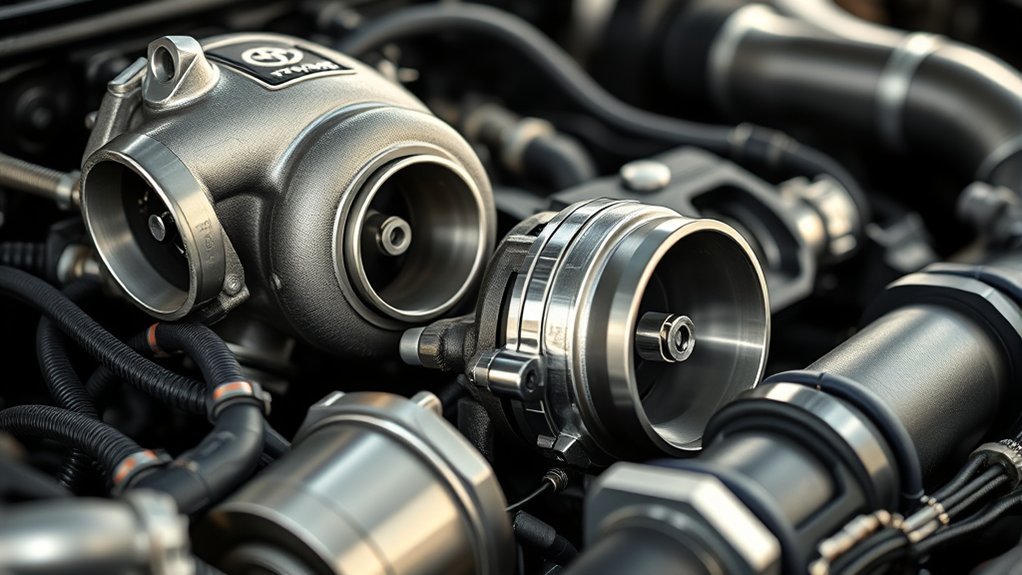
The turbocharger uses exhaust energy to spin a turbine wheel. A shaft connects that turbine to a compressor wheel, which raises intake-air pressure. The engine can then take in more air mass and produce more torque from its 2.4L displacement.
Compressed air heats up, so the charge-air cooler, commonly called the intercooler, removes heat before the air reaches the engine. The wastegate controls how much exhaust energy reaches the turbine and helps the engine-management system control boost.
Compressor and Intercooler Flow
Air moves from the filter and inlet duct into the compressor. It then travels through charge piping and the intercooler before reaching the intake manifold. A leak anywhere after the compressor can lower delivered boost even when the turbo still spins normally.
| Component | Main job | Typical fault clue |
|---|---|---|
| Compressor | Raises intake-air pressure and mass flow | Abnormal whine, damaged wheel, low airflow, or oil carryover after other causes are ruled out |
| Charge pipe and couplers | Carry compressed air between components | Hiss, oily spray at a joint, loose clamp, split hose, or underboost |
| Intercooler | Lowers charge temperature before the engine | Cracked end tank, damaged core, leaking connection, or heat-related power loss |
| Intake sensors | Report airflow, pressure, or temperature to engine control | Implausible data, warning light, poor response, or a code that needs circuit testing |
A clean filter and sealed connections reduce unnecessary compressor work. They also give a technician a reliable starting point when comparing requested and measured airflow or pressure.
Wastegate and Boost Control
The wastegate diverts some exhaust flow around the turbine when the engine-management system needs to limit boost. Its actuator, linkage, wiring, connectors, and control strategy must work together.
A control fault can cause low boost, excessive boost, uneven power, or a warning light. Those symptoms still do not prove the turbo’s wheels or bearings are damaged. The shop should test the actuator command and response before replacing the whole assembly.
Do not move or force the actuator linkage by hand unless Toyota’s service procedure specifically directs it. The control hardware and adjustment method are system-specific, and forced movement can damage the linkage or disturb its setup.
Tacoma Turbo Parts You Must Know
The turbo assembly is only one part of the system. A complete diagnosis also covers the oil supply and return, intake path, charge-air cooler, exhaust path, sensors, wastegate control, crankcase ventilation, and engine condition.
This system view matters because turbo damage can be the result of another fault. Replacing the assembly without correcting oil starvation, contamination, a blocked drain, foreign-object entry, or a charge-air leak can lead to repeat failure.
[Products Worth Considering]

This PCV valve and hose kit is designed as a direct replacement for select Toyota, Scion, and Lexus applications, helping restore proper crankcase ventilation and engine performance. Built with durable NBR rubber and made for straightforward installation, it offers a reliable fit for compatible 2.4L models. It is a practical maintenance part for addressing worn or failing PCV components while supporting smoother engine operation.

Walker exhaust pipe flange gasket is designed to help complete exhaust repairs with a reliable seal for compatible vehicles. Built to work with OE exhaust components and Walker replacement parts, it features heat-deflecting construction, durable materials, and slotted bolt holes where applicable for easier installation. Engineered and tested for real-world performance, it supports long-lasting exhaust system service.

This silicone vacuum hose kit provides a versatile selection of tubing sizes and connector pieces for automotive, marine, and industrial routing tasks. Built for heat resistance and durability, it supports air and water applications in engine bays, custom intake setups, turbo piping, and cooling system projects. The included size variety makes it a practical choice for repairs, fabrication, and DIY maintenance work.
Turbocharger Oil System
Engine oil lubricates and cools the turbo’s rotating center section. The feed path must deliver clean oil at the correct pressure, while the return path must let oil drain without restriction.
Do not treat every oil trace as a failed turbo seal. Turbochargers use a pressure-based sealing system, and oil leakage can result from a restricted drain, excessive crankcase pressure, an incorrect oil level, air-path restriction, or another engine problem. The root cause must be found before a turbo is replaced.
- Check the engine oil level and service history before diagnosis.
- Inspect visible feed and return connections for fresh leakage, heat damage, or chafing.
- Look for pooled oil, not only a light film, in accessible charge-air connections.
- Replace damaged or restricted lines when testing confirms a problem.
Wastegate and Actuator
The wastegate controls exhaust flow around the turbine. The actuator and its control circuit position that valve so the engine can meet its boost target.
Possible faults include a sticking linkage, damaged connector, wiring problem, actuator fault, valve problem, or control issue. The correct test depends on the exact Tacoma year and system design.
Ask the shop whether the actuator can be serviced separately, whether calibration or initialization is required, and which test proved the fault. Do not approve a complete turbo assembly only because the truck has an underboost-related code.
Routine Inspection and Maintenance Checklist
Toyota does not publish a universal 5,000- to 10,000-mile DIY shaft-play inspection for Tacoma owners. Follow the scheduled maintenance guide for your exact model year and use the special-operating-condition schedule when your driving matches it.
- Use the specified oil. Follow the viscosity, quality standard, capacity, and replacement interval in your owner’s and maintenance guides.
- Adjust for severe use. Dirt, dust, towing, heavy loading, extensive idling, and repeated short trips can change required service items or intervals.
- Keep the intake sealed. Seat the air filter and airbox correctly, and repair damaged ducts or charge-air connections.
- Track oil level and symptoms. Record oil use, smoke, warning lights, new sounds, and when they occur.
- Keep service records. Save oil receipts, inspection notes, code reports, and repair invoices for diagnosis and warranty review.
- Leave shaft-play measurement to the service procedure. Acceptable movement and inspection conditions are model-specific, and an incorrect check can damage the wheel or contaminate the intake.
Pro tip: Photograph leaks, hose joints, and warning messages before cleaning or disassembly. A dated record helps the shop see whether the problem is growing or returning.
Use Toyota’s 2024 Tacoma Warranty and Maintenance Guide only for a 2024 truck. Select the correct guide for another model year through Toyota Owners.
[Products Worth Considering]

AutoLine Pro HyperSmoke is a professional automotive smoke tester designed to quickly find EVAP, vacuum, intake, boost, exhaust, and other leak sources with thick visible smoke. It features adjustable pressure, built-in air compressor motor, instant warmup, and OEM approved smoke fluid for safe, accurate diagnostics across a wide range of vehicles and systems. The kit includes essential accessories and is backed by a full coverage warranty for dependable shop or garage use.

These genuine Toyota oil drain plug gaskets are designed to help maintain a reliable seal during oil changes, reducing the chance of leaks and supporting proper engine maintenance. With an OEM fit and trusted Toyota quality, they are a practical choice for routine service on compatible vehicles. The convenient quantity pack is ideal for keeping multiple maintenance intervals covered.

This all-in-one car emergency kit helps drivers stay prepared for roadside breakdowns, flat tires, and dead batteries with essential tools in one compact package. It includes a portable air compressor, heavy-duty jumper cables, a first aid kit, and other safety items designed for year-round peace of mind. Compact enough for easy trunk storage, it makes a practical safety solution and thoughtful gift for drivers of all ages.
How Long Should You Let a Tacoma Turbo Cool Down?
For the 2024 Tacoma, Toyota requires added idle time only after the higher-load conditions shown below. Normal city driving and a constant speed of about 50 mph (80 km/h) do not require an extra cool-down period. Check the owner’s manual for your exact model year because Toyota may revise the wording or examples.
| 2024 driving condition | Toyota’s stated idle time before shutdown |
|---|---|
| Normal city driving | Not necessary |
| High-speed driving at a constant speed of about 50 mph (80 km/h) | Not necessary |
| Steep hill driving or continuous driving at 62 mph (100 km/h) or more | Approximately 1 minute |
Lower-load driving while exiting the highway, entering a parking area, or approaching your destination may reduce turbo temperature before you stop. Do not assume that this always replaces Toyota’s stated idle period after steep hill driving or continuous operation at 62 mph (100 km/h) or more.
Do not use long idling as a substitute for correct oil, normal oil level, sealed airflow, or scheduled service. Follow the specific turbo precautions in your 2024 Tacoma owner’s manual.
Turbo Repair Options, Cost Drivers, and Timeline
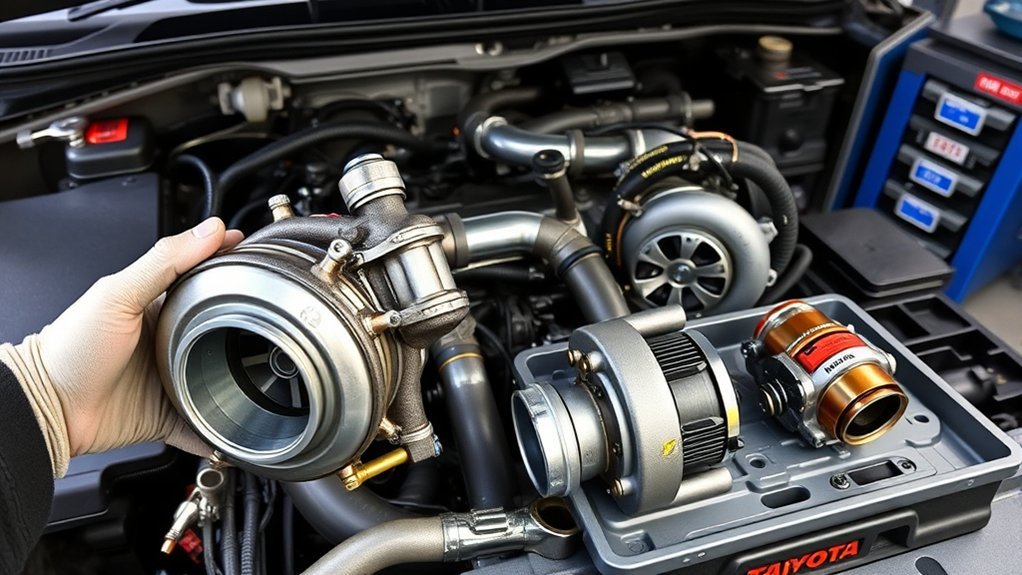
Do not use a generic national price as a Tacoma quote. The total depends on the failed part, model year, gas or hybrid configuration, labor rate, parts source, oil and coolant service, gaskets and lines, diagnostic time, software work, taxes, and warranty coverage.
| Confirmed finding | Repair path to discuss | What the estimate should show |
|---|---|---|
| Loose clamp, split hose, leaking intercooler connection, filter restriction, or wiring fault | Repair the root cause. A turbo assembly should not be included without separate evidence of damage. | Diagnostic test, failed connection or circuit, parts, labor, and post-repair verification |
| Actuator or wastegate-control fault | Confirm whether the actuator is separately serviceable and whether calibration is required. | Command-and-response test, part availability, calibration or initialization, and warranty |
| Damaged wheel, housing crack, metal contact, severe shaft wear, or foreign-object damage | A complete new or approved remanufactured assembly is usually the safer path. | Root-cause repair, assembly source, lines and gaskets, fluids, labor, and debris inspection |
| Repairable core accepted by a qualified turbo specialist | Consider rebuilding only when the shop can restore balance and calibration to the required specification and provide a written warranty. | Inspection report, replaced internals, high-speed balance or equivalent verification, actuator setup, and warranty terms |
Ask a Toyota dealer to check warranty eligibility by VIN before you authorize work. Toyota’s 2024 Tacoma brochure lists 60 months or 60,000 miles of powertrain coverage, but coverage depends on the truck’s in-service date, mileage, diagnosis, maintenance, modifications, and warranty terms. Another model year may differ.
A hose or connector repair may be completed during one visit. Turbo assembly work can take longer when diagnosis, parts ordering, line replacement, cleaning, software setup, or hybrid-specific access is required. Get a written timeline after the shop confirms the failed part.
Before installation, the shop should document why the original system failed. It should also check the air path, oil supply and return, crankcase pressure where required, intercooler, exhaust path, and debris risk so the replacement is not damaged by the same root cause.
[Products Worth Considering]
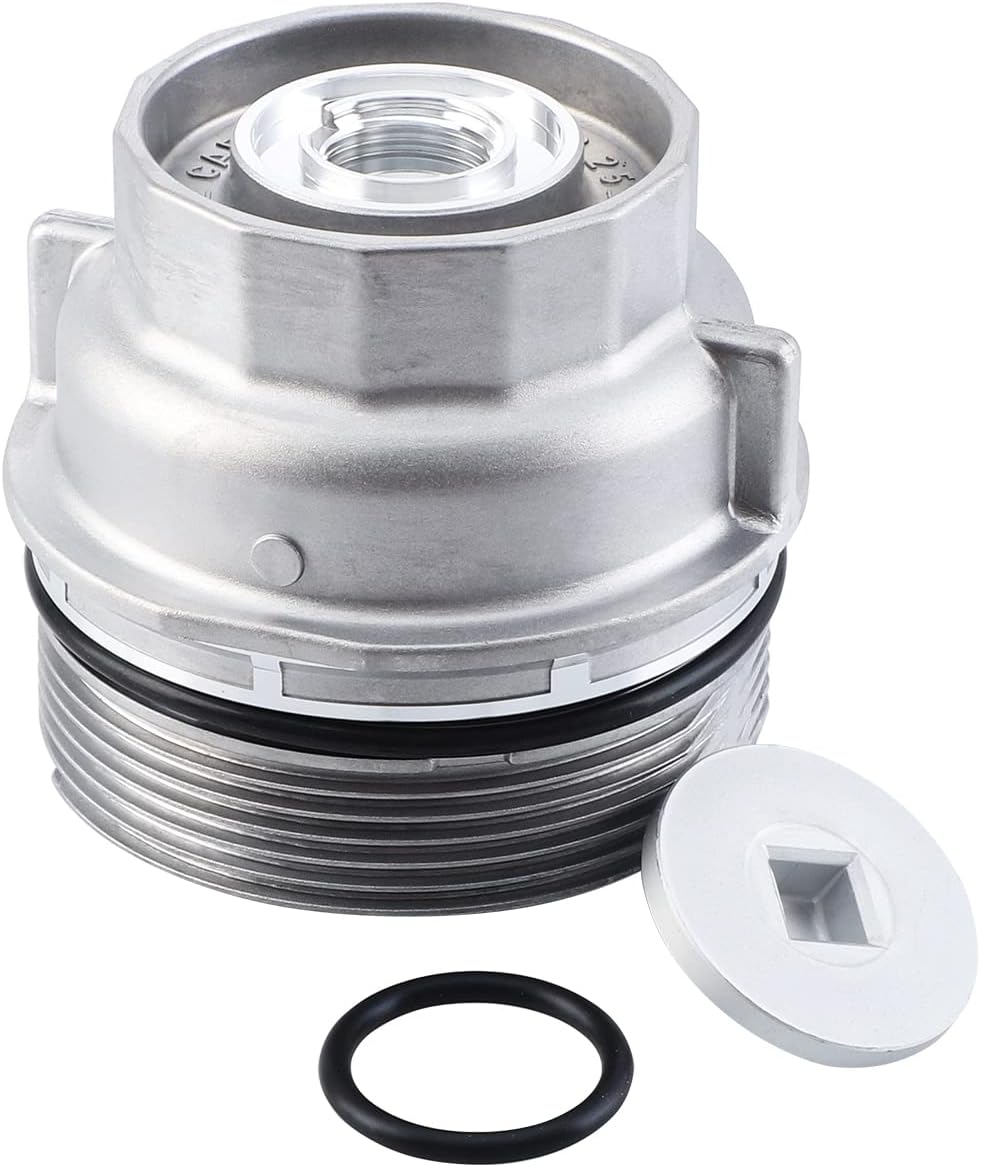
This oil filter housing cap assembly is designed as a replacement for select Toyota and Lexus vehicles, helping restore proper sealing and reliable oil filter function during routine maintenance. Built to meet OEM standards, it supports leak-free performance and long-lasting durability while fitting a wide range of popular models across multiple years.

This A-Premium engine air filter is designed to help maintain clean airflow for compatible Lexus and Toyota vehicles, supporting better engine performance and efficiency. It uses fine filtration media to capture debris while minimizing airflow restriction, making it a practical replacement for routine maintenance. With fitment for multiple popular models and a convenient boxed single-pack design, it offers a straightforward solution for keeping your engine protected.

This plug-and-play OBD2 scanner helps drivers quickly read and clear engine error codes while providing live data, freeze frame information, I/M readiness, and MIL status for more confident troubleshooting. It adds a built-in voltage test and clear status indicators to support electrical checks and faster diagnostics, making it a practical choice for home users, car enthusiasts, and repair professionals. Compatible with most OBDII vehicles since 1996 and designed with an easy-to-use interface, it offers broad coverage and simple operation in one compact tool.
What Should Be Verified After a Turbo Repair?
A completed invoice should show more than the installed part. Ask for the root-cause repair and the post-repair checks that confirm the system is sealed, controlled correctly, and safe to return to service.
- No active engine-oil or coolant leaks after the required warm-up and inspection.
- Correct oil and coolant levels, with any replaced lines, gaskets, seals, and clamps listed.
- Intake, charge-air, intercooler, sensor, and exhaust connections secured and checked.
- Saved pre-repair codes and freeze-frame data, followed by confirmation that the fault does not return.
- Commanded and measured boost or pressure behaving as Toyota’s procedure requires during the approved verification test.
- Any actuator initialization, calibration, software update, or relearn completed when required.
- Foreign-object, oil-pooling, and debris risks addressed before the truck is released.
Frequently Asked Questions
Which Toyota Tacoma Years Have a Factory Turbo?
For the U.S. market, factory Tacoma engines through 2023 were naturally aspirated. The redesigned 2024, 2025, and 2026 Tacomas use 2.4L turbocharged i-FORCE or i-FORCE MAX powertrains. An older Tacoma has a turbo only if an aftermarket system was added.
Is the Toyota 2.4L Turbo Engine Good?
The Tacoma’s 2.4L turbo engine delivers strong low-speed torque and meets Toyota’s stated output targets. However, the Tacoma version debuted for 2024, so it does not yet have decades of Tacoma-specific high-mileage history. Judge a used truck by maintenance records, diagnostic history, modifications, oil use, warning lights, and a pre-purchase inspection instead of assuming it is proven or unreliable.
What Are the First Signs of a Tacoma Turbo Problem?
Early signs can include weak acceleration, slower boost response, a new hiss or whine, an engine warning, smoke, or unusual oil use. These symptoms also have non-turbo causes, so save the codes and inspect the intake and charge-air system before replacing the turbo.
Can a Boost Leak Feel Like a Bad Turbo?
Yes. A leak can reduce delivered air pressure and make the truck feel weak even when the turbocharger still works. Check charge pipes, couplers, clamps, intercooler connections, and related sensor readings before condemning the assembly.
Does an Underboost Code Mean the Turbo Is Bad?
No. An underboost-related code means measured or calculated boost did not match the expected target under the recorded conditions. Possible causes include a charge-air leak, restriction, sensor or wiring fault, wastegate-control problem, exhaust leak, or turbo damage. Use the Toyota diagnostic procedure for the exact code and VIN.
How Long Should a Tacoma Turbo Idle Before Shutdown?
The 2024 Tacoma owner’s manual calls for approximately one minute after steep hill driving or continuous driving at 62 mph (100 km/h) or more. Added idle time is not required after normal city driving or a constant speed of about 50 mph (80 km/h). Check the manual for your exact model year.
How Much Does Toyota Tacoma Turbo Replacement Cost?
There is no reliable universal Tacoma turbo-replacement price. The total depends on the confirmed failure, model year, gas or hybrid configuration, parts source, labor rate, lines and gaskets, fluids, cleaning, calibration work, taxes, and warranty coverage. Get a VIN-specific, itemized estimate after diagnosis.
Is a Tacoma Turbo Covered Under Warranty?
A factory turbo problem may fall within applicable powertrain coverage, but coverage is not automatic. Eligibility depends on the in-service date, mileage, diagnosis, maintenance history, modifications, and warranty terms. Ask a Toyota dealer to check the VIN and give the coverage decision in writing before authorizing work.
Should You Rebuild or Replace a Tacoma Turbo?
Use a rebuild only when a qualified specialist confirms the core and housings are serviceable, can restore balance and actuator setup to specification, and provides a written warranty. Replacement is the safer choice when the wheels, shaft, housing, or center section has major damage, or when Toyota supplies the required parts only as an assembly.
Can You Drive With a Leaking Turbo?
A light external seep and a rapid internal oil leak are not the same. Stop driving if the oil level drops quickly, heavy smoke appears, the engine runs abnormally, an oil-pressure warning appears, or you hear grinding or siren-like noise. Arrange diagnosis promptly for any confirmed leak because oil loss can damage the engine, turbo, or exhaust system.
Conclusion
A Toyota Tacoma turbo problem should be diagnosed as a complete air, boost-control, lubrication, exhaust, and engine system. A leak, restriction, sensor fault, wiring fault, wastegate-control problem, oil-drain issue, or engine fault can create the same warning signs as a damaged turbocharger.
Record the model year, VIN, codes, warning messages, oil level, sound, smoke, temperature, and driving conditions before anything is cleared or cleaned. Stop and tow the truck for heavy smoke, rapid oil loss, grinding, siren-like noise, overheating, an oil-pressure warning, or severe power loss. For less urgent symptoms, request a charge-system test and documented boost-control diagnosis before approving parts.
Follow Toyota’s maintenance schedule, use the specified oil, keep the intake sealed, and follow the exact model-year cool-down guidance after sustained high load. For broader ownership planning, see the site’s guide to Toyota Tacoma engine lifespan.
References
- The 2026 Toyota Tacoma: Adventure Awaits | Toyota Pressroom, 2025
- 2024 Toyota Tacoma Is the Ultimate Adventure Machine | Toyota Pressroom, 2023
- 2023 Toyota Tacoma Adds New SR5 SX and Chrome Packages | Toyota Pressroom, 2022
- 2024 Toyota Tacoma Brochure | Toyota
- 2024 Toyota Tacoma Owner’s Manual | Toyota
- 2024 Toyota Tacoma Warranty and Maintenance Guide | Toyota
- 2026 Toyota Tacoma Manuals and Warranties | Toyota Owners
- How a Turbocharger Works | Garrett Motion
- Turbocharger Troubleshooting | Garrett Motion
- The Turbocharger Oil and Gas Sealing System | Garrett Motion, 2022
- Why Do Turbochargers Fail? | Garrett Motion