To keep your 2025 Toyota Tacoma stable, predictable, and easier on tires, use the right tire rotation pattern for your tire type. Most Tacomas with same-size, non-directional tires should use the rearward cross pattern: the rear tires move straight forward, and the front tires cross to the opposite rear positions. Just as important, Toyota’s maintenance schedule calls for tire rotation at regular 5,000-mile service intervals, or every six months if you drive fewer miles.
Quick Answer
For most 2025 Toyota Tacoma models with same-size, non-directional tires, use the rearward cross pattern: rear tires move straight to the front, and front tires cross to the opposite rear positions. Rotate tires every 5,000 miles or six months, following Toyota’s maintenance schedule.
Key Takeaways
- Use the rearward cross pattern for same-size, non-directional Tacoma tires: rear tires go straight forward, and front tires cross to the rear.
- Toyota’s 2025 Tacoma maintenance chart lists Rotate Tires at each 5,000-mile interval, and Toyota recommends scheduled maintenance every 5,000 miles or six months.
- Directional tires, staggered tires, and some specialty tire setups need a different pattern, so check the tire sidewall before crossing tires.
- Always use jack stands, a torque wrench, and the Tacoma’s approved jacking points; never work under a truck supported only by a jack.
At a Glance
| Time Required | 30–60 minutes for a careful DIY rotation |
| Difficulty | Moderate; safe lifting and proper torque are required |
| Tools Needed | Jack, jack stands, wheel chocks, lug wrench or breaker bar, torque wrench, tire pressure gauge, and chalk or tape |
| Cost | No parts cost if you already own the tools; otherwise, use a qualified tire shop or Toyota service center |
What Is Tire Rotation and Why Does It Matter?
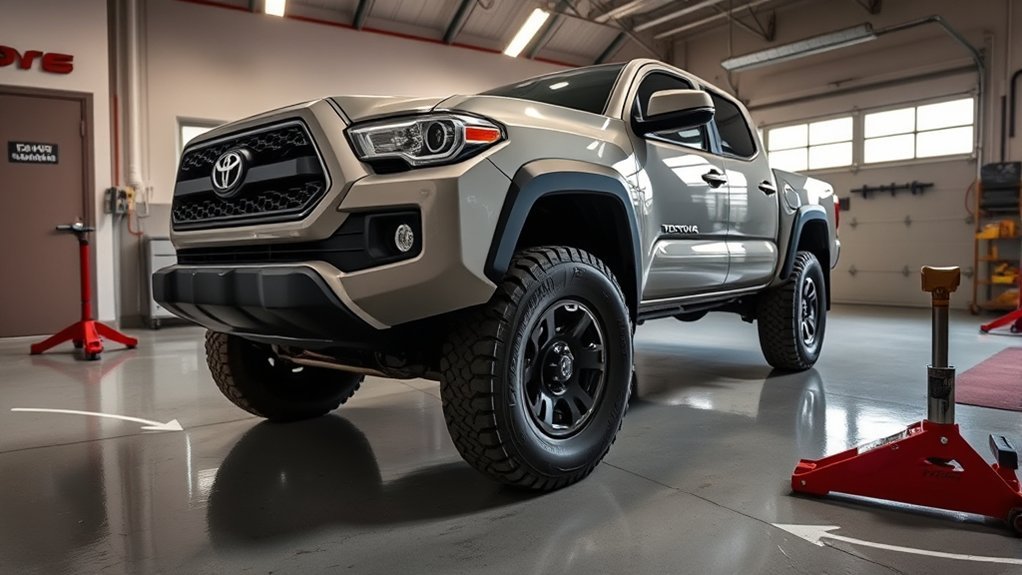
Tire rotation means moving each tire to a new position on the vehicle so the set wears more evenly. On a Tacoma, the front and rear tires do different jobs. The front tires handle steering and much of the braking load, while the rear tires carry drive forces and often more weight when hauling or towing.
Because of those different jobs, tires can develop uneven tread wear if they stay in the same position too long. Regular rotation helps even out tread depth, supports predictable handling, and can extend tire life. The 2025 Toyota Tacoma Warranty & Maintenance Guide lists Rotate Tires as a scheduled service at each 5,000-mile interval, and Toyota recommends scheduled maintenance every 5,000 miles or six months, whichever comes first.
Tire rotation does not fix every tire problem. If one tire is cupping, feathering, wearing only on one shoulder, or vibrating at speed, the root cause may be alignment, balance, suspension wear, underinflation, or damage. Rotation can help manage wear, but mechanical problems should be corrected first.
Note: Toyota’s schedule is the starting point. If you tow, drive off-road, carry heavy loads, or spend a lot of time on dirt or dusty roads, inspect your tires more often and rotate sooner if you see uneven wear.
Signs That Indicate Your Tires Need Rotation Now
A Tacoma that is due for tire rotation may still drive normally, so do not wait for a dramatic symptom. Use mileage and time first, then watch for these warning signs between scheduled services:
- One pair of tires is wearing faster: If the front tires look more worn than the rear, or the rear tires look noticeably lower, rotation is due.
- Uneven tread depth: Measure tread depth at several points across each tire. A clear difference from tire to tire means the set is not wearing evenly.
- Cupping or scalloping: Dips around the tread can point to worn suspension parts, imbalance, or lack of rotation.
- Pulling to one side: A pull may be caused by tire wear, tire pressure, alignment, or brake drag. Do not assume rotation alone will solve it.
- Vibration at highway speed: Vibration often points to wheel balance, tire damage, or uneven wear. Inspect the tires before rotating them.
- Increased road noise: A humming or chopping sound can come from irregular tread wear.
The National Highway Traffic Safety Administration recommends paying attention to changes in tire performance, including pressure loss, noise, and vibration. If you notice any of these symptoms, inspect the tires, check pressure when cold, and correct alignment or balance problems before they shorten the life of the whole set.
Warning: Do not rotate a tire that has exposed cords, sidewall bulges, deep cuts, severe cracking, or tread worn to the wear bars. Replace unsafe tires before driving normally.
Best Tire Rotation Patterns for Your 2025 Toyota Tacoma
The best 2025 Toyota Tacoma tire rotation pattern depends on the tire type. Most Tacoma owners with factory-style, same-size, non-directional tires should use the rearward cross pattern. This pattern is commonly used for rear-wheel-drive and four-wheel-drive vehicles with tires that are the same size and type.
| Tire Setup | Best Pattern | How the Tires Move |
|---|---|---|
| Same-size, non-directional tires | Rearward cross | Rear tires move straight to the front; front tires cross to the opposite rear positions. |
| Directional tires with arrows on the sidewall | Front-to-rear on the same side | Left front swaps with left rear; right front swaps with right rear. Do not cross them unless they are dismounted and remounted correctly. |
| Different front and rear tire sizes | Limited rotation | Do not move tires front-to-rear if the sizes differ. Follow the tire maker’s instructions. |
| Matching full-size spare | Five-tire rotation only if permitted | Include the spare only when it matches the road tires in size, type, and condition. Adjust its pressure before use. |
[Products Worth Considering]

This wheel alignment tool makes it easy to check and adjust toe-in and toe-out at home for better handling, stability, and more even tire wear. Designed for one-person use, it includes tape-measure slots for simple setup and accurate measurements without extra help. Its stainless steel construction and broad vehicle compatibility make it a practical addition to any DIY garage.

This cordless impact wrench delivers high torque for fast lug nut removal, stubborn bolt loosening, and heavy-duty repair work on cars, trucks, and machinery. A brushless motor, dual 21V batteries, variable speed control, and built-in safety protections help you work efficiently with less effort. The included sockets, charger, and storage case make it a ready-to-use kit for home garages and professional jobsites.

The SEESII cordless impact wrench delivers high torque for fast tire changes, bolt removal, and demanding automotive or construction tasks. Its brushless motor, variable-speed control, dual batteries, and included socket set help you work longer with less fatigue and greater precision. A compact design, LED work light, and protective carrying case make it a practical all-in-one solution for home garages, roadside repairs, and jobsite use.
Rearward Cross Pattern for Most Tacomas
For same-size, non-directional tires, use this Tacoma rearward cross layout:
- Left rear moves straight to left front.
- Right rear moves straight to right front.
- Left front crosses to right rear.
- Right front crosses to left rear.
This pattern helps even out wear because the tires spend time on different axle positions and, when appropriate, different sides of the truck. The U.S. Tire Manufacturers Association Tire Care and Safety Guide shows rearward cross as a typical pattern for rear- and four-wheel-drive vehicles when the tires are the same size and type.
When Not to Cross Your Tires
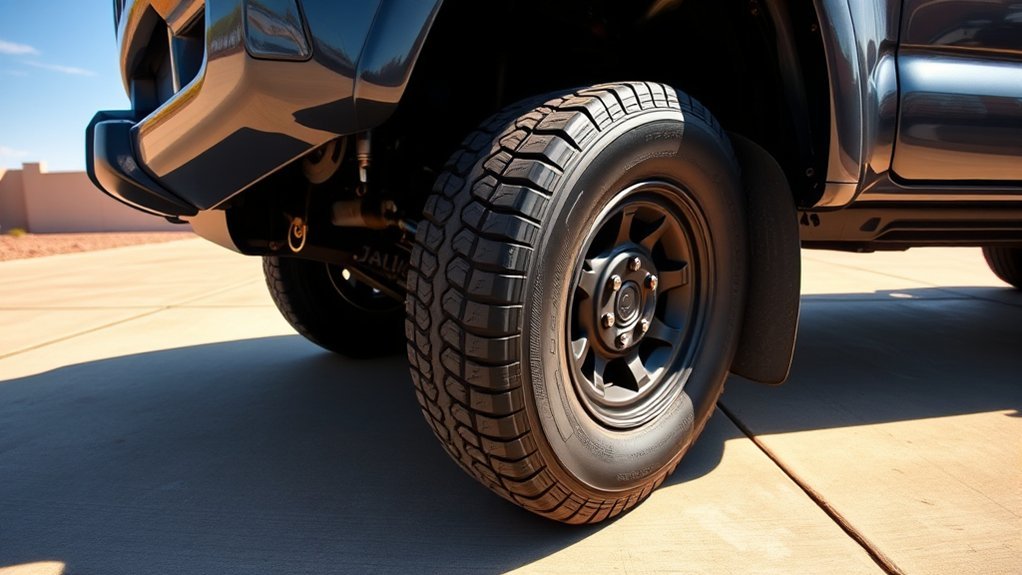
Before you rotate, look at the tire sidewalls. If your tires have an arrow showing the rolling direction, they are directional. Keep each tire on the same side of the truck and swap front-to-rear only. If your tires are labeled Outside or Inside, they are asymmetrical; many can still be rotated if the correct side stays facing outward, but always follow the tire manufacturer’s instructions.
Pro Tip: Mark each tire with chalk or painter’s tape before removal: LF, RF, LR, and RR. It prevents confusion once all four wheels are off the truck.
What Tools Make Tire Rotation Easy?
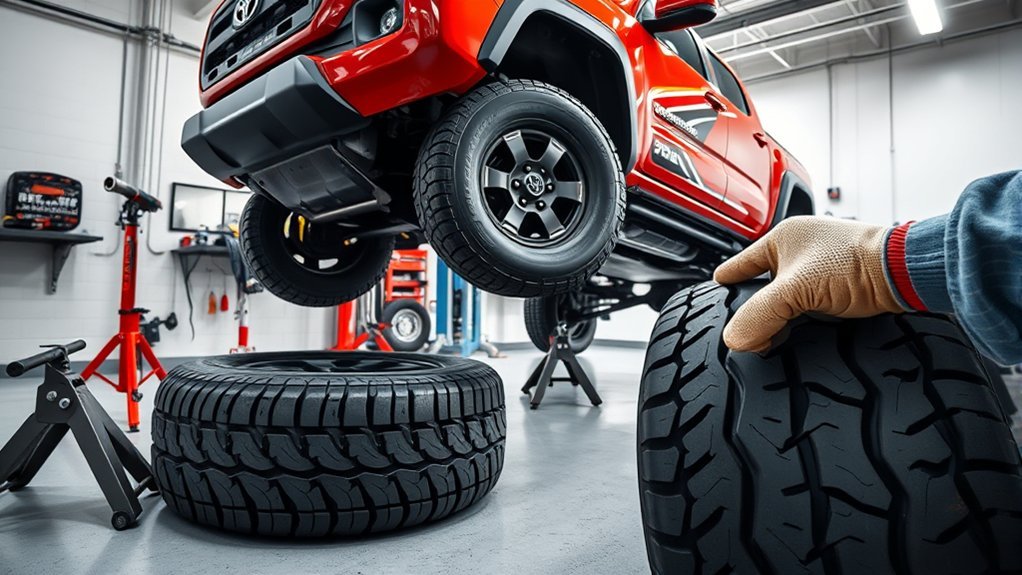
Rotating your Tacoma’s tires is straightforward, but only if you can lift and support the truck safely. The right tools make the work faster and reduce the risk of damaged studs, loose lug nuts, or personal injury.
[Products Worth Considering]

This AstroAI digital tire pressure gauge delivers factory-calibrated readings with dependable ±1 PSI accuracy, helping you keep cars, trucks, motorcycles, and spare tires at the right pressure. Its bright backlit LCD and illuminated nozzle make nighttime checks easy, while the one-button unit switch and auto-off design add convenience and battery efficiency for routine maintenance.
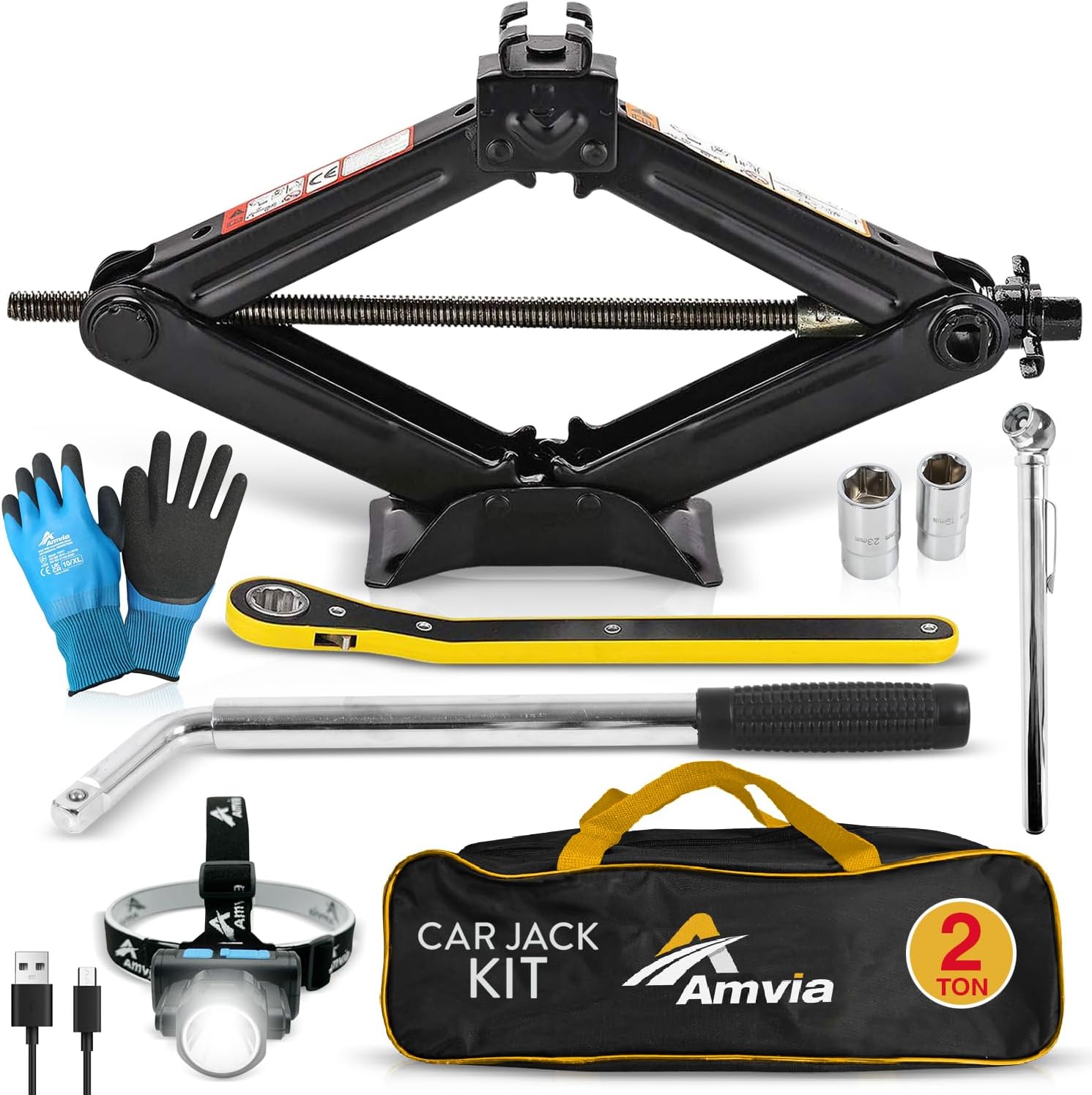
This all-in-one car jack kit is built to help drivers handle flat tire emergencies quickly and safely. It includes a 2 ton scissor jack, telescopic lug wrench, USB rechargeable LED headlamp, tire pressure gauge, gloves, and a storage bag for organized trunk storage. Designed for a wide range of vehicles, it offers a compact, portable solution for roadside tire changes day or night.
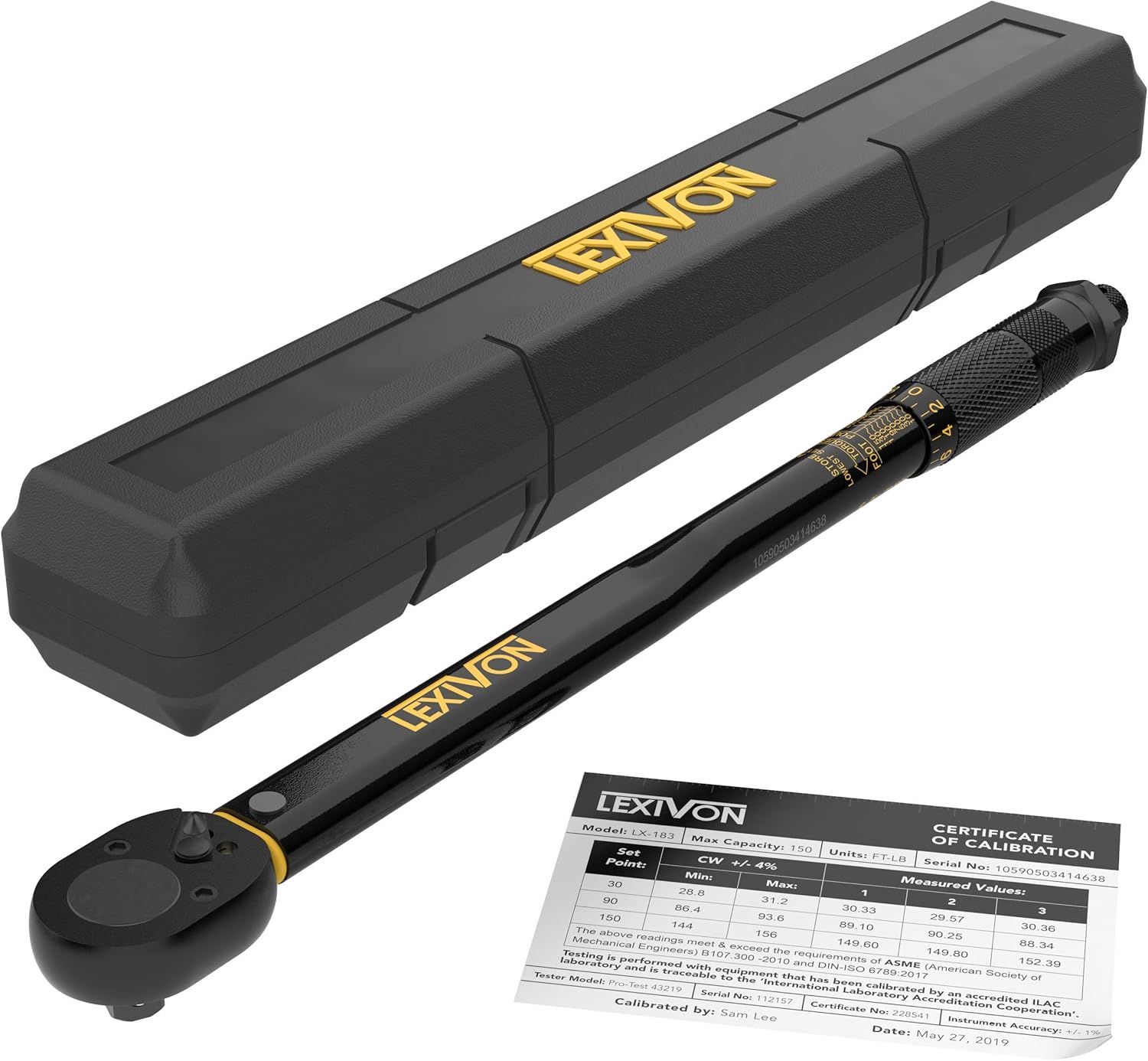
The LEXIVON 1/2-inch drive click torque wrench delivers accurate, dependable tightening for automotive and mechanical jobs with pre-calibrated precision. Its dual-range scale, reversible ratchet head, and ergonomic knurled handle make it easy to set, read, and use comfortably in a variety of applications. Built with hardened chrome vanadium steel and a corrosion-resistant finish, it is designed for lasting performance and reliability.
Essential Tools Required
- Hydraulic floor jack or Toyota-approved jack: Use the correct jacking points listed for your Tacoma.
- Four jack stands: Choose stands rated for the truck’s weight. A jack is for lifting, not supporting.
- Wheel chocks: Chock the wheels that remain on the ground before lifting.
- Lug wrench, breaker bar, or impact wrench: Use these to loosen lug nuts before the wheel leaves the ground.
- Torque wrench: Final tightening must be done with a torque wrench, not by guessing with an impact gun.
- Tire pressure gauge: Check and adjust pressure after the tires move to their new positions.
- Chalk, tape, or marker: Label each tire’s starting position before removal.
Safety Equipment Importance
Safety equipment matters because tire rotation puts your Tacoma in the air while you work around heavy wheels. Park on a level, solid surface, shift to Park or first gear for a manual transmission, set the parking brake, and chock the wheels before lifting.
Never crawl under the truck or place any part of your body under a wheel area while the Tacoma is supported only by a jack. Use jack stands on approved support points, and give the truck a gentle stability check before removing wheels.
Tire Pressure Management
Pressure should be checked when the tires are cold. NHTSA explains that a cold tire has not been driven for at least three hours, and that the vehicle manufacturer’s recommended pressure should be found on the tire information placard, certification label, or owner’s manual. For your Tacoma, use the pressure listed on the driver-side door placard unless your tire or wheel setup requires professional guidance.
Do not inflate to the maximum pressure printed on the tire sidewall unless that number matches the vehicle’s requirement for your load and tire setup. The sidewall number is the tire’s maximum rating, not the Tacoma’s normal recommended pressure.
Step-by-Step Guide to Rotating Your Tacoma’s Tires
Use these steps for a Tacoma with same-size, non-directional tires and the rearward cross pattern. If your tires are directional, staggered, or specialty off-road tires with a tire-maker-specific pattern, follow the tire maker’s rotation instructions instead.
[Products Worth Considering]

The DEWALT 20V MAX XR 1/2-inch high torque impact wrench delivers powerful fastening and breakaway performance for demanding jobs like wheel lugs, pipe flanges, and anchor setting. Its 4-mode control, variable speed trigger, and precision wrench mode help improve accuracy and reduce overtightening, while the on-tool LED light boosts visibility in dark work areas. Built with a brushless motor, battery guard, and durable housing, it is designed for tough jobsite use.
This pair of front axle shaft nuts is designed to secure CV joints and wheel bearings on compatible Toyota and Lexus front drive axles. Built from heat-treated carbon steel for durability and corrosion resistance, it helps maintain proper torque and reliable power transfer. It is a direct replacement for several factory part numbers and is recommended for paired replacement.

This cordless 1/2-inch impact wrench delivers powerful torque for car maintenance, tire changes, and everyday repair work. Compatible with DeWalt 20V batteries, it features a brushless motor, variable speed control, auto-stop, and a built-in LED light for better visibility. Designed as a bare tool for flexible use, it offers strong performance in a compact, ergonomic form.
Tools Required For Rotation
Gather your tools before loosening any lug nuts:
- Hydraulic jack or the Tacoma’s approved jack
- Four properly rated jack stands
- Wheel chocks
- Lug wrench, breaker bar, or impact wrench
- Torque wrench
- Tire pressure gauge
- Chalk, tape, or marker
Rotation Patterns Explained
For the standard rearward cross pattern, remember this simple rule: rear tires go straight forward; front tires cross to the rear. That means the left rear becomes the left front, the right rear becomes the right front, the left front becomes the right rear, and the right front becomes the left rear.
If your tires are directional, do not use that cross pattern. Instead, keep the tires on the same side and swap front-to-rear. If the tire sizes differ front and rear, do not move them to the other axle unless the tire and wheel manufacturer says it is safe.
How to Rotate the Tires
- Park safely. Use a flat, solid surface. Set the parking brake and chock the wheels.
- Check the tire sidewalls. Look for directional arrows, “Outside/Inside” markings, unusual sizes, or damaged areas.
- Label each tire. Mark the current positions as LF, RF, LR, and RR.
- Loosen lug nuts slightly. Break each lug nut loose about a quarter turn while the tire is still touching the ground. Do not remove the nuts yet.
- Lift and support the Tacoma. Use approved jacking points and place the truck securely on jack stands.
- Remove the wheels. Keep lug nuts organized and inspect studs, lug nuts, wheels, and tire sidewalls.
- Inspect tread and damage. Look for nails, cuts, bulges, cracks, exposed cords, cupping, and uneven shoulder wear.
- Move the tires into the new positions. For rearward cross, rear tires go straight to the front and front tires cross to the rear.
- Hand-start the lug nuts. Thread each lug nut by hand first to avoid cross-threading.
- Snug in a star pattern. Lightly tighten the lug nuts in a crisscross sequence while the truck is still raised.
- Lower the truck enough for the tires to touch. Do not put the full weight on the wheels until the lug nuts are seated evenly.
- Torque the lug nuts. Use a torque wrench and tighten in a star pattern to the wheel-nut torque specification listed for your exact Tacoma wheel setup.
- Set tire pressure. Adjust cold pressure to the driver-side door placard value for the new positions.
- Test drive carefully. Listen for noise, feel for vibration, and recheck the lug nuts if anything feels unusual.
Warning: Do not use an impact wrench for final tightening. Impact tools can over-tighten lug nuts, damage wheel studs, or leave clamping force uneven. Final tightening should be done with a calibrated torque wrench.
Essential Tips for Tire Maintenance Post-Rotation
After rotating your Tacoma’s tires, spend a few minutes checking the details that affect safety and tire life.
- Check pressure when cold: Use the driver-side placard pressure, and remember to check the spare if it is part of your rotation or used for emergency duty.
- Measure tread depth: NHTSA’s tire safety guidance explains that tires are generally worn out at 2/32 inch of remaining tread. The penny test can help, but a tread-depth gauge is more accurate.
- Inspect wear bars: Toyota’s 2025 Tacoma tire guidance notes that treadwear indicators show when tires need replacement.
- Watch for alignment symptoms: Pulling, crooked steering wheel position, feathered edges, or one-shoulder wear point to alignment or suspension issues.
- Keep records: Write down the date, mileage, rotation pattern, and tire pressures. This helps you stay on Toyota’s 5,000-mile/six-month maintenance rhythm.
- Inspect after off-road driving: Toyota’s maintenance guide calls for daily checks after driving off-road through deep sand, mud, or water, including brake components, differential oil, drive shaft boots, steering linkage, transfer case oil on 4WD models, and chassis/body fasteners.
Common Mistakes to Avoid When Rotating Tacoma Tires
- Using the wrong pattern: Rearward cross is right for many Tacoma setups, but not for every tire. Directional tires need same-side rotation.
- Skipping torque specs: “Good and tight” is not a safe measurement. Use a torque wrench.
- Ignoring tire pressure after rotation: Pressure should match the Tacoma placard for the tire’s new position and load use.
- Rotating damaged tires: Rotation should not hide a tire with bulges, cords, puncture damage, or severe uneven wear.
- Forgetting the spare: If your Tacoma has a matching full-size spare and you choose a five-tire rotation, check its age, tread depth, and pressure first. Do not include a temporary-use spare in a regular rotation pattern.
- Assuming rotation fixes alignment: If wear is already uneven, the tire may continue to wear poorly until the alignment, balance, or suspension issue is corrected.
Frequently Asked Questions
What is the best tire rotation pattern for a 4×4 Toyota Tacoma?
For a 4×4 Tacoma with same-size, non-directional tires, the best general pattern is the rearward cross pattern. Move the rear tires straight to the front, then cross the front tires to the opposite rear positions. Directional or staggered tires need a different pattern.
What does Toyota recommend for 2025 Tacoma tire rotation?
Toyota’s 2025 Tacoma maintenance guide lists tire rotation at each 5,000-mile service interval, and Toyota recommends scheduled maintenance every 5,000 miles or six months, whichever comes first. For the exact pattern, match the rotation method to your tire type and wheel setup.
Why do some Toyota tire rotations go front-to-back instead of crosswise?
Front-to-back rotation is used when tires must stay on the same side, such as many directional tires. A Tacoma with same-size, non-directional tires can usually use the rearward cross pattern, but directional tires should not be crossed unless they are dismounted and remounted correctly.
Can I include the spare tire in my Tacoma rotation?
Only include the spare if it is a matching full-size tire with the same size, type, load rating, tread pattern, and safe condition as the other tires. Check and adjust spare pressure first. Do not include a temporary-use spare in regular tire rotation.
Should I rotate tires before or after an alignment?
If the tires show abnormal wear, pulling, or a crooked steering wheel, have the alignment and suspension checked before relying on rotation. Rotation can move the tires around, but it will not correct the mechanical issue that caused the uneven wear.
How do I know if my Tacoma tires are directional?
Look for an arrow or the word “Rotation” on the sidewall. That arrow shows the direction the tire must roll when driving forward. Directional tires should stay on the same side of the truck unless a tire professional dismounts and remounts them correctly.
Conclusion
Keeping your 2025 Toyota Tacoma’s tires in top shape is simple when you follow the right pattern and schedule. For most same-size, non-directional Tacoma tires, the rearward cross pattern is the correct choice: rear tires move straight forward, and front tires cross to the rear. Rotate them every 5,000 miles or six months, check pressure when cold, inspect tread and sidewalls, and use a torque wrench every time the wheels come off. That small routine helps protect tire life, handling, braking, and confidence on the road or trail.
Sources
- Toyota 2025 Tacoma Warranty & Maintenance Guide — verifies the 5,000-mile/six-month scheduled maintenance interval and tire rotation at each 5,000-mile service interval.
- Toyota Owners: 2025 Tacoma Tires — supports tire inspection guidance, treadwear indicators, uneven wear checks, and spare tire pressure checks.
- U.S. Tire Manufacturers Association Tire Care and Safety Guide — supports rearward cross rotation patterns, directional tire restrictions, full-size spare guidance, and pressure adjustment after rotation.
- NHTSA TireWise — supports tire pressure, TPMS, vibration/noise warning signs, tread checks, and tire maintenance safety.
- NHTSA Tire Safety Brochure — supports cold tire pressure checks, vehicle placard pressure guidance, treadwear indicators, 2/32-inch replacement threshold, and the penny test.