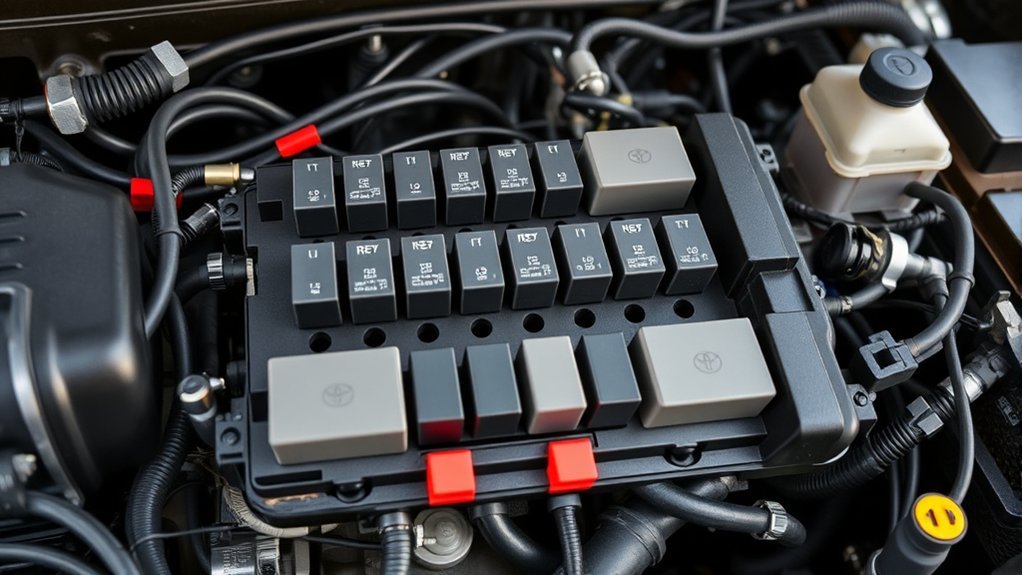
Relays are small electrical switches that help your Toyota Tacoma run high-current parts, such as lights, motors, pumps, and accessories, without sending all that current through delicate switches and control modules. The exact relay locations and labels depend on the Tacoma model year and trim, so the fuse-box cover and your owner’s manual should always be your final reference.
Quick Answer
Toyota Tacoma relays are usually found in the engine-compartment fuse/relay boxes and in interior fuse panels. They control circuits such as the horn, lights, starter-related circuits, fuel-system power, fans, outlets, and accessories. To diagnose one, identify the relay by the fuse-box label, test the circuit safely, then replace it only with the correct Toyota or equivalent relay.
Key Takeaways
- Tacoma relay locations vary by model year, so use the fuse-box lid diagram and Toyota’s official owner’s manual library for your exact truck.
- A relay lets a low-current signal control a higher-current circuit, which helps protect switches and control electronics.
- Common relay-related symptoms include a no-start condition, dead accessories, inoperative lights, clicking noises, or intermittent operation.
- Never “upgrade” a factory relay by guessing. Match the pin layout, coil voltage, current rating, and any built-in diode or resistor design.
- If a relay or fuse fails again after replacement, diagnose the underlying circuit instead of installing a higher-rated part.
At a Glance
| Time Required | 10–30 minutes for basic inspection or relay swapping |
| Difficulty | Easy for visual checks; moderate for multimeter testing |
| Tools Needed | Owner’s manual, fuse-box lid diagram, flashlight, needle-nose pliers or fuse puller, multimeter, and the correct replacement relay |
| Cost | Usually $0 for testing; commonly $10–$40 for a replacement relay, depending on part type and source |
Warning: Turn the truck off before opening fuse boxes or removing relays. Do not modify fuse boxes, bypass a relay, replace a fuse with wire, or install a higher-amperage fuse than specified. Toyota warns that incorrect fuse repairs can damage the vehicle and may create a fire or injury risk.
The Role of Relays in Your Tacoma’s Electrical System
In your Toyota Tacoma, a relay works like a remote-controlled switch. A small control signal energizes the relay coil, and the relay contacts then open or close a separate circuit that can carry more current. That design is common in automotive electrical systems because it keeps high electrical loads away from small dashboard switches, steering-column controls, and electronic modules.
Relays may be used for circuits such as exterior lighting, horn operation, blower motors, cooling fans, power outlets, accessory feeds, starter-related control circuits, and fuel-system power. The exact list changes by generation, engine, trim, drivetrain, and optional equipment.
The best relay diagram is not a generic internet chart. It is the diagram printed on your Tacoma’s fuse-box cover and the official owner’s manual for your model year.
Where to Find Relays in a Toyota Tacoma
Most Tacoma owners will find relays in the same general areas as the fuse boxes, but there is no single universal location for every Tacoma year. Toyota’s 2025 Tacoma fuse-service instructions, for example, identify engine-compartment fuse boxes, a passenger-side instrument-panel fuse area, and an under-right-rear-seat fuse area on vehicles with rear seats.
Older Tacoma generations commonly use an engine-compartment fuse/relay box and an interior fuse panel under or near the instrument panel. Some relays may be built into larger integration modules rather than appearing as simple plug-in cubes.
Common Tacoma Relay and Fuse Panel Areas
- Engine compartment: Often near the battery or along the side of the engine bay. This area commonly houses higher-load circuits.
- Interior fuse panel: Usually under the dashboard, behind a trim cover, or near the kick panel, depending on the generation.
- Passenger-side instrument-panel area: Used on some newer Tacoma models.
- Rear-seat area: Some newer Tacomas with rear seats include a fuse area under the right-hand rear seat.
- Integrated relay modules: Some circuits may be controlled by a body ECU, integration relay, or module rather than a replaceable standalone relay.
Note: If your Tacoma’s fuse-box lid uses abbreviations, match them with the owner’s manual before removing parts. Labels such as HORN, EFI, IG, ACC, P/OUTLET, FAN, or HEAD may appear differently across years.
Identifying and Testing Relays in Your Tacoma
Before testing, confirm the symptom. A dead horn, inoperative light, no-start condition, or accessory failure does not automatically mean the relay is bad. The problem could be a blown fuse, weak battery, corroded ground, damaged wiring, failed switch, bad motor, faulty bulb, or a control-module issue.
[Products Worth Considering]

This 26-piece terminal removal tool kit is designed to help you depin and service automotive wire connectors with greater speed and accuracy. It supports a wide range of connector types used in cars, trucks, motorcycles, and other equipment, while the organized case keeps each tool easy to find and carry. Built for reliable, damage-free terminal removal, it is a practical choice for professional electrical work and DIY wiring repairs.

This compact relay tester quickly checks the condition of most common 12-volt 4- and 5-pin automotive relays outside the vehicle. It provides self-contained testing without needing to connect to the battery, helping you identify coil and contact issues fast. Clear green and red LED indicators make pass or fail results easy to read, and the included batteries let you start using it right away.

This automotive circuit tester checks low-voltage DC systems from 3-65V, making it useful for diagnosing headlights, taillights, fuses, sockets, and other vehicle wiring issues. The digital backlit display provides clear voltage readings with fine accuracy, while the bidirectional polarity indicator helps you test from either ground or positive. Built with a durable probe, insulated tip, and extra-long spring wire, it is designed for dependable everyday use in automotive and household electrical work.
Step 1: Identify the Correct Relay
Turn the vehicle off and open the appropriate fuse or relay box. Use the diagram on the cover first, then verify the abbreviation in the owner’s manual. If the lid is missing or unreadable, use Toyota’s official manual source for your exact model year rather than relying only on a generic diagram.
Step 2: Inspect the Relay and Socket
Look for melted plastic, heat discoloration, green or white corrosion, loose terminals, water intrusion, or a relay that does not sit firmly in its socket. A relay that repeatedly overheats usually points to a circuit problem, not just a weak relay.
Step 3: Check Related Fuses First
If the component is completely dead, check the related fuse before blaming the relay. Toyota’s fuse instructions state that fuses are designed to blow to protect the wiring harness from damage. If a replacement fuse blows again, the circuit needs diagnosis.
Step 4: Use the Swap Test Carefully
If your Tacoma has another relay with the same part number, same pin layout, and same rating, you can temporarily swap it with the suspect relay. If the failed circuit starts working and the other circuit stops working, the relay is likely bad.
Warning: Do not swap relays just because they are the same size. Two relays can look identical but have different internal wiring, suppression diodes, resistors, or current ratings.
Step 5: Test With a Multimeter
A basic relay test checks the coil side and the switched-contact side. With the relay removed, identify the coil terminals and contact terminals from the relay diagram printed on the case or from service information. A multimeter can check coil resistance and whether the relay contacts open or close when the coil is energized with the proper voltage.
If you are not comfortable identifying terminals, energizing a relay, or reading wiring diagrams, it is safer to have a qualified technician test it. Incorrect testing can short a circuit, damage a control module, or blow fuses.
Common Relay Types in a Toyota Tacoma
The relay names below are common in automotive systems, but your Tacoma may use different abbreviations or may control some circuits through modules instead of replaceable plug-in relays.
Starter-Related Relays
Starter-related relays help control the starting circuit. A failure may cause a click, intermittent no-start, or no response when you press the start button or turn the key. However, similar symptoms can also come from a weak battery, bad starter, faulty brake or clutch switch, security-system issue, or corroded cable connection.
Fuel Pump or EFI Relays
Fuel-system and EFI-related relays supply power to engine-management components. If one fails, the engine may crank without starting, stall, or lose fuel-system power. Because fuel and engine controls are safety-critical, diagnose these circuits carefully before replacing parts.
Headlight and Lighting Relays
Lighting relays can control headlamps, fog lights, or other exterior-light circuits, depending on the year and equipment. Symptoms may include one lighting function not working, intermittent lights, or a relay that clicks without the lights turning on.
Horn Relay
A horn relay lets a low-current steering-wheel horn switch control the higher-current horn circuit. If the horn does not work, check the fuse, relay, horn unit, steering-wheel switch circuit, and wiring before replacing parts.
Accessory and Power Outlet Relays
Accessory relays help power circuits that operate with the ignition in ACC or ON. These may include outlets, infotainment-related feeds, or other convenience circuits. If several accessories fail at once, a fuse, relay, ignition feed, or ground may be involved.
Key Relay Functions: Ignition, Fuel Pump, and Accessories
Ignition, fuel-system, and accessory circuits are among the most common areas owners suspect when a Tacoma has electrical problems. A relay in one of these circuits can make the difference between a working system and a completely dead component.
- Ignition-related control: Helps distribute power when the ignition is in the correct position. A fault can mimic battery, starter, or switch problems.
- Fuel-system power: Helps supply power to fuel and engine-management components when commanded by the vehicle’s control system.
- Accessory operation: Allows items such as outlets and convenience features to receive power only when the vehicle is in the proper mode.
- Lighting and horn circuits: Let small switches control higher-current electrical loads.
Because many modern Tacoma circuits are computer-controlled, a relay may not receive power until the ECU or body control system commands it. That means a “dead” relay socket can be caused by a missing command signal, not necessarily by a bad relay.
Troubleshooting Common Relay Issues
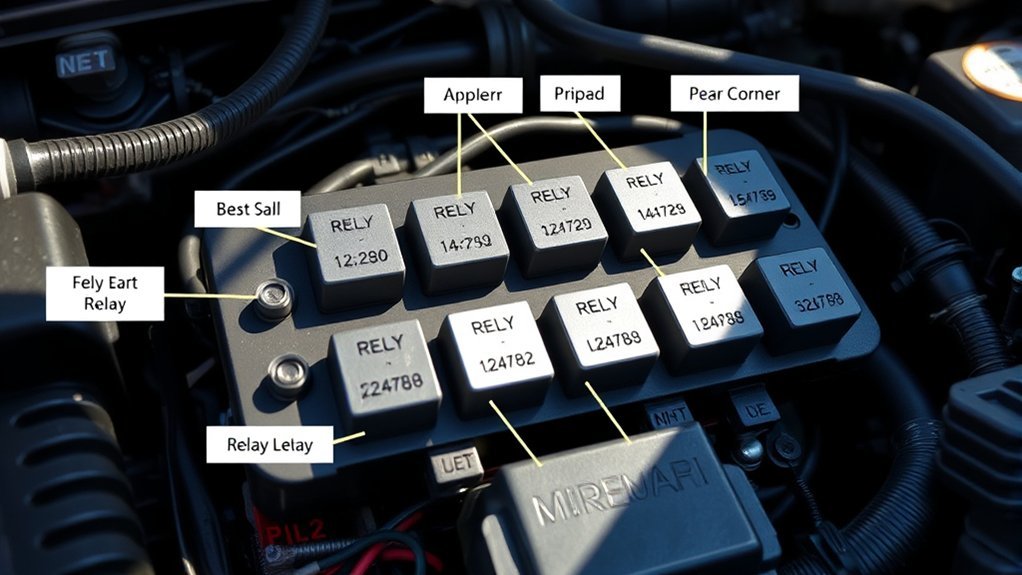
Relay troubleshooting works best when you follow the symptom instead of guessing. Start with the simplest checks: battery voltage, visible corrosion, related fuses, fuse-box labels, and whether the same component works intermittently.
Symptom: Relay Clicks but Component Does Not Work
A click means the relay coil may be energizing, but it does not prove the load side is good. The relay contacts could be burned, the fuse may be open, the load may have failed, or wiring between the relay and the component may be damaged.
Symptom: No Click and No Operation
If the relay never clicks, the relay coil may not be receiving power or ground. Possible causes include a blown fuse, faulty switch, control-module command issue, broken wire, bad ground, or a failed relay coil.
Symptom: Intermittent Operation
Intermittent relay problems often come from heat, vibration, loose terminals, corrosion, failing contacts, or an overloaded circuit. Try to note whether the problem happens when the truck is hot, when driving over bumps, after rain, or only with certain accessories turned on.
Symptom: Replacement Relay Fails Again
If the new relay fails quickly, stop replacing parts and inspect the circuit. Repeated failures can point to excessive current draw, a short, a binding motor, water intrusion, a poor ground, or a non-factory accessory wired into the wrong circuit.
Pro Tip: Take a clear photo of the fuse box before removing relays. It gives you a fast reference if multiple relays are pulled or if a cover diagram is hard to read.
How to Replace a Tacoma Relay Safely
Replacing a plug-in relay is usually simple, but choosing the wrong replacement can create new electrical problems. Use the relay part number, Toyota parts catalog information, or a trusted equivalent from a reputable supplier.
- Turn the vehicle off. Remove the key or keep the smart key away from the truck if needed.
- Open the correct fuse or relay box. Use the lid diagram and owner’s manual to confirm the relay position.
- Inspect the area. Look for corrosion, water, heat damage, or loose sockets before pulling the relay.
- Remove the relay straight out. Use gentle pressure and avoid twisting the terminals.
- Compare the replacement. Confirm the same terminal layout, voltage, current rating, and internal circuit symbol.
- Install the relay fully. It should seat firmly without forcing it.
- Test the circuit. Verify normal operation and recheck if the relay gets unusually hot.
- Reinstall the cover. Fuse-box covers help protect terminals from dirt and moisture.
[Products Worth Considering]

The V500 Pro is an all-in-one automotive electrical diagnostic tool that combines circuit testing, wire tracing, oscilloscope analysis, multimeter functions, injector testing, relay and fuse checks, and component activation in one device. It helps technicians and DIY users quickly find open circuits, short circuits, broken wires, and current leaks while reducing disassembly and guesswork. With a rotating screen, built-in flashlight, and adjustable low-voltage power supply, it is designed to speed up troubleshooting in tight and low-light work areas.

This 12V relay box provides six organized relay slots and six fuse positions, helping you build cleaner, safer electrical setups for vehicles and marine systems. Pre-wired, color-coded 12 AWG wiring simplifies installation while the sealed cover and gasket help protect against dust and splashing water in demanding environments. It is a versatile solution for controlling lights, pumps, motors, and other accessories in automotive, truck, RV, or boat applications.

This Titan Series cargo net is designed to help secure gear in the short bed of compatible Toyota Tacoma trucks with factory deck rails. It features a tighter grid, oversized premium bungee, upgraded carabiners, and patented bed rail integration for a strong, reliable hold. Built for heavy-duty use and backed by a lifetime warranty, it offers a no-hardware solution for organizing cargo with confidence.
How to Upgrade Your Tacoma’s Relays for Better Performance
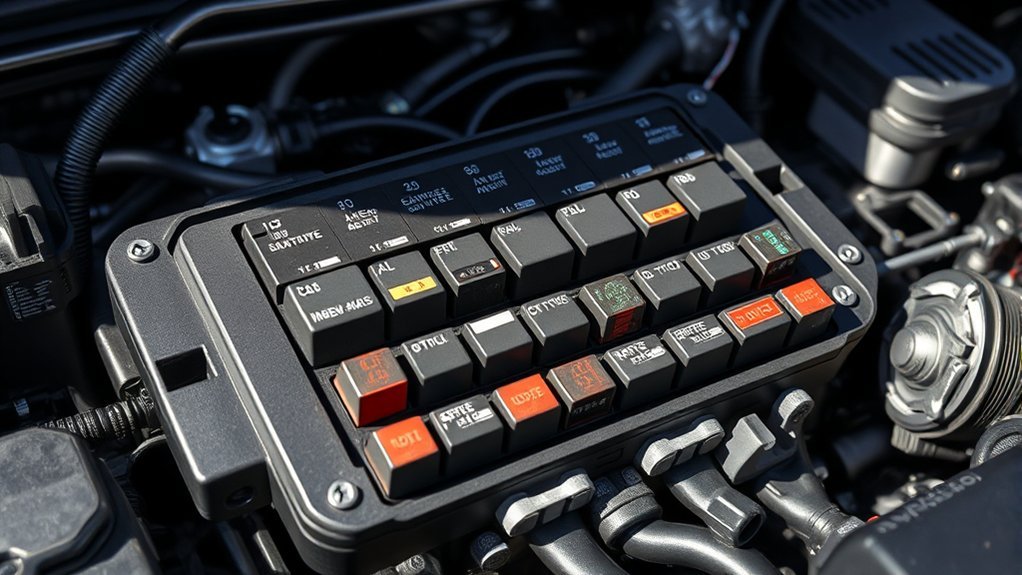
For factory circuits, the best “upgrade” is usually not a higher-rated relay. It is a correct, high-quality replacement relay that matches the original specification. DENSO, an original-equipment automotive supplier, notes that automotive relays are designed to let a small electrical signal manage a more powerful current, and its replacement relays are engineered around heat, arcing, contact force, and packaging requirements.
If you are adding accessories such as auxiliary lights, an air compressor, a winch controller, or an aftermarket horn, use a dedicated fused relay harness sized for the accessory. That approach protects the Tacoma’s factory wiring and avoids overloading existing circuits.
[Products Worth Considering]

This 4-piece automotive electrical disconnect pliers set helps safely remove stubborn push-tab connectors from mass air flow sensors, fuel injectors, and ignition coils without damaging delicate tabs. It includes straight and 60-degree angled pliers, a hose clamp plier, and a dual-ended terminal pin remover to handle a wide range of under-hood wiring tasks. Organized in a rugged storage case, it is built for mechanics and DIYers who need reliable access to tight engine bay spaces.

This automotive test light combines a bright LED voltage display with quick polarity indication for fast, accurate circuit checks in a wide range of vehicle systems. It helps diagnose battery, charging, lighting, and fuse issues with a sharp stainless probe, long spring wire, and easy-to-use alligator clip for efficient troubleshooting.
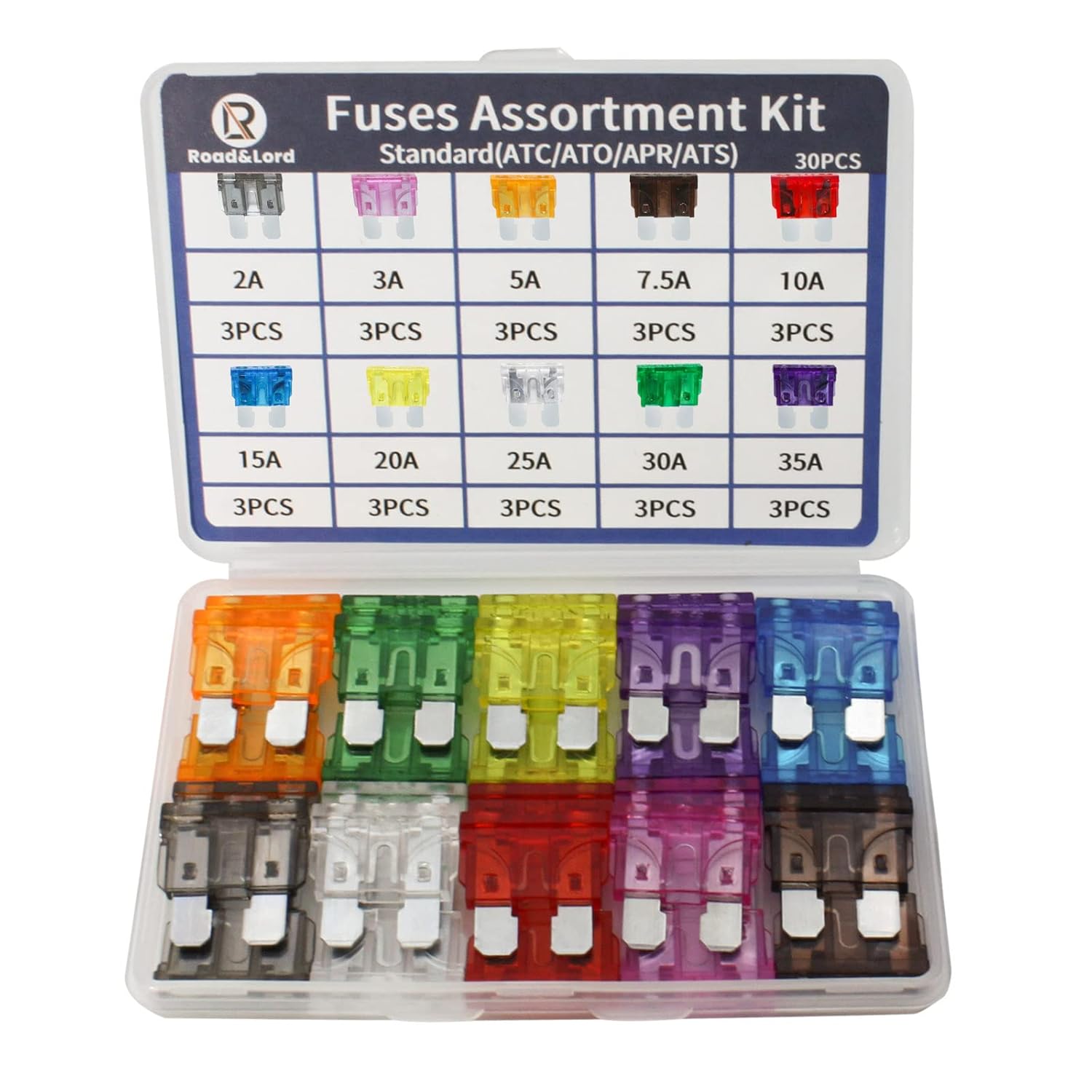
This standard blade fuse assortment kit provides a convenient selection of common amp ratings to help protect vehicle electrical systems from overloads, short circuits, and wiring damage. With transparent, color-coded housings and clearly marked ratings, it makes blown fuse replacement fast and easy for cars, trucks, boats, RVs, and other DC applications. The durable compact case keeps the fuses organized for reliable storage and quick access when needed.
Safe Upgrade Rules for Aftermarket Accessories
- Use a dedicated fused power feed from the battery or approved power source when the accessory requires it.
- Size the wire correctly for the current draw and circuit length.
- Install the fuse close to the power source so the wiring is protected.
- Use weather-resistant connectors in the engine bay or underbody areas.
- Ground the circuit properly to clean, secure metal or an approved ground point.
- Do not tap safety-critical circuits such as airbags, ABS, stability control, or engine-management wiring.
Warning: A higher-current relay does not make factory wiring safe for higher current. The fuse, wire gauge, connector, switch, and load must all be rated for the circuit.
Best Practices for Maintaining Your Tacoma’s Electrical System
Relay life depends on heat, current load, vibration, moisture, and the condition of the circuit it controls. Routine electrical maintenance helps prevent small problems from turning into no-starts, dead accessories, or repeated fuse failures.
- Keep the battery terminals clean and tight. Low voltage can cause strange electrical symptoms that look like relay problems.
- Keep fuse-box covers installed. Covers protect relays and fuses from moisture, dirt, and accidental contact.
- Fix water leaks quickly. Moisture inside a fuse box or cabin panel can corrode terminals and create intermittent faults.
- Use the correct fuse rating. Toyota states that higher-rated fuses or substitute objects should not be used in place of the specified fuse.
- Inspect aftermarket wiring. Poorly installed lighting, audio, dash cams, and bed accessories can overload factory circuits.
- Do not ignore repeat failures. A relay or fuse that fails again is a diagnostic clue, not a request for a stronger part.
When to See a Mechanic
Basic relay replacement is a reasonable DIY job for many Tacoma owners, but some symptoms deserve professional diagnosis. See a qualified technician if the truck has a no-start condition, repeated fuse failures, burning smells, melted terminals, warning lights, water-damaged fuse boxes, or suspected ECU/body-control issues.
You should also get help if the relay appears to be part of an integrated module. Replacing a module can require service information, calibration, initialization, or diagnostic scan tools.
Frequently Asked Questions
Where is the relay box located in my Tacoma?
It depends on the model year. Most Tacomas have relays in the engine-compartment fuse/relay box and in an interior fuse panel. Some newer models also have fuse locations near the passenger-side instrument panel or under the right-hand rear seat on vehicles with rear seats. Use the fuse-box cover and official owner’s manual for your exact Tacoma.
How do I know if a relay is faulty?
Common signs include a component that will not work, intermittent operation, a relay that clicks but does not power the load, or a circuit that works after swapping in an identical known-good relay. Always check related fuses, battery voltage, grounds, wiring, and the component itself before blaming the relay.
Can I replace Tacoma relays with higher-rated ones?
Do not install a higher-rated relay by guessing. The replacement must match the original circuit requirements, terminal layout, coil voltage, current rating, and internal suppression design. If you are adding an accessory, install a separate fused relay harness instead of trying to increase the capacity of a factory circuit.
Do relays have a lifespan or expiration date?
Relays do not have a simple calendar expiration date. Their life depends on switching cycles, current load, heat, vibration, moisture, and circuit condition. A relay in a clean, properly loaded circuit can last many years, while one in an overloaded or corroded circuit can fail early.
Are there any specific tools needed for relay replacement?
For a simple plug-in relay replacement, you usually need a flashlight, the fuse-box diagram, and sometimes needle-nose pliers or a fuse puller. For diagnosis, a multimeter is helpful. For complex circuits, a scan tool and factory wiring information may be needed.
Why does my replacement relay keep failing?
Repeated relay failure usually means the circuit has another problem, such as excessive current draw, a short, a poor ground, water intrusion, a failing motor, loose terminals, or an aftermarket accessory overloading the circuit. Diagnose the cause before installing another relay.
Conclusion
Understanding your Tacoma’s relays helps you troubleshoot electrical problems with less guesswork. Start with the correct diagram for your model year, check fuses and visible wiring first, and replace relays only with the correct matching part. For accessories, protect your truck by using a dedicated fused relay harness instead of overloading factory circuits. A careful, methodical approach keeps your Tacoma’s electrical system safer, more reliable, and easier to diagnose.
Sources
- Toyota Owners — Manuals and Warranties — official owner’s manual source for Tacoma model-year-specific fuse and relay information
- Toyota Owners — 2025 Tacoma Checking and Replacing Fuses — fuse-box locations, fuse replacement process, and fuse safety warnings
- DENSO Auto Parts — Relays — automotive relay function, relay design features, heat, arcing, and electrical-load information
- DENSO Electronics — Product Specs and Relay Precautions — relay specification cautions and the importance of using relays within their intended design limits