
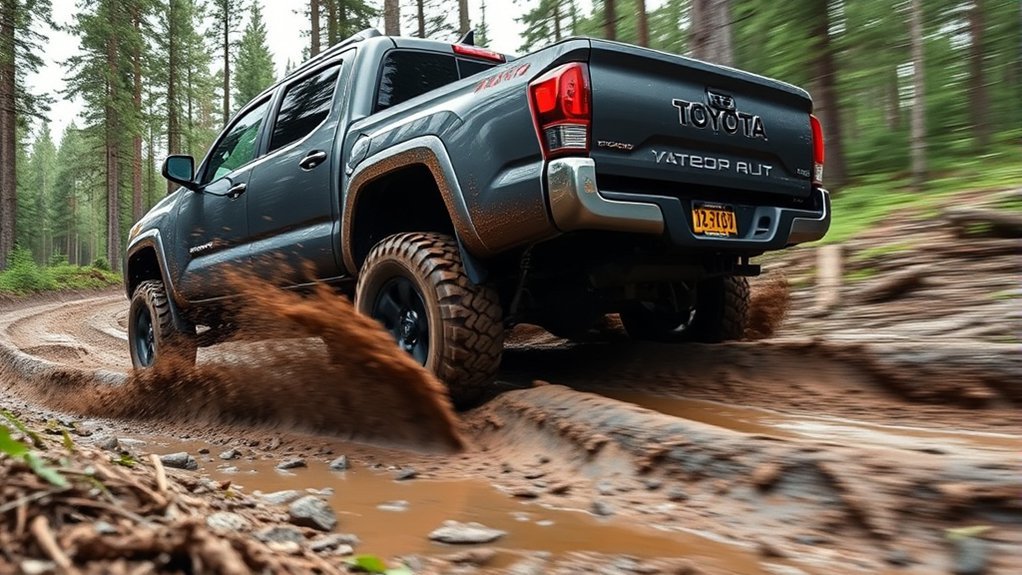
Driving a Toyota Tacoma in mud is mostly about choosing the right 4WD setting, reading the terrain before you commit, and using smooth inputs instead of panic throttle. Start with the least aggressive setup that keeps the truck moving, protect the drivetrain, and remember that deep mud can damage trails as quickly as it can trap a truck.
Quick Answer
Use 4HI for most moderate mud where momentum matters, switch to 4LO for slow, deep ruts or recovery, and use the rear locker only at very low speed when one rear tire is spinning. Air down carefully, keep steering straight, avoid wheelspin, and recover with steady, controlled moves.
Key Takeaways
- 4HI is the default mud mode for most moving sections because it keeps speed and traction balanced.
- 4LO is for slow control, deep ruts, steep climbs, careful descents, or recovery—not high-speed mud runs.
- Use the rear locker sparingly and follow your owner’s manual; Toyota warns not to lock it while wheels are spinning or drive fast with it engaged.
- Tire pressure matters, but always reinflate before road driving and never go below a pressure you can safely manage with your tire and wheel setup.
- Responsible mud driving matters: stay on legal routes, avoid sensitive wet areas, and do not widen trails by driving around obstacles.
At a Glance
| Time Required | 10–15 minutes of prep before the trail, plus post-run cleaning |
| Difficulty | Beginner to intermediate, depending on mud depth and recovery risk |
| Tools Needed | Tire gauge, portable compressor, shovel, traction boards, rated recovery strap, rated shackles, gloves, flashlight |
| Cost | Free if equipped; recovery gear and compressor commonly add $150–$500+ |
Select the Right 4WD Mode for Tacoma Mud Driving
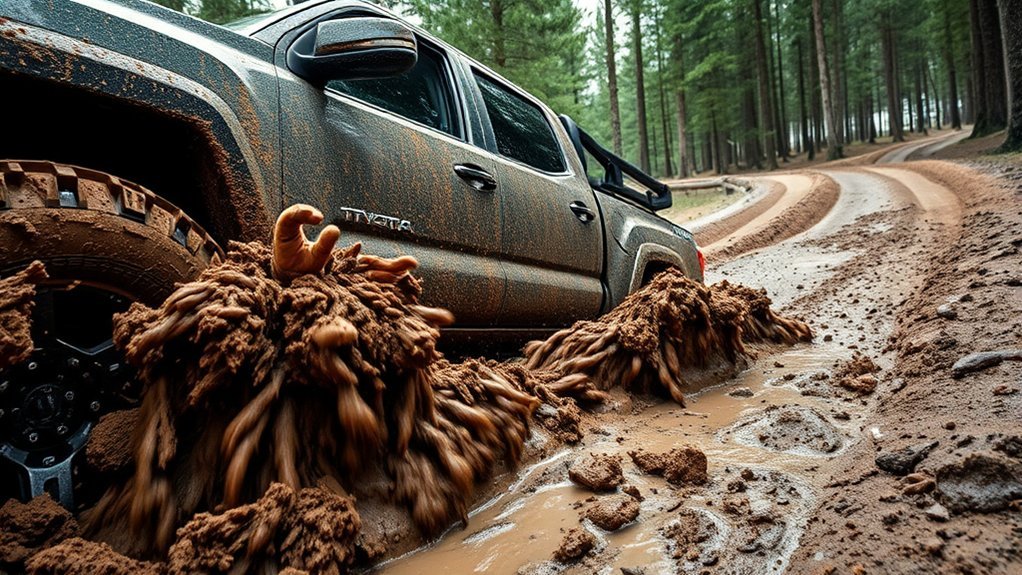
For most muddy trails, start in 4HI. It sends power to both axles while still letting you carry the steady momentum that mud often requires. Use 2WD only on shallow, firm, low-risk sections where you are practicing feel or driving on a surface that does not need 4WD.
Use 4LO when speed is no longer your friend: deep ruts, steep muddy climbs, slick descents, tight technical turns, or recovery attempts. 4LO gives more controlled low-speed torque, but it can also make it easier to dig holes if you stab the throttle.
Many Tacomas label the modes as 2H, 4H, and 4L or similar. Toyota’s owner information describes 2H as the normal mode for dry, hard-surfaced roads, while 4WD modes are for slippery or low-traction conditions. Always follow the instructions for your exact model year because transfer-case controls, Multi-Terrain Select, Crawl Control, and locker operation vary by trim.
Warning: Do not use 4WD on dry pavement unless your owner’s manual specifically allows it. Part-time 4WD systems can bind on high-traction surfaces, which may stress tires and drivetrain parts.
Do Pre-Drive Checks & Pack Recovery Gear
Before you hit mud, do a quick vehicle inspection: check fluid levels, tire pressure, tread depth, wipers, lights, recovery points, and anything hanging under the truck. Verify your Tacoma’s 4WD engages properly before you need it, and keep recovery tools where you can reach them without unloading the whole bed.
[Products Worth Considering]
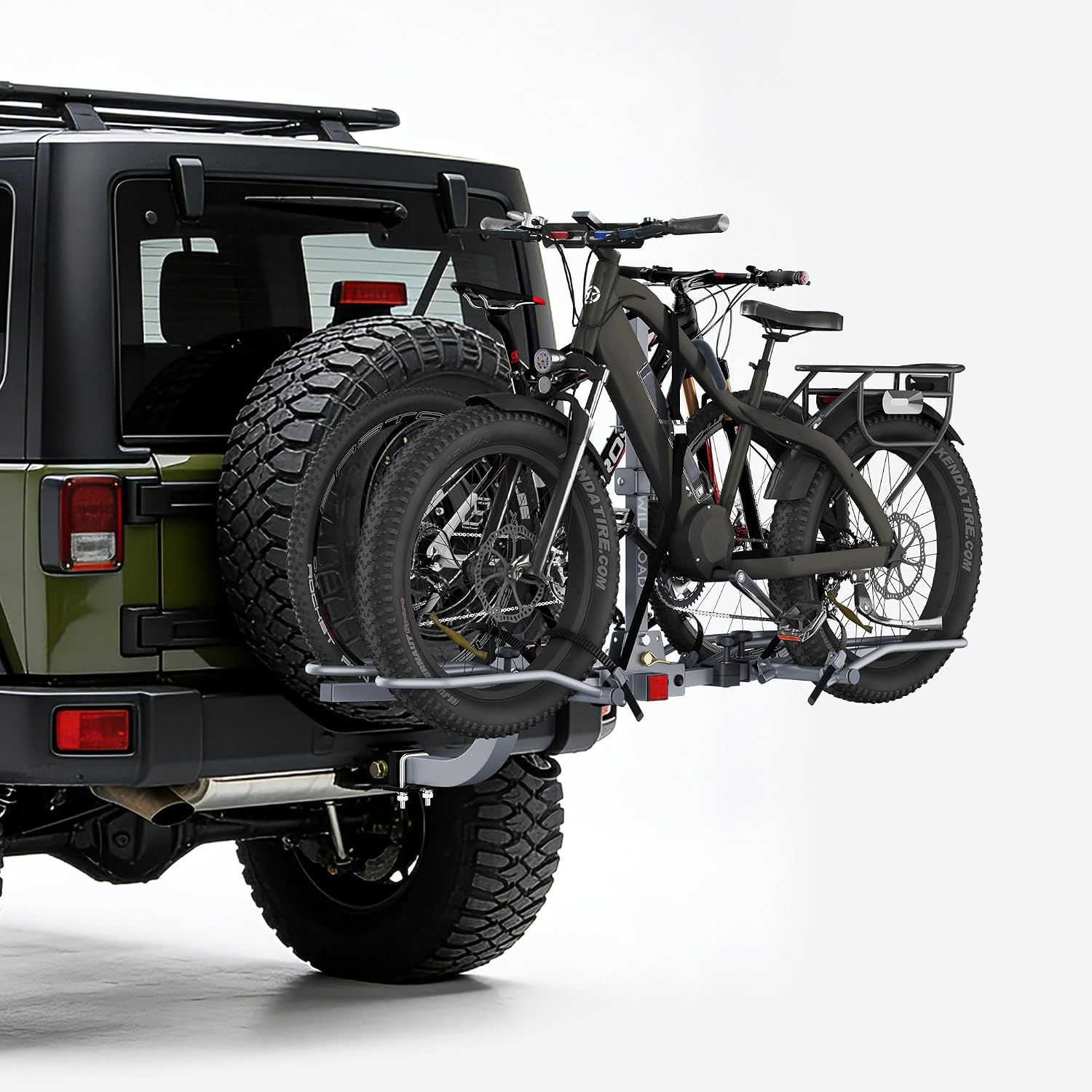
This WILDROAD 2-bike hitch rack is designed to securely carry a variety of bicycles on SUVs, trucks, and off-road vehicles. Its tilting and foldable design makes trunk access and storage easier, while adjustable hooks, tire holders, and stability features help keep bikes steady during travel.

This portable 12V tire inflator delivers fast, convenient inflation for cars, SUVs, trucks, motorcycles, and other inflatables. It features a digital display, bright LED lighting, auto shutoff, and multiple nozzle adapters to help you inflate accurately and safely, even in low-light situations. The long power cord and air hose make it easy to reach all tires and handle roadside emergencies or routine maintenance.

This Rhino USA recovery tow strap is built for reliable vehicle pulling and towing in flat recovery situations. Made from durable polyester with reinforced loop ends, it is designed to help secure safe connection points while resisting wear, abrasion, and stress during recovery use. It is a practical choice for off-road recovery, roadside assistance, and general towing needs.
Quick Vehicle Inspection
Start with a slow walkaround. Look for visible leaks, loose skid plates, damaged sidewalls, low-hanging mud flaps, and anything that could catch in ruts. Confirm your windshield washer fluid is full because mud on glass can turn a simple trail into a visibility problem.
Check tire pressure with a real gauge, not a guess. The National Highway Traffic Safety Administration recommends checking tire pressure when tires are cold and using the pressure listed on the driver-side tire placard or in the owner’s manual for normal road use.
Essential Recovery Tools
Pack a rated recovery strap, rated shackles or soft shackles, gloves, a sturdy shovel, traction boards or mats, and a portable air compressor. Add a first-aid kit, flashlight or headlamp, extra clothing, water, and a trash bag for muddy gear.
Inspect recovery gear before the trip. Replace straps with cuts, frays, melted areas, or damaged stitching. Check shackle pins and threads. Test the compressor at home so you do not discover a dead plug or blown fuse at the trailhead.
Pro Tip: Store recovery gear in the cab or at the tailgate, not buried under coolers and camping bins. When the truck is stuck in mud, easy access matters.
Prepare Tires & Pressures for Mud
Tires make the biggest difference between crawling out and digging down. Mud-terrain or aggressive all-terrain tires with open voids clear muck better than highway tires. Worn tread, cracked sidewalls, or street-focused tires reduce your margin quickly.
For mixed trail and road driving, start near your door-placard pressure and adjust only at the trailhead. For soft mud, many off-roaders air down to increase the contact patch, but there is no single safe PSI for every Tacoma. Tire size, load, wheel width, bead design, speed, and terrain all matter.
A practical range for many light off-road situations is a modest drop into the mid-20s to low-30s PSI. More aggressive airing down may help flotation, but it raises the risk of debeading, sidewall damage, heat buildup, and rim impact. Drive slowly when aired down, avoid sharp steering at speed, and reinflate before highway driving.
Note: The pressure molded on a tire sidewall is not the normal recommended driving pressure. Use the Tacoma’s tire placard or owner’s manual for road pressure, and treat off-road airing down as a temporary trail adjustment.
[Products Worth Considering]

Built for towing, winching, and off-road recovery, this D-ring shackle set delivers dependable strength in a compact, easy-to-use design. The drop-forged steel construction and protective coated finish help provide reliable performance and resistance to rust in demanding outdoor conditions. Compatible with Jeeps, ATVs, UTVs, trucks, trailers, and SUVs, it is a practical recovery accessory for everyday trail and rescue use.

These off-road traction boards are designed to help vehicles recover from mud, sand, and snow with reliable grip and easier ramp-up. Their double-sided diamond construction, cross-shaped teeth, and contoured ramps improve traction while the durable polypropylene build stays flexible in harsh conditions. Convenient mounting points, ergonomic handles, and a visible leash make them practical to carry, store, and retrieve when recovery is needed.

Read Mud: Depth, Consistency, and Choosing a Line
Before you commit, read the mud like a hazard, not a puddle. Stop in a safe spot, look for water movement, ruts, tire tracks, high-center marks, rocks, roots, and places where other vehicles have already dug holes.
Use a stick, shovel handle, or visible track depth to check how deep the mud is. Shallow, firm mud may only need steady 4HI and straight steering. Deep mud with standing water, hidden ruts, or a soft bottom may need 4LO, a different line, or a decision to turn around.
Choose firmer ground when possible. Avoid the deepest center ruts if they will high-center the truck, but do not drive off the legal trail to make a new path. Tread Lightly’s off-road guidance recommends staying on designated routes and avoiding wet, muddy trails when possible to reduce erosion and trail damage.
The best mud-driving decision is often made before the tires touch the mud: check depth, choose the firmest legal line, and know where you will exit before you enter.
Step-by-Step: Entering and Exiting Mud Safely
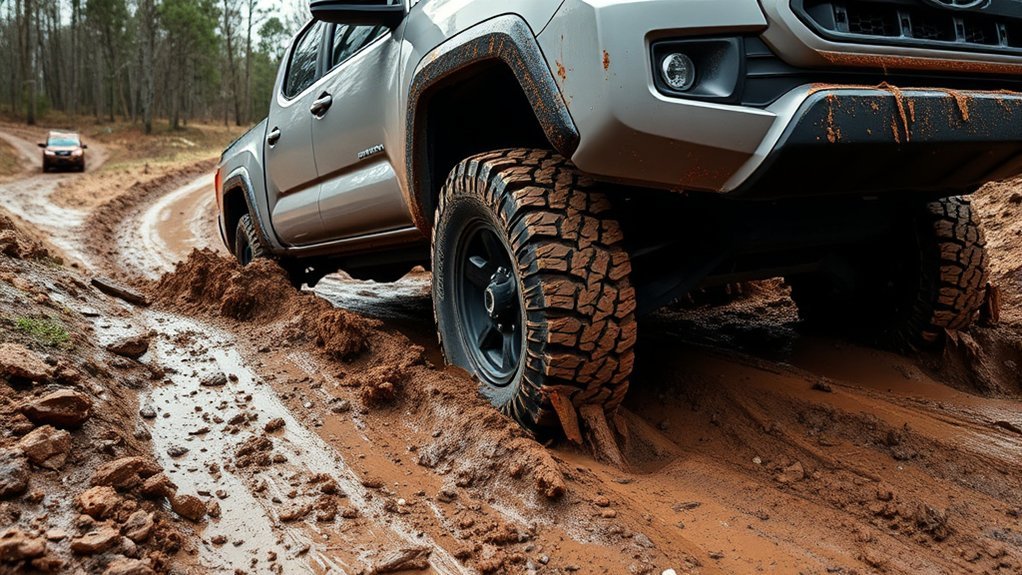
Approach mud with controlled momentum, not speed for its own sake. Keep the wheels as straight as possible, apply smooth throttle, and avoid sudden braking or steering that can turn forward motion into digging.
Enter Mud With Momentum
Line up before the mud starts. Enter at a slow-to-moderate, steady pace with the wheels straight, then hold a smooth throttle so the tires keep cleaning themselves without spinning wildly. If you feel the truck bogging, add power gently. If the tires spin fast and the truck stops moving, ease off before you dig to the frame.
Look through the mud toward the exit, not just at the hood. Keep small steering inputs and avoid sawing the wheel. Big steering angles create drag and can pull the truck into ruts.
Exit Mud With Care
As you reach firmer ground, keep the wheels straight and avoid a big throttle burst. Sudden acceleration at the exit can break traction, throw mud onto the windshield, or shove the truck sideways.
If the truck stalls, binds, or stops moving, pause. Keep the wheels straight, shift calmly, and use gentle throttle to back out if the path behind you is safe. Clear packed mud from the tread and try a better line instead of repeating the same mistake.
Throttle & Gear Control: Avoid Wheel Spin, ECT/S-Mode Tips
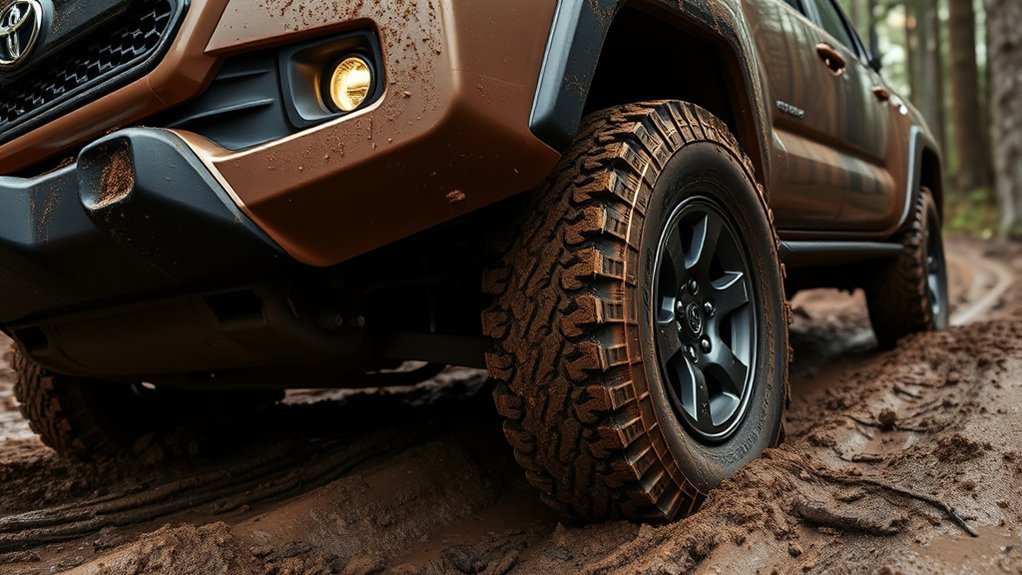
Mud rewards smooth inputs. Roll into the throttle progressively, use lower gears when needed, and avoid sudden changes that break traction. In automatic Tacomas, manual shift mode or S-Mode can help hold a gear and prevent unwanted upshifts. ECT Power, where equipped, changes throttle and shift behavior, so use it only if it helps you keep steady torque instead of making your inputs too aggressive.
- Start smooth: Press the throttle gradually to avoid instant wheelspin.
- Use lower gears: Keep the engine in a useful torque range without racing it.
- Hold a gear when needed: S-Mode or manual selection can reduce hunting between gears.
- Read tire behavior: If tires spin fast but the truck is not moving, reduce throttle and reassess.
- Use small steering corrections: Straight tires roll through mud more easily than turned tires.
Traction Control, VSC, and Off-Road Drive Settings
Modern Tacomas may include systems such as traction control, Vehicle Stability Control, Multi-Terrain Select, Crawl Control, Downhill Assist Control, or A-TRAC depending on year and trim. These features can help in some low-traction situations, but the best setting depends on your truck and the terrain.
If traction control is cutting power too aggressively in mud, using the approved off-road mode or partially disabling stability/traction intervention may help the tires clear themselves. Do this only as your owner’s manual describes. Do not assume every Tacoma uses the same button sequence or behavior.
Warning: Turning off stability or traction aids can make the truck slide more easily. Re-enable normal safety systems before returning to pavement or higher speeds.
When to Use the Rear Locker: And When Not To
Use the rear differential lock only when you need it: one rear tire is spinning, the other rear tire has grip, and open-differential action is stopping forward progress. Locking the rear diff forces both rear wheels to turn together, which can help in deep slick ruts or a slow muddy climb.
Do not use the rear locker casually on hard-packed dirt, dry pavement, or while turning sharply on high-traction surfaces. A locked rear axle resists normal differential action, which causes tire scrub and can stress drivetrain parts.
Toyota’s Tacoma owner information warns drivers not to lock the rear differential while the wheels are spinning and not to drive faster than 5 mph (8 km/h) when the rear differential is locked. On many factory-equipped Tacomas, the rear locker is intended for very low-speed, low-traction use and may require 4LO/L4 operation. Check your exact model year and trim before relying on it.
[Products Worth Considering]

Compatible with: For Toyota Tacoma 2.7l L4 4.0l V6 2005 2006 2007 2008 2009 2010 2011 2012
Getting Unstuck: Practical Recovery Steps
If the Tacoma stops moving, stay calm. Spinning harder usually digs deeper. Stop, keep the wheels straight, and check what is holding the truck: tire holes, frame contact, packed mud in the tread, a hidden rut, or a high-centered skid plate.
- Stop early: The sooner you stop spinning, the easier recovery usually is.
- Clear the tires: Remove mud from tread blocks and from in front of the tires.
- Use traction boards: Place them firmly under the tires in the direction you want to move.
- Rock gently: Shift between reverse and drive only with controlled throttle and safe spacing.
- Dig smart: Clear mud from the chassis, differentials, and tire path before pulling.
- Use rated recovery points: Never attach a strap to a bumper skin, ball hitch, suspension arm, or unknown hook.
If another vehicle helps with a pull, communicate clearly, keep bystanders away from the strap line, and use only rated equipment. A slow, controlled pull is safer than a snatch attempt when the situation does not require dynamic force.
Manage Skids, Visibility, and Post-Run Mud Cleanup
In a mud skid, avoid panic braking. Ease off the throttle, look where you want to go, and let the tires regain bite. Keep steering inputs small and avoid overcorrecting.
Visibility can disappear quickly when mud hits the glass, lights, mirrors, or camera lens. Before a muddy run, check wipers and washer fluid. If mud covers the windshield or headlights, stop in a safe place and clear them before continuing.
After the run, wash the Tacoma promptly. Flush the undercarriage, wheel wells, brakes, radiator area, skid plates, suspension joints, and tire tread. Mud holds moisture and grit, which can accelerate corrosion, hide damage, affect balance, and reduce braking performance.
Practice Drills: Progress From 2WD to Confident 4WD Mud Driving
Build skill in a legal, open, low-risk area before you try deep ruts or remote trails. The goal is to learn how your Tacoma reacts before you are stuck with no room to recover.
Start In 2WD
Start in 2WD on flat, shallow, firm muddy ground only if conditions are safe. Practice feathering the throttle, keeping wheels straight, and feeling the point where tires start to spin. This teaches vehicle response without relying on 4WD immediately.
- Feather the gas to prevent wheelspin.
- Brake gently and note how stopping distance changes.
- Keep the wheel straight through soft spots.
- Check depth and firmness before each pass.
- Stop the drill before ruts get deeper or the area becomes damaged.
Transition To 4HI
Once you understand the truck’s 2WD behavior, shift into 4HI according to your owner’s manual and repeat the same drill at low speed. Notice how the front axle helps pull the truck forward and how much less throttle you need.
Vary your speed slightly to find the sweet spot between bogging and spinning. Practice stopping, reversing, and choosing a new line before conditions become difficult. Use 4LO and the rear locker only in controlled low-speed drills where they are appropriate.
Common Mistakes to Avoid
- Entering blind: Never assume a muddy puddle is shallow just because it looks small.
- Too much throttle: Fast wheelspin digs holes, packs tread, and makes recovery harder.
- Turning too much: Sharp steering adds drag and can pull the truck sideways.
- Using the locker too early: A locked rear diff can reduce steering control and stress parts on firm ground.
- Forgetting to air back up: Low trail pressure is not safe for normal highway driving.
- Driving around obstacles: Going around mud holes can widen trails and damage sensitive soil.
Frequently Asked Questions
Should I use 4×4 low or high in mud?
Use 4HI for most moderate mud where you need steady momentum. Use 4LO for deep ruts, steep muddy climbs, controlled descents, or recovery where slow torque matters more than speed.
Is Tacoma 4WD good for off-roading?
Yes. A 4WD Tacoma can be very capable off-road, especially with proper tires, recovery gear, skid protection, and driver skill. Capability varies by trim and equipment, so learn your truck’s 4WD modes, traction systems, and recovery points before the trail.
Will 4-wheel drive help in mud?
Yes, 4WD helps by sending power to both axles, which improves traction compared with 2WD. It does not make mud risk-free. Tire choice, tire pressure, ground clearance, momentum, and driver input still decide whether you get through or get stuck.
When should I use the Tacoma rear locker in mud?
Use the rear locker only at very low speed when one rear tire is spinning and the other has grip. Follow your owner’s manual, stop wheelspin before locking it, and unlock it once you clear the obstacle.
How much should I air down a Tacoma for mud?
For light trail use, many drivers start with a modest drop into the mid-20s to low-30s PSI, then adjust carefully. The safe pressure depends on tire size, wheel setup, load, and speed. Always reinflate to the door-placard pressure before normal road driving.
Conclusion
You’ll be safer and more effective in mud if you pick the right 4WD mode, inspect the truck, set tire pressures carefully, and read the terrain before committing. Use 4HI for most muddy movement, 4LO for slow technical control, and the rear locker only when traction loss truly calls for it.
Practice on easy ground first, carry real recovery gear, stay on legal routes, and clean the truck thoroughly afterward. A capable Tacoma helps, but calm decisions and smooth inputs are what keep you moving.
Sources
- Toyota Owners: 2024 Tacoma Four-wheel Drive System — supports 2H/4WD mode guidance and owner-manual-specific operation.
- Toyota Owners: 2024 Tacoma Rear Differential Lock System — supports rear locker cautions, low-speed use, and avoiding engagement while wheels spin.
- NHTSA Tire Safety — supports tire pressure, cold-pressure checks, tread inspection, and tire placard guidance.
- Tread Lightly! T.R.E.A.D. Principles — supports responsible off-road driving, staying on designated routes, and avoiding sensitive wet areas.


[…] severe situations, reducing the resistance can avoid a high-load pull altogether. The site’s Tacoma mud-driving guide and Tacoma off-road traction guide cover traction management in more […]