Last updated: September 16, 2026 · Editorial basis: Toyota model specifications, Toyota owner and maintenance documentation, Toyota/NHTSA recall records, and current model-specific rear-disc conversion documentation. [VERIFY: add a real automotive specialist / ASE-certified technician reviewer only after credentials are confirmed]
For a Toyota Tacoma drum vs. disc brakes decision, start with model year and how the truck is used. U.S.-spec 2016–2023 Tacomas use front disc and rear drum brakes, while Toyota changed the fourth-generation Tacoma to standard front and rear disc brakes for 2024 and continues that layout for 2025 and 2026. On an older Tacoma, healthy factory rear drums are normally appropriate for daily driving and ordinary hauling. A rear-disc conversion becomes more relevant when repeated heat, mud/water servicing, or another documented use problem justifies the added cost and installation complexity.
Quick Answer
1995.5–2023 Tacoma (Gen 1–3): These generations use a front-disc/rear-drum layout. For a normally used truck, diagnose and service the factory system before considering a rear-disc conversion. Check tires, front pads and rotors, rear shoes and hardware, wheel cylinders, parking-brake operation, brake fluid condition, and any hydraulic fault first.
2024+ Tacoma (Gen 4): Toyota equips the fourth-generation Tacoma with factory front and rear disc brakes plus an electronic parking brake. Follow the model-year maintenance schedule and check the VIN for open recalls rather than attempting to solve a braking symptom with an aftermarket architecture change.
Key Takeaways
- Platform Baseline: Earlier Tacoma generations use front discs and rear drums; Toyota moved the redesigned 2024 Tacoma to standard four-wheel disc brakes and retained that architecture for 2025 and 2026.
- Brake Workload: Forward weight transfer means the front brakes normally perform most of the friction-braking work, but the exact front/rear contribution changes with load, traction, deceleration and electronic brake control.
- Heat & Fade: Exposed disc rotors generally shed heat faster than enclosed drums, which is useful during repeated hard stops, towing and long descents.
- Conversion Complexity: A rear-disc conversion is not just a rotor-and-caliper swap. Verify axle and lug fitment, parking-brake retention, ABS routing, hydraulic compatibility, wheel clearance and the required backing-plate or axle work.
- Diagnosis First: A low, spongy or sinking pedal, pulling, leakage, grinding or a brake warning light requires diagnosis; those symptoms are not proof that rear drums are inherently inadequate.
- Recall Update: Toyota expanded the 2024–2025 Tacoma rear-brake-hose recall beyond the original 4WD group to certain 2WD and 4WD trucks with specified brake and wheel configurations. Confirm eligibility by VIN.
At a Glance: Tacoma Brake Decision Matrix
| Tacoma Use Case & Model | Recommended Hardware Decision | Cost Position | Key Technical Rationale |
|---|---|---|---|
| 1995.5–2023 Daily Driver | Diagnose, service and retain the factory rear drums unless a specific use problem remains | Usually lower than a complete rear-disc conversion; parts and labor vary by year and condition | Factory drums provide adequate rear braking and parking-brake function when the system is correctly adjusted and free of hydraulic or mechanical faults. |
| 1995.5–2023 Repeated Heat, Towing or Severe Off-Road Use | Correct maintenance and front-system problems first; evaluate a model-specific rear-disc conversion only if a real rear-brake limitation remains | Current 2005–2023 6-lug base-kit examples checked in September 2026 start around $700–$1,000 before options, shipping and labor | Discs improve cooling and service access, but kit compatibility, parking-brake hardware, wheel clearance and installation work vary substantially. |
| 2024+ Fourth-Generation Tacoma | Maintain the OEM four-wheel-disc system and verify VIN recalls | Service cost varies by trim, brake package, parts choice and whether rotors require replacement | Toyota already integrates four-wheel discs, ABS/EBD functions and an electronic parking brake into the platform. |
| Abnormal Symptoms | Diagnose the brake system before modifying it | Varies by fault | A spongy or sinking pedal, pulling, leakage, overheating or warning lights can indicate a hydraulic, friction-material, hose, caliper, wheel-cylinder or adjustment problem. |
Toyota Tacoma Drum vs. Disc Brakes: Which Is Better?
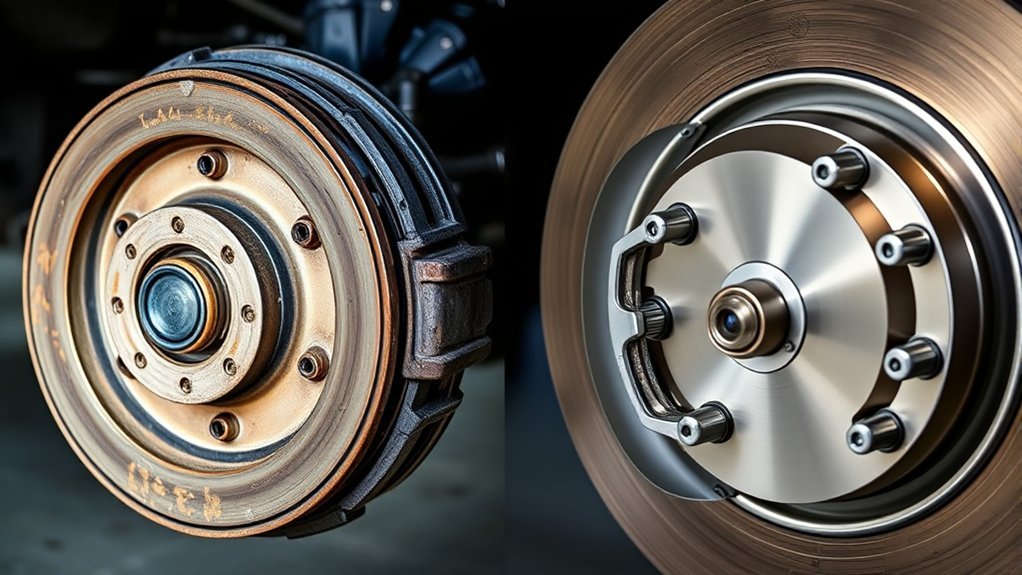
Disc brakes have the advantage in repeated-stop heat management and ease of inspection, while factory rear drums remain a practical solution for normally used older Tacomas. A single stop is influenced heavily by tire grip, road surface, ABS operation, vehicle loading and the condition of the entire brake system—not simply whether the rear axle uses drums or discs.
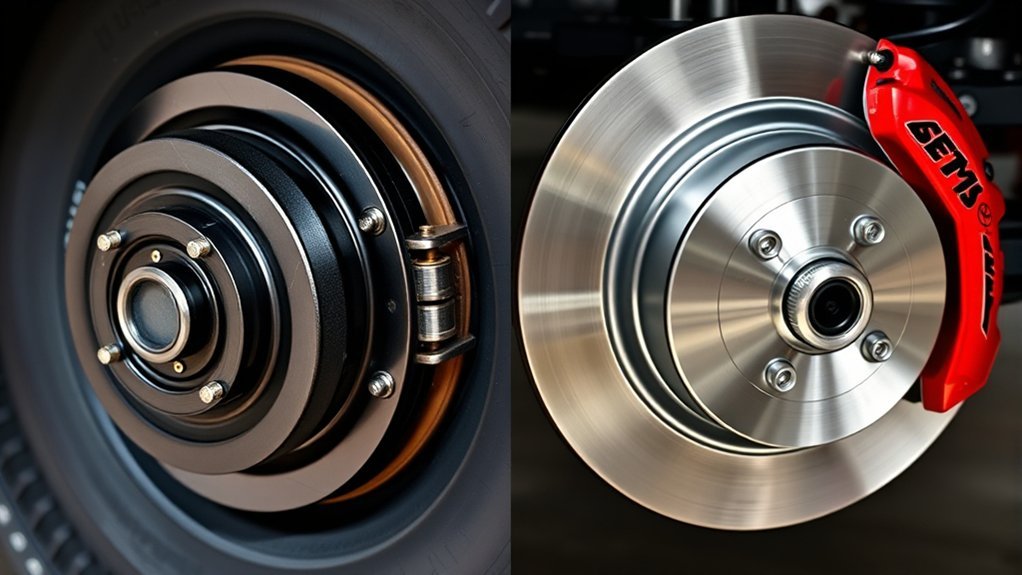
Disc brakes use a caliper to squeeze pads against an exposed rotor. The open rotor has direct airflow around it, so heat and water are generally shed more quickly. This helps discs maintain more consistent performance during repeated braking, trailer towing and long downhill mountain driving.
Drum brakes press curved shoes outward against the inside of a drum. Their self-energizing action can produce useful braking torque with modest hydraulic pressure, and the enclosed design integrates a strong mechanical parking brake efficiently. The tradeoff is that the enclosure retains more heat and can also trap mud, water and brake dust. For the generic mechanical differences, see the site’s disc brakes vs. drum brakes guide.
Factory Platform Update: Toyota introduced standard front and rear disc brakes on the redesigned 2024 Tacoma. Toyota says TRD models and higher grades receive a larger front brake package, while TRD-and-above i-FORCE MAX models add a larger rear brake package. The platform also uses an electronic parking brake. Source: Toyota USA Newsroom
[Products Worth Considering]

This brake bleeder bottle is designed to make fluid bleeding easier for one-person use with a built-in check valve and magnetic mount. The flexible hose fits most bleeder valves and helps reduce the chance of air entering the system during service. With a practical fluid capacity and universal fit, it is a handy tool for brake maintenance and repair.

This proportional trailer brake controller provides smooth, responsive braking by automatically matching your tow vehicle’s stopping force for safer trailer control. The bright LED digital display makes it easy to monitor voltage output in real time, while adjustable braking and sync settings help tailor performance to different trailers and road conditions. Designed for quick installation and broad compatibility, it supports 1 to 4 axle trailers for dependable towing confidence.

This proportional electric brake controller automatically applies trailer brakes based on your vehicle's braking force and speed for smoother, more responsive stopping. It is compatible with a wide range of tow vehicles and trailer setups, and includes an LED display for easy setup, diagnostics, and manual braking control. The included mounting hardware and plug-and-play port help make installation simple and convenient.
Which Tacoma Models Use Drum or Disc Brakes?
The basic dividing line is the 2024 redesign. Toyota’s 2023 specifications list ventilated front discs with rear drums across the Tacoma lineup, while Toyota’s 2024, 2025 and 2026 information lists front and rear discs on the fourth-generation truck.
| Tacoma Generation & Model Years | Factory Brake Architecture | Service & Ownership Implications |
|---|---|---|
| 1st Gen (1995.5–2004) | Front disc / Rear drum | Older hardware makes condition, adjustment, corrosion, wheel-cylinder leakage and parking-brake operation more important than the drum-versus-disc label alone. |
| 2nd Gen (2005–2015) | Front disc / Rear drum | Current aftermarket rear-disc conversion kits commonly target 2005–2023 6-lug trucks, but fitment and parking-brake provisions vary by kit. |
| 3rd Gen (2016–2023) | Power-assisted ventilated front disc / Rear drum | Toyota retained the front-disc/rear-drum architecture through the 2023 model year. Diagnose adjustment, wear, leakage and parking-brake faults before considering a conversion. |
| 4th Gen (2024–Present) | Front and rear disc brakes | Toyota integrates four-wheel discs with an electronic parking brake. TRD models and higher grades use a larger front package; qualifying i-FORCE MAX grades add a larger rear package. |
Toyota describes the fourth-generation switch as an increase in braking performance. The new platform also uses an electronic parking brake, which supports functions such as brake hold and low-speed radar cruise control. Toyota USA Newsroom
[Products Worth Considering]

Bendix Premium Ceramic Front Brake Pads are engineered to match original equipment fit, form, and function for a straightforward replacement. Built with durable materials to help resist wear and corrosion, they support consistent braking performance and reduced brake fade for everyday driving. These pads are a dependable choice for compatible Pontiac, Scion, Toyota, and related vehicles.

The CURT Venturer NEXT is a compact, time-delay electric trailer brake controller designed for dependable braking control from inside your vehicle. Its low-profile design, adjustable power and ramp time, and plug-and-play friendly setup make it a practical choice for towing with confidence. Built for 12-volt systems and compatible with electric over hydraulic brakes, it offers flexible installation without leveling or internal moving parts.
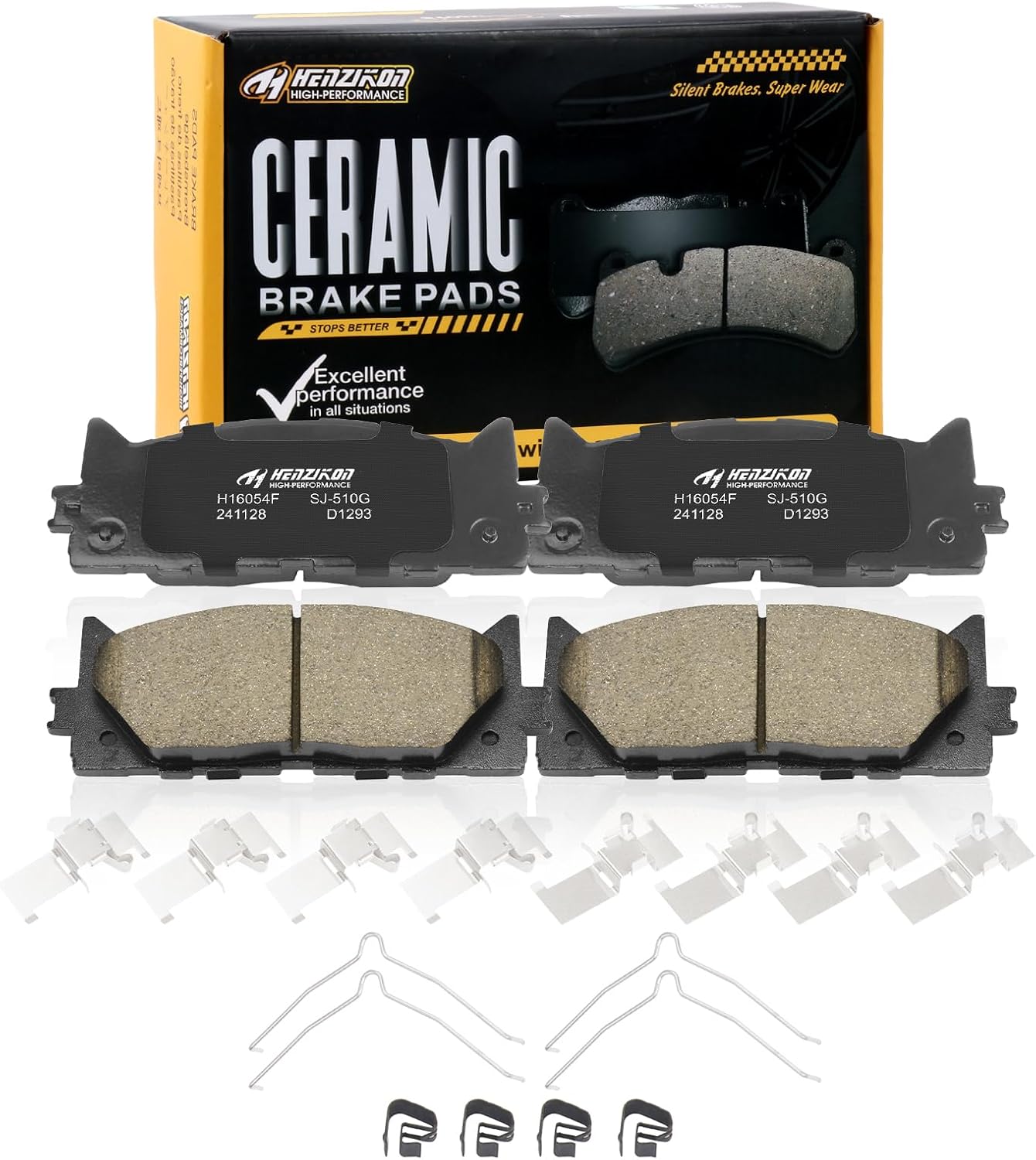
These ceramic front brake pads are designed for compatible Toyota Avalon, Camry, and Lexus ES-series vehicles, offering dependable stopping power and smooth, consistent braking performance. Built with included hardware for easier installation, they help reduce squealing and brake dust while supporting long-term durability for everyday driving.
Key Differences Between Drum and Disc Brakes
For a Tacoma owner, the useful differences are heat control, inspection access, parking-brake design, contamination behavior and conversion complexity. Both systems can provide dependable braking when maintained to the correct factory specifications.
| Performance Metric | Rear Drum Brakes (Gen 1–3) | Four-Wheel Disc Brakes (Gen 4 & Conversions) |
|---|---|---|
| Thermal Dissipation | Enclosed assembly retains more heat during repeated hard braking | Exposed rotor generally sheds heat faster and recovers from repeated stops more quickly |
| Inspection & Friction Service | Internal shoes, springs, adjusters and wheel cylinders require drum removal for a complete inspection | Pad and rotor condition is generally easier to inspect; pad service is mechanically simpler on many designs |
| Cost Position | Usually economical to retain when the factory system is healthy; exact service cost depends on wear and corrosion | Routine Gen 4 service varies by brake package; an older-truck conversion adds brackets, calipers, rotors, hoses and potentially parking-brake or hydraulic hardware |
| Parking Brake Mechanism | Mechanical parking-brake action is integrated into the drum assembly | Can use a drum-in-hat mechanism, a caliper-integrated mechanism or an electronic parking brake depending on the system |
| Off-Road Contamination | Enclosure shields hardware from direct impacts but can retain mud, sand and water once contamination gets inside | Open hardware is exposed but easier to inspect and rinse after muddy or wet use |
Performance & Hydraulic Dynamics
During forward deceleration, vehicle weight transfers toward the front axle, so the front brakes normally perform most of the friction-braking work. The exact front/rear contribution is not one fixed percentage: it changes with payload, trailer influence, tire grip, road surface, deceleration level and ABS/EBD intervention.
Heat becomes more important during repeated stops or long grades. An enclosed drum has less direct airflow than an exposed rotor, so it generally releases heat more slowly. That does not mean a healthy Tacoma drum system is unsafe; it means discs have a thermal-management advantage when the duty cycle repeatedly adds heat faster than the brakes can release it.
For ordinary driving, a properly maintained factory rear-drum system is usually the sensible baseline on a 1995.5–2023 Tacoma. Consider a rear-disc conversion only after diagnosing the stock system and identifying a real heat, contamination or service-access problem that the conversion will solve.
Cost and Maintenance Realities
Rear drum shoes often wear slowly because the front axle carries much of the braking workload during normal deceleration, but service can be more involved. A complete drum inspection includes shoes, springs, hold-down hardware, adjusters, wheel cylinders, backing-plate contact points and parking-brake operation.
Rear-disc conversions add more than rotors and calipers. Current 2005–2023 Tacoma kits may be limited to 6-lug trucks, may require checking or changing master-cylinder compatibility, and can make the mechanical parking brake an optional part of the package. Installation documentation can also require backing-plate cutting or axle/bearing disassembly plus ABS-sensor and brake-line clearance checks.
Diagnostic Tip: If an older Tacoma has rear brake drag, weak parking-brake action or uneven rear braking, inspect the complete drum mechanism—including parking-brake linkage, shoe adjustment, return hardware and wheel cylinders—before assuming the drum design itself is the problem. Do not apply an arbitrary mileage-based lubrication interval unless it appears in the service information for your exact truck.
Performance Insights: Why Disc Brakes Excel in Heavy-Duty Use
Disc brakes become more valuable as repeated braking generates more heat. Braking heat rises with vehicle mass and increases sharply with speed because kinetic energy is proportional to mass and to the square of speed. That is why a loaded truck descending a grade places a very different thermal demand on the brakes than the same truck making one moderate stop in town.
Thermal Management and Fade Resistance
An aftermarket rear-disc conversion does not guarantee a shorter single dry panic stop. In one ABS-limited stop, tire traction, road surface, vehicle loading and brake-system calibration strongly influence stopping distance. The main advantage of additional disc-brake thermal capacity is repeatability: an open rotor can release heat more effectively between repeated braking events.
This distinction matters for owners comparing “stopping power” claims. A conversion should be evaluated by the problem it solves—such as repeated fade, difficult mud cleanup or service access—not by an unsupported promise that rear discs alone will transform emergency stopping distance.
Consistent Performance Under Load & Towing
Towing adds vehicle-and-trailer mass and can increase repeated braking demand. Properly functioning trailer brakes, where required or equipped, are part of the total stopping system. On the fourth-generation Tacoma, Toyota pairs the factory four-wheel-disc layout with available towing technologies including an integrated trailer brake controller on applicable configurations.
Toyota also gives i-FORCE MAX versions upgraded rear discs, pads and calipers on qualifying grades compared with the standard i-FORCE configuration. That factory distinction is a useful example of matching brake thermal capacity to a specific vehicle package rather than applying one universal aftermarket rule.
Warning: Brake modifications do not increase your Tacoma’s manufacturer-rated GVWR, GCWR, payload or towing capacity. Follow the limits for your exact VIN/configuration and the instructions for your trailer and brake controller.
Cost Breakdown: Maintenance vs. Conversion
Service pricing varies too much by model year, parts brand, region and vehicle condition to treat one generic labor estimate as authoritative. The useful comparison is the number of systems and parts each path can involve. Current conversion-kit prices below are examples checked in September 2026, not permanent market prices.
| Brake Service / Upgrade Path | Current Cost Position | Extra Work to Budget For | Recommended Application |
|---|---|---|---|
| Complete Rear Drum Service (Gen 1–3) Shoes, hardware, drums and wheel cylinders as condition requires |
Quote by VIN and actual wear; usually the lower-cost path when existing hardware is serviceable | Adjustment, corrosion cleanup, parking-brake linkage and hydraulic inspection | Daily driving, ordinary hauling and trucks without documented rear-brake heat or contamination problems |
| Front Brake Restoration / Upgrade (Gen 1–3) Correct pads, rotors, caliper condition and fluid issues |
Varies by model year, rotor/caliper condition and parts grade | Caliper operation, rotor condition, hose inspection, tire condition and proper bedding where applicable | A logical first step when braking performance has degraded and the factory rear system is otherwise healthy |
| Aftermarket Rear Disc Conversion (2005–2023 examples) Rotors, calipers, brackets, hoses; parking-brake and master-cylinder hardware vary by kit |
Base-kit examples checked September 2026 start around $700–$1,000 before options, shipping and labor | Possible parking-brake kit, wheel-clearance work, master-cylinder changes, axle/bearing work, brake bleeding and alignment of lines/ABS wiring | Trucks with a documented use case that justifies additional rear thermal capacity or easier contamination cleanup |
| OEM 4-Wheel Disc Routine Service (Gen 4) Front/rear pads and rotors as wear requires |
Varies by trim and brake package | Follow model-specific electronic parking-brake and service procedures | Standard maintenance for 2024+ Tacomas |
For price context only, a current 2005–2023 6-lug Trail-Gear-style conversion listing was about $700 when checked, while the current SOS 2005–2023 base conversion was about $1,000 before selected options. Prices and included hardware can change, so compare the actual kit contents rather than treating either figure as a permanent market price. Current Trail-Gear kit listing · Current SOS Tacoma conversion listing
Should You Convert an Older Tacoma From Drum to Disc Brakes?
For most normally used 1995.5–2023 Tacomas, the first step is to restore the factory braking system rather than replace its architecture. A rear-disc conversion makes more sense when you can identify a repeatable problem—such as thermal fade during a specific duty cycle, persistent contamination-related servicing, or another specialized requirement—and a model-specific kit solves that problem without compromising the parking brake, ABS or hydraulic balance.
Recommended Brake Upgrade Hierarchy
- Inspect Tires and Load Ratings: Braking force reaches the road through the tires. Verify adequate tread, correct inflation and load capacity for the truck’s actual configuration rather than assuming one tire load range is mandatory for every build.
- Restore the Front Brake System: Check pad thickness, rotor condition, caliper operation and hose condition. Use replacement parts that match the truck’s exact model year, trim and duty requirements.
- Service the Rear Drum Assembly Completely: Inspect shoes, drums, springs, self-adjusters, backing-plate contact points, wheel cylinders and parking-brake operation. Correct leakage, drag and adjustment problems before evaluating a conversion.
- Inspect Brake Fluid and Hydraulics: Use only the brake-fluid specification listed by Toyota for your exact model year. Bleed the system correctly after hydraulic service and never substitute an unapproved fluid type. See the Tacoma brake fluid interval guide.
- Verify Trailer Braking: Follow your trailer manufacturer’s requirements, applicable law and the Tacoma owner’s manual. If trailer brakes and a controller are fitted or required, verify correct operation and adjustment.
- Evaluate a Complete Rear-Disc System: If a real rear-brake limitation remains, compare engineered kits by vehicle fitment, parking-brake design, ABS clearance, hydraulic requirements, wheel clearance, replacement-parts availability and installation method.
A Rear Disc Conversion May Be Worth It If:
- You repeatedly experience confirmed heat-related rear-brake fade during a legitimate towing or heavy-duty use cycle after the factory system has been inspected and serviced.
- Your wheel/tire and vehicle build materially increase braking heat, and a qualified brake-system professional confirms that the proposed conversion is compatible with the rest of the system.
- You frequently drive through deep mud, water or silt and place high value on easier visual inspection and cleanup after trail use.
- You are already performing axle or bearing work and can install a model-specific system while correctly retaining ABS, hydraulic-line routing and a functional parking brake.
Before Buying a Rear-Disc Conversion Kit
- Confirm axle and lug fitment: Several current 2005–2023 kits specify 6-lug Tacoma applications rather than every Tacoma configuration.
- Confirm parking-brake hardware: Do not assume it is included. Some systems make the mechanical parking-brake assembly optional.
- Check master-cylinder requirements: Some kit suppliers offer or recommend a master-cylinder change for particular configurations.
- Check wheel-to-caliper clearance: Wheel diameter alone does not guarantee spoke or balance-weight clearance.
- Understand the backing-plate procedure: Depending on the kit, installation may involve cutting the original backing plate or removing the axle/bearing assembly.
- Protect ABS and hose routing: Verify sensor-wire, hose and hard-line clearance throughout suspension travel before road use.
Keeping Factory Rear Drums Is Smarter If:
- The truck is used mainly for commuting, ordinary hauling and recreational driving without documented heat-related fade.
- You value retaining a simple factory mechanical parking-brake system and readily available OEM-style service parts.
- Your current complaint is a low, spongy, sinking or inconsistent pedal. That symptom requires diagnosis for leaks, air, adjustment problems and hydraulic faults rather than an automatic drum-to-disc conversion.
Maintenance Tips for Tacoma Drum and Disc Brakes
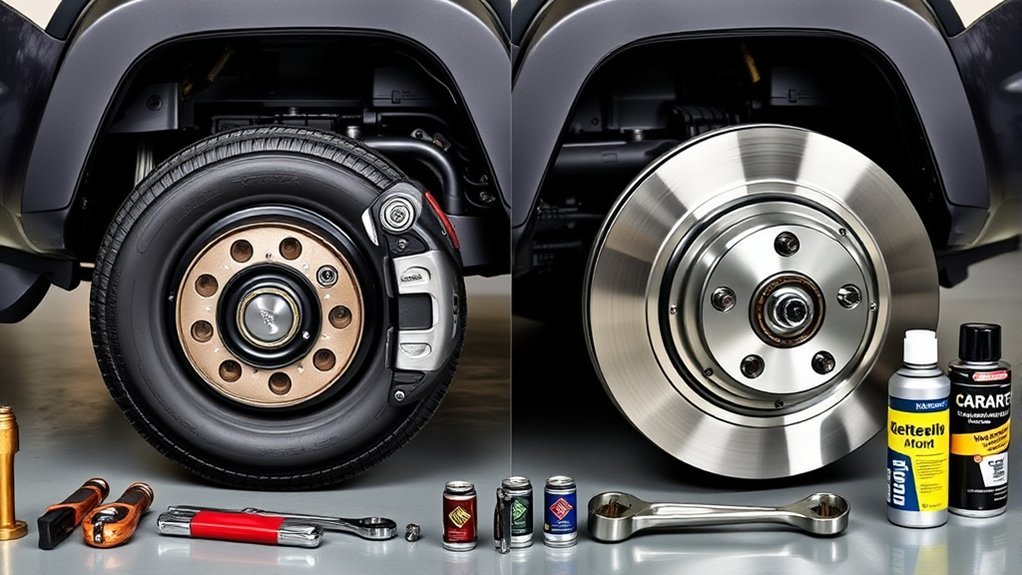
Use the Toyota maintenance schedule for your exact model year. For the 2023 Tacoma, Toyota’s regular maintenance log calls for visual inspection of brake linings/drums and brake pads/discs at 5,000 miles or six months. The same guide also calls for extra off-road inspections after driving through deep sand, mud or water. 2023 Toyota Tacoma Warranty & Maintenance Guide
- Use Model-Specific Wear Limits: Measure pad or shoe thickness and compare it with the wear limit in the Toyota owner’s manual or repair manual for your exact model year and brake package. Do not apply one universal thickness limit to every Tacoma generation.
- Inspect Rear Drum Hardware: On Gen 1–3 trucks, inspect shoe adjustment, return springs, self-adjusters, backing-plate contact areas and parking-brake linkage for corrosion, binding or abnormal wear.
- Clean Drum Assemblies Safely: Do not blow accumulated brake dust into the air with compressed air. Use an appropriate brake-cleaning method and suitable personal protective equipment.
- Inspect Wheel Cylinders for Leakage: Fluid around a rear wheel cylinder or inside the drum requires repair before continued driving. Inspect the opposite side and the rest of the hydraulic system as part of the diagnosis.
- Use the Correct Brake Fluid: Use only the fluid specification Toyota lists for the truck’s exact model year and brake system, from a sealed container. Do not assume one fluid specification applies unchanged across every Tacoma generation.
- Service Friction Components Symmetrically: Brake friction components on the same axle should be evaluated together so side-to-side wear, contamination or hardware problems are not overlooked.
- Respond to Warning Signs: Grinding, pulling, abnormal pulsation, a sinking pedal, visible fluid loss or an illuminated brake-system warning requires prompt diagnosis.
A red brake-system warning, sudden loss of pedal resistance or visible brake-fluid leakage can indicate a serious hydraulic problem. Stop in a safe location and arrange professional inspection rather than continuing to drive. Consult the Tacoma dashboard warning lights guide for related warning-light information.
Check Tacoma Brake Recalls Before Buying Parts
If you own a 2024 or 2025 Tacoma and have brake-fluid loss, a brake warning or unexplained pedal changes, check the VIN for open recalls before buying parts. Toyota’s rear-brake-hose recall began with certain 4WD trucks and was later expanded.
Official Safety Recall Update: Toyota’s current notice says the recall includes certain 2024–2025 Tacoma 2WD and 4WD vehicles equipped with 16-inch brakes and specified 17-inch or 18-inch Toyota wheels. Toyota says mud or dirt can build up inside the rear wheels and damage the rear brake hoses over time, potentially causing a brake-fluid leak. Dealers replace both rear brake hoses with improved parts at no charge. Toyota reports that the expanded U.S. population is approximately 222,000 vehicles. Eligibility is VIN-specific, so check Toyota Recall Lookup or NHTSA Recall Lookup rather than relying on drivetrain or wheel size alone.
The recall is also a useful reminder for modified trucks: brake-hose routing and clearance have to remain safe through suspension travel and in the presence of mud or debris. Any aftermarket conversion should be inspected for hose, hard-line, ABS-wire and caliper clearance before road use.
Weather, Off-Road, and Towing Considerations
Rain, Ice, and Winter Road Salt
Disc rotors are exposed, so normal braking helps wipe water from the friction surfaces. Drum assemblies shield internal hardware from direct splash but can retain moisture, salt and debris once contamination gets inside. In road-salt regions, inspect external parking-brake linkages, hoses and other exposed brake hardware for corrosion as part of routine underbody maintenance.
Mud, Sand, and Technical Trail Driving
Drums protect shoes and hardware from direct rock contact, but fine mud, sand and water can enter the enclosure and remain trapped. Disc hardware is more exposed, but its condition is easier to see and the area is easier to rinse after trail use.
Toyota’s 2023 maintenance guide adds a Tacoma-specific rule for severe off-road exposure: after driving through deep sand, mud or water, perform the listed off-road inspections daily. Those checks include brake lines and hoses plus brake pads/discs, along with other chassis and driveline items. Owners of other model years should follow their own Toyota maintenance guide for the applicable off-road inspection list.
Towing and Long Downhill Descents
On a long descent, use the transmission and available towing functions as described in the owner’s manual to help control speed instead of continuously riding the brake pedal. Continuous brake application can accumulate heat faster than the system can release it. If your Tacoma has Tow/Haul or another model-specific downhill strategy, follow the instructions for that configuration rather than assuming every generation uses the same controls. 2024 Toyota Tacoma Owner’s Manual
Final Recommendation: What Should a Tacoma Owner Choose?
Maintain and diagnose the factory rear drums first if you drive a 1995.5–2023 Tacoma and do not have a documented heat or contamination problem. Correct tires, front-brake wear, drum adjustment, wheel-cylinder leakage, parking-brake faults and hydraulic problems before spending money on a rear conversion.
Consider an engineered rear-disc conversion when repeated heavy-use conditions expose a real limitation and the kit is verified for your exact axle and wheel configuration. The system should preserve safe hydraulic behavior, ABS operation, brake-line clearance and a dependable parking brake. Current kit documentation also shows why installation scope matters: backing-plate modification, axle/bearing work, wheel clearance and optional master-cylinder or parking-brake hardware can materially change total cost.
Maintain the OEM four-wheel-disc system on 2024+ models. Use the Toyota maintenance schedule for your year and trim, follow electronic parking-brake service procedures, and check the VIN for open recalls. For 2024–2025 trucks, do not assume the rear-hose recall is limited to 4WD because Toyota expanded the affected population.
[Products Worth Considering]

Bosch QuietCast premium ceramic rear brake pads are engineered for quiet, reliable stopping power with low dust performance. Featuring pre-attached multilayer shims, corrosion-resistant backing plates, and OE-style slots and chamfers, this set is designed for smooth fitment and long-lasting durability. It includes pads for one axle, plus hardware and lubricant where available, making installation easier for compatible Lexus, Pontiac, and Toyota vehicles.
Armor All Extreme Wheel and Tire Cleaner is a powerful spray designed to cut through stubborn dirt, grease, tar, and brake dust on wheels and tires. It is safe for use on factory and aftermarket finishes, including alloy, steel, chrome, and plastic wheel trims, while its fast-acting formula works in just seconds. The deep-cleansing action helps reach hard-to-clean areas and leaves wheels looking clean and shiny.

These ceramic front brake pads are designed for smooth, quiet braking and dependable stopping power across a range of compatible Toyota and Lexus vehicles. The chamfered, multi-layer construction helps reduce noise and brake dust while supporting stable performance in demanding driving conditions. Built for consistent braking response, they offer confident pedal feel and long-lasting reliability.
Frequently Asked Questions
Are disc brakes better than drum brakes for a Toyota Tacoma?
Disc brakes are better at shedding heat and are easier to inspect after repeated heavy braking or muddy use. Factory rear drums remain a practical, reliable choice on older Tacomas when they are correctly adjusted, dry, leak-free and used within the truck’s intended operating limits.
Do 2024 and newer Toyota Tacomas still use rear drum brakes?
No. Toyota changed the redesigned 2024 Tacoma to standard front and rear disc brakes. Toyota’s 2025 and 2026 model information continues to list front and rear discs across the Tacoma lineup.
Is a rear disc brake conversion worth the cost on an older Tacoma?
For most normally used trucks, servicing the factory brakes first is the more sensible starting point. A conversion is easier to justify when you have a documented repeated-heat or contamination problem and a model-specific kit that preserves ABS, hydraulic compatibility, wheel clearance and a functional parking brake.
What should I check before buying a Tacoma rear disc conversion kit?
Confirm the exact model-year and axle fitment, lug pattern, minimum wheel and spoke clearance, parking-brake provision, ABS sensor and wire routing, brake-hose routing, master-cylinder requirements and whether installation requires backing-plate cutting or axle/bearing disassembly.
What are common symptoms of failing rear drum brakes on a Tacoma?
Possible symptoms include poor parking-brake holding, grabbing or dragging, grinding, abnormal rear-wheel heat, visible hydraulic leakage or uneven shoe wear. A low, spongy or sinking pedal can also indicate other hydraulic faults, so diagnose the complete brake system rather than assuming the drums are the cause.
What are common symptoms of worn disc brakes on a Tacoma?
Common warning signs include wear-indicator noise, grinding, abnormal pedal pulsation, pulling, uneven pad wear, rotor damage or leakage around a caliper or hose. Inspect the system promptly if braking feel or warning lights change.
Does upgrading from drum to disc brakes increase Tacoma towing capacity?
No. A brake conversion may change heat management or service characteristics, but it does not change Toyota’s rated GVWR, GCWR, payload or towing capacity for the truck.
Is there a brake-hose recall on 2024–2025 Toyota Tacomas?
Yes. Toyota’s current notice covers certain 2024–2025 Tacoma 2WD and 4WD vehicles with specified 16-inch brake and 17- or 18-inch Toyota wheel configurations. Mud or dirt can accumulate inside the rear wheels and damage the rear brake hoses, potentially causing a fluid leak. Toyota dealers replace both hoses with improved parts at no charge. Check the VIN at Toyota or NHTSA because eligibility is configuration-specific.
What type of brake fluid should be used in a Toyota Tacoma?
Use the brake-fluid specification listed in the Toyota owner’s manual or repair information for your exact Tacoma model year. The Tacoma spans multiple generations, so do not assume that one fluid specification applies unchanged to every year. Use fresh fluid from a sealed container and do not substitute a fluid type Toyota does not approve for that vehicle.
Conclusion
For older Toyota Tacomas, rear drum brakes are not automatically a defect that needs to be converted. A healthy factory front-disc/rear-drum system is suitable for normal use, while four-wheel discs offer meaningful advantages in heat rejection, visual inspection and cleanup when duty becomes more demanding. Toyota made front and rear discs standard with the 2024 redesign and continues that architecture on current models.
Before modifying a 1995.5–2023 truck, diagnose the system you already have. Inspect tires, front brake condition, rear shoes and hardware, wheel cylinders, parking-brake operation, hoses and brake fluid. If a rear-disc conversion still solves a documented need, verify axle fitment, wheel clearance, ABS routing, parking-brake hardware and hydraulic requirements before purchase. For 2024–2025 trucks, also check the VIN for the expanded rear-brake-hose recall.
Sources
- 2023 Toyota Tacoma eBrochure — confirms power-assisted ventilated front disc brakes and rear drum brakes across the 2023 U.S. Tacoma lineup.
- Toyota USA Newsroom: 2016 Tacoma — confirms the third-generation Tacoma’s front-disc/rear-drum architecture.
- Toyota USA Newsroom: 2024 Toyota Tacoma Is the Ultimate Adventure Machine — confirms four-wheel discs, larger TRD/higher-grade front brakes, larger rear brakes on qualifying i-FORCE MAX grades and electronic parking brake integration.
- Toyota USA Newsroom: The 2026 Toyota Tacoma — confirms that current Tacoma models continue with standard front and rear disc brakes.
- 2023 Toyota Tacoma Warranty & Maintenance Guide — provides scheduled brake inspection and off-road maintenance guidance.
- Toyota Tacoma Rear Brake Hose Safety Recall Notice — current Toyota notice describing the expanded 2024–2025 Tacoma population and free hose replacement.
- NHTSA Safety Recall Report 25V-058 — documents the original federal recall filing; use Toyota/NHTSA VIN lookup for current vehicle-specific eligibility.
- SOS Performance 2005–2023 Tacoma Rear Disc Conversion — current fitment, optional parking-brake and master-cylinder information used to illustrate conversion compatibility considerations.