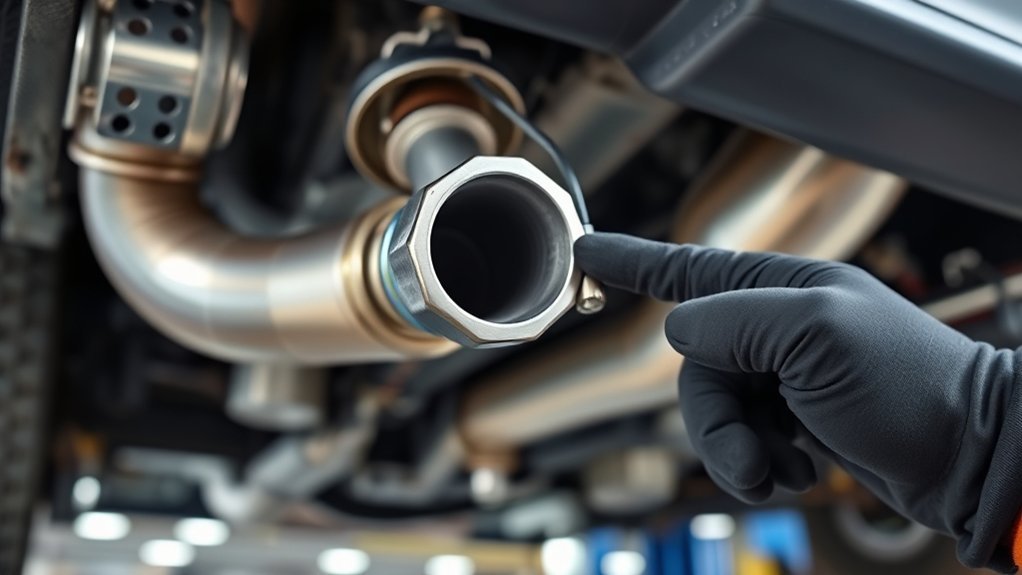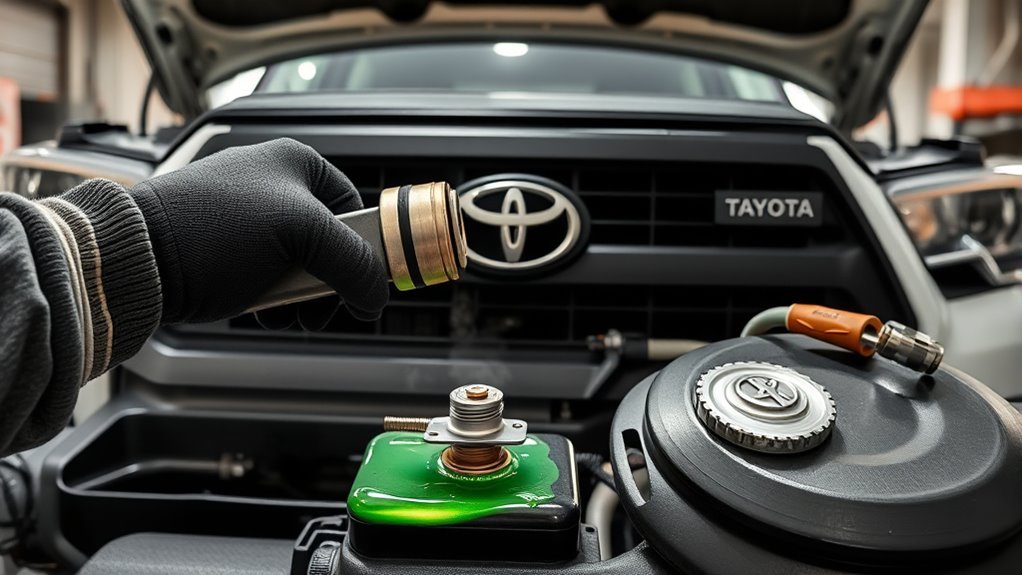
A Toyota Tacoma coolant leak requires an immediate, methodical diagnosis: verify that the fluid is pink/red coolant rather than clear A/C condensate, let the engine cool completely, inspect high-frequency leak points (water pump weep hole, radiator tanks, thermostat housing, and bypass pipes), and pressure-test the system at 13–15 psi if the source is hidden. Tow the truck if coolant loss is rapid, steam appears, or the engine temperature gauge rises.
By: Auto Review Nest Technical Editorial Team |
Last updated: July 23, 2026
Quick Answer
To find a Tacoma coolant leak, inspect a completely cold engine. Confirm pink or red fluid, then check the coolant reservoir, radiator plastic end tanks, hose clamps, water pump weep hole, thermostat housing, and engine-specific bypass pipes. If no leak is visible, connect a cooling-system pressure tester and pump to 13–15 psi (never exceeding the cap rating). Replace failed pumps, split hoses, or cracked housings; never rely on stop-leak as a permanent fix.
Key Takeaways
- Never open a radiator or coolant-reservoir cap while the engine is hot; pressurized coolant above 200°F (93°C) will spray violently.
- Common Tacoma leak sources vary by engine: water pump weep hole (4.0L 1GR-FE & 3.5L 2GR-FKS), rear water-bypass joint (2022 3.5L T-SB-0083-22 Rev2), plastic water bypass pipe under the intake (2.7L 2TR-FE), and radiator tank crimp seams.
- Clear, odorless water dripping on the passenger side near the firewall after A/C use is harmless condensation, not coolant.
- Pressure testing should be conducted cold at 13–15 psi (88–103 kPa); exceeding 16–18 psi risks rupturing the heater core or radiator tank seals.
- 4th-Gen (2024+) i-FORCE MAX hybrid Tacomas feature separate engine and intercooler/inverter cooling circuits; keep clear of orange high-voltage lines.
- Professional repair costs (RepairPal data) range from $61–$90 for diagnostic leak tests to $672–$896 for water pump replacement and $3,004–$4,027 for cylinder head gasket repairs.
At a Glance
| Inspection Time | 15–45 minutes for visual check; 1–2 hours if skid plates or intake components are removed |
| Difficulty | Beginner for visual checks; Intermediate for pressure testing/hoses/pumps; Advanced for heater cores or head gaskets |
| Tools Needed | Flashlight, inspection mirror, paper towels, drain pan, cooling system pressure tester (with Toyota adapter), cooling-system-safe UV dye |
| Do Not Drive If | Engine temp gauge spikes, steam appears, coolant is actively pouring, or fluid contacts hybrid high-voltage electronics |
| Estimated Cost | $20–$80 (DIY hose/clamp/seal) to $350–$900+ (Professional hose, water pump, or thermostat replacement) |
Warning: Never twist or remove a radiator cap or pressurized reservoir cap when the engine is warm. Always allow the engine to cool for at least 1 hour until hoses feel soft and cool to the touch. Trapped steam can cause severe burns.
Identify Your Engine Configuration: Cooling system architecture differs significantly between Tacoma generations: 2.7L I4 (3RZ-FE / 2TR-FE), 3.4L V6 (5VZ-FE), 4.0L V6 (1GR-FE), 3.5L V6 (2GR-FKS), and the 4th-Gen 2.4L Turbo / i-FORCE MAX Hybrid (T24A-FTS).
Hybrid Safety Warning: On i-FORCE MAX trucks, avoid contact with all orange high-voltage wiring, inverter enclosures, and electric motor generator connections. If a coolant leak is near hybrid power electronics, have the truck towed to a certified Toyota dealership.
Safety Prep: How to Ready Your Tacoma for Inspection
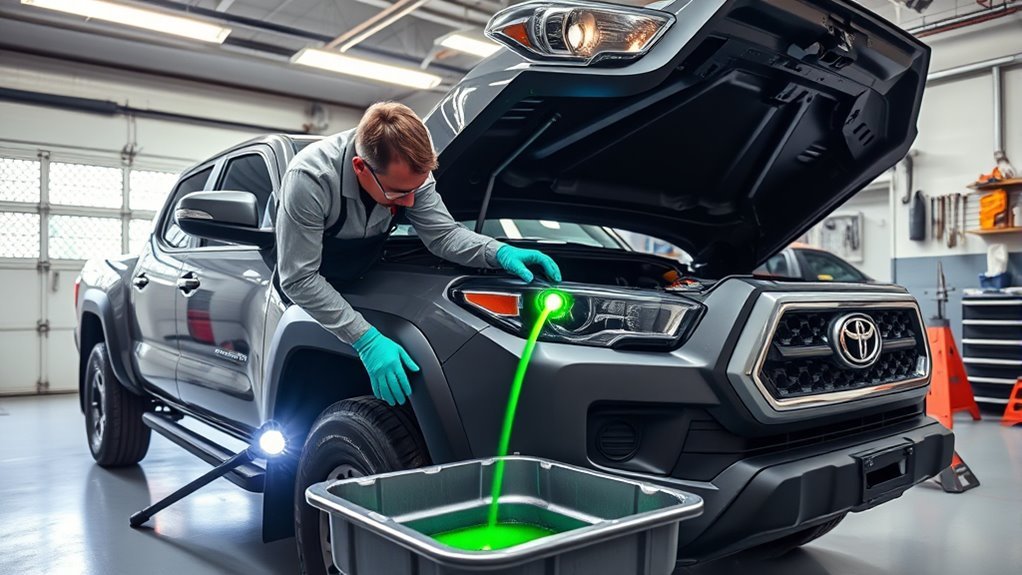
Park the truck on a level surface, engage the parking brake, shut off the ignition, and let the powertrain cool completely. Put on nitrile gloves and eye protection. Automotive engine coolant contains ethylene glycol, which is toxic if ingested and harmful to skin and eyes.
Keep pets and wildlife away from your work area. Ethylene glycol has a sweet scent that attracts animals but is fatal if consumed in small amounts. Always place a clean catch pan under the engine bay to capture fluid, and dispose of used coolant at an authorized recycling facility or automotive parts retailer.
Assemble your inspection kit: a high-lumen LED flashlight, an extendable inspection mirror, white paper towels, and a cooling system pressure testing kit with Japanese-vehicle bayonet adapters. If your Tacoma has an engine skid plate (factory steel or TRD aluminum), unbolt it with a 12mm or 14mm socket to gain a clear line of sight to the lower radiator tank, oil pan skirt, and lower engine pulley area.
Coolant Chemistry Note: Modern Tacomas use pre-diluted 50/50 Toyota Super Long Life Coolant (SLLC – Pink). Older Tacomas (pre-2004) originally used concentrated Toyota Long Life Coolant (LLC – Red) mixed with distilled water. Never mix silicate-based universal green antifreeze with Toyota organic acid technology (OAT/HOAT) formulas, as this causes gel precipitation that clogs heater cores. See the Tacoma coolant type guide for complete chemistry details.
Is the Puddle Coolant or Normal A/C Water?
Before ordering replacement parts, confirm the chemical identity of the puddle under your truck. The air-conditioning evaporator naturally extracts humidity from the cabin, discharging pure water onto the ground below the passenger-side firewall. Engine coolant, by contrast, has distinct visual and physical characteristics.
| Fluid Type | Appearance & Texture | Paper Towel Test | Typical Leak Location | Immediate Action |
|---|---|---|---|---|
| A/C Condensate | Clear, thin, watery, 100% odorless | Dries clear with no residue or stain | Passenger-side firewall drain tube | Normal operation; no action needed |
| Toyota OEM Coolant | Pink or Red, slightly slippery/slick feel, sweet syrup odor | Leaves distinct pink/red stain; dries to a chalky crust | Radiator, water pump, hoses, bypass tubes | Cool engine completely and perform leak inspection |
| Engine Oil | Amber (new) to Dark Brown/Black (used), viscous, oily | Heavy dark brown/black oily residue | Directly under oil pan, filter, or valve cover | Check dipstick level; diagnose oil seal failure |
| Automatic Trans Fluid (ATF) | Red, pinkish-brown, or dark red; pungent petroleum odor | Reddish oily stain that does not dry clean | Transmission bell housing, pan, or cooler lines | Inspect transmission pan and lower radiator ATF cooler lines |
The White Paper Towel Test: Dab a clean white paper towel directly into the droplet. If the towel shows vibrant pink, red, or green fluid with a sweet smell, you have an active cooling system leak. If the fluid is clear and dries completely without residue, it is harmless evaporator condensation.
Quick Diagnosis Checklist for a Tacoma Coolant Leak
Follow this 9-step diagnostic sequence to locate the origin of the coolant loss before replacing any parts:
- Verify Symptoms: Note whether you are experiencing external puddles, an empty overflow bottle, sweet cabin odor, heater blowing cold at idle, or temperature gauge spikes.
- Confirm Fluid Identity: Use the white paper towel test to rule out A/C condensation and transmission cooler line leaks.
- Perform Cold Static Inspection: Check the expansion tank, pressure cap seal, radiator upper and lower crimp seams, and heater core firewall connections.
- Trace Top to Bottom: Look for dried pink crystalline tracks starting from high points (thermostat housing, upper hose) down to lower components.
- Inspect Underbody and Skid Plates: Inspect the lower radiator tank, drain petcock, and the water pump weep channel. Remember that moving pulleys and cooling fans blow fluid rearward.
- Check Engine-Specific Vulnerabilities: Inspect the 2.7L under-intake bypass pipe, 3.5L rear water bypass tube, or 4.0L water pump housing based on your truck’s engine code.
- Perform a Controlled Pressure Test: Attach a pressure tester to the radiator filler neck on a cold engine and pump to 13–15 psi. Watch the gauge for pressure drop and listen for hissing.
- Perform Internal Leak Diagnostics if External Checks are Clean: If the truck loses coolant with no external dripping, test for combustion gases in the radiator with a chemical block tester.
- Bleed and Pressure-Verify Post-Repair: After installing new parts, purge all air pockets using a spill-free funnel and perform a final heat-and-cool pressure check.
Common Leak Points by Tacoma Engine & Generation
Tacoma cooling system failures often follow distinct patterns depending on the engine family under the hood:
| Engine Family | Tacoma Model Years | Primary Failure Location | Diagnostic Clue |
|---|---|---|---|
| 2.7L I4 (2TR-FE) | 2005–2023 (Gen 2 & Gen 3) | Plastic water bypass pipe under intake manifold | Coolant runs down the driver-side rear engine block; often mistaken for a head gasket or rear main seal leak. |
| 4.0L V6 (1GR-FE) | 2005–2015 (Gen 2) | Water pump shaft seal / weep hole; 2005–2006 cylinder #6 head gasket | Pink crust on front timing cover and drive belt; rough cold idle with bubbling overflow reservoir on early models. |
| 3.5L V6 (2GR-FKS) | 2016–2023 (Gen 3) | Rear water bypass joint & No. 1 outlet pipe; water pump weep hole | Coolant dripping down transmission bell housing (covered under T-SB-0083-22 Rev2); pink spray inside crankshaft pulley. |
| 2.4L Turbo / Hybrid (T24A-FTS) | 2024+ (Gen 4) | Dual-circuit radiator fittings & intercooler coolant connections | Fluid loss in secondary sub-radiator tank; quick-connect hose coupling seepage under boost. |
Does a 2022 Tacoma Leak Coolant From the Rear of the Engine?
Toyota Technical Service Bulletin T-SB-0083-22 Rev2 addresses a recognized factory defect on certain 2022 Tacoma models equipped with the 3.5L V6 2GR-FKS engine. In affected vehicles, coolant leaks at the junction where the rear water-bypass joint connects to the No. 1 water-outlet pipe at the back of the engine assembly.
Because this joint is located high on the rear engine valley, leaking coolant trickles down the bell housing of the transmission, dripping from the bottom inspection plate. This frequently leads owners to suspect a faulty transmission seal, rear main seal, or blown head gasket.
Diagnostic Pro-Tip: If you find a trail of pink crust or liquid coolant running down the rear of a 2016–2023 3.5L Tacoma engine or dripping from the bell housing, use an inspection mirror and bore scope behind the intake plenum to check the T-SB-0083-22 rear bypass joint before authorizing an expensive water pump or head gasket replacement.
The repair requires removing the intake manifold and upper fuel injection components to access, align, and replace the outlet pipe O-rings and bypass joint to revised factory torque specifications. Dealership technicians or experienced independent mechanics should confirm VIN applicability before proceeding.
Visual Inspection: Radiator, Reservoir, Hoses, Clamps, Overflow
Begin your cold visual inspection at the translucent coolant expansion tank. Check the reservoir body for hairline stress cracks, particularly around the lower mounting tabs and the overflow hose barb. A damaged reservoir cap or cracked overflow tube will allow expanding hot coolant to escape rather than return to the radiator during cool-down.
Next, examine the radiator assembly. Modern Tacoma radiators feature aluminum tube cores joined to plastic end tanks via crimped aluminum tabs. Inspect along the entire perimeter of these upper and lower crimped seams. As plastic tanks undergo thousands of expansion cycles, the internal rubber gasket hardens, resulting in hairline seepage that leaves heavy pink crust along the bottom corners.
Inspect the upper and lower radiator hoses. Squeeze the hose bodies with your hand: healthy automotive rubber should feel resilient and firm. Replace hoses that exhibit:
- Sponginess or Softness: Internal electrochemical degradation breaking down rubber layers.
- Hardness or Brittleness: Severe heat hardening leading to sudden split failure under pressure.
- Swelling or Bulging: Oil contamination (often from power steering or oil filter drips) causing rubber to delaminate.
Inspect factory spring tension clamps versus aftermarket worm-gear clamps. Constant-tension spring clamps automatically adjust to thermal expansion and contraction. Worm-drive clamps that have been overtightened can cut into the hose jacket, while loose clamps allow seepage during cold winter mornings.
Pro Tip: Spray suspect areas with clean water and wipe them completely dry with a shop towel. Drive the truck until it reaches operating temperature, allow it to cool, and inspect with an ultraviolet light or flashlight. Fresh wetness confirms an active leak, distinguishing it from harmless historical residue.
Check While Running: Water Pump, Pulley, and Belt Area
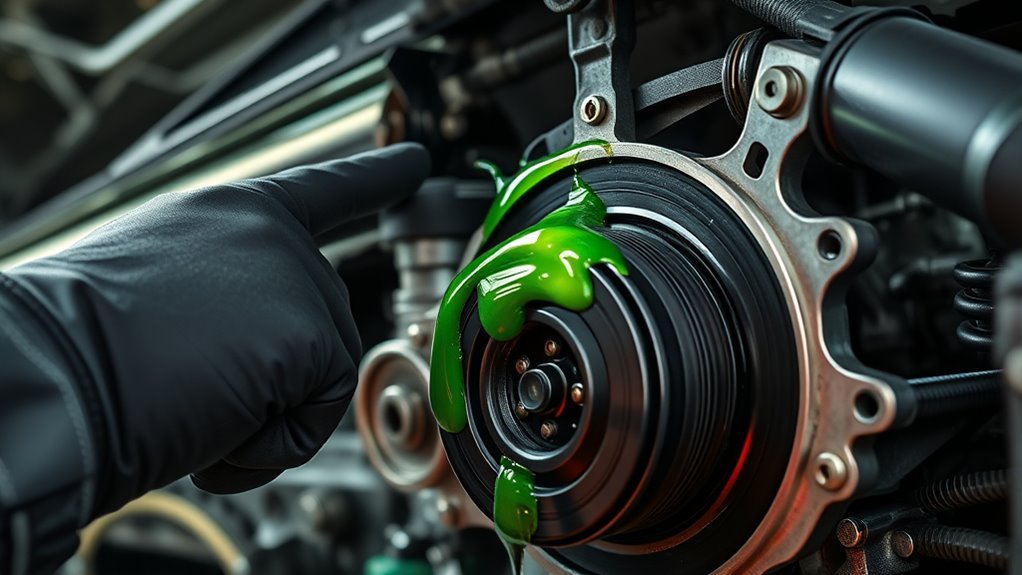
Inspect the water pump only when the coolant level is verified safe and your hands, hair, clothing, and tools are kept well clear of spinning mechanical cooling fans, idler pulleys, and serpentine belts.
The water pump features an internal mechanical seal lubricated by engine coolant. A small weep hole in the pump casting allows minimal vapor to vent normally. However, when the internal ceramic/carbon seal or shaft bearing fails, liquid coolant pours through the weep hole.
| Component / Area | Visual Indicator | Diagnostic Meaning |
|---|---|---|
| Weep Hole Cavity | Light dry pink powdery crust (< 1 inch) | Normal vapor venting; wipe clean and monitor |
| Weep Hole Cavity | Heavy dripping or wet crystalline stalactite | Failed internal shaft seal; pump replacement required |
| Water Pump Pulley Face | Radial pink spray lines thrown outward | Coolant dripping onto spinning pulley; imminent bearing failure |
| Serpentine Belt | Glazing, squealing, cracking, or slick coating | Belt contaminated with coolant; replace alongside pump |
| Pump Mounting Perimeter | Pink crust along block mating surface | Deteriorated pump housing gasket or loose mounting bolts |
If you confirm that the mechanical shaft seal or bearing is compromised, replace the water pump assembly promptly. Do not attempt to seal the weep hole with silicone or stop-leak; blocking the weep passage forces coolant into the bearing race, causing catastrophic pump seizure and thrown serpentine belts. Follow the Tacoma water-pump replacement guide for step-by-step removal procedures.
Thermostat Housing & Lower Radiator Hose: Common Leak Points
Positioned low on the engine block, the thermostat housing and lower radiator hose neck endure continuous vibrational stress and severe thermal cycling from sub-zero winter temperatures to 195°F+ operating temperatures.
Thermostat Housing Leak Signs
Inspect the aluminum or composite thermostat housing where it bolts to the water inlet pipe. Signs of leakage include:
- Dried pink buildup surrounding the mounting flange bolts.
- Corrosion or pitting on the aluminum mating surface that breaks the rubber O-ring seal.
- Pinched or improperly seated jiggle-valve seals following a previous thermostat replacement.
When installing a new thermostat on a Tacoma, ensure the small “jiggle valve” (air bleed pin) is oriented facing straight up (12 o’clock position) on vertical housings, or within 30 degrees of vertical as specified by the Toyota service manual. An improperly positioned jiggle valve traps air bubbles and causes localized overheating.
Lower Radiator Hose Wear
The lower radiator hose carries cooled fluid from the radiator back into the engine block under suction. Inspect the hose where it passes near front suspension control arms, accessory brackets, and steering linkages for signs of mechanical chafing. Check the hose clamp at the thermostat housing inlet: road grime and salt frequently corrode the lower spring clamp, reducing clamping tension.
Tightening and Replacement Tips
Always clean aluminum mating necks with a non-abrasive Scotch-Brite pad before installing new hoses or thermostat seals. Do not use RTV silicone on O-ring style thermostat gaskets; silicone creates slippery surfaces that cause rubber gaskets to squeeze out when torqued. Torque housing bolts to factory specification (typically 69–80 in-lbs / 8–9 Nm for small M6 fasteners on 1GR/2GR engines; do not overtighten into aluminum threads).
Find Hidden Leaks: Pressure Test, UV Dye, and Simple Tools
When a Tacoma loses coolant from the reservoir without leaving a visible puddle on the ground, the leak is either evaporating rapidly on hot engine surfaces or escaping only when the system reaches operating pressure. A cooling-system pressure tester is the most definitive tool for finding these hidden leaks.
- Ensure the Engine is Completely Cold: Performing a pressure test on a hot engine creates unpredictable pressure changes and risks scalding.
- Select the Correct Bayonet Adapter: Attach the Toyota-specific radiator adapter to the filler neck (or pressurized overflow tank on newer models).
- Pressurize to Cap Rating (13–15 psi / 88–103 kPa): Pump the hand cylinder slowly. Match the PSI rating stamped on your radiator cap. Never exceed 16–18 psi, as excessive manual pressure can rupture internal heater core tubes or plastic radiator seams.
- Observe the Gauge for 15 Minutes: A healthy cooling system will hold steady pressure. If the needle drops, systematically inspect all joints, bypass tubes, hose clamps, and the heater matrix for escaping droplets or faint hissing sounds.
A leak that occurs only at full operating temperature and pressure will readily appear during a 15 psi cold pressure test, without the hazard of hot moving engine components.
Using Cooling-System-Safe UV Dye: If a pressure test reveals a slow pressure drop without obvious dripping, add 1 ounce of cooling-system-rated fluorescent UV dye to the radiator. Run the engine for 15 minutes to circulate the dye, let it cool completely, and inspect the engine bay in darkness using a 395nm UV blacklight. The dye fluoresces bright neon green-yellow at the exact point of origin, highlighting hairline cracks in plastic pipes or micro-seepage around the water pump shaft.
[Products Worth Considering]

This spill-proof radiator coolant filling funnel kit helps you refill cooling systems cleanly while reducing trapped air pockets that can affect heater and engine performance. It includes a 5-inch extension bar and 45-degree elbow for easier access under shrouds or at awkward angles. Color-matched caps for dedicated adapters make setup simpler and more organized.
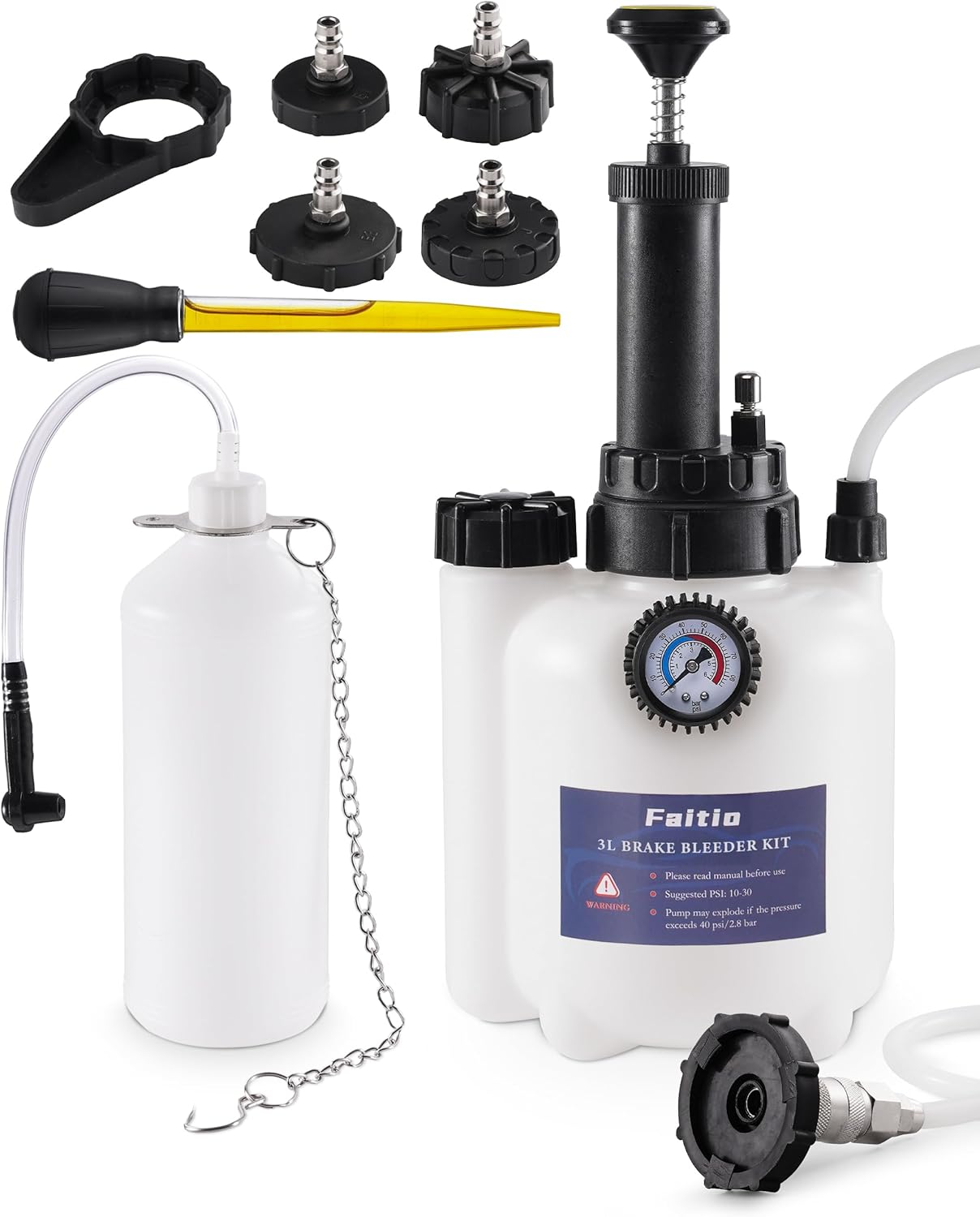
This one-man brake bleeding kit helps flush old brake fluid and remove trapped air for firmer, more responsive braking without the hassle of a second person. Its improved sealing and translucent catch bottle help prevent leaks while making fluid level checks easy during use. With multiple adapter sizes for many vehicle makes, it is a practical tool for clean, efficient brake system maintenance.

This universal brake bleeder kit makes one-person brake and clutch line bleeding simple by using compressed air to create stable vacuum-assisted fluid flow. Its extra-large 3L tank helps complete full-system flushes with fewer interruptions, while the included refill bottle, flexible hose, and universal adapter support clean, efficient use on standard and ABS brake systems.
Check for Internal Coolant Leaks
When a Tacoma continues to consume coolant but shows zero external wetness during a 15 psi pressure test, coolant may be leaking internally into the combustion chambers or engine oiling galleries. Look for these critical warning indicators:
- Persistent Billowing White Exhaust Smoke: Sweet-smelling white exhaust smoke that persists after the engine has reached full operating temperature indicates coolant burning in the cylinders.
- Continuous Bubbling in the Radiator / Reservoir: Rapid, continuous stream of bubbles in the expansion bottle after complete system bleeding points to cylinder compression gases pushing past a failed head gasket into the water jacket.
- “Chocolate Milk” Engine Oil: Foamy, milky brown emulsion on the engine oil dipstick or underside of the oil fill cap indicates coolant entering the crankcase oil. (Note: Light white vapor condensation under the oil cap after short winter trips is normal; check the dipstick pan oil to confirm).
- Sweet Smell Inside Cabin with Greasy Windshield Fog: Indicates a leaking heater core inside the dashboard HVAC box. Look for dampness on the passenger-side floor carpet under the floor mat.
- Cold-Start Cylinder Misfire (P0300–P0306): On 2005–2006 4.0L V6 (1GR-FE) Tacomas, head gasket failure commonly begins with coolant seeping into cylinder #4 or #6 overnight, causing a 10-second rough idle and misfire code on morning startup.
Confirmation Testing: Use a chemical block test kit (combustion leak tester). Draw vapor from the radiator neck through blue bromothymol test fluid: if combustion gases ($CO_2$) are present in the cooling system, the fluid turns from blue to yellow/green, confirming a blown head gasket or cracked cylinder head.
Emergency Overheating Protocol: If the temperature gauge approaches the red zone or the multi-information display shows “Engine Coolant Temp High,” pull over immediately, turn on the cabin heater to full blast to shed core heat, and shut down the engine. Driving an overheating aluminum-block Toyota engine for even a few minutes can warp cylinder heads and blow head gaskets.
When to Replace vs. Patch: Water Pump, Thermostat, Hoses
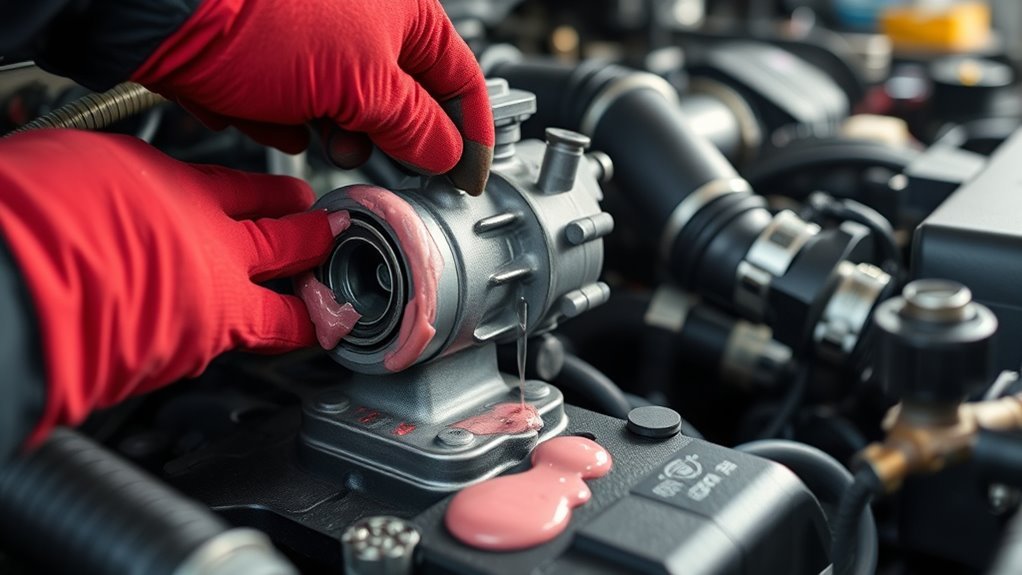
Permanent component replacement is the only dependable solution for cooling system integrity. Chemical stop-leak additives, radiator epoxy, and silicone patches should be treated strictly as extreme trailside emergency measures to reach safety.
[Products Worth Considering]

This 12V relay box provides six organized relay slots and six fuse positions, helping you build cleaner, safer electrical setups for vehicles and marine systems. Pre-wired, color-coded 12 AWG wiring simplifies installation while the sealed cover and gasket help protect against dust and splashing water in demanding environments. It is a versatile solution for controlling lights, pumps, motors, and other accessories in automotive, truck, RV, or boat applications.

This waterproof 6-circuit fuse block helps keep automotive and marine wiring neat, protected, and easy to troubleshoot. Built for 12V-32V DC systems, it includes a negative bus, LED blown-fuse indicators, and corrosion-resistant busbars for dependable performance in cars, boats, RVs, and trucks. The flame-retardant base and damp-proof cover add an extra layer of safety for demanding electrical installations.
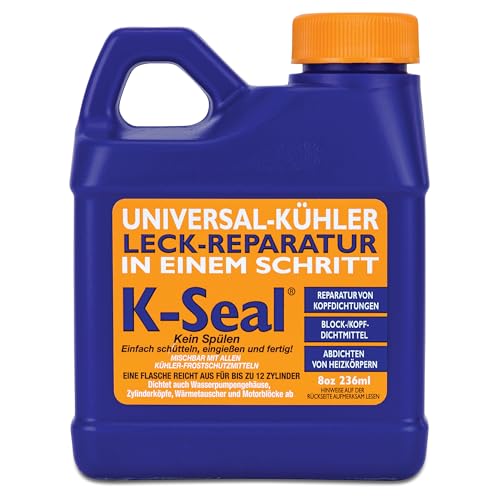
FIX IT FAST: Our multi-purpose solution works in minutes to quickly seal leaks in the radiator, head gasket, freeze plugs, block, heater matrix & water pump. Fixes most leaks in water-cooled engines
When to Replace
Component replacement is mandatory whenever structural integrity or dynamic mechanical seals fail:
| Component | Definitive Replacement Trigger | Risk of Delaying Replacement |
|---|---|---|
| Water Pump | Weep hole dripping, shaft wobble, or bearing growl | Bearing seizure, thrown drive belt, total loss of cooling |
| Thermostat & Gasket | Stuck open/closed, temperature erratic, housing corrosion | Engine running cold (sludge buildup) or severe overheating |
| Radiator Hoses | Cracking, swelling, sponginess, or age > 10 years | Sudden high-pressure hose blowout on highway |
| Radiator Assembly | Crimp seam leakage, cracked plastic tanks, fin corrosion | Complete separation of plastic tank under pressure |
| Heater Core | Cabin coolant flooding, foggy windows, strong odor | Electrical short circuits under dash; floorboard rust |
Temporary Patch Risks
Commercial pour-in stop-leak compounds contain micro-fibers, copper flake, or sodium silicate that react with air to plug holes. While they may temporarily slow a pinhole leak, they deposit sludge throughout the entire system. In Toyota cooling systems, stop-leak frequently plugs the narrow 1mm passages inside the heater core matrix and coats the radiator tubes, reducing overall thermal dissipation by up to 30%.
Time & Cost Estimates for Common Tacoma Coolant Repairs
The following repair estimates represent average professional shop pricing across North America (based on RepairPal data updated June 18, 2026). DIY costs represent replacement OEM or high-grade aftermarket parts (such as Aisin, Denso, Gates, or Bando).
| Repair Job | Professional Cost (Parts + Labor) | DIY Parts Cost | Estimated Shop Time | DIY Difficulty Level |
|---|---|---|---|---|
| Coolant Leak Diagnosis & Pressure Test | $61–$90 | $0 (Free loaner tool) / $35 (Kit) | 0.5–1.0 hour | Beginner |
| Upper & Lower Radiator Hoses | $359–$432 | $40–$75 | 1.0–2.0 hours | Beginner |
| Thermostat & Housing Gasket | $516–$606 | $35–$65 | 1.5–3.0 hours | Intermediate |
| Engine Water Pump Replacement | $672–$896 | $85–$160 (OEM Aisin) | 3.0–6.0 hours | Intermediate / Advanced |
| 2.7L Under-Intake Bypass Pipe | $450–$650 | $60–$110 (Metal upgrade) | 3.0–5.0 hours | Intermediate |
| Complete Radiator Replacement | $650–$920 | $150–$280 (Denso OEM) | 2.5–4.0 hours | Intermediate |
| Heater Core Replacement | $1,032–$1,627 | $110–$220 | 8.0–12.0 hours (Dash removal) | Advanced / Professional |
| Cylinder Head Gasket Replacement | $3,004–$4,027 | $250–$450 (Gaskets/Bolts) | 15.0–25.0 hours | Professional Only |
[Products Worth Considering]

Specifically-engineered materials resist collapse under vacuum
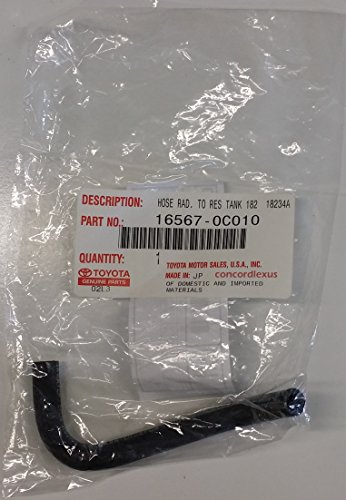
Reservoir hose: TOYOTA 16567-0C010 Engine Coolant Recovery Tank Hose

Specifically-engineered materials resist collapse under vacuum
Post-Repair Checks: Bleeding, Leak Re-Check, and Test Drive
Replacing the defective cooling component is only half the job. Air pockets trapped within the cylinder heads or heater core cause localized hot spots, inaccurate temperature gauge readings, and heater malfunction.
Bleeding the Tacoma Cooling System
- Elevate the Front End: Park on an incline or raise the front wheels slightly on ramps so the radiator filler neck is the highest physical point in the cooling circuit.
- Attach a Spill-Free Bleeding Funnel: Fit a no-spill funnel securely to the radiator neck with the appropriate adapter, and fill it 1/3 full with 50/50 Toyota Super Long Life Coolant.
- Set Cabin Heat to Maximum: Turn the ignition on, set the climate control temperature dial to maximum heat, and set the blower fan to low speed. This opens the heater control circuit.
- Run Engine Through Thermostat Cycle: Start the engine and let it idle until the upper radiator hose becomes hot to the touch, indicating the thermostat has opened. Gently rev the engine to 1,500–2,000 RPM intermittently to dislodge trapped air bubbles.
- Monitor Bubble Evacuation: Large air pockets will burp upward into the funnel. Continue idling until no further air bubbles appear and hot air blows consistently from the cabin dash vents.
- Allow Complete Cool-Down: Remove the funnel, install a new OEM radiator cap, and ensure the overflow reservoir is filled exactly to the “FULL” mark when cold.
Post-Repair Leak Check
Take the truck on a 15-minute test drive under varying engine loads. Watch the temperature gauge closely. After returning, park over clean cardboard or pavement, let the truck sit overnight to cool completely, and inspect the repaired fittings with a flashlight. Top off the overflow reservoir only when the engine is 100% cold.
Prevent Tacoma Coolant Leaks: Maintenance Best Practices
Prevent major cooling system failures during towing and off-road trips with these preventative practices:
- Adhere to Factory Coolant Service Intervals: Initial flush for Toyota Super Long Life Coolant (Pink) is scheduled at 100,000 miles (160,000 km) or 10 years, followed by flushes every 50,000 miles (80,000 km) or 5 years.
- Replace Radiator Pressure Cap Every 5–7 Years: Radiator caps contain precision rubber seals and calibrated pressure springs. A worn cap loses spring tension, allowing coolant to boil at lower temperatures.
- Perform Pre-Trip Visual Sweeps: Scan the lower radiator tank corners, water pump pulley area, and heater core firewall hoses before towing heavy trailers or heading off-grid.
- Flush Only with Distilled Water: If using concentrated coolant (Toyota Red LLC), mix exclusively with distilled water. Tap water contains minerals that create scale deposits and accelerate internal galvanic corrosion.
- Keep Skid Plates Clean: Mud and road salt packed onto skid plates trap moisture against lower radiator hoses and petcock drains, accelerating metal corrosion.
Frequently Asked Questions
Why is my Tacoma losing coolant but shows no puddle?
If your Tacoma loses coolant without leaving a visible puddle, the fluid is likely evaporating upon contact with hot engine components (such as a minor water pump weep hole or rear bypass pipe leak) or leaking internally into the engine through a head gasket or into the cabin via the heater core. A cold 13–15 psi pressure test and chemical block test will identify the source.
Can I drive my Tacoma with a minor coolant leak?
You should only drive a Tacoma with a known leak for short distances to reach a repair facility if the engine is completely cold, the coolant reservoir is topped up to the full line, and the temperature gauge stays strictly within the normal operating range. Never drive if the truck is steaming, dropping coolant rapidly, or showing high temperature warnings.
What is the rear water bypass leak on the 2022 Tacoma 3.5L?
Toyota Service Bulletin T-SB-0083-22 Rev2 addresses a recognized defect on certain 2022 Tacomas with the 3.5L V6 (2GR-FKS) engine where coolant leaks from the joint between the rear water-bypass joint and No. 1 water-outlet pipe. Coolant runs down the transmission bell housing and requires intake manifold removal to repair.
What color coolant does a Toyota Tacoma take?
Most modern Tacomas (2004–2026+) use pink, pre-diluted Toyota Super Long Life Coolant (SLLC). Older Tacomas (pre-2004) originally used red concentrated Toyota Long Life Coolant (LLC). Do not mix universal green silicate antifreeze with Toyota OEM pink/red organic acid coolants.
What pressure should I test my Tacoma cooling system at?
Test a cold Tacoma cooling system at 13–15 psi (88–103 kPa), matching the pressure rating stamped on the OEM radiator cap. Never exceed 16–18 psi during manual testing to avoid damaging the heater core or radiator tank crimp seals.
How do I know if my Tacoma water pump is failing?
A failing Tacoma water pump typically displays wet pink coolant tracks dripping from the cast weep hole cavity below the pulley, radial pink spray marks flung outward across the under-hood area, bearing growl/rumble noises, or play in the pump pulley shaft when moved by hand.
What is the 2.7L (2TR-FE) Tacoma water bypass pipe issue?
On 2.7L 4-cylinder Tacomas (2TR-FE engine), the plastic water bypass pipe located underneath the intake manifold becomes brittle from years of engine heat cycles and cracks. Coolant trickles down the rear driver-side of the engine block, often misdiagnosed as a cylinder head gasket leak.
Will stop-leak additives safely fix my Tacoma radiator?
No. Pour-in stop-leak additives are emergency trailside measures only. They clog the fine tubes of the aluminum radiator and heater core matrix, reducing heat transfer efficiency and requiring costly flushing and component replacements later.
Conclusion
Diagnosing a Toyota Tacoma coolant leak requires a cold, systematic inspection starting with fluid identification. Trace external paths from top to bottom—evaluating the radiator tanks, hoses, water pump weep hole, thermostat housing, and engine-specific bypass pipes. Utilize a 13–15 psi pressure tester or cooling-safe UV dye when fluid loss is hidden.
Always replace worn mechanical components with OEM or high-grade equivalent parts, avoid stop-leak additives, and thoroughly burp air pockets using a spill-free funnel. If your truck overheats, blows heavy white exhaust smoke, or shows fluid near hybrid electrical components, shut off the ignition and arrange a flatbed tow to prevent engine damage.
Sources
- Toyota Owners: 2024 Tacoma engine-coolant level information — official maintenance and inspection standards.
- Toyota Owners: 2024 Tacoma overheating guidance — safety procedures for high-temperature emergencies.
- Toyota T-SB-0083-22 Rev2 hosted by NHTSA — rear water-bypass and outlet-pipe joint leak on 2022 2GR-FKS 3.5L V6 engines.
- U.S. EPA: How Do I Dispose of Used Antifreeze? — ethylene glycol environmental and safety standards.
- U.S. EPA: Antifreeze Recycling Best Environmental Practices — proper recovery procedures.
- RepairPal: Tacoma coolant-leak diagnosis cost — benchmarked June 18, 2026.
- RepairPal: Tacoma water-pump replacement cost — benchmarked June 18, 2026.
- RepairPal: Tacoma thermostat replacement cost — benchmarked June 18, 2026.
- RepairPal: Tacoma radiator-hose replacement cost — benchmarked June 18, 2026.
- RepairPal: Tacoma heater-core replacement cost — benchmarked June 18, 2026.
- RepairPal: Tacoma head-gasket replacement cost — benchmarked June 18, 2026.