Last updated: July 31, 2026
If your Toyota Tacoma battery dies overnight, first determine whether the truck loses charge while parked or while driving. A no-start after the Tacoma sits usually points to a weak or undercharged battery, poor cable connections, or an excessive key-off electrical draw. A battery warning light, dimming electronics, or stalling while driving points more toward the charging system. Test in that order so you diagnose the failed system instead of replacing parts by guesswork.
For 2024-and-newer Tacoma i-FORCE MAX models, use the hybrid-specific owner information and service procedure for the exact year. The 12-volt system still needs diagnosis, but charging-system checks may not follow the same assumptions used for every non-hybrid Tacoma.
Quick Answer
Fully charge the battery, inspect and tighten the terminals, and have the battery load- or conductance-tested if it keeps going dead. Then check whether the charging system raises voltage above the resting level. If the Tacoma runs normally but loses charge while parked, let it enter sleep mode, measure parasitic draw, and isolate the active circuit by checking voltage drop across fuses or removing one fuse at a time.
Key Takeaways
- Separate a parked battery drain from a charging-system failure before testing individual circuits.
- A fully charged 12-volt battery commonly reads about 12.6 to 12.8 volts at rest, but resting voltage alone does not prove that the battery can deliver starting current.
- Charge and test the battery before measuring parasitic draw, or a weak battery can mislead the diagnosis.
- Let the Tacoma enter sleep mode before judging current. Less than 50 mA is a common general guideline, while a steady draw above 100 mA deserves investigation; confirm the limit for the exact year and equipment.
- A fuse identifies the affected circuit, not necessarily the failed component.
- Use a smart battery maintainer when the truck sits for long periods or makes repeated short trips.
At a Glance
| Time Required | 15 to 20 minutes for basic checks; 45 to 90 minutes for a sleep-mode and circuit-isolation test. |
| Difficulty | Moderate. Voltage checks are straightforward; low-current testing requires careful meter setup. |
| Tools Needed | Fused digital multimeter or low-amp DC clamp meter, battery charger, battery brush, basic hand tools, eye protection, gloves, and the fuse diagram for the exact Tacoma year. |
| Stop Testing If | The battery is swollen, leaking, frozen, hot, or damaged; wiring is melted; a circuit overheats; or the current exceeds the meter’s fused input rating. |
Toyota Tacoma Battery Drain Symptoms and First Checks
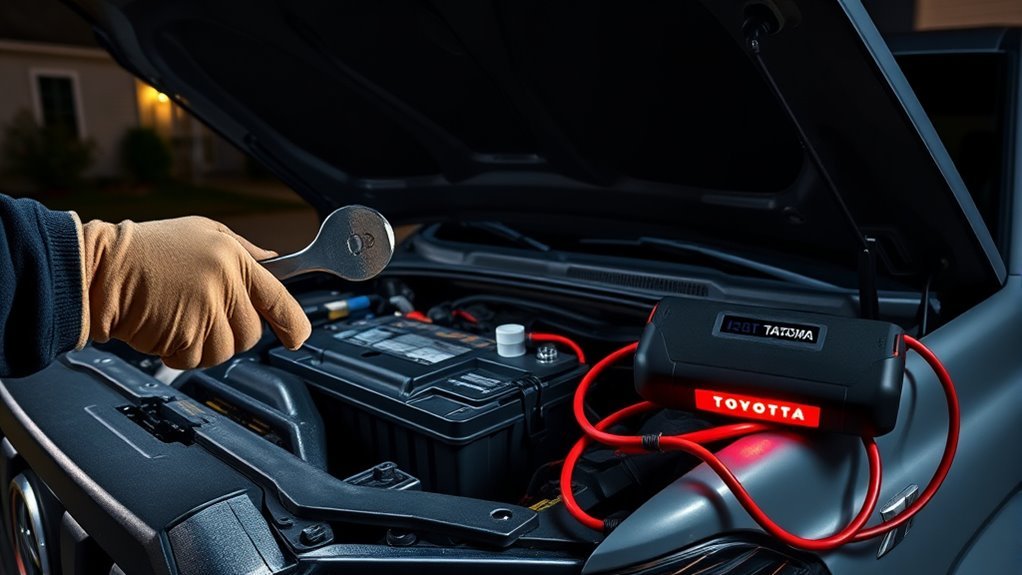
Start with the failure pattern. A Tacoma that starts after a jump and then runs normally may have a discharged battery or a key-off draw. A truck that shows a battery or charging warning while driving, loses electrical power on the road, or stalls after the jump is more likely to have a charging-system fault.
| Symptom Pattern | Likely Area | First Check |
|---|---|---|
| Dead after one night, but runs normally after a jump | Weak battery, light or accessory left on, or parasitic draw | Charge and test the battery, then measure key-off draw after sleep mode. |
| Slow crank or rapid clicking after short parking periods | Low charge, weak battery, loose clamps, or cable resistance | Inspect the case and terminals, check resting voltage, and obtain a battery load or conductance test. |
| Battery warning, dimming lights, or stalling while driving | Charging system, belt, wiring, ground, or control fault | Stop safely and test the charging system; do not continue driving until the cause is known. |
| Problem began after a dash cam, alarm, stereo, lighting, or trailer-wiring installation | Aftermarket circuit or incorrect constant-power connection | Disconnect or isolate the new equipment and repeat the overnight or current-draw test. |
| Dead only after several parked days or repeated short trips | Undercharged or aging battery, normal standby load, or a smaller excess draw | Fully charge and test the battery, then compare the sleep-mode draw with year-specific service data. |
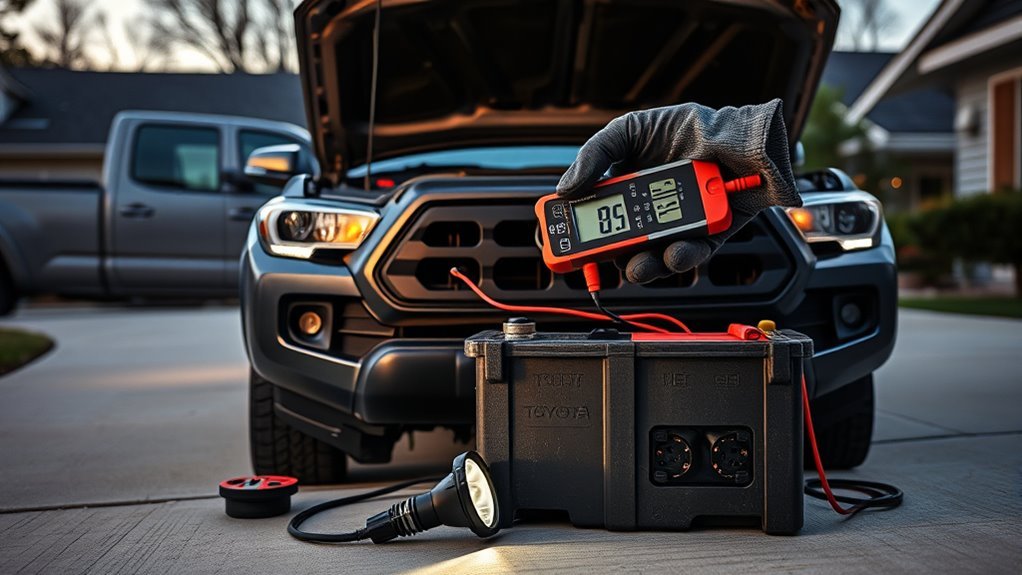
Check the battery voltage with a multimeter after the truck has been off long enough for surface charge to settle. GS Yuasa says a fully charged 12-volt battery should read about 12.6 to 12.8 volts at rest. If the reading is below about 12.4 volts, charge the battery fully before diagnosing the charging system or parasitic draw.
Resting voltage shows state of charge, not full battery health. A battery can read near 12.6 volts after charging and still fail when the starter demands high current.
Inspect the case, hold-down, posts, clamps, and ground connections. Clean corrosion from the contact surfaces with an approved terminal cleaner and battery brush. Tighten the clamps so they do not move by hand, then apply terminal protectant to the exposed exterior. Do not place grease or contamination between the electrical contact surfaces.
If the battery repeatedly loses charge, have it load- or conductance-tested before replacing the alternator or chasing modules. A portable 12-volt jump starter can get the truck moving in an emergency, but it does not diagnose the cause.
Warning: Do not work around a battery with loose jewelry, open flame, damaged cables, swelling, leaking, or a frozen case. Stop and call a qualified mechanic if you see acid leakage, melted wiring, smoke, or signs of overheating.
Battery and Charging-System Readings to Know
Use these figures as general diagnostic guides. Battery type, temperature, recent charging, smart charging controls, engine state, and installed equipment can change the reading. Confirm the specification for the exact Tacoma year, engine, and trim before condemning a component.
| Test | General Reading | What It Means |
|---|---|---|
| Resting battery voltage | About 12.6 to 12.8V when fully charged | The battery is near full state of charge after resting; this does not confirm starting capacity. |
| Resting voltage below about 12.4V | Partly discharged | Recharge fully, let the battery rest, and retest before drawing conclusions. |
| Battery load or conductance test | Pass or fail against the battery’s rating | This checks whether the battery can deliver current, which a resting-voltage reading cannot prove. |
| Charging voltage on a conventional gasoline system | Often about 13.7 to 14.7V, but regulated systems vary | Voltage should respond as the charging system operates; compare the result with Tacoma service data rather than using one universal cutoff. |
| Parasitic draw after sleep mode | Less than 50 mA is a common guideline; 100 mA or more is suspect | A steady high reading means a circuit may remain awake or powered after shutdown. |
Interstate Batteries notes that a voltage reading cannot reveal the battery’s internal resistance and recommends a battery test when condition is uncertain. This is why a battery that looks charged on a meter may still crank slowly or collapse under load.
For non-hybrid Tacoma charging checks, many conventional systems run in the upper-13- to mid-14-volt range. Modern control strategies can still push voltage outside that range during normal operation, so use the charging test as a trend and compare it with service information for the exact truck.
2024+ i-FORCE MAX note: Toyota identifies i-FORCE MAX as a hybrid powertrain. Use the hybrid-specific owner manual and service information for 12-volt charging diagnosis instead of assuming every conventional alternator test applies unchanged. Trim and equipment level can also change whether the truck relies on a DC-DC converter alone or also includes a traditional alternator, so confirm which architecture your specific truck has before testing charging voltage.
Do 2024–2025 i-FORCE MAX Tacomas Have a Known Battery Drain Issue?
Some owners of new, low-mileage 2024 and 2025 Tacoma i-FORCE MAX trucks have reported the 12-volt battery going dead after only a few days of normal parking, in some cases even after a dealer inspection found no draw outside the expected range. Part of the confusion comes from the hybrid powertrain itself: depending on trim and equipment, some i-FORCE MAX Tacomas charge the 12-volt battery through a DC-DC converter fed by the hybrid battery rather than a conventional belt-driven alternator, while other configurations include a traditional alternator as well. That distinction matters for diagnosis, because a charging-voltage test written for a conventional alternator does not automatically apply to a truck that has no alternator at all. If a hybrid Tacoma keeps losing its battery after only a few days of sitting, treat it as a case for the dealer’s hybrid-specific diagnostic equipment rather than the standard alternator test described above.
How Do You Measure Parasitic Draw on a Toyota Tacoma?
Measure parasitic draw only after the battery is fully charged and tested, the ignition is off, accessories are disconnected, doors are closed or latched, and the truck has entered sleep mode. For a more detailed instrument setup and test sequence, see the full Tacoma parasitic battery drain test guide.
Fluke advises allowing roughly 10 to 45 minutes for vehicle modules to sleep. Some Tacoma configurations may need a different interval, so use the stabilized reading and year-specific service information rather than judging the initial current spike.
Warning: Never place a meter set to amps directly across the battery terminals. Do not crank the engine, open powered doors, switch on lights, or run high-load accessories while the meter is connected in series. These actions can blow the meter fuse or damage the meter.
- Fully charge the battery and confirm the meter’s current-input fuse is intact.
- Turn the Tacoma off, remove the key, and keep the key fob away from the truck.
- Close the doors or latch the switches so interior lights stay off.
- Set the multimeter to DC amps and start on the highest fused range, often the 10A input.
- Disconnect the negative battery cable and connect the meter in series between the negative post and removed cable.
- Keep the connection stable and wait until the modules enter sleep mode.
- Record the stabilized baseline before checking any fuse or circuit.
After sleep mode, less than 50 milliamps is a common general guideline and more than 100 milliamps is commonly treated as suspect. These are not universal Tacoma specifications. Compare the reading with service data for the exact year, trim, smart-key system, factory options, and aftermarket equipment.
Pro Tip: A low-amp DC clamp meter or a voltage-drop check across fuses can help preserve module memory because you do not have to break the battery connection. Confirm that the tool can resolve low DC current before relying on it.
[Products Worth Considering]
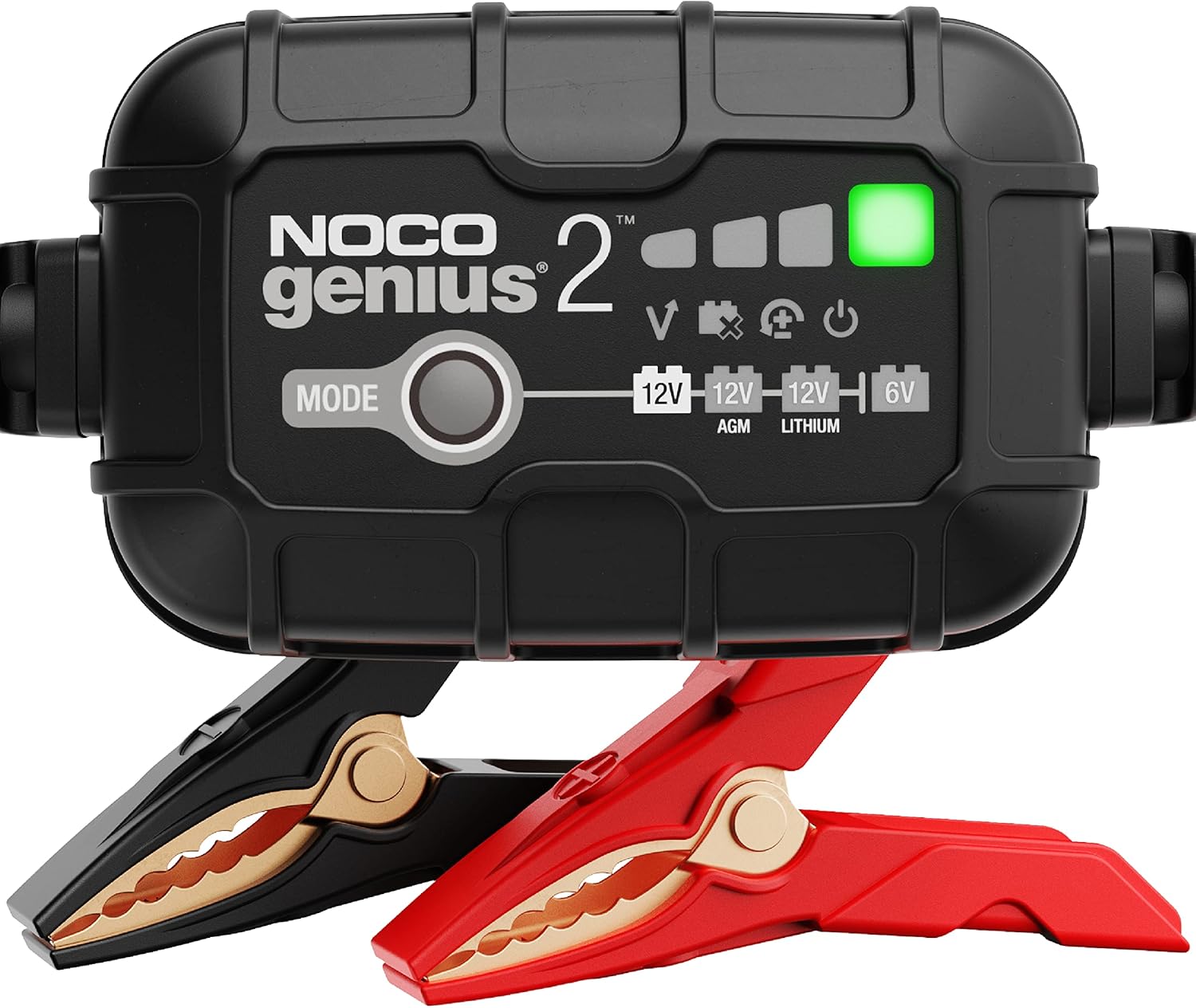
The NOCO GENIUS2 is a compact, all-in-one smart charger that automatically charges, maintains, and restores 6V and 12V lead-acid and lithium batteries. It features temperature compensation, overcharge protection, pulse desulfation, and Force Mode for reviving deeply discharged batteries, making it ideal for long-term battery care across many vehicle types. Designed for safe indefinite connection, it helps extend battery life and keep batteries ready to go.
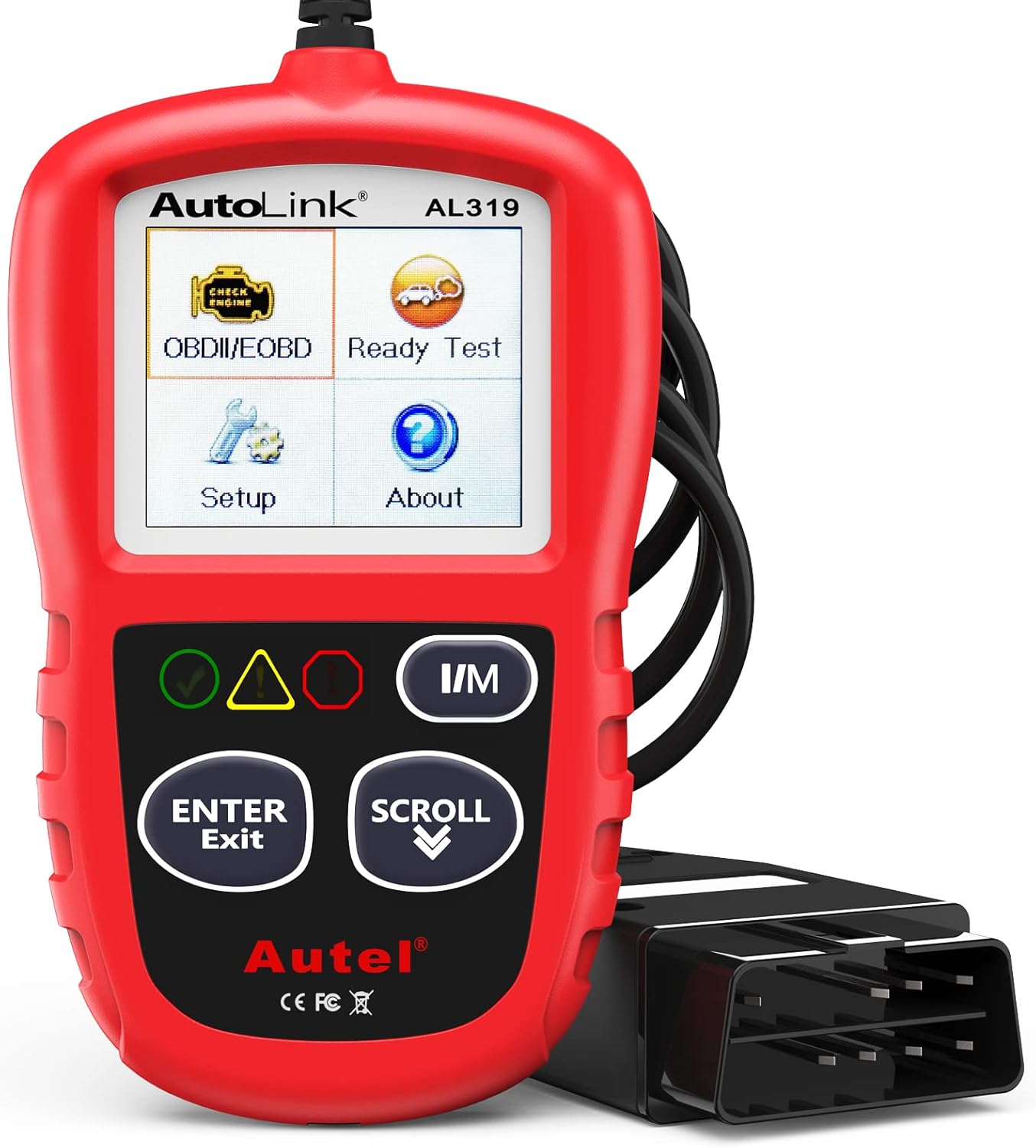
The Autel AL319 is a user-friendly OBD2 scan tool designed to help drivers quickly diagnose check engine light issues and understand vehicle fault codes. It supports reading and clearing DTCs, live data, freeze frame, I/M readiness, and vehicle information, making it a practical choice for DIYers and everyday car owners. With plug-and-play operation, a color display, built-in speaker, and broad vehicle compatibility, it delivers fast, reliable diagnostics without complicated setup.

This automatic 12V charger and maintainer delivers a full charge before switching to float mode to help keep powersports batteries ready for storage and regular use. Its four-step charging program is designed for lead-acid, flooded, AGM, and gel cell batteries, helping prevent overcharging while supporting longer battery life. Compact and easy to use, it includes both ring terminal and alligator clip connections plus smart safety features for dependable charging.
What Commonly Drains a Tacoma Battery While Parked?
Start with anything that changed shortly before the problem began. A new dash cam, alarm, remote starter, stereo amplifier, GPS tracker, auxiliary switch panel, bed lighting kit, trailer brake controller, or USB adapter is a stronger lead than an unrelated factory module. Disconnect the add-on or remove its dedicated fuse, then repeat the parked-current test.
Next, inspect lights and switches. A glove-box, dome, map, vanity, cargo, or bed light can remain on because of a stuck switch, misadjusted latch, or added wiring. Check the truck in a dark area after the normal shutdown delay.
Then inspect trailer wiring, added fuse blocks, relays, grounds, and areas exposed to water. Corrosion or a stuck relay can keep a circuit powered. If a factory module remains awake, another switch, sensor, network signal, or accessory may be causing the wake-up; do not replace the module only because its fuse lowers the draw.
A failed alternator rectifier diode can also create a key-off path on a non-hybrid charging system. AutoZone explains that a damaged diode can allow current to flow backward after the engine is off. Test the circuit before replacing the alternator.
Note: Short trips can make the problem appear worse because the charging system may not restore all the energy used during starting and accessory operation. Fully charge the battery with a suitable charger before deciding that a parked draw is the only fault.
How Do You Pinpoint the Drain With Fuses?
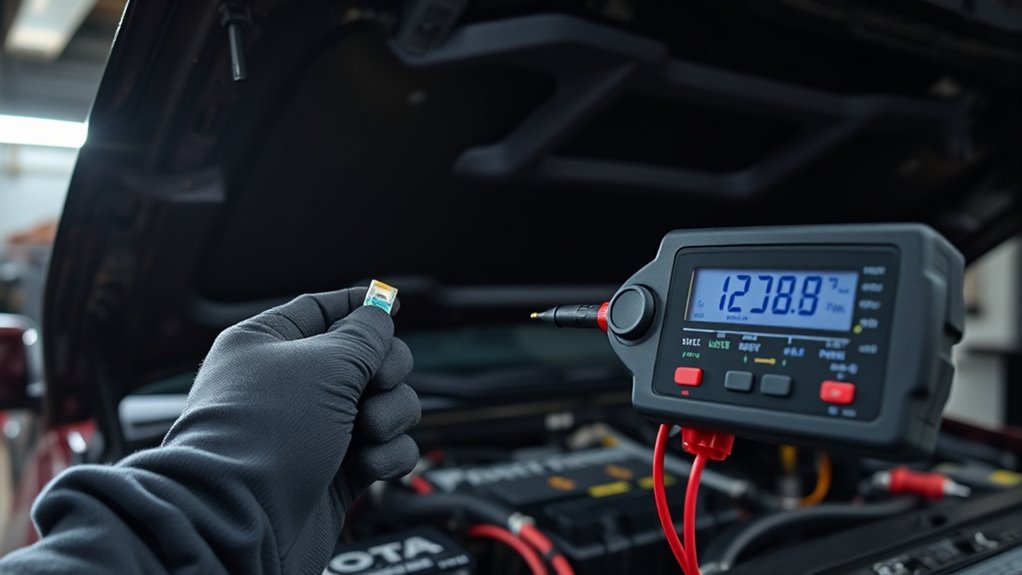
Use circuit isolation only after you confirm a steady high draw. Keep the Tacoma asleep and monitor the baseline while checking one circuit at a time. Pull one fuse, record the reading, reinstall it, and move to the next fuse. A large drop identifies the circuit to investigate; it does not prove that the fuse or the first module listed on that circuit is defective. Fuse box layout and labeling also differ between 3rd-generation Tacomas (2016–2023) and 4th-generation trucks (2024 and newer), so match the fuse diagram to the exact model year before pulling anything.
On modern vehicles, measuring the small voltage drop across each installed fuse can reduce module wake-ups caused by removing and reinstalling fuses. Fluke describes this as an alternative when the technician has the correct meter resolution and fuse-reference data. For a basic DIY check, the one-fuse-at-a-time method remains easier to understand.
| Fuse Location | What to Record | What to Inspect Next |
|---|---|---|
| Engine-bay fuse box | Current before and after each fuse, or fuse voltage drop | Relays, charging circuits, exterior lighting, trailer circuits, and feeds to other fuse blocks. |
| Cabin fuse block | Current before and after each fuse, or fuse voltage drop | Interior lights, infotainment, smart-key or security functions, chargers, dash cams, and body modules. |
| Added accessory fuse block, if installed | Current change after the block’s main feed or branch fuse is isolated | Aftermarket lights, compressors, bed accessories, audio equipment, inverters, and added power ports. |
If the draw does not change after the normal branch fuses are checked, stop and verify the test setup. A door or hood switch may have woken a module, the meter may be on the wrong input, or the draw may be on a main feed that requires a wiring diagram and professional equipment.
Disconnecting the battery can clear stored information and may require system initialization on some Tacomas. Toyota lists systems that may need initialization after battery reconnection on the 2024 Tacoma. Check the owner manual for the exact model year before beginning.
[Products Worth Considering]

Veepeak OBDCheck BLE is a Bluetooth LE OBD-II scanner designed to read and clear check engine codes, view live sensor data, and access freeze frame and readiness information through a compatible third-party app. It works with most 1996+ gas vehicles and many light trucks for standard diagnostics, with broader features depending on the app and vehicle support. This compact adapter is built for iOS and Android users who want a simple wireless way to monitor vehicle health without WiFi pairing.

This battery terminal cleaner kit helps remove corrosion, dirt, and debris from automotive and marine battery terminals for better electrical contact and easier starting. It includes dual-head cleaning brushes and fiber washers that help protect terminals from acid damage while supporting longer battery life. Designed for cars, trucks, vans, and boats, it is a practical maintenance tool for keeping battery connections clean and reliable.

Industry color coding standard
How Fast Can a Parasitic Draw Discharge the Battery?
Use a simple calculation to understand the scale of the problem: amps × hours = amp-hours used. This does not predict the exact no-start time because battery capacity, age, temperature, state of charge, and the current needed to crank the engine all matter. It does show why a draw that looks small can become important over several days.
| Steady Draw | Energy Used Per 24 Hours | Diagnostic Meaning |
|---|---|---|
| 50 mA (0.05A) | 1.2 Ah per day | Common general upper guideline after sleep; still matters when the battery is weak or the truck sits for long periods. |
| 100 mA (0.10A) | 2.4 Ah per day | A sustained draw at this level deserves circuit isolation unless year-specific data says otherwise. |
| 250 mA (0.25A) | 6 Ah per day | Large enough to cause repeated no-starts over a relatively short parked period, especially with an undercharged battery. |
| 500 mA (0.50A) | 12 Ah per day | A major draw that can quickly expose a weak or partly charged battery. |
Fixes and Prevention for Toyota Tacoma Battery Drain
Repair only the fault confirmed by testing. Replace the battery if it fails a proper battery test. Repair a cable or ground if inspection or voltage-drop testing shows excess resistance. Replace or repair the charging component only after the charging-system test identifies the problem. If a fuse points to a circuit, inspect every device and connection on that circuit before blaming a control module.
After the repair, fully charge the battery and repeat the same test that exposed the fault. Confirm that the resting voltage holds, the charging system behaves correctly, or the sleep-mode draw returns to an acceptable level. Verification prevents a second no-start caused by an incomplete repair or a battery damaged by repeated deep discharge.
For prevention, clean and tighten the battery connections, secure added wiring, remove accessories you no longer use, and install new electronics through the correct switched or constant-power circuit with proper fuse protection. Use a smart maintainer during long storage, repeated short-trip use, or periods when the truck is driven infrequently.
For the complete low-current test procedure, review the Tacoma parasitic draw diagnosis guide. For other model-specific maintenance topics, browse the Toyota Tacoma guide library.
[Products Worth Considering]
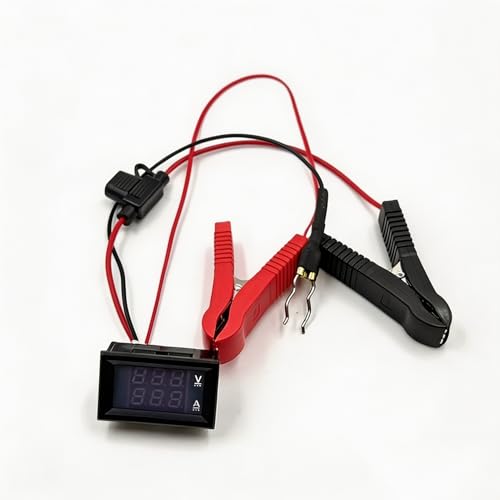
NO-DISCONNECT SAFE TESTING: Innovative design allows you to track down parasitic battery drain without disconnecting the vehicle's electrical system. This completely prevents vehicle computer (ECU) resets, loss of radio codes, and anti-theft system lockouts, ensuring a hassle-free diagnostic process.

🔋 Locate the Exact Fuse Causing Battery Drain: Stop guessing which circuit is draining your battery. This tester allows you to pinpoint the specific fuse responsible for abnormal parasitic current draw—fast, accurate, and without disconnecting the battery.

Used for rapid detection to determine if your vehicle has abnormal battery leaks or excessive power consumption.
When to Get Professional Help
Call a qualified mechanic if the battery drains after you identify a high-draw circuit but cannot locate the component. Professional help is also appropriate when the draw is intermittent, the reading changes every few minutes, the problem involves a hybrid, airbag, smart-key, security, infotainment, body-control, or networked module circuit, or the truck has water intrusion or complex aftermarket wiring.
Stop testing immediately if you smell burning, find melted fuse plastic, see damaged wiring, notice repeated blown fuses, or find a hot cable, relay, or module. A shop can use a scan tool to identify modules that remain awake and can check main feeds without repeatedly resetting the truck.
Frequently Asked Questions
Why does my Toyota Tacoma battery die overnight?
A Tacoma battery can die overnight because the battery is weak or undercharged, a terminal or ground connection has high resistance, the charging system did not restore the charge, or a light, relay, module, or aftermarket device stayed powered after shutdown. Charge and test the battery first, then measure key-off draw after sleep mode.
What is a normal parasitic draw on a Toyota Tacoma?
Less than 50 milliamps after all modules sleep is a common general guideline, and a steady reading near 100 milliamps or more deserves investigation. The correct limit can vary by Tacoma year, trim, smart-key system, factory options, and aftermarket equipment, so compare the result with model-specific service data.
Which fuse causes battery drain on a Tacoma?
There is no single Tacoma fuse that causes every battery drain. The affected fuse depends on the model year and the circuit that remains powered. A large current drop after checking or removing a fuse identifies the circuit to inspect, but the actual cause may be a light, relay, accessory, module, switch, wiring fault, or water-damaged connector on that circuit.
Can a bad alternator drain a Tacoma battery overnight?
Yes, on a conventional alternator system a failed rectifier diode can allow current to flow backward when the engine is off. Test the charging system and isolate the alternator circuit before replacing the alternator. Use hybrid-specific service information for i-FORCE MAX models.
How long can a Tacoma sit before the battery dies?
There is no reliable fixed number of days. Battery capacity, age, temperature, starting reserve, state of charge, and key-off current all change the result. A 100 mA draw uses about 2.4 amp-hours per day, while a weak or partly charged battery can fail much sooner than a fully charged healthy battery.
Will replacing the battery fix a parasitic drain?
Only if the battery itself is the failed part. A new battery may temporarily hide an electrical draw, but it will discharge again if a circuit stays powered. Test the battery, charging system, and key-off current so the replacement addresses the proven fault.
Is it normal for a new Tacoma i-FORCE MAX to lose its battery after a few days parked?
No healthy battery should go dead after only a few days of normal parking, even on a new hybrid Tacoma. Some 2024–2025 i-FORCE MAX owners have reported this pattern on low-mileage trucks, and it is worth a dealer visit for hybrid-specific diagnostics, since some trims charge the 12-volt battery through a DC-DC converter rather than a conventional alternator.
Safety Disclaimer: This article gives general information only and does not replace the owner manual, model-specific service data, or advice from a qualified mechanic. If you are unsure about electrical testing, battery handling, hybrid systems, or wiring repair, stop and get professional help.
Conclusion
Diagnose Toyota Tacoma battery drain by following the failure pattern. Test the battery and cable connections first. If the truck loses power while driving, check the charging system. If it runs normally but dies after parking, allow the modules to sleep, measure key-off current, and isolate the circuit without guessing at parts. After the repair, recharge the battery and repeat the test to prove that the drain is gone.
Sources
- GS Yuasa: How can I tell if my GS Yuasa battery is fully charged? — supports resting 12-volt battery voltage guidance, accessed July 31, 2026.
- Fluke: How to Find Parasitic Battery Drain with a Multimeter — supports sleep-mode timing, in-series meter setup, current thresholds, fuse isolation, and fuse voltage-drop testing, accessed July 31, 2026.
- Interstate Batteries: The Official Way to Jump Start a Car — supports the limits of resting-voltage checks and the need for a battery test, accessed July 31, 2026.
- AutoZone: How to Test the Alternator and Charging System — supports general charging-system voltage checks, accessed July 31, 2026.
- AutoZone: Can an Alternator Drain a Battery? — supports alternator rectifier-diode leakage as a possible key-off drain, accessed July 31, 2026.
- Toyota Owners: Manuals and Warranties — supports using the exact model-year owner information for battery safety and procedures, accessed July 31, 2026.
- Toyota Owners: 2024 Tacoma Items to Initialize — supports the warning that battery reconnection can require system initialization, accessed July 31, 2026.
- Toyota USA Newsroom: 2024 Toyota Tacoma Is the Ultimate Adventure Machine — supports identifying i-FORCE MAX as a hybrid Tacoma powertrain, accessed July 31, 2026.