
Last updated: September 14, 2026. This guide was revised to separate older Supra cooling systems from the modern A90/A91 GR Supra and to remove universal coolant and pressure-test assumptions.
Affiliate disclosure: This page may display monetized tool or parts recommendations. If you buy through a qualifying link, we may earn a commission at no extra cost to you. Always verify parts and tools against your exact Supra year, engine, and cooling circuit before buying.
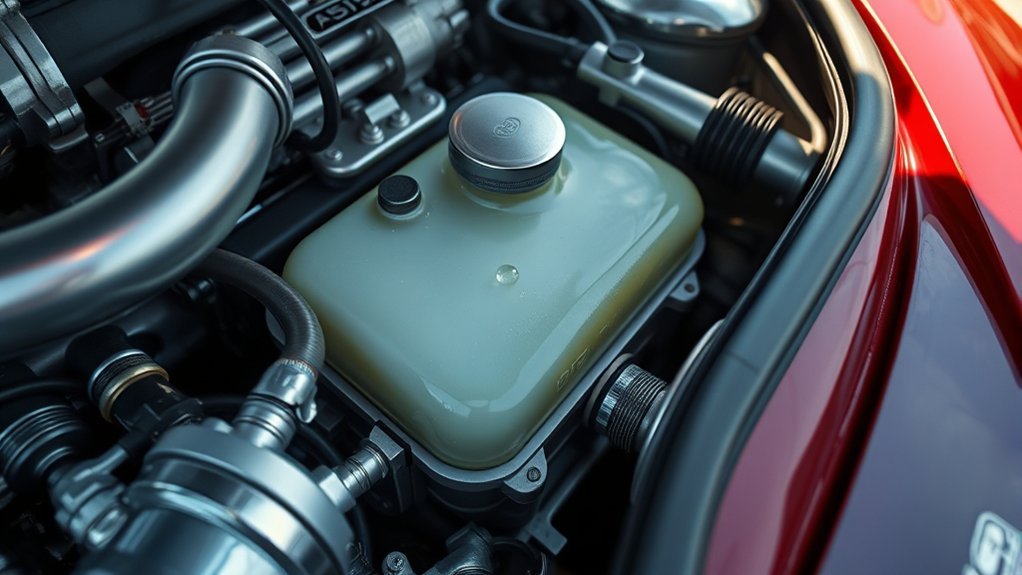
A Toyota Supra coolant leak should be diagnosed with the engine fully cold. First identify your Supra generation because older A70/A80 cars and the 2020+ A90/A91 GR Supra use different cooling layouts. Look for fresh coolant, dried residue, or wet areas around the coolant reservoir or reservoirs, hoses, radiator, water pump, thermostat area, connections, and under the vehicle. If no leak is visible, use a cooling-system pressure tester with the correct adapter and only the test pressure specified for your exact model year and cooling circuit. Do not assume one pressure setting fits every Supra. Stop driving if the engine is overheating, steam is present, a warning persists, or coolant is being lost quickly. For factory specifications, check the Toyota owner’s manual for your model year.
How Do You Diagnose a Toyota Supra Coolant Leak?
Use this order: confirm the engine is cold, identify the Supra generation, record which coolant reservoir is low, inspect for residue from the highest point downward, and then pressure-test the correct circuit if a visual check does not reveal the source. A pressure drop means the system is losing pressure, but also verify that the tester and adapter themselves are sealing correctly. If coolant continues to disappear without an external leak, move to heater-circuit and internal-leak diagnosis rather than repeatedly topping off the system.
| Supra generation | Cooling-system point to know | Diagnostic implication |
|---|---|---|
| A70/MkIII, U.S. 1986.5–1992 | Older-generation cooling layout | Use the year- and engine-specific manual rather than modern GR Supra coolant or reservoir instructions. |
| A80/MkIV, U.S. 1993–1998 | Older 2JZ-era hose and cooling layout | Hard-to-reach rear/heater hoses can be relevant. “Suicide hose” is enthusiast terminology, not a universal Toyota component name. |
| A90/A91 GR Supra, 2020–2026 | Modern owner-manual guidance identifies engine and auxiliary cooling reservoirs, depending on configuration, and specifies Frostox HT-12 coolant. | Identify which circuit is losing coolant and do not apply old 2JZ hose or generic Toyota-coolant advice to the modern car. |
Signs You Might Have a Coolant Leak
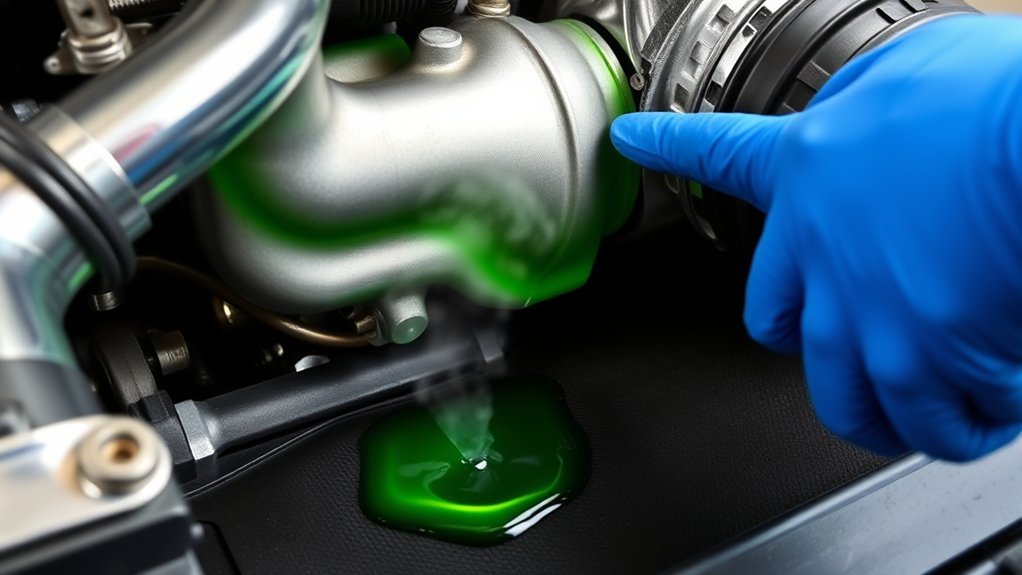
Common coolant-leak signs include a falling cold coolant level, dried coolant residue, wet connections, a puddle under the vehicle, a low-coolant warning, steam, or an engine temperature that rises above normal. A sweet smell in the engine bay can accompany an external leak from a hose, fitting, reservoir, radiator, pump, or another cooling-system component.
A sweet smell inside the cabin can justify inspecting the heater circuit. If you also see persistent white exhaust after the engine is fully warm, oil-and-coolant contamination, repeated bubbling, or unexplained pressure buildup, professional testing for an internal engine leak may be appropriate. Do not diagnose an internal leak from smell or steam alone.
If the temperature is rising, steam is coming from the engine bay, or coolant is being lost rapidly, stop driving and let the vehicle cool. Continuing to drive an overheating engine can turn a small cooling-system fault into major engine damage.
Common Locations for Coolant Leaks in the Supra
Start with the components that can actually apply to your Supra generation. Across many models, hoses and their connections, the radiator, coolant reservoir or cap, water-pump area, thermostat-area seals, and other cooling-system joints are reasonable inspection points. The exact layout changes substantially by generation.
On an older A80/MkIV, inspect aging coolant and heater hoses, including hard-to-reach hoses near the rear of the engine where applicable. Do not assume an enthusiast nickname identifies the same hose on every engine or market.
On an A90/A91 GR Supra, determine whether the engine-cooling or auxiliary-cooling reservoir is losing coolant before chasing parts. Inspect the applicable reservoir and cap, hose connections, radiator/heat-exchanger area, water-pump area, and visible fittings for fresh coolant or dried residue. For a deeper radiator-specific check, see the Supra radiator leak guide. For water-pump symptoms, see the Supra water-pump guide.
Initial Steps to Diagnose Your Coolant Leak
Diagnose the leak systematically instead of replacing parts based only on where coolant drips onto the ground.
- Let the engine cool completely. Never remove a pressurized coolant cap from a hot system.
- Identify the generation and engine. The A70, A80, and A90/A91 do not share one cooling-system procedure.
- Record the cold coolant level. On a modern GR Supra, identify which reservoir or circuit is losing coolant.
- Trace residue upward. Coolant can run along brackets, hoses, covers, or an undertray before dripping somewhere far from the actual leak.
- Pressure-test only if needed. Use the correct adapter and the model/circuit-specific test pressure.
Common Leak Locations
When you find coolant residue, do not automatically replace the component directly above the puddle. Follow the wet or dried trail toward its highest visible point. Check hose ends and quick connections, reservoir seams and caps, radiator joints, water-pump areas, thermostat-area seals, and any recently serviced connection. On older cars, inspect aged heater and coolant hoses carefully for cracking, hardening, swelling, or seepage.
If an A90/A91 undertray is wet, inspect above it before assuming the radiator itself is leaking. A small amount of coolant can travel before reaching the ground.
Visual Inspection Techniques
With the engine cold, use a flashlight to look for fresh wetness and dried coolant residue around the relevant reservoir, hoses, connections, radiator area, water pump, and thermostat area. Check the ground and any underbody panel for fluid, but remember that the final drip point may not be the source.
Document the cold coolant level and the location of any residue before cleaning the area. After cleaning, recheck after a normal heat cycle once the engine has cooled again. A returning trail can make a slow seep easier to trace.
If nothing is visible but the coolant level keeps falling, a pressure test or compatible UV leak-detection dye may help. Follow the dye manufacturer’s instructions and confirm that the product is suitable for the cooling system.
Pressure Testing Methods
Pressure-test the cooling system only when the engine is fully cold. Attach the correct tester adapter to the fill point specified for that model and circuit. Pressurize the system only to the pressure stated in the applicable service information or cap/system test specification. Do not assume 15–20 psi is correct for every Toyota Supra.
Watch the gauge while inspecting hoses, connections, the radiator area, reservoirs, the water pump, thermostat-area seals, and other accessible joints. A falling gauge reading suggests pressure loss, but first make sure the tester and adapter are not leaking. A cooling-system leak may produce wetness, a hiss, or fresh residue under pressure even when it stays dry while parked.
Release tester pressure slowly according to the tool instructions. If the pressure falls but no external source appears, professional diagnosis may be needed for a cap fault, heater-circuit leak, or internal leak.
How to Check Your Coolant Levels
Check the coolant only when the engine is cold and the vehicle is on suitable level ground. The correct procedure and level marks depend on the generation. On modern A90/A91 GR Supras, owner-manual guidance identifies an engine-cooling reservoir and an auxiliary-cooling reservoir depending on configuration, so check the applicable circuits rather than assuming there is only one tank.
For a detailed level-check procedure, see how to check Toyota Supra coolant level.
Check Coolant Reservoir Level
For a modern GR Supra, let the engine cool and inspect the applicable reservoir or reservoirs using the level method specified by the owner’s manual. Current GR Supra guidance specifies Antifreeze and Corrosion Inhibitor Frostox HT-12. Do not substitute a generic Toyota coolant solely because it is the same brand or a similar color.
If you are using coolant concentrate, follow the manual and coolant manufacturer’s required water-to-additive ratio. Do not add extra water to a premixed 50/50 product. Older Supras have different coolant guidance, so use the manual for the exact year rather than applying the modern GR Supra specification retroactively.
For coolant-selection details, see the Supra coolant type and service guide.
Inspect Hoses for Damage
Check accessible coolant hoses for cracks, hardening, swelling, abrasion, wetness, or dried residue. Inspect clamps and connection points for seepage and corrosion. Older hoses can fail under temperature and pressure even when a cold visual check looks acceptable.
Do not tighten every clamp blindly. Some modern cooling connections use designs that are not serviced by simply tightening a worm-drive clamp. Match the repair method to the exact hose and connection.
Why Coolant Color Alone Cannot Identify the Correct Fluid
Color can help you notice that a fluid may be coolant, but it does not reliably identify its chemistry, approval, or compatibility. Green, pink, orange, red, blue, and other colors are used by different coolant families and manufacturers.
- Fresh colored residue: May help trace the physical path of a coolant leak.
- White or crusty dried residue: Can remain after a small coolant seep evaporates.
- Brown, oily, or muddy coolant: Requires diagnosis for contamination rather than choosing replacement fluid by color.
- Unknown coolant: Verify the installed specification before mixing another product into the system.
For the modern GR Supra, match the required HT-12 specification rather than choosing a bottle because its color “looks right.”
Tools You’ll Need for Leak Detection
You do not need a large tool collection for the first inspection. Start with tools that help you observe and document the leak without disturbing the system.
[Products Worth Considering]
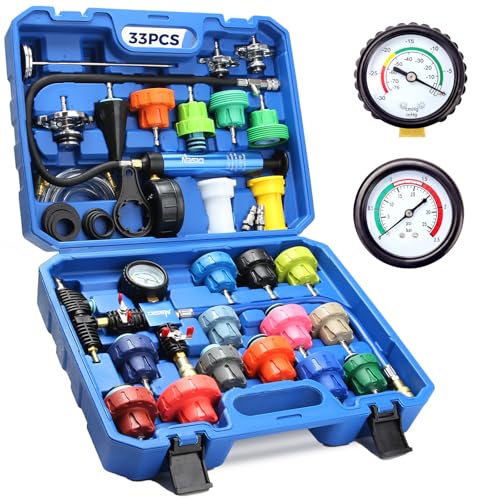
🔧【COMPLETE 33-PIECE MASTER KIT】This all-in-one coolant pressure tester and vacuum refill kit includes 23 radiator adapters (22 specific + 1 universal), a vacuum pump, a vacuum purge & refill tool, a probe thermometer, a wrench, EU & US air intake joints, O-rings, and hoses. Everything you need to diagnose cooling system leaks and refill without air pockets—all in one rugged carrying case.

Comprehensive Tool Set: Orion Motor Tech's 19 pcs coolant pressure tester kit makes detecting internal & external pressure leaks in your vehicle's cooling system easy, including 15 adapters, a manual vacuum pump, a probe thermometer, a wrench, and O-rings
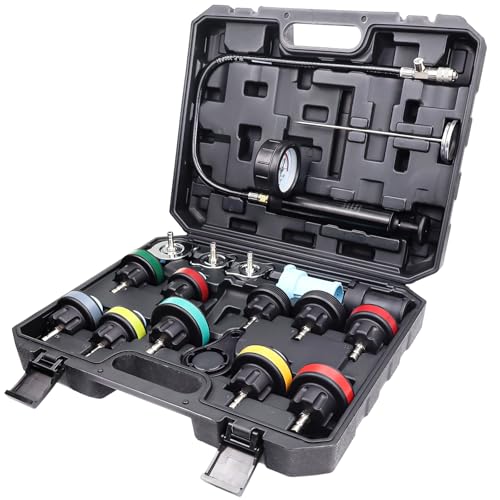
[Coolant Pressure Tester Kit]:This coolant pressure tester kit makes it convenient to select the suitable adapter without any mess. With 18 pieces, it's perfect for testing cooling systems on most vehicles.
Essential Leak Detection Tools
- Flashlight: Helps identify wet spots and dried residue.
- Inspection mirror: Useful around the rear or underside of components.
- Clean rags or paper towels: Help confirm whether residue is currently wet.
- Cooling-system pressure tester: Use only with the correct adapter and model-specific test pressure.
- Compatible UV dye and UV light: Useful for slow leaks when the dye is approved for the cooling system.
- Basic eye and hand protection: Coolant is hazardous and a cooling system can remain hot or pressurized after driving.
Common Diagnostic Techniques
Begin with the cold visual inspection and coolant-level record. If you see residue, clean the suspected area and check whether it returns. If the coolant drops without a visible source, pressure-test the correct circuit using the specified pressure. UV dye can help trace very small leaks that appear only when the system is hot or pressurized.
If repeated coolant loss occurs with no external evidence, move beyond basic leak detection. Heater-circuit leakage, cap problems, or an internal engine leak may require specialized testing. Do not keep topping off a system indefinitely without finding the cause.
Performing a Pressure Test on Your Cooling System
A pressure test can expose a leak that is difficult to see when the car is cold and unpressurized. The safe procedure is model-specific.
- Let the engine and cooling system cool fully.
- Identify the correct circuit and fill point.
- Install the correct pressure-tester adapter.
- Use only the pressure specified for that model and cooling circuit.
- Watch the gauge and inspect for fresh leakage or residue.
- Confirm the tester itself is sealed before blaming the vehicle for a pressure drop.
- After any repair, refill and bleed the affected circuit using the correct Toyota procedure, then verify the repair again after the engine has cooled.
If you do not have the correct specification or adapter, do not guess. A shop can pressure-test the system without risking damage from excessive pressure.
[Products Worth Considering]

Universal Compatibility: 17 color-coded test caps and 3 test covers fit most Japanese, European, and American cars. Quickly identify the right adapter for efficient cooling system diagnosis

Radiator Leak down Tester Kit: The radiator pressure tester kit helps you change coolant and test for leaks in your vehicle's cooling system, including the radiator, heater core and radiator cap, in a simple and straightforward manner. Self-locking quick coupler for easy adapter installation, and thumb-operated relief valve allows for repeated pressure tests and pressure release while testing the cooling system. Stainless steel thermometer(0-200℃ / 32-400℉) measures coolant temperature.
Why You Should Check Hoses and Connections
Hoses and their connection points are common places for cooling systems to seep. Look for cracking, abrasion, swelling, hardening, wetness, and dried residue. Follow any coolant trail to its highest visible point rather than assuming the lowest wet hose is the source.
On older A70/A80 cars, aging and hard-to-reach coolant or heater hoses deserve close inspection. On an A90/A91 GR Supra, use the modern cooling-system layout rather than searching for an older-generation “suicide hose.” If a connection uses a molded quick-connect or another specialized fitting, repair it using the specified replacement method.
[Products Worth Considering]

Fit for Toyota Camry 2002 2003 2004 2005 2006; Fit for Solara 4cyl Radiator 2004 2005 2006 2007 2008; Replace 16571-28080, 16572-28080, 165710H020,165720H020
When Should You Seek Professional Help for a Supra Coolant Leak?
Stop driving and arrange professional diagnosis if the Supra is overheating, steam is coming from the engine bay, coolant is leaving the system rapidly, or a temperature/low-coolant warning persists. Also get help if the system loses pressure without an identifiable external leak.
- Engine temperature rises above normal or an overheating warning appears.
- Steam or a large active leak is present.
- The coolant level drops again soon after a correct top-off.
- A sweet cabin smell or damp interior suggests a heater-circuit problem.
- Oil and coolant appear contaminated.
- You cannot identify which cooling circuit is losing coolant.
- You do not know the correct pressure-test specification or bleeding procedure.
These symptoms do not all prove an internal engine leak, but they justify diagnosis before normal driving continues.
Preventative Measures to Avoid Future Leaks
Prevent repeat coolant problems by following the maintenance information for the exact Supra year and engine. Check cold coolant levels periodically, inspect hoses and visible connections during service, and investigate a recurring level drop instead of repeatedly adding coolant.
Use the specified coolant rather than selecting fluid by color. Replace damaged hoses, seals, caps, or other components with parts confirmed for the exact vehicle. Pressure testing is primarily a diagnostic or post-repair verification tool; it does not need to become a routine maintenance procedure when the cooling system is healthy.
After a component replacement or coolant drain, use the correct refill and bleeding procedure for that cooling circuit. Air left in the system can produce unstable coolant levels or overheating even after the original leak has been repaired.
Frequently Asked Questions
Can You Drive a Toyota Supra With a Coolant Leak?
If the Supra is overheating, producing steam, showing a persistent coolant or temperature warning, or losing coolant rapidly, do not keep driving it. Arrange towing or professional assistance. Even a smaller leak should be diagnosed before normal use because coolant loss can become worse once the system is hot and pressurized.
What Coolant Does a Modern GR Supra Use?
Current A90/A91 GR Supra owner-manual guidance specifies Antifreeze and Corrosion Inhibitor Frostox HT-12. Follow the manual for your exact model year and do not choose replacement coolant by color alone. Older Supra generations have different guidance.
Why Is My Supra Losing Coolant With No Puddle?
A small leak may appear only when the cooling system is hot and pressurized, dry before it reaches the ground, or collect on an underbody panel. A cap, heater-circuit leak, or internal leak can also cause coolant loss without an obvious garage-floor puddle. Record the cold level and pressure-test the correct circuit if the loss continues.
What Pressure Should I Use to Test a Supra Cooling System?
Use only the pressure specified for your exact model year, engine, and cooling circuit. There is no safe universal 15–20 psi instruction for every Supra. Use the correct tester adapter and the applicable Toyota service information.
How Much Does It Cost to Get a Coolant Leak Diagnosed?
RepairPal’s Toyota Supra coolant-leak diagnosis estimator lists an average of about $61–$90 before taxes and fees. Actual prices vary by location, model year, shop labor rate, diagnostic work required, and any repairs that follow.
Conclusion
A Toyota Supra coolant leak is easiest to diagnose when you first identify the generation and cooling circuit, then work from a cold visual inspection to a controlled pressure test. Do not apply A80/2JZ hose advice, generic coolant colors, or one pressure specification to every Supra. Modern GR Supra owners should identify which coolant reservoir is losing fluid and use the specified HT-12 coolant.
If the engine overheats, steam appears, coolant loss is rapid, or you cannot locate a recurring leak, stop driving and have the system diagnosed. Finding the source before replacing parts is safer and usually cheaper than guessing.



[…] This guide applies most directly to the current-generation GR Supra. Toyota’s current owner information says gasoline Supra models use two cooling circuits, so both coolant reservoirs must be checked when the engine is cold. Older Supra generations use different cooling-system layouts, so confirm the exact model year and engine before ordering a radiator, cap, hose, or coolant. For whole-system diagnosis rather than radiator-specific troubleshooting, see the Toyota Supra coolant leak diagnosis guide. […]