On a Toyota RAV4, diagnostic trouble code P0420 indicates that the Engine Control Module (ECM) has detected Catalyst System Efficiency Below Threshold — Bank 1. This code is triggered when the post-catalyst oxygen sensor mirrors the switching pattern of the upstream sensor, meaning the catalytic converter is no longer storing and utilizing oxygen effectively. While a degraded converter substrate is common on higher-mileage vehicles, P0420 is frequently caused by exhaust manifold leaks, a biased Air-Fuel Ratio (A/F) sensor, engine misfires, or oil burning. Never replace the converter until you have verified sensor live data, inspected for exhaust leaks, and corrected upstream engine faults.
Last updated: July 23, 2026 · By: Merrick Vaughn, Founder, AutoReviewNest · Diagnostic data and repair estimates verified against Toyota Technical Information System (TIS) specifications and industry sources updated June 18, 2026.
Quick Answer & Diagnostic Protocol
A Toyota RAV4 P0420 code does not automatically condemn the catalytic converter. Follow this 4-step triage before buying parts: (1) Save all freeze-frame data and check for accompanying misfire (P0300–P0304) or fuel-trim codes (P0171/P0172); (2) Inspect the exhaust manifold donut gasket, flex pipe, and downstream sensor bung for air leaks; (3) Verify that the upstream A/F sensor reads ~3.3V at steady cruise while the downstream O2 sensor holds a steady 0.65V–0.75V; (4) If the downstream sensor oscillates rapidly between 0.1V and 0.9V with no exhaust leaks or engine faults present, the catalytic converter has lost oxygen storage capacity and requires replacement.
Key Takeaways for RAV4 Owners
- P0420 is an ECM monitor calculation, not a single component failure alarm. The ECM evaluates oxygen storage capacity over time; false codes can stem from pinhole exhaust leaks or biased sensor signals.
- Understand your sensor voltages. 2004+ RAV4s use a wideband Air-Fuel Ratio (A/F) sensor upstream (baseline ~3.3V or 0.0 mA) and a heated narrow-band O2 sensor downstream (0.1V–0.9V). Do not misdiagnose a normal 3.3V upstream reading as a stuck sensor.
- Watch for 2AZ-FE oil consumption (2006–2008 models). Chronic oil burning coats the catalytic converter’s platinum-rhodium washcoat, causing premature catalyst failure.
- Aftermarket converters require high washcoat loading. Toyota ECMs use tight efficiency windows. Inexpensive 49-state universal converters often trigger repeat P0420 codes within 1,000 miles. Use OEM or CARB-compliant direct-fit units.
- Check your warranty before paying. Federal EPA emissions warranty covers the catalytic converter for 8 years / 80,000 miles. In California emissions (CARB/PZEV) states, coverage on select RAV4 models extends up to 15 years / 150,000 miles.
At a Glance: Toyota RAV4 P0420 Troubleshooting
| Diagnostic Time | 30 minutes for code scan, freeze-frame review, and visual inspection; 1–2 hours for live-data graphing and smoke/leak testing |
| Technical Difficulty | Beginner for reading OBD-II data; intermediate for sensor voltage bench-testing, smoke testing, and exhaust replacement |
| Required Tools | OBD-II scanner with live graphing (PID support for A/F and O2 sensors), digital multimeter, automotive smoke machine or low-pressure soap solution, infrared thermometer, oxygen sensor socket |
| Estimated Repair Cost | Exhaust gasket / leak repair: $80–$250; Downstream O2 sensor replacement: $180–$380 (DIY: $60–$120); Catalytic converter replacement: $950–$2,400 (OEM/CARB compliant parts cost more). Verified against RepairPal and national parts databases updated June 18, 2026. |
Safety Warning: Stop driving immediately if your Check Engine Light is flashing. A flashing light indicates an active engine misfire dumping raw fuel into the exhaust, which can overheat the catalytic converter beyond 1,600°F (870°C) and cause irreversible thermal meltdown within minutes. On RAV4 Hybrid and Prime models, disconnect the 12V auxiliary system before mechanical service and never touch orange high-voltage cabling.
Toyota RAV4 P0420 Code: What It Means & Diagnostic Matrix
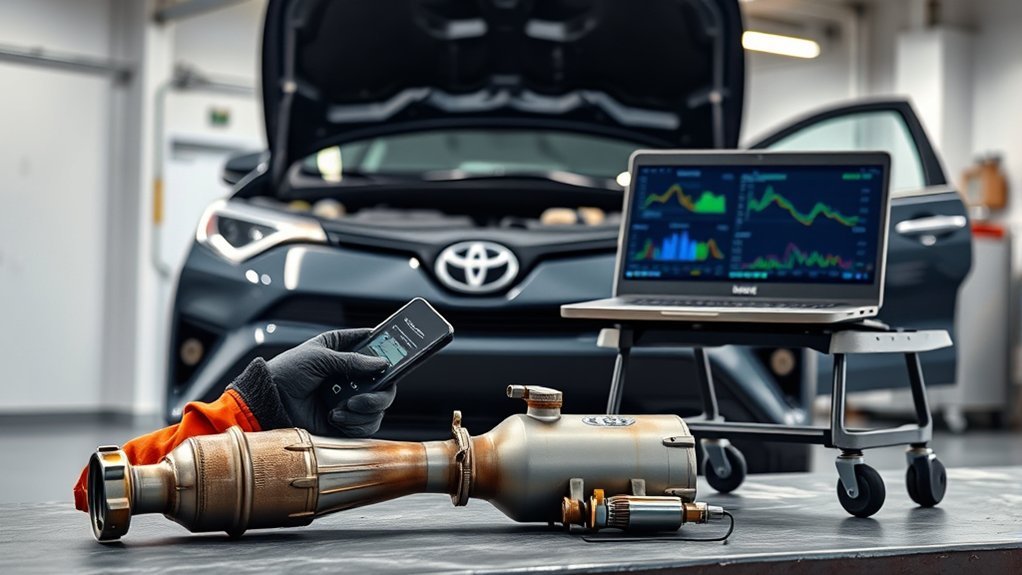
P0420 stands for Catalyst System Efficiency Below Threshold (Bank 1). On all 4-cylinder Toyota RAV4 models (2.0L 1AZ-FE, 2.4L 2AZ-FE, 2.5L 2AR-FE, and 2.5L Dynamic Force A25A-FKS/FXS), the engine has only one cylinder bank, making Bank 1 the entire exhaust stream. On third-generation RAV4 V6 models (2006–2012 with the 3.5L 2GR-FE), Bank 1 refers to the rear cylinder bank closest to the firewall (cylinders 1, 3, and 5), while Bank 2 refers to the front radiator side (which triggers P0430 if inefficient).
The ECM continuously monitors the catalytic converter once operating conditions (engine at operating temperature, closed-loop fuel control, and steady highway cruising) are satisfied. By comparing the rate of change between the upstream sensor and downstream sensor, the computer calculates the oxygen storage capacity of the catalyst. When this capacity drops below approximately 70–75% of its original specification, P0420 is stored.
| RAV4 Powertrain / Generation | Bank 1 Location & Sensor Configuration | Model-Specific Diagnostic Consideration |
|---|---|---|
| 2001–2005 RAV4 (2.0L / 2.4L 4-Cyl) | Single Bank. Integrated manifold-converter assembly located at the front of the engine bay. | Check for hairline cracks along the manifold runners and inspect early A/F sensor heater resistance. |
| 2006–2012 RAV4 (2.4L 2AZ-FE / 2.5L 2AR-FE) | Single Bank. Upstream A/F sensor in manifold; downstream O2 sensor after underfloor converter. | 2006–2008 2.4L engines are prone to heavy oil burning that poisons the catalyst substrate. 2009+ 2.5L 2AR-FE is highly reliable; check exhaust donut gaskets first. |
| 2006–2012 RAV4 (3.5L 2GR-FE V6) | Dual Bank. Bank 1 is the rear bank (firewall side, cylinders 1-3-5); Bank 2 is the front bank (radiator side). | Bank 1 rear manifold is difficult to access; verify rear downstream O2 sensor wiring harness for heat degradation. |
| 2013–2018 RAV4 (2.5L 2AR-FE 4-Cyl) | Single Bank. Close-coupled manifold catalytic converter + secondary underfloor catalyst. | Efficiency monitor primarily tracks the front close-coupled converter. Inspect flex pipe welds for stress cracks. |
| 2019–Present RAV4 (Gas & Hybrid A25A) | Single Bank. Dynamic Force engine with high-speed CAN communication and wideband A/F sensing. | Check for hybrid engine start/stop thermal cycling anomalies and verify ECM software calibration before replacing hardware. |
What Symptoms Can P0420 Cause on a RAV4?
Because the catalytic converter is an emissions-cleaning device rather than an active engine-management actuator, a failing catalyst often produces no obvious drivability symptoms in its early stages. However, as degradation or physical restriction progresses, watch for the following:
- Steady Check Engine Light (CEL): The most common symptom. The vehicle drives, idles, and starts normally.
- Sulfur or “Rotten Egg” Exhaust Smell: Occurs when an overloaded or degraded catalyst fails to convert hydrogen sulfide into sulfur dioxide.
- Sluggish High-RPM Acceleration: If the internal ceramic honeycomb substrate has broken down or melted, exhaust backpressure increases, choking engine breathing above 3,500 RPM.
- Rattling Noise Beneath the Floorpan: A fractured ceramic block rattling inside the stainless steel converter housing, particularly audible on cold start and idle.
- Failed Emissions / State Smog Inspection: High tailpipe hydrocarbon (HC) and carbon monoxide (CO) levels, accompanied by an “Incomplete” or failed catalyst monitor.
Diagnostic Decision Matrix: What Your Scan Tool Data Means
| Live Data PID & Operating Condition | Healthy System Reading | Faulty Converter Indication | Likely Alternate Fault |
|---|---|---|---|
| Upstream A/F Sensor (Bank 1 Sensor 1) Warm engine, 2,500 RPM cruise |
Steady at ~3.25V–3.35V (0.00 mA current), responding crisply to throttle blips. | Normal (~3.3V), showing engine fuel management is operating properly. | Stuck below 3.0V (rich) or above 3.6V (lean); high fuel trims indicate intake leak or fuel delivery issue. |
| Downstream O2 Sensor (Bank 1 Sensor 2) Warm engine, 2,500 RPM cruise |
Stable line hovering between 0.60V and 0.80V with minimal fluctuation. | Oscillates rapidly between 0.10V and 0.85V, mirroring the engine’s combustion cycles. | Stuck flatline at 0.0V or 0.1V (exhaust leak drawing fresh air, or open signal wire); stuck at 0.9V (shorted wire). |
| Total Fuel Trim (STFT + LTFT) Idle and 2,500 RPM |
Between -5% and +5% (Total correction under 10%). | Normal (-5% to +5%), indicating proper air-fuel mixture entering the catalyst. | Exceeds ±12% to ±20% (vacuum leaks, dirty MAF sensor, faulty fuel pressure, leaking injectors). |
How Do RAV4 Sensors and the Catalytic Converter Work?
Understanding the interaction between your RAV4’s exhaust sensors and the catalytic converter is the key to avoiding an unneeded $1,000+ repair. Modern Toyota systems do not use simple switching sensors on both sides of the converter.
Upstream A/F Sensor vs. Downstream Oxygen Sensor
The Upstream Sensor (Bank 1, Sensor 1) on 2004+ RAV4s is a wideband Air-Fuel Ratio (A/F) Sensor located before the catalytic converter in the exhaust manifold. Unlike a traditional oxygen sensor that only indicates whether the mixture is rich or lean relative to stoichiometry (14.7:1), an A/F sensor measures the exact air-fuel ratio across a wide spectrum. It outputs a current signal that the ECM converts to a voltage reference: precisely 3.30V represents a perfect 14.7:1 stoichiometric ratio. Voltages below 3.3V indicate a rich mixture, while voltages above 3.3V indicate lean.
The Downstream Sensor (Bank 1, Sensor 2) is a conventional heated narrow-band zirconia oxygen sensor mounted behind the catalytic converter. Its primary role is not engine fuel trim management, but rather serving as an efficiency watchdog for the catalyst. It outputs a signal between 0.1V (lean, excess oxygen) and 0.9V (rich, minimal oxygen).
How the ECM Evaluates Catalyst Efficiency
A functioning three-way catalytic converter absorbs excess oxygen during lean combustion moments and releases it to oxidize harmful hydrocarbons (HC) and carbon monoxide (CO) during rich moments. Because the converter constantly buffers oxygen, the exhaust gas exiting the catalyst contains very little free oxygen fluctuation.
When the catalyst is healthy, the downstream sensor produces a smooth, steady voltage line (typically 0.65V to 0.75V). If the catalytic washcoat degrades, the converter loses its oxygen storage capacity. Exhaust pulses pass straight through unbuffered, causing the downstream sensor to rapidly oscillate between 0.1V and 0.9V in tandem with engine cycles. When the calculated correlation ratio exceeds Toyota’s calibrated limit, the ECM flags code P0420.
What Destroys a RAV4 Catalytic Converter?
Catalytic converters are passive components designed to last the life of the vehicle. They rarely fail on their own; they are killed by upstream engine malfunctions:
- Unburned Fuel (Misfires): A faulty ignition coil, worn spark plug, or sticking injector sends raw gasoline into the exhaust. When this fuel hits the hot converter, it ignites, melting the ceramic substrate.
- Engine Oil Poisoning (Phosphorus/Zinc): Worn valve stem seals or sticking oil control rings (notably on the 2.4L 2AZ-FE engine) cause oil to enter the combustion chamber. Burning oil creates ash deposits that glaze over the catalyst’s precious metal coating (platinum, palladium, and rhodium), chemically deactivating it.
- Coolant Contamination (Silicon/Phosphates): A leaking head gasket allows engine coolant into the exhaust, creating silica deposits that permanently coat and ruin the catalyst substrate.
- Exhaust Leaks: Cracked manifold welds or rusted flange gaskets draw outside air (containing 21% oxygen) directly past the downstream sensor via the venturi effect, tricking the ECM into storing a false P0420.
Common Causes of P0420 on a Toyota RAV4
Every RAV4 P0420 diagnosis falls into one of four distinct categories. Work through these in order of frequency and diagnostic cost:
1. Exhaust Leaks Near Flanges and Sensor Bungs (Most Overlooked)
On third-generation (2006–2012) and fourth-generation (2013–2018) RAV4s, exhaust flange donut gaskets and flex pipes deteriorate due to heat cycles and winter road salt. Even a microscopic pinhole leak upstream of or near the downstream O2 sensor bung introduces atmospheric oxygen into the exhaust stream. The downstream sensor reads this extra oxygen as poor catalyst conversion, triggering a false P0420 on an otherwise perfectly healthy catalytic converter.
2. Degraded or Biased Downstream O2 Sensor
The downstream oxygen sensor operates in a harsh, high-heat environment. Over 100,000–150,000 miles, the sensor element slows down, develops internal resistance, or suffers from contaminated external air references. If the sensor reports a sluggish or erratic voltage signal, the ECM cannot accurately verify catalyst performance. Inspect the sensor harness for heat damage and test the circuit before buying an expensive converter.
3. Aged or Contaminated Catalytic Converter
When the internal substrate degrades due to age, high mileage (typically 150,000+ miles), or previous engine misfires, the catalyst loses its chemical conversion capability. Common indicators of true catalyst failure include a downstream O2 signal that closely tracks upstream switching, persistent P0420 with perfect fuel trims and zero exhaust leaks, or an internal substrate rattle.
Warranty Verification Note: Under the U.S. Federal Clean Air Act (40 CFR § 85.2103), major emissions components including catalytic converters and ECMs are warranted by Toyota for 8 years or 80,000 miles. Furthermore, vehicles certified under California PZEV/TZEV standards (sold in CA, CT, ME, MD, MA, NJ, NY, OR, RI, VT, WA) may carry up to 15 years or 150,000 miles of emissions component coverage. Check your warranty booklet on the Toyota Owners Portal before authorizing out-of-pocket replacements.
4. Upstream Engine Running Issues (Misfires & Fuel Trim Drift)
If your scan tool reveals stored misfire codes (P0300, P0301, P0302, P0303, P0304) or fuel mixture codes (P0171 lean, P0172 rich), resolve these immediately. Operating an engine with a ±15% fuel trim imbalance overloads the catalytic converter with excess hydrocarbons or excess oxygen, forcing the catalyst outside its operational window.
How Do You Diagnose RAV4 P0420 Step by Step?
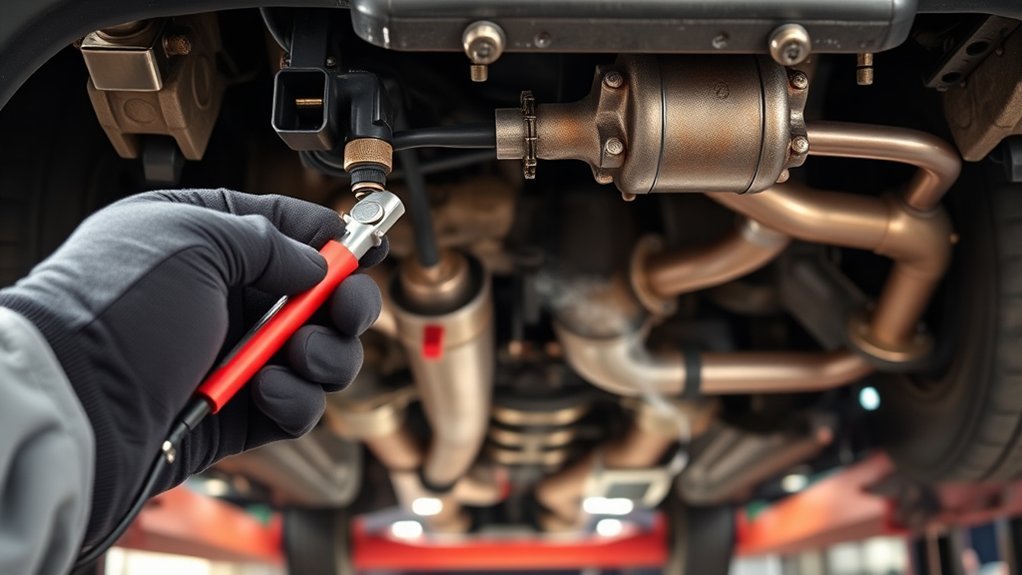
Follow this standardized diagnostic procedure used by professional Toyota technicians to isolate the exact failure point without guessing.
[Products Worth Considering]

This oxygen O2 sensor set is designed for select Toyota Camry and RAV4 models with 2.4L engines, providing upstream and downstream replacement coverage in one package. Built to OEM specifications for plug-and-play installation, it helps improve fuel efficiency, support accurate air-fuel monitoring, and restore reliable engine performance. The stainless steel and heat-resistant construction is made for long-lasting durability and stable operation.

This ignition coil and iridium spark plug kit is designed to restore smooth engine performance, reliable starts, and efficient combustion for compatible Toyota models. Built for a precise fit across select Camry, RAV4, Sienna, Highlander, and Venza applications, it helps improve idle stability, fuel economy, and emissions. The kit includes durable replacement parts backed by a one-year unlimited-mileage guarantee for added confidence on the road.

The Mityvac MV8500 Silverline Elite is a versatile automotive service kit for brake and clutch bleeding, diesel fuel priming, and vacuum or pressure testing. Its dual-capability pump streamlines diagnostics and maintenance across motorcycles, cars, trucks, and SUVs, while the ergonomic design supports comfortable use during longer jobs. Built with a durable zinc-aluminum die-cast body and a 4.5oz fluid reservoir, it delivers reliable performance for professional and DIY repair work.
Step 1: Capture Freeze-Frame Data and Check System Codes
Plug in your OBD-II scan tool and read all stored, pending, and permanent DTCs. Before clearing anything, save the Freeze Frame Data. Note the engine RPM, coolant temperature, vehicle speed, and fuel trims when P0420 set. If the code set at highway speed under closed-loop operation, it represents a standard monitor failure. If it set during abnormal engine temperatures or alongside misfire codes, address those root causes first.
Step 2: Inspect Exhaust System for Physical Leaks
With the exhaust system cold, perform a physical and acoustic inspection:
- Inspect the exhaust manifold for hairline cracks along the welds, particularly on 2001–2005 2.0L/2.4L models.
- Check the spring-bolt donut gasket connecting the exhaust manifold downpipe to the mid-pipe. Look for black carbon soot trails, which indicate leaking exhaust gas.
- Inspect the downstream O2 sensor bung weld and the underfloor flex pipe section for pinholes or rust perforation.
- Pro Tip: Connect a shop vacuum to the tailpipe on “blow” mode with the engine off. Spray a soapy water solution onto all exhaust flanges, sensor bungs, and weld joints. Any bubbling reveals a leak drawing in fresh air.
Step 3: Graph Upstream and Downstream Live Sensor Data
Warm the engine to full operating temperature (coolant temperature > 180°F / 82°C). Drive the vehicle or hold engine speed steady at 2,500 RPM in Park/Neutral for 2–3 minutes while recording live sensor PIDs:
- Bank 1 Sensor 1 (A/F Sensor): Should remain stable near 3.30V (or 0.0 mA). Snap the throttle open quickly; the voltage should briefly dip rich (< 3.0V) and rebound lean (> 3.6V) on deceleration.
- Bank 1 Sensor 2 (Downstream O2): Must hold a steady, stable line between 0.60V and 0.80V. If it continuously sweeps between 0.1V and 0.9V matching engine throttle pulses, the catalyst is failing to store oxygen.
Step 4: Check Fuel Trims and Air-Fuel Balance
Examine Short-Term Fuel Trim (STFT) and Long-Term Fuel Trim (LTFT). Add the two numbers together at idle and at 2,500 RPM. A total fuel trim between -8% and +8% confirms healthy engine fuel control. If total trim exceeds +12%, diagnose vacuum leaks, a contaminated Mass Air Flow (MAF) sensor, or low fuel pressure. If total trim is below -12%, check for leaking fuel injectors or a saturated EVAP canister.
Step 5: Perform an Exhaust Restriction / Backpressure Test (If Power Loss Is Present)
If the RAV4 exhibits sluggish acceleration or lacks high-RPM power, test for a clogged or melted catalyst substrate. Remove the upstream A/F sensor and install an exhaust backpressure gauge. A healthy exhaust system shows less than 1.25 psi of backpressure at 2,500 RPM. Backpressure exceeding 2.5–3.0 psi indicates a physically restricted, collapsed catalytic converter that requires replacement.
Step 6: Execute the Official Toyota Catalyst Monitor Drive Cycle
After completing repairs or verifying system integrity, clear DTCs and execute the factory drive cycle to verify the catalyst monitor sets to “Ready” without triggering P0420:
- Ensure the fuel tank is between 1/4 and 3/4 full.
- Start the cold engine and allow it to idle in Park for 5 minutes with the rear defroster and A/C off.
- Accelerate smoothly to 45–55 mph on a highway. Maintain steady throttle and speed for 10 to 15 consecutive minutes.
- Release the accelerator pedal completely and allow the vehicle to coast down to 20 mph without applying the brakes (deceleration fuel cut-off test).
- Stop the vehicle, idle in Drive for 2 minutes, and check readiness monitor status on your scan tool.
Will Catalytic Converter Cleaner Fix RAV4 P0420?
Chemical “catalytic converter cleaner” additives will not fix a physically damaged, broken, melted, or poisoned catalytic converter. Pour-in-tank cleaners are essentially concentrated fuel-system detergents. While they can remove light carbon glaze from intake valves, fuel injectors, and combustion chambers, they cannot restore missing platinum-rhodium washcoat, repair fractured ceramic honeycombs, or reverse phosphorus poisoning from engine oil burning.
If your P0420 code is triggered by light carbon build-up from short-trip city driving, an approved fuel system cleaner combined with a spirited 45-minute highway drive (an “Italian tune-up”) may temporarily improve combustion efficiency. However, if the code returns after completing the official drive cycle, mechanical diagnosis is required. Never use additives if the engine has active misfires or heavy oil consumption.
How Do You Replace a RAV4 Catalytic Converter?
Replacing a RAV4 catalytic converter requires matching the replacement unit strictly to your VIN, engine displacement, drivetrain (FWD vs AWD), and underhood emissions certification label.
Emissions Compliance & Aftermarket Warning: Federal EPA regulations prohibit modifying or bypassing emissions systems. On Toyota vehicles, generic low-cost “49-state universal” converters frequently trigger repeat P0420 codes within 500–2,000 miles due to insufficient precious metal loading. If you live in California, New York, Colorado, Maine, or other CARB-adopting states, you must install an OEM unit or a CARB-certified aftermarket converter stamped with a valid Executive Order (EO) D-number matching your exact engine family.
[Products Worth Considering]

【Vehicle Fitment】Catalytic Convertor Specifically engineered for 2009-2018 Toyota RAV4 L4 2.5L, 2016-2018 RAV4 L4 2.5L (Gas), 2011-2016 Scion TC L4 2.5L.

【Vehicle Compatibility】Specifically engineered for Toyota RAV4 2001-2003 L4 2.0L, Reference Number: 674-593, 674593, 16385, 642277, 2505128080, 2505128260

【Vehicle Fitment】Catalytic Convertor Compatible with 2006-2008 Toyota Rav4 2.4L L4, 2008-2015 Scion xB 2.4L L4. Make sure to research the part's fit for your vehicle before purchasing. Enter your vehicle's information (year, make, model, engine, and trim) to verify compatibility and review the qualifier notes.
Tools and Hardware Required
- Direct-fit replacement catalytic converter assembly (with new exhaust manifold studs/nuts)
- OEM exhaust manifold gasket and downstream spring-bolt donut gasket
- 22mm (7/8″) slotted oxygen sensor socket
- Metric socket set (10mm, 12mm, 14mm, 17mm) with long extensions and swivel joints
- High-grade penetrating oil (e.g., PB Blaster or Kroil)
- Torque wrench (capable of 25–45 lb-ft)
- Heavy-duty jack stands or hydraulic vehicle lift
Step-by-Step Replacement Overview
- Soak All Fasteners in Penetrating Oil: Exhaust manifold nuts and spring-flange bolts undergo extreme thermal cycling and rust heavily. Apply penetrating oil generously 12–24 hours before starting the job.
- Disconnect the 12V Battery: Disconnect the negative terminal to prevent accidental electrical shorts and reset ECM adaptive trim tables.
- Disconnect and Remove Exhaust Sensors: Unplug the wiring harnesses before unthreading the sensors to prevent twisting and snapping the internal wire leads. Use a dedicated sensor socket.
- Unbolt Lower Exhaust Spring Flange: Support the mid-pipe and remove the lower spring-loaded exhaust flange bolts. Discard the old crushed donut gasket.
- Remove Heat Shields and Manifold Flange Fasteners: Unbolt the upper exhaust manifold nuts in a cross-pattern to prevent warping the cylinder head mating surface.
- Install the New Converter with Fresh Gaskets: Fit the new OEM-quality exhaust manifold gasket. Hand-tighten all nuts, then torque to Toyota factory specification (typically 27–33 lb-ft for 2.4L/2.5L engines; verify your model-year manual) working from the center outward.
- Reinstall Sensors with Anti-Seize: Apply a tiny smear of high-temperature copper anti-seize to the sensor threads only—never touch the sensor tip. Torque sensors to 30–33 lb-ft.
- Check for Leaks and Perform Drive Cycle: Start the engine, verify zero exhaust leaks at all flanges, and complete the drive cycle to set monitor readiness.
How Much Does RAV4 P0420 Repair Cost?
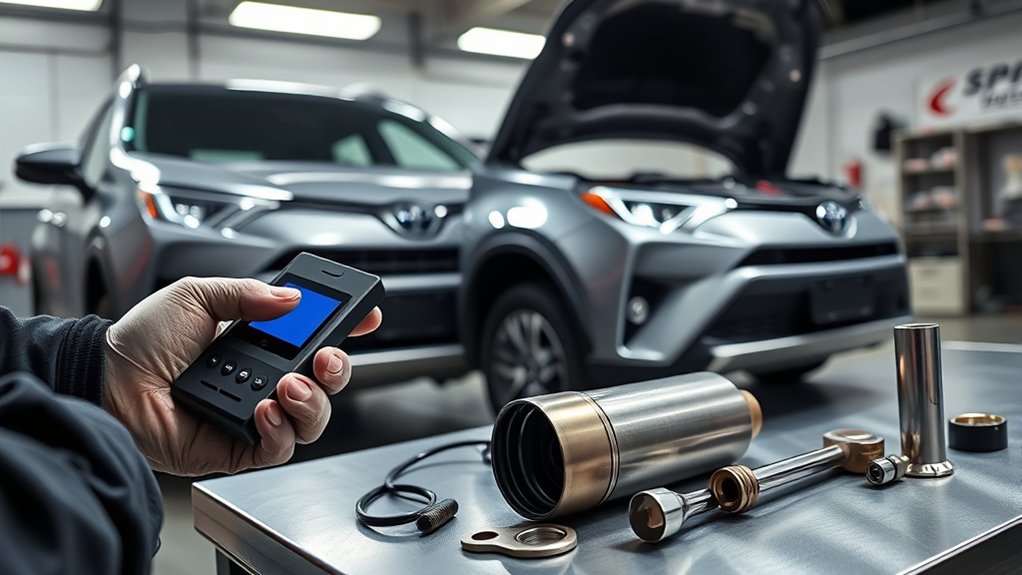
Repair costs for P0420 depend on whether the true culprit is a $25 exhaust gasket, a $150 oxygen sensor, or a full catalytic converter replacement. Below is an itemized breakdown of typical national parts and labor costs verified against industry pricing databases updated June 18, 2026.
| Diagnostic or Repair Item | DIY Parts Cost | Professional Shop Total (Parts + Labor) | Diagnostic & Application Notes |
|---|---|---|---|
| Professional Diagnostic / Smoke Test | $0–$30 (DIY Scanner) | $120–$195 | Includes live-data graphing, freeze-frame extraction, and smoke testing for exhaust leaks. Usually waived if the shop performs the repair. |
| Exhaust Donut Gasket / Flange Repair | $18–$45 | $140–$280 | Resolves false P0420 caused by ambient oxygen entering the exhaust stream near the downstream sensor. |
| Downstream Oxygen Sensor (Sensor 2) | $65–$130 (Denso OEM) | $220–$380 | Use only OEM Denso sensors. Aftermarket generic sensors often have incorrect internal resistance. |
| Upstream Air-Fuel Ratio Sensor (Sensor 1) | $110–$190 (Denso OEM) | $310–$490 | Replace only if live-data testing shows slow response, open heater circuit, or fuel trim skew. |
| Direct-Fit Catalytic Converter (EPA 49-State) | $380–$750 | $950–$1,650 | Direct-fit manifold assembly. Legal in non-CARB states only. Labor ranges from 2.0 to 3.5 hours. |
| OEM Toyota or CARB-Compliant Converter | $900–$1,600 | $1,650–$2,500+ | Mandatory for California/CARB states and recommended for long-term durability on Gen 4 and Gen 5 models. |
[Products Worth Considering]

PRECISE FIT: Compatible with Toyota Rav4 2004-2005 2.4L, Reference Number: 54648, 1742028380. Use the Confirm Fit tool above before ordering to avoid returns.

PRECISE FIT: Compatible with Toyota RAV4 2006-2008 2.4L 2ps Front and Rear.

[Vehicle Compatibility] - Catalytic converter Replacement for RAV-4 2006-2008 2.4L (Built in USA), xB 2008-2015 2.4L/2011-2015 2.4L. OEM replace number: 674966, 16480. Please refer Compatibility in the page description is more detail to confirm.
Questions to Ask Your Mechanic Before Approving a Converter Replacement
- Did you verify that total fuel trims (STFT + LTFT) are within ±8% at both idle and 2,500 RPM?
- Did you perform a smoke test or physical inspection to rule out exhaust leaks at the manifold donut gasket and sensor bungs?
- What were the specific live-data voltage waveforms for Bank 1 Sensor 1 and Bank 1 Sensor 2?
- Is the replacement catalytic converter an EPA direct-fit or CARB-compliant unit with sufficient washcoat loading to satisfy Toyota’s ECM window?
- Has my VIN been checked against active Federal (8 yr / 80k mi) or California (15 yr / 150k mi) emissions warranty coverage?
How Can You Keep RAV4 P0420 From Returning?
Installing a new catalytic converter without addressing the underlying engine condition that caused it to fail guarantees a repeat P0420 code within 12 to 24 months. Protect your exhaust investment by following these maintenance rules:
- Fix Ignition Misfires Instantly: Never ignore a rough idle, stumbling acceleration, or flashing Check Engine Light. Replace spark plugs at the factory interval (every 60,000 miles for standard plugs; 100,000–120,000 miles for OEM Iridium).
- Monitor Engine Oil Levels Closely: If your 2.4L 2AZ-FE RAV4 consumes oil, check the dipstick every 1,000 miles. Keep the oil topped off and clean the PCV (Positive Crankcase Ventilation) valve annually to reduce oil vapor blow-by into the intake.
- Address Cooling System Leaks Immediately: Use only Toyota Super Long Life Coolant (Pink). If your coolant level drops without external leaks, perform a combustion leak block test to catch head gasket leaks before coolant poisons the catalyst.
- Maintain Clean Fuel Delivery: Replace dirty air filters promptly and clean the Mass Air Flow (MAF) sensor and electronic throttle body every 30,000 miles to prevent lean fuel trim drift.
- Avoid Cheap Unbranded Universal Converters: Always install OEM Denso sensors and direct-fit, high-load catalytic converters engineered for Toyota emissions calibration.
Frequently Asked Questions
What does code P0420 mean on a Toyota RAV4?
On a Toyota RAV4, diagnostic trouble code P0420 stands for “Catalyst System Efficiency Below Threshold (Bank 1).” It means the engine computer (ECM) has calculated that the catalytic converter’s oxygen-storage capacity has dropped below the minimum calibrated efficiency threshold based on comparing the upstream Air-Fuel Ratio sensor and downstream oxygen sensor signals.
Does a P0420 code always mean the catalytic converter is bad?
No. While a worn catalytic converter is common on high-mileage vehicles, P0420 is frequently triggered by exhaust manifold flange leaks, damaged sensor wiring, a degraded downstream oxygen sensor, rich/lean fuel trim imbalances, or minor ignition misfires. Thoroughly test exhaust sealing and sensor voltages before replacing the converter.
Can I drive my Toyota RAV4 with a P0420 code?
Yes, it is generally safe to drive for a limited time if the Check Engine Light is steady and the RAV4 is driving, accelerating, and idling normally. However, you should stop driving immediately if the light is flashing, the vehicle severely hesitates, the exhaust smells strongly of sulfur, or exhaust components glow red, as this indicates active catalyst overheating.
Will catalytic converter cleaner fix code P0420 on my RAV4?
No. Pour-in-tank fuel additives cannot repair a cracked, melted, or chemically degraded catalyst substrate, nor can they seal an exhaust leak or fix a failed oxygen sensor. Cleaners may temporarily remove light carbon deposits, but if the code returns after a complete drive cycle, physical diagnosis is necessary.
Which sensor should I replace for code P0420?
Never replace a sensor based on the P0420 code alone. Use a scan tool to review live data: the upstream A/F sensor should hover around 3.3V, and the downstream O2 sensor should hold steady around 0.65V–0.75V at 2,500 RPM. If the downstream sensor is stuck at 0.0V or has an open heater circuit, replace the downstream sensor. If the downstream sensor is rapidly oscillating with zero exhaust leaks present, the converter—not the sensor—is at fault.
How do I complete the Toyota RAV4 catalyst readiness drive cycle?
To complete the catalyst monitor drive cycle on a Toyota RAV4: start the cold engine and idle for 5 minutes; drive on the highway at a steady 45–55 mph for 10–15 consecutive minutes with smooth throttle; let off the gas completely and coast down to 20 mph without touching the brakes; then stop and idle in Drive for 2 minutes. Verify monitor status with an OBD-II scanner.
Conclusion
Treating a Toyota RAV4 P0420 code as an automatic catalytic converter replacement is an expensive mistake. By capturing freeze-frame evidence, checking fuel trims, inspecting exhaust flange donut gaskets, and graphing live upstream A/F and downstream O2 sensor voltages, you can accurately differentiate between a simple $30 exhaust leak, a lazy oxygen sensor, and true catalyst substrate failure. Before investing in a replacement, verify your Federal (8 yr / 80k mi) or California (15 yr / 150k mi) emissions warranty coverage, and always install OEM-grade or CARB-compliant direct-fit components to guarantee long-term reliability.
Sources
- U.S. EPA — On-Board Diagnostic (OBD-II) Regulations & Requirements — Technical basis for catalyst monitor thresholds and secondary O2 evaluation.
- Electronic Code of Federal Regulations — 40 CFR § 85.2103 Emission Warranty — Federal statutory warranty requirements for specified major emissions control components (8 years/80,000 miles).
- Toyota Owners Official Portal — Warranty & Maintenance Guides — Verification of model-year specific emissions warranty limits and service schedules.
- California Air Resources Board (CARB) — Aftermarket Catalytic Converter Database — Executive Order (EO) compliance standards and vehicle application lookup.
- RepairPal — Toyota RAV4 Catalytic Converter Replacement Cost — Industry labor and parts pricing benchmarks updated June 18, 2026.
- RepairPal — Toyota RAV4 Oxygen Sensor Replacement Cost — National averages for sensor diagnosis and replacement pricing.