
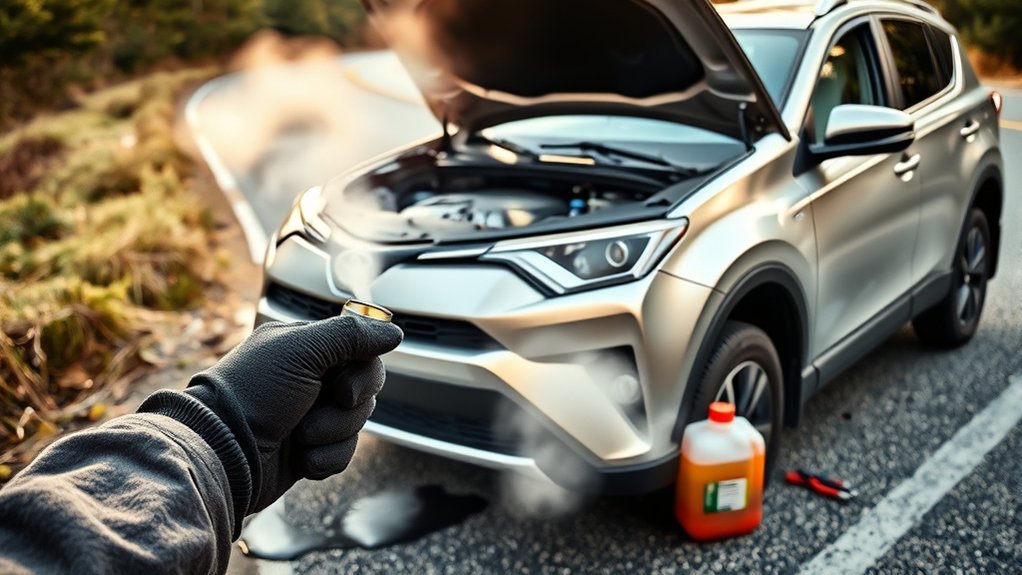
If your RAV4 overheats, treat it as a safety issue first and a repair issue second. Slow down, turn on your hazard lights, pull over where traffic will not put you at risk, turn off the A/C, and follow Toyota’s overheating procedure before touching anything under the hood. A hot cooling system can spray scalding coolant, and driving with the temperature warning active can turn a small coolant leak into engine damage.
Quick Answer
When a Toyota RAV4 overheats, pull over safely, turn off the air conditioning, stop the engine if the gauge is in the red or steam appears, and let it cool before checking coolant level, hoses, fans, and leaks. Do not open the coolant cap while hot. Tow it if the warning returns.
Key Takeaways
- Steam, a red temperature gauge, loss of power, or a coolant temperature warning means you should stop driving and let the RAV4 cool.
- The safest first checks are coolant level, visible leaks, hoses, radiator/condenser blockage, radiator cap condition, and electric fan operation.
- Common RAV4 overheating causes include low coolant, trapped air, thermostat failure, water pump problems, radiator restriction, fan faults, and head gasket leakage.
- Use Toyota Super Long Life Coolant or an equivalent coolant that matches Toyota’s specification, and confirm the exact interval in your model-year owner documents.
- If the temperature rises again after topping off coolant, arrange a pressure test or tow instead of trying to “nurse it home.”
At a Glance
| Time Required | 10–30 minutes for safe roadside checks; 1–2 hours for shop diagnosis |
| Difficulty | Beginner for visual checks; intermediate/pro for pressure testing, thermostat, pump, and fan diagnosis |
| Tools Needed | Gloves, flashlight, clean rag, premixed Toyota-compatible coolant, funnel, OBD scanner, cooling-system pressure tester |
| Cost | $20–$60 for coolant/top-off supplies; several hundred to over $1,000 for major cooling-system repairs |
What to Do Right Now If Your RAV4 Overheats
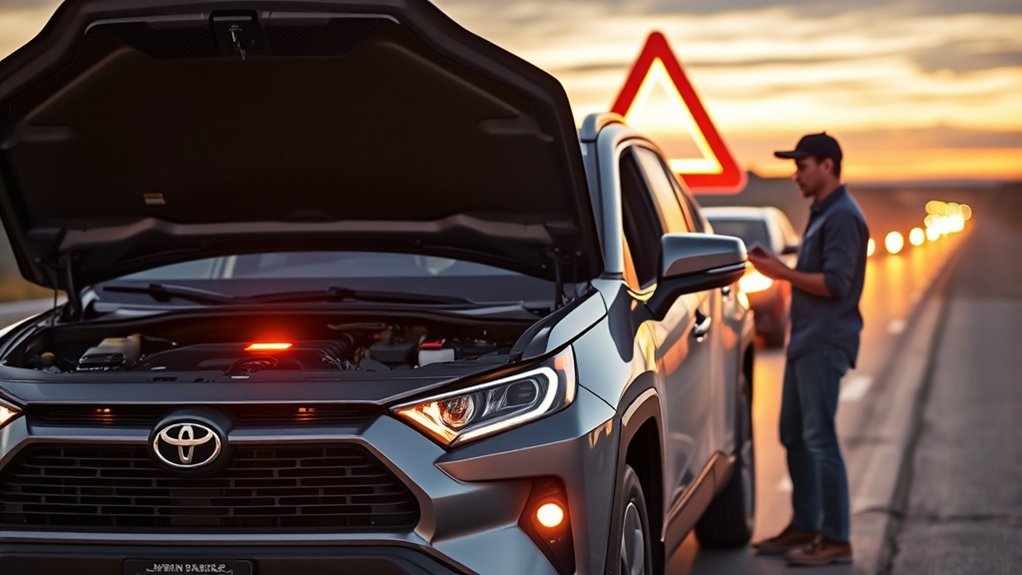
Follow the warning signs in your RAV4 first: the temperature gauge entering the red zone, a loss of engine power, steam from under the hood, or an “Engine Coolant Temp High” message means the cooling system is no longer controlling heat properly. Toyota’s owner guidance is to stop in a safe place, turn off the air conditioning, and stop the engine when overheating is indicated. You can review the official Toyota procedure in the Toyota RAV4 owner manual overheating section.
- Pull over safely. Turn on hazard lights and move as far away from traffic as you safely can. NHTSA notes that move-over laws protect vehicles with flashing lights in many states, so visibility matters when you are stopped roadside.
- Turn off the A/C. This reduces load on the engine and cooling system.
- Stop the engine if the gauge stays high, warning text appears, or steam is visible. Do not keep driving to “see if it clears.”
- Wait before opening the hood. If steam is present, move away from the vehicle and wait until the steam stops.
- Do not loosen the coolant reservoir cap or radiator cap while hot. Hot coolant and steam can spray out under pressure.
- After the engine cools, inspect for obvious leaks. Look under the front of the vehicle, around radiator hoses, the radiator, the reservoir, and the water pump area.
- Call roadside assistance or tow it if the warning returns. A RAV4 that overheats again after cooling down needs diagnosis before more driving.
Warning: Never open a hot coolant cap, and never pour cold coolant into a very hot engine. Toyota warns that hot coolant can spray out and that adding coolant too quickly to a hot engine can damage the system.
Do Not Drive Until You Know Why It Overheated
A RAV4 can sometimes cool down after you stop, especially if the issue started in traffic or on a long climb. That does not mean the problem is gone. If coolant is low, air is trapped, the fan is not working, or the thermostat is stuck, the temperature can spike again within minutes.
You should tow the vehicle instead of driving if any of these are true:
- Steam came from under the hood.
- The coolant warning light or message returns after restarting.
- The reservoir is empty or coolant is pouring out.
- You see milky oil, white exhaust smoke, or constant bubbling in the reservoir.
- The heater blows cold air while the engine temperature is high.
- The electric cooling fans do not run when commanded.
Note: RAV4 Hybrid and RAV4 Prime models add hybrid-system cooling concerns. If a hybrid warning appears or the power control unit/inverter coolant is low, use Toyota’s hybrid-specific guidance and avoid DIY electrical diagnosis around high-voltage components.
RAV4 Quick Checks: Coolant, Fans, Hoses, and Caps
Once the engine is completely cool, start with the simple items that fail most often. These checks do not require removing parts, and they help you decide whether the vehicle can be moved safely or needs a shop.
Check Coolant Level and Coolant Type
Look at the coolant reservoir when the engine is cold. The level should be between the low and full marks. If it is below the minimum mark, you may have a leak, an air pocket, or coolant loss from boil-over.
Toyota’s maintenance guide states that late-model RAV4 vehicles use Genuine Toyota Super Long Life Coolant or a similar high-quality ethylene-glycol coolant with long-life hybrid organic acid technology. The guide also warns that replacement intervals may differ if another coolant type is used. Use your owner manual and the Toyota RAV4 Warranty & Maintenance Guide for your model year.
Pro Tip: If coolant is low, top off only after the engine cools. Use premixed Toyota-compatible coolant when available. Water can be used only as an emergency measure to reach service, and the system should be corrected with the right coolant afterward.
Inspect Hoses and Clamps
With the engine cool, squeeze the upper and lower radiator hoses. They should feel firm but flexible. Replace hoses that are swollen, cracked, oil-soaked, brittle, or mushy. Check the clamp areas for dried pink or white residue, which can show where coolant has been seeping.
Check the Radiator Cap or Reservoir Cap
A weak cap lowers system pressure and can allow coolant to boil earlier than it should. Look for torn seals, corrosion, cracked plastic, or weak spring tension. If the cap looks questionable, replace it with the correct pressure-rated part for your RAV4.
Confirm Cooling Fan Operation
Electric fans are critical in traffic, at idle, and after low-speed driving. After the engine is cooled and safely restarted, the fans should run when the engine reaches operating temperature or when the A/C is on. If the temperature climbs but the fans stay off, the problem may be a fan motor, relay, fuse, wiring issue, temperature sensor, or control module command.
A fused test lead or scan-tool fan command can help a technician separate a bad motor from a bad control circuit. Avoid probing fan wiring without a wiring diagram because shorting a control circuit can create more faults.
Look for Radiator and Condenser Blockage
Leaves, plastic bags, mud, bugs, and bent fins can reduce airflow through the radiator. Shine a flashlight through the grille and inspect the radiator and A/C condenser area. Clean debris gently; do not crush fins with high-pressure spray.
Diagnose RAV4 Thermostat, Water Pump, Radiator, and Trapped Air
After the quick checks, move through the system in a logical order: coolant level, airflow, coolant flow, pressure, and combustion-gas contamination. Guessing can waste money because the same symptom—high temperature—can come from several different failures.
[Products Worth Considering]

These Energizer jumper cables are built to help start dead or weak batteries quickly and safely for a wide range of vehicles, including cars, SUVs, and trucks. The 16-foot length and flexible cable design make it easier to reach battery connections, while the protective coating and sturdy handles support secure placement. A carrying bag is included for convenient transport and storage.

This spill-proof radiator coolant filling funnel kit helps you refill cooling systems cleanly while reducing trapped air pockets that can affect heater and engine performance. It includes a 5-inch extension bar and 45-degree elbow for easier access under shrouds or at awkward angles. Color-matched caps for dedicated adapters make setup simpler and more organized.

This 12V relay box provides six organized relay slots and six fuse positions, helping you build cleaner, safer electrical setups for vehicles and marine systems. Pre-wired, color-coded 12 AWG wiring simplifies installation while the sealed cover and gasket help protect against dust and splashing water in demanding environments. It is a versatile solution for controlling lights, pumps, motors, and other accessories in automotive, truck, RV, or boat applications.
Thermostat Symptoms
A thermostat that sticks closed can block coolant flow through the radiator. Typical signs include rapid overheating after startup, little or no cabin heat, and a hot engine with radiator hoses that do not warm normally. A thermostat stuck open usually causes slow warm-up and poor heat, not sudden overheating.
A basic hose-temperature check can help, but it is not a final test. As the engine warms, the upper radiator hose should heat as the thermostat opens and coolant begins flowing. If the engine gets hot but the hose remains cool, the thermostat or flow path may be restricted.
Water Pump Symptoms
A failing water pump can leak, wobble, make bearing noise, or stop moving coolant efficiently. Look for seepage near the pump weep hole, crusty coolant residue, pulley play, grinding noise, or overheating that gets worse under load. Some late-model pumps are electric, so scan-tool data and fault codes can be useful.
Radiator Restriction or Leak
A restricted radiator may have cold spots, external fin damage, or poor heat transfer even when coolant level is correct. A leaking radiator may leave dried coolant at the side tanks or lower corners. If the radiator is blocked internally, flushing may not solve it; replacement is often the reliable repair.
Trapped Air After Coolant Service
Air pockets can form after a coolant drain, hose replacement, thermostat replacement, or leak repair. Symptoms include fluctuating temperature, gurgling behind the dash, poor heater output, and bubbling in the reservoir. Bleeding the system correctly is important because trapped air can keep coolant away from sensors and hot engine surfaces.
Head Gasket Warning Signs
Persistent bubbles in the reservoir, coolant pushed out repeatedly, white exhaust smoke, sweet exhaust smell, unexplained coolant loss, or milky oil can point to combustion gases entering the cooling system. A shop can confirm this with a block test, pressure test, leak-down test, or borescope inspection.
Warning: Do not assume a head gasket has failed just because the RAV4 overheated once. Confirm it with proper testing. Replacing parts before testing can turn a fixable coolant leak into an expensive guessing game.
What a Shop Should Test
If overheating continues after the basic checks, ask for a structured cooling-system diagnosis. A good shop should not simply replace the thermostat because it is the cheapest familiar part. The technician should test the system and document the failure.
- Cooling-system pressure test: Finds external leaks at hoses, radiator seams, water pump seals, heater hoses, and the reservoir.
- Cap pressure test: Confirms the cap holds the correct pressure.
- Fan command test: Checks fan motors, relays, fuses, wiring, and module control.
- Thermostat and coolant-flow check: Confirms circulation through the radiator.
- Infrared temperature check: Looks for radiator cold spots and flow restrictions.
- Combustion-gas test: Screens for head gasket leakage when bubbling or coolant loss continues.
- OBD scan: Looks for coolant temperature sensor, fan control, electric water pump, or hybrid cooling codes.
[Products Worth Considering]

This portable fuel transfer pump makes refilling containers fast, simple, and cleaner with an auto-stop sensor and beep alert to help prevent overflow. It offers two power options, multiple can adapters, and long hoses for transferring gasoline, diesel, and oil with minimal effort. Built for garage and shop use, it combines easy one-button operation with leak protection and a lightweight design for convenient handling.

This automatic 12V charger and maintainer delivers a full charge before switching to float mode to help keep powersports batteries ready for storage and regular use. Its four-step charging program is designed for lead-acid, flooded, AGM, and gel cell batteries, helping prevent overcharging while supporting longer battery life. Compact and easy to use, it includes both ring terminal and alligator clip connections plus smart safety features for dependable charging.

A comprehensive coolant system pressure test & refill kit locates system leaks from header and expansion tanks and fittings, head gasket, radiator core, heater matrix, water pump, hoses and pipes, and is designed for refilling radiators with coolant without introducing air pockets.
Repair vs. Replace: Costs, Urgency, and What a Shop Will Test
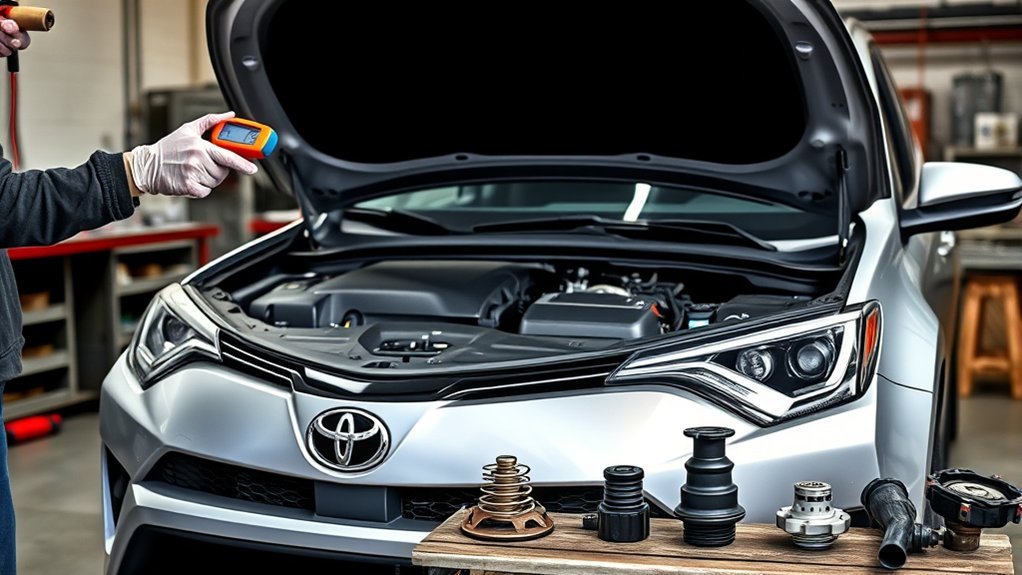
Because overheating can escalate quickly, decide based on test results, part age, leak severity, and how long you plan to keep the vehicle. A small hose seep is usually a repair. A cracked radiator tank, noisy water pump, dead fan motor, or thermostat that fails a test is usually a replacement. If the RAV4 overheated severely, also ask the shop to check oil condition and scan for stored temperature-related codes.
| Component or Issue | Typical Action | Planning Cost Range |
|---|---|---|
| Low coolant with no visible leak | Pressure test, top off, bleed system | $100–$250 shop diagnosis/service |
| Radiator cap or reservoir cap | Replace if seal or pressure is weak | $15–$60 part; more with labor |
| Hoses or clamps | Replace damaged hose and clamps | $150–$450 installed |
| Thermostat | Replace after confirming temperature-control failure | $400–$750 installed on many late-model estimates |
| Water pump | Replace if leaking, noisy, loose, seized, or not circulating | $600–$1,100+ depending on year and pump type |
| Radiator | Replace if leaking, cracked, or internally restricted | $900–$1,300+ on many RAV4 estimates |
| Cooling fan, relay, fuse, or sensor | Repair the failed electrical component | $150–$900 depending on part and diagnosis time |
| Head gasket or engine damage | Confirm with testing before authorizing major work | $1,500–$4,000+; engine replacement can be higher |
Published repair estimators such as RepairPal show that RAV4 radiator, water pump, and thermostat replacement costs can vary widely by year, region, labor rate, and related repairs. Use the table as a planning guide, then compare written quotes before approving major work.
RAV4 Hybrid and Prime Overheating Checks
RAV4 Hybrid and RAV4 Prime models can have more than one coolant loop. The engine cooling system and hybrid power-control cooling system are not the same thing, so one reservoir being full does not automatically clear the other system. Toyota’s RAV4 Hybrid overheating procedure specifically warns not to loosen coolant caps while hot and to add coolant only after the hybrid system has cooled enough.
Use these hybrid-specific rules:
- Do not touch orange high-voltage cables or hybrid electrical components.
- Check the correct reservoir only after the system cools.
- Use Toyota-compatible coolant in the correct loop.
- Tow the vehicle if a hybrid system warning appears with overheating symptoms.
- Let a qualified technician diagnose inverter/power-control cooling faults, electric pump faults, and hybrid trouble codes.
Preventive Maintenance Checklist to Avoid RAV4 Overheating
Preventive checks catch most cooling problems before the temperature warning appears. Toyota’s maintenance guide calls for regular inspections and fluid checks, and it lists engine coolant replacement at 100,000 miles or 120 months for the referenced RAV4 schedule. Always confirm your exact model year and powertrain in your owner manual because schedules can vary.
- Every fuel stop or every few weeks: Watch for coolant smell, puddles, temperature swings, or heater changes.
- Monthly: Check the coolant reservoir level when the engine is cold.
- Every 5,000 miles or 6 months: Have fluid levels inspected and adjusted as part of scheduled maintenance.
- At routine service: Ask for a visual inspection of hoses, clamps, radiator, condenser, water pump area, and fan operation.
- Before summer, towing, or mountain trips: Clean radiator/condenser debris and confirm the fans operate.
- At the Toyota coolant interval: Drain and refill with Toyota Super Long Life Coolant or a Toyota-approved equivalent.
- After any coolant repair: Bleed the system correctly and recheck level after the first full heat cycle.
A RAV4 that overheats once deserves a cooling-system check. A RAV4 that overheats twice should not be driven until the cause is found.
Frequently Asked Questions
What are 10 common causes of overheating on a Toyota RAV4?
Common causes include low coolant, coolant leaks, trapped air, a stuck thermostat, water pump failure, clogged radiator fins, internal radiator restriction, cooling fan failure, a weak coolant cap, and head gasket leakage. Heavy loads, long climbs, hot weather, and stop-and-go traffic can expose these problems faster.
How much does it cost to replace a radiator in a Toyota RAV4?
Many RAV4 radiator replacement estimates land around $900–$1,300 or more, depending on model year, labor rate, parts choice, coolant, taxes, and related repairs. Older vehicles, aftermarket parts, and independent shops may cost less, while dealer labor or extra damage can cost more.
Can I drive my RAV4 after it overheats?
Only drive again if the engine fully cools, coolant level is safe, there is no steam, no major leak, and the temperature stays normal. If the warning returns, the heater blows cold, coolant is empty, or the fans do not run, tow it instead.
Why is my RAV4 overheating when the coolant reservoir is full?
A full reservoir does not rule out a stuck thermostat, bad water pump, blocked radiator, air pocket, failed fan, weak cap, coolant-flow restriction, or head gasket problem. The system may also have coolant in the reservoir but not enough coolant circulating through the engine.
What coolant should I use in a Toyota RAV4?
Use Genuine Toyota Super Long Life Coolant or a similar high-quality non-silicate, non-amine, non-borate ethylene-glycol coolant with long-life hybrid organic acid technology. Confirm the exact requirement in your owner manual, especially for Hybrid and Prime models.
Should I replace the thermostat first when my RAV4 overheats?
Not automatically. A thermostat is a common failure point, but low coolant, leaks, fan faults, radiator blockage, water pump problems, and trapped air can create the same symptom. Test first, then replace the part that failed.
Conclusion
When your RAV4 overheats, the right move is controlled and simple: pull over safely, turn off the A/C, stop the engine when the warning is active or steam appears, and let the vehicle cool before inspecting coolant level, leaks, hoses, caps, fans, and airflow. Do not open a hot coolant cap, do not keep driving with the temperature warning active, and do not guess at parts before testing. A pressure test, fan command test, thermostat check, and combustion-gas test can separate a small repair from a major engine-risk problem. Keep up with Toyota’s coolant and inspection schedule, and your RAV4 is far less likely to leave you waiting on a tow truck.
Sources
- Toyota Owners: 2024 RAV4 “If your vehicle overheats” — official overheating procedure and hot-coolant safety warnings
- Toyota Owners: 2024 RAV4 Hybrid “If your vehicle overheats” — hybrid-specific overheating and coolant cautions
- Toyota RAV4 Warranty & Maintenance Guide — coolant type, inspection guidance, and maintenance interval references
- NHTSA: Move Over, It’s the Law — roadside visibility and stopped-vehicle safety context
- RepairPal: Toyota RAV4 Radiator Replacement Cost Estimate — radiator replacement cost range context
- RepairPal: Toyota RAV4 Thermostat Replacement Cost Estimate and RAV4 Water Pump Replacement Cost Estimate — thermostat and water pump cost range context


[…] coolant leak can turn a small maintenance issue into engine damage fast. Your Toyota RAV4‘s cooling system works under pressure, so even a slow drip can lead to overheating. This guide shows you how to spot […]