You’ll use an OBD‑II scanner to pull codes that map to fuel, ignition, EVAP, sensor, and hybrid systems on a RAV4. Start with P0300 (random misfire: check plugs, coils, injectors), P0171/P0174 (lean: inspect intake leaks, MAF, fuel pressure), and P0420 (catalyst efficiency: check O2 sensors, exhaust leaks). Log freeze‑frame data, monitor fuel trims and misfire counters, and prioritize safety systems first — continue for step‑by‑step diagnostics and cost guidance.
What This Guide Covers and Who It’s For

If you own or service a Toyota RAV4 and need clear, actionable help with OBD‑II trouble codes, this guide gives a focused overview of the most common DTCs, what they mean for vehicle performance, and how they affect drivability and emissions. You’ll get OBD II basics tailored to Toyota diagnostics so you can quickly map error codes to subsystem categories—engine, fuel system, emissions—streamlining vehicle maintenance decisions. The guide lists frequent DTCs like P0420 and P0171, the symptoms they trigger, and practical troubleshooting tips that point to likely causes. You’ll find concise common repairs and DIY fixes where appropriate, plus when to escalate to a technician. The tone stays diagnostic and empowering: you’ll learn to interpret error codes, prioritize interventions that restore vehicle performance, and reduce unnecessary shop visits. Use this as a liberation tool to reclaim control over repairs and avoid being kept in the dark.
Quick RAV4 OBD‑II Triage Checklist
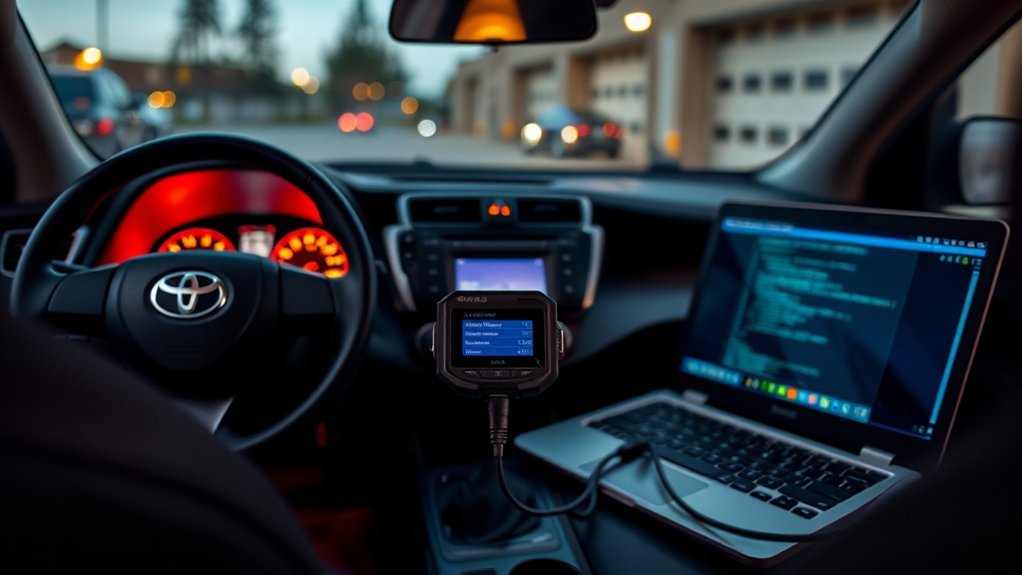
Wondering where to start when a RAV4 throws a check‑engine light? Begin with OBD II basics: connect an OBD‑II scanner to the RAV4’s port, wake the ECU, and pull stored and pending DTCs. Use appropriate scanner types—basic code readers for quick pulls, Bluetooth dongles for mobile diagnostics, or advanced scan tools for live data and freeze‑frame capture.
Record every code, timestamp, and freeze‑frame reading. Prioritize persistent codes over single pending entries but note pendings; they flag intermittent faults that can escalate. Cross‑reference codes with symptoms (run‑ability, idle, fuel economy) to isolate systems: intake, ignition, fuel, or exhaust. Inspect probable components implicated by codes and live data before replacing parts.
Keep a concise log of tests performed and results to avoid repeated work. Your goal is freedom from guesswork: retrieve codes, interpret with targeted tests, and resolve the root cause—fast, efficient, and controlled.
Top RAV4 Fault Codes to Diagnose First (P0300, P0171, P0420)
Start by scanning the RAV4 with an OBD2 tool to pull P0300, P0171, or P0420 and watch live data for misfires, fuel trim, and O2 sensor readings. For P0300 check spark plugs, coils, and injectors; for P0171 inspect intake leaks, fuel pressure, and the filter or pump; for P0420 verify upstream/downstream O2 sensors and exhaust leaks before assuming catalytic converter failure. Prioritize fixes that match live-data anomalies to stop damage and restore performance and emissions.
Causes And Common Triggers
When diagnosing the RAV4, prioritize P0300, P0171, then P0420 because misfires can cascade into fuel trims and emissions faults; check ignition coils and spark plugs, inspect intake hoses and vacuum lines for leaks, and verify fuel pressure and filter condition before replacing oxygen sensors or the catalytic converter. You’ll recognize misfire symptoms like rough idle, hesitation, and intermittent power loss that often point to ignition or fuel delivery faults. Lean conditions often arise from vacuum leaks, clogged filters, or weak pumps, producing long-term fuel trim corrections. P0420 commonly follows unresolved misfires or persistent lean conditions that damage the catalyst or skew O2 readings. Stay focused on root causes, avoid premature parts swaps, and aim for freedom from repeat failures.
- Ignition coil failure
- Vacuum/intake leaks
- Fuel delivery issues
- O2 sensor/catalyst degradation
Diagnostic Steps And Fixes
Although codes P0300, P0171, and P0420 can appear related, you should tackle them in a deliberate sequence: retrieve and freeze-frame the codes with an OBD-II scanner, clear non-persistent codes, then reproduce the fault conditions while monitoring live PID data (misfire counters, short/long fuel trims, upstream/downstream O2 voltages, and fuel pressure). You’ll use diagnostic tools to isolate root causes: inspect spark plugs, coils, and injectors for P0300; run vacuum and fuel pressure tests for P0171; and compare upstream/downstream O2 activity for P0420. Apply systematic troubleshooting techniques: verify fuel delivery and intake integrity, swap suspect coils/injectors, pressure-test for leaks, and confirm sensor operation before replacing the catalytic converter. Document findings, reset codes, and verify repair by road-testing under the same conditions.
Prioritize Repairs: What to Fix First and Typical Costs
Start with safety-critical systems: if a code indicates engine misfire (P0300) or major emissions failure (P0420), you should fix those before minor EVAP leaks (P0442) because they can cause further damage or regulatory failures. Balance cost versus severity by choosing inexpensive fixes that prevent escalation—spark plugs or coils ($150–$600) and simple exhaust or wiring repairs (~$100) are often high-value interventions. Reserve expensive parts like catalytic converters or control modules ($1,000–$1,500+) for confirmed failures after accurate diagnosis.
Safety-Critical Systems First
Because braking and steering faults directly affect control, you should fix safety-critical systems first and address engine or transmission DTCs that impair drivability immediately. You need safety repairs and urgent diagnostics to keep control and freedom of movement. Start with codes tied to braking/steering; follow with engine/transmission faults that cause stalling or loss of drive.
- Inspect ABS and wheel-speed sensors for DTCs (quick check, $100–$300 typical sensor replacement).
- Prioritize steering system faults; address play or electronic assist errors immediately.
- Treat engine/transmission misfires or range-sensor faults (P0300, P0705) if they reduce drivability.
- Ignore warnings at your peril: they raise accident risk and future repair scope.
Act decisively—diagnose, isolate, repair, regain autonomy.
Cost vs. Severity
Having handled safety-critical faults first, you’ll next weigh repair cost against severity to decide what to fix and when. Use repair prioritization and cost analysis to allocate resources: urgent codes like P0300 (random misfire) and P0420 (catalytic converter) demand immediate attention — misfires risk engine damage, P0420 repairs range $1,000–$2,500. Less severe performance codes such as P0171 (system too lean) often trace to vacuum leaks and cost $100–$500 to fix. Electrical faults like P0500 (vehicle speed sensor) impair drivability but are typically $100–$300. Emissions faults like P0440 (EVAP) can fail inspections; expect $150–$800 depending on cause. Prioritize safety-first, then address highest-risk, high-cost failures; defer minor issues when they don’t threaten reliability or legal compliance.
Fuel‑Trim & MAF Errors (P0171, P0174, P0101): Causes & Fixes
When your RAV4 throws P0171, P0174, or P0101, it’s telling you the engine’s running too lean on one or both banks or the MAF isn’t reading correctly, so you should immediately check for intake air leaks, a fouled MAF sensor, and fuel delivery issues; common diagnostics include smoke-testing the intake and vacuum lines, inspecting and cleaning or replacing the MAF, and verifying fuel pressure and filter condition. You’ll see CEL illumination, poor throttle response, or rough idle. Diagnose systematically: isolate post-MAF leaks, confirm MAF maintenance history, and monitor short- and long-term fuel trim data to pinpoint where air/fuel imbalance originates. Clean or replace the MAF when readings are erratic; replace clogged fuel filters or test the pump/regulator if fuel pressure falls short. Fix vacuum leaks at boots, hoses, and intake gaskets. After repairs, clear codes and verify fuel trim returns to near-zero correction under various loads. Liberation comes from controlling variables and restoring precise air/fuel control.
- Smoke-test intake and vacuum lines
- Clean/replace MAF sensor
- Measure fuel pressure and filter
- Monitor short/long-term fuel trim
O2 Sensor & Catalyst Faults (P0420, P0430): Tests and Repair Options
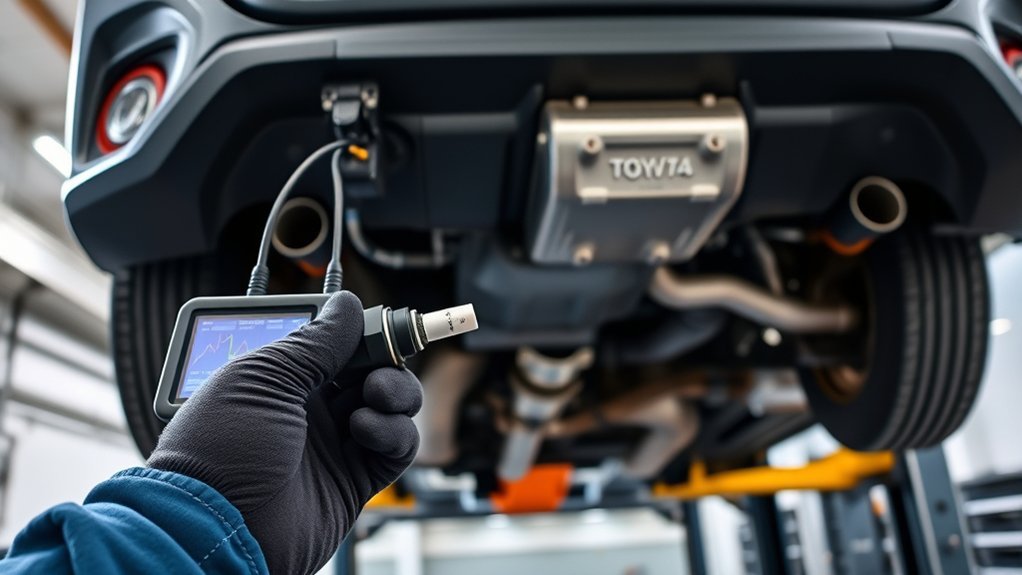
If your RAV4 throws a P0420 or P0430, it’s signaling that the downstream oxygen sensor’s readings match the upstream sensor too closely, indicating reduced catalytic converter efficiency on bank 1 or bank 2. You should treat this as a systems-failure flag, not just a sensor complaint. Begin with a visual exhaust inspection and leak check; even small leaks skew sensor signals. Proceed to Oxygen Sensor Testing: monitor upstream and downstream O2 voltages and response rates with a scanner or scope. Upstream should switch rapidly; downstream should be more stable but show a different pattern. If both mirror each other, suspect catalytic degradation. Perform a backpressure or catalyst temperature test to confirm substrate failure. For repair, replace faulty oxygen sensors if tests isolate them. If catalyst tests fail, pursue Catalytic Converter Replacement. Address fuel delivery or ignition issues that can damage the converter to prevent recurrence and reclaim control of emissions and efficiency.
EVAP Purge & Leak Codes (P0441, P0442, P0455): Step‑by‑Step Diagnosis
Though EVAP codes P0441, P0442, and P0455 all point to fuel‑vapor control problems, they require different diagnostic priorities: you’ll isolate flow issues for P0441, small leaks for P0442, and gross breaches for P0455. Begin with a visual inspection of the evap system: check hoses, canister, and gas cap for cracks or looseness. Test the purge valve electrically and for proper vacuum/flow; a stuck or leaking purge valve often triggers P0441. For P0442 and P0455, perform a controlled smoke test to locate tiny or obvious leaks in lines and fittings. Tighten or replace a faulty gas cap when applicable. Replace cracked hoses or torn lines; clear clogs that impede purge flow. After repairs, clear codes and perform a drive cycle to confirm the system holds and the ECU registers normal vent/ purge behavior. Maintain procedural discipline: inspect, test, repair, verify—so you regain control of emissions and freedom from recurring faults.
Isolate P0441 flow faults, P0442 small leaks, P0455 gross breaches—inspect, test, repair, then verify with a drive cycle
- Inspect visually first
- Test purge valve operation
- Use smoke test for leaks
- Repair, then verify with drive cycle
Cam, Coolant Temp & Idle Codes (P0340, P0115, P0125): Symptoms & Tests
After handling EVAP faults, move on to ignition and thermal sensors that directly affect timing and fuel control: P0340 flags a camshaft position sensor circuit malfunction, P0115 denotes an engine coolant temperature (ECT) sensor circuit fault, and P0125 indicates the engine isn’t reaching the temp required for closed‑loop operation. You’ll see CEL illumination, rough idle, misfires, hard starts, or cold running inefficiency. For P0340, prioritize cam sensor diagnostics: inspect connector security, backprobe signal and reference voltages with a multimeter or lab scope, and check timing or reluctor wheel integrity. For P0115 and P0125, perform coolant temperature troubleshooting: verify sensor resistance vs. temperature chart, confirm proper grounding, and monitor live ECT values via an OBD‑II scanner to confirm readings rise to operating thresholds. Replace faulty sensors, repair wiring faults, or correct timing issues as indicated. These steps free you from guessing—target the exact fault, restore efficiency, and reclaim dependable operation.
Hybrid & Powertrain Alerts (P3000, P1603): Immediate Steps for RAV4 Hybrids

When your RAV4 hybrid logs P3000 or P1603, don’t ignore it: these codes point to high‑voltage battery faults and ECM–HCM communication errors that can immediately reduce power and compromise hybrid operation. You need decisive, technical action to protect hybrid performance and reclaim control.
- Inspect high‑voltage battery for visible damage, corrosion on terminals, and secure connections.
- Verify battery cooling system operation (fans, ducts) to prevent thermal degradation that reduces battery maintenance intervals.
- Trace ECM–HCM wiring and connectors for chafing, corrosion, or poor pins; repair or replace faulty harness sections.
- After physical repairs, clear codes and perform a road or diagnostic drive to confirm the fault doesn’t return and hybrid performance is restored.
These steps prioritize safety and functional recovery. If the P3000 persists despite clean terminals and cooling, or P1603 returns after wiring fixes, escalate to qualified hybrid technicians with the right HV tools and diagnostic access to avoid further compromise.
RAV4 Network & Speed‑Sensor Faults (U0073, P0500, P1500): Basic Troubleshooting
Start by checking CAN Bus basics: verify node presence, bus voltage, and termination to rule out U0073 as a network-level fault. Then test the vehicle speed sensor circuit for P0500—measure sensor output at speed and inspect tone wheel and connectors. Finally, trace wiring and grounds for P1500 and related faults, looking for corrosion, breaks, or loose grounds that can mimic sensor or module failures.
CAN Bus Basics
One key system you’ll check is the RAV4’s CAN bus, which links ECUs and relays sensor and status data critical for functions like speed sensing and starter control. You need to understand CAN bus topology and communication protocols so you can isolate U0073 faults quickly. Inspect harness continuity, connector integrity, and module ground references. Don’t assume an ECU swap fixes a network issue.
- Verify wiring harness for chafing, corrosion, or breaks.
- Confirm secure, seated connectors at each ECU and junction.
- Measure CAN high/low differential voltages and termination resistance.
- Check starter relay wiring and control circuit continuity for P1500 implications.
Act deliberately, document findings, and reclaim control of your vehicle’s network.
Speed Sensor Diagnosis
Because CAN faults and VSS failures often present together on RAV4s, you should approach speed‑sensor diagnosis as both an electrical and network troubleshooting task. You’ll check U0073 (CAN comms), P0500 (VSS malfunction) and P1500 (starter signal) in parallel, using diagnostic tools to isolate module faults versus sensor failures. Inspect connectors, test sensor resistance, verify VSS installation, and confirm starter signal integrity without yet digging into wiring or grounds. Prioritize module resets and CAN integrity checks before part swaps. Symptoms include erratic speedometer, driveability issues, and transmission engagement faults. Use a methodical process to reclaim control and freedom on the road.
| Code | Likely Cause | Quick Test |
|---|---|---|
| U0073 | Module/CAN error | CAN bus scan |
| P0500 | VSS failure | Resistance test |
| P1500 | Starter signal | Crank signal check |
Wiring And Grounds
Begin by visually and mechanically inspecting the wiring and grounds for the VSS, starter signal, and CAN nodes, since damaged insulation, loose pins, or corroded ring terminals will often produce U0073, P0500 and P1500 concurrently. You’ll focus on wiring integrity and grounding techniques to restore reliable communication and control. Check for chafing, pin pull, and melted insulation; wiggle connectors under load. Verify ring terminals and chassis grounds for corrosion and resistance under 0.1 ohm. Use proper grounding techniques: star grounds, secure bolts, and dielectric grease after cleaning. Isolate circuits with a scope or DVOM to localize faults.
- Inspect harnesses at bulkhead and ECU pins
- Measure VSS and starter circuit continuity
- Load-test suspect grounds
- Swap peripherals to confirm module health
Frequently Asked Questions
How to Read Toyota OBDII Fault Code?
Plug an OBD II scanner into the port, turn ignition on, run code retrieval with diagnostic tools, read the fault code, then interpret for engine issues using vehicle diagnostics; you’ll act empowered to diagnose and fix problems.
What Is the Most Common OBD2 Code?
P0420 is the most common OBD2 code; you’ll troubleshoot catalytic efficiency first. For RAV4 performance issues, check oxygen sensors, exhaust leaks, and wiring, then run targeted diagnostics to reclaim reliable, liberated driving and resolve code faults.
How to Interpret OBD2 Codes?
Read codes, research codes, resolve causes: you’ll learn OBD II basics and use code troubleshooting steps. You’ll scan the port, note P/B/C/U prefixes, decode digits, compare symptoms, then test, repair, clear, and verify.
Conclusion
Think of your RAV4 like a clinic: codes are patients, sensors the essentials, and your scanner the stethoscope. Triage the noisy, recurring codes first — misfire, fuel‑trim, catalytic efficiency — then trace sensors, vacuum, EVAP and network lines methodically. For hybrids, act fast on powertrain warnings. Diagnose with data, replace only failed parts, and confirm repairs with clear freeze‑frame and readiness checks. Treat symptoms precisely and you’ll keep the vehicle healthy and predictable.