
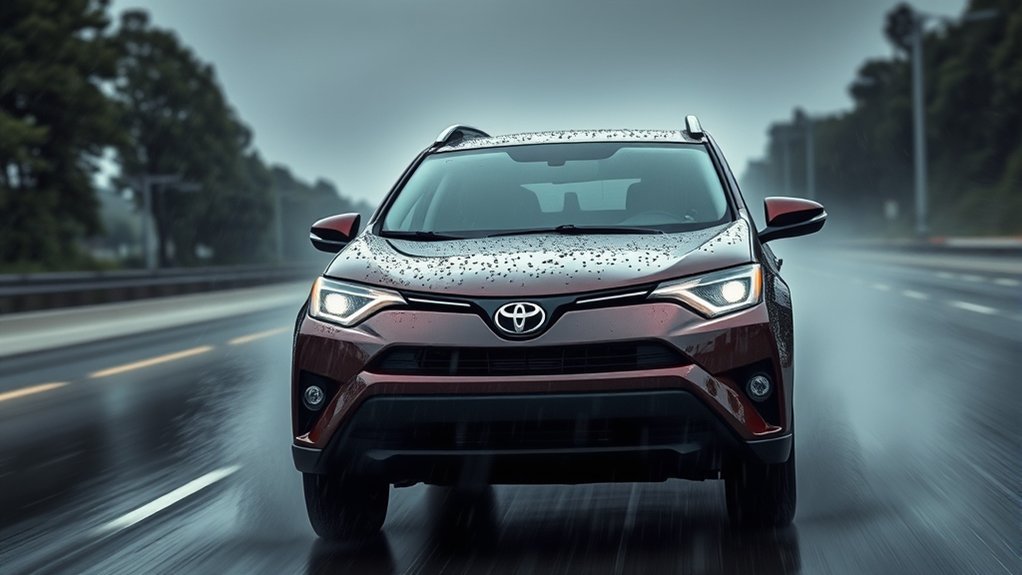
Heavy rain can quickly turn a normal Toyota RAV4 drive into a low-visibility, low-traction situation. The safest approach is to prepare the vehicle before the storm, slow down early, leave more space, keep driver-assist systems on, and avoid flooded roads completely whenever possible.
Quick Answer
To drive a Toyota RAV4 safely in heavy rain, slow below the posted speed, increase your following distance to at least four seconds, use low-beam headlights and wipers, avoid cruise control, keep traction control on, and never drive into floodwater or rising water.
Key Takeaways
- Check tires, wipers, lights, brakes, and washer fluid before driving in heavy rain.
- For wet-weather safety, consider replacing tires at about 4/32 inch of tread; the legal minimum of 2/32 inch is not the best safety target for rain.
- Keep AWD, traction control, ABS, and stability control working for you; do not turn traction control off unless you are stuck and need to rock the vehicle free.
- If water covers the road, is moving, or is rising, turn around. A RAV4 is not designed to drive through deeply flooded roads.
At a Glance
| Time Required | 10–15 minutes for pre-drive checks |
| Difficulty | Easy |
| Tools Needed | Tire pressure gauge, tread depth gauge or quarter, washer fluid, flashlight, clean cloth |
| Cost | Usually $0–$20 for basic checks; more if tires, wipers, or brakes need replacement |
Key Vehicle Maintenance Checks for Safe Rain Driving
Before you drive your Toyota RAV4 in heavy rain, start with the parts that control grip and visibility. Wet roads increase stopping distance, so small maintenance issues can become serious quickly.
[Products Worth Considering]

This three-piece windshield wiper set is designed for compatible Toyota RAV4 and Highlander models to help deliver clear visibility in everyday driving. The natural rubber blades feature a graphite-treated surface for quiet, smooth wiping performance and reliable weather resistance. Installation is quick and tool-free, making it easy to replace worn blades on the front and rear of your vehicle.

This front wiper blade set is designed to deliver clear, quiet visibility for compatible Toyota, Hyundai, and Honda vehicles with J/U hook wiper arms. The included driver and passenger blades provide a straightforward replacement for worn front wipers, with an OE-style connector and natural rubber edge for smooth wiping in rain, snow, and everyday driving. Always confirm your vehicle's fitment and original blade sizes before ordering.
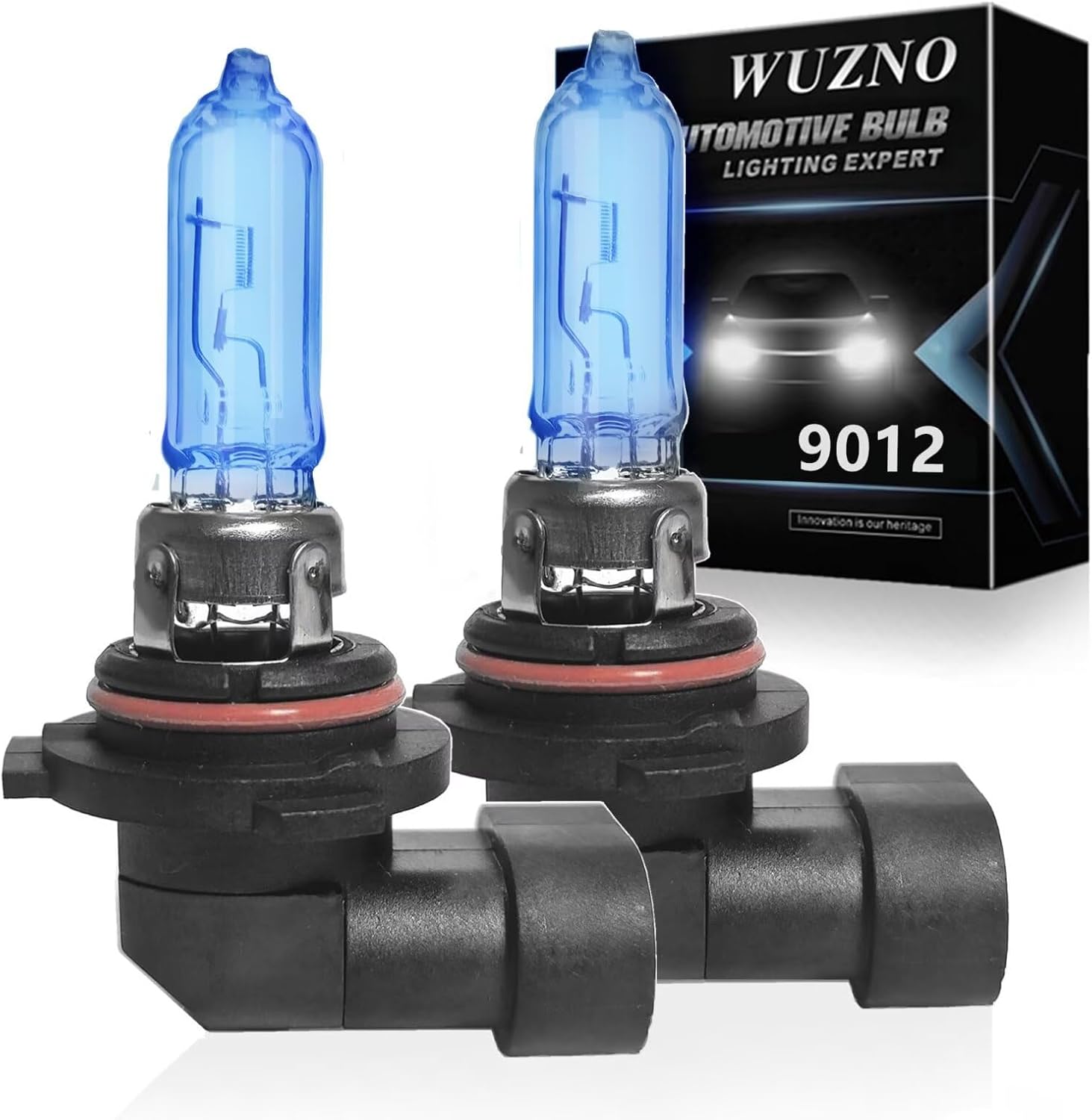
These halogen headlight bulbs are designed as a direct replacement for compatible Toyota models, offering plug-and-play installation with the same base and connector as the original bulbs. They deliver brighter, whiter light for improved visibility and a more modern look while helping reduce eye fatigue during night driving. Built for long life and reliable performance, this two-pack is ideal for restoring or upgrading your vehicle's headlight output.
Check Tire Tread and Pressure
Inspect all four tires for tread depth, uneven wear, sidewall cracks, bulges, nails, or low pressure. NHTSA says tire pressure should be checked when the tires are cold, using the pressure listed on the vehicle placard or owner’s manual.
The U.S. legal minimum tread depth is commonly 2/32 inch, but that is a minimum wear limit, not an ideal wet-weather safety target. For heavy rain, treat about 4/32 inch as the point where you should strongly consider replacing tires, especially if you regularly drive at highway speeds. AAA testing found that tires worn to 4/32 inch had much longer wet-road stopping distances than new tires.
Note: If your RAV4 tires are near 4/32 inch or lower, avoid unnecessary driving in heavy rain. If any tire is at 2/32 inch, replace it before relying on the vehicle in wet conditions.
Inspect Wipers, Lights, and Washer Fluid
Replace wiper blades if they chatter, skip, smear, or leave streaks. Fill the windshield washer reservoir with proper washer fluid, not plain water, so road spray and grime can be cleared quickly.
Check low beams, tail lights, brake lights, turn signals, and hazard lights. Clean the headlight and tail light lenses, because dirt and road film can reduce visibility for you and other drivers.
Confirm Brakes Are Working Smoothly
If your RAV4 pulls to one side, vibrates, squeals, scrapes, or takes longer than usual to stop, have the brakes checked before driving in a storm. Toyota also advises lightly pressing the brake pedal after driving through a puddle to confirm the brakes are working properly, because wet brake pads may reduce braking performance.
Understanding Hydroplaning and Its Risks
Hydroplaning happens when your tires ride on a layer of water instead of maintaining solid contact with the road. When that happens, steering, braking, and acceleration can feel suddenly light or unresponsive.
Hydroplaning Causes
Hydroplaning is more likely when rain is heavy, speed is too high for conditions, tire tread is shallow, tire pressure is wrong, or water collects in wheel ruts. The first part of a rainstorm can also be slick because oil, dust, and debris on the road mix with water.
Watch for standing water, shiny pavement, tire spray from vehicles ahead, and water pooling near the edges of lanes. These are signs to slow down smoothly before you reach the hazard.
Hydroplaning Prevention Tips
You cannot eliminate hydroplaning risk, but you can reduce it:
- Slow down before you reach standing water.
- Keep both hands on the wheel and steer gently.
- Avoid sudden braking, sharp turns, and hard acceleration.
- Drive in the tracks of the vehicle ahead when safe, because those tires may have displaced some water.
- Turn cruise control off so you can respond smoothly to changing traction.
- Keep tires properly inflated and replace worn tires before heavy rain becomes a routine problem.
What to Do If Your RAV4 Hydroplanes
If your RAV4 starts to hydroplane, stay calm and avoid sudden inputs. Ease off the accelerator, keep the steering wheel pointed where you want to go, and wait for the tires to regain traction. Do not slam the brakes or jerk the wheel. If braking is necessary, apply steady, gentle pressure and let ABS help manage wheel lockup.
Pro Tip: If the steering suddenly feels light or the engine sound changes while speed stays the same, your tires may be losing contact with the road. Ease off the accelerator and hold a steady line.
How to Drive Safely in Heavy Rain
When heavy rain hits, your goal is simple: make every action slower, smoother, and more predictable. According to the Federal Highway Administration, 75% of weather-related vehicle crashes happen on wet pavement, and 47% happen during rainfall.
Wet pavement is the most common setting for weather-related crashes, so the safest rain-driving habit is to slow down before traction becomes a problem.
Use these steps when driving your RAV4 in heavy rain:
- Reduce speed: Drive below the posted limit when visibility or traction is reduced. There is no single safe rain speed; the right speed is the one that lets you stop within the distance you can clearly see.
- Increase following distance: Keep at least a four-second gap from the vehicle ahead. Use a fixed object, such as a sign or bridge, to count the gap.
- Use low-beam headlights: Low beams help you see and help others see you. Avoid high beams in heavy rain because glare can reflect off water droplets.
- Turn off cruise control: Manual throttle control helps you react more smoothly if the tires begin to slip.
- Use smooth inputs: Brake, steer, and accelerate gently. Toyota warns that sudden braking, acceleration, and steering on slippery roads can reduce your ability to control the vehicle.
- Avoid lane changes when possible: Water often collects in ruts between lanes, and sudden moves increase slip risk.
- Pull over if visibility collapses: If you cannot see lane markings, vehicles, or hazards clearly, exit the road safely, stop in a safe place away from traffic, and use hazard lights only when stopped or when local law allows.
Warning: Do not rely on AWD, traction control, or driver-assist features to overcome physics. They can help with stability, but they cannot create grip if tires are worn, water is deep, or speed is too high.
Using RAV4 AWD, Traction Control, and Drive Modes in Rain
Many RAV4 models include AWD or other traction-support systems, but the safest setting depends on the situation.
Should You Use AWD in Heavy Rain?
If your RAV4 has AWD, leave it in its normal operating mode. Toyota says the RAV4 AWD system can automatically adjust drive power in conditions such as slippery roads due to rain, helping with stable operation and driving stability. AWD can help you start moving and maintain stability, but it does not shorten stopping distance on wet pavement.
Should You Turn Off Traction Control in Rain?
No. Keep traction control on during rain. Toyota describes TRAC as a system that helps maintain drive power and reduce drive-wheel spin when starting or accelerating on slippery roads. The owner’s manual notes that turning TRAC off may help only when the vehicle is stuck in mud, dirt, or snow and needs to be rocked free.
What About Trail Mode or Snow Mode?
Use special drive modes only for the conditions described in your RAV4 owner’s manual. Trail Mode is not meant to expand the limits of the vehicle, and wet pavement is not the same as off-road terrain. In normal heavy rain on paved roads, smooth driving, good tires, and safe speed matter more than selecting a special mode.
Maintaining Visibility During Rainy Weather
Visibility is just as important as traction. If you cannot see far enough ahead to stop safely, you are driving too fast for the conditions.
[Products Worth Considering]

This 3-piece windshield wiper set is designed for Toyota RAV4 models from 2019 to 2024 and also fits select Mazda 5 vehicles. It includes front and rear blades for a complete replacement, with Teflon-coated rubber for smooth, quiet wiping and reliable all-weather performance. The easy-install design helps match the original wiper arm structure for a simple, secure fit.

This front windshield washer nozzles kit is designed to help restore proper spray performance for a wide range of Toyota, Lexus, and Scion vehicles. Made from durable plastic for reliable replacement use, it offers an easy way to refresh worn or damaged washer nozzles and improve windshield cleaning coverage. The kit includes two nozzles and is a practical fitment solution for many popular models and years.

【Original Fit Replacement 】5 Plus Wiper Blades Replacement For TOYOTA RAV4 2025 2024 2023 2022-2019/RAV4 Prime 2021-2024 Windshield Wipers(Set of 3)
Proper Use of Headlights
Use low-beam headlights in heavy rain, even during the day. Low beams improve your RAV4’s visibility to other drivers without causing the glare that high beams can create in rain, mist, and road spray.
- Turn headlights on before visibility becomes poor.
- Keep headlight lenses clean.
- Do not use high beams in heavy rain or fog.
- Use hazard lights only when appropriate under local law, usually when stopped or moving much slower than traffic.
Wiper Maintenance and Functionality
Well-maintained wipers are essential for clear visibility in your Toyota RAV4. Replace blades when they streak, squeak, split, or fail to clear water in one pass. Many drivers replace wipers every six to twelve months, but climate, sun exposure, ice, and use can shorten blade life.
Before a storm, test the intermittent, low, and high settings. Also clean the windshield and blade edges with a damp cloth to remove oil and grit that can cause smearing.
Tips for Driving Through Flooded Areas
The safest tip for flooded areas is simple: do not drive through them. Toyota says the RAV4 is not designed to drive on roads that are deeply flooded, submerged, or where water is rising. The National Weather Service also warns that it is never safe to drive or walk into floodwater.
- Turn around early: If you cannot see the pavement, lane markings, or road edge, do not enter the water.
- Avoid moving water: Flowing water can push a vehicle sideways or sweep it away.
- Do not follow another vehicle through: A larger vehicle may make it through while your RAV4 stalls or floats.
- Watch for hidden damage: Floodwater can hide washed-out pavement, potholes, debris, open manholes, or downed power lines.
- Use alternate routes: A longer route is safer than risking engine damage, electrical failure, or being swept away.
Warning: Six inches of fast-moving floodwater can knock over an adult, 12 inches of rushing water can carry away many cars, and 2 feet can carry away SUVs and trucks. Turn around, don’t drown.
What to Do If You Encounter Flash Floods While Driving?
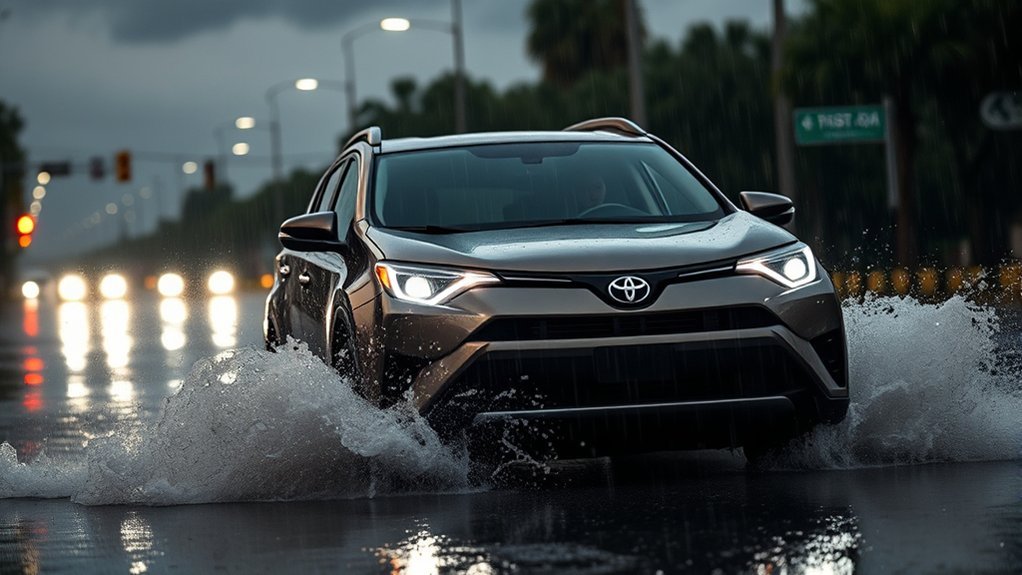
If you encounter flash flooding while driving your Toyota RAV4, do not try to estimate whether the vehicle can make it through. Water depth is hard to judge from the driver’s seat, and road damage may be hidden under the surface.
| Situation | Action to Take | Risk Level |
|---|---|---|
| Water covers the lane or road edge | Turn around and choose another route | High |
| Water is moving across the road | Do not enter; seek higher ground | Severe |
| Water is rising around your vehicle | Exit if safe, call emergency services, and move to higher ground | Life-threatening |
| Vehicle stalls in water | Do not restart the engine; leave the vehicle if safe | High |
If your RAV4 has been exposed to deep water, do not keep driving as if nothing happened. Have the brakes, wheel bearings, fluids, electrical connectors, hybrid components if equipped, and underbody inspected. Water intrusion can cause delayed damage even after the vehicle seems normal.
What to Carry in Your RAV4 During Heavy Rain Season
A small emergency kit can help if you need to wait out a storm or stop safely:
- Flashlight with fresh batteries
- Phone charger or power bank
- First aid kit
- Reflective triangles or road flares
- Rain jacket or poncho
- Bottled water and simple snacks
- Microfiber towel for glass and mirrors
- Tire pressure gauge
- Emergency escape tool stored within reach, not in the cargo area
Keep the kit secured so it does not slide under the pedals during a sudden stop.
[Products Worth Considering]

Portable & Compact: The car safety kit is designed to fit neatly into an organizer bag, allowing for easy storage in either the backseat or trunk of your vehicle. This ensures that all essential safety items are kept together and easily accessible in case of an emergency. By keeping the kit organized and readily available, you can be better prepared for unexpected situations while on the road

If your car is parked at the scene of an accident waiting to be rescued, you may need this car emergency kit

【Things you may need】: This roadside assistance packages is a perfect gift.Contain the necessary roadside kits, snow shovel, flashing lights, reflective triangle warning signs, advanced jumpers (8.2 foot), powerful towing rope, safety hammer and seat belt cutters, life blankets, raincoats, compasses and more!
Frequently Asked Questions
What is the safest way to drive a Toyota RAV4 in heavy rain?
Slow down, increase your following distance to at least four seconds, use low-beam headlights, keep wipers on, turn cruise control off, and avoid sudden braking, steering, or acceleration. If visibility becomes poor or water covers the road, pull over safely or choose another route.
What is the weakness of the Toyota RAV4 in heavy rain?
The RAV4’s main rain limitation is the same as any SUV: tires and traction matter more than ground clearance or AWD. Worn tires, high speed, standing water, and sudden inputs can still cause hydroplaning or long stopping distances. AWD helps with traction while accelerating, but it does not make the vehicle stop faster.
Should I use AWD in heavy rain?
Yes, if your RAV4 has AWD, leave it active in normal operation. Toyota’s AWD systems can automatically help with stability on slippery roads due to rain. However, AWD does not prevent hydroplaning and does not reduce braking distance on wet roads.
Should I turn off traction control in rain?
No. Keep traction control on in rain. It helps reduce drive-wheel spin when starting or accelerating on slippery roads. Turn it off only in the limited situations described in the owner’s manual, such as when the vehicle is stuck and you need to rock it free.
Can I use cruise control in heavy rain?
It is safer to turn cruise control off in heavy rain. Manual throttle control helps you slow down smoothly when water pools, traffic changes, or the tires start to lose grip.
How much tire tread is safe for driving a RAV4 in rain?
For heavy rain, 4/32 inch is a smart replacement point to consider because wet stopping distance and handling decline as tread wears. At 2/32 inch, the tire is at the common legal minimum and should be replaced.
What should I do if my RAV4 starts hydroplaning?
Ease off the accelerator, keep the steering wheel pointed where you want to go, and avoid sudden braking or sharp steering. Let the tires regain traction before making any major speed or direction change.
Conclusion
Driving a Toyota RAV4 in heavy rain can be safe when you prepare the vehicle, slow down, stay visible, and respect water hazards. Good tires, working wipers, clean lights, steady inputs, and extra following distance make the biggest difference. AWD and traction control can help, but they are not a substitute for caution. When in doubt, slow down, pull over safely, or turn around.
Sources
- NHTSA Tire Safety — tire pressure, tread, and tire inspection guidance.
- AAA: Worn Tires Put Drivers at Risk — wet-road stopping distance and handling effects at 4/32 inch tread depth.
- Federal Highway Administration: Rain and Flooding — crash risk and weather-related crash statistics for wet pavement and rainfall.
- National Weather Service: Turn Around Don’t Drown — floodwater depth and vehicle safety warnings.
- Toyota 2025 RAV4 Owner’s Manual: Driving Assist Systems — AWD, TRAC, ABS, VSC, and traction-control guidance.
- Toyota 2025 RAV4 Owner’s Manual: Submerged Vehicle and Rising Water — Toyota floodwater and rising-water warnings.



[…] and sanitizing the evaporator and ducts. A neighbor’s 2017 RAV4 had this exact problem after heavy rain. A quick drain clear, a shot of foam cleaner, and a new HEPA cabin filter fixed it completely. If […]