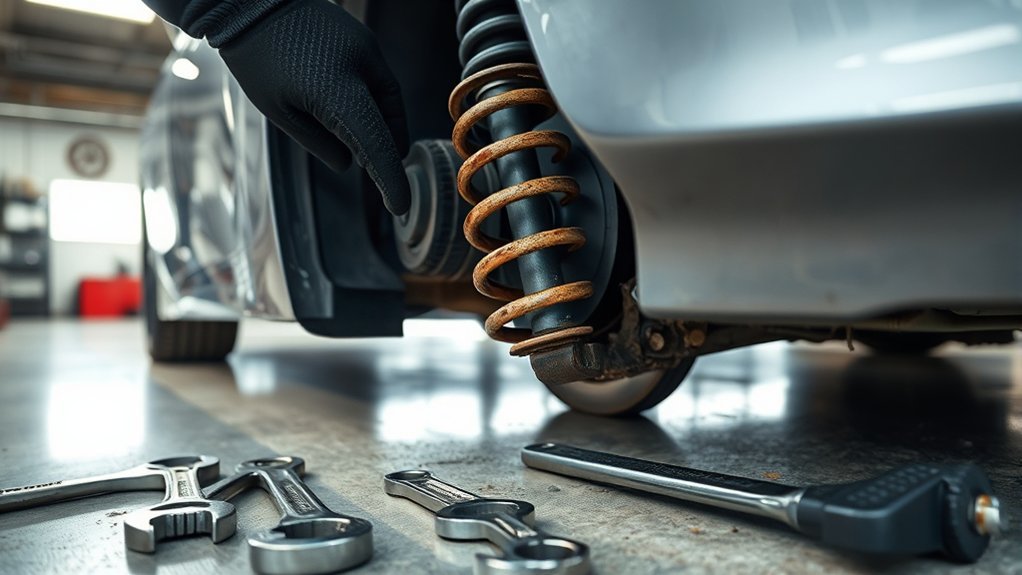
If your Toyota Camry’s suspension squeaks, the sound is usually coming from dry or worn rubber bushings, a ball joint or tie-rod end with a damaged boot, a sway-bar link, a strut mount, or a rear suspension bushing. A light rubber squeak may be simple to quiet, but clunks, loose steering, pulling, vibration, or uneven tire wear should be inspected before you keep driving.
Quick Answer
A Toyota Camry suspension usually squeaks because rubber bushings have dried out, a sway-bar bushing is rubbing, or a ball joint, tie-rod end, strut mount, or rear suspension joint is worn. Silicone lubricant can quiet minor rubber squeaks, but torn boots, loose steering, clunks, vibration, or uneven tire wear need repair, not spray.
Key Takeaways
- A squeak over bumps often points to dry bushings, sway-bar bushings, strut mounts, or ball joints.
- A clunk, pop, loose steering feel, or pulling is more serious than a light squeak and should be inspected promptly.
- Use only a rubber-safe silicone lubricant on rubber parts, and treat it as a temporary diagnostic aid, not a permanent repair.
- Do not cut, drill, or slice suspension bushings to force lubricant inside. If a bushing is torn or cracked, replace it.
- Uneven tire wear can point to worn suspension parts, alignment problems, incorrect tire pressure, or tire/wheel damage.
At a Glance
| Time Required | 30–60 minutes for a basic visual inspection |
| Difficulty | Beginner for listening and visual checks; intermediate for safely lifting the car |
| Tools Needed | Flashlight, gloves, wheel chocks, floor jack, jack stands, tire-pressure gauge, silicone lubricant, clean rags |
| Cost | About $10–$25 for lubricant; hundreds more if worn parts need replacement |
Warning: Never crawl under a Toyota Camry supported only by a jack. Use wheel chocks, lift on a level surface, place jack stands at approved support points, and check your vehicle-specific Toyota owner’s manual before lifting.
Why a Toyota Camry Suspension Squeaks
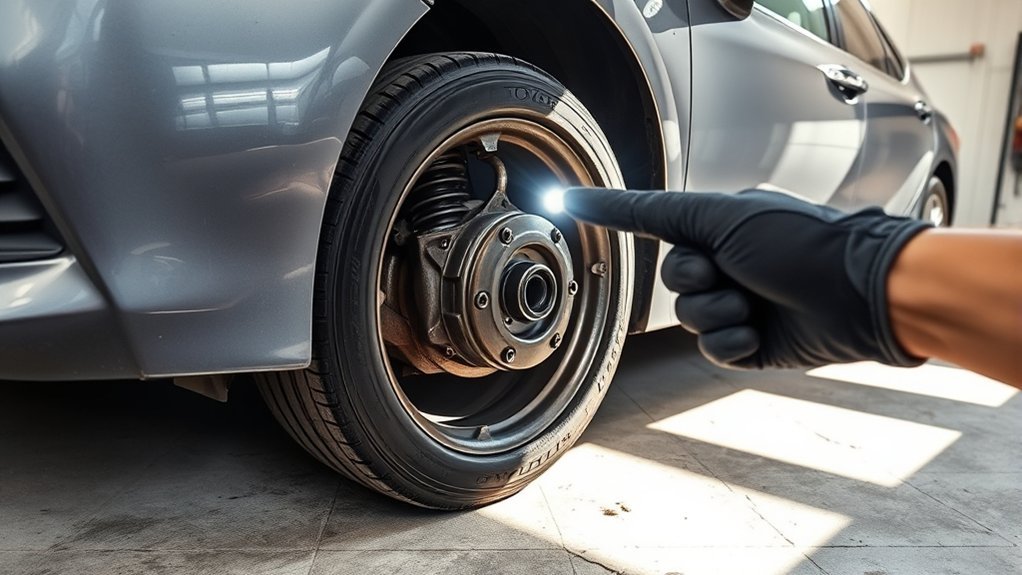
A squeak is usually friction. Rubber, metal, and grease all work together in the suspension. When a rubber bushing dries out, a ball-joint boot tears, a sway-bar bushing gets contaminated with road grit, or a strut mount wears, the moving parts can squeak, creak, groan, pop, or clunk.
On newer Camrys, Toyota describes the suspension as an optimally tuned MacPherson strut front suspension and multi-link rear suspension. Earlier recent Camrys also used a MacPherson strut front layout, while 2018-era models introduced a double-wishbone-style rear suspension design. That matters because a “control arm bushing” may mean different parts depending on the model year and whether the noise is coming from the front or rear.
| What You Hear or Feel | Common Source | What It Usually Means |
|---|---|---|
| Light squeak over small bumps | Dry sway-bar bushing, control-arm bushing, or rear link bushing | Rubber may be dry, dirty, cracked, or compressed |
| Squeak or pop while turning slowly | Ball joint, tie-rod end, strut mount, or steering linkage | Possible wear, torn boot, or loss of lubrication |
| Clunk over bumps | Sway-bar link, strut mount, ball joint, control arm, or loose hardware | Often more serious than a squeak; inspect before driving far |
| Steering vibration or wandering | Suspension wear, alignment, tire balance, tire damage, or wheel bearing issue | Needs diagnosis; do not assume lubricant will fix it |
| Uneven tire wear | Alignment, worn ball joint, worn bushing, strut issue, or tire-pressure problem | Check tires and suspension together |
Common Symptoms of Worn Suspension Components
Unusual Noises While Driving
A light squeak when the car moves over speed bumps often points to rubber-on-metal or rubber-on-rubber friction. Start by listening for where the sound comes from: front left, front right, rear left, rear right, or center. A helper can gently bounce the parked car while you listen from outside, but keep hands, hair, and clothing away from moving parts.
If the noise changes when you turn the steering wheel, pay closer attention to the front strut mount area, outer tie-rod ends, ball joints, and lower control-arm bushings. If the sound comes from the rear, inspect the rear sway-bar bushings, rear links, rear shocks, and rear suspension bushings.
Steering Wheel Vibration Issues
Steering wheel vibration is not always a suspension squeak problem. It can come from tire balance, a bent wheel, uneven tire wear, a worn bearing, brake rotor issues, or loose suspension and steering parts. If vibration appears with a squeak, inspect both the tires and the suspension before assuming one part is the cause.
Uneven Tire Wear Patterns
Uneven tire wear is one of the clearest signs that the suspension, alignment, or tire maintenance needs attention. The National Highway Traffic Safety Administration recommends tire inspection, correct tire pressure, and attention to vehicle load limits as key tire-safety habits.
- Inner or outer edge wear: often points to alignment or worn front-end parts.
- Cupping or scalloping: can point to worn shocks/struts, tire imbalance, or loose suspension components.
- Center wear: often suggests overinflation.
- Both-edge wear: often suggests underinflation or heavy cornering.
Note: If your Camry has uneven tire wear and a suspension squeak, plan on an alignment check after worn steering or suspension parts are replaced.
Gather Your Tools for Inspection
Before inspecting your Toyota Camry’s suspension, gather the right tools and pick a flat, well-lit place to work. You do not need to disassemble the suspension for a basic inspection, but you do need to lift the car safely if you remove a wheel.
- Flashlight or work light
- Mechanic gloves and safety glasses
- Wheel chocks
- Floor jack rated for the vehicle
- Jack stands rated for the vehicle
- Lug wrench or impact wrench
- Torque wrench for reinstalling wheels
- Tire-pressure gauge
- Clean rags
- Rubber-safe silicone spray or silicone paste
Use your vehicle-specific Toyota owner’s manual from Toyota’s official manuals and warranties page to confirm jack points, tire pressure, and model-specific safety information.
Step-by-Step Suspension Inspection
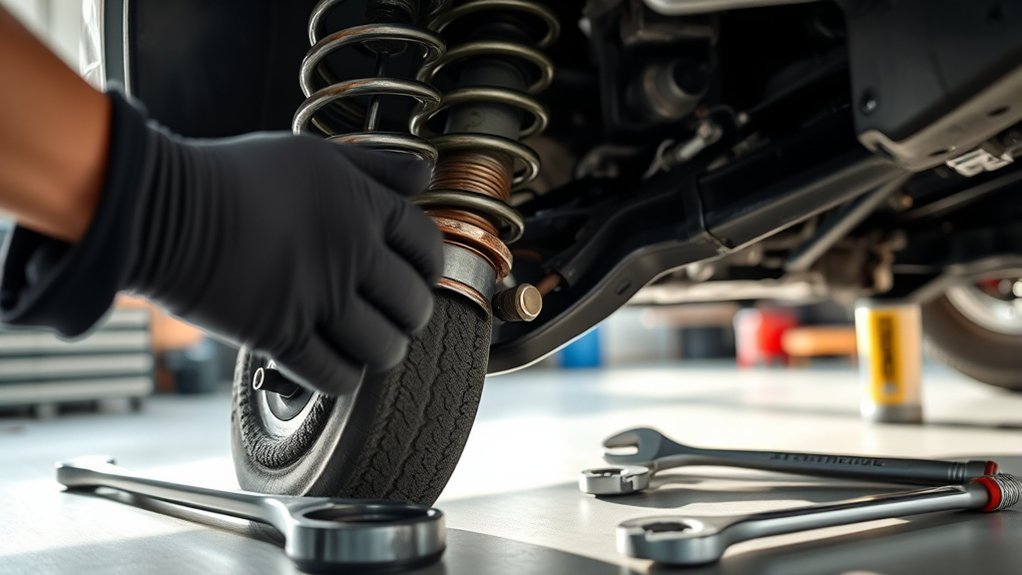
- Road-test carefully first. Drive slowly over a familiar smooth road, then over a small bump or driveway entrance. Note when the squeak happens: bumps, turns, braking, acceleration, cold starts, rain, or only with passengers.
- Check tire pressure and tire wear. Incorrect pressure and uneven tire wear can create noises and vibration that feel like suspension trouble.
- Look for obvious damage. With the car parked, inspect around each wheel for broken plastic shields, loose trim, leaking shocks/struts, cracked boots, or hanging parts.
- Bounce each corner. Push down firmly on one corner of the car and release. A squeak during body movement can help narrow the area. Excessive bouncing may point to weak shocks or struts.
- Lift only if needed. If you need to remove a wheel, chock the wheels, loosen lug nuts slightly before lifting, support the car with jack stands, and never place any part of your body under an unsupported vehicle.
- Inspect rubber bushings. Look for cracks, separation, missing rubber, shiny rub marks, oil-soaked rubber, or bushing sleeves that look off-center.
- Inspect ball-joint and tie-rod boots. A torn boot lets grease out and dirt in. A dry or loose joint can squeak, pop, or clunk.
- Check sway-bar links and bushings. Sway-bar parts commonly make noise over small bumps, especially when one wheel moves more than the other.
- Reinstall wheels correctly. Tighten lug nuts in a star pattern and torque them to the specification in your owner’s manual.
Pro Tip: Use your phone to record the sound from inside and outside the car. A short video helps a mechanic identify whether the squeak comes from the front suspension, rear suspension, steering, brakes, or tires.
[Products Worth Considering]

The NOCO Boost X GBX45 is a powerful portable jump starter designed to revive gas and diesel engines with fast, reliable performance. It combines spark-proof, reverse-polarity-safe operation with USB-C charging, power bank functionality, and a built-in LED flashlight for roadside emergencies and everyday utility.

COMPATIBILITY – Fits 2004-2006 Lexus RX330; 2007-2008 Lexus RX350; 1997-2001 Lexus ES300; 2001-2003 Toyota Highlander; 1997-1999 Toyota Avalon; 1997-2001 Toyota Camry; 1999-2003 Toyota Solara
How to Diagnose Your Squeaky Suspension
The fastest way to diagnose a Toyota Camry suspension squeak is to match the sound to the driving condition. Do not replace parts just because they are common. Confirm the location first.
Common Squeak Sources
- Sway-bar bushings: often squeak or groan over small bumps or when entering driveways at an angle.
- Sway-bar end links: more likely to clunk or rattle than squeak.
- Lower control-arm bushings: can squeak, thump, or shift under braking and acceleration.
- Ball joints: can squeak, pop, or clunk, especially when turning or going over bumps.
- Tie-rod ends: can make noise while turning and may create loose steering feel.
- Strut mounts: can creak, pop, or bind when the steering wheel turns.
- Rear links and bushings: can squeak from the rear over bumps or during body roll.
- Brake hardware or dust shields: can mimic a suspension squeak, especially at low speeds.
Inspection Techniques Explained
Use a flashlight and inspect one corner at a time. Compare the noisy side with the quiet side. You are looking for differences: a torn boot on one side, a shiny rub mark, one bushing that looks collapsed, one leaking strut, or one tire with unusual wear.
| Component | What to Check | Likely Next Step |
|---|---|---|
| Rubber bushing | Cracks, separation, shiny rub marks, dry surface, oil contamination | Lubricate only if intact; replace if torn or separated |
| Ball joint | Torn boot, grease leak, rust dust, looseness, popping | Professional inspection or replacement |
| Tie-rod end | Boot damage, looseness, steering play | Repair and alignment check |
| Strut or shock | Oil leakage, broken mount, excessive bounce, clunking | Replace worn unit; align if front struts are replaced |
| Sway-bar link or bushing | Loose link, cracked bushing, noise over one-wheel bumps | Replace worn link/bushing; lubricate only intact rubber bushings |
Warning: Stop driving and arrange an inspection if you hear loud clunks, feel loose or wandering steering, see a torn ball-joint boot with grease loss, notice the car pulling hard to one side, or see rapid tire wear.
Applying Silicone Spray to Quiet Minor Bushing Squeaks
Silicone lubricant can help when the squeak is from dry, intact rubber. It will not repair a torn bushing, loose ball joint, bad tie-rod end, failed strut mount, or worn shock/strut. Use a product that clearly says it is safe for rubber. WD-40 Specialist Silicone, for example, says it is safe on most metals, plastics, rubbers, and vinyl when used as directed. 3M Silicone Paste also lists rubber chassis and steering bushings among its uses.
- Clean the bushing area with a rag so dirt does not get pushed into the joint.
- Spray or apply silicone only to the outside of the intact rubber bushing and the contact area where it moves.
- Wipe away overspray from brake rotors, tires, belts, and exhaust parts.
- Drive slowly over the same bump or driveway entrance to see whether the noise changes.
- If the squeak returns quickly, or if the bushing is cracked or separated, plan on replacement instead of repeated spraying.
Note: Do not cut, drill, or slice a suspension bushing to inject lubricant. A cut bushing is a damaged bushing. If lubricant cannot reach the contact area safely, inspect and replace the part instead.
Repair Options and Costs
The cost to fix a squeaky Toyota Camry suspension depends on the part that is actually worn. A rubber-safe lubricant is inexpensive, but a worn joint, control arm, strut, or rear suspension link can cost much more because parts, labor, and alignment may be required.
| Likely Repair | Typical Situation | Cost Context |
|---|---|---|
| Silicone lubricant | Dry but intact rubber bushing | Usually about $10–$25 for DIY lubricant |
| Sway-bar bushing or link | Noise over small bumps, driveway angles, or body roll | Often less than major strut/control-arm work, but varies by labor rate |
| Ball joint | Squeak/pop/clunk, torn boot, steering looseness, tire wear | RepairPal lists Toyota Camry ball-joint replacement at about $341–$513, excluding taxes, fees, and location differences |
| Shock or strut replacement | Leakage, bounce, clunking, poor ride control | RepairPal lists Toyota Camry shock/strut replacement at about $803–$964, excluding taxes, fees, and location differences |
| Control arm or rear suspension link | Cracked bushing, shifted arm, alignment problems, clunking | Varies widely by model year, side, part quality, and whether alignment is needed |
[Products Worth Considering]

COMPATIBILITY — Fits 2001-2007 Toyota Highlander; 2002-2006 Toyota Camry; 2005-2006 Lexus ES330.

【Kit Includes】1x Front Lower Control Arm (Driver) - K620334; 1x Front Lower Control Arm (Passenger) - K620333; 1x Front Driver Side Lower Ball Joint - K500044; 1x Front Passenger Side Lower Ball Joint - K500043; 1x Front Left Outer Tie Rod End - ES80603; 1x Front Right Outer Tie Rod End - ES80602; 2x Front Inner Tie Rod Ends - Driver & Passenger Side - EV800306; 2x Front Stabilizer Sway Bar End Links - K750123; 2x Rear Stabilizer Sway Bar End Links - K750011.
Keep Your Suspension in Top Shape
Suspension maintenance is mostly about catching wear early. You do not need to spray every bushing on a schedule. Instead, inspect the car when symptoms appear and check visible parts during tire rotations, oil changes, and seasonal tire-pressure checks.
| Task | When to Do It |
|---|---|
| Check tire pressure | Monthly and before long trips |
| Inspect tire wear | At every oil change or tire rotation |
| Listen for new squeaks, clunks, or pops | Any time the ride or steering changes |
| Look for leaking shocks/struts and torn boots | During tire service or brake service |
| Check alignment | After suspension/steering repairs, pothole impacts, or uneven tire wear |
| Use silicone lubricant | Only on intact rubber parts when dry rubber squeak is confirmed |
When Should You Seek Professional Help for Suspension Issues?
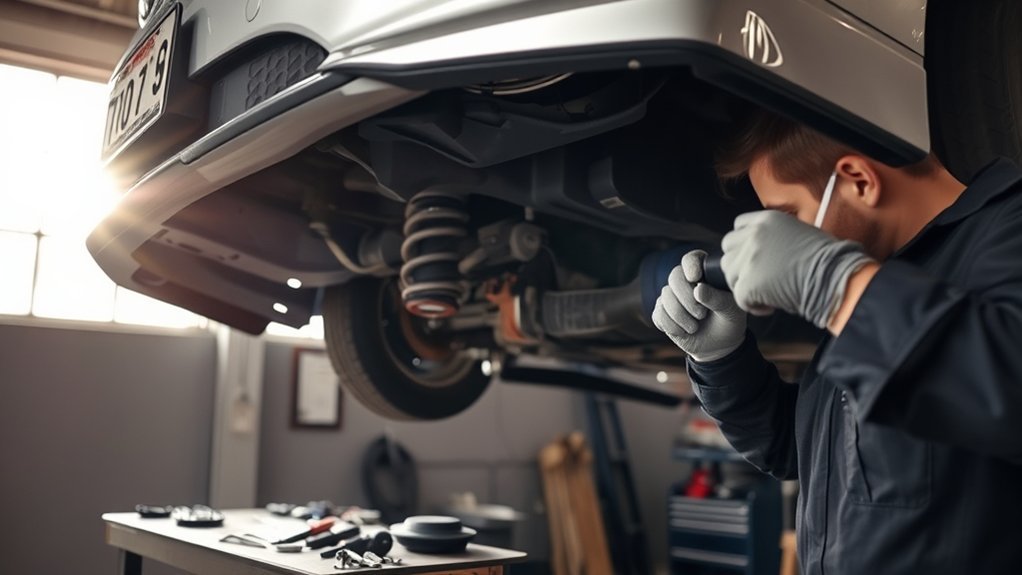
Get professional help if the squeak is paired with handling, steering, tire, or braking symptoms. Suspension parts affect how the tires stay planted on the road, so a small sound can become a safety issue when a joint or bushing is loose.
- The squeak turns into a clunk, knock, or pop.
- The steering feels loose, shaky, or delayed.
- The car pulls to one side.
- You see uneven or rapid tire wear.
- A ball-joint or tie-rod boot is torn or leaking grease.
- A shock or strut is leaking oil.
- The car bounces excessively after bumps.
- The noise continues after a rubber-safe lubricant test.
- You are not comfortable lifting the vehicle safely.
A squeak is not always dangerous, but a squeak with clunking, loose steering, pulling, or uneven tire wear should be treated as a repair issue, not a noise annoyance.
Frequently Asked Questions
How much does it cost to fix the suspension on a Toyota Camry?
It depends on the failed part. A rubber-safe lubricant may cost about $10–$25, while a worn ball joint, strut, control arm, or rear link can cost hundreds of dollars. Current RepairPal examples list Toyota Camry ball-joint replacement around $341–$513 and shock/strut replacement around $803–$964, before taxes, fees, and local price differences.
How much does it cost to fix a squeaking suspension?
A simple dry-bushing squeak may only need inspection and a rubber-safe silicone lubricant. If the squeak comes from a torn bushing, bad ball joint, strut mount, tie-rod end, or worn shock/strut, the cost rises because parts, labor, and sometimes alignment are needed.
Why is my Toyota Camry squeaking when I go over bumps?
A squeak over bumps commonly points to dry sway-bar bushings, control-arm bushings, rear suspension bushings, strut mounts, sway-bar links, or ball joints. If the sound is a hard clunk instead of a light squeak, inspect the suspension before driving far.
Can I spray WD-40 on Toyota Camry suspension bushings?
Do not use standard petroleum penetrants as a long-term rubber-bushing fix. If you use WD-40, use the Specialist Silicone version or another lubricant that clearly says it is safe for rubber. Keep lubricant away from brake rotors, tires, belts, and exhaust parts.
Is it safe to drive with a squeaky suspension?
A light rubber squeak may be safe for a short time, but you should not ignore it. Stop driving and get the car inspected if the squeak comes with clunking, pulling, loose steering, vibration, torn boots, leaking struts, or uneven tire wear.
Will an alignment fix a Toyota Camry suspension squeak?
An alignment can correct tire angles, but it will not fix a squeaking bushing, bad ball joint, loose sway-bar link, or worn strut mount. If worn parts are found, replace them first, then align the car if the repair affects alignment.
Conclusion
A Toyota Camry suspension squeak is usually a clue, not a diagnosis. Dry rubber bushings can sometimes be quieted with a rubber-safe silicone lubricant, but torn boots, loose joints, clunks, steering vibration, pulling, leaking struts, and uneven tire wear need proper inspection. Start with a safe visual check, confirm where the sound comes from, and repair worn parts before they affect handling or tire life.
Sources
- Toyota Owners Manuals and Warranties — vehicle-specific owner’s manual, lifting, tire, and maintenance reference.
- Toyota USA Newsroom: 2025 Camry — current Camry suspension layout details.
- NHTSA Tire Safety — tire inspection, tire pressure, and tire-safety guidance.
- WD-40 Specialist Silicone Lubricant — rubber-safe silicone lubricant compatibility when used as directed.
- 3M Silicone Paste 08946 Data Sheet — silicone paste uses for rubber chassis and steering bushings.
- RepairPal Toyota Camry Ball Joint Replacement Cost and RepairPal Toyota Camry Shock or Strut Replacement Cost — repair-cost examples.