Last updated: August 31, 2026
For U.S.-market Toyota and Scion vehicles covered by the 2AZ oil-consumption procedures, the commonly called “1,200-mile test” is a controlled dealer inspection with a 1,100–1,300-mile return window. The dealer fills the engine to the full mark, records the mileage, and seals key service points. When you return, the dealer checks the seals and oil level and, when required by the procedure, adds exactly one quart before making the final dipstick check. For ZE7 eligibility, Toyota required a dealer-performed test. Your role is to protect the seals, return in the required mileage window, and stop the engine if the low oil-pressure warning appears.
Quick Answer
Toyota’s U.S. 2AZ inspection procedure uses a 1,100–1,300-mile return window. The dealer fills the engine to the full mark and seals the dipstick, drain plug, fill cap, oil cooler line, and oil filter. At the return visit, a dipstick that is still full means the bulletin does not apply. If it is not full, the dealer adds exactly one quart, warms the engine, waits five minutes, and rechecks it. Above full means the bulletin does not apply; below full sends the vehicle to Toyota’s 2AZ repair procedure.
Key Takeaways
- For ZE7 eligibility, Toyota required a dealer-performed oil-consumption test. A home oil-use log can support your complaint, but it does not replace the dealer test.
- Return to the same dealer inside the 1,100–1,300-mile window; being outside that range makes the official test result void.
- Do not break, move, clean, or replace any tamper label or sealed part during the test.
- ZE7 secondary coverage ended at the earlier of 10 years from the vehicle’s first-use date or 150,000 miles. By August 31, 2026, most affected vehicles are outside that window, although a vehicle with a sufficiently late first-use date may require a VIN-specific dealer check.
At a Glance
| Time Required | Two dealer visits plus 1,100–1,300 miles of normal driving |
| Owner’s Role | Protect the seals, drive normally, and return to the same dealer inside the mileage window |
| Records to Bring | Repair orders, oil-change receipts, odometer notes, and any pre-test oil-use log |
| Cost | Varies by dealer and current coverage status; an oil change may be owner-paid if due before the test |
Editorial basis: This guide interprets U.S.-market Toyota/Scion service bulletins, ZE7 warranty-enhancement documents, and Toyota owner-manual instructions. It does not claim a hands-on oil-consumption test of a specific vehicle. Procedures and coverage can differ outside the United States.
How Does Toyota’s 1,200-Mile Oil Consumption Test Work?
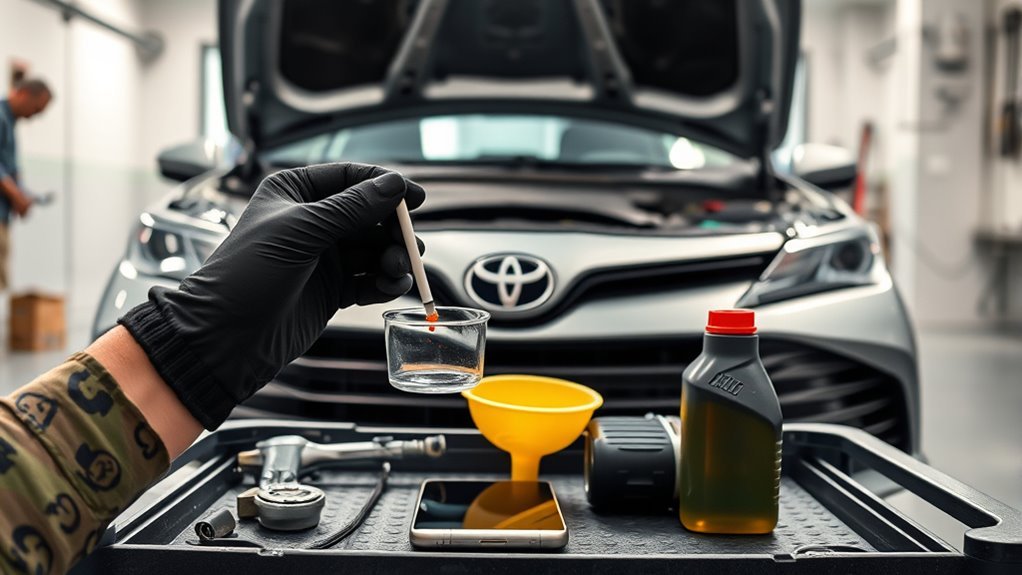
Start by scheduling an appointment with a Toyota dealer and asking for the engine oil consumption inspection procedure. Toyota’s U.S. 2AZ Engine Oil Consumption Inspection Procedure says the dealer confirms the complaint, fills the oil to the “Full” mark on the dipstick, and marks sealed locations before returning the vehicle to the customer. ZE7 also included certain Scion tC and xB vehicles, which used the corresponding Scion inspection procedure rather than Toyota T-SB-0158-14.
- Dealer confirms the complaint. Tell the service adviser how often you add oil, what oil you use, and whether the low oil pressure light has appeared.
- Dealer checks for conditions that can affect the test. External oil leaks may need to be repaired before the official test starts.
- Dealer fills oil to the full mark. The starting level and odometer reading should be written on the repair order or oil consumption test form.
- Dealer seals the system. Toyota’s procedure identifies the dipstick, oil drain plug, fill cap, oil cooler line, and oil filter as marked locations.
- You drive normally. Keep your usual city, highway, commuting, and load pattern. Do not change your driving style simply to influence the result.
- You return in the correct window. Bring the vehicle back to the same dealer after 1,100–1,300 miles, not simply “whenever it reaches 1,200.”
- The dealer performs the final check. The dealer verifies the seals, checks the dipstick, adds oil from a one-quart container if the level is not full, warms the engine, waits five minutes, checks the level again, and records the result.
What Result Counts as Excessive Oil Consumption?
Toyota’s 2AZ inspection bulletin uses a measured one-quart check rather than an owner-estimated consumption rate. When you return after 1,100–1,300 miles, the dealer first checks whether the dipstick is still full. If it is not full, the technician adds one quart from a quart container, warms the engine to operating temperature, shuts it off, waits five minutes, and checks the dipstick again.
| Reading | Bulletin Direction |
|---|---|
| Dipstick is full when the vehicle first returns | The bulletin does not apply; no one-quart measurement is needed. |
| After adding exactly 1 qt, the level is above full | The bulletin does not apply. Toyota directs the dealer to drain the level back to full. |
| After adding exactly 1 qt, the level remains below full | Follow the 2AZ Engine Oil Consumption Repair Procedure. |
| After adding exactly 1 qt, the level appears exactly at full | The published T-SB explicitly gives “above full” and “below full” branches but does not state a separate “exactly full” branch. Ask the dealer to record the reading and apply Toyota’s current service guidance rather than guessing at the outcome. |
Warning: Do not remove, clean, move, or replace any inspection label or sealed part during the dealer test. If the seals appear tampered with, the result can be void. If the low oil pressure warning light flickers or stays on, pull over safely, stop the engine immediately, and call the dealer or a qualified repair shop before driving farther.
How Should You Track Oil Use Before the Dealer Test?
Before the dealer test, keep a consistent oil-level log so you can show the service adviser what has been happening. Toyota’s 2007 Camry manual recommends checking the oil level every time you refuel. During the official sealed test, follow the dealer’s written instructions and do not open or move a sealed part. Your home log supports the complaint, but it does not replace the dealer’s ZE7 measurement.
For consistent readings, park on level ground, warm the engine, turn it off, and wait a few minutes so oil can drain back into the pan. Pull the dipstick, wipe it clean, reinsert it fully, then pull it again and read the level. Toyota’s 2007 Camry owner’s manual warns that an incorrect dipstick insertion can give a false reading and that overfilling can damage the engine.
| Date | Odometer | Oil Level | Oil Added | Notes |
|---|---|---|---|---|
| June 1 | 142,300 | Full | 0 qt | Baseline after oil change |
| June 14 | 142,875 | Halfway between full and low | 0 qt | No leaks seen |
- Record the date, odometer, oil level, oil brand/viscosity, and amount added.
- Keep oil-change receipts and repair orders with the log.
- Take clear photos of the dipstick only if doing so does not disturb dealer seals.
- Do not overfill above the full mark to “stretch” the interval; that can create a new problem.
Pro Tip: Read the dipstick the same way each time: same parking spot, level ground, engine warmed, engine off, and a short wait before checking. Consistency makes your log more useful to the service adviser.
[Products Worth Considering]

Castrol EDGE 0W-20 advanced full synthetic motor oil is engineered for drivers seeking strong wear protection, excellent viscosity control, and thermal stability. It delivers superior performance in critical engine areas, including fuel economy, high-temperature protection, sludge control, and wear defense. Designed for extended oil-change intervals, it helps keep modern engines running smoothly under demanding conditions.

These genuine Toyota oil drain plug gaskets are designed to help maintain a reliable seal during oil changes, reducing the chance of leaks and supporting proper engine maintenance. With an OEM fit and trusted Toyota quality, they are a practical choice for routine service on compatible vehicles. The convenient quantity pack is ideal for keeping multiple maintenance intervals covered.

This PCV valve and hose kit is designed as a direct replacement for select Toyota, Scion, and Lexus applications, helping restore proper crankcase ventilation and engine performance. Built with durable NBR rubber and made for straightforward installation, it offers a reliable fit for compatible 2.4L models. It is a practical maintenance part for addressing worn or failing PCV components while supporting smoother engine operation.
What Else Can Cause Engine Oil Loss?
Oil can disappear because it is burned inside the engine, drawn through a faulty PCV system, or lost through an external leak. The dealer consumption test measures how much oil is lost, but it does not by itself identify every possible cause. Start with visible leaks and basic checks, then use a qualified technician for compression, leak-down, or other internal-engine testing when needed.
- Look for external leaks. Check the oil pan, drain plug, timing cover area, valve cover gasket, oil filter, and cooler lines for wet oil, drips, or fresh oil trails.
- Watch for blue smoke. Blue smoke at startup can be consistent with valve-seal leakage, while smoke under load can be consistent with oil entering the combustion chamber through rings or cylinders. Smoke pattern alone is not a conclusive diagnosis.
- Check the PCV valve and hose. A faulty PCV system can affect crankcase ventilation and contribute to oil entering the intake, so it is worth inspecting before assuming the engine needs major internal work.
- Inspect spark plugs. Oil-fouled plugs can provide supporting evidence that oil is entering one or more combustion chambers.
- Request compression and leak-down tests when appropriate. These tests can add evidence about cylinder sealing, but their results should be interpreted with the vehicle’s other symptoms and inspection findings.
If you are diagnosing a Camry specifically, the Toyota Camry oil-leak diagnosis guide covers common external leak locations in more detail.
Note: Under ZE7 guidance, an external oil leak could prevent the official consumption test from starting until the leak was addressed. That distinction matters because oil lost onto the outside of the engine is not the same as oil consumed internally.
Which Toyota and Scion Models Were Included in ZE7?
ZE7 applied only to certain vehicles and VINs equipped with the 2AZ engine, so model year alone is not enough to establish eligibility. The ZE7 coverage population also should not be confused with the applicability table in Toyota T-SB-0158-14: related Toyota and Scion inspection bulletins covered their own model sets, while ZE7 defined the vehicles eligible for the warranty-enhancement program. Ask a dealer to check the VIN and service history rather than relying only on the year and model.
| Model | Model Years Listed in ZE7 Materials | Engine Family |
|---|---|---|
| Toyota Camry | Certain 2007–2009 | 2AZ |
| Toyota Camry Hybrid | Certain 2007–2011 | 2AZ |
| Toyota Camry Solara | Certain 2007–2008 | 2AZ |
| Toyota Corolla | Certain 2009–2011 | 2AZ |
| Toyota Corolla Matrix | Certain 2009–2013 | 2AZ |
| Toyota RAV4 | Certain 2006–2008 | 2AZ |
| Scion tC | Certain 2007–2010 | 2AZ |
| Scion xB | Certain 2008–2015 | 2AZ |
That table describes ZE7 materials, not a blanket statement that every vehicle in those years had the condition or qualified for a repair. VIN applicability, the original engine, previous repairs, mileage, first-use date, maintenance history, and the dealer-performed consumption test all affected the program decision.
What Happens If the Toyota Oil Test Shows Excessive Use?

If your oil tracking and dealer test show excessive use, keep the complete paperwork together: repair orders, oil-change receipts, your oil log, odometer readings, and any diagnostic reports. Toyota’s Warranty Enhancement Program ZE7 documents explain that parts-replacement eligibility depended on a dealer-performed oil-consumption test and the vehicle meeting the program conditions.
Best evidence: Keep the date, odometer, oil level, amount added, oil type, repair order number, seal status, and the dealer’s written test result together in one file.
ZE7 had two coverage limits. Primary coverage ran until October 31, 2016 regardless of mileage. After that, secondary coverage applied for 10 years from the vehicle’s date of first use or 150,000 miles, whichever came first. As of August 31, 2026, a vehicle first used before August 31, 2016 has passed the 10-year time limit. A sufficiently late first-use date can still affect the calculation for a small number of later vehicles, so ask the dealer to verify the VIN, first-use date, mileage, original-engine status, and service history before relying on a general year-based answer.
- Ask for a copy of the completed oil consumption test form or repair order.
- Confirm whether the result passed, failed, or was void because of mileage, leaks, or seal tampering.
- Ask which bulletin, expired warranty-enhancement program, current warranty, goodwill review, or customer-pay repair path applies to your vehicle today.
- If a repair is authorized, request a written repair order listing the scope, parts, labor, and estimated downtime.
- If coverage is denied, ask for the reason in writing and keep the records for a second opinion or Toyota customer-support discussion.
[Products Worth Considering]

This 6-pack engine oil filter set is designed for Toyota applications and compatible cross-reference part numbers, helping support clean oil flow and dependable engine protection. Built from quality materials and featuring 99% multi-pass efficiency, it is made to help extend engine life and maintain performance between service intervals. The included six filters make it a practical choice for routine maintenance and multiple oil changes.

The Funnel King 32950 Oil Drain Pan is a compact fluid catch basin designed for clean, easy draining during routine maintenance. Its open shape and pour edge help transfer used oil, coolant, and other shop fluids with less mess, while the lightweight polypropylene construction stands up to common automotive chemicals. Sized to fit under many cars and small engines, it is a practical choice for garages, workshops, and DIY oil changes.

This 12-pack oil filter and drain plug washer set is designed for a wide range of Toyota and Scion vehicles, helping support clean oil flow and dependable engine performance. It replaces several common OE part numbers and offers an easy-fit solution for routine maintenance. Built with corrosion-resistant materials and efficient filtration, it helps keep engine contaminants out and supports longer service life.
Can Oil Additives or Thicker Oil Fix 2AZ Oil Burning?
Temporary oil strategies can help you manage the level, but they do not restore worn piston rings, cylinder walls, or valve stem seals. Do not use a “stop leak,” oil additive, or unapproved viscosity to influence a dealer consumption test. A change that alters the symptom can complicate diagnosis without repairing the underlying fault.
Use the viscosity and oil performance level specified for your particular engine and vehicle. ZE7 materials list 0W-20 or 5W-20 for the covered vehicles, while the owner’s manual for the 2007 Camry lists SAE 5W-20 or 0W-20 for the 2.4L 2AZ-FE engine. The API Motor Oil Guide likewise recommends following the vehicle manufacturer’s SAE viscosity and API or ILSAC performance standard.
If inspection and testing support internal engine wear, the long-term repair may involve piston/ring service, short-block work, or engine replacement depending on the actual failure and the vehicle’s condition. Prices vary widely by labor rate, parts availability, location, and repair strategy. Get written estimates before authorizing engine teardown.
Note: If the vehicle is outside ZE7 or other warranty coverage, it can still be worth paying for a proper diagnosis before replacing the engine. An external leak or PCV-system problem can cost far less to address than major internal engine work.
[Products Worth Considering]

This MOTOALL oil filter kit is designed for compatible Toyota and Lexus vehicles, helping support routine engine maintenance with a convenient five-piece pack. It fits select Avalon, Camry, RAV4, Sienna, and several Lexus models, making it a practical choice for scheduled oil changes. Built new and well packed, it includes multiple interchangeable part numbers for easy replacement matching.

This oil filter housing cap assembly is designed as a direct replacement for a wide range of Toyota and Lexus vehicles, helping restore proper oil filter housing sealing and reliable engine protection. It includes the cap, plug, and gasket for convenient installation, and is built to match multiple OEM part numbers for broad compatibility. Always verify your vehicle year and part number before purchase to ensure the correct fit.

This A-Premium cartridge engine oil filter is designed for a wide range of Toyota and Lexus vehicles, helping support cleaner oil flow and dependable engine protection. With high filtration efficiency and included O-rings, it offers a practical replacement solution for routine maintenance. Built for extended service intervals, it is suitable for conventional or synthetic oil applications.
Frequently Asked Questions
How do you perform a Toyota oil consumption test?
For the U.S. Toyota 2AZ procedure, schedule a dealer visit. The dealer fills the oil to the full mark, seals key service points, records the mileage, and sends you out to drive normally. You then return to the same dealer within 1,100–1,300 miles for the final measurement.
Can I do Toyota’s 1,200-mile oil test myself?
You can track oil use at home, but a home log is not the official ZE7 test. Toyota’s warranty-enhancement program required a dealer-performed oil-consumption test, including the dealer’s setup, security seals, repair-order documentation, and final measurement.
What year Toyota Camry had oil consumption problems?
ZE7 materials include certain 2007–2009 gasoline Camry vehicles and certain 2007–2011 Camry Hybrid vehicles equipped with a 2AZ engine. Not every VIN in those model years was covered, so the year alone cannot establish applicability.
What is Toyota’s oil consumption specification for the 2AZ campaign?
For the U.S. ZE7/2AZ procedure, the dealer returns to a measured one-quart check after 1,100–1,300 miles. If the oil is not full, one quart is added. After warm-up and a five-minute wait, a level that remains below full sends the vehicle to Toyota’s repair procedure, while a level above full means the bulletin does not apply.
Is Toyota’s 1.1 qt per 600 miles figure the same as the ZE7 test limit?
No. The 2007 Camry owner’s manual separately lists a general maximum oil-consumption figure of 1.0 L per 1,000 km, or 1.1 qt per 600 miles. The ZE7/T-SB procedure uses its own dealer-controlled 1,100–1,300-mile test and one-quart final measurement. Do not substitute the owner-manual figure for the campaign’s test procedure.
What if the dipstick is exactly full after the dealer adds one quart?
Toyota’s published T-SB explicitly provides an “above full” branch, where the bulletin does not apply, and a “below full” branch, where the repair procedure follows. It does not state a separate “exactly full” branch in that step. Ask the dealer to document the dipstick reading and apply Toyota’s current service guidance rather than assuming an outcome that the published bulletin does not state.
What happens if I miss the 1,100–1,300-mile return window?
The official test result is void if the mileage difference is outside the required 1,100–1,300-mile range. Under the original ZE7 rules, another test could be requested after 5,000 miles or six months had elapsed if the vehicle still met the program conditions. Because ZE7 coverage is now expired for most affected vehicles, ask the dealer about the current cost and retest policy.
How do you diagnose engine oil consumption?
Start with repeatable dipstick readings and checks for external leaks. Then inspect the PCV system, look for exhaust-smoke clues, inspect spark plugs, and use appropriate mechanical tests when needed. No single smoke pattern or compression reading should be treated as proof of worn piston rings without the rest of the diagnosis.
Will thicker oil or additives fix Toyota oil burning?
Usually not. A different viscosity or additive may change the symptom, but it does not restore worn rings, cylinders, or valve stem seals. Use the oil viscosity and performance standard specified for your engine, especially before a dealer consumption test.
Can I add oil during Toyota’s sealed consumption test?
Do not open the fill cap, move the dipstick seal, or add oil unless the dealer gives you instructions. If the low oil-pressure warning appears, pull over safely, stop the engine, and contact the dealer or a qualified repair shop before driving farther. Protecting the engine takes priority over completing the test.
Does Toyota still cover ZE7 oil-consumption repairs in 2026?
ZE7 secondary coverage was limited to 10 years from the vehicle’s first-use date or 150,000 miles, whichever came first. By August 31, 2026, most affected vehicles are outside that window. A sufficiently late first-use date can still affect the calculation for some later vehicles, so a dealer should verify the VIN, first-use date, mileage, original-engine status, and service history before giving a final answer.
Conclusion
For U.S.-market 2AZ vehicles, Toyota’s commonly called 1,200-mile oil consumption test depends on a controlled process: dealer setup, a full starting level, sealed components, normal driving, and a return visit within 1,100–1,300 miles. Before the appointment, document your oil level and collect maintenance records. During the sealed test, protect every inspection label and stop the engine if the low oil-pressure warning appears. At the final visit, get the dipstick result and repair or coverage decision in writing. If ZE7 no longer applies, use the same records to separate external leaks or PCV problems from internal-engine repairs before paying for major engine work.
Sources
- Toyota T-SB-0158-14 Rev2: 2AZ Engine Oil Consumption Inspection Procedure — official U.S. dealer test steps, sealed locations, 1,100–1,300-mile return window, and final measurement process.
- Toyota Warranty Enhancement Program ZE7 Service Consultant Reference Guide — covered vehicle list, coverage limits, oil type table, and dealer/warranty process.
- Toyota Warranty Policy Bulletin POL14-12 / ZE7 — warranty enhancement terms, testing documentation, and VIN applicability guidance.
- 2007 Toyota Camry Owner’s Manual — oil level checking method, general oil-consumption figure, oil-pressure warning, and engine oil selection.
- 2009 Toyota Camry Scheduled Maintenance Guide — maintenance interval context and owner service documentation.
- API Motor Oil Guide — API/ILSAC oil certification marks and manufacturer-recommended viscosity guidance.