Last updated: July 15, 2026 · Reviewed by: [VERIFY: add real author name and credentials]
Your Toyota Camry’s 12V auxiliary battery usually lasts about 3 to 5 years. Heat, repeated short trips, long parking periods, vibration, corrosion, and electrical drain can shorten that window. Gasoline-only U.S. Camrys sold through the 2024 model year use the 12V battery to crank the engine and power electronics. U.S. Camrys from the 2025 model year onward are hybrid-only, so they have both a 12V auxiliary battery and a separate high-voltage traction battery.
How this guide was checked: Toyota warranty and parts documents, Toyota’s current Camry model-year information, AAA battery-aging guidance, and OSHA battery-safety rules.
Quick Answer
A Toyota Camry 12V battery usually lasts 3–5 years. Test it sooner if you notice slow cranking, failure to enter READY mode, dim lights, repeated jump-starts, corrosion, swelling, or a battery that loses charge while parked. A charging-system warning while driving needs charging-system diagnosis, not an automatic battery replacement. The hybrid traction battery is a separate high-voltage system.
Key Takeaways
- Test the 12V battery annually after year three, or sooner if you live in severe heat, make mostly short trips, or leave the car parked for long periods.
- For many rested lead-acid batteries, about 12.6V suggests a high state of charge. A 12.4V reading means partial charge, not automatic failure. Voltage must be paired with a load or conductance test.
- Match the correct group size, terminal layout, hold-down, CCA or Ah requirement, venting, and battery chemistry for your exact year and trim.
- Toyota TrueStart service batteries have 24 months of free-exchange coverage and prorated battery-only coverage up to 84 months when warranty terms apply.
- For U.S. Toyota hybrids from model year 2020 onward, the original hybrid battery is covered for 10 years or 150,000 miles, whichever comes first. Replacement-part warranty terms can differ.
- Never service orange high-voltage hybrid cables or the hybrid traction battery yourself.
At a Glance
| Time Required | About 5–10 minutes for a basic voltage check; replacement time varies by model year, battery location, and access |
| Difficulty | Beginner for a voltage check; replacement ranges from beginner to professional depending on access, venting, and electronic connections |
| Tools Needed | Digital multimeter, safety glasses, gloves, terminal brush, socket/wrench set, and a charger or load tester if needed |
| Cost | Varies by model year, group size, battery chemistry, retailer, location, installation, core charge, and diagnostic needs |
Which Camry Battery Problem Do You Have?
Start with the symptom, because a weak battery, a charging fault, a bad cable connection, and a parasitic drain can look similar.
| Symptom | Most useful first check | What it helps separate |
|---|---|---|
| Slow crank or click on a gasoline Camry | Inspect terminals, check resting voltage, then run a load or conductance test. | Weak 12V battery versus poor cable contact or starter trouble. |
| Hybrid will not enter READY mode | Test the 12V battery first. If it passes, scan the hybrid system. | Low auxiliary voltage versus a high-voltage or control-system fault. |
| Battery dies after sitting overnight | Fully charge and retest the battery, then check key-off current draw if it loses charge again. | A battery that cannot hold charge versus a parasitic drain. |
| Charging-system warning while driving | Reduce electrical loads, stop safely, and test the charging system. | Battery failure versus alternator, DC-DC converter, belt, cable, or control faults. |
| Swollen, leaking, hot, or sulfur-smelling battery | Stop testing or charging it and arrange safe replacement. | A hazardous battery condition that should not be handled as routine diagnosis. |
Camry Battery Types: 12V vs. Hybrid Battery
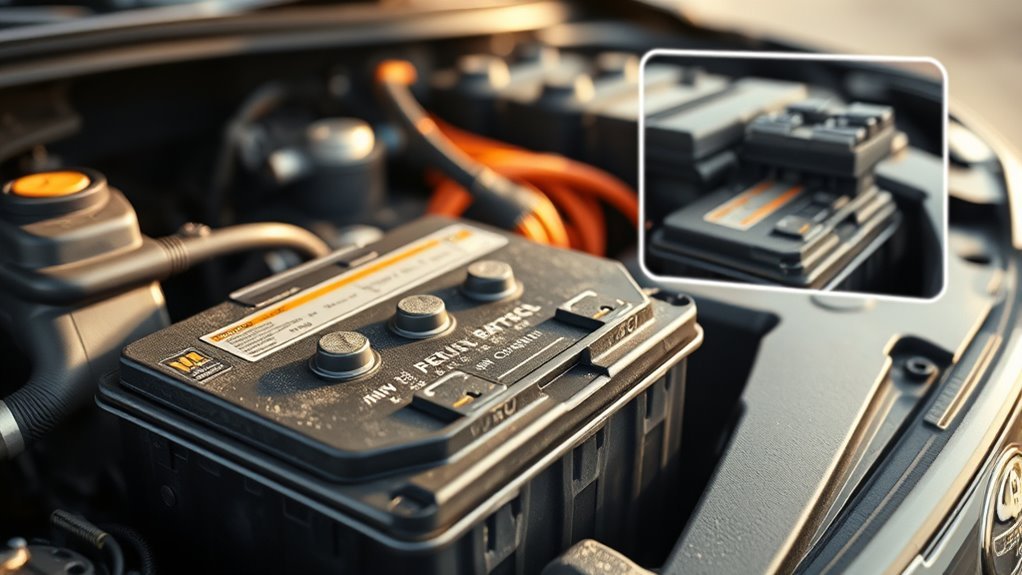
The first thing to know is that “Camry battery” can mean two different things:
| Battery | What it does | Owner service? |
|---|---|---|
| 12V auxiliary battery | Powers vehicle electronics, lights, locks, computers, and startup systems. On a gas Camry, it also supplies starting power for the engine starter. | Testing and terminal cleaning are reasonable DIY tasks. Replacement may be DIY if you use the correct battery and follow safety steps. |
| Hybrid high-voltage battery | Stores energy for the hybrid system and electric motor assist. It is separate from the 12V battery. | No. Diagnosis and service should be handled by Toyota-trained or hybrid-certified technicians. |
For gasoline-only U.S. Camrys through model year 2024, the 12V battery supports engine starting and vehicle electronics. Toyota made the 2025 U.S. Camry exclusively hybrid. Those cars still use a 12V auxiliary battery for low-voltage electronics and system startup, plus a separate high-voltage battery for the hybrid drive system. Battery location and access can vary by model year, so check the owner’s manual before testing or replacement.
Note: The 12V battery and the hybrid traction battery are not interchangeable. A weak 12V battery can keep a Camry Hybrid from entering READY mode even when the high-voltage battery is healthy.
Toyota states that the original hybrid battery in U.S. Toyota hybrid vehicles from model year 2020 onward is supported by a 10-year/150,000-mile limited warranty, whichever comes first and subject to the warranty terms. That coverage period is not a predicted failure date. Toyota does not publish one universal replacement age for every Camry Hybrid battery, and warranty terms for a dealer-installed replacement battery can differ from the new-vehicle warranty.
How Long Does a Camry 12V Battery Last?
A Camry’s 12V battery usually lasts about 3 to 5 years. AAA identifies time, heat, vibration, short-trip use, and extended parking as major battery-aging factors. Mild temperatures and regular drives may help a battery reach the upper end of the range, while severe heat or chronic undercharging can cause earlier failure.
After the third year, do not wait for a no-start. A quick voltage and load test can catch a weak Camry battery before it leaves you stranded.
Typical Lifespan Range
| Use pattern | Expected 12V battery life | What to do |
|---|---|---|
| Mild climate, regular longer drives | Often 4–5 years | Test annually and before long trips. |
| Hot climate or heavy accessory use | Often closer to 3 years | Test every 6 months after year three. |
| Frequent short trips or long storage | Can fail early | Use a smart maintainer if the car sits. |
When Should You Test Before Year Three?
Battery age is only one clue. Test earlier when the Camry sits for weeks, makes mostly short trips, carries always-on accessories, has visible terminal corrosion, or starts differently than usual. One low-voltage event does not prove the battery is defective, but repeated discharge needs diagnosis.
A swollen case, leaking fluid, unusual heat, or a strong sulfur smell is not a “test it later” situation. Stop charging or jump-starting the battery and arrange safe replacement.
What Affects Camry Battery Life?
The biggest battery-life factors are time, heat, vibration, charge level, and driving pattern. Heat speeds internal battery wear. Cold reduces available power and makes the vehicle need more energy to start. Short trips prevent the charging system from restoring the battery fully. Dirty or loose terminals add resistance and can make a good battery act weak.
Pro Tip: Look for the date sticker or stamped date code on the battery. If it is more than three years old and you are seeing symptoms, test it before the next hot summer or cold snap.
Factors That Shorten Camry Battery Life
If you expose your Camry’s 12V battery to extreme heat or cold, run lots of short trips, leave the car parked for weeks, use accessories with the engine or READY mode off, or skip terminal maintenance, you can shorten battery life significantly.
Common causes include:
- Heat exposure: Under-hood temperatures can accelerate internal corrosion and fluid loss in lead-acid batteries.
- Cold starts: Cold weather lowers battery output at the same time the vehicle needs more starting power.
- Short-trip driving: A 5-minute errand may not replace the energy used during startup.
- Parasitic drain: A light, module, aftermarket alarm, dashcam, or accessory can drain the battery while parked.
- Loose or corroded terminals: Bad contact can reduce available power and confuse electronic systems.
- Vibration: A loose hold-down can damage internal plates over time.
To extend battery life, keep the battery secured, clean the terminals, avoid leaving accessories on when the vehicle is off, combine short errands when possible, and use a smart battery maintainer if the Camry sits for long periods.
Signs Your Camry’s 12V Battery Is Failing
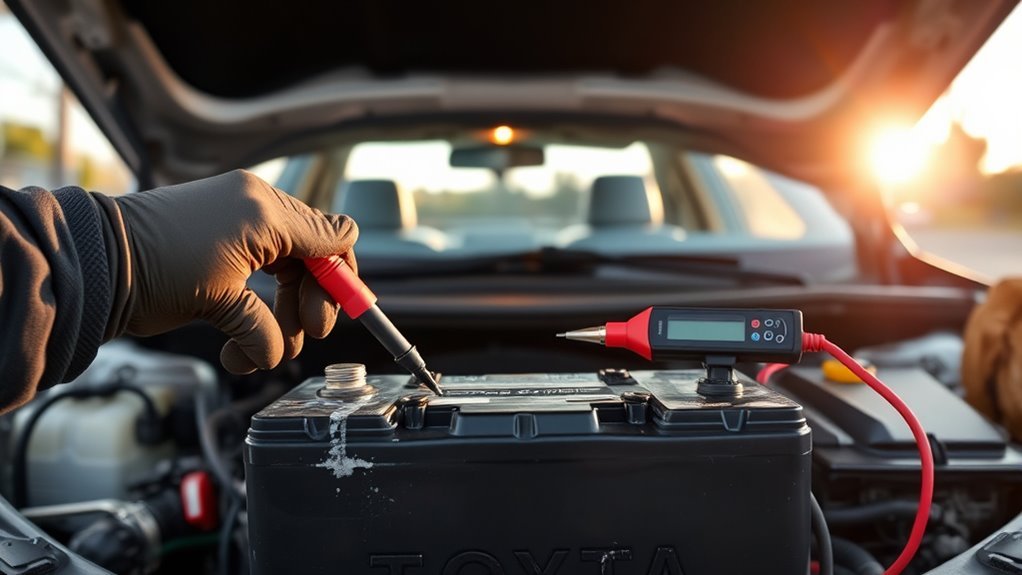
A weak 12V battery usually shows up first through electrical behavior. However, the battery is not the only possible cause. Starter problems, loose cables, alternator issues on gas models, DC-DC converter issues on hybrids, and parasitic drains can create similar symptoms. Testing helps separate a weak battery from a charging-system problem.
Slow Engine Crank
On a gasoline Camry, a weak 12V battery may make the engine crank slowly or hesitate before starting. On a Camry Hybrid, you may not hear a traditional starter crank, but a weak 12V battery can still cause no-start behavior, warning messages, or failure to enter READY mode.
Check the terminals first. If they are clean and tight, test resting voltage and then have the battery load-tested if symptoms continue.
Dimming Interior Lights
Dim cabin lights, weak headlights, or lights that fade when accessories are switched on can point to low battery capacity or poor cable contact. Dimming that happens only while driving may also involve the charging system, so do not replace the battery blindly without a basic test.
Dashboard Warning Indicators
Low 12V voltage can trigger several unrelated-looking messages because modern Camrys rely on stable power for control modules. However, a battery or charging-system warning that stays on while driving can also indicate an alternator problem on a gasoline model, a DC-DC converter or control fault on a hybrid, or a cable problem.
Do not replace the battery from a warning light alone. Test the battery and charging system. Stop driving and seek help if the warning comes with dimming lights, loss of electrical functions, overheating, smoke, or repeated stalling.
Test Your Camry’s 12V Battery at Home
Warning: Wear safety glasses and gloves when working near a lead-acid battery. Keep sparks, cigarettes, and open flames away. Do not test, charge, jump-start, or clean a frozen, leaking, swollen, or damaged battery. On Camry Hybrids, never touch orange high-voltage cables or the hybrid battery pack.
To test the 12V battery with a digital multimeter:
- Park safely, switch off the vehicle and all accessories, keep the key fob away, and let the battery rest. Waiting at least 20 minutes helps reduce surface-charge effects; wait longer after charging or a long drive when practical.
- Set the multimeter to DC volts.
- Use the battery terminals or the approved under-hood test/jump points shown in the owner’s manual. Touch the red probe to positive and the black probe to negative or an approved ground.
- Read the voltage and compare it with the table below.
- If the result is low, charge the battery with a compatible charger and retest. If voltage falls again, the battery may be failing or the vehicle may have a key-off drain.
Important: Resting voltage estimates state of charge, not full battery health. Temperature, recent charging, battery chemistry, and meter accuracy affect the reading. AGM and EFB batteries may use different manufacturer-specific thresholds.
| Resting voltage | What it usually means | Next step |
|---|---|---|
| 12.6V–12.8V | Near full charge for many rested lead-acid batteries | Do not treat voltage alone as a health pass; load-test if symptoms remain. |
| 12.4V–12.5V | Partially charged; not proof of battery failure | Charge fully, let it rest, retest, and load-test if symptoms continue. |
| 12.2V–12.3V | Low state of charge | Charge and investigate short-trip use, battery age, or key-off drain. |
| Below 12.0V | Deep discharge; damage or failure is possible | Charge only if the battery is undamaged and compatible with the charger; replace it if it fails testing. |
A voltage check is useful, but it does not tell the whole story. A battery can show 12.6V at rest and still fail under load. If the Camry struggles to start, have the battery tested for cold cranking amps (CCA) and internal resistance.
[Products Worth Considering]

The TOPDON BT100 helps you quickly check the health and charge status of 12V lead-acid batteries with clear analytical results, including state of health, state of charge, voltage, and cranking performance. It supports a wide range of battery types and vehicles, making it a practical tool for diagnosing starting and charging issues at home or in the shop. Compact and easy to use, it provides fast, reliable testing without needing to charge the device first.

The NOCO GENIUS5 is an all-in-one battery charging and maintenance solution for 6V and 12V lead-acid and lithium batteries. It features temperature compensation, dead-battery recovery, desulfation, and safe long-term maintenance to help extend battery life and performance. Compact and versatile, it works with a wide range of vehicles and comes with mounting accessories and a warranty.

The ANCEL BA101 helps diagnose 12V batteries quickly with clear readings for battery health, charge level, voltage, CCA, cranking, and charging system performance. Designed for a wide range of vehicles and battery types, it offers easy-to-read results, reliable clamp connections, and built-in protection to make testing safer and more convenient.
Interpreting Battery Test Results and Next Steps
Most battery testers report voltage, CCA, state of charge, and sometimes state of health. Use those numbers to choose the next step:
- Voltage is low but the battery passes load testing: Recharge it and look for short-trip use, accessory drain, or a charging issue.
- CCA is far below the battery label rating: Replace the battery before hot or cold weather makes the problem worse.
- Voltage drops sharply during load testing: The battery is weak even if it looked okay at rest.
- Battery passes but symptoms continue: Inspect cables, grounds, starter, alternator on gas models, or the DC-DC charging system on hybrids.
- Battery is swollen, leaking, or smells like sulfur: Do not keep testing it at home. Replace it safely.
Note: If your Camry Hybrid has a weak 12V battery, the high-voltage battery may still be fine. Start diagnosis with the 12V battery before assuming the hybrid traction battery has failed.
Camry Battery Upgrade Options: Flooded, EFB, AGM, and High-CCA
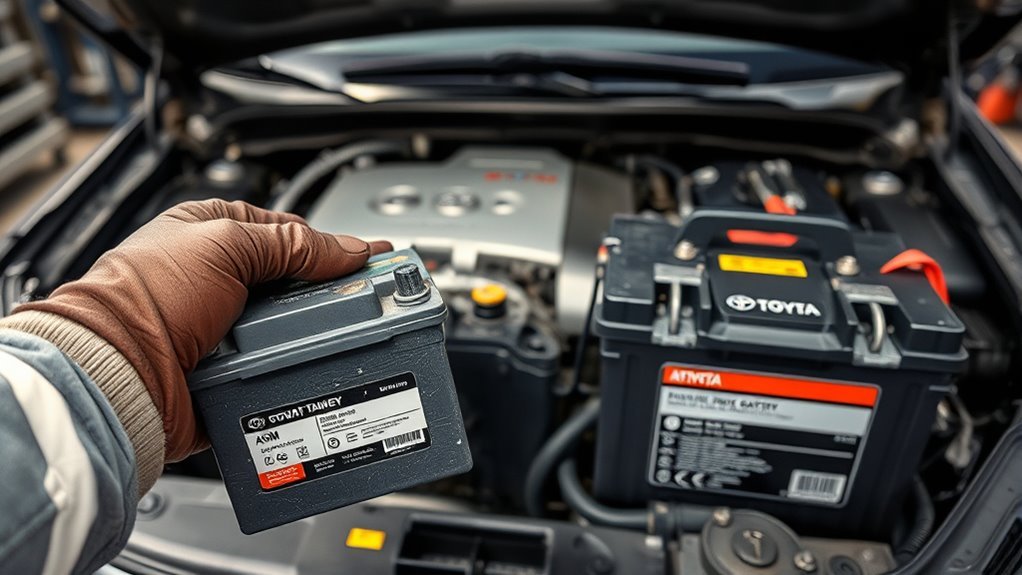
When choosing a replacement, match the battery to your exact Camry rather than guessing by size or assuming every model year uses the same location and chemistry. Confirm fitment by VIN, the owner’s manual, or Toyota’s parts lookup.
| Battery type | Best for | Watch out for |
|---|---|---|
| Flooded lead-acid | Many older Camrys and budget replacements | Can be more sensitive to deep discharge and vibration. |
| EFB | Vehicles that need improved cycling over standard flooded batteries | Must match the vehicle’s charging system and fitment. |
| AGM | Higher accessory loads, vibration resistance, and some newer applications | Do not install AGM just because it is “better.” It must be compatible with your Camry’s charging strategy. |
| High-CCA battery | Cold climates and owners who want more cold-start margin | Meet or exceed OEM CCA, but do not sacrifice physical fit, terminal layout, or hold-down security. |
[Products Worth Considering]

This smart automatic battery charger and maintainer helps keep automotive batteries charged and ready by delivering a full charge before switching to float mode for long-term maintenance. It supports 6V and 12V batteries with broad compatibility for lead-acid, AGM, gel, and lithium types, while built-in safety features like reverse polarity detection and spark-proof connection help ensure reliable use. Compact construction, included connection cables, and indicator lights make it a convenient choice for cars, SUVs, trucks, and storage maintenance.

Battery Tender Plus is a smart 12V charger and maintainer designed to keep automotive, motorcycle, and powersports batteries in optimal condition. Its adaptive 4-step charging program helps extend battery life while the quick disconnect harness and included cables make setup simple and convenient. The two-color LED status indicator provides clear charging feedback for easy, worry-free maintenance.

The MOTOPOWER MP00205A is an automatic battery charger, maintainer, trickle charger, and desulfator designed for 12V lead-acid batteries, including flooded, AGM, gel, and sealed maintenance-free types. It uses pulse current technology to help reduce sulfation, optimize battery performance, and support long-term battery health without manual intervention. Built with energy-saving standby operation and multiple safety protections, it is a simple plug-in solution for reliable charging and maintenance.
Battery Fitment Checklist
Before buying a Camry battery, confirm:
- BCI group size or Toyota part fitment for your year and trim.
- Terminal orientation so cables reach without stretching.
- Hold-down compatibility so the battery cannot move.
- CCA rating that meets or exceeds the original requirement.
- Reserve capacity appropriate for accessories and climate.
- Venting needs, especially if the battery is mounted outside the engine bay.
- Battery location and access, including any trim panels, vent tube, temperature sensor, or cable-routing requirements shown for your vehicle.
- Battery chemistry that matches the charging system.
Toyota’s official parts listings show applicable Toyota TrueStart service batteries with an 84-month limited warranty, including 24 months of free exchange followed by prorated battery-only coverage under the stated terms. Fitment and dealer price vary, so confirm the correct part by VIN before purchase.
Camry Battery Replacement Cost, Labor, and Warranty
Camry 12V battery pricing changes by model year, group size, chemistry, brand, retailer, region, core charge, installation, and diagnostic needs. A useful quote should state whether it includes the battery, core charge, terminal service, installation, testing, taxes, and any memory-reset work. Use your VIN when requesting a current price so you do not compare batteries that fit different Camry generations.
Do not confuse a 12V battery quote with a hybrid high-voltage battery quote. The traction battery is a different component that requires hybrid-system diagnosis. Toyota’s new-vehicle hybrid battery warranty and the warranty on a later replacement part may also use different terms.
| Item | Typical guidance |
|---|---|
| Standard flooded 12V battery | Request a current VIN-specific quote and confirm the included warranty, core charge, and installation. |
| EFB or AGM 12V battery | Usually positioned above a basic flooded battery. Buy only when the chemistry and fitment match the vehicle. |
| Labor and terminal service | May be included with purchase or billed separately when access, corrosion cleanup, testing, or reset procedures add work. |
| Electrical diagnosis | May add cost when the battery dies overnight, the charging warning stays on, or a new battery also goes flat. |
| Toyota TrueStart service-battery warranty | Toyota states TrueStart batteries are free exchange for 24 months, then prorated battery-only coverage applies up to 84 months when the terms are met. |
| Original Toyota hybrid battery warranty | For U.S. Toyota hybrids from model year 2020 onward, Toyota lists 10-year/150,000-mile limited coverage, whichever comes first and subject to the warranty terms. |
Keep your receipt, installation paperwork, and battery test results. Warranty decisions often depend on the purchase date, battery type, proof of purchase, and whether the battery failed due to defect rather than misuse, deep discharge, incorrect installation, or vehicle electrical problems.
[Products Worth Considering]

The NOCO GENIUS10 is an all-in-one smart charger, maintainer, trickle charger, and desulfator designed to keep 6V and 12V batteries performing at their best. It supports lead-acid and lithium batteries, charges deeply discharged batteries, and uses temperature compensation for safer, more accurate charging in changing conditions. Compact and versatile, it is ideal for a wide range of vehicles and long-term battery maintenance.

This fully automatic 5 amp, 12 volt battery charger and maintainer delivers a complete charge and then switches to float mode to keep batteries ready without overcharging. Designed for lead acid, AGM, gel, and lithium applications, it includes smart safety features like reverse polarity detection, spark-proof connection, and adaptive charging for dependable everyday use. With compact construction and long cord reach, it’s a convenient solution for keeping cars, SUVs, trucks, and other vehicles powered up.

This automatic 12V charger and maintainer delivers a full charge before switching to float mode to help keep powersports batteries ready for storage and regular use. Its four-step charging program is designed for lead-acid, flooded, AGM, and gel cell batteries, helping prevent overcharging while supporting longer battery life. Compact and easy to use, it includes both ring terminal and alligator clip connections plus smart safety features for dependable charging.
How to Replace a Camry 12V Battery Safely
If the battery is easy to access and you are comfortable with basic tools, replacing a Camry 12V battery can be a DIY job. First check the owner’s manual for the exact battery location, venting, cable-routing, and reset instructions. Use a shop if the battery is hard to access, damaged, leaking, swollen, hot, or connected to unfamiliar sensors or wiring.
- Confirm the replacement by VIN, including group size, chemistry, terminal layout, CCA or Ah requirement, hold-down, and any vent-tube connection.
- Turn the vehicle off, move the key fob away from the cabin, switch off accessories, and keep doors closed when practical.
- Put on safety glasses and gloves.
- Take a photo of the battery, cable positions, sensors, venting, and hold-down before removing anything.
- Disconnect the negative cable first, then the positive cable.
- Remove the hold-down and lift the battery straight up. Batteries are heavy, so use proper lifting form.
- Clean the tray and terminal clamps if needed. Replace damaged cables or clamps rather than forcing them onto the new battery.
- Install the correct battery, reconnect any required vent tube or sensor, and secure the hold-down.
- Connect the positive cable first, then the negative cable.
- Start the gasoline model or put a hybrid into READY mode. Check for warning lights and confirm normal operation.
- Reset the clock, window auto-up/down, radio presets, or other memory items if the owner’s manual requires it.
Warning: On a hybrid Camry, this section applies only to the 12V battery. Do not open or service the high-voltage battery case, orange cables, inverter, or hybrid system components.
When to Visit a Dealer or Certified Shop for Service
Visit a dealer or certified shop if your Camry has repeated no-starts, multiple warning lights, a battery that dies overnight, a battery that tests good but symptoms continue, or any hybrid-system warning. A professional can test the battery, inspect cable voltage drop, check charging output, scan diagnostic codes, and identify parasitic draw.
Use a dealer or hybrid-certified shop immediately if the concern involves the high-voltage battery, orange cables, inverter, DC-DC converter, or hybrid READY mode problems that do not resolve after the 12V battery tests good.
Bring the battery age, test results, and service history with you. That helps the technician separate a simple weak battery from a charging, cable, starter, module, or drain issue.
Frequently Asked Questions
How long does a Toyota Camry 12V battery last?
Most Toyota Camry 12V batteries last about 3 to 5 years. Severe heat, repeated short trips, long parking periods, vibration, corrosion, and electrical drain can shorten that range. Test annually after year three and sooner when symptoms appear.
How long does a Toyota Camry Hybrid traction battery last?
Toyota does not publish one universal replacement age for every Camry Hybrid traction battery. For U.S. Toyota hybrids from model year 2020 onward, the original hybrid battery is covered for 10 years or 150,000 miles, whichever comes first and subject to the warranty terms. Warranty length is not the same as predicted service life.
Does a 12.4V reading mean my Camry battery is bad?
No. A rested reading around 12.4V usually indicates partial charge, not automatic battery failure. Charge the battery with a compatible charger, let it rest, retest it, and use a load or conductance test if starting problems continue.
What does the battery warning light mean on a Toyota Camry?
A battery or charging-system warning while driving can point to a charging fault, cable problem, alternator issue on a gasoline Camry, or a DC-DC converter or control issue on a hybrid. Test the charging system instead of assuming the 12V battery alone needs replacement.
How do I know if a Camry 12V battery needs replacement?
Replace or professionally test the battery if you notice slow starting, failure to enter READY mode, repeated jump-starts, swelling, leaking, unusual heat, a sulfur smell, or voltage that falls again after a full charge. A load or conductance test is more useful than resting voltage alone.
How long is the Toyota TrueStart 12V battery warranty?
Toyota states that TrueStart service batteries are covered by free exchange for 24 months from purchase, regardless of mileage, followed by prorated battery-only coverage up to 84 months when the warranty terms apply. True-2 batteries use different terms.
Can I replace a Camry 12V battery myself?
Yes, when the battery is easy to access, undamaged, and you can follow the exact model-year instructions. Disconnect negative first, then positive; reconnect positive first, then negative. Match the fitment, venting, and chemistry. Never attempt high-voltage hybrid battery work yourself.
Is an AGM battery worth it for a Toyota Camry?
AGM can make sense when your Camry’s factory specification or approved fitment supports it, especially for cycling and vibration resistance. It is not an automatic upgrade for every Camry. Match the chemistry, physical size, terminal layout, venting, and electrical requirements to your exact vehicle.
How much does a Toyota Camry 12V battery replacement cost?
The total varies by model year, group size, chemistry, retailer, region, core charge, installation, and diagnosis. Request a current VIN-specific quote that shows the battery, warranty, core charge, installation, testing, taxes, and any terminal or reset work.
Conclusion
Treat 3 to 5 years as the normal planning window for a Camry 12V battery, not a guaranteed replacement date. Test annually after year three, diagnose repeated discharge instead of repeatedly jump-starting, and use a load or conductance test when voltage alone is inconclusive. Buy by VIN-confirmed fitment, not price or CCA alone. Leave orange-cable and high-voltage hybrid battery work to trained technicians.
Sources
- Toyota Owners Manuals and Warranties — current Camry warranty/manual reference and Toyota hybrid warranty details
- Toyota Electrified Vehicles Battery Warranty — Toyota hybrid battery warranty coverage
- Toyota TrueStart 24F EFB Battery — Toyota 12V battery warranty and fitment reference
- Toyota USA Newsroom: Next-Generation Camry — 2025 Camry hybrid-only model-year context
- AAA: How Long Do Car Batteries Last? — typical 3–5 year battery life and factors that affect battery aging
- OSHA Battery Charging and Changing — battery charging, ignition-source, and jump-start grounding safety guidance