
Last updated: August 30, 2026 — 2026 Tacoma trim drivetrain availability, shift-on-the-fly parameters, driveline binding mechanics, sources, and schema reviewed.
The primary difference between 2026 Toyota Tacoma four-wheel-drive systems is how power is distributed to the front axle. Part-time 4WD operates in rear-wheel drive (2H) on dry pavement and mechanically locks front and rear driveshafts together in 4H or 4L for loose surfaces. Full-time 4WD uses an open center differential (H4F) to safely distribute power to all four wheels on any surface, including dry pavement.
Quick Answer
Choose part-time 4WD if you want traditional manual control (2H for pavement, 4H/4L for dirt, snow, or trails). Choose full-time 4WD if you want set-and-forget traction across rain, slush, patchy snow, and dry roads. For 2026, Toyota equips the Limited trim (with i-FORCE MAX) with full-time 4WD; all other 4×4 grades (including TRD Off-Road, Trailhunter, and TRD Pro) use part-time 4WD.
Which 2026 Tacoma Has Full-Time 4WD?
Toyota’s 2026 Tacoma release structures the lineup across rear-wheel drive (2WD), selectable part-time 4WD, and full-time 4WD. For the U.S. market, Toyota equips the Tacoma Limited (paired with the i-FORCE MAX hybrid powertrain) with full-time 4WD featuring an electronic locking center differential.
Dedicated off-road and adventure grades—including the TRD Off-Road, TRD Pro, and Trailhunter—retain a traditional selectable part-time 4WD transfer case paired with an electronic locking rear differential. Because specific packages and drivetrain offerings can vary by market, verify the cabin selector knob and your window sticker before purchase.
| Tacoma System | Normal Road Mode | Low-Traction Modes | Best Fit |
|---|---|---|---|
| Part-time 4WD | 2H (Rear-Wheel Drive) | 4H and 4L | Daily commuters, off-roaders, and overlanders wanting selectable 4WD for snow, job sites, mud, and trails (SR, SR5, TRD PreRunner [2WD], TRD Sport, TRD Off-Road, TRD Pro, Trailhunter) |
| Full-time 4WD | H4F (Center Diff Open) | H4L and L4L (Center Diff Locked) | Drivers seeking automatic all-weather road stability across rain, slush, patchy ice, gravel, and changing pavement (Limited grade) |
Key Takeaways
- Part-time 4WD must only be engaged on surfaces that allow tire slip (such as loose Tacoma trails, snow, ice, mud, sand, or wet gravel). Operating 4H on dry pavement causes severe driveline binding.
- Full-time 4WD operates continuously on dry pavement in H4F because the integrated planetary center differential accommodates wheel speed differences in turns.
- Center diff locks (H4L and L4L on full-time models) mechanically lock front and rear axle speeds together and must be reserved strictly for low-traction off-pavement conditions.
- Shift-on-the-fly: Part-time 4WD allows shifting from 2H to 4H at speeds up to 62 mph (100 km/h) in a straight line; shifting into 4L or L4L requires coming to a complete stop in Neutral (N).
- Braking vs. Traction: 4WD improves acceleration and climbing grip, but does not decrease vehicle stopping distance on ice or snow.
[Products Worth Considering]

This multi-function valve stem removal kit streamlines tire maintenance with single-head and double-head tools for quick valve core removal, installation, and cleaning. Built with corrosion-resistant materials and tested valve cores, it offers dependable performance for cars, trucks, motorcycles, bicycles, and more. The compact set includes multiple cores and caps, making it a practical solution for repairs at home or on the go.
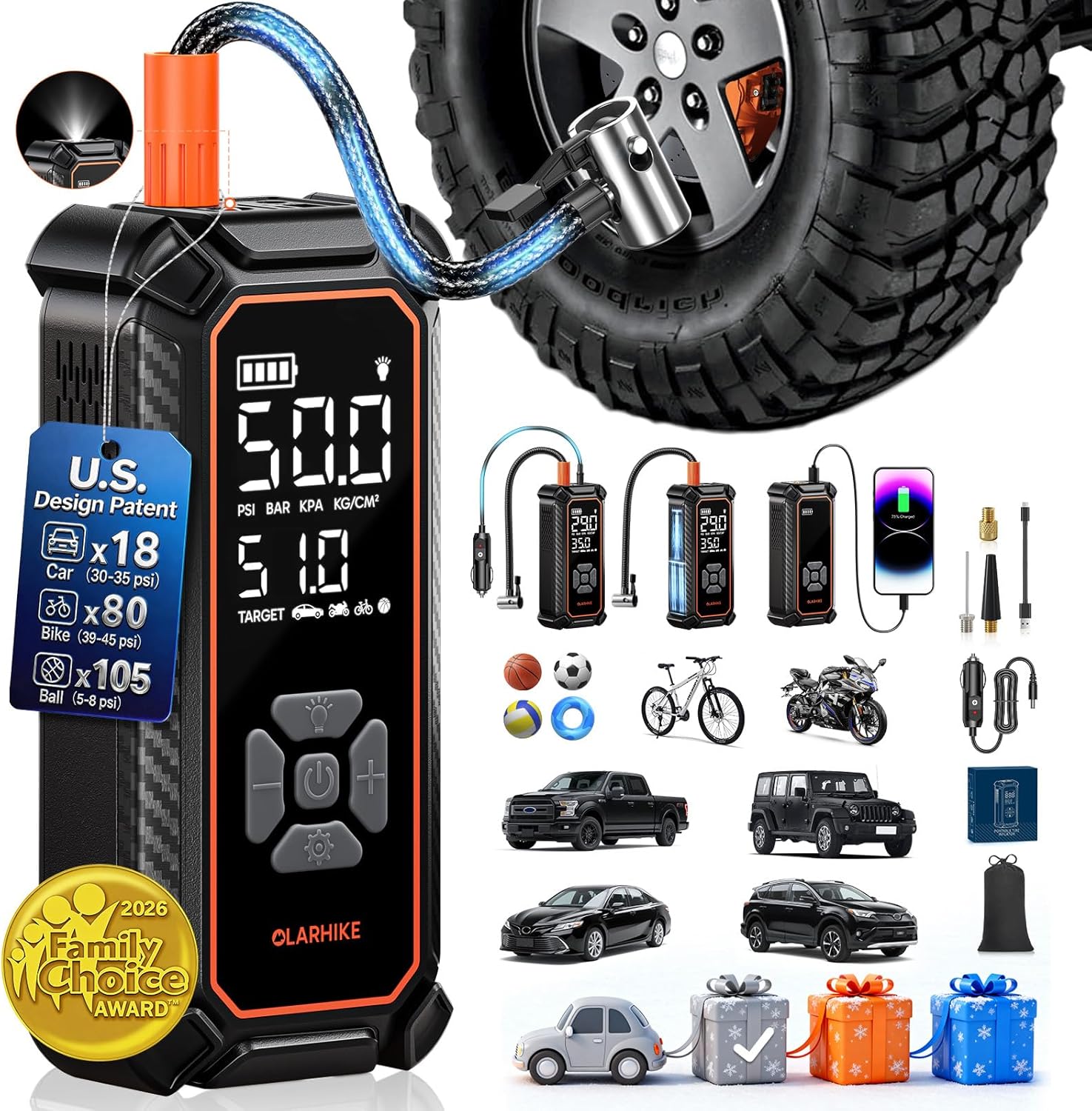
The OlarHike tire inflator delivers fast, reliable inflation for car, SUV, motorcycle, bicycle, and sports equipment needs, making it a practical tool for travel and roadside emergencies. Its dual power design lets you use either the built-in rechargeable battery or a 12V car outlet, while the auto shut-off function helps prevent over-inflation for safer, easier use. A bright display, preset modes, LED flashlight, and included accessories add convenience whether you're at home or on the road.

TOVASTY rear brake pads are designed for a wide range of Toyota and Lexus models, delivering dependable braking performance with a carbon ceramic formula. They help reduce brake dust, promote quieter operation, and support consistent stopping power with improved heat resistance for everyday driving confidence.
How Does Full-Time 4WD Work on a Tacoma?
Toyota’s full-time 4WD system delivers continuous drive torque to both front and rear axles. It incorporates a center differential (a Torsen-style or planetary gear assembly) positioned between the front and rear driveshafts. This center differential allows the front and rear axles to rotate at different speeds when cornering on high-traction pavement, preventing mechanical binding and tire scuffing.
In standard driving conditions, the full-time system remains in H4F (High 4 Full-Time). When extra traction is required off-road or in deep snow, the driver can engage the electronic center differential lock, converting the system into H4L (High 4 Locked) or L4L (Low 4 Locked), which forces a 50/50 front-to-rear torque split.
Note: “Full-time” refers solely to the default H4F mode. Engaging H4L or L4L locks the center differential, creating the same mechanical coupling as a part-time 4WD system. Always disengage center lock before returning to dry pavement.
What Do H4F, H4L, and L4L Mean?
| Mode | Mechanical Status | Shift Execution & Speed Limit | Best Use |
|---|---|---|---|
| H4F | High-range full-time 4WD (Center Diff Open) | Default operational mode; active at all speeds | Dry highways, daily commuting, rain, wet pavement, and patchy winter roads |
| H4L | High-range 4WD (Center Diff Electronically Locked) | Shift on the fly below 62 mph (100 km/h) while driving straight | Deep snow, packed ice, loose gravel roads, sand, and dirt trails |
| L4L | Low-range 4WD (Center Diff Locked + Gear Reduction) | Stop completely, shift transmission to Neutral (N), then engage switch | Steep rocky climbs, steep descents, deep mud, soft sand, and technical crawling |
How Does Part-Time 4WD Work on a Tacoma?
Part-time 4WD is the traditional, mechanically robust truck system found on most Tacoma models. During normal daily driving, the transfer case disconnects the front driveshaft completely, running 100% of engine power to the rear wheels in 2H. This eliminates front driveline drag during everyday highway use.
When entering slippery or unpaved terrain, the driver shifts into 4H or 4L. An electronic transfer case actuator engages the front driveshaft, locking the front and rear outputs together at a fixed 50/50 speed ratio. Because there is no center differential between the axles, both driveshafts are forced to turn at identical speeds.
Warning: Never use 4H or 4L on dry, high-traction pavement. When turning, your front wheels trace a wider arc than the rear wheels. Without a center differential to absorb this rotational variance, driveline binding occurs, causing severe stress to the transfer case, CV joints, and front differential gears.
[Products Worth Considering]

VEHICLE FITMENT: Compatible with select 2012-2020 Toyota 4Runner, 2005-2017 Toyota Tacoma and 2000-2006 Toyota Tundra 4WD models. Use as a Tacoma transfer case actuator or Tundra transfer case actuator only when the OE number, connector layout, housing shape and transfer case configuration match the original part.

Vehicle Fitment: Transfer Case Shift Motor Actuator compatible with Toyota Tacoma 2002 2.4L L4/2.7L L4/3.4L V6, 2005‑2010 2.7L L4, 2011‑2015 2.7L L4/4.0L V6, 2016 3.5L V6 (built before 08/2015); For Toyota 4Runner 2004‑2009 4.0L V6, 2014‑2019 4.0L V6; For Toyota Tundra 2000‑2001, 2003‑2006 4.7L V8. NOTE: Only fits 4‑Wheel Drive vehicles,NOT compatible with RWD/2‑Wheel Drive models. TIPS: Please check Amazon Confirmed Fit tool and original part number before ordering to avoid mismatch

Engineered for original equipment and replacement applications. Designed and manufactured to operate reliably under all conditions. Easy and quick installation. Please enter your vehicle in your Amazon Confirmed Fit above to see if this part is compatible with your vehicle
What Do 2H, 4H, and 4L Mean?
| Mode | Mechanical Status | Shift Execution & Speed Limit | Best Use |
|---|---|---|---|
| 2H | High-range rear-wheel drive (Front Axle Disengaged) | Standard road mode; engage anytime | Dry pavement, highway cruising, dry city commuting, and towing on dry roads |
| 4H | High-range 4WD (Front/Rear Driveshafts Coupled 50/50) | Shift on the fly below 62 mph (100 km/h) in a straight line with foot off throttle | Continuous snow, ice-covered roads, unpaved gravel, wet dirt, and loose forest roads |
| 4L | Low-range 4WD (50/50 Split with ~2.57:1 Gear Reduction) | Stop vehicle, depress brake, shift transmission to Neutral (N), turn dial | Rock crawling, technical trails, pulling heavy loads out of mud or sand, steep off-road grades |
Tacoma Part-Time vs Full-Time 4WD: Which Is Better?
Neither drivetrain is universally superior; each solves different operating demands. Part-time 4WD maximizes traditional off-road durability, simplicity, and zero-drag 2WD cruising. Full-time 4WD delivers unmatched driver convenience and stability on paved roads subject to sudden weather shifts.
| Driving Condition | Part-Time 4WD (2H / 4H / 4L) | Full-Time 4WD (H4F / H4L / L4L) |
|---|---|---|
| Dry Pavement Cruising | Run in 2H (Front axle disconnected) | Run in H4F (Open center diff active) |
| Heavy Rain & Standing Water | Remain in 2H (Wet asphalt often maintains too much grip for 4H) | Remain in H4F (All four wheels distribute traction safely) |
| Patchy Winter Roads (Dry / Slush / Ice) | Requires frequent manual shifting between 2H and 4H to prevent binding | Leave in H4F continuously without driver intervention |
| Consistent Deep Snow or Sand | Engage 4H or 4L | Engage H4L or L4L (Center diff locked) |
| Technical Rock Crawling | Engage 4L; pair with rear locker if equipped | Engage L4L; rely on center lock and electronic traction aids |
| Driver Workload | High (Driver must evaluate surface traction before shifting) | Low (H4F manages all pavement conditions seamlessly) |
[Products Worth Considering]

FITMENT: Only compatible with Tacoma 2016 2017 2018 2019 2020 2021 2022 2023. It doesn't suitable for other vehicles.

Dual led backlit on-off push button switch, it comes with the wiring connector, convenient for you to install.

How Can You Identify the System From the Selector?
The cabin drive selector dial provides immediate confirmation. Part-time Tacoma models feature a rotary switch or toggle labeled 2H, 4H, and 4L. Full-time Tacoma models feature a selector labeled H4F, H4L, and L4L, often accompanied by a dedicated push-button center differential lock icon.
Which System Fits Your Driving?
- Choose part-time 4WD if you live in moderate climates, use your truck for dry-weather commuting or highway towing, and specifically want an off-road model (like TRD Off-Road, Trailhunter, or TRD Pro) with an electronic locking rear axle.
- Choose full-time 4WD if you live in regions with severe winter freezes, drive across mountain passes with alternating dry and icy patches, or want the luxury-oriented ride of the Tacoma Limited without worrying about drivetrain binding.
- For Towing Applications: Drivetrain configuration does not dictate maximum tow capacity. Always check the specific payload and towing rating on your driver door jamb sticker. Full-time 4WD simplifies launching boats on slick, wet concrete ramps.
When Should You Use Part-Time 4WD?
Engage part-time 4WD only when driving surfaces provide sufficient tire slippage to relieve internal drivetrain tension. Rain alone on paved asphalt is generally not slick enough to justify 4H; refer to our guide on using Tacoma 4WD in rain for exact grip criteria.
- Continuous Snow and Ice: Engage 4H when roads are fully packed with snow or ice. If bare dry asphalt patches appear continuously, return to 2H.
- Mud and Wet Dirt: Use 4H to maintain forward momentum and prevent rear-wheel spin. Refer to our Tacoma mud-driving guide for throttle modulation techniques.
- Deep Beach Sand: Air down tires and engage 4H (or 4L in deep dunes) to distribute engine torque across all four tires.
- Steep Off-Road Inclines & Declines: Stop the vehicle, shift into Neutral, and select 4L. Low-range gear reduction increases hill-climbing torque and maximizes downhill engine compression braking. Follow the steps in our Tacoma 4LO guide.
Pro Tip: Shift into 4H *before* entering an obstacle or steep snowy hill. Activating 4WD while the rear tires are actively spinning under heavy throttle can shock-load the transfer case splines and cause mechanical damage.
Why Is Full-Time 4WD Easier for Daily Driving?
Full-time 4WD eliminates the guesswork of evaluating surface grip. In modern variable winter weather, roads frequently alternate between wet pavement, slushy ruts, and dry overpasses within a few miles. In a part-time truck, leaving 4H engaged across dry sections causes driveline strain, while staying in 2H risks sudden loss of traction on ice.
The full-time system’s H4F mode resolves this dilemma. The open center differential dynamically sends torque to both axles while allowing total cornering freedom, providing seamless stability without driver intervention.
| Feature | Full-Time 4WD Driver Benefit |
|---|---|
| Unpredictable Weather | No need to switch modes when moving between dry asphalt and icy highway patches |
| Wet Pavement Handling | All-wheel traction reduces rear-wheel slip when accelerating from wet intersections |
| Off-Road Capability | Locking the center differential (H4L/L4L) provides the exact same 50/50 rigid pulling power as a part-time 4×4 |
| Driveline Protection | Prevents accidental driver-induced driveline binding on high-grip surfaces |
Does Full-Time 4WD Use More Fuel?
In theory, running in 2H on a part-time truck creates marginally less rotational friction than spinning a continuous all-wheel driveline in H4F. However, real-world Tacoma fuel economy depends far more heavily on powertrain selection, vehicle curb weight, tire rolling resistance, and aerodynamics than the 4WD system alone.
Toyota rates the standard 2026 i-FORCE 2.4L turbo engine at up to 26 mpg highway, while the higher-output i-FORCE MAX hybrid powertrain achieves up to an EPA-estimated 23 mpg combined. Because full-time 4WD is restricted to the heavily equipped Limited i-FORCE MAX grade, any minor variance in mileage is predominantly driven by vehicle weight, tire dimensions, and hybrid battery equipment rather than transfer case mechanics.
Does Either 4WD System Increase Towing Capacity?
No. 4WD configuration does not elevate maximum gross vehicle weight (GVWR) or towing capacity. Safe towing limits are determined by frame construction, cooling capacity, suspension tuning, axle gearing, and curb weight. Always consult the tire and loading certification label located on the driver-side door jamb.
How Do You Maintain a Tacoma 4WD System?
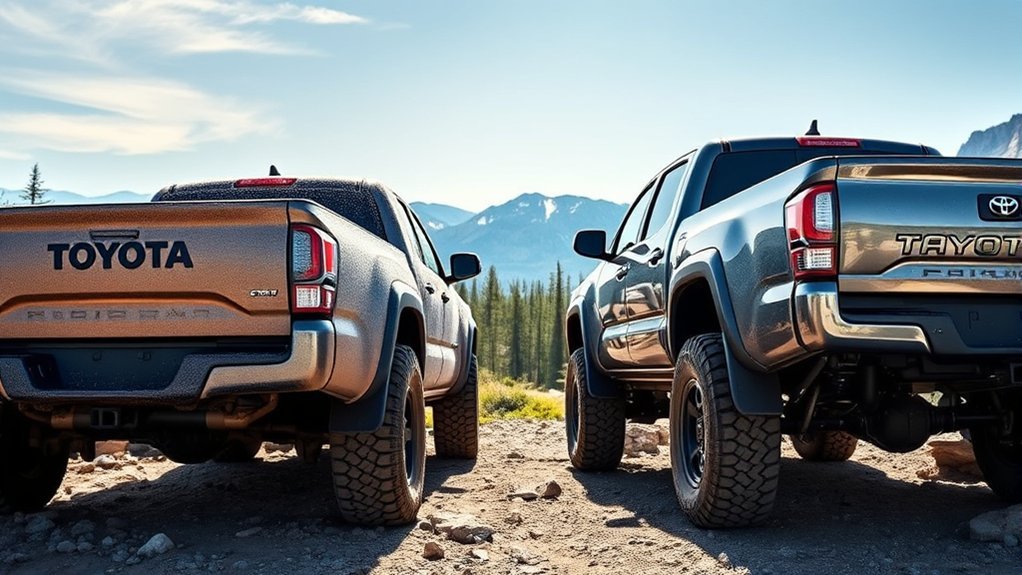
Maintaining both part-time and full-time Tacoma systems ensures long-term actuator reliability and prevents gear wear. Follow the official 2026 Toyota Tacoma Scheduled Maintenance Guide, adjusting intervals for severe operating duty.
- Exercise the 4WD Actuators Monthly: On part-time models, Toyota recommends driving at least 10 miles (16 km) per month in 4WD on a suitable slippery surface or straight unpaved road. This circulates gear lubricant and prevents the electric transfer case actuator from seizing.
- Service Transfer Case and Differential Oils: Inspect front differential, rear differential, and transfer case fluids every 15,000–30,000 miles. Replace fluids sooner if regularly towing, driving through deep dust, or off-roading.
- Maintain Identical Tire Circumference: Mismatched tire tread depths or incorrect pressures force differentials to work continuously, generating excess heat. Always rotate all four tires every 5,000 miles.
- Inspect Breathers After Water Forging: If differential or transfer case housings are submerged during water crossings, inspect fluid for milky emulsification immediately.
How Do Center and Rear Lockers Affect Tacoma Traction?
Understanding differential locks prevents confusion when configuring drive modes. The center differential and rear differential control rotational speed differences on completely separate axes:
- Electronic Center Differential Lock (Full-Time Models): Locks the front driveshaft to the rear driveshaft, forcing a 50/50 front-to-rear torque split (H4L / L4L).
- Electronic Rear Differential Lock (TRD Off-Road, Pro, Trailhunter): Mechanically locks the left and right rear axle shafts together. Even if one rear wheel is suspended in mid-air, the opposing wheel receives 100% of available rear drive torque.
- Active Traction Control (A-TRAC): Uses rapid ABS brake pulsing to clamp spinning wheels and redirect torque across open differentials. See our guide on how Tacoma A-TRAC works for detailed off-road modulation tips.
Common Mistakes to Avoid With Tacoma 4WD
- Engaging Part-Time 4H on Dry Pavement: Causes severe driveline binding, tire hopping, and excessive transfer case chain stretch.
- Shifting into 4L While in Gear: Shifting into 4L or L4L while moving or while the transmission is in Drive (`D`) causes actuator grinding and error warnings. Always come to a complete stop and shift into Neutral (`N`).
- Exceeding 62 mph (100 km/h) When Shifting to 4H: Shift-on-the-fly engagement must occur below 62 mph in a straight line with the accelerator pedal momentarily released.
- Assuming 4WD Improves Ice Braking: 4WD only aids acceleration and directional control under power; stopping distances remain entirely dependent on tire grip and vehicle weight.
- Forgetting to Disengage Diff Locks: Always disengage the rear locker and center differential lock before returning to packed, high-traction roads.
Frequently Asked Questions
Which 2026 Tacoma has full-time 4WD?
In the U.S. market, Toyota equips the 2026 Tacoma Limited grade (with the i-FORCE MAX hybrid powertrain) with full-time 4WD and an electronic locking center differential. Trims like SR5, TRD Sport, TRD Off-Road, TRD Pro, and Trailhunter use selectable part-time 4WD.
Can you drive a part-time 4WD Tacoma in 4H on dry pavement?
No. Driving a part-time Tacoma in 4H on dry pavement forces the front and rear axles to rotate at the same speed. During turns, this creates driveline binding, severe tire scrub, and potential mechanical failure in the transfer case and front differential.
What is the speed limit for shifting into 4H on a Tacoma?
Toyota allows shifting between 2H and 4H on the fly at speeds up to 62 mph (100 km/h). Ensure the wheels are pointed straight ahead and release the accelerator pedal momentarily while turning the dial.
How do I shift a Tacoma into 4L (Low Range)?
To engage 4L or L4L: bring the truck to a complete stop, press and hold the brake pedal, shift the automatic transmission into Neutral (N), and turn the drive mode dial to 4L. Wait for the 4LO dashboard indicator to stop flashing and illuminate steadily before shifting back into Drive.
Is Tacoma full-time 4WD the same as All-Wheel Drive (AWD)?
While both drive all four wheels on pavement, truck full-time 4WD includes a true two-speed transfer case with a dedicated low-range reduction gear (L4L) and an electronic locking center differential for heavy-duty off-road traction, features absent on most car-based AWD systems.
Which Tacoma 4WD system is better for winter snow?
Full-time 4WD (H4F) is superior for mixed winter driving because it seamlessly transitions between dry asphalt, slush, and icy patches without driver switching. Part-time 4WD is equally capable in deep continuous snow once 4H is manually engaged.
Conclusion
Part-time 4WD is the rugged, traditional choice for drivers who want 2H efficiency on dry highways and dedicated 4H/4L traction for off-road trails and deep snow. Full-time 4WD provides effortless, year-round security on mixed pavement by utilizing an open center differential in H4F mode.
When shopping the 2026 Tacoma lineup, remember that full-time 4WD is exclusive to the Limited trim, while enthusiast grades like TRD Off-Road, Trailhunter, and TRD Pro maximize trail traction through selectable part-time 4WD and rear differential lockers. Always follow proper shift speeds and exercise your transfer case actuators monthly to ensure peak mechanical reliability.
Sources
- Toyota USA Newsroom: 2026 Toyota Tacoma — Official drivetrain lineup specifications, Limited grade full-time 4WD, and fuel economy estimates.
- Toyota Owners: 2026 Tacoma Manuals and Warranties — Official owner’s manuals, shift execution protocols, and maintenance schedules.
- Toyota Owners: Tacoma Hybrid Part-Time 4WD System — Operational parameters for 2H, 4H, and 4L transfer case modes.
- Toyota Owners: Tacoma Hybrid Full-Time 4WD System — Technical operating instructions for H4F, H4L, L4L, and center differential locking.

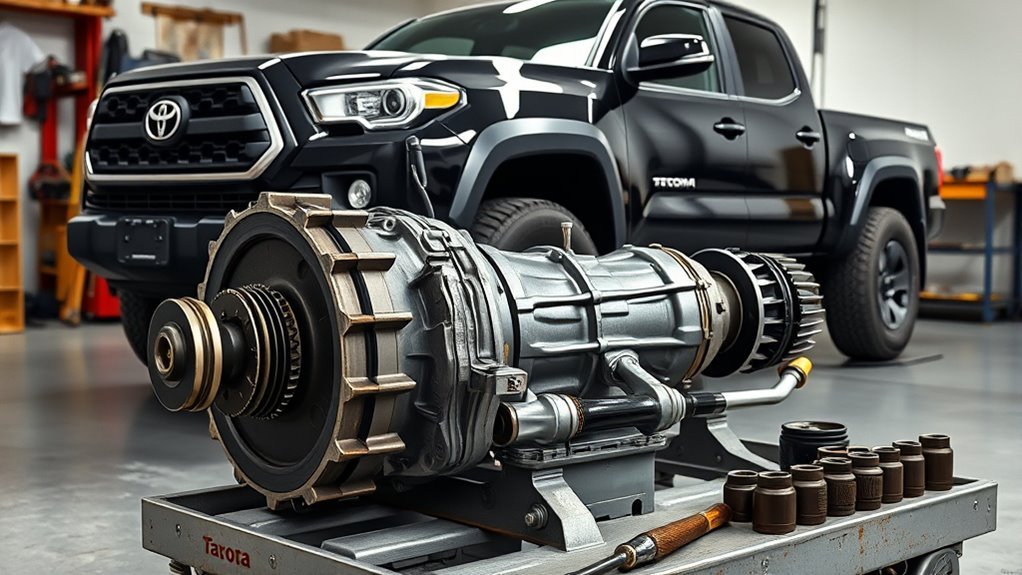
[…] Toyota’s current-generation technical description explains that rear-wheel-drive Tacomas use an automatic limited-slip differential, while applicable part-time 4WD models use an electronically controlled two-speed transfer case with high and low ranges plus Active Traction Control. If you want more detail about the operating differences, see this Tacoma part-time vs. full-time 4WD guide. […]