To rotate tires at home on a Hyundai Sonata, first check the owner’s manual for your exact model year and read the markings on all four tire sidewalls. There is no single rotation pattern or mileage interval that fits every Sonata. Same-size directional tires normally move front-to-rear on the same side, while same-size non-directional tires may use a cross-rotation pattern specified by Hyundai. Use a jack only to lift the car, support it with properly rated jack stands at the approved lift points, and tighten the wheel nuts to the torque listed for your exact model year. Many recent Sonata manuals specify 79–94 lbf-ft (11–13 kgf·m), but older models can differ.
Last updated: September 16, 2026 — rotation intervals, wheel-nut torque guidance, AWD coverage, tire-pattern guidance, DIY safety steps, and inspection advice were rechecked and revised.
Understanding Tire Rotation and Its Benefits

Tire rotation moves each wheel and tire to another permitted position so normal front-to-rear and side-to-side wear is shared more evenly. On a Hyundai Sonata, the correct interval depends on the model year and maintenance schedule. Many newer Hyundai schedules use 8,000 miles (13,000 km) or 12 months, while older Sonata schedules may differ. Always use the schedule for your exact car and rotate sooner if irregular wear develops. You can find Hyundai’s model-specific information in the Hyundai digital owner’s manual.
Rotation is preventive maintenance, not a repair for alignment, balance, suspension, or tire-damage problems. If one edge is wearing rapidly, the steering wheel is consistently off-center, the vehicle pulls on a level road, a tire has severe cupping, or vibration continues after pressure is corrected, diagnose the underlying problem instead of relying on rotation to hide it.
How to Identify Directional vs. Non-Directional Tires
Check every tire sidewall before moving a wheel. Directional tires normally have an arrow and wording such as “Rotation” showing the required forward rolling direction. If all four directional tires are the same size, they are normally rotated front-to-rear on the same side so the rolling direction does not reverse.
Asymmetric tires are different from directional tires. They usually have “Outside” and “Inside” molded into the sidewall. The side marked “Outside” must continue to face outward after rotation. A tire can be asymmetric without being directional, so an asymmetric same-size tire may still be eligible for the cross-rotation pattern specified for the vehicle.
Also compare the front and rear tire sizes. If the Sonata has a staggered setup with different front and rear sizes or incompatible wheel offsets, do not move the wheels front-to-rear unless the vehicle and tire manufacturers specifically permit it. Tire Rack’s rotation-pattern guide illustrates how directional, same-size, and staggered configurations change the available patterns.
Step-by-Step Guide to Rotating Tires on a Hyundai Sonata
A safe DIY tire rotation requires more than swapping wheel positions. Before starting, confirm the rotation pattern, factory lift points, cold tire-pressure specification, and wheel-nut torque for your exact Sonata. If you cannot safely support the required corners of the car with properly rated equipment, have a tire shop perform the rotation rather than improvising.
[Products Worth Considering]

This heavy-duty car ramp set provides a stable, reliable lift for routine maintenance like oil changes, tire rotations, brake work, and undercarriage inspections. Built from high-impact poly with a non-skid tread and rubber feet, it helps keep vehicles secure while offering a lightweight, corrosion-resistant alternative to steel ramps. The wide, gradual design supports a broad range of vehicles, from compact cars to trucks, SUVs, and vans.

These low profile jack stands provide secure vehicle support for routine garage and repair work on most cars and small vehicles. Built with a welded steel frame, adjustable ratchet design, and wide base for stability, they offer dependable lifting support with a concave saddle for safer contact. The low minimum height and compact design make them a practical choice for many automotive maintenance tasks.

This click torque wrench delivers accurate, repeatable tightening for automotive and home repair tasks, helping prevent over-tightening and fastener damage. Its dual-range scale, knurled non-slip grip, and durable ratchet head make it easy to use, while the included extension bar and storage case add extra convenience.
Required Tools And Equipment
You’ll need a suitable floor jack, properly rated jack stands, wheel chocks, a lug wrench or breaker bar, a torque wrench, and a tire-pressure gauge. Work on a hard, level surface. Set the parking brake and chock the wheels before lifting. Never depend on a hydraulic or emergency jack alone to support the vehicle while wheels are removed.
Use only the lift and support locations specified for your model year. Before the tire leaves the ground, loosen each wheel nut slightly so you are not applying high loosening force to a raised car. After the wheels are reinstalled, hand-start every nut to reduce the chance of cross-threading, snug them gradually in a star pattern, lower the vehicle, and make the final torque check with a torque wrench. Many recent Sonata manuals specify 79–94 lbf-ft (11–13 kgf·m), but use the exact value or range in your own manual because older model years can differ.
Rotation Pattern Guidelines
Do not choose a pattern from drivetrain alone. Use the pattern in the owner’s manual for your exact Sonata first, then make sure it is compatible with the tire design and wheel sizes.
| Tire / Vehicle Setup | Rotation Guidance |
|---|---|
| Same-size non-directional tires | Use the cross-rotation pattern shown in the exact Hyundai owner’s manual; common industry patterns include forward-cross and X-pattern. |
| Same-size directional tires | Move front-to-rear on the same side so the required rolling direction is preserved. |
| Asymmetric, non-directional tires | They can usually follow the permitted vehicle rotation pattern as long as the side marked “Outside” remains facing outward. |
| Different front/rear tire sizes | Do not assume front-to-rear rotation is permitted; check the exact vehicle and tire guidance. |
| Compact temporary spare | Do not include it in the normal four-tire rotation. |
After choosing the correct pattern, follow this sequence:
- Park on a hard, level surface, set the parking brake, and place wheel chocks.
- Confirm tire direction, tire sizes, the rotation diagram, factory lift points, and wheel-nut torque.
- Loosen the wheel nuts slightly while the tires still touch the ground.
- Lift the vehicle only at approved locations and support it securely with jack stands.
- Remove the wheels and move them according to the correct pattern.
- Inspect tread, sidewalls, valve stems, and visible brake components while the wheels are off.
- Reinstall the wheels and hand-start every wheel nut.
- Snug the nuts gradually in a star pattern.
- Lower the vehicle and tighten the nuts to the model-specific torque with a torque wrench.
- Set each tire to the vehicle’s recommended cold pressure and record the mileage.
When’s the Best Time to Rotate Your Tires?
The best time is the interval listed in the maintenance schedule for your exact Hyundai Sonata, or sooner when irregular wear develops. Do not automatically tie rotation to every oil change because oil-change intervals can differ from tire-rotation intervals.
Here’s a more useful reference:
| Situation | Recommended Action |
|---|---|
| Normal scheduled maintenance | Follow the mileage/time interval in the owner’s manual for the exact model year. |
| Uneven front-to-rear wear | Rotate sooner if the tires are otherwise healthy and the pattern is permitted. |
| Rapid one-edge wear | Check alignment, tire pressure, and suspension instead of relying on rotation alone. |
| Seasonal tire change | Record each wheel’s prior position so the set can be repositioned correctly when reinstalled. |
| Repeated pressure loss | Inspect for a puncture, valve leak, wheel problem, or tire damage; rotation is not the repair. |
If the tires are wearing evenly, following Hyundai’s scheduled interval is normally more useful than rotating simply because another maintenance service happens to be due.
Tire Rotation Patterns for Your Sonata
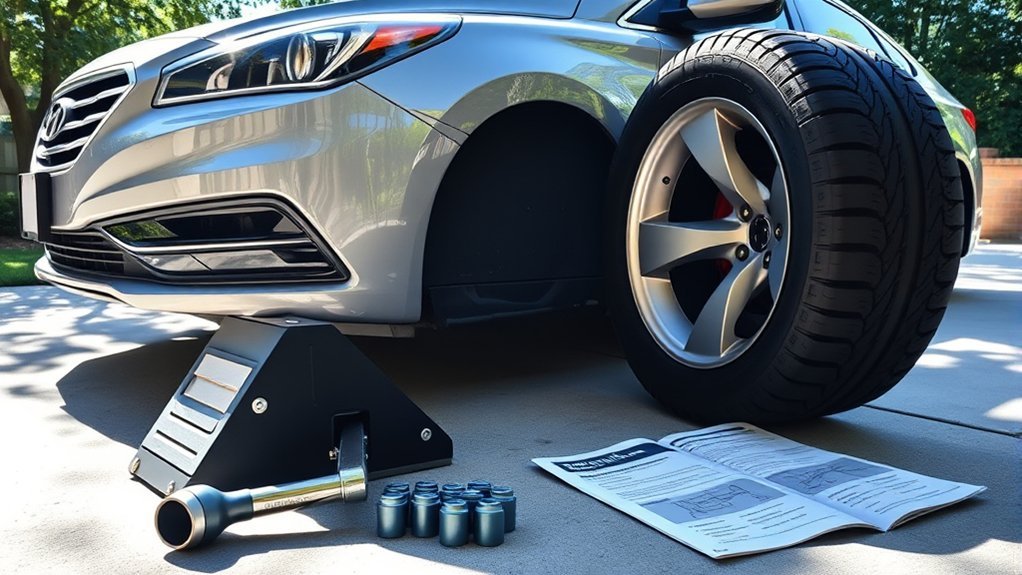
The correct Hyundai Sonata tire rotation pattern depends on four things: the owner’s-manual diagram, tire directionality, whether all four tires are the same size, and the drivetrain. Do not assume every non-directional set should be moved in exactly the same way.
[Products Worth Considering]

This smart color coded tire tread depth gauge makes it easy to check tread wear at a glance with clear red, yellow, and green ranges. Calibrated from 0 to 1 inch in 1/32 inch increments, it helps you quickly assess tire condition for safer driving and timely replacements. The pocket clip design makes it convenient to carry and use on trucks, motorcycles, cars, and other passenger vehicles.

Turn your iPhone, Android device, or Windows PC into a professional-grade diagnostic scan tool with this Bluetooth OBD2 adapter. It is designed for broad vehicle compatibility and supports popular apps for deeper diagnostics, live data, and code clearing. Built-in protections and firmware updates help keep your vehicle and scanner safe while delivering reliable performance.

Vehicle Application — Precision-Matched Outer Tie Rod Ends: Front outer tie rod ends Kit Fit for 2011–2014 Hyundai Sonata (Excluding Hybrid Models), 2012–2017 Hyundai Azera, 2010–2015 Hyundai Tucson; 2014–2016 Kia Cadenza, 2011–2016 Kia Sportage, 2011–2015 Kia Optima (Excluding Hybrid Models). Direct replacement for OE interchange numbers: ES800717, ES800718. Verify vehicle VIN, platform designation, and steering system type prior to purchase
Common Rotation Patterns
For same-size non-directional tires, the industry commonly uses patterns such as forward-cross or X-pattern. A forward-cross pattern moves the front tires straight to the rear and crosses the rear tires to the front. An X-pattern moves each tire diagonally to the opposite axle. The vehicle manufacturer’s diagram should take priority when it specifies a pattern.
For same-size directional tires, use front-to-rear movement on the same side unless the tire is professionally dismounted and remounted in a way that preserves its designed rolling direction. A temporary compact spare should not be added to the normal rotation.
Directional vs. Non-Directional
Directional tires have a required rolling direction, usually identified by an arrow on the sidewall. Crossing a mounted directional tire to the opposite side can reverse that direction, so same-size directional sets normally stay on the same side and exchange front-to-rear positions.
Non-directional tires have more rotation flexibility, but that does not mean every wheel can automatically go anywhere. Confirm that all four tires and wheels are compatible in size and offset, and use the model-specific pattern. For asymmetric tires, keep the side marked “Outside” facing outward.
AWD Considerations for Sonata
Recent Sonata model years are available with HTRAC all-wheel drive on selected trims, so AWD is a real configuration rather than a hypothetical exception. AWD makes consistent tire circumference and tread condition especially important, but it does not create one universal rotation pattern.
- Follow the rotation diagram for your exact AWD Sonata model year.
- Confirm all four tires are compatible in size, type, and directionality.
- Measure tread depth at all four positions and investigate unusually large differences.
- Do not prescribe front-to-back rotation simply because the car has AWD.
If one AWD tire requires replacement while the others are substantially worn, check Hyundai’s model-specific requirements and the tire manufacturer’s guidance before mixing tread depths or tire models.
Check Tire Pressure and Condition During Rotation
Check tire pressure when the tires are cold and use the PSI printed on the vehicle’s Tire and Loading Information label or specified in the owner’s manual—not the maximum pressure molded into the tire sidewall. NHTSA recommends checking cold pressure regularly and identifies the driver-side door area as the normal location for the vehicle pressure label. See NHTSA TireWise for tire-pressure and inspection guidance.
Measure tread depth at several points across each tire. A tread-depth gauge gives a clearer comparison between the inner, center, and outer portions of the tread than a quick visual check.
| Tire Condition | Action Needed |
|---|---|
| At or near 2/32" (1.6 mm) / wear bars | Replace the tire; do not rely on rotation to extend normal service. |
| Bulge, exposed cord, or serious sidewall damage | Do not continue normal driving; have the tire professionally inspected or replaced. |
| One-edge or feathered wear | Check alignment, pressure, steering, and suspension. |
| Cupping or vibration | Check balance, wheel condition, tire condition, and suspension. |
| Repeated pressure loss | Find and repair the leak or damaged component. |
| Pressure simply incorrect | Adjust to the vehicle’s specified cold PSI. |
Hyundai also recommends inspecting the disc brake pads when the tires are rotated. While each wheel is off, look for obvious pad, rotor, or hardware problems that deserve closer inspection. After the rotation, restore the specified front and rear tire pressures and confirm every wheel nut has been torqued correctly.
[Products Worth Considering]

1. Accurately measures tire tread depth gauge tool, Calibrated from 0 to 1 inch in 1/32 inch

1.Accurate and Efficient: Different colors on the bar represents different scopes, the red range on bar: 0 - 3/ 32; Yellow range on bar: 3/ 32 - 6/ 32; Green range on bar: 6/ 32 - 32/ 32, allowing you easy and fast to read and calibrated

ACCURATE: ( 2% true PSI). Dial measures in pounds per square inch (PSI, 0-120, 2-lb. increments) and kilopascal (kPa, 0-800, increments of 20) readings.
Frequent Tire Rotation Errors and How to Avoid Them
The most consequential DIY errors are choosing a rotation pattern before checking the tires, lifting the vehicle unsafely, using a generic torque value, and treating abnormal wear as something rotation will repair.
- Check the exact Hyundai manual before selecting the pattern or service interval.
- Read all four sidewalls for directional arrows and “Inside/Outside” markings.
- Compare front and rear tire sizes before moving a wheel between axles.
- Never rely on a jack alone while a wheel is removed.
- Do not include a compact temporary spare in the normal rotation.
- Hand-start wheel nuts and use a torque wrench for final tightening.
- Set pressure from the door-jamb placard or owner’s manual when the tires are cold.
- Diagnose severe or one-sided wear instead of repeatedly rotating the problem to another position.
Signs You Need to Rotate Your Tires Soon

The clearest reason to schedule a routine rotation is that you have reached the interval in your exact maintenance schedule. A moderate difference in normal tread wear between the front and rear tires can also justify rotating sooner. More serious symptoms should trigger diagnosis rather than an automatic rotation.
| Sign | What to Do |
|---|---|
| Scheduled interval reached | Rotate using the permitted pattern. |
| Normal front/rear tread-depth difference developing | Consider rotating sooner if the tires are otherwise healthy. |
| Heavy wear on one shoulder | Check alignment, pressure, and suspension. |
| Vehicle consistently pulls or steering wheel is off-center | Check tire condition and alignment; rotation alone is not a fix. |
| Persistent vibration | Inspect tire condition, wheel balance, wheels, and suspension. |
| Repeated pressure loss | Find the leak or damage before normal driving continues. |
How Alignment Affects Tire Rotation
Correct wheel alignment helps the tread meet the road at the intended angles. When toe, camber, or another alignment angle is outside specification, the tire can wear rapidly on one edge or develop feathering. Tire rotation cannot correct that alignment fault.
- Rotate normally when wear is reasonably even and the maintenance interval is due.
- Check alignment if one shoulder wears much faster than the other.
- Investigate a steering wheel that stays off-center while traveling straight.
- Inspect alignment and suspension after a hard pothole or curb impact if handling or wear changes.
- Do not expect moving a damaged or severely uneven tire to another corner to restore it.
Frequently Asked Questions
How to Rotate Tires on a Hyundai Sonata?
Check the rotation diagram for your exact Sonata model year and confirm the tire type and sizes first. Loosen the wheel nuts slightly on the ground, lift at the approved points, support the vehicle securely with jack stands, move the wheels according to the permitted pattern, inspect the tires and brakes, reinstall the wheels, hand-start the nuts, snug them in a star pattern, lower the car, torque the nuts to the model-specific specification, and set cold tire pressure from the door-jamb label.
Is It Possible to Do a Tire Rotation at Home?
Yes, if you have the proper lifting equipment, jack stands, wheel chocks, torque wrench, a hard level work surface, and the correct factory lift-point information. If you cannot safely support the car while the necessary wheels are removed, use a professional shop instead of improvising with an unsupported jack.
How to Do Hyundai Tire Rotation?
Use Hyundai’s model-specific rotation diagram rather than assuming every Hyundai follows the same pattern. Same-size directional tires normally stay on the same side and swap front-to-rear. Same-size non-directional tires may use a cross pattern, while staggered sizes and other special configurations can restrict rotation.
Can You Rotate Tires Without Doing an Alignment?
Yes. A routine tire rotation does not automatically require a wheel alignment. Have the alignment checked when the vehicle consistently pulls, the steering wheel is off-center, one side of a tire wears rapidly, feathering appears, or handling changes after a curb or pothole impact.
How Often Should Hyundai Sonata Tires Be Rotated?
Follow the maintenance schedule for your exact model year rather than a universal mileage number. Many recent Hyundai schedules use 8,000 miles (13,000 km) or 12 months, while older Sonata schedules can differ. Rotate sooner if irregular wear develops.
What Is the Hyundai Sonata Lug Nut Torque?
Use the wheel-nut torque in the owner’s manual for your exact model year. Several recent Sonata manuals specify 79–94 lbf-ft (11–13 kgf·m), but older Sonatas can use a different specification, so do not apply one generic value to every generation.
Conclusion
A safe Hyundai Sonata tire rotation starts with the exact model-year manual, not a generic rotation diagram. Confirm the tire design and sizes, support the vehicle correctly, inspect the tires and brakes while the wheels are off, and use a torque wrench for final tightening. Rotation can help keep normal wear more even, but it will not repair alignment problems, damaged tires, air leaks, or severe abnormal wear. Record the mileage after the job so the next rotation follows the correct maintenance schedule.