

Last updated: July 31, 2026 — 2016–2018 left-side location, 2020–2021 DCM battery-drain guidance, model-year scope, and voltage-testing cautions reviewed.
On U.S.-market Toyota RAV4 Hybrid HEV models, the 12V auxiliary battery is in the rear luggage compartment, not under the hood. The exact side depends on the generation: 2016–2018 models place it on the left-hand side, while 2019–2025 models place it on the right-hand side. Lift the rear cargo floor and follow the model-specific side-cover path to reach it.
Toyota provides a separate positive jump-start terminal inside the under-hood fuse box for emergency starting. This guide covers the standard RAV4 Hybrid HEV. Do not apply its panel instructions to a gas-only RAV4 or RAV4 Prime/PHEV without checking that model’s owner’s manual. Because the 2026 RAV4 starts an all-new generation, use the 2026 manual for its exact battery location, jump points, and trim procedure.
Quick Answer
2016–2018 RAV4 Hybrid: lift the rear deck board and look beneath the left-side luggage-compartment covers. 2019–2025 RAV4 Hybrid: lift the rear cargo floor and open the applicable right-side protective cover. The physical battery is not under the hood. For an emergency jump-start, use the designated under-hood positive terminal and approved ground point shown in the model-year owner’s manual.
Key Takeaways
- The 2016–2018 RAV4 Hybrid 12V battery is in the left-hand side of the rear luggage compartment.
- The 2019–2025 RAV4 Hybrid 12V battery is in the right-hand side of the rear luggage compartment.
- Use the rear cargo area to locate, inspect, test, disconnect, or replace the physical battery.
- Use the designated under-hood jump terminal when the model-year manual directs you there.
- The 12V battery powers control modules and accessories; it is separate from the high-voltage traction battery.
- This procedure is for the standard RAV4 Hybrid HEV, not the gas-only RAV4 or RAV4 Prime/PHEV.
- Wear gloves and eye protection, prevent sparks, and never touch orange high-voltage cables or hybrid service components.
Model-Year Applicability
| Model Years | Battery Location | Initial Access Path |
|---|---|---|
| 2016–2018 | Left-hand side of the rear luggage compartment. | Remove the rear deck board, then follow the left-side deck-cover and battery-cover procedure in the model-year manual. |
| 2019–2025 | Right-hand side of the rear luggage compartment. | Lift the rear cargo floor, then remove the applicable right-side protective cover or trim piece. |
| 2026 | Model-year-specific location for the all-new sixth generation. | Use the 2026 owner’s manual before removing panels or selecting a jump point. Do not assume the 2019–2025 layout is unchanged. |
Choose the Right Access Point
| Your Goal | Access Point | What to Do |
|---|---|---|
| Locate or inspect the battery | Rear luggage compartment | Use the left-side path for 2016–2018 or the right-side path for 2019–2025. |
| Test, disconnect, or replace it | Physical battery in the rear | Follow the exact battery-cover, terminal, venting, and reset instructions for the vehicle. |
| Emergency jump-start | Under-hood fuse box and specified ground point | Use the designated positive jump terminal and cable sequence in the owner’s manual. |
| Work on a 2026 model | Model-year-specific | Use the redesigned model’s owner’s manual before removing trim or connecting external power. |
Where Is the RAV4 Hybrid 12V Battery Located?
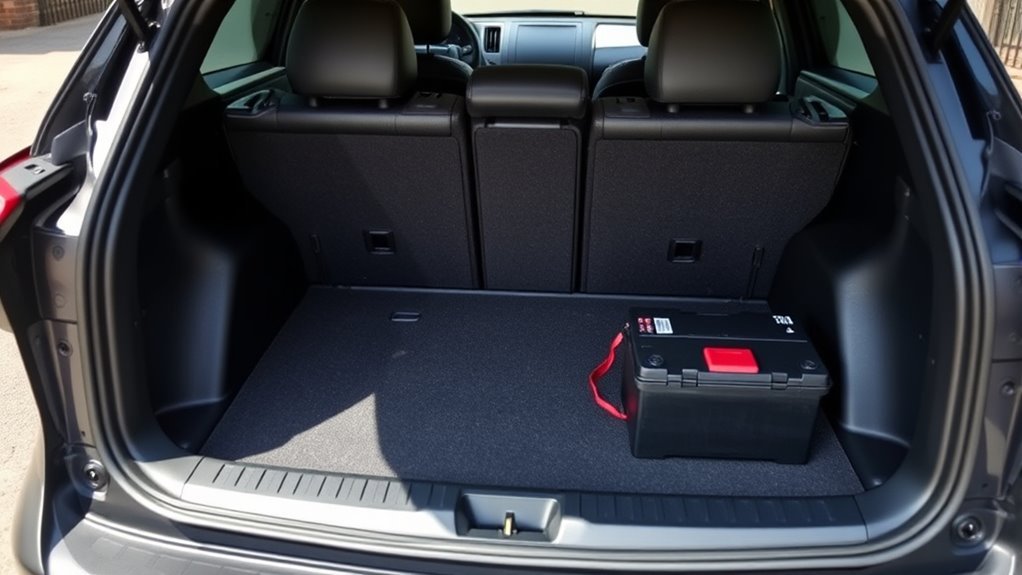
The RAV4 Hybrid’s physical 12V battery is in the rear luggage compartment, but Toyota changed sides between generations.
- 2016–2018 RAV4 Hybrid: The battery is beneath the rear cargo deck on the left-hand side of the luggage compartment.
- 2019–2025 RAV4 Hybrid: The battery is beneath the rear cargo floor on the right-hand side of the luggage compartment.
- 2026 RAV4 Hybrid: Use the all-new generation’s owner’s manual for its confirmed location and trim procedure.
Opening the hood on 2016–2025 RAV4 Hybrid models reveals a fuse box and designated positive jump-start terminal, not the physical auxiliary battery. Toyota provides the remote terminal so the low-voltage system can be energized during an emergency without first dismantling the rear cargo area.
Model-year locations and emergency connection guidance in this article were cross-checked against Toyota owner-manual information. The panel procedure applies to the standard RAV4 Hybrid HEV. Gas-only RAV4 and RAV4 Prime/PHEV layouts should be checked separately.
| Component | Where You Encounter It | What It Is For |
|---|---|---|
| 12V auxiliary battery | Left-rear luggage area for 2016–2018; right-rear luggage area for 2019–2025 | Powers low-voltage electronics and lets the control systems wake up |
| Positive jump-start terminal | Inside the under-hood fuse box on applicable models | Provides the approved positive connection point for emergency starting |
| High-voltage traction system | Sealed hybrid components identified by warnings and high-voltage markings | Supplies propulsion energy and is not a DIY inspection or service point |
2026 model note: Toyota identifies the 2026 RAV4 as an all-new sixth-generation vehicle. Confirm the exact auxiliary-battery location, jump point, and panel-removal procedure in the 2026 owner’s manual before using instructions written for the previous generation.
What Does the 12V Battery Do in a RAV4 Hybrid?
The 12V auxiliary battery supplies low-voltage power when the RAV4 Hybrid is off and during its startup sequence. It lets the control computers, relays, security system, and dashboard wake up so the vehicle can enter READY mode.
Systems supported by the auxiliary battery include:
- Door locks, courtesy lights, and exterior lighting
- Dashboard electronics and low-voltage control modules
- Smart Key and security functions
- Infotainment and accessory circuits
- The control sequence that activates the hybrid system
The auxiliary battery is separate from the high-voltage traction battery. The traction system supplies propulsion energy and should be inspected or repaired only by personnel trained to work on Toyota hybrid systems.
Warning: Do not touch, probe, cut, disconnect, or work around orange high-voltage cables, service plugs, or hybrid battery components. This guide covers low-voltage visual access and screening only.
What Are the Signs of a Weak RAV4 Hybrid 12V Battery?
A weak auxiliary battery can prevent the RAV4 Hybrid from entering READY mode even when the high-voltage traction battery still has energy. Low or unstable voltage may also produce several unrelated-looking electrical messages at once.
Common Warning Signs
- The hybrid system will not enter READY mode
- Interior or exterior lights appear unusually dim
- The vehicle repeatedly needs a jump-start
- The Smart Key or power locks work intermittently
- Warning messages appear after the vehicle has been parked
- Accessories reset, flicker, or operate erratically
- The dashboard clicks, flickers, or remains blank when you try to start
These symptoms do not prove that the battery itself has failed. Loose terminals, a discharged battery, an electrical drain, key-recognition trouble, and other faults can produce similar behavior. Use the RAV4 Hybrid won’t start troubleshooting guide when you need a complete diagnostic sequence.
Visual Battery Indicators
After reaching the auxiliary-battery compartment, inspect the case, battery posts, terminal clamps, cables, hold-down, and surrounding area. A serviceable installation should be dry, securely mounted, and free from heavy corrosion.
- Corrosion: White, blue, or green buildup can increase resistance at a terminal connection.
- Loose terminals: A clamp that moves on the battery post can imitate a weak or dead battery.
- Swelling or cracks: A distorted or damaged case requires professional attention.
- Fluid or sulfur odor: Stop working if you notice leakage, heat, smoke, or a strong rotten-egg smell.
- Loose hold-down: Battery movement can damage the case, cables, terminals, or surrounding components.
- Damaged venting: If the installed battery uses a vent tube, make sure it is connected and routed as specified.
What Tools and Safety Gear Do You Need?
A visual inspection requires only basic protective equipment and trim-access tools. Keep metal objects away from the battery posts, and do not place loose tools on top of the battery.
| Purpose | Recommended Tool | Safety Note |
|---|---|---|
| Protect your hands | Work gloves | Help prevent contact with residue and sharp trim edges |
| Protect your eyes | Safety glasses | Wear them whenever working around a lead-acid battery |
| Release panels | Plastic trim tool | Release clips gently instead of forcing the panel |
| See the compartment | Flashlight | Inspect the area without moving wiring blindly |
| Screen voltage | Digital multimeter | Select DC volts before touching the probes to the posts |
| Organize fasteners | Small tray or parts bowl | Keep clips and fasteners in removal order |
[Products Worth Considering]

The ANCEL BA101 helps diagnose 12V batteries quickly with clear readings for battery health, charge level, voltage, CCA, cranking, and charging system performance. Designed for a wide range of vehicles and battery types, it offers easy-to-read results, reliable clamp connections, and built-in protection to make testing safer and more convenient.

This replacement filter set is designed for a range of Toyota hybrid vehicles, including popular models like RAV4 Hybrid, Camry Hybrid, Highlander Hybrid, Sienna, Venza, and more. It combines cabin and engine filtration to help support cleaner airflow, reduce dust and odors, and protect your HVAC and engine systems. Built for easy installation and extended service life, it offers a convenient maintenance upgrade for compatible hybrid and gas-only Corolla models.

These power liftgate struts are designed to restore smooth, reliable rear hatch operation on Toyota RAV4 models from 2013 to 2018. Built for plug-in installation with original-style fitment, they help reduce noise and shock while delivering strong, dependable lift support. The units are engineered for durability and long service life, making them a practical replacement for worn electric tailgate actuators.
How Do You Access the RAV4 Hybrid 12V Battery?
The following visual-access procedure covers the typical U.S.-market 2016–2025 RAV4 Hybrid HEV layouts. The key difference is the side of the luggage compartment: use the left-side access path for 2016–2018 and the right-side access path for 2019–2025. Use the 2026 owner’s manual for the redesigned model.
- Park safely. Stop on a level surface, shift to Park, set the parking brake, turn the vehicle completely off, and keep the Smart Key away from the cabin.
- Clear the cargo area. Remove loose cargo that could block the deck board or fall into the open compartment.
- Open the rear hatch. The physical battery is reached from the luggage area rather than the engine compartment.
- Lift the rear cargo floor or deck board. Remove the cargo mat, floor panel, or loose lower storage piece only as required by your configuration.
- Choose the correct side. For a 2016–2018 model, work toward the left-side deck cover. For a 2019–2025 model, work toward the right-side protective cover.
- Check for model-specific clips. Some 2016–2018 configurations use locking clips in the rear deck board. Check the manual before turning, prying, or releasing a fastener.
- Release the applicable cover carefully. Use your fingers or a plastic trim tool. Stop if a panel resists and check for a hidden clip, claw, tray, or fastener.
- Remove the battery cover if fitted. Keep clips and fasteners arranged in their removal order.
- Inspect without disconnecting. Check the case, posts, clamps, hold-down, cables, and any visible vent tube.
- Reinstall the trim. Seat each clip, cover, deck board, and storage piece securely so the cargo trim does not loosen or rattle.
Pro Tip: Photograph each panel and fastener position before removal. The photos provide a reliable reassembly reference without relying on memory.
Which Panels and Fasteners May Need to Come Off?
Access generally involves the rear deck board, the generation-specific side deck cover or protective panel, and a battery cover. The number and style of clips can vary with model year, production version, trim level, spare-tire configuration, and cargo-floor equipment.
- Rear deck board: Raises or lifts out to expose the lower luggage area.
- Left-side deck cover: Provides the access path on 2016–2018 RAV4 Hybrid models.
- Right-side protective cover: Provides the access path on 2019–2025 RAV4 Hybrid models.
- Plastic clips or claws: Secure trim pieces and should be released without twisting or forcing them.
- Battery cover: Shields the battery posts and upper case where fitted.
- Hold-down bracket: Restrains the battery and should remain secure and corrosion-free.
- Vent tube: May be fitted to route battery gases outside the occupied compartment.
Do not use a metal tool close to an exposed positive post and grounded body metal at the same time. A tool bridging those points can create a direct short circuit.
How Do You Inspect and Maintain the 12V Battery?
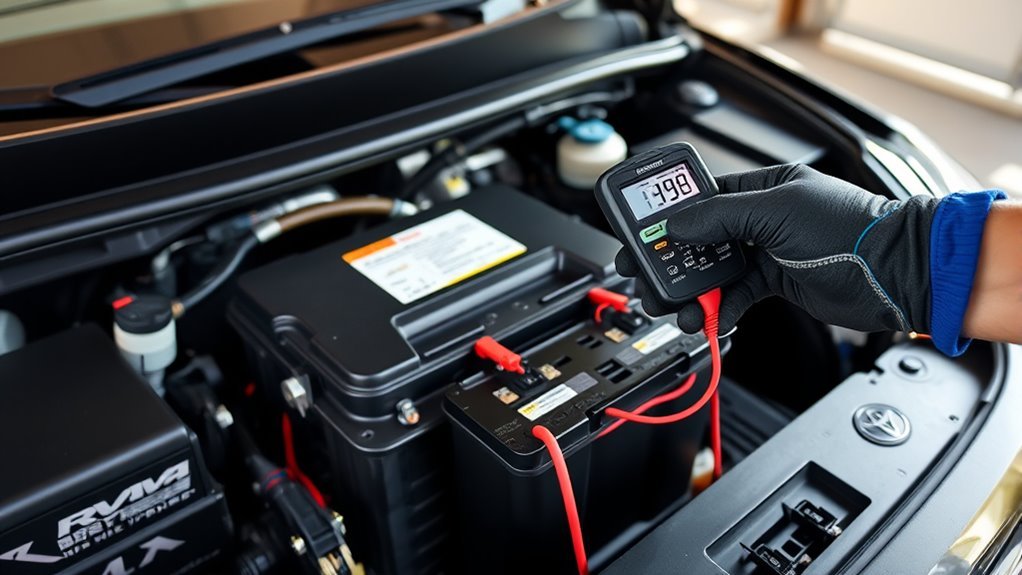
A basic inspection should confirm clean electrical contact, secure mounting, an undamaged case, and unobstructed approved venting. You do not need to disturb the high-voltage hybrid system for any of these checks.
- Confirm that neither terminal clamp moves on its battery post.
- Look for corrosion between the post and clamp, not only on the visible outer surface.
- Verify that the hold-down prevents the battery from shifting.
- Check the case for distortion, cracks, leakage, staining, or heat damage.
- If a vent tube is fitted, verify that it is attached and not pinched or blocked.
- Keep loose cargo and debris away from the battery cover and venting area.
- Record test dates and readings so you can identify a declining pattern.
Light surface corrosion can be cleaned by an experienced person using battery-safe supplies after the correct disconnect procedure has been confirmed. Stop and seek professional service if corrosion is heavy, the case is damaged, the battery is hot, or liquid has escaped.
How Do You Test the 12V Battery With a Multimeter?
A resting-voltage measurement provides a rough state-of-charge check, not a complete battery-health diagnosis. Temperature, battery chemistry, recent charging, recent electrical use, surface charge, and background vehicle loads can all influence the number.
For a basic test, turn the vehicle off and allow the battery to rest for several hours when possible; an overnight rest gives a more useful screening reading. Opening doors, unlocking the vehicle, recent charging, and background module loads can still change the result. Set the multimeter to DC volts. Place the red probe directly on the positive 12V battery post and the black probe on the negative post. Do not probe orange cables, service plugs, or hybrid connectors.
| Approximate Resting Voltage | Rough Screening Meaning | What to Do Next |
|---|---|---|
| 12.6–12.8 V | Near a full state of charge for many rested lead-acid batteries | Do not assume the battery is healthy; request a load or conductance test if symptoms continue |
| 12.4–12.5 V | Partially charged | Charge with equipment approved for the installed battery type, then retest after rest |
| 12.0–12.3 V | Substantially discharged | Recharge and have the battery tested before assuming it needs replacement |
| Below 12.0 V | Deeply discharged or potentially damaged | Arrange proper charging and professional battery-health testing |
These ranges are approximate and should not be used as universal pass-or-fail limits. A deteriorated battery may display acceptable voltage while resting and then collapse when the vehicle’s control systems draw power. A battery that repeatedly loses charge needs a load or conductance test and, when appropriate, a parasitic-draw diagnosis.
Why Does the 12V Battery Keep Dying on Some 2020–2021 Models?
Toyota service bulletin T-SB-0089-21 Rev1 covers some 2020–2021 RAV4 and RAV4 Hybrid vehicles that may experience a depleted 12V battery while the ignition is off. The bulletin describes a Data Communication Module, or DCM, reset and firmware update for applicable vehicles.
Clues that may appear with the battery problem include:
- A 12V battery that repeatedly becomes discharged while the vehicle is parked
- A red SOS indicator that remains illuminated after its normal bulb check
- Toyota App, remote-service, Wi-Fi, or connected-service problems
- Diagnostic trouble code B15A804 in current or stored history
These symptoms do not prove that the DCM is responsible. A worn battery, loose connection, accessory, damaged wiring, or another module can also cause repeated discharge. Ask a Toyota dealer or qualified technician to check bulletin applicability for the VIN, test the battery, and measure parasitic draw before replacing parts or repeatedly jump-starting the vehicle.
Important: A technical service bulletin is not the same as a recall and does not mean every vehicle in the listed model years has the condition. Diagnosis and coverage depend on the vehicle, symptoms, warranty status, and bulletin applicability.
How Do You Jump-Start a RAV4 Hybrid?
For applicable RAV4 Hybrid models, Toyota directs owners to the designated positive terminal inside the under-hood fuse box and a specified metallic ground point. This emergency connection point is separate from the battery’s physical location in the rear luggage compartment.
Open the model-year owner’s manual before connecting cables or a booster pack. Confirm the approved positive terminal, grounding point, cable order, power-source requirements, waiting period, and disconnection sequence. After the connections are made exactly as directed, attempt to start the hybrid system and confirm that the READY indicator illuminates.
Warning: Reversed polarity, an unsuitable ground point, or an incorrect cable sequence can create sparks, damage fuses, harm electronic modules, or injure someone. Follow the manual for your exact model year instead of relying on a generic cable diagram.
Once READY mode is established, remove the connections in the manual’s specified reverse order. Have the battery tested if it was deeply discharged, if warning messages remain, or if the vehicle needs another jump-start. A RAV4 Hybrid cannot be push-started as a substitute for the correct low-voltage procedure.
[Products Worth Considering]

This Yuirote universal car motor diagnostic tool helps drivers quickly detect engine fault codes and identify system issues for routine inspections and maintenance. It also supports electronic parking brake reset and emergency release functions, making it useful for handling EPB-related problems without a repair shop visit. Its compact, ergonomic design and broad vehicle compatibility make it a practical choice for car owners and DIY repair enthusiasts.

Upgrade the front-end look of your vehicle with this windshield wiper side cowl extension cover trim designed for select RAV4 models. It helps protect the wiper area from weather exposure while delivering a cleaner, more polished appearance. With a straightforward installation process and vehicle-specific fitment, it is a simple way to enhance both style and function.

This metal key fob cover is designed to help protect compatible Toyota smart keys from daily wear, including drops, bumps, scratches, dust, and water. Made from zinc alloy with silicone and PET materials, it offers a premium feel while maintaining full signal function. It also adds a stylish, luxury look to your key, but may increase the key's weight and size.
When Should You Replace the Battery or Call a Technician?
Arrange professional testing when the battery repeatedly loses charge, cannot pass a load or conductance test, or shows physical damage. Persistent warnings after the vehicle enters READY mode may indicate a fault beyond the auxiliary battery.
- Plan replacement: The battery remains weak after a complete approved charge and fails a battery-health test.
- Stop DIY work: The case is cracked, swollen, leaking, unusually hot, smoking, or producing a strong sulfur odor.
- Request diagnostics: Warning messages return after stable 12V power is restored.
- Check for an electrical drain: A charged battery goes flat again after the vehicle sits.
- Check bulletin applicability: Some 2020–2021 vehicles with repeated discharge and DCM-related symptoms may require dealer diagnosis and a firmware update.
- Confirm exact fit: Match the replacement battery’s chemistry, dimensions, capacity, terminal orientation, restraint fit, and venting to the vehicle.
Do not select a replacement based only on a generic RAV4 group-size list. Battery specifications can vary by model year, production source, and installed battery type. Confirm the requirement using the vehicle identification number, current owner information, the installed battery label, or a qualified Toyota parts source.
A weak auxiliary battery can contribute to multiple warning messages, but it does not prove that every hybrid warning is a low-voltage issue. Use the RAV4 Hybrid System Malfunction guide when a warning remains after the 12V system has been properly tested.
[Products Worth Considering]

This AstroAI digital multimeter is designed for accurate troubleshooting of automotive and household electrical systems. It measures AC/DC voltage and current, resistance, continuity, capacitance, frequency, duty cycle, diode, and temperature, while the True RMS and auto-ranging functions help deliver reliable readings. A backlit LCD, data hold, kickstand, and safety-focused fuse protection make it practical and dependable for everyday diagnostics.

These custom-fit mud flaps are designed for Toyota RAV4 and RAV4 Hybrid models across multiple years to help protect your vehicle from snow, salt, sand, rocks, and road debris. Made from durable black ABS plastic, they offer strong resistance to wear, cold, and aging while helping keep your lower body panels cleaner. The set includes front and rear splash guards for a complete exterior protection upgrade.

This automotive test light combines a bright LED voltage display with quick polarity indication for fast, accurate circuit checks in a wide range of vehicle systems. It helps diagnose battery, charging, lighting, and fuse issues with a sharp stainless probe, long spring wire, and easy-to-use alligator clip for efficient troubleshooting.
Frequently Asked Questions
Where is the 12V battery in a 2016–2018 RAV4 Hybrid?
It is on the left-hand side of the rear luggage compartment beneath the cargo deck and applicable left-side covers. Remove the rear deck board, then follow the model-year manual’s left-side deck-cover and battery-cover procedure.
Where is the 12V battery in a 2019–2025 RAV4 Hybrid?
It is on the right-hand side of the rear luggage compartment, beneath the cargo floor and behind the applicable trim or protective cover. Access it from the rear hatch area rather than the engine compartment.
Is the RAV4 Hybrid 12V battery under the hood?
Not on the 2016–2025 RAV4 Hybrid generations covered here. Their physical auxiliary battery is in the rear luggage compartment. Applicable models provide a separate positive jump-start terminal inside the under-hood fuse box.
Where is the 12V battery in a 2026 RAV4 Hybrid?
The 2026 RAV4 begins an all-new sixth generation. Check the 2026 owner’s manual for the confirmed auxiliary-battery location, jump point, and trim procedure instead of assuming the 2019–2025 layout is unchanged.
What does the 12V battery do in a RAV4 Hybrid?
It powers locks, lights, accessories, security functions, low-voltage control modules, and the startup sequence that lets the hybrid system enter READY mode. It is separate from the high-voltage traction battery that supplies propulsion energy.
Can I jump-start a RAV4 Hybrid from the rear battery?
Use the connection points specified in the owner’s manual for your model year. Toyota’s procedure for many RAV4 Hybrid models uses the designated positive terminal in the under-hood fuse box and an approved metallic ground point instead of exposing the rear battery during an emergency.
What voltage should a healthy RAV4 Hybrid 12V battery show?
A rested lead-acid battery near room temperature often reads about 12.6 to 12.8 volts when near full charge. That reading is only a screening result. Temperature, battery chemistry, recent charging, and background loads affect voltage, so repeated failures require a load or conductance test.
Why does the 12V battery keep dying on my 2020 or 2021 RAV4 Hybrid?
A weak battery, loose connection, accessory, wiring fault, or parasitic draw can cause repeated discharge. Toyota bulletin T-SB-0089-21 Rev1 also covers some 2020–2021 RAV4 and RAV4 Hybrid vehicles with a depleted 12V battery while the ignition is off and provides a DCM reset and firmware-update procedure. Ask a qualified technician to test the battery, measure draw, and confirm bulletin applicability for the VIN.
What if the power liftgate will not open because the 12V battery is dead?
Do not force the powered liftgate or dismantle the interior blindly. Use the mechanical-entry and emergency-power instructions in your model-year owner’s manual. On applicable models, the under-hood jump terminal can restore low-voltage power without first reaching the rear battery.
Conclusion
For a U.S.-market RAV4 Hybrid HEV, use the model-year split before removing cargo trim: the 2016–2018 12V battery is on the left side of the rear luggage compartment, while the 2019–2025 battery is on the right side. Use the physical rear battery for inspection, testing, disconnection, or replacement, and use the designated under-hood terminal for emergency jump-starting when the owner’s manual directs you there.
Treat a multimeter reading as a screening result rather than proof of battery health. Arrange proper testing if the battery repeatedly discharges, and ask about DCM bulletin applicability when a 2020–2021 vehicle combines a dead battery with SOS, Toyota App, remote-service, or connectivity symptoms. Stop and call a technician if the battery is leaking, swollen, hot, smoking, or accompanied by persistent hybrid-system warnings.
Sources
- Toyota Owners: 2025 RAV4 Hybrid 12-Volt Battery — supports the right-hand luggage-compartment location and Toyota’s auxiliary-battery safety guidance.
- 2018 Toyota RAV4 Hybrid Owner’s Manual, Page 500 — identifies the left-hand luggage-compartment location and the generation-specific rear-deck access path.
- Toyota USA: RAV4 Hybrid Auxiliary Battery Location and Jump Starting — confirms that RAV4 Hybrid models beginning with the 2016 model year place the auxiliary battery in the rear and use an under-hood jump procedure.
- Toyota USA Newsroom: 2026 RAV4 Arrives — confirms that the 2026 RAV4 begins an all-new sixth generation.
- Toyota Owners: 2026 RAV4 Hybrid Owner Information — use this current-generation owner information to confirm the exact 2026 battery and trim layout.
- Toyota Owners: If the 12-Volt Battery Is Discharged — supports use of the designated jump terminal, READY indicator guidance, and the push-start warning.
- Toyota Owners: RAV4 Hybrid System Precautions — supports the separation between low-voltage owner checks and high-voltage hybrid-system service.
- NHTSA Interim Guidance for Electric and Hybrid-Electric Vehicles — supports avoiding high-voltage cabling and warning-labeled components.
- Battery University: How to Measure State of Charge — supports the approximate lead-acid voltage ranges and the limitations of voltage-only state-of-charge estimates.
- Toyota T-SB-0089-21 Rev1: DCM Reset and Firmware Update — covers applicable DCM symptoms, depleted 12V batteries while IG-OFF, and the dealer firmware-update procedure for affected vehicles.




[…] Initialization may be required after certain battery, fuse, connector, ECU, actuator, or liftgate repairs. The requirement can depend on whether the hatch was open or closed during the work. If the problem followed a weak or disconnected 12-volt battery, first confirm the battery is charged and serviceable. RAV4 Hybrid owners can also review the RAV4 Hybrid 12-volt battery location and testing guide. […]