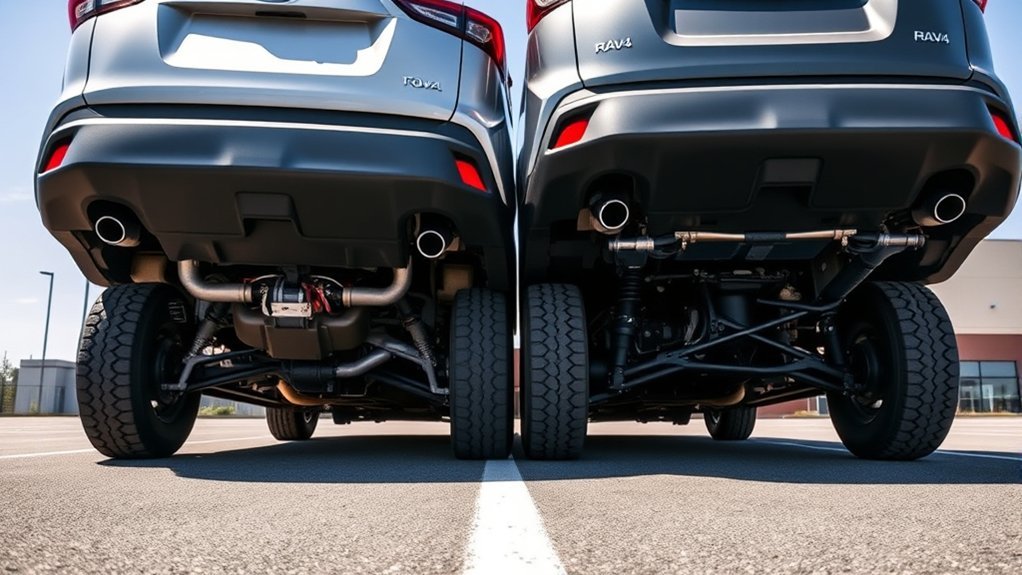
Choose FWD if you want lower purchase price, simpler maintenance and the best fuel economy for daily city commuting; pick AWD if you need stronger traction, better stability in rain, snow or loose terrain and more confidence on mountain or rural roads. FWD is lighter and cheaper to run, while AWD shifts power to all wheels for grip at the cost of a few mpg and higher upkeep. Keep going and you’ll find detailed comparisons and use-case tips.
Short Answer: AWD or FWD for Your RAV4?
Wondering which drivetrain fits your needs? You’ll weigh driving preferences against cost and conditions: AWD boosts traction in snow and rain and improves acceleration and handling in slippery situations, while FWD is more fuel-efficient and cheaper up front. AWD typically adds about $1,000 to the RAV4’s purchase price, so if you rarely leave urban roads, FWD usually suffices and keeps ownership costs down.
Assess your routine objectively: if you face frequent winter storms, unpaved routes, or want extra confidence off the beaten path, AWD gives tangible safety and performance benefits. If your priority is economy, lower purchase price, and mostly city commuting, FWD aligns with liberation through simplicity and lower recurring expenses. Both drivetrains offer similar cabin quietness at equal trims, so interior comfort won’t sway you. Base your choice on realistic weather considerations and daily driving preferences to free yourself from regret and unnecessary expense.
How RAV4 AWD and FWD Work
Although they both move your RAV4 down the road, FWD and AWD do it in different ways: you get simpler, lighter FWD that sends engine torque only to the front wheels, improving fuel efficiency while offering reliable everyday traction control under normal conditions. AWD, by contrast, actively manages power distribution to all four wheels, engaging the rear axle when slippage is detected to maintain grip and stability.
| System | Power Distribution | Typical Benefit |
|---|---|---|
| FWD | Front wheels only | Better fuel economy |
| AWD (basic) | Mostly front, shifts rear as needed | Improved grip |
| AWD (advanced) | Adaptive split front/rear | Enhanced control in adversity |
You’ll feel AWD’s torque dynamics when roads get rougher; it trades some efficiency for predictable stability. Both systems use torque and electronic controls, but AWD’s adaptive scheme gives you greater freedom to move confidently in varied conditions.
RAV4 AWD vs FWD: Traction in Rain, Snow, and Gravel
When roads turn slick—whether from rain, packed snow, or loose gravel—the RAV4’s AWD system gives you more consistent traction by routing torque to all four wheels and engaging the rear axle quickly when front grip wanes; this delivers clear traction advantages in adverse weather conditions. You’ll notice reduced wheel spin in snow, smoother acceleration, and improved driving stability compared with FWD, which concentrates power at the front and can lose grip if a front wheel slips. In heavy rain, AWD helps you maintain control through torque redistribution, while FWD often needs high-quality winter tires to approach the same confidence. On gravel, the AWD’s ability to send torque rearward improves control and off road performance, letting you tackle loose surfaces with less intervention. Objectively, AWD broadens your operational envelope across varied conditions, giving you more predictable handling and marginally greater safety margins. You should weigh those benefits against cost and intended use when choosing your drivetrain.
RAV4 AWD vs FWD: Fuel Economy and Daily Cost
When comparing RAV4 AWD and FWD for fuel economy and daily cost, you’ll notice AWD typically reduces mpg by about 5–10%, which raises your fuel spend. You’ll also pay roughly $1,000 more up front for AWD and may see slightly higher maintenance and tire wear over time. Finally, consider long-term ownership costs—fuel, tires, and service—and whether AWD’s traction benefit justifies the added recurring expenses for your driving conditions.
Fuel Economy Differences
Curious how much more you’ll spend at the pump for AWD? You’ll notice the RAV4 FWD generally delivers better fuel efficiency and lighter driving dynamics, averaging about 28–30 mpg combined versus 25–27 mpg for AWD. That gap stems from added weight and drivetrain complexity.
- FWD combined: ~28–30 mpg; AWD combined: ~25–27 mpg.
- City: FWD ~24–26 mpg; AWD ~22–24 mpg—AWD typically costs more in stop-and-go traffic.
- AWD systems raise consumption ~5–10% due to extra components and resistance.
- With good winter tires, you can rely on FWD in many conditions, reducing the need for AWD and preserving fuel savings.
Weigh your desire for freedom on the road against modest efficiency losses.
Running Cost Comparison
Although AWD gives you better traction in bad weather, it usually raises both your upfront cost and daily running expenses: expect about a $1,000 premium at purchase and roughly 5–10% worse fuel economy versus FWD, which translates to higher per-mile fuel spend and slightly greater long-term maintenance risk due to the added drivetrain complexity. You’ll find FWD delivers better fuel efficiency for routine commuting, so you’ll save at the pump and realize clear maintenance savings over time. If you want control without excess cost, choose FWD and invest in quality winter tires—this can match AWD traction in snow while keeping running costs lower. AWD is justified only if you need consistent all-weather capability despite higher daily expenses.
Long-Term Ownership Costs
If you plan to keep a RAV4 for many years, the choice between AWD and FWD will meaningfully affect your fuel bills and maintenance outlay. You’ll weigh ownership longevity and a clear cost analysis: AWD adds roughly $2,000 upfront and typically lowers fuel economy by 5–10%, raising daily fuel costs. Maintenance is higher for AWD due to transfer cases and differentials, increasing repair exposure over time. FWD gives better mpg and lower long-term service bills, and with quality winter tires it can handle snow without AWD.
- Upfront premium: ~ $2,000 for AWD
- Fuel hit: 5–10% worse for AWD
- Maintenance: higher on AWD systems
- Trade-off: traction vs lower operating costs
Performance and Towing: Acceleration, Handling, and Payload
When evaluating performance and towing, focus on how traction, power delivery, and weight affect acceleration, handling, and payload capacity. You’ll notice acceleration dynamics differ: AWD RAV4s launch more confidently in slippery conditions because traction prevents wheel spin, while FWD models, being lighter, can still be brisk on dry pavement but may suffer torque steer under hard throttle. Torque distribution in AWD channels power between front and rear axles to stabilize cornering and maintain grip, which sharpens handling and reduces corrective steering.
For towing and payload, both trims usually offer similar rated capacities—roughly 1,500 to 3,500 pounds depending on engine and setup—so your choice hinges less on raw tow numbers and more on conditions you’ll face. Hybrids with AWD deliver combined torque (around 221 Nm), boosting acceleration and making loaded starts easier. If you crave freedom to go anywhere in confidence, AWD gives you the traction and balanced power delivery to do that without sacrificing practical payload.
Purchase and Ownership Costs: Price, Maintenance, and Repair Risks
When comparing RAV4 FWD and AWD, you’ll pay roughly $1,000 more up front for the AWD option due to its added hardware. That extra complexity also tends to raise long-term maintenance and repair costs—AWD systems add weight, increase fuel use by about 5–10%, and introduce parts like transfer cases and rear differentials that need more service. We’ll assess how those higher operating and repair risks weigh against the traction benefits so you can make a cost-informed choice.
Upfront Purchase Price
Expect to pay roughly $1,000–$2,000 more for an AWD RAV4 than for its FWD counterpart, and that initial premium is only part of the ownership cost equation. In an upfront costs pricing comparison, you’ll weigh immediate outlay against capability and resale. Choose AWD if you need traction; choose FWD if you want lower entry price and simpler systems.
- AWD premium: adds ~$1,000–$2,000 at purchase, raising your initial investment.
- FWD savings: lower sticker price and fewer components reduce early repair exposure.
- Fuel impact: AWD’s extra weight can cut efficiency, nudging fuel spend higher.
- Resale and demand: AWD can fetch a premium in certain markets, but not always enough to offset upfront costs.
Be deliberate—liberation comes from informed choice.
Long-Term Maintenance Costs
Although AWD adds roughly $2,000 to your RAV4’s purchase price, its real cost difference shows up over time in maintenance and repairs, since the extra transfer case, driveshafts, and rear differential increase the number of serviceable components and failure points. You should weigh maintenance frequency: AWD typically requires more frequent inspections and fluid changes at tighter service intervals. A clear cost analysis shows higher average annual spend driven by additional repair types and reduced fuel economy. Consider component lifespan—rear differentials and transfer cases can outlive warranties, so warranty implications matter for avoided expense. Assess your DIY potential realistically; some tasks are doable, but many systems need specialized tools. Follow mechanic recommendations and you’ll protect value while choosing the drivetrain that frees you most.
Repair Risk And Complexity
Because AWD adds mechanical complexity—transfer cases, extra driveshafts and rear differentials—you’ll face higher repair risk and more complicated service procedures than with FWD, which uses fewer moving parts and tends to be simpler to diagnose and fix. You should weigh repair likelihood and mechanical intricacies against capability and freedom.
- AWD raises purchase price (~$1,000) and adds parts that increase maintenance and repair likelihood.
- Extra components (transfer case, differential) mean more failure modes and more expensive shop time.
- Hybrids with AWD can have specific reliability issues (high-voltage cable connectors) that bite after warranty.
- FWD’s simpler architecture lowers mechanical intricacies, fuel penalty, and long-term ownership costs, freeing you from frequent, costly repairs.
Tires and Seasons: How Winter Tires Change the Equation
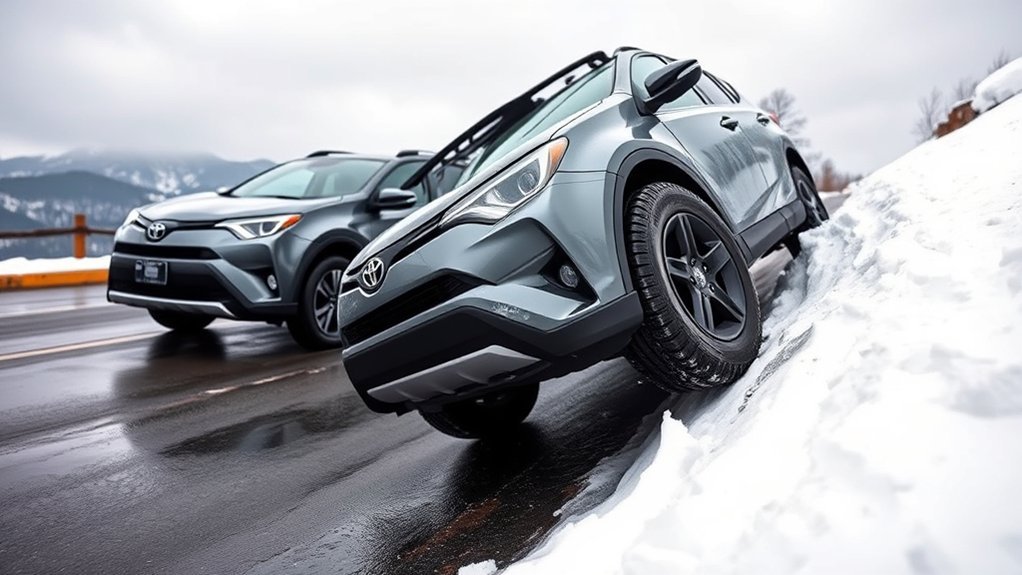
When temperatures drop and roads get snow- or ice-covered, fitting dedicated winter tires changes the traction picture for both FWD and AWD RAV4s: winter tire benefits include rubber compounds that stay flexible and tread patterns that evacuate snow, essential for a clear traction comparison. You’ll find winter tires dramatically improve grip and control, cutting stopping distances by up to 30% on snow and ice. That narrows the practical gap between FWD and AWD; a FWD RAV4 on quality winter rubber can outperform an AWD on worn or all-season tires in severe conditions. At the same time, you shouldn’t underuse AWD—pairing it with winter tires maximizes its four-wheel traction and reliability in harsh weather. Choose tires based on climate, driving needs, and road exposure. If you want freedom from winter risk, prioritize dedicated winter tires for either drivetrain: they’re the most effective, cost-efficient upgrade to enhance safety and performance.
Hybrid & PHEV RAV4s: Electrified AWD vs FWD Differences
If you’re weighing electrified RAV4 options, the Hybrid and PHEV change the FWD vs AWD tradeoffs by using electric motors to manage torque rather than relying solely on mechanical differentials. You’ll notice electric torque is applied strategically: the Hybrid often keeps a FWD bias with an auxiliary rear motor adding traction when needed (total hybrid system torque ~221 Nm), while the PHEV’s front motor alone can deliver about 270 Nm, boosting acceleration and responsiveness.
You’ll value these traits if you want freedom from compromises. Compare key distinctions numerically:
- Traction: Electrified AWD auto-adjusts torque distribution for better grip.
- Performance: PHEV front motor’s higher electric torque yields stronger acceleration.
- Efficiency: PHEV AWD can improve fuel economy under mixed driving.
- Handling: AW D setups enhance stability in slippery or variable terrain, increasing terrain adaptability.
This gives you clear criteria to choose liberation through capability, efficiency, or pure acceleration without romanticizing either setup.
Use-Case Guide: City, Mountain, Family, or Adventure
Having compared how Hybrid and PHEV systems shift torque between front and rear, it’s useful to match those mechanical differences to real-world uses so you can pick the RAV4 that fits your routine. You’ll value FWD for city conditions: it maximizes fuel efficiency and cost effectiveness, easing daily commutes while preserving driving comfort. Choose AWD when traction needs grow—mountain roads, snow, or wet passes—because it boosts weather adaptability and off road capability. For family use, AWD raises family safety and control when roads turn rough or icy. For adventure, AWD’s power distribution preserves momentum on trails and loose surfaces.
| Use Case | FWD Strengths | AWD Strengths |
|---|---|---|
| City | fuel efficiency, cost effectiveness | unnecessary weight |
| Mountain | adequate on cleared roads | traction needs, weather adaptability |
| Family | driving comfort, economical | family safety, stability |
| Adventure | lighter, cheaper | off road capability, control |
| Snow | acceptable with tires | superior traction, confidence |
Quick Checklist to Choose AWD or FWD for Your Next RAV4
Because your driving routine and local weather determine the benefits you’ll actually use, start by listing typical routes, seasonal conditions, and passengers or gear you carry; weigh AWD’s extra traction and higher purchase/maintenance costs against FWD’s better fuel economy and lower complexity, remembering that good winter tires can narrow the performance gap in snow.
Use this quick checklist to choose AWD or FWD for your next RAV4. Consider your driving habits and weather conditions objectively, then decide which trade-offs fit your life.
- Frequency of snow/ice: pick AWD if you regularly face slippery roads; otherwise FWD with good tires often suffices.
- Daily routes: steep, unmaintained, or remote roads favor AWD; urban and highway commutes favor FWD.
- Budget and maintenance: FWD costs less to buy and maintain; AWD adds roughly $1,000 and potential repair complexity.
- Cargo and passengers: heavier loads and towing can benefit from AWD’s traction; light family use often finds FWD adequate.
Choose for freedom: align drivetrain to real needs, not perceived safety.
Frequently Asked Questions
What Is the Difference Between AWD and FWD RAV4?
AWD gives you power to all four wheels for better traction and performance comparison in poor conditions, while FWD focuses on fuel efficiency and lower cost; you’ll choose freedom between grip or economy based on needs.
What Are the Disadvantages of AWD Vs FWD?
Like a heavier anchor, AWD costs more upfront and in maintenance requirements; you’ll face higher cost considerations, reduced fuel efficiency from weight difference, and more complex repairs, so you’ll trade simplicity for traction.
Conclusion
You’ve seen how AWD and FWD differ in grip, fuel use, and cost — now pick what fits your life. If you drive mostly city streets and want better MPG, FWD’s a sensible, wallet-friendly choice. If you face snow, gravel, or tow occasionally, AWD gives extra confidence and control. Think practicality first, then extras. Weigh needs against budget, and you’ll hit the nail on the head when you choose the right RAV4.