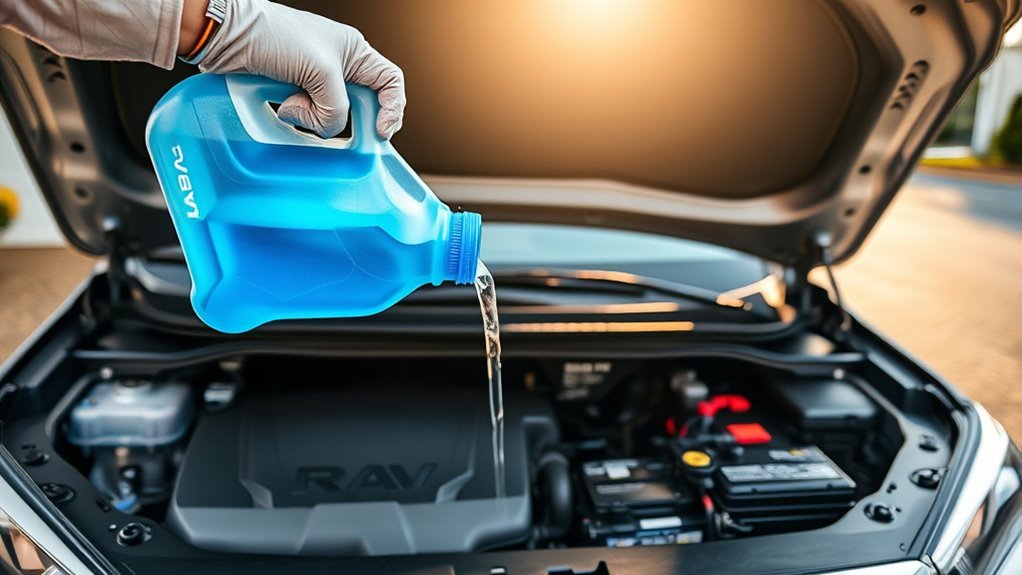
To add windshield washer fluid to a Toyota RAV4, park safely, shut off the engine, secure the hood, and find the cap marked with the windshield-and-spray symbol. Check whether your fluid is premixed or concentrated, then pour it slowly until the reservoir is near full. Close the cap and test the front and rear washers. In freezing weather, use fluid rated below the lowest temperature the vehicle will face.
This guide applies to most late-model RAV4s. Check your owner’s manual if your engine-bay layout, hood support, or washer-fluid reservoir looks different.
Last updated: July 15, 2026
Quick Answer
Park the RAV4 on a level surface, turn off the engine, open and secure the hood, and find the washer-fluid cap with the windshield-and-spray symbol. Confirm whether the fluid is ready to use or must be diluted, then pour it slowly until the reservoir is near full. Replace the cap and test both the front and rear washer spray.
Key Takeaways
- Identify the washer reservoir by the windshield-and-spray symbol, not by the cap color.
- Use only windshield washer fluid. Do not add coolant, engine antifreeze, dish soap, or household glass cleaner.
- Pour ready-to-use fluid directly, but dilute a concentrate exactly as its label directs.
- Choose fluid rated below your area’s lowest expected temperature so the reservoir, pump, hoses, and nozzles do not freeze.
- Stop before the reservoir overflows, close the cap firmly, and test the spray before driving.
At a Glance
| Time Required | About 3–5 minutes |
| Difficulty | Easy |
| Tools Needed | Washer fluid and a clean funnel, if needed |
| Fill Level | Add slowly until near full; exact capacity varies by model year |
| Approx. Reservoir Capacity | Roughly 3.8–5.7 liters (about 1–1.5 gallons), based on owner reports — Toyota does not publish an official figure |
Before You Start: Safety and Supplies
Park the RAV4 on a level surface, shift into Park, set the parking brake, and turn the engine off. Let the engine bay cool if you have just driven, especially before reaching near hot parts. You do not need to disconnect the battery or remove any parts for a normal top-off.
Read the washer-fluid bottle before you pour. A product labeled ready to use or premixed goes directly into the reservoir. A concentrate must be diluted exactly as its label directs.
Gather these items before opening the hood:
- Windshield washer fluid rated for your climate
- A clean funnel if the bottle is heavy or the opening is hard to reach
- A clean cloth or paper towel to wipe dust from the cap area
- Gloves if you want to avoid skin contact with washer fluid
Warning: Some windshield washer fluids contain methanol or other toxic alcohols. Keep the product in its original labeled container and away from children and pets. Avoid swallowing it or breathing concentrated vapors. If someone tastes or swallows washer fluid, contact Poison Control immediately at 1-800-222-1222 in the United States.
Open and Secure the Hood
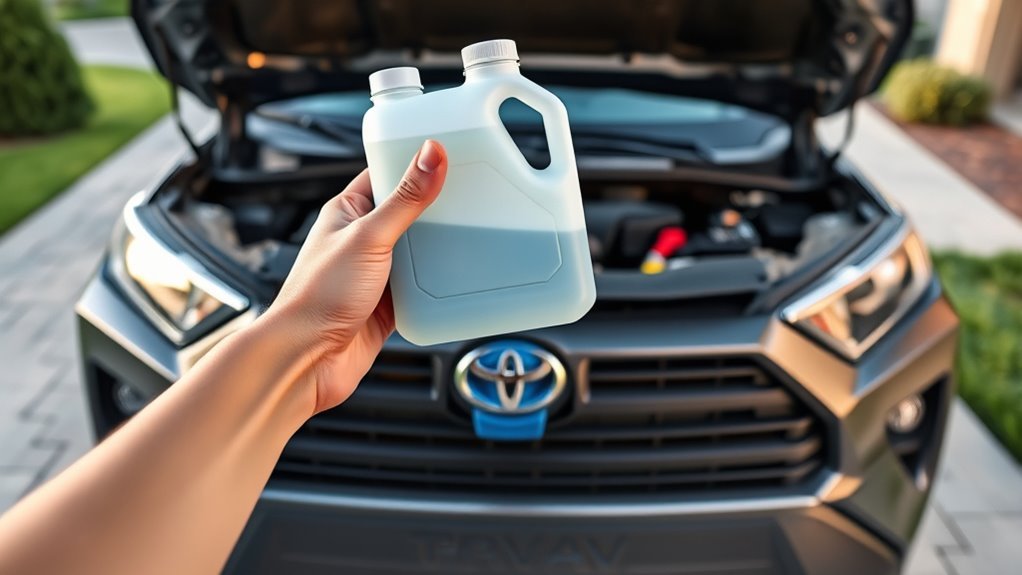
Locate the hood release lever on the driver’s side near the lower dash or footwell and pull it to release the hood latch. Move to the front of the RAV4, feel under the hood edge for the secondary hood latch, release it, and lift the hood fully.
Secure the hood using the support system fitted to your RAV4. If it has a prop rod, remove the rod from its clip and place it in the designated hole or slot. If your model uses another hood-support system, raise and secure it as described in the owner’s manual.
Give the hood a gentle stability check before reaching into the engine bay. If the support is bent, loose, missing, or will not hold the hood securely, lower the hood and correct that issue before adding fluid.
Where Is the RAV4 Washer-Fluid Reservoir?
Look for the washer-fluid reservoir cap marked with a windshield-and-spray symbol. Identify the cap by this symbol rather than by its color. The filler neck is generally near one side of the engine bay, but its exact position can vary by model year and powertrain.
The reservoir may be semi-opaque, allowing you to see some or all of the fluid level. However, covers, lighting, and the reservoir’s position can make the level difficult to judge on some vehicles.
Before opening the cap, wipe loose dirt away from the top of the reservoir. This keeps grit from entering the tank, where it could obstruct a washer line or nozzle. Open the cap and check that the filler neck is free of visible debris.
Use this quick checklist before pouring:
- The hood is fully open and stable.
- The cap shows the windshield-and-spray symbol.
- The surrounding area is wiped clean.
- The bottle says windshield washer fluid.
- The bottle is either ready to use or has dilution instructions you have followed.
Note: If you are unsure you found the correct cap, stop and compare the symbol and engine-bay layout with the windshield-washer section of the Toyota RAV4 owner’s manual library. Pouring fluid into the wrong reservoir can cause expensive damage.
How to Add Windshield Washer Fluid to a Toyota RAV4
- Confirm the fluid is prepared correctly. Use a ready-to-use product directly, or dilute a concentrate according to its label before filling.
- Remove the washer-reservoir cap. Flip or pull the cap open carefully so dirt does not fall into the filler neck.
- Insert a clean funnel if needed. A funnel helps prevent spills, especially when you are pouring from a large or full bottle.
- Pour slowly. Add fluid in steady pours. Pause regularly so the fluid can settle and you can monitor the level.
- Stop before it overflows. Fill the reservoir until it is near full, but stop once fluid approaches the filler neck. Do not assume the reservoir will accept a complete bottle because capacity varies by model year.
- Wipe up spills. Follow the product label for spill cleanup and wipe or rinse residue from painted panels, plastic trim, and rubber parts promptly.
- Close the cap firmly. A loose cap can allow dirt into the reservoir or let fluid splash out while driving.
- Test the system. Start the RAV4 or switch it to the required ON mode, then activate the front washer. Test the rear washer as well.
Watch the spray pattern on the windshield. It should wet enough of the glass for the wipers to clear dust, road film, salt, pollen, and insects without leaving large dry areas.
Pro Tip: Keep a sealed bottle of compatible washer fluid in its original container in your garage. Check the reservoir before long trips, winter storms, pollen season, bug-heavy travel, or road-salt driving instead of waiting for it to run dry.
[Products Worth Considering]

This anti-theft license plate screw kit helps secure front or rear plates with a tamper-proof design that resists common removal tools. Made from rustproof 304 stainless steel, it is built for durable outdoor use while helping reduce plate vibration and paint scratching. The kit includes screws, nuts, caps, washers, a screwdriver, and nylon plugs for broad compatibility with cars, trucks, motorcycles, and trailers.

This foldable windshield sun shade helps block harsh sunlight and harmful UV rays to keep your car interior cooler and more comfortable. Its reflective design reduces glare and helps protect dashboards, steering wheels, seats, and electronics from heat buildup and fading. With a pop-up foldable style and universal fit for many vehicles, it installs quickly and stores neatly when not in use.

These Tomatoman seat covers are designed to fit Tacoma models across multiple years and trims, giving your front seats a refreshed look with added protection. Made from faux leather with a non-slip backing, they are waterproof, comfortable, and built to resist wear while maintaining compatibility with side airbags for safety. Installation is straightforward with guidance from the manual or video, making them a practical upgrade for daily driving and long-term interior protection.
How Do You Choose the Right Washer Fluid?
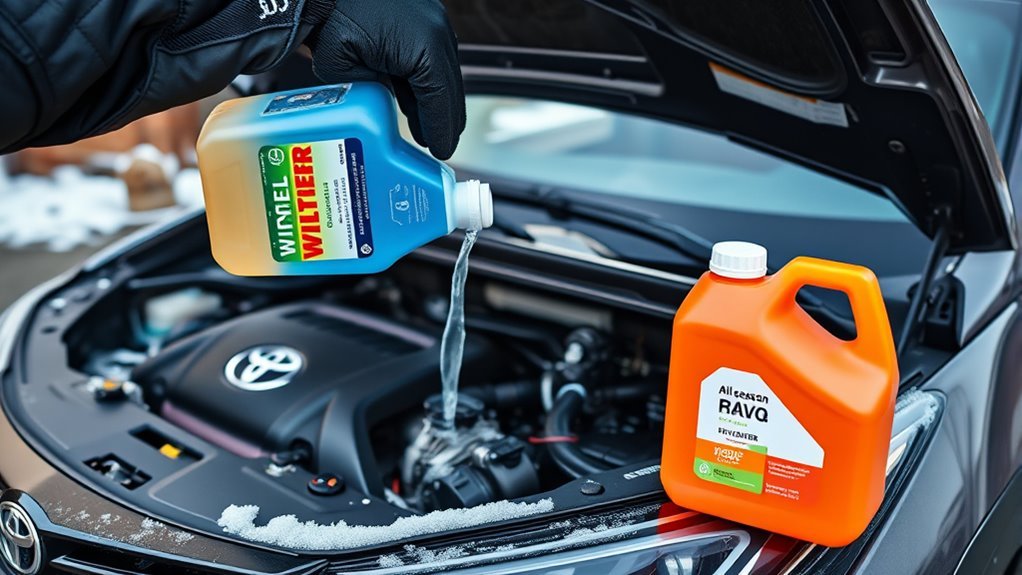
Choose washer fluid by the lowest temperature your RAV4 may face while driving or parked, not only by the current daytime temperature. Plain water freezes at 32°F, and a frozen mixture can prevent the pump, hoses, and nozzles from working.
Use this label-based guide before filling:
| Label Type | What to Do | Main Caution |
|---|---|---|
| Ready to use or premixed | Pour it directly into the reservoir. | Confirm its freeze rating suits your weather. |
| Concentrate | Dilute it exactly as the label directs. | Do not guess the water-to-fluid ratio. |
| Winter or de-icer | Choose a rating below your coldest expected temperature. | Mixing it with summer fluid may weaken freeze protection. |
| Bug-removing or summer | Use it for warm-weather residue and insects. | Do not assume it protects against freezing. |
For a warm climate, a ready-to-use summer or all-season product may be suitable when freezing weather is not expected. For mixed or cold climates, choose a clearly marked freeze rating below the lowest overnight temperature the vehicle may encounter.
Avoid homemade blends containing dish soap, household glass cleaner, or an unmeasured amount of alcohol. They can foam, streak, clean poorly, or provide uncertain freeze protection. Washer-fluid formulas and availability can also vary by region because some jurisdictions regulate volatile organic compounds used for freeze protection.
Rule of thumb: Use a fluid whose labeled freeze protection is lower than the coldest temperature your RAV4 is likely to face.
[Products Worth Considering]

SYLVANIA SilverStar Ultra H11 halogen bulbs are designed to deliver brighter down-road visibility and a whiter light for improved clarity at night. Patented Tri-Band Technology enhances contrast to help you spot road signs and hazards more easily, while replacing bulbs in pairs supports more consistent performance. Built for exact-fit compatibility in H11 applications, this two-bulb pack is a practical upgrade for safer nighttime driving.

Meguiar's Ultimate Liquid Wax delivers a glossy finish, long-lasting protection, and exceptional water beading in an easy one-step application. Its pure synthetic formula helps shield paint from contaminants and UV rays while enhancing depth, shine, and reflections on glossy finishes and clear coats. Designed for simple use by hand or with a dual action polisher, it applies smoothly even in full sun for professional-looking results.
How Do You Test and Troubleshoot the Washer System?
After filling the reservoir, activate the washer and check the spray. If the spray is weak, uneven, delayed, or missing, work from the simplest cause toward the more involved repairs.
[Products Worth Considering]

Fitment: Replacement for Toyota Prius 2004-2014 Camry 2007-2017 FJ Cruiser 2007-2014 Corolla 2009-2016 Highlander 2004-2013 Sienna 2004-2014, Lexus ES350 2007-2014, Ford Fusion 2006-2016 and more other car models

【Function】A ABIGAIL Windshield Washer Pumps provide pressure that enables pumps fluid from washer fluid reservoir, through the washer nozzle, onto your windshield to help wash away dirt.

Exact Fit for Specific Vehicles - Compatible for Toyota RAV4 2000-2005, for Toyota Echo 2000-2005, for Toyota Sienna 1998-2003, for Toyota Solara 1999-2008, for Toyota Corolla 2003-2008, for Toyota Celica 2003-2005, for Toyota Tundra 2000-2006, for Toyota Matrix 2003-2008, for Toyota Camry 1992-2006, for Toyota 4Runner 1992-2002, for Toyota Land Cruiser 1998-2007. Full compatibility list available in "Technical Details". Verify your vehicle's make, model, year, and OE reference number (OE# 85330-02020 ) before purchase.
Why Does No Washer Fluid Spray?
- Check the reservoir level. The tank may still be empty if fluid leaked out during or after filling.
- Listen for the pump. If you hear it, check for frozen fluid, blocked nozzles, a kinked hose, a disconnected line, or a leak.
- Check the washer nozzles. Look for wax, dirt, pollen, or ice covering the openings.
- Inspect visible hoses. Look for disconnected, cracked, pinched, or leaking washer lines.
- Consider an electrical fault if the pump is silent. A fuse, switch, connection, wiring problem, or failed pump may require diagnosis.
Why Is the Washer Spray Weak or Uneven?
Clean the outside of each nozzle with a damp cloth or soft brush. Do not insert a pin, drill bit, or other hard object into the opening because it can enlarge the nozzle or alter the spray pattern.
If one side sprays and the other does not, check the affected nozzle and its hose. If both sides are weak, check for low fluid, frozen fluid, a leak, a restricted line, or a weak pump.
What Should You Do If the Washer Fluid Freezes?
Move the RAV4 to a warmer place if possible and let the system thaw naturally. Do not pour hot water over the reservoir, nozzles, or windshield, and do not repeatedly operate the pump while the system is frozen.
After the system has thawed, replace the weak mixture with properly rated winter washer fluid according to the product directions. Use only short washer bursts while confirming that fluid is moving normally.
What Does a Washer-Fluid Leak Mean?
A puddle under the front of the vehicle after filling may point to a cracked reservoir, loose hose, damaged fitting, or leaking pump seal. If the tank empties quickly or the pump area remains wet, repair the leak before another top-off.
Warning: Do not keep running the washer pump when the reservoir is empty or the fluid is frozen. Short testing bursts are enough. Repeated operation can strain the pump.
How Often Should You Check RAV4 Washer Fluid?
A monthly check is a practical habit, but inspect the level more often during winter, pollen season, dusty driving, bug-heavy travel, or frequent highway use. Check it before long drives and whenever a low washer-fluid warning appears.
Some RAV4 trims display a washer-fluid icon or message on the instrument cluster or multi-information display when the reservoir runs low — treat that as your cue to check the level, even outside your usual schedule.
If your RAV4 sits outside in freezing weather, switch to appropriately rated winter fluid before the first hard freeze. Do not wait until the reservoir or washer lines have already frozen.
Common Washer-Fluid Mistakes to Avoid
- Identifying the reservoir by color: Use the windshield-and-spray symbol instead.
- Pouring concentrate directly into the tank: Dilute it exactly as the label instructs.
- Using plain water in freezing weather: It can freeze and stop the washer system from working.
- Using engine antifreeze: Coolant is not washer fluid and can smear the glass or damage finishes.
- Using household glass cleaner or dish soap: These products are not formulated for the washer tank and may foam or streak.
- Overfilling the reservoir: Stop before fluid backs up through the filler neck.
- Ignoring weak spray: Poor spray can indicate a clog, leak, frozen line, or failing pump.
- Leaving summer fluid in severe cold: Its freeze rating may not protect the reservoir, hoses, pump, and nozzles.
Frequently Asked Questions
Can I use distilled water instead of washer fluid?
Use distilled water only as a short-term emergency option when temperatures will remain safely above freezing. It does not clean as effectively as washer fluid and does not provide dependable freeze protection. Replace it with suitable washer fluid as soon as practical.
How often should I refill washer fluid?
Check the level about once a month, before road trips, and during heavy-use seasons such as winter, pollen season, or bug season. Refill whenever the reservoir is low or the low washer-fluid warning appears.
How much washer fluid does a Toyota RAV4 hold?
Toyota does not publish an official capacity figure, and it can vary by model year and configuration. Owner reports put full capacity at roughly 3.8–5.7 liters (about 1–1.5 gallons). Don’t assume the RAV4 will accept a complete gallon at once — pour slowly, watch the filler neck, and stop when the reservoir is near full without overflowing.
Can I mix different windshield washer fluids?
Compatible ready-to-use washer fluids can often be used for a normal top-off, but mixing summer and winter formulas makes the final freeze rating uncertain. Before severe cold, use down the existing fluid and refill with a clearly rated winter product. Never mix a concentrate without following its dilution instructions.
Is washer fluid harmful to paint or plastic?
Follow the product label and wipe or rinse spills promptly. Do not allow concentrated fluid or dried residue to remain on painted surfaces, rubber trim, or plastic engine-bay covers.
Can I add washer fluid with the engine running?
Turn the engine off before filling. This provides a quieter engine bay and reduces the chance of contact with hot or moving parts. Close the reservoir cap before restarting the RAV4.
Where can I recycle an empty washer-fluid container?
Follow the disposal instructions on the product label and check your local recycling or household-hazardous-waste rules. Do not rinse, puncture, burn, or place the jug in curbside recycling unless your local program specifically accepts that container. Containers that still hold fluid should be handled through an approved local disposal program.
What should I do if I poured washer fluid into the wrong reservoir?
Do not start the engine or drive if washer fluid entered the coolant reservoir, brake-fluid reservoir, engine-oil fill opening, or another fluid reservoir. Close the affected opening, record what happened, and have the contaminated system inspected and drained by a qualified technician.
Why does my RAV4 washer pump make noise but nothing comes out?
If the pump runs but no fluid sprays, check for an empty reservoir, blocked nozzles, frozen fluid, a disconnected hose, a kinked line, or a leak. Start with the fluid level and visible nozzle openings before replacing the pump.
Conclusion
Adding washer fluid to a RAV4 takes only a few minutes. Park safely, secure the hood, identify the windshield-and-spray symbol, check whether the fluid is premixed or concentrated, and pour slowly until the reservoir is near full.
Close the cap and test both washer functions before driving. If the pump runs without spraying, inspect the fluid level, nozzles, hoses, and visible leaks before buying replacement parts.
Sources
- Toyota: Changing Your Windshield Washer Fluid — general Toyota guidance on checking, selecting, and filling washer fluid.
- Toyota Owners: RAV4 Manuals and Warranties — official RAV4 owner-manual reference for model-specific details.
- Toyota Owners: Windshield Wipers and Washer — washer-system operation and troubleshooting reference.
- Poison Control: Windshield Washer Fluid — safety information about washer-fluid ingestion and methanol exposure.
- U.S. EPA: Household Hazardous Waste — guidance on safe storage and local disposal of potentially hazardous household products.
- California Air Resources Board: Windshield Washer Fluid — information about regional VOC rules and freeze-protection formulations.