

A Toyota RAV4 likely needs an alignment check when it consistently pulls on multiple flat roads, the steering wheel remains off-center while you travel straight, or the tread shows one-sided or feathered wear. Vibration alone points first toward tire balance, tire or wheel damage, brakes, or worn steering and suspension parts. Check cold tire pressure and visible tire condition first, then request a complete inspection if the symptom remains.
Quick Answer
Book an alignment check when the RAV4 has a steady pull, an off-center steering wheel, one-sided or feathered tread wear, or new symptoms after a curb or pothole impact. Check tire balance and tire or wheel condition first when the main symptom is vibration at road speed. Inspect the brakes first when pulling or vibration occurs mainly while braking.
Key Takeaways
- Toyota’s public guidance focuses on symptoms such as pulling, an off-center steering wheel, and uneven tire wear rather than one universal RAV4 alignment interval.
- One-sided or feathered tread wear is a stronger alignment clue than steering-wheel vibration by itself.
- Highway-speed vibration usually calls for a tire, wheel, balance, and runout inspection before alignment is treated as the only cause.
- Ask the shop to measure all four wheels, inspect the steering and suspension, and provide a before-and-after alignment printout.
- Toyota T-SB-0063-20 provides useful pull-diagnosis guidance for 2002–2021 Toyota vehicles, including the RAV4; newer models require model-year-specific repair information.
At a Glance
| Strongest Alignment Clues | Steady pull on multiple flat roads, off-center steering wheel, feathering, or one-sided tread wear. |
| First Checks | Cold tire pressure, visible tire damage, tread pattern, recent impacts, and whether the symptom changes with speed or braking. |
| Time Required | 10–15 minutes for a basic home inspection; shop time varies with diagnosis, adjustment, and repairs. |
| Difficulty | Easy for inspection; measuring and adjusting alignment requires professional equipment. |
| Tools Needed | Tire-pressure gauge, tread-depth gauge or penny, and a flashlight. |
| Cost | A home inspection is free or low-cost. Shop cost depends on location, vehicle condition, and whether steering or suspension repairs are required. |
What Are the Main RAV4 Alignment Symptoms?
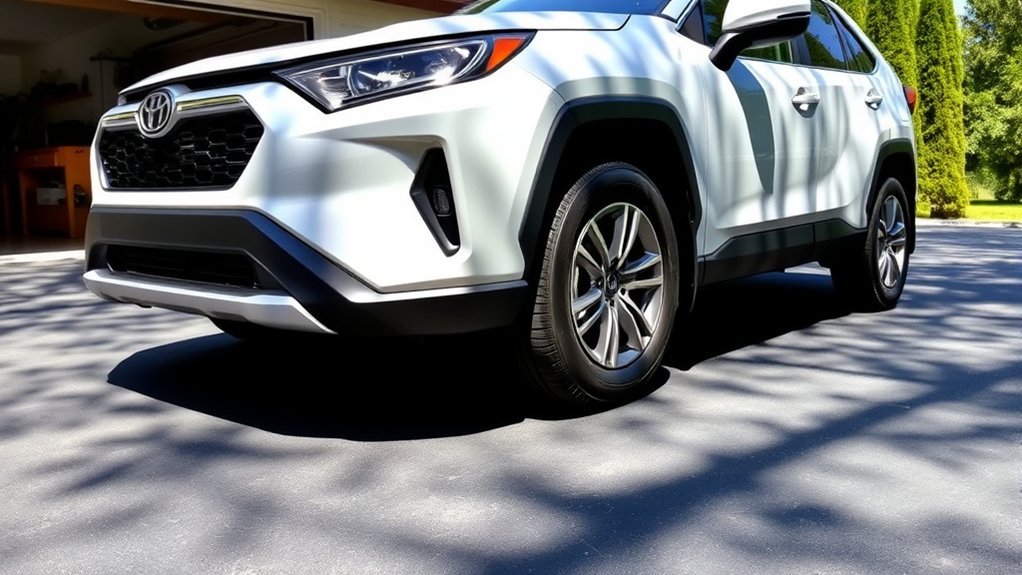
A wheel alignment sets the angles at which the wheels meet the road. The principal angles are toe, camber, and caster. Incorrect toe can scrub or feather the tread. Incorrect camber can place extra load on one tire edge. Caster differences can affect straight-line tracking and steering return.
Toyota’s current wheel-alignment guidance identifies uneven wear, vehicle veering, and an off-center steering wheel as common warning signs. It also separates wheel alignment from tire balancing: alignment controls wheel angles, while balancing corrects uneven weight distribution in the rotating tire and wheel assembly.
Toyota diagnostic principle: A vehicle pull is not proof of bad alignment. Tire force, road crown, tire-pressure differences, brake drag, impact damage, and worn steering or suspension parts can create similar symptoms.
Warning: Do not keep driving normally if the RAV4 suddenly pulls hard, feels unstable, has a tire bulge, shows exposed cords, develops a loose or wobbling wheel, or vibrates heavily. Slow down safely, avoid unnecessary highway driving, and arrange an inspection before continuing.
Is It Alignment, Balance, Brakes, or Suspension?
Match the symptom to the condition that triggers it. A constant pull is different from a pull that happens only while braking, and a speed-related shake is different from an off-center steering wheel with no vibration.
| Symptom | Possible Causes | Best Next Step |
|---|---|---|
| RAV4 consistently pulls left or right on several flat roads | Alignment, pressure difference, tire conicity, worn steering or suspension part, impact damage | Correct cold pressure, inspect the tires, then request an alignment and suspension diagnosis if the pull remains. |
| Steering wheel is crooked while the RAV4 travels straight | Toe or steering-wheel centering issue, previous impact, suspension wear, incomplete prior adjustment | Ask the shop to confirm whether the vehicle is actually pulling and to check wheel angles and steering-wheel centering. |
| One tire edge wears faster or the tread feels feathered | Toe or camber issue, loose or worn parts, missed rotations | Measure tread depth across the tire and have the alignment and suspension inspected. |
| Steering wheel shakes mainly at highway speed | Tire imbalance, out-of-round or damaged tire, bent wheel, runout, wheel bearing, worn suspension | Request tire and wheel inspection, balancing, and runout checks before assuming alignment is the only problem. |
| Pulling or vibration happens mainly while braking | Brake drag, sticking caliper, uneven brake force, rotor or hub issue | Have the brake system inspected. See the RAV4 sticking brake caliper guide for related warning signs. |
| Symptoms begin after a pothole or curb strike | Tire sidewall damage, bent wheel, shifted alignment, bent steering or suspension part | Inspect the tire and wheel immediately, then arrange a professional steering, suspension, and alignment check. |
| RAV4 still pulls after a recent alignment | Tire conicity, road crown, pressure difference, brake drag, worn parts, damage, incomplete diagnosis | Return with the printout and ask the shop to reproduce the pull and diagnose the tires, brakes, and mechanical condition. |
What Do RAV4 Tire Wear Patterns Mean?
Uneven tire wear is one of the strongest signs that the RAV4 needs attention, but the location and shape of the wear matter. One-sided wear and feathering point more directly toward wheel angles. Center wear and wear on both shoulders point first toward inflation. Cupping or scalloping can indicate balance or suspension trouble.
Michelin’s tire-wear guidance treats these patterns as diagnostic clues rather than final proof. More than one condition can exist at the same time, so pressure, tire condition, balance, steering, suspension, and alignment may all need inspection.
| Wear Pattern | What It Often Suggests | What to Check |
|---|---|---|
| Inner or outer edge worn more than the rest | Camber or toe problem, worn or bent component | Alignment measurements plus ball joints, tie rods, bushings, bearings, and impact damage |
| Feathered or sawtooth tread ribs | Excessive toe or movement from worn suspension parts | Toe readings, steering linkage, and control-arm bushings |
| Both outer shoulders worn | Chronic underinflation or overloading | Cold pressure, leaks, vehicle load, and pressure-check habits |
| Center tread worn faster | Chronic overinflation | Door-placard pressure and gauge accuracy |
| Cupped or scalloped dips around the tire | Imbalance, worn dampers or suspension parts, bearing movement, or runout | Balance, tire and wheel runout, struts, bearings, and suspension condition |
| Localized flat or damaged area | Brake lock, impact damage, separation, storage flat spot, or another tire fault | Professional tire inspection before normal-speed driving |
Once an abnormal wear pattern develops, correcting the cause does not restore the missing rubber. The tire may continue to make noise or vibrate even after the pressure, balance, suspension, or alignment problem is repaired.
If you recently installed new tires, ask for an alignment check when the old tires had one-sided or feathered wear. Otherwise, the new tread can begin developing the same pattern.
Pro Tip: Photograph the inner edge, center tread, outer edge, and sidewall of every tire before service. Also record tread depth at all three positions. This gives you a baseline for checking whether the wear continues after repair.
What Should You Check Before Booking a RAV4 Alignment?
You cannot accurately measure alignment angles without the correct equipment, but you can identify the symptoms and safety concerns that determine what the shop should inspect.
- Check tire pressure when the tires are cold. Use the pressure listed on the driver-door placard for your specific RAV4, not the maximum pressure molded into the tire sidewall.
- Inspect all four tires. Look for bald areas, exposed cords, sidewall bubbles, cuts, nails, cracks, and uneven wear.
- Compare tread depth. Measure the inner edge, center, and outer edge of each tire. Record the readings instead of relying only on appearance.
- Think about recent changes. Note any pothole or curb impact, tire installation, wheel removal, collision repair, steering repair, suspension repair, or change in tire pressure.
- Match the symptom to the driving condition. Record whether it is constant, speed-related, braking-related, acceleration-related, or limited to certain roads.
- Use only a normal, safe observation drive. Keep both hands in normal control, obey all traffic laws, and do not release the steering wheel or disable driver-assistance systems to copy a technician road test.
- Book service if the symptom remains. Request tire-pressure verification, tire and wheel inspection, balance and runout checks when vibration is present, brake inspection when the symptom occurs during braking, and alignment measurement when pulling, steering-wheel position, or tread wear supports it.
Road-crown note: Roads are commonly sloped for drainage. A slight change in drift between left and right lanes may be environmental. A pull that remains in the same direction on several suitably flat roads deserves closer inspection.
[Products Worth Considering]

This LUMITECO tire tread depth gauge set makes it easy to monitor tire wear and maintain safer driving performance. The color-coded scale provides quick, easy-to-read measurements, while the compact pocket-size design and included clip make it convenient to keep in your vehicle or toolbox. Suitable for cars, trucks, motorcycles, and more, it offers a simple reusable way to check tread depth whenever needed.

This digital tire tread depth gauge helps you check tire wear quickly and accurately with fractional inch, decimal inch, and millimeter readouts. Its large LCD screen, zero reset function, and automatic shutoff make it easy to use for cars, motorcycles, SUVs, trucks, and pickups. Designed for clear readings and dependable measurement, it is a practical tool for routine tire safety checks.

This master ball joint removal kit gives you the tools needed to remove and install ball joints, tie rod ends, Pitman arms, and other front-end components. It is designed for broad compatibility with many GM, Chevrolet, Ford, and Dodge vehicles, including a range of light trucks, vans, and SUVs. Built from forged steel and stored in a molded ABS case, it offers durable performance and organized portability for garage or shop use.
What Does Toyota’s Pull-Diagnosis Bulletin Measure?
Toyota’s T-SB-0063-20 alignment bulletin applies to 2002–2021 Toyota vehicles, including the RAV4. It distinguishes an off-center steering wheel from a true vehicle pull. An off-center wheel means the vehicle travels straight but the wheel is angled. A pull means the vehicle moves laterally when the driver is not applying corrective steering effort.
For its controlled technician road test, the bulletin uses a flat road, 100 metres of travel, and a constant 35 mph where conditions permit. Lateral movement of more than five feet is classified as a pull in that procedure; five feet or less is within the bulletin’s stated range. Toyota also instructs technicians to check tire size, wear, pressure, collision or impact damage, bent or worn parts, modifications, and brake drag before blaming alignment.
Do not reproduce the bulletin’s controlled test yourself on a public road. It is professional diagnostic guidance, not a recommendation to release the steering wheel or switch off safety systems. For a 2022-or-newer RAV4, the shop should use Toyota repair information for the exact model year.
Is RAV4 Steering-Wheel Vibration an Alignment or Balance Problem?

Steering-wheel vibration can appear alongside alignment-related tire wear, but vibration at road speed points more directly toward rotating components. Common first checks include tire pressure, missing balance weights, tire damage, an out-of-round tire, a bent wheel, wheel or tire runout, wheel-bearing condition, and looseness in the steering or suspension.
If vibration happens mainly while braking, inspect the brake rotors, hubs, pads, calipers, and bearings. If it grows mainly during acceleration, the drivetrain may require diagnosis. The dedicated RAV4 steering-wheel vibration guide covers those broader brake and drivetrain paths without expanding this alignment article into a competing vibration guide.
NHTSA TireWise explains that tire balancing helps prevent shaking and vibration, while wheel alignment helps stop a vehicle from veering on a straight, level road. A useful service request is: “Please inspect the tires and wheels, check balance and runout if vibration is present, inspect the brakes and suspension as indicated, and then measure alignment.”
What Should a Shop Check During a RAV4 Alignment Visit?
A proper alignment visit should begin with diagnosis rather than immediate adjustment. Toyota’s bulletin says technicians should identify whether the complaint is a true pull or merely an off-center steering wheel and inspect tires, wheels, steering, suspension, brakes, and impact or collision damage before changing alignment values.
Ask the service advisor for these items:
- Measurement of all four wheels. Adjustment availability varies by RAV4 model year and rear-suspension design.
- A before-and-after printout showing the measured values, specification ranges, and final results.
- Tire-pressure correction before alignment measurements are taken.
- Tire and wheel inspection for one-sided wear, feathering, cupping, sidewall damage, bent wheels, runout, or tire-force concerns.
- Steering and suspension inspection for loose, worn, bent, or damaged parts before adjustments.
- Brake inspection when the RAV4 pulls while braking or one wheel appears unusually hot.
- Tire balance and runout checks when the main symptom is vibration.
- A verification road test after adjustment or repair.
If a tie rod, bushing, ball joint, bearing, strut, wheel, or other part is loose, worn, or bent, the alignment may not remain within specification until that fault is repaired.
[Products Worth Considering]

This dial type tire tread depth gauge helps you quickly check tread wear on motorcycles, cars, trucks, and buses with easy-to-read 1/32-inch increments. Its colorful zone markings make it simple to assess tire condition for safer driving in different weather, while the durable zinc cast body and legible dial provide dependable everyday use.

This wheel alignment tool makes it easy to check and adjust toe-in and toe-out at home for better handling, stability, and more even tire wear. Designed for one-person use, it includes tape-measure slots for simple setup and accurate measurements without extra help. Its stainless steel construction and broad vehicle compatibility make it a practical addition to any DIY garage.

This 50-pack of tire tread depth gauges offers a simple way to check tire wear quickly and accurately. Color-coded reading zones make it easy to see tread condition at a glance, while the compact design and pocket clip support convenient everyday carry. Built for repeated use, these gauges help drivers monitor tire safety with confidence.
How Do You Read the Alignment Printout?
- Before measurements show the wheel angles when the RAV4 entered the alignment rack.
- Specification ranges show the acceptable limits loaded into the equipment for the selected model and configuration.
- After measurements show the final values after permitted adjustments.
- Toe strongly affects tread scrubbing and feathering. Camber affects how the tire loads its inner and outer edges. Caster affects directional stability and steering return.
- An all-green printout is not a complete diagnosis. The RAV4 can still pull or vibrate because of tire conicity, road crown, imbalance, runout, brake drag, tire damage, or worn parts.
When Should You Schedule a RAV4 Alignment Check?
Schedule an alignment inspection when the RAV4 develops a repeatable pull, the steering wheel remains off-center, the tread becomes feathered or wears on one side, or the symptoms begin after a hard curb or pothole impact.
An alignment check is also appropriate after repairs or changes that affect wheel position, including tie-rod, control-arm, ball-joint, strut, steering, collision, or suspension work. When replacing tires, check alignment if the old set had abnormal wear or the vehicle already had a steering symptom.
Toyota’s public alignment guidance does not provide one universal RAV4 mileage interval. Follow the maintenance information for your exact model year, inspect the tread during rotations, and respond to symptoms rather than buying an alignment automatically at every service visit.
Toyota’s 2023 RAV4 maintenance guide includes tire rotation throughout its scheduled maintenance log. Rotation helps expose differences in tire wear, but it does not repair bad wheel angles, loose parts, tire damage, or an imbalance.
[Products Worth Considering]

This smart tire tread depth gauge provides quick, accurate readings from 0 to 1 inch in 1/32-inch increments, helping drivers assess tire wear with confidence. Its color-coded display makes it easy to see tread condition at a glance, while the pocket clip adds convenient portability for garages, glove boxes, and on-the-go inspections. Designed for use on trucks, motorcycles, automobiles, and other passenger vehicles, it is a simple tool for safer tire maintenance.

This DIY toe alignment tool kit helps home mechanics quickly check and adjust front-end toe after suspension, steering, or tire service. Stainless steel toe plates and dual tape measures provide a simple, reliable reference for reducing uneven tire wear and improving straight-line tracking without needing a full alignment machine.

This all-in-one front end service kit is designed to help remove stubborn ball joints, tie rod ends, and pitman arms on a wide range of vehicles. Built from hardened alloy and organized in a portable ABS case, it offers reliable performance for both professional mechanics and DIY repairs.
How Can You Reduce RAV4 Alignment and Tire-Wear Problems?
- Maintain the placard pressure. Check all tires cold with a reliable gauge.
- Inspect tires monthly. Check tread depth, one-sided wear, feathering, cupping, cuts, nails, and bulges.
- Rotate tires according to the model-year guide. Rotation distributes normal wear but cannot correct a mechanical fault.
- Slow down for potholes and rough road edges. Impacts can damage tires, bend wheels, and move or damage steering and suspension parts.
- Respond to a crooked steering wheel. An off-center wheel can exist without a true pull, but it still deserves measurement and correct centering.
- Keep service records and printouts. Comparing tread measurements and alignment sheets helps identify a recurring problem.
- Recheck after repairs. Confirm that the steering wheel is centered, the pull is gone, and abnormal wear is not continuing.
Frequently Asked Questions
When should I check wheel alignment on a Toyota RAV4?
Check alignment when the RAV4 consistently pulls, the steering wheel remains off-center while traveling straight, the tires show one-sided or feathered wear, or the symptoms begin after an impact or steering or suspension repair. Toyota’s public guidance focuses on symptoms rather than one universal RAV4 mileage interval.
How long does an alignment take on a Toyota RAV4?
A straightforward measurement and adjustment can fit within a normal service appointment, but total time depends on the shop, equipment, vehicle condition, road-test requirements, and whether the technician finds damaged tires, bent wheels, worn parts, brake drag, or balance problems. Ask for a time estimate when booking.
Can I drive my RAV4 if the alignment is bad?
A mild, stable symptom may allow a cautious trip to a nearby repair facility, but do not continue normal driving if the RAV4 pulls sharply, feels unstable, shakes heavily, has loose steering, or shows a bulge, exposed cords, wheel wobble, smoke, or another visible safety problem.
Is steering-wheel vibration always an alignment problem?
No. Speed-related vibration more directly suggests tire imbalance, tire or wheel runout, tire damage, a bent wheel, a bearing problem, or worn steering and suspension parts. Braking-only vibration points toward the brake and hub assemblies. Alignment becomes more likely when vibration appears with pulling, an off-center wheel, or one-sided or feathered wear.
Should I get an alignment after replacing RAV4 tires?
Have alignment measured when replacing tires if the previous tires had one-sided or feathered wear, the RAV4 pulls, the steering wheel is off-center, or the vehicle recently hit a pothole or curb. New tires should also be balanced when installed.
Does every RAV4 need a four-wheel alignment?
Ask the shop to measure all four wheels so the front and rear relationship is documented. The angles that can be adjusted vary by RAV4 model year and suspension design, so a technician should follow Toyota’s model-specific procedure rather than promise that every angle on every wheel is adjustable.
Can road crown make a RAV4 pull to one side?
Yes. Roads are often sloped for drainage, and the direction or strength of the drift can change between lanes. A pull that remains in the same direction on several suitably flat roads is more useful diagnostic evidence than a drift noticed on one crowned road.
Why does my RAV4 still pull after an alignment?
The cause may be tire conicity, unequal pressure, road crown, brake drag, tire or wheel damage, a worn or bent steering or suspension part, or an incomplete prior diagnosis. Return with the alignment printout and ask the shop to reproduce the symptom before making another adjustment.
What should I ask the repair shop for?
Ask for cold tire-pressure correction, tire and wheel inspection, measurement of all four wheels, a steering and suspension inspection, a before-and-after printout, and a verification road test. Add balance and runout checks for speed-related vibration and a brake inspection for braking-related pulling or vibration.
Conclusion
The clearest RAV4 alignment symptoms are a repeatable pull on several flat roads, an off-center steering wheel, and one-sided or feathered tread wear. Highway-speed vibration points first toward tires, wheels, balance, and runout, while braking-only symptoms require brake inspection.
Start with cold tire pressure and visible tire condition. If the symptom remains, ask the shop to diagnose the tires, wheels, brakes, steering, and suspension before changing alignment values. Request measurements, a before-and-after printout, and a verification road test so you know what was found and whether the underlying problem was corrected.
Sources
- Toyota: Wheel Alignment & Why It Matters — supports alignment-angle definitions, common symptoms, and the distinction between alignment and balancing.
- Toyota Technical Service Bulletin T-SB-0063-20 — supports the 2002–2021 scope, pull-versus-off-center distinction, road-crown and tire-conicity guidance, inspection order, and controlled road-test benchmark.
- NHTSA TireWise: Tire Safety Ratings and Awareness — supports cold-pressure checks, tire inspection, tread monitoring, balance, alignment, vibration concerns, and rotation guidance.
- Toyota 2023 RAV4 Warranty & Maintenance Guide — supports model-year maintenance and recurring tire-rotation guidance.
- Michelin: Tire Wear Problems — supports distinctions among one-sided wear, feathering, inflation wear, and cupping or scalloping.




[…] bushings can cause clunking over bumps, squeaking, steering wander, vibration, poor alignment, and uneven tire wear. A noise or visible crack is only a clue, not a complete diagnosis. If the vehicle pulls sharply, […]