If your RAV4 defroster is not working, first identify which system failed. A front windshield that will not clear points to airflow, A/C dehumidification, heater output, or HVAC-door control. A rear window that stays foggy points to the rear defogger circuit, connector tabs, or printed grid. Start with the switch, fuse, airflow, and visible damage before replacing parts. Do not drive until the windshield, side glass, and mirrors give you a safe view.
Last updated: September 1, 2026 · Reviewed against official Toyota RAV4 owner guidance, NHTSA winter-visibility advice, and current defogger-repair instructions.
Quick Answer
For a front windshield problem, select front defrost, use outside air, raise fan speed and temperature, and confirm the A/C dehumidification function and blower airflow. If airflow is strong but stays cold after normal engine warm-up, check the heating/coolant side before assuming an HVAC door has failed. For the rear glass, check the switch and fuse, then verify near battery/system voltage at the feed side, a good ground at the return side, and continuity through the printed grid.
What’s in This Article
- Symptoms That Point to a Front or Rear Defroster Fault
- Quick Checks to Try First (Fuse, Switch, A/C, Blower, Vents)
- Test the Rear Defroster Grid and Feed Tabs Safely
- Front Defrost Causes: Mode Door, Blend Door, Servos
- How the RAV4 Defroster Systems Work (Front vs. Rear)
- DIY Repairs vs. Replacement: Conductive Paint, Conductive Epoxy, New Glass
- Diagnostic Checklist and Next Steps by Symptom
- When to Stop Driving and Get Professional Help
- Frequently Asked Questions
Key Takeaways
- Check the simple items first: switch, fuse, A/C, blower speed, cabin filter, and blocked vents.
- Test the rear grid with the vehicle in its normal ready-to-drive power state and the rear defogger turned on.
- Small rear grid breaks often respond to conductive paint or a proper defroster repair kit.
- Front defrost trouble can come from weak airflow, a clogged cabin filter, low heat output, or a stuck HVAC door.
- Stop driving if fog, frost, smoke, burning smells, or electrical heat blocks safe visibility.
Model-year scope: RAV4 fuse names, relay locations, HVAC actuators, heated-mirror behavior, and scan-tool procedures vary by generation, powertrain, trim, and market. Use the owner manual and service information for your exact model year before removing trim or replacing electrical parts.
| What You See | Most Likely Area to Check First | Best Next Test |
|---|---|---|
| Front glass fogs; rear glass clears | Front HVAC airflow or heat | Check defrost mode, outside air, fan speed, cabin filter, and air temperature |
| Rear glass does not clear at all | Power, ground, fuse, relay/control, or main tab | Verify feed voltage and ground before testing individual grid lines |
| Only one or a few rear strips stay foggy | Printed grid-line break | Trace the affected line gently with a voltmeter |
| Strong front airflow stays cold after warm-up | Heating/coolant path or blend door | Confirm engine warm-up and heater output before actuator replacement |
Symptoms That Point to a Front or Rear Defroster Fault
Start by matching the symptom to the right system. If the windshield stays foggy but the rear glass clears, focus on the front heating, ventilation, and air conditioning (HVAC) system. If the windshield clears but the rear glass stays foggy, focus on the rear defogger circuit and glass grid.
A front defrost fault may show weak airflow, air coming from the wrong vents, cold air after the engine has warmed, or clicking behind the dash. A rear defogger fault splits more cleanly: if every grid line fails, test power, ground, fuse, control, relay, and tabs first; if one or a few strips fail while the rest clear, inspect those printed traces for a break.
Quick Checks to Try First (Fuse, Switch, A/C, Blower, Vents)
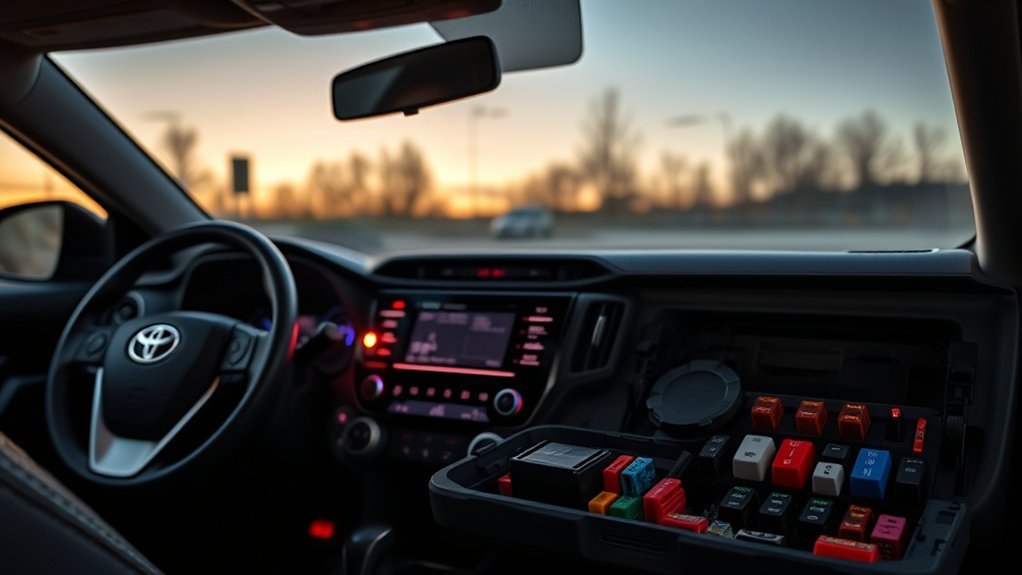
Start with five quick checks you can do in minutes. First, press the rear defroster switch and confirm the indicator lights, if your RAV4 has one. The light confirms the control request, but it does not prove that power reaches the rear grid.
Next, inspect the correct fuse listed in your owner manual or fuse-box cover. Replace a blown fuse only with the same amp rating. If the new fuse blows again, stop and have the circuit checked before you keep testing.
Third, select front defrost and confirm the A/C dehumidification function is available. Toyota says A/C dehumidification helps defog the windshield, and it recommends outside-air mode plus higher airflow and temperature for faster clearing. Do not diagnose a failed A/C system from one cold-weather test alone because operating logic can vary with conditions and model year.
Fourth, test each blower motor speed. Weak airflow, no airflow, or odd blower noise can point to the blower circuit, control electronics, or a restricted cabin filter. If airflow is weak, replace your RAV4 cabin air filter only after confirming it is dirty or restricted. Finally, clear papers, dash covers, ice, or debris that blocks the windshield defrost outlets and side-window vents.
[Products Worth Considering]

This cabin air filter replacement helps keep the air inside your vehicle cleaner and fresher for driver and passengers. Designed for broad fitment across Toyota, Lexus, Subaru, and Mazda models, it supports improved HVAC performance and includes soda and carbon filtration for odor reduction. It is a practical maintenance part with a recommended replacement interval for continued cabin comfort.

Bosch 6029C HEPA cabin air filter is designed to help keep your vehicle’s passenger compartment filled with clean, fresh, odor-free air. Its dense HEPA media and electrostatic layer are engineered to capture fine particles while the added cotton layer supports higher filtration capacity. Built with structural ribs for stability, it helps maintain filter shape and airflow performance over time.

This Matchbox 2023 Toyota RAV4 TRD replica brings the rugged look of the real SUV into a compact 1:64 scale diecast collectible. Its deep green finish, detailed styling, and official licensing make it a standout choice for display or play. Packaged new in box, it is a great addition for diecast collectors and Toyota fans alike.
Test the Rear Defroster Grid and Feed Tabs Safely
Before you probe the rear grid, place the vehicle in its normal ready-to-drive power state, turn on the rear defogger, and set a multimeter to DC volts. Check the feed tab and return/ground side first. The feed side should be near battery/system voltage relative to a known good ground, while the ground side should stay close to ground potential. Across the two main bus bars, you should see roughly the available system voltage under load.
Only after power and ground look normal should you trace an individual horizontal line. Touch the probe lightly so you do not scratch the printed conductor. Move along the line from one side toward the other. On a complete line, voltage should change progressively across the grid; an abrupt change helps locate an open section. If every line is dead, stop tracing individual strips and return to the main power, ground, fuse, control, relay, and connector path.
Warning: Turn the rear defogger off and disconnect the battery before you clean, sand, or apply conductive adhesive to the grid or tab.
If the feed tab has no usable voltage or the ground side shows an obvious ground fault, inspect the connectors and then follow the year-specific circuit through the fuse, relay/control path, wiring, and ground before blaming the glass. A lit dashboard indicator confirms the command was requested; it does not prove current is reaching the grid.
For one short line break, clean the glass, mask the trace, and apply conductive grid-repair compound exactly as the product directs. For a detached electrical tab, use a conductive tab adhesive intended for rear-window defoggers. Many repair products require a long cure before the wire is reattached or the defogger is powered, so follow the kit’s stated cure time. If the glass is cracked or the grid/bus-bar damage is widespread, professional glass repair or replacement may be more reliable.
Front Defrost Causes: Mode Door, Blend Door, Servos
After you check the rear grid, shift attention to the front HVAC assembly. Airflow routing and air temperature decide how fast the windshield clears. You need to inspect three main parts: the mode door, blend door, and actuator servos.
The mode door sends air to the windshield, floor, or dash vents. If it sticks in the wrong position, warm air may never reach the defrost outlets. The blend door controls temperature, so a stuck blend door can leave you with cold air even when the engine warms up.
Listen for clicking behind the dash when you change modes or temperature. Watch for airflow that changes vents slowly, fails to change at all, or stays cold after the vehicle reaches normal operating temperature. If airflow is strong but remains cold, check the heating side before condemning a blend door: low coolant, poor engine warm-up, restricted heater-core flow, or an air-mix problem can produce similar symptoms. See the site’s RAV4 heater blowing cold air guide for that deeper branch. Some actuator repairs need dash access, so verify the fault before removing trim.
Note: Exact actuator location and access steps vary by RAV4 model year, so verify your repair manual before removing trim.
| Component | Common Symptom | Next Action |
|---|---|---|
| Mode door | No airflow to windshield vents | Check actuator movement and door linkage |
| Blend door | Temperature does not respond to setting changes | Confirm heater output first, then test door/actuator response |
| Actuator servo | Clicking, buzzing, or no movement | Inspect connector, calibrate if supported, or replace |
How the RAV4 Defroster Systems Work (Front vs. Rear)
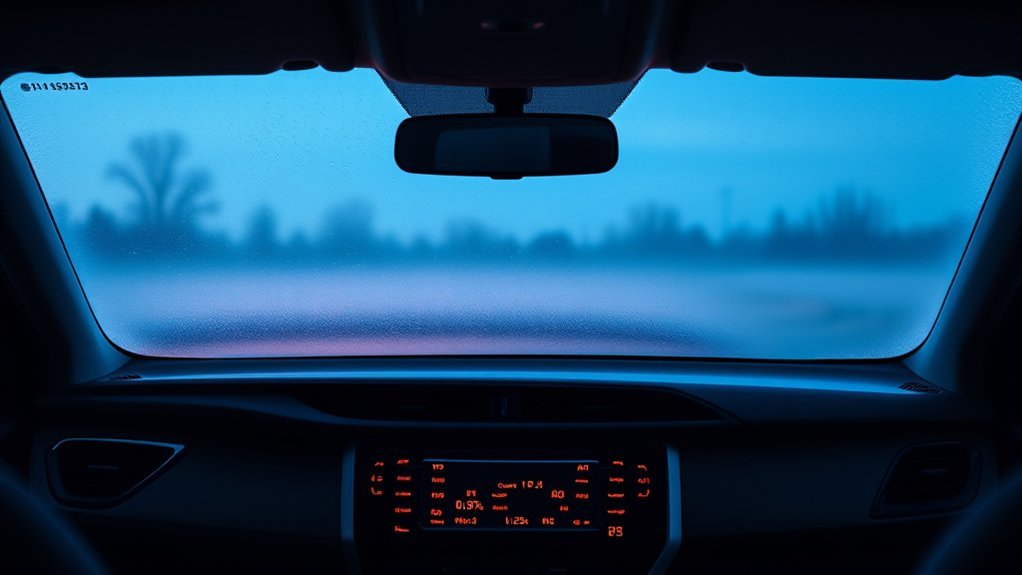
Your RAV4 uses two different defogging systems. The front vent and dash system directs conditioned airflow to the windshield and front side windows; heat and A/C dehumidification help remove interior fog. The rear glass heating grid uses electrical resistance in printed traces on the inside of the rear window.
Toyota owner guidance says the rear window defogger clears the rear glass and, on equipped models, the same control also heats the outside mirrors. Toyota’s 2019 RAV4 and 2023 RAV4 Hybrid guidance state a 15-minute automatic shutoff, while older RAV4 model years can use different timing. Use your exact owner’s manual if the timer behavior matters to diagnosis.
Troubleshooting differs because the two systems fail in different ways. For the front, inspect airflow, vent doors, cabin filter restriction, blower strength, and actuator movement. For the rear, inspect fuses, wiring, grid lines, side tabs, connectors, and the printed heating traces.
Front Vent/Dash System
Select front defrost on the RAV4’s HVAC control. The system routes air through the defrost outlets aimed at the windshield and front side windows. Toyota guidance also recommends outside-air mode and higher airflow and temperature for faster windshield clearing.
You depend on dry, warm airflow to clear interior fog. If clearing feels weak, check for a clogged cabin filter, blocked dash outlets, a weak blower, or a stuck mode door. A dirty cabin filter can restrict airflow and slow defrost performance.
Rear Glass/Heating Grid
The rear defroster uses a resistive heating grid printed on the inside of the rear glass. The grid warms when electrical current passes through the conductive traces. The exact control path varies by RAV4 year, but the circuit includes a protected power supply, wiring/control components, connector tabs, the printed grid, and a return path to ground.
Start with the fuse and switch, then test voltage at the feed tab. If the grid has power but one strip stays cold, inspect that strip for a break. Small breaks can respond to conductive paint, but tab damage often needs a conductive tab adhesive or professional glass repair.
Avoid aggressive scraping, metal tools, or abrasive cleaning pads on the inside of the rear glass. These can damage the printed lines. If several lines fail or the tab pulls away from the glass, compare the cost and reliability of repair against rear glass replacement.
DIY Repairs vs. Replacement: Conductive Paint, Conductive Epoxy, New Glass
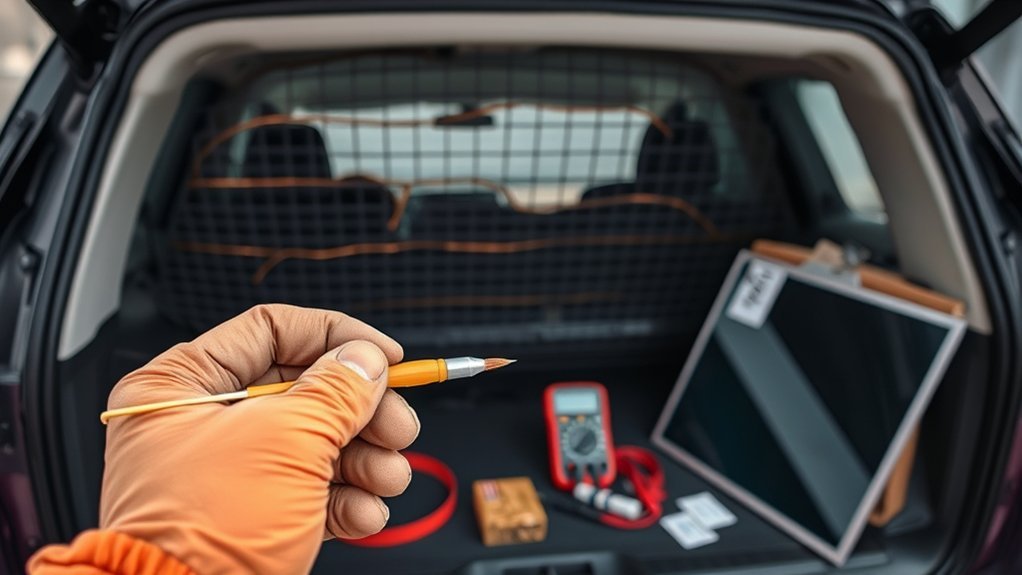
Choose the repair based on the failure type. Small breaks in the RAV4’s rear defroster grid can often respond to conductive paint if you clean the area, mask the line, apply the compound neatly, and let it cure fully. Test voltage at the rear defroster feed tab before you repair the glass, so you don’t patch a grid that never receives power.
- Conductive paint: best for one or two short grid-line breaks when the tabs and wiring still work.
- Conductive epoxy or tab adhesive: best for a loose or broken electrical tab that must carry current.
- Rear glass replacement: best when the glass cracks, several lines fail, or the tab area can’t hold a reliable repair.
Do not use household glue or standard non-conductive epoxy for an electrical joint. It may hold a tab in place, but it will not restore current flow. Use a defroster tab adhesive or conductive epoxy made for rear-window grid repair.
Do not improvise a high-heat tab repair. Some vehicle manufacturers publish model-specific solder procedures, but localized heat can crack automotive glass if the method, solder, temperature, or glass condition is wrong. For a general RAV4 DIY repair, use a conductive rear-defogger tab adhesive unless your year-specific Toyota service information explicitly specifies another method.
[Products Worth Considering]

These Click&Fit windshield washer nozzles are designed to replace worn or damaged sprayers on a wide range of Toyota models, helping restore reliable windshield cleaning performance. The dual spray outlets provide broad fluid coverage for improved visibility and more efficient washer fluid use. Built for easy installation, they offer a quick way to refresh your vehicle's washer system and maintain clear driving conditions.

This cabin air filter replacement is designed to help keep your vehicle’s interior air fresher and cleaner by capturing dust, odors, and fine particles with a multi-layer filtration structure. The activated carbon layer helps reduce unwanted smells, while the extended service life makes it a practical maintenance part for many compatible Toyota, Lexus, Subaru, Scion, and Jaguar models.

Waterproof Adhesive: The Permatex 21351 adhesive is waterproof and suitable for use on glass and rubber surfaces.
Diagnostic Checklist and Next Steps by Symptom
Use a methodical checklist when your RAV4 defroster does not work. Start with non-invasive checks, then move toward electrical testing, actuator diagnosis, or glass repair only after you confirm the fault. Record the model year, weather, settings, symptoms, and meter readings so an intermittent problem is easier to reproduce.
- Confirm the symptom. Note whether the front windshield, rear glass, or both fail to clear.
- Check the switch and indicator. Confirm the defroster command works before you test the glass.
- Inspect the fuse. Replace a blown fuse with the correct rating, then stop if it blows again.
- Test blower airflow. Check every fan speed and inspect the cabin filter if airflow feels weak.
- Verify A/C and outside-air mode. Use the front defrost setting, outside air, higher fan speed, and heat for fast clearing.
- Measure rear-grid voltage. Verify near battery/system voltage at the feed side and a sound ground/return path while the system is commanded on.
- Trace each rear grid line. Watch for a sudden voltage change that marks a broken trace.
- Inspect rear tabs and connectors. Look for loose tabs, corrosion, damaged wires, or overheated contacts.
- Escalate only when needed. Use a proper conductive repair for isolated grid damage; use professional electrical or glass service for repeated fuse failure, uncertain control faults, cracked glass, or widespread grid damage.
If you find no voltage at the rear feed tab, trace the fuse, relay, wiring, switch, and ground before you blame the glass. If you find voltage at the feed tab but a line stays cold, focus on the printed grid. This order helps you avoid replacing expensive parts before you prove the cause.
[Products Worth Considering]

Specifications: ●Side: Left ●Glass Type: Flat ● Heat/Defrost: Yes ●Blind Spot Light: No ● Towing Mirror Glass: No ●Automatic Dimming: No ●On Glass Turn Signal Light: No ●Plastic Back Plate: Yes

Direct Fit : Driver side view mirror glass compatible with 2019-2024 Rav4 . Item Specifications : Heated Glass, INCLUDES Back Plate, INCLUDES Blind Spot Monitoring (Left)

Direct Replacement : Side view mirror set compatible with 2013-2015 RAV4. Item Features : Power Adjusted Glass , Heated , Manual Folding , Turn Signal , Painted Black 202 , 7 wires (w/o Power Fold, w/o BSM)
When to Stop Driving and Get Professional Help
Do not drive until you can see clearly through the windshield, side windows, and mirrors. The National Highway Traffic Safety Administration (NHTSA) advises drivers to make sure defrosters and windshield wipers work before winter driving. If your RAV4 has the feature, the site’s RAV4 wiper de-icer guide explains what it can and cannot clear, and the RAV4 snow and winter-driving guide covers broader cold-weather preparation.
Get professional help if a fuse keeps blowing, you smell burning plastic, you see melted connectors, the rear glass cracks, or the dash needs major disassembly. You should also call a technician if the vehicle has water leaks, electrical shorts, or airbag-area trim near the repair zone.
Frequently Asked Questions
Why Is Only Part of My RAV4 Rear Defroster Working?
If most of the rear glass clears but one or a few horizontal bands stay foggy, the main circuit is probably delivering power and the failed area is more likely an open printed grid line. Inspect the affected trace for a scratch or break, then use a voltmeter gently to locate the abrupt voltage change before applying a conductive grid-repair compound.
How Do I Know If My RAV4 Rear Defroster Fuse Is Blown?
Use the fuse-box cover or owner manual for your exact model year to identify the correct defogger-related fuse, then inspect or electrically test it. Replace a blown fuse only with the same rating. If the replacement blows again, stop replacing fuses and have the circuit checked for a short or overload.
Why Is My RAV4 Front Defroster Blowing Cold Air?
If the blower is strong but the air remains cold after normal warm-up, the problem may be on the heating side rather than the defrost vent itself. Check whether the engine reaches normal temperature and whether heater output works in other vent modes. Low coolant, restricted heater-core flow, or an air-mix/blend-door fault can produce similar symptoms.
Does the A/C Need to Be On for RAV4 Windshield Defrost?
A/C dehumidification helps remove moisture from cabin air, so it can clear interior windshield fog faster. Toyota also recommends outside-air mode and higher airflow and temperature for quick defogging. The exact automatic A/C behavior can vary by model year and ambient conditions.
How Do You Test a RAV4 Rear Window Defroster Grid?
With the vehicle safely powered on and the rear defogger commanded on, verify near system voltage at the feed side and a sound ground at the return side. If those are normal, touch the meter probe lightly along an affected grid line. A progressive voltage change is expected; an abrupt change can reveal an open section. Avoid scratching the printed conductor with the probe.
Can You Repair a Broken RAV4 Rear Defroster Line?
Yes, an isolated printed-line break can often be repaired with a conductive rear-window grid repair product. Clean and mask the area, follow the product instructions exactly, and allow the full stated cure time before powering the grid. A detached tab needs a conductive tab adhesive, while cracked glass or widespread grid damage may justify professional replacement.
Can Windshield Wipers Damage Heated Rear Defroster Grids?
Normal rear wiper use should not scrape the heated grid because the printed traces are on the inside of the rear glass. Damage is more likely from interior scraping, abrasive pads, cargo rubbing the glass, sticker or tint removal, or damage around the electrical tabs.
Safety Disclaimer: This article is for informational purposes only and does not replace professional automotive advice. Electrical testing, glass repair, and dashboard work can create safety risks. Consult a qualified mechanic or auto glass technician if you are unsure, if a fuse keeps blowing, or if visibility remains unsafe.
Conclusion
A RAV4 defroster problem becomes easier to diagnose when you separate front HVAC faults from rear electrical-grid faults. Start with the operating mode, airflow, fuse, and visible damage. If the rear glass fails, prove power and ground before repairing the grid. If the front airflow is strong but cold, prove the heating side before replacing an actuator. Restore safe visibility first, then repair only the fault your tests support.
References
- Toyota Owners: 2019 RAV4 Automatic Air Conditioning System — official windshield and rear-window defogger operation.
- Toyota Owners: 2023 RAV4 Hybrid Automatic Air Conditioning System — official A/C dehumidification, outside-air, and rear-defogger guidance.
- NHTSA Winter Weather Driving Tips — visibility, windshield wiper, and defroster safety guidance.
- Permatex Window Defogger Repair Kit — conductive grid repair and cure instructions.
- Permatex Rear Window Defogger Electrical Conductive Tab Adhesive — tab preparation and cure instructions.