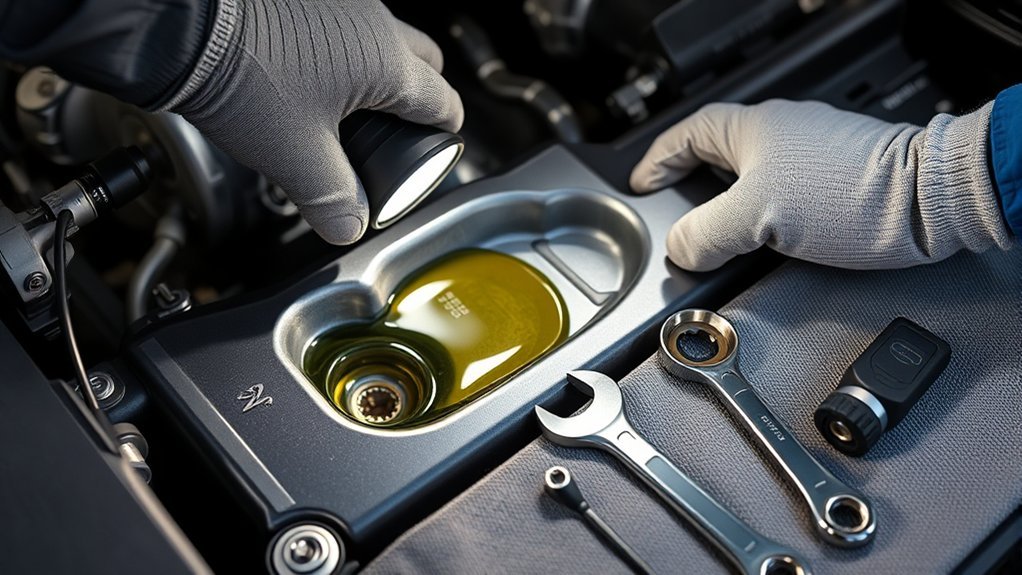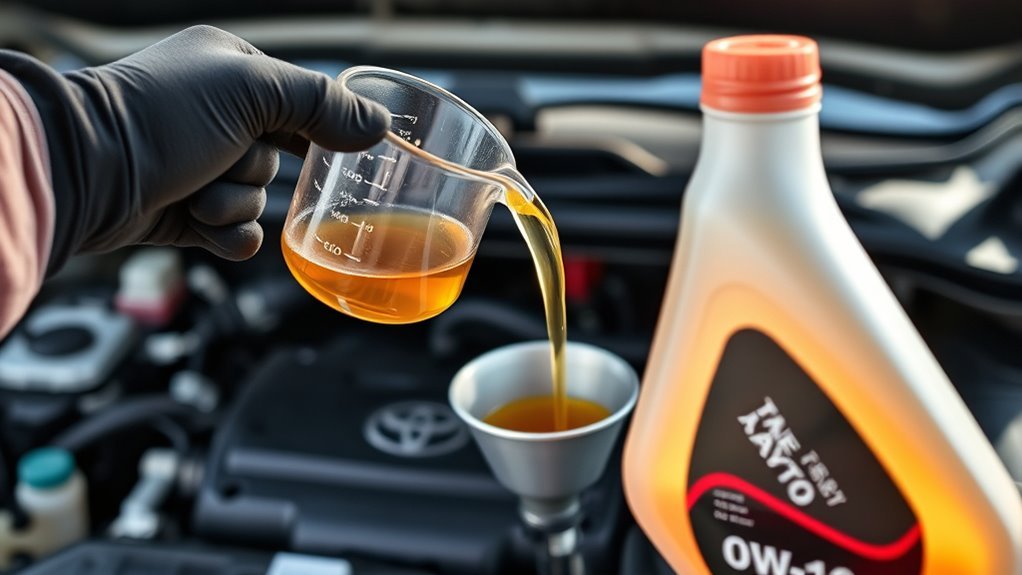
Modern Toyota RAV4 engines are designed around low-viscosity oil, so the right choice is not “the thickest oil you can buy.” For most 2019–2025 RAV4 gas, Hybrid, and Prime models, Toyota’s published recommendation is SAE 0W-16 engine oil that meets the required ILSAC/API standard. Always confirm the oil grade on your oil filler cap or in your exact owner’s manual, because 2026-and-newer RAV4 Hybrid guidance can differ.
Quick Answer
Use 0W-16 in most 2019–2025 Toyota RAV4 models because Toyota specifies it for good fuel economy and cold-weather starting. Choose oil that meets ILSAC GF-6B or newer GF-7B/API SQ where available, verify capacity in your manual, and use 0W-20 only as a temporary substitute if 0W-16 is unavailable.
Key Takeaways
- Toyota lists SAE 0W-16 as the preferred oil for many 2019–2025 RAV4 models because it supports fuel economy and cold-start lubrication.
- 0W-20 may be used only when 0W-16 is not available; Toyota says to replace it with 0W-16 at the next oil change.
- Oil capacity varies by powertrain and model year, so treat published capacities as a starting point and finish with a dipstick check.
- Normal oil-and-filter service is typically every 10,000 miles or 12 months, while special operating conditions require 5,000-mile or 6-month oil changes.
- For 2026 RAV4 Hybrid models, check the manual carefully: Toyota’s 2026 RAV4 Hybrid maintenance data lists 0W-8 as the preferred oil, with 0W-16 only as a temporary fallback.
At a Glance
| Time Required | 10 minutes to verify or top off; 30–60 minutes for a careful DIY oil change |
| Difficulty | Easy for checking oil; moderate for a full oil-and-filter change |
| Tools Needed | Owner’s manual, correct oil, funnel, dipstick, oil filter, drain pan, socket, torque wrench, and new drain-plug gasket if changing oil |
| Cost | Varies by oil, filter, gasket, location, and whether you do it yourself or use a shop |
Which Oil Should a Modern RAV4 Use?
For most modern RAV4 models in the 2019–2025 generation, the safe default is SAE 0W-16 engine oil that meets the oil grade listed in the owner’s manual. Toyota’s 2024 RAV4 maintenance data lists ILSAC GF-6B multigrade engine oil with SAE 0W-16 as the recommended viscosity, and it states that 0W-16 is the best choice for good fuel economy and good starting in cold weather.
That does not mean every RAV4 ever built uses 0W-16. Older RAV4 generations often used thicker grades such as 0W-20 or 5W-30, and newer model years may change again. The oil filler cap, owner’s manual, and Toyota maintenance data for your exact model year are the final authority.
Note: This guide focuses on modern RAV4 models that specify 0W-16. If your manual lists 0W-8, 0W-20, or another grade, follow that exact specification instead of general internet advice.
[Products Worth Considering]

Full Synthetic Engine Oil is a high-performance lubricant designed to provide unparalleled engine protection, fuel efficiency, and longevity.

Superior Engine Performance: Engineered with advanced synthetic technology to offer exceptional engine protection and improve fuel efficiency.

Advanced protection against the four main causes of engine breakdown: wear friction heat and deposits
What 0W-16 Means: Cold Flow and Operating Viscosity
The 0W part describes the oil’s low-temperature behavior. The “W” means winter, not weight. A 0W oil is designed to pump and flow well during cold starts, which helps oil reach bearings, timing components, and valve-train parts quickly after startup.
The 16 part describes the oil’s high-temperature viscosity grade. The SAE J300 engine oil viscosity classification defines engine oil grades by rheological properties, including low-temperature and high-temperature viscosity behavior. In simple terms, 0W-16 is thinner at operating temperature than 0W-20, 5W-30, or 10W-30.
That thinner oil reduces internal drag when the engine is designed for it. In a RAV4 engine calibrated for 0W-16, that helps support fuel economy without giving up the required lubrication standard.
Why Toyota Specifies 0W-16 for the RAV4 2.5L
Toyota specifies 0W-16 because the 2.5L Dynamic Force engine family was engineered with tight clearances, efficient oil flow, and fuel economy targets in mind. The thinner oil circulates quickly after startup and reduces pumping and friction losses once the engine is warm.
That is especially useful in daily driving, where many engine starts happen before the oil is fully warm. Better cold-start flow helps the oil reach critical parts quickly, while the correct ILSAC/API performance standard keeps the oil from being “thin only” without the additive package needed for wear, deposits, sludge control, and timing-chain protection.
Use the specified grade to preserve the balance Toyota designed: easier cold starting, lower friction, proper variable-valve-timing operation, and predictable oil pressure and flow in normal service.
[Products Worth Considering]

Mobil 1 0W-16 is a low viscosity, advanced full synthetic motor oil


Optimum oil pressure under all operating conditions
0W-16 vs. 0W-20: Fuel Economy, Protection, and Trade-Offs
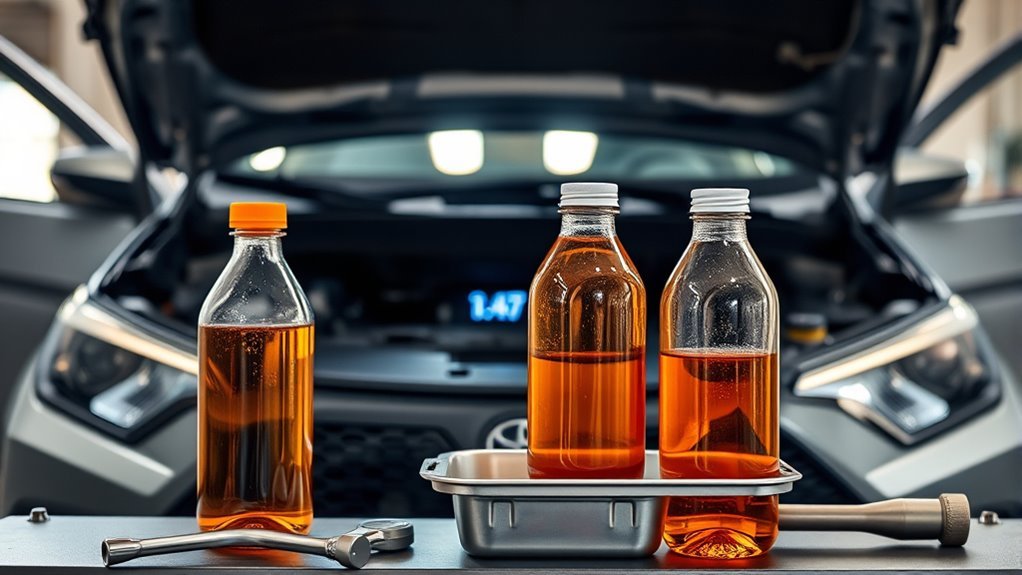
0W-16 and 0W-20 are close, but they are not identical. Both have a 0W cold-temperature rating, but 0W-20 is slightly thicker at operating temperature. In older engines or engines designed around 0W-20, that can be exactly what the manufacturer wants. In a RAV4 engine designed around 0W-16, Toyota’s preferred choice is still 0W-16.
| Comparison Point | 0W-16 | 0W-20 |
|---|---|---|
| Toyota status for many 2019–2025 RAV4 models | Preferred grade | Temporary substitute if 0W-16 is unavailable |
| Cold-start behavior | Excellent low-temperature pumpability | Also excellent because it is still a 0W oil |
| Fuel-economy target | Best match for Toyota’s 0W-16 calibration | May slightly reduce the intended efficiency benefit |
| Best use | Routine oil changes when specified | Short-term use only, then switch back at the next oil change |
Warning: Do not choose 5W-30, 10W-30, diesel oil, racing oil, or a random “high-protection” thicker oil for a RAV4 that calls for 0W-16 unless Toyota’s manual for your exact vehicle allows it.
0W-16 Certifications to Check: GF-6B, GF-7B, API SP, and API SQ
Do not shop by viscosity alone. A bottle can say 0W-16 and still be the wrong choice if it does not meet the required performance standard.
For many 2019–2025 RAV4 models, Toyota lists ILSAC GF-6B. As the oil market transitions, you may also see ILSAC GF-7B and API SQ. The API Motor Oil Guide lists GF-7B as the current 0W-16 ILSAC category introduced in March 2025 and says GF-6B remains current until October 1, 2026, with GF-7B used where GF-6B is recommended.
Look for the API Shield mark on 0W-16 oils. The Shield is the API certification mark for 0W-16 oils meeting the relevant ILSAC “B” standard. API SP is still acceptable for many current oils, but API SQ is the newer gasoline-engine service category. API SN Plus is older; API SP includes SN Plus requirements, so do not treat “SN Plus only” as the best current choice when newer certified oils are available.
Pro Tip: The front label tells you the viscosity. The back label usually tells you the API and ILSAC certifications. Check both before buying.
When to Use 0W-16 and When 0W-20 Is Acceptable
Use 0W-16 for routine service whenever your RAV4 manual specifies it. This is the correct choice for normal commuting, highway driving, cold starts, city traffic, and most owner use cases.
Use 0W-20 only as a short-term fallback if 0W-16 is unavailable and your manual explicitly allows it. Toyota’s 2024 RAV4 maintenance data says 0W-20 may be used if 0W-16 is not available, but it must be replaced with 0W-16 at the next oil change.
Do not keep using 0W-20 long-term in a 0W-16 RAV4 just because it is easy to find. The small viscosity difference matters because Toyota calibrated the engine, fuel economy targets, and lubrication system around the specified oil grade.
RAV4 Oil Capacity and How to Fill Correctly
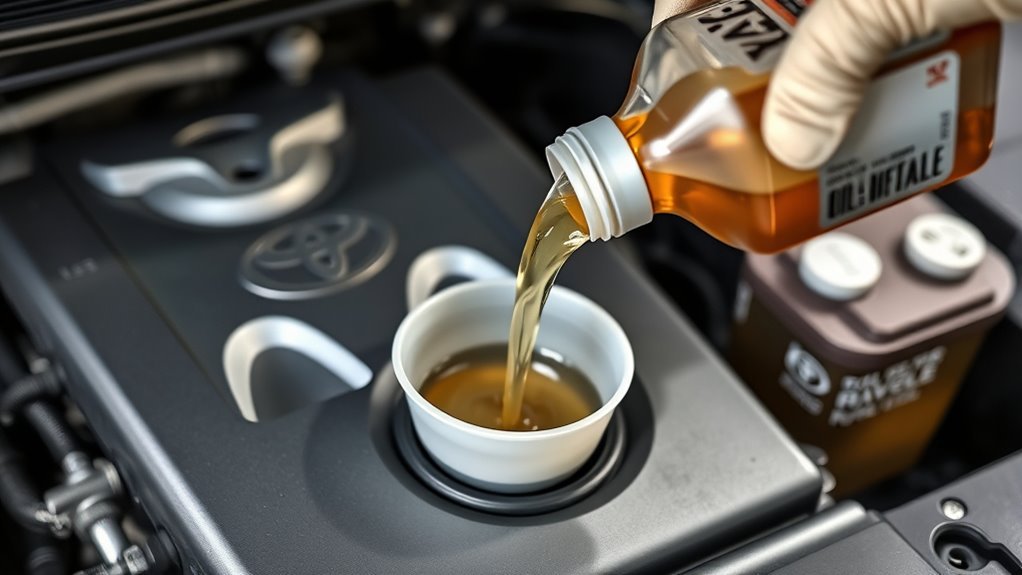
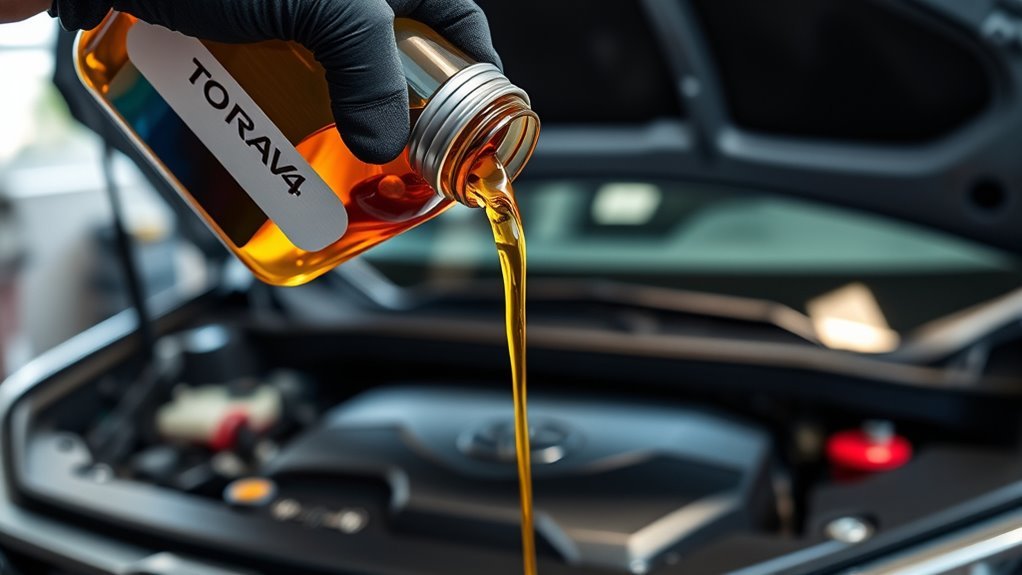
Oil capacity depends on model year, powertrain, and whether the filter is replaced. Many 2.5L gas RAV4 models list about 4.8 quarts with the filter, while some RAV4 Hybrid maintenance data lists a lower reference capacity. The safest method is to use the manual’s capacity as a starting point, add oil gradually, run the engine briefly, wait, and confirm the final level on the dipstick.
[Products Worth Considering]


Advanced protection against the four main causes of engine breakdown: wear friction heat and deposits

6X better wear protection on critical engine parts than industry standards**
Engine Oil Capacity
| RAV4 Type | Common Reference Capacity | What to Do |
|---|---|---|
| 2019–2025 RAV4 2.5L gas | Often about 4.8 qt with filter | Confirm in your owner’s manual and finish with the dipstick |
| RAV4 Hybrid | Can vary by year; Toyota’s 2024 Hybrid data lists 4.5 qt with filter | Use your exact hybrid manual and avoid overfilling |
| RAV4 Prime or newer RAV4 variants | Model-specific | Check the oil cap, manual, and Toyota maintenance data by VIN or model year |
Correct Fill Procedure
- Park on level ground and make sure the engine is off and safe to service.
- Remove the oil filler cap.
- Add the correct 0W-16 oil slowly, starting slightly below the listed capacity.
- Wait a few minutes, then check the dipstick.
- If you changed the filter, start the engine briefly, shut it off, and wait about 5 minutes for oil to settle.
- Recheck the dipstick and top off slowly until the oil level is between the low and full marks.
- Check for leaks around the drain plug and filter before driving.
Checking Final Level
The final dipstick reading matters more than pouring in a memorized number. Too little oil can starve the engine during acceleration, braking, cornering, or high-load driving. Too much oil can foam, increase crankcase windage, and cause leaks or drivability issues.
After an oil change, warm the engine, turn it off, wait about 5 minutes, and check the dipstick on level ground. The oil should sit between the low and full marks. Add small amounts at a time if needed.
Oil Change Intervals: Normal Service and Severe-Service Rules
Toyota’s schedule is not simply “change oil whenever the dashboard says so.” The 2025 RAV4 Warranty & Maintenance Guide says scheduled maintenance is recommended every 5,000 miles or 6 months, while the maintenance chart places normal engine oil and filter replacement at 10,000-mile intervals. Under special operating conditions, Toyota calls for oil and filter replacement at 5,000 miles or 6 months regardless of oil used.
Normal Service Intervals
For normal service, plan on oil and filter replacement about every 10,000 miles or 12 months, while still following Toyota’s 5,000-mile or 6-month maintenance visits for inspections, tire rotation, fluid checks, and other scheduled items.
Do not extend the interval just because the oil is synthetic. The oil still collects fuel dilution, moisture, soot, and combustion byproducts over time.
Severe Service Guidelines
Use the shorter 5,000-mile or 6-month oil-and-filter interval if most of your driving falls under Toyota’s special operating conditions. These include driving on dirt or dusty roads, towing or heavy loading where applicable, using a car-top carrier, extensive idling or low-speed driving for long distances, and repeated trips of less than five miles in freezing temperatures.
Short trips are especially hard on oil because the engine may not stay hot long enough to evaporate moisture and fuel dilution. If your RAV4 is mostly used for school runs, delivery work, short winter commutes, or stop-and-go city driving, the severe-service interval is the safer choice.
High-Mileage and RAV4 Hybrid: Best Oil Choices and Additives
A high-mileage RAV4 still needs the correct viscosity and certification. If your engine calls for 0W-16, choose a high-mileage 0W-16 only if it also meets the required ILSAC/API standard. Do not switch to 5W-30 just because the odometer has passed 75,000 miles.
High-mileage oils can include seal conditioners, detergents, and anti-wear additives, but they are not a cure for leaks, worn rings, or neglected maintenance. If the engine is consuming oil, check for external leaks, PCV issues, maintenance history, and Toyota service information before changing viscosity.
For RAV4 Hybrid models, remember that the gasoline engine may start automatically when the vehicle is in READY mode. Keep the vehicle fully off while checking or changing oil, and do not touch orange high-voltage cables or components.
2026 model-year note: Toyota’s official 2026 RAV4 Hybrid maintenance data lists JASO GLV-1 SAE 0W-8 as the preferred oil and says 0W-16 may be used only if 0W-8 is unavailable, then replaced with 0W-8 at the next oil change. Always check your exact manual before assuming 0W-16 applies.
Common Mistakes, Risks of Wrong Viscosity, and How to Verify OEM Approval
The most common mistake is treating oil viscosity as an upgrade path. Thicker oil is not automatically better. In an engine designed for 0W-16, thicker oil can slow cold flow, increase drag, reduce fuel economy, and interfere with the oil flow Toyota expected when calibrating variable valve timing and other systems.
Another mistake is shopping only by brand. Brand matters less than the correct SAE viscosity, ILSAC/API certification, and service interval. Use Toyota Genuine Motor Oil or an equivalent oil that satisfies the grade and viscosity listed in the manual.
Avoid these mistakes:
- Using 5W-30 because it “feels safer.”
- Using 0W-20 long-term when the manual says to return to 0W-16.
- Buying oil without checking the API Shield or ILSAC/API standard.
- Overfilling after assuming every RAV4 takes the same amount.
- Adding aftermarket oil additives that Toyota does not call for.
- Skipping the 5,000-mile severe-service interval when your driving clearly qualifies.
The best oil for a modern RAV4 is not the thickest oil. It is the oil grade Toyota specified, in the right amount, changed on the right schedule.
Frequently Asked Questions
Why does Toyota use 0W-16 in many modern RAV4 models?
Toyota uses 0W-16 because it supports cold-weather starting, fast oil circulation after startup, and improved fuel economy in engines designed for low-viscosity oil. It is part of the engine’s overall efficiency and lubrication design, not just a fuel-saving shortcut.
What is the viscosity of 0W-16 oil?
0W-16 is an SAE multigrade engine oil. The 0W rating describes low-temperature winter performance, while the 16 rating describes the oil’s high-temperature viscosity grade. It is thinner at operating temperature than 0W-20 and much thinner than 5W-30.
Can I use 0W-20 instead of 0W-16 in a RAV4?
For many 2019–2025 RAV4 models, Toyota allows 0W-20 only if 0W-16 is not available. It should be replaced with 0W-16 at the next oil change. Do not use 0W-20 as a permanent substitute unless your exact manual lists it as an approved routine grade.
How many quarts of oil does a RAV4 take?
Many 2.5L gas RAV4 models list about 4.8 quarts with the oil filter, but capacity varies by model year and powertrain. Some hybrid data lists a lower reference amount. Always confirm the capacity in your manual and finish by checking the dipstick on level ground.
Does a high-mileage RAV4 need thicker oil?
Not automatically. A high-mileage RAV4 should still use the viscosity and certification Toyota specifies unless a qualified technician diagnoses a problem and Toyota service information supports a different approach. If you want high-mileage oil, choose one in the correct viscosity and standard.
Is 0W-16 still correct for a 2026 RAV4?
Do not assume. Toyota’s 2026 RAV4 Hybrid maintenance data lists SAE 0W-8 as the preferred oil, with 0W-16 allowed only as a temporary fallback. Other 2026 RAV4 variants may differ, so the oil cap and exact owner’s manual are the final authority.
Conclusion
Use Toyota’s specified 0W-16 oil in modern RAV4 models that call for it because it matches the engine’s cold-start, fuel-economy, and lubrication design. Check for the right ILSAC/API certification, use 0W-20 only as a temporary substitute when Toyota allows it, and never guess on oil capacity. The correct oil, correct fill level, and correct service interval matter more than brand loyalty or the idea that thicker oil is always safer.
Sources
- Toyota 2024 RAV4 Maintenance Data — supports the 0W-16 recommendation, 0W-20 temporary-use rule, oil standard, and dipstick-check guidance.
- Toyota 2025 RAV4 Warranty & Maintenance Guide — supports maintenance intervals, special operating conditions, and 5,000-mile severe-service oil changes.
- API Motor Oil Guide — supports API Shield, GF-7B, GF-6B, API SQ, API SP, and SN Plus information.
- SAE J300 Engine Oil Viscosity Classification — supports the explanation of SAE viscosity grades.
- Toyota 2026 RAV4 Hybrid Maintenance Data — supports the 2026 Hybrid note about 0W-8 and temporary 0W-16 use.