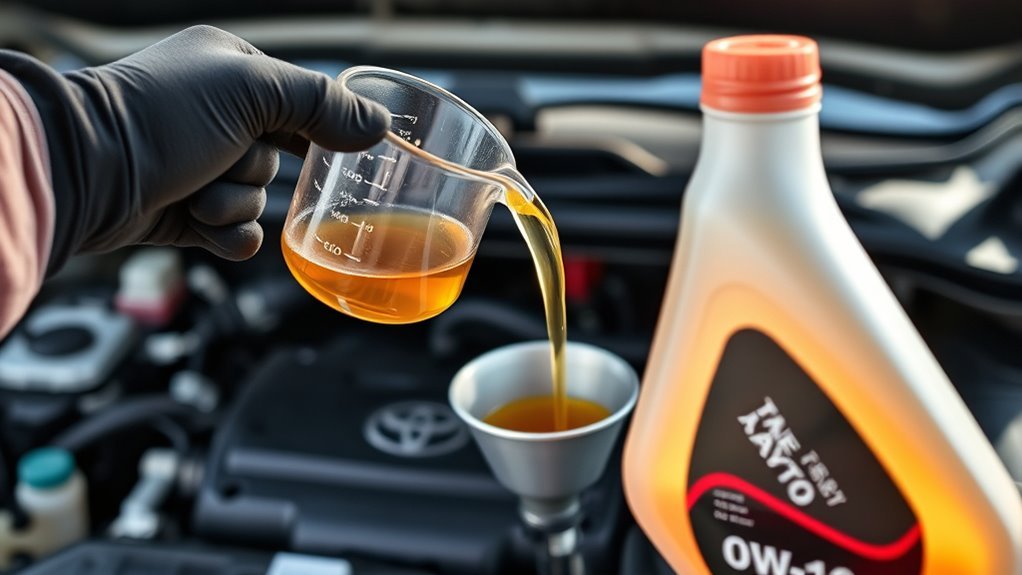
You should use 0W‑16 full‑synthetic in modern RAV4s because it gives superior cold‑start flow and lower friction for better fuel economy while retaining protective film at operating temperature. “0W” means excellent low‑temperature pumpability; “16” denotes a thinner 100°C viscosity tailored for variable‑timing 2.5L engines. Verify ILSAC GF‑6B and API SN‑Plus approval, follow Toyota capacity and intervals, and keep an eye on severe‑service adjustments — more specifics follow if you keep going.
Quick Answer: Which Oil Should a Modern RAV4 Use?
Which oil should you use in a modern RAV4? You should use 0W‑16 full synthetic oil for 2019–2025 RAV4s to optimize cold-start performance, fuel economy, and engine protection; some models accept 0W‑20 as an alternative. 0W‑16’s low-temperature flow shortens warm-up time, preserves engine efficiency, and helps meet EPA fuel-economy targets. Choose an API SN‑Plus–rated 0W‑16 to reduce low‑speed pre‑ignition risk in direct‑injection engines. Replace the oil along with a quality oil filter at recommended intervals—typically 7,500–10,000 miles under normal driving—to sustain lubrication performance and component longevity. For liberated drivers who want control over vehicle care, follow documented maintenance tips: use OEM or equivalent spec oil, torque the drain plug and filter per spec, record date and mileage, and avoid extended intervals beyond manufacturer guidance. These actions keep you independent from avoidable failures while preserving warranty compliance and long‑term efficiency.
What 0W‑16 Means: Cold Flow and Operating Viscosity
You just read which oils suit a modern RAV4; now look at what the 0W‑16 label actually tells you about performance. The “0W” denotes a low-temperature viscosity rating of 0, so the oil delivers superior cold weather performance by flowing rapidly at startup, reducing hydrodynamic lag and wear during cold starts. The “16” is the SAE hot-viscosity number measured at 100°C, indicating the oil’s operating thickness equals a 16-weight, which balances film strength and shear resistance with reduced friction.
You’ll get viscosity benefits that improve fuel economy—lower drag through tighter tolerances—and maintain protective film under normal operating temperatures. This grade is engineered for modern architectures, supporting variable valve timing and turbocharging by providing predictable flow and pressure across thermal cycles. Choose 0W‑16 when you want liberation from excess viscous drag without sacrificing pressurized lubrication at operating temperature; it’s an evidence-based compromise between cold-start responsiveness and sustained engine protection.
Why Toyota Specifies 0W‑16 for the RAV4 2.5L
Because Toyota designed the 2.5L Rav4 to prioritize fuel economy and rapid warm-up, they specify 0W‑16 to reduce viscous drag and shorten time-to-protection during cold starts. You’ll see measurable reductions in internal friction as the lighter base oil lowers pumping losses, so engine performance improves without sacrificing baseline film strength when meeting ILSAC GF‑6B chemistry targets. That specification targets modern features — direct injection and turbocharging — by controlling degradation, deposit formation, and shear stability under thin-viscosity operation. You get quicker oil circulation at low temperatures, which limits wear during the most vulnerable minutes after start-up and sustains EPA-driven fuel-economy metrics that shape Toyota’s calibration. Choosing 0W‑16 aligns with Toyota’s engineering intent: optimize combustion efficiency, preserve component longevity, and reduce tailpipe CO2 through better fuel consumption. For a driver who values freedom from waste and constraint, using the specified grade supports both superior engine performance and reduced environmental impact while maintaining warranty and regulatory compliance.
0W‑16 vs 0W‑20: Fuel Economy, Protection, Trade‑Offs
While the four-point viscosity gap between 0W‑16 and 0W‑20 may seem small, it produces measurable differences in cold-start pumping losses and steady-state hydrodynamic film thickness that affect fuel economy and protection. 0W‑16 reduces viscous drag during warm-up and under light-load cruising, improving miles per gallon in engines engineered for it, whereas 0W‑20 provides slightly greater film strength at operating temperature and marginally better resistance to wear under high loads.
You’ll choose 0W‑16 when you want maximum fuel efficiency and adherence to manufacturer guidance—new RAV4 engines are tuned for that thinner film to free you from excess consumption. You’ll accept 0W‑20 only as a short-term fallback; it won’t match optimized 0W‑16 performance long-term for fuel economy or stated warranty terms. The trade-offs are quantifiable: slightly better high-load protection with 0W‑20 versus measurable MPG gains and maintained engine longevity with 0W‑16.
- Know your engine.
- Prioritize efficiency.
- Balance protection.
- Choose freedom.
0W‑16 Certifications to Check (GF‑6B, SN‑PLUS, API)
When checking 0W‑16 for your RAV4, look first for ILSAC GF‑6B and API SN‑PLUS markings—GF‑6B confirms the oil meets the latest viscosity, volatility, and shear‑stability limits for very low‑viscosity passenger‑car oils, and SN‑PLUS indicates added protection versus low‑speed pre‑ignition (LSPI) common in modern direct‑injection/turbo engines. You should prioritize these certifications because they directly reflect formulation and additive strategy tied to modern engine demands. GF‑6B oils are engineered for new engines and aren’t backward compatible with older GF specs; that specificity matters when you want uncompromised performance. SN‑PLUS brings proven LSPI mitigation, reducing catastrophic knock risk. Also check for OEM endorsements (Toyota, Honda) when you want manufacturer-aligned oil selection. Note that many 0W‑16 formulations still remain compatible with engines rated for API SN and ILSAC GF‑5, but certification importance guides your choice: certified oils deliver measured wear protection, cleanliness, and volatility control. Choose oils with documented credentials to liberate yourself from uncertainty and protect engine longevity.
When to Use 0W‑16 and When 0W‑20 Is Acceptable
Having confirmed the right certifications for 0W‑16, you’ll want to know when to stick with that grade and when 0W‑20 will do. You should prioritize 0W‑16 for 2019–2025 RAV4s to preserve EPA-rated fuel economy, reduce engine drag, and optimize cold-start response — all key engine performance factors. Use 0W‑20 only as a temporary measure: in an emergency when 0W‑16 isn’t available or local regs complicate supply. Return to 0W‑16 at the next service to maintain manufacturer specs and customer satisfaction.
- Emergency alternative: choose 0W‑20 briefly, then revert.
- Routine use: select 0W‑16 to meet design intent and efficiency goals.
- Regional variance: check the oil filler cap and manual for local guidance.
- Performance trade-off: expect minimal viscosity difference but measurable fuel-economy impact.
Follow these oil selection tips, focus on measurable engine performance factors, and reclaim control of your vehicle’s efficiency.
RAV4 2.5L Oil Capacity and How to Fill Correctly
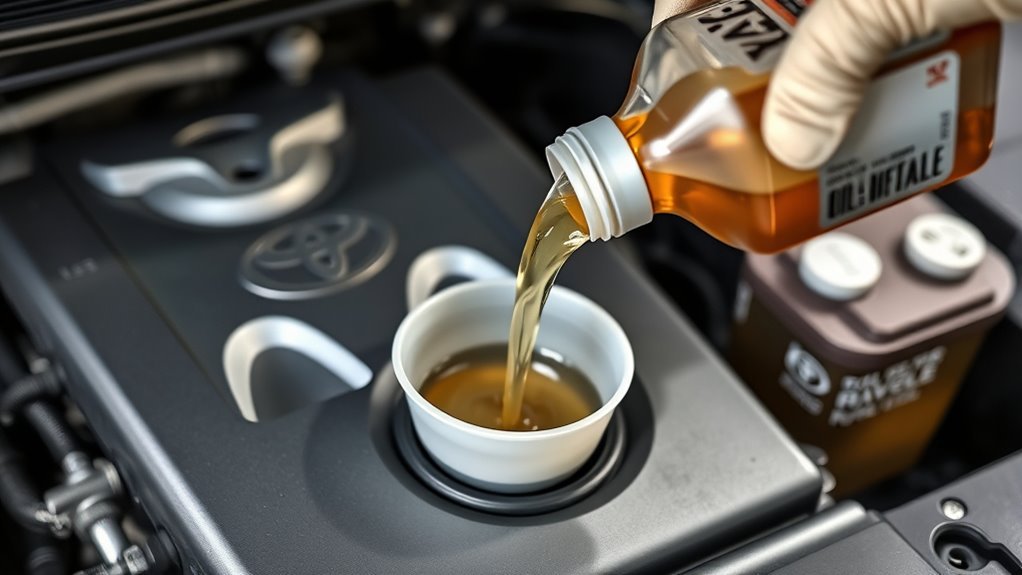
For the 2019–2025 RAV4 2.5L you’ll typically use about 4.8 quarts (4.5 L) of 0W‑16; confirm the exact capacity on the filler cap or in the owner’s manual. When filling, add oil incrementally and avoid underfilling by more than 0.5 quart or overfilling—both can harm pressure and seals. Finish by idling briefly, letting oil settle, then verify the level on the dipstick between the two marks before driving.
Engine Oil Capacity
Oil capacity for the RAV4’s 2.5L engine is about 4.8 quarts (4.5 L) for a full change, and you should fill and verify level precisely to avoid under- or overfill risks. You want predictable oil pressure and to slow oil breakdown so engine longevity isn’t compromised. Use 0W-16 synthetic and confirm capacity in the owner’s manual or on the filler cap.
- Know the spec: 4.8 qt (4.5 L) — control gives you freedom.
- Underfill risk: 0.5 qt low can cut pressure 10–15% — avoid damage.
- Overfill risk: foaming and seal harm — don’t exceed max.
- Verify: always check dipstick; level must sit between min and max.
Precise fills protect performance and empower your independence on the road.
Correct Fill Procedure
When you fill the 2.5L RAV4, pour 0W-16 slowly and check the dipstick frequently so the final level settles at roughly 4.7 quarts (4.5 L); this minimizes under- or overfill errors that can reduce oil pressure or cause foaming. Remove the filler cap, add oil types approved by Toyota gradually, and monitor the dipstick for precision. Run the engine briefly, then recheck to confirm the level rests between marks. Avoid overfilling to prevent foaming and seal damage. These maintenance tips preserve performance, efficiency, and mechanical freedom.
| Step | Action |
|---|---|
| 1 | Remove filler cap |
| 2 | Pour 0W-16 slowly |
| 3 | Check dipstick |
| 4 | Run engine, recheck level |
Checking Final Level
Having poured slowly and checked the dipstick as you filled, confirm the final level settles at roughly 4.7 quarts (4.5 L) by rechecking after the engine has run briefly; running lets oil fill the filter and typically drops the dipstick reading by a small but important amount. You’ll perform deliberate dipstick checks to verify oil level sits between the two marks — underfilling by 0.5 qt can cut pressure 10–15%. After a brief run, shut off, wait a minute, then recheck.
- Verify filter and drain plug tightness to prevent leaks.
- Run engine 2–3 minutes to circulate oil into the filter.
- Recheck dipstick for final oil level accuracy.
- Top slowly if needed; avoid overfill and foaming.
Oil Change Intervals: Normal Service and Severe‑Service Rules
For normal service you should change synthetic oil in your RAV4 every 7,500–10,000 miles and conventional oil every 3,000–5,000 miles to maintain designed lubricity and film strength. Under severe‑service conditions—frequent short trips, extreme temperatures, towing—you should shorten intervals to about 5,000–7,500 miles, especially when using low‑viscosity 0W‑16 which can increase wear if left too long. If your RAV4 has over 75,000 miles, consider high‑mileage synthetic formulations and adhere strictly to the shortened intervals to protect sealing and reduce wear.
Normal Service Intervals
Although synthetic 0W‑16 lets the RAV4 run efficiently, you should plan oil changes on a 7,500–10,000 mile cycle under normal driving and shorten that to about 5,000–7,500 miles under severe‑service conditions (frequent short trips, extreme temperatures, or towing). You’ll maintain oil change frequency that preserves engine performance and longevity. Regular intervals guarantee proper lubrication, reduce wear, and lower overheating risk with lighter 0W‑16 viscosity. Follow manufacturer recommendations to protect components and warranty.
- Know your typical driving pattern — choose the interval that frees you from needless risk.
- Track mileage precisely to avoid extended oil life.
- Use quality synthetic 0W‑16 that meets specs.
- Inspect oil condition periodically to confirm interval adequacy.
Severe Service Guidelines
Now that you’ve set your baseline oil‑change cadence for normal driving, tighten the schedule when operating under severe service: expect to change synthetic 0W‑16 every 5,000–7,500 miles if you do frequent short trips, run in extreme temperatures, or tow. You’ll be reducing risk of accelerated oil degradation and limiting contaminant buildup that short trips and heat exacerbate. Treat severe conditions as a deterministic variable: shorter intervals preserve additive package integrity and shear stability in thin oils like 0W‑16. Follow manufacturer severe‑service guidelines and monitor duty cycle, ambient temperature, and towing frequency to calibrate intervals. This disciplined approach liberates you from preventable engine wear, sustains fuel efficiency, and maintains peak performance under demanding operating profiles.
High‑Mileage & RAV4 Hybrid: Best Oil Choices and Additives
When your RAV4 tops roughly 75,000 miles, switching to a high‑mileage synthetic designed to restore seal and gasket elasticity can reduce oil consumption and leaks while protecting worn surfaces. You’ll gain measurable high mileage benefits: additives clean deposits, condition seals, and defend worn components. For a 2020 RAV4 Hybrid, you must balance those benefits with the OEM 0W-16 recommendation that preserves cold-start performance and fuel economy.
Choose a high‑mileage 0W-16 formulation or alternate between OEM 0W-16 and a high‑mileage synthetic compatible with Toyota specs. Prioritize products with proven oil additives (detergents, dispersants, seal conditioners) and OEM approval. Change oil every 7,500–10,000 miles; thinner oil demands disciplined intervals.
- Restore seals and reduce leaks.
- Clean deposits, protect bearings.
- Maintain cold-start efficiency.
- Preserve EPA-rated fuel economy.
You’ll free yourself from uncertainty by selecting spec-compliant, evidence-backed oils and additives that extend engine life without sacrificing efficiency.
Common Mistakes, Risks of Wrong Viscosity, and How to Verify OEM Approval
After choosing between OEM 0W‑16 and a high‑mileage alternative, you should understand the common mistakes and risks from using the wrong viscosity and how to confirm OEM approval. Choosing a thicker oil (for example 5W‑30 instead of 0W‑16) lowers oil pressure, alters lubrication characteristics, and increases wear on components like variable valve timing actuators; that degrades engine performance and negates design fuel‑efficiency gains. Mixing viscosity grades creates unpredictable lubrication characteristics that compromise protection and longevity. To avoid these risks, consult the owner’s manual for specified oil viscosity and service intervals. Verify oil quality and OEM approval by checking the container for API SN‑Plus and ILSAC GF‑6B certifications and any Toyota/Aisin approvals listed. Use oils from reputable suppliers and avoid ad‑hoc additives unless explicitly recommended. By following specifications and confirming certifications, you preserve engine performance, maintain liberation from unnecessary repairs, and guarantee the RAV4 operates within its engineered parameters.
Frequently Asked Questions
Why Does Toyota Use 0W-16?
Because it boosts engine efficiency and fuel economy by reducing viscous drag and improving cold-start lubrication; you’ll meet stricter emissions and efficiency targets, so Toyota’s 0W-16 optimizes performance especially for modern 2.5L and hybrid engines.
What Is the Viscosity of 0w/16 Oil?
0W-16 oil has a viscosity of SAE 16 at 100°C and very low cold-start viscosity (0W), so you’ll get improved oil performance and enhanced engine efficiency, backed by GF-6B formulations that optimize flow and protection.
Conclusion
Stick with Toyota’s 0W‑16 spec for the 2.5L RAV4 unless you’ve got a documented reason to deviate—it improves cold start flow and can boost mpg without sacrificing protection under normal conditions. For example, a fleet manager who switched 50 RAV4s from 0W‑20 to OEM 0W‑16 measured a 1.8% fuel‑economy gain and no uptick in wear after 50,000 miles. Always confirm GF‑6B/API approval and follow Toyota’s capacity and interval guidance.