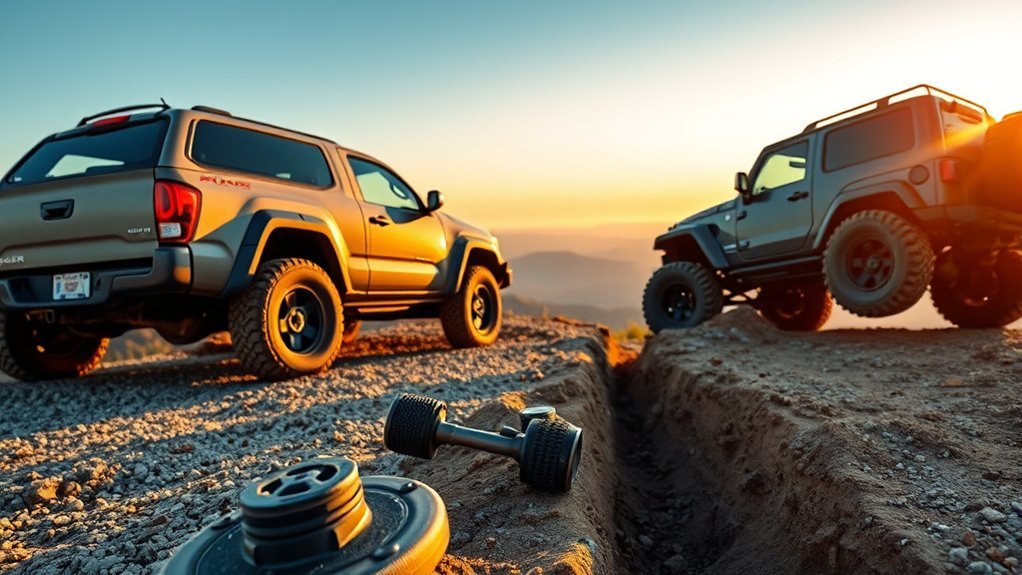
You’ll pick part‑time 4WD if you want lighter weight, better fuel economy and direct low‑range control for technical off‑roading; it lets you switch between 2WD and 4WD but lacks a center differential so you must avoid using it on dry pavement. Full‑time 4WD keeps torque distributed continuously via a center differential (often Torsen) for predictable handling in mixed or slick conditions at the cost of added complexity and fuel use — keep going to learn specifics and use cases.
Quick Guide: Which 4WD Should You Choose?

Wondering which 4WD fits your needs? You assess driving conditions and user preferences to choose liberation through capability. If you mostly drive paved roads in variable weather and want constant traction without mode switching, full‑time 4WD gives a consistent torque split and often a Torsen center differential for predictable handling and enhanced safety. You’ll appreciate uninterrupted traction management and daily reliability.
If your priority is lightweight efficiency and targeted off‑road performance, part‑time 4WD reduces weight and improves fuel economy when 4WD isn’t required. You’ll engage 4HI only on low‑traction surfaces—sand, mud, snow—because systems without a center differential can bind on high‑traction pavement and risk damage.
Match system choice to how and where you drive: choose FT4WD for everyday security and broad user preferences toward reliability; choose PT4WD if your liberation is remote trails and you accept mode discipline to protect the drivetrain.
Part‑Time Vs Full‑Time 4WD Explained
When you pick between part‑time and full‑time 4WD, you’re choosing how the drivetrain manages traction: part‑time systems let you switch between 2WD and 4WD to save weight and fuel for off‑road use but lack a center differential and can bind on high‑traction surfaces, while full‑time systems continuously send torque to all wheels—often via a Torsen center differential with a fixed split (e.g., 40/60)—for smoother operation and more predictable handling in slippery conditions. You’ll value part‑time 4WD if you prioritize simplicity, lower mass and fuel economy during ordinary driving, and deliberate engagement for demanding terrain types. You must pair part‑time systems with informed driving skills to avoid engaging 4WD on high‑traction surfaces, which risks binding and damage. Full‑time 4WD suits drivers who want consistent traction without intervention, improving stability in rain, snow and mixed surfaces. Choose based on how you intend to use the vehicle, the terrain types you’ll face, and your desire for mechanical simplicity versus continuous control.
How PT And FT 4WD Work (Center Diffs, Transfer Cases, Locks)
You’ll compare the center differential’s role in FT4WD with the transfer case function in PT4WD, focusing on how each handles torque split and driveline windup. Examine how locking mechanisms—automatic locks in FT4WD and manual or selectable locks in PT4WD—alter torque distribution for low-traction and low-range scenarios. This sets up practical trade-offs in control, complexity, and terrain capability.
Center Differential Roles
One key distinction between part-time and full-time 4WD systems is the presence and role of a center differential: part-time setups lack one and force you to switch between 2WD and 4WD for off-road or low-traction use. You’ll value center differential benefits in FT4WD because they permit continuous engagement and prevent drivetrain binding on high-traction surfaces. A center differential provides torque distribution advantages by allocating a fixed or variable split (for example, 40/60) between front and rear axles, improving stability during cornering and in adverse weather. Advanced designs like Torsen differentials react to slip, redirecting torque automatically for grip and control. Understand this mechanism so you can choose systems that free you from limitations while protecting drivetrain integrity.
Transfer Case & Locks
The transfer case and locking mechanisms form the functional core of both part‑time and full‑time 4WD systems, controlling how torque is routed and when axle speeds are forced to match. You’ll use transfer case functionality differently depending on system type: in part‑time 4WD you manually engage the transfer case to couple front and rear axles, but there’s no center differential, so you must avoid high‑traction driving in 4WD to prevent drivetrain binding. In full‑time 4WD the transfer case works with a center differential (often Torsen) to distribute torque continuously while allowing differential axle speeds for safe on‑road handling. Both architectures often include locking mechanisms; you’ll engage locks to force equal torque to all wheels for maximal traction during extreme off‑road maneuvers.
On‑Road Behavior: Safety, Handling, Traction
When road surfaces get slick, full‑time 4WD systems keep torque distributed to all wheels automatically, improving traction and directional stability compared with part‑time systems that must be manually engaged and can’t be used on dry pavement without causing driveline binding. You’ll notice FT4WD smooths on road dynamics by maintaining a consistent torque split (often via a Torsen center differential) so traction control and stability systems have predictable inputs. You don’t need to decide mid‑drive; the system liberates you from constant mode management.
| System | Engagement | Road use |
|---|---|---|
| FT4WD | Automatic | Safe on wet/slippery |
| PT4WD | Manual | Only on low‑traction |
| Notes | Torsen/torque split | Avoid dry pavement |
You must still monitor conditions: PT4WD requires confidence before engagement to prevent binding and handling issues. FT4WD offers superior everyday safety and handling by integrating continuous torque distribution with electronic traction control for liberated, controlled driving.
Off‑Road Performance: When PT Beats FT And Vice Versa
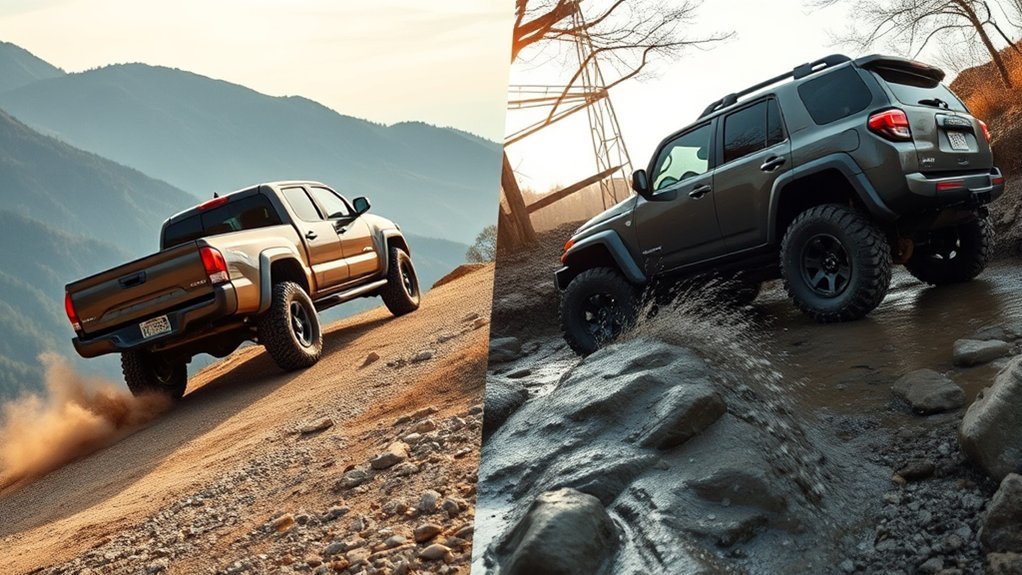
When you need low-speed torque for rock crawling or precise wheel placement, part-time 4WD often gives you the edge because you can lock driveline components and control torque delivery. In contrast, full-time 4WD gives you continuous high-traction maneuvering on mud, ice, or mixed surfaces by distributing power automatically and relying on advanced differentials. We’ll compare how each system’s torque management and traction strategies affect roll, slip, and driver input in common off‑road scenarios.
Low-Speed Torque Advantage
A torque-focused part-time 4WD setup gives you a clear advantage at low speeds by delivering direct drive to the wheels without a center differential absorbing torque losses. You gain superior torque management and low speed performance when you engage PT4WD: direct coupling and low-range gearing multiply wheel torque for climbs, rock crawling, and tight obstacle negotiation. You also reduce drivetrain drag and fuel use when you revert to 2WD on firm surfaces.
| System | Benefit |
|---|---|
| PT4WD engaged | Max torque to wheels |
| PT4WD disengaged | Reduced wear, better fuel economy |
| FT4WD constant | Continuous traction, some torque loss |
| Low-range PT | Extreme torque multiplication |
Choose PT4WD when you need precise, liberated control.
High-Traction Maneuvering
Shifting from low-speed torque advantages to high-traction maneuvering highlights different trade-offs: you’ll want PT4WD for controlled wheelspin and selective engagement on loose surfaces, but FT4WD for predictable behavior on wet, icy, or paved roads where continuous all-wheel torque prevents sudden loss of grip. In high traction scenarios you’ll choose based on intended driving conditions and desired control. PT4WD gives you liberation to modulate traction manually, reducing weight and fuel use off-road, but you must avoid 4HI on dry pavement to prevent driveline binding. FT4WD, often with a Torsen or similar center differential, delivers seamless torque distribution, smoother turning and safer responses in mixed or high-traction driving conditions, no driver intervention required.
Fuel, Weight, And Maintenance: Real Ownership Costs
Because weight and mechanical complexity directly affect operating costs, you’ll notice clear differences between part-time and full-time 4WD systems in fuel use and maintenance. Part-time systems typically deliver better fuel efficiency because reduced weight and simpler weight distribution cut rolling and driveline losses; that improves ownership expenses and supports liberation from frequent refueling. Maintenance reliability is higher in part-time designs: fewer moving parts mean less routine service and greater component longevity, lowering lifecycle costs for off-road use. Full-time systems offer continuous traction benefits but at the cost of higher fuel consumption and more complex servicing. Specialized elements like center and Torsen differentials increase repair frequency and service complexity, raising maintenance bills. Ultimately, your driving habits and the traction differences you encounter determine net cost: if you routinely need constant all-wheel engagement, full-time may justify its expenses; if you seek efficient, resilient ownership with occasional low-traction use, part-time 4WD is usually the more economical choice.
When To Use 4HI, 4LO, Or Leave Full‑Time Engaged
Having weighed fuel and maintenance trade-offs, you’ll next need clear rules for when to engage 4HI, 4LO, or leave a full‑time system active. Use 4HI when traction is uncertain—wet, snowy, or loose surfaces—but never on dry pavement to avoid binding. Reserve 4LO for extreme low-speed needs: steep climbs, deep mud, or rock crawling where max torque and control matter. If you have a full‑time 4WD, leaving it engaged gives continuous traction and stability in adverse weather without manual switching.
- Engage 4HI for transient low-adhesion conditions; it aids control but don’t treat it as a cure-all—avoid 4WD myths that suggest it prevents all skids.
- Switch to 4LO only when speeds are very low or stationary; changing on the fly risks drivetrain damage.
- Rely on full‑time 4WD for daily slippery-road confidence; it frees you from constant mode toggling.
- Master basic driving techniques: throttle modulation, gear selection, and path choice to exploit any 4WD mode effectively.
Use‑Case Guide: Commuter, Snow, And Serious Off‑Road Buyers
When you pick a 4WD system, match it to your routine and worst-case conditions: full‑time 4WD gives continuous, predictable traction for commuters who face frequent rain or snow, while part‑time 4WD suits serious off‑roaders who need the simplicity and control of selectable 4HI/4LO to conserve fuel and reduce drivetrain wear when paved. If your daily route includes wet highways or urban microclimates, prioritize commuter safety with FT4WD and a robust center differential for consistent torque distribution. For regular snowy regions, FT4WD simplifies snow handling by maintaining drive to all wheels without manual engagement, reducing error under stress. Choose PT4WD only if you plan frequent technical trails: its selectable modes deliver superior off road control, low‑speed torque in 4LO, and the ability to disengage when efficiency matters. Across choices, active traction management and competent driving skills remain decisive; select the system that minimizes intervention while maximizing mobility and the freedom to go where you want.
Examples & Buying Checklist: 4Runner, Tacoma, Land Cruiser Lessons
Vehicle selection should map specific system traits to your use case: the 4Runner and Tacoma employ part‑time 4WD—lighter and more fuel‑efficient but requiring disengagement on dry pavement and offering selectable 4HI/4LO control for technical trails—while the Land Cruiser’s full‑time 4WD delivers continuous torque distribution for predictable traction in mixed and adverse conditions. You’ll match 4Runner capabilities and Tacoma versatility to episodic trail use; choose Land Cruiser reliability when daily confidence in variable conditions matters. Inspect drivetrain modes, transfer case wear, and service history. Confirm 4HI/4LO engagement, inspect for leaks, and verify electronic controls.
- Verify transfer case fluid interval, shift feel, and mode annunciation for off road readiness.
- Check differential locks, underbody damage, and skid plate integrity relative to intended terrain.
- Assess fuel penalty versus mission: PT4WD for lighter, tactical excursions; FT4WD for routine mixed-condition freedom.
- Confirm manufacturer options and maintenance records; prioritize systems that align with your liberation goal: dependable traction when you demand it.
Frequently Asked Questions
What Is the Difference Between Part-Time and Full-Time 4WD?
Part-time 4WD requires manual engagement and favors off road capabilities and drivetrain efficiency for occasional rough terrain; full-time 4WD runs continuously, offering consistent traction and liberation to handle variable surfaces without driver intervention.
Is Part-Time 4WD Worth It?
Yes — imagine kicking up gravel as you conquer a ridge; you’ll get superior off road performance and better fuel efficiency when you switch in, you’ll save weight and maintenance costs, and you’ll stay liberated on rough terrain.
How Does a Part-Time 4WD System Work?
You switch PT4WD from 2WD to 4WD; engagement benefits include improved traction when needed, while operational efficiency stays high in 2WD. You’ll engage 4HI/4LO selectively to avoid drivetrain stress and maximize control.
Is Part-Time 4WD Good in Snow?
Yes — you’ll get good snow performance if you engage part-time 4WD when tires can slip; it boosts traction, but you’ll need steady traction control, careful inputs, and the freedom to choose engagement only in low-traction conditions.
Conclusion
So you want a short, technical wrap-up with irony, in second person, active voice, 75 words. Here it is:
You’ll pick part‑time if you love simple, locked drivetrain control and don’t mind switching modes — because who doesn’t enjoy manually preventing drivetrain wind‑up? You’ll pick full‑time if you prefer seamless center‑diff torque management and fewer driver decisions — ideal for daily commutes that secretly crave off‑road credibility. Either way, you’ll trade convenience, weight, fuel, and cost in predictable engineering compromises you’ll happily call “choices.”