High-mileage Hyundai Sonata maintenance should start with the maintenance schedule for your exact model year, engine, transmission, and driving conditions—not one universal mileage rule. Once a Sonata is around 100,000 miles or more, verify its service history, check the engine-oil level regularly, look for leaks or warning lights, inspect the brakes, tires, steering, suspension, belts, hoses, and battery condition, and confirm that any due fluids, filters, spark plugs, or other scheduled items were actually serviced. Before paying for major engine work, also check the VIN for open Hyundai recalls, service campaigns, or applicable warranty extensions.
Last updated: September 16, 2026. This update rechecked Hyundai maintenance guidance, high-mileage/severe-service instructions, Hyundai recall and service-campaign resources, NHTSA recall guidance, engine warranty information, and repair-versus-replace decision guidance.
Editorial basis: Maintenance intervals and fluid specifications vary by Sonata generation and powertrain. Use the Hyundai Owner’s Manual for the exact vehicle, then check the Hyundai safety recall and service campaign lookup and NHTSA recall database by VIN where applicable.
Quick Checklist: What to Do Today for Your High-Mileage Sonata
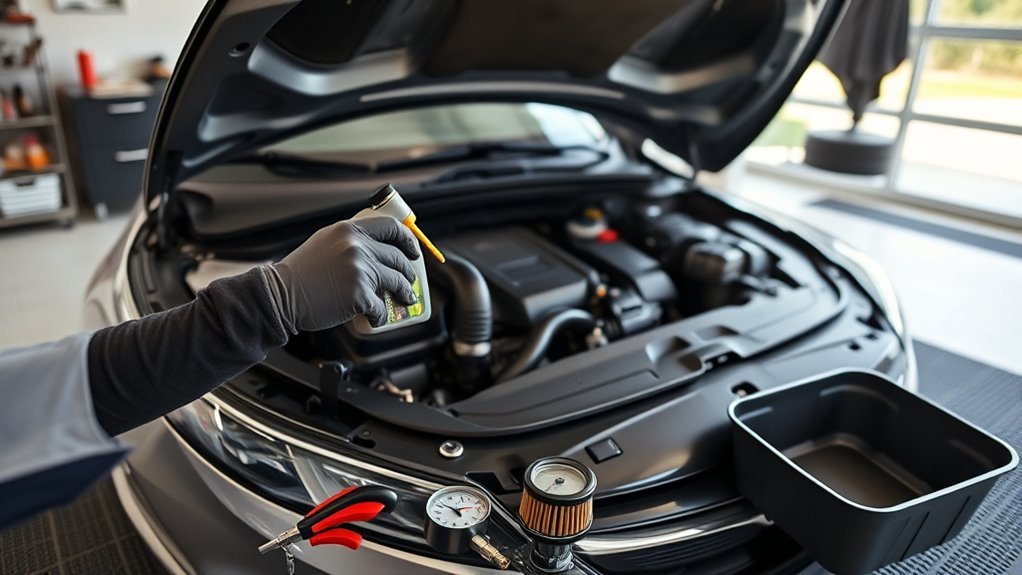
Start with a baseline inspection rather than automatically replacing parts because the odometer is high. Confirm the oil level and service history, look underneath for fresh leaks, check tire pressure and tread, test all exterior lights, inspect visible belts and hoses, and note any warning lights, overheating, abnormal engine noise, braking changes, or shifting problems.
- Check the engine-oil level: High mileage makes regular level checks especially important. Do not wait for an oil-pressure warning to tell you the engine is low.
- Review the service records: Identify overdue time- and mileage-based maintenance using the manual for the exact model year and engine.
- Inspect tires and brakes: Look for uneven tire wear, low tread, vibration, pulling, brake noise, or a soft pedal.
- Look for leaks: Check for engine oil, coolant, transmission fluid, or brake-fluid leakage. Clear water from the air conditioner can be normal.
- Scan warning lights: Read diagnostic trouble codes when the check-engine or other warning lights are on rather than replacing parts by guesswork.
- Check the VIN: Verify open recalls and service campaigns before paying for major repairs.
Stop driving and arrange diagnosis or towing if the oil-pressure warning stays on, the engine develops severe knocking, the temperature gauge shows overheating, coolant is rapidly disappearing, the brakes or steering become unsafe, the transmission loses normal engagement, or the vehicle is losing a substantial amount of fluid.
Check Service History & Fix These 5 Immediate Issues
For a Sonata over 100,000 miles, the first goal is to establish what has actually been maintained. Do not assume a spark-plug, coolant, brake-fluid, transmission-fluid, belt, or filter service happened simply because the vehicle passed the mileage at which it may have been due. Compare receipts with the schedule for the exact vehicle and inspect anything with an unknown history.
| Priority | Issue | Action |
|---|---|---|
| 1 | VIN recalls/campaigns | Check Hyundai and NHTSA before major repairs |
| 2 | Oil pressure, oil loss, or engine knock | Check oil level; stop driving for persistent oil-pressure warning or severe knock |
| 3 | Overheating or coolant loss | Stop an overheating engine and inspect the cooling system before further driving |
| 4 | Brakes, tires, steering | Inspect immediately if braking, handling, or tire condition is unsafe |
| 5 | Transmission engagement or slipping | Check for leaks/codes and obtain diagnosis before assuming a fluid change will fix it |
Some older Sonatas have model- and engine-specific campaign or warranty history. Hyundai has published engine warranty information for certain 2011–2019 Sonata vehicles equipped with specified 2.4L GDI or 2.0L Turbo GDI engines. Eligibility depends on the vehicle, so use Hyundai’s VIN resources rather than assuming every Sonata from those years is covered. If you are troubleshooting shifting rather than routine maintenance, see the Sonata transmission symptom checklist.
What Maintenance Schedule Should a High-Mileage Hyundai Sonata Follow?
Follow the schedule in the owner’s manual for the exact Sonata and continue the prescribed intervals after 100,000 miles. The correct interval can change with model year, engine, transmission, market, and driving conditions. Severe use can also shorten service intervals, so a generic “5,000–7,500 miles for every Sonata” rule is not reliable.
Hyundai classifies conditions such as frequent short trips, extended idling, dusty or unpaved roads, road salt, heavy traffic, repeated mountain driving, towing, frequent high-speed or rapid acceleration, and stop-and-go use as severe conditions in applicable manuals. Some Sonata-era Hyundai manuals also instruct owners to use the severe-maintenance schedule after 10 years or 100,000 miles. Check the wording in your exact manual before applying that rule to your car.
For a mileage-by-mileage reference, use the site’s Sonata maintenance schedule by mileage guide together with the official manual for the exact vehicle.
| Maintenance area | High-mileage approach |
|---|---|
| Engine oil & filter | Follow the exact normal/severe schedule and check the oil level regularly between services |
| Transmission | Identify the transmission and follow its specified fluid, interval, and service procedure; do not use a universal ATF interval |
| Coolant | Verify the scheduled replacement history and inspect for leaks, hose deterioration, and overheating |
| Brake system | Inspect pads, rotors, hoses/lines, fluid condition, and pedal behavior at the prescribed intervals and whenever symptoms appear |
| Spark plugs & belts | Check the exact engine schedule and replace when due or when condition requires it |
| Tires | Maintain the door-jamb cold-pressure specification, rotate as scheduled, and investigate uneven wear |
| Steering & suspension | Inspect boots, joints, mounting hardware, shocks/struts, and abnormal play or noise |
| Battery | Test condition and starting performance rather than replacing solely because of age |
Quality OEM Parts & Fluids for High-Mileage Sonatas
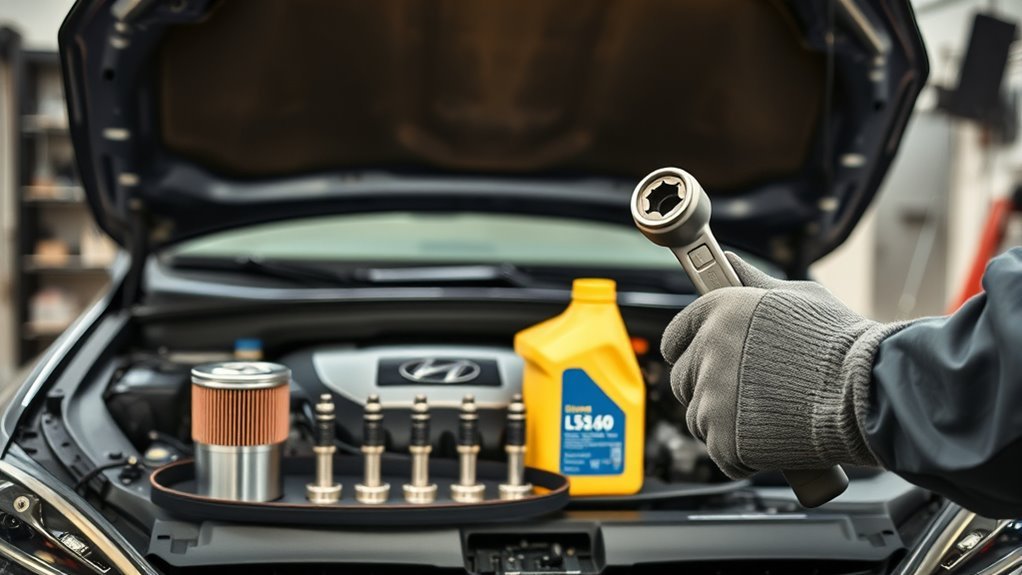
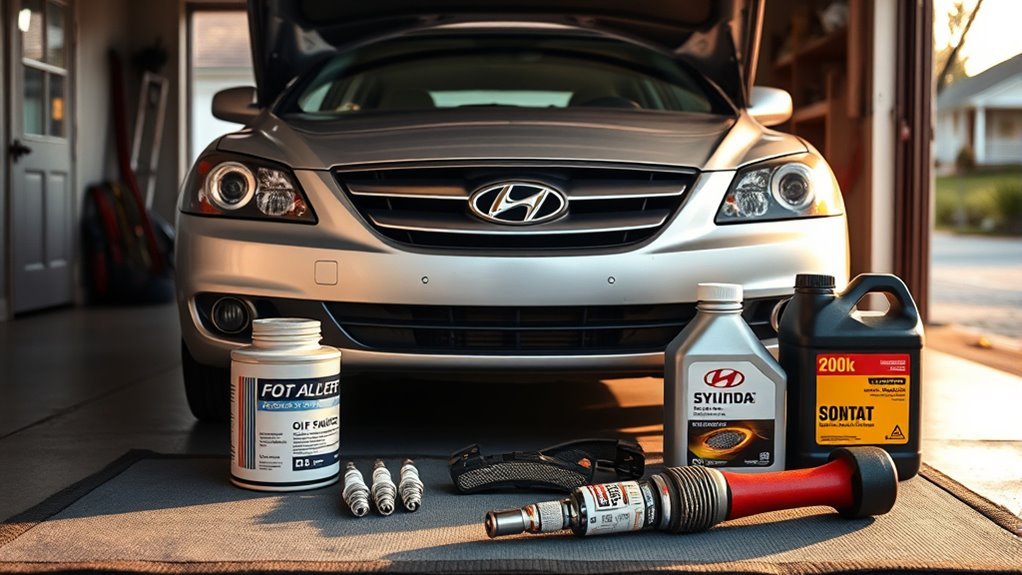
Use parts and fluids that meet the specification for the exact Sonata. “OEM-spec” is more important than choosing something simply because its label says premium or high mileage. Confirm viscosity, fluid type, fitment, part number or cross-reference, and any engine- or transmission-specific requirement before installation.
Stick To OEM Specs
OEM parts are one way to obtain factory-correct fitment, but reputable replacement parts can also be appropriate when they match the required specification and application. What matters is that the part actually fits the model year, engine, trim, and system being serviced. Avoid choosing a sensor, filter, ignition component, belt, or brake part by appearance alone.
| Item | What to verify |
|---|---|
| Oil | Required viscosity and performance specification for the exact engine |
| Brakes | Correct pad/rotor fitment, remaining thickness, and hardware condition |
| Trans fluid | Exact ATF or DCT fluid specification and service procedure |
| Filters | Correct size, seal, filtration application, and replacement interval |
| Sensors | Correct connector, calibration/application, and confirmed diagnosis before replacement |
Choose High-Quality Fluids
For engine oil, use the viscosity and performance standard listed for the exact engine and operating conditions. Do not assume a thicker “high-mileage” oil is automatically better for every older Sonata. If the engine consumes oil, monitor the level closely and diagnose abnormal consumption rather than relying on viscosity changes alone.
For transmission fluid, use the exact specified fluid. Some Sonata configurations use a conventional automatic while others use a dual-clutch transmission, and the service requirements are not interchangeable. Some normal maintenance schedules do not call for routine transmission-fluid replacement while applicable severe-use schedules do. If the transmission is already slipping, delaying engagement, leaking, or producing fault codes, diagnose the problem before treating a fluid change as a repair.
Use the fuel grade and any additive guidance stated in the owner’s manual. For Sonata owners researching older direct-injection engines, the site’s Hyundai Sonata GDI guide explains the system in more detail.
Replace Wear Parts Proactively
Proactive maintenance means replacing a part when the schedule or its measured condition justifies replacement—not changing every component because the vehicle has high mileage. Check brake pads and rotors for actual wear, inspect belts for cracking or deterioration, replace filters and spark plugs when due, measure tire tread, inspect steering and suspension components for play, and test the battery.
Age also matters. Rubber hoses, seals, boots, weatherstripping, suspension bushings, and electrical connections can deteriorate even when annual mileage is low. During routine service, look for seepage, cracking, looseness, corrosion, and other visible deterioration before it causes a larger repair.
Stop Rust Before It Starts: Undercarriage & Corrosion Protection
Inspect a high-mileage Sonata for corrosion at the underbody, suspension mounting areas, rocker/pinch-weld areas, brake and fuel lines, subframes, and other exposed metal. Surface corrosion and structural corrosion are not the same problem: flaking metal, perforation, weakened mounting points, or heavily corroded brake lines deserve professional inspection.
In areas that use road salt or other corrosive materials, rinse accumulated salt and dirt from the underbody and wheel wells. If you apply a corrosion-protection product, follow its instructions and keep coatings away from brake friction surfaces, exhaust components, drains, sensors, and other areas the product manufacturer excludes. Fix water leaks and damaged coatings before corrosion spreads underneath them.
[Products Worth Considering]

Perfect for use on bare or primed metal underbodies of cars, trucks, trailers, RVs and more
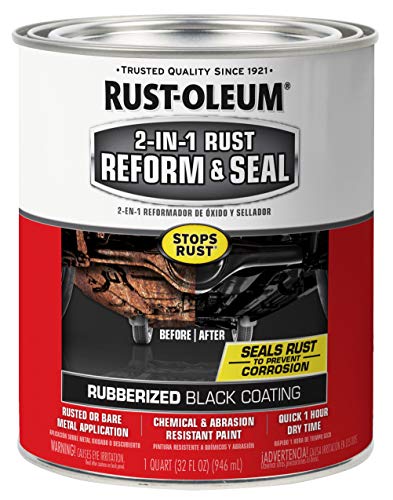
Easy to use spray seals and protects metal surfaces from corrosion and moisture
Track Costs & Decide: Repair vs. Replace for a High-Mileage Sonata
Track maintenance separately from unexpected repairs. Oil changes, tires, brakes, filters, and other normal wear do not mean the car is automatically becoming uneconomical; a replacement vehicle also needs maintenance. The more useful question is whether the next repair makes sense given the Sonata’s current condition, value, expected remaining use, and the cost of replacing it.
AAA has used a repair cost approaching roughly 50% of the vehicle’s value as a reason to seriously consider replacement, but treat that as a screening point rather than an automatic rule. Consumer Reports also recommends dividing a repair cost by the number of additional months you expect to keep the vehicle, then comparing that monthly cost with the realistic cost of replacing the car.
- Get the current repair estimate: Include related work likely to be required at the same time.
- Estimate current vehicle value: Use mileage, condition, accident history, rust, and your local market.
- Look beyond one repair: Consider other known engine, transmission, suspension, brake, tire, HVAC, or corrosion problems.
- Calculate cost per month: Divide the repair by the additional months you reasonably expect to keep the vehicle.
- Compare with replacement cost: Include purchase price, financing, taxes/fees, insurance differences, and any immediate maintenance a replacement car may need.
A well-maintained car with one expensive repair can still be cheaper to keep than replacing it. A car with structural rust, repeated breakdowns, major engine and transmission problems, or several expensive repairs arriving together may point in the opposite direction.
Frequently Asked Questions
How Many Miles Is Too Many for a Hyundai Sonata?
There is no universal “too many miles” number for a Hyundai Sonata. Condition, engine and transmission history, oil consumption, corrosion, maintenance records, unresolved recalls or campaigns, and the cost of upcoming repairs matter more than the odometer alone. A higher-mileage Sonata with documented service can be a better ownership proposition than a lower-mileage example with neglected maintenance.
How to Keep High Mileage Vehicles Running Longer?
Use the maintenance schedule for the exact vehicle, check engine-oil level regularly, repair leaks and warning-light problems promptly, keep the cooling and braking systems healthy, maintain correct tire pressure, inspect age-related rubber and suspension parts, and keep service records. Avoid continuing to drive through oil-pressure warnings, overheating, serious knocking, unsafe braking, or major fluid loss.
Should a High-Mileage Sonata Use the Severe Maintenance Schedule?
Use the severe-maintenance schedule when the owner’s manual says your driving conditions qualify. Some Hyundai Sonata-era manuals also tell owners to use the severe schedule after 10 years or 100,000 miles, but requirements vary by model year and market. Verify the instructions in the manual for the exact Sonata rather than applying that rule universally.
Should You Change Sonata Transmission Fluid After 100,000 Miles?
Do not choose transmission-fluid service from mileage alone. Identify the exact transmission, review its maintenance history, and follow the normal or severe schedule and fluid specification for that Sonata. If it is slipping, leaking, delaying engagement, or showing transmission fault codes, diagnose the problem before assuming a fluid change will correct it.
Conclusion
A high-mileage Hyundai Sonata does not need a made-up universal maintenance schedule. It needs the correct schedule for its exact configuration, a documented baseline after 100,000 miles, regular oil-level checks, prompt attention to safety and drivetrain symptoms, VIN-based recall and campaign checks, and sensible inspection of age-related wear. Keep records of both maintenance and repairs, then judge expensive repairs against the car’s overall condition and realistic replacement cost rather than mileage alone.