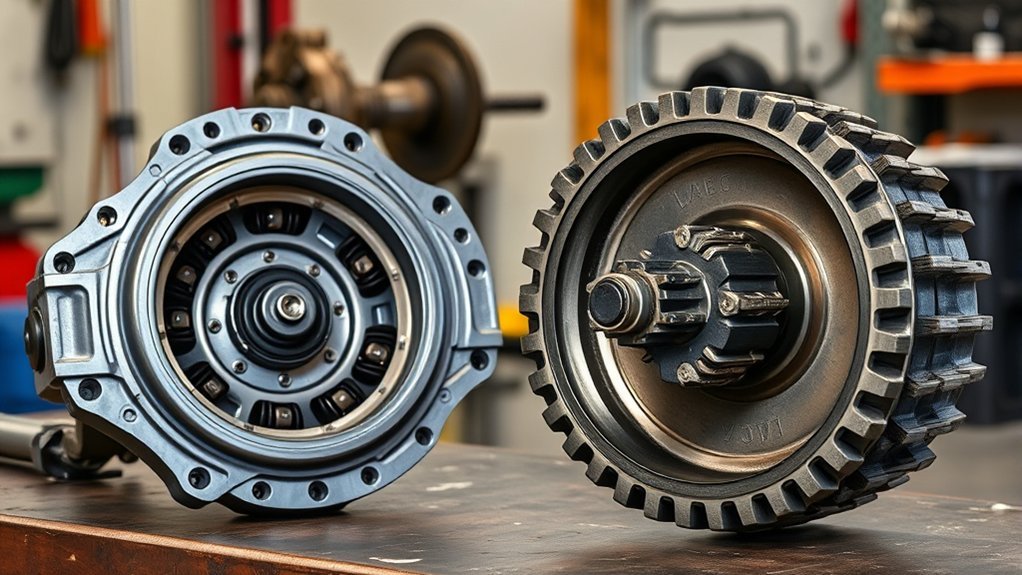
You want predictable traction without harsh handling? Choose a limited‑slip differential for daily use: it senses slip and biases torque to the grippier wheel via clutches or helical gears, preserving cornering behavior and ride comfort while reducing wheelspin. Opt for a locker when you need absolute traction off‑road; it physically locks both wheels together for equal torque but forces tires to scrub in turns. Continue for details on mechanisms, maintenance, and application tradeoffs.
Quick Decision: Locker or Limited‑Slip for You?
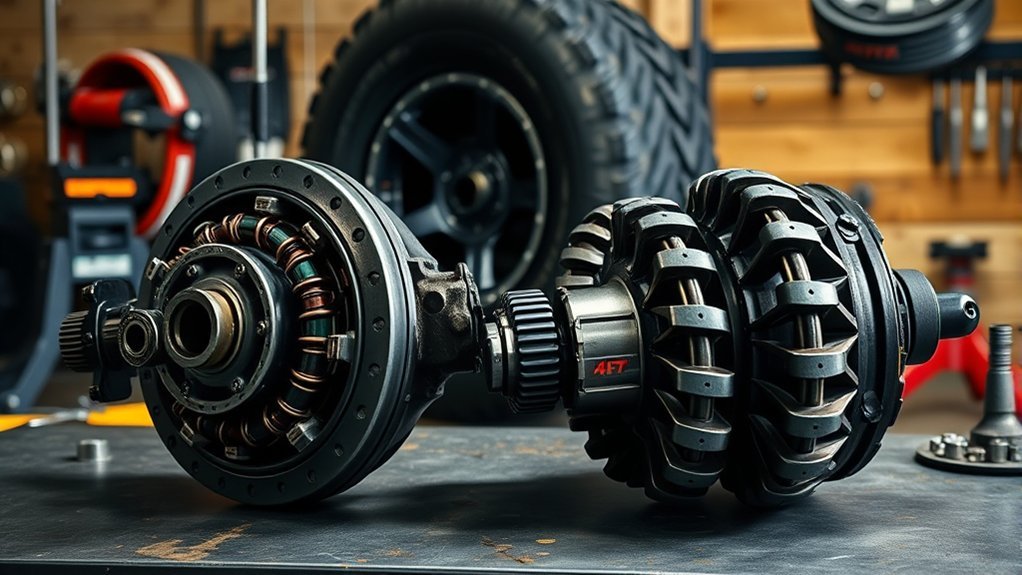
Need a locker or a limited‑slip? You’ll pick based on use: choose limited‑slip for daily driving and mixed surfaces, and a locker for off‑road or extreme conditions where maximum traction frees you from getting stuck. Consider traction management: limited‑slip benefits include smoother power distribution during turns, reducing abrupt torque transfer and maintaining directional control; locker advantages mean full engagement under power, locking both wheels to deliver equal torque for climbing and recovery. Performance tradeoffs are clear: a limited‑slip can allow one wheel to spin in extreme cases, while a locker forces both wheels to turn the same speed, guaranteeing traction when you need liberation from terrain. Maintenance and cost matter: limited‑slip differentials may demand more upkeep from clutch‑pack wear and typically cost more to buy and install; lockers usually have fewer moving parts, greater durability, and can be a simpler, cost‑effective upgrade. Choose based on your terrain and commitment to maintenance.
How Limited‑Slip (LSD) Differentials Work and When They Win
You’ll see LSDs transfer torque by biasing drive to the wheel with more grip using clutches, helical (Torsen) gears, or viscous couplings. Clutch-type units use stacked plates and pressure rings for sudden torque transfer, helical gears provide smooth, maintenance‑light biasing, and viscous units meter slip via fluid shear. You’ll choose an LSD when you want improved traction and handling on pavement or light off‑road without the noise, tire wear, or harshness of a full locker.
How LSDs Transfer Torque
Think of an LSD as a torque manager: it senses when one wheel slips and uses clutches or geared elements to transfer torque to the wheel with grip, improving traction without fully locking the axle. You get controlled torque distribution and measurable traction improvement without sacrificing maneuverability. An LSD redirects up to ~70% more torque to the wheel with grip, engaging proportionally as slip or torque demand increases. It’s ideal for wet or moderate off-road use where you want freedom to move without full lockup.
- Detects wheel slip and reacts proportionally
- Uses internal clutches or gear geometry to shift torque
- Preserves differential action for cornering
- Reduces wheel spin and tire wear
- Enhances controllable forward motion and liberation
Clutch, Helical, Viscous Types
Three common LSD designs—clutch, helical (Torsen-style), and viscous—use distinct mechanisms to manage torque transfer and suit different driving needs. You’ll find clutch-type LSDs rely on spring-loaded plates; their clutch engagement dynamics provide immediate torque bias under load, favored in performance settings for predictable lock-up and tunability. Helical gear designs exploit worm and spur geometry; helical gear advantages include smooth, noise-minimized torque distribution and low maintenance since they use purely mechanical gear action. Viscous units depend on fluid shear; viscous fluid properties create progressive resistance as speed differentials grow, yielding gradual lock without abrupt engagement. When selecting, weigh performance tuning considerations versus durability and quiet operation to match your liberated driving intentions.
Best Use Cases
A limited‑slip differential (LSD) gives controlled torque transfer between wheels, so it improves traction during acceleration and on slippery surfaces while still allowing smooth steering inputs in corners. You’ll prefer an LSD when you need predictable grip without sacrificing maneuverability. It’s quieter and lower‑maintenance than a locking differential, fitting road use and liberation from drivetrain harshness. It excels in high performance applications and daily drivers facing mixed driving conditions, yet it can struggle if one wheel has almost no traction.
- High‑performance sports cars needing cornering traction and power delivery control
- Daily drivers on wet or variable roads seeking safer acceleration
- Light off‑road use where moderate torque bias helps progress
- Track days where modulation beats full lock
- Vehicles prioritizing comfort and low maintenance
How Locking Differentials/Lockers Work and When They Win
When you apply throttle, many lockers (like the Detroit Locker) automatically lock the axle so both wheels receive equal torque, then allow different wheel speeds during turns for normal drivability. That full-lock behavior gives decisive traction on rough, uneven terrain and over obstacles where a slipping wheel would otherwise rob power. Expect tradeoffs on the street: increased noise, harsher engagement, and reduced comfort compared with an LSD, though lockers are durable and low‑maintenance.
How Lockers Engage
Understand how lockers engage: they mechanically lock both axle shafts together under torque so each wheel gets equal power, either automatically when load is sensed or via a driver-selectable switch, maximizing traction on uneven or slippery terrain.
You’ll learn locker engagement mechanisms and the tradeoffs of automatic vs selectable systems. Lockers engage by positive mechanical coupling; some use springs, ramps, or detents triggered by torque or air/electric actuation. Selectable lockers let you choose when to lock for control and freedom; automatic units react without input.
- Engagement triggers: torque threshold, electronic command, vacuum/air signal
- Mechanical methods: dog rings, splines, pawls
- Driver control: on/off switch, momentary or latched
- Downsides: binding in turns, tire wear, drivetrain stress
- Use: reserve lockers for when liberation requires uncompromised traction
Benefits On Rough Terrain
Because lockers lock both axle shafts together under load, you’ll get equal torque to each wheel and far better traction on irregular, low-grip surfaces. You gain decisive traction improvement in mud, snow, and rock: the locker transforms into a spool under power, preventing a single wheel from spinning and forcing drive to the wheel with grip. That lets you climb, pull, and maintain momentum where open differentials fail. In technical terms, lockers maximize tractive effort and stabilize yaw moments during slip events, reducing stall and recovery cycles. For obstacle navigation, they let you commit to lines and power through ruts, ledges, and boulders with predictable wheel behavior. Use them for liberation from terrain limits—where control and maximum traction matter most.
Tradeoffs For Street Use
Although lockers give you unbeatable traction off-road, they impose clear compromises on paved roads: when engaged they lock both axle shafts and eliminate differential action, causing binding, tire chirp, and increased steering effort in turns. You’ll gain torque equality and escape rut or low-traction traps, but you’ll trade comfort and predictable corner behavior. Consider these practical street tradeoffs:
- Traction balance shifts strongly toward wheel equality, improving recovery but reducing corner compliance.
- Lockers can behave like a spool, causing tire chirp and sudden breakaway in turns.
- Limited-slip units permit controlled slip, offering smoother steering and better everyday manners.
- Lockers may accelerate tire wear relative to LSDs under torque and tight-radius driving.
- Your driving style dictates choice: prioritize liberation off-road, choose lockers; prioritize daily comfort, choose LSD.
Spools vs Differentials: What They Do and When to Avoid Them
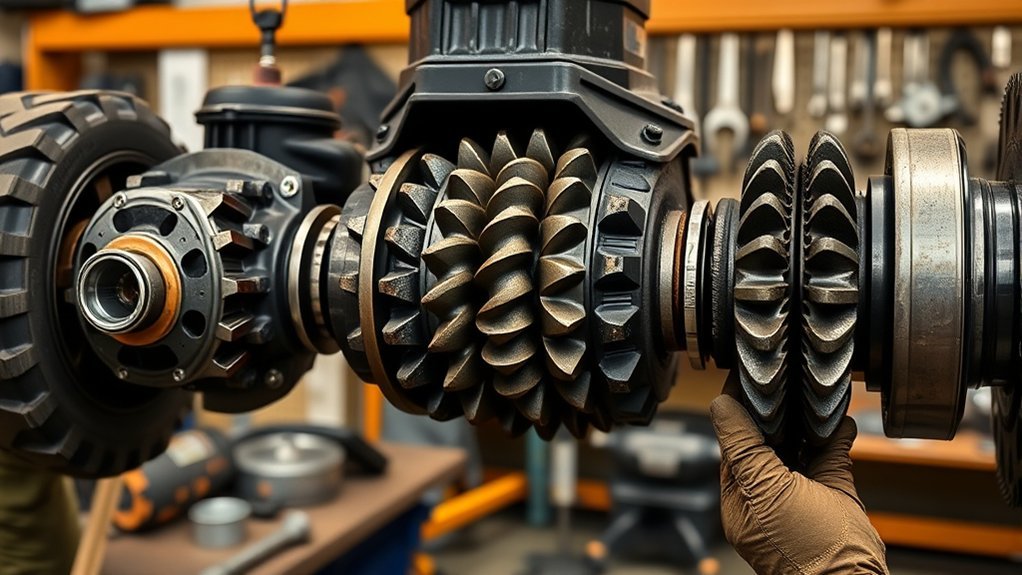
When you swap a differential for a spool, both axle shafts are locked together so the wheels spin at the same rate, giving maximum traction but eliminating the ability to compensate for different wheel speeds during turns. You gain spools advantages like simple, robust traction control for straight-line applications; you accept spools disadvantages such as poor cornering, accelerated tire wear, and compromised handling stability. Differential types and differential benefits remain relevant: open, limited-slip, and locker designs balance traction and maneuverability for liberated, everyday use.
| Item | Benefit | Tradeoff |
|---|---|---|
| Spool (full) | Maximum traction | No turning compensation |
| Mini spool | Easier install | Same rigid lock |
| Open diff | Smooth cornering | Limited traction |
| LSD | Improved balance | Complexity/cost |
| Locker | Strong traction | Intermittent instability |
Avoid spools on street-driven vehicles; reserve them for drag or controlled environments where absolute traction outweighs the loss of steering finesse.
Choose Your Axle: Daily Driver, Performance, or Off‑Road
Which axle best suits you depends on how and where you drive: choose an LSD for daily comfort and improved traction in mixed conditions, a gear-driven LSD for aggressive street/track work, or a locker for extreme off-road traction. You want freedom to go where you choose, so match axle function to mission. Consider daily driver considerations and terrain impact when selecting: LSDs balance traction and smooth turning for pavement and varied surfaces; gear-driven LSDs (Truetrac-style) resist slip under high torque for precise control; lockers (Detroit Locker) force equal wheel rotation for maximum bite in mud, rock, or snow.
- Daily commuting: clutch-type LSD for comfort and predictable grip.
- Performance/track: gear-driven LSD for rapid torque transfer and durability.
- Off-road: selectable or full locker for uncompromising traction.
- Mixed-use: choose versatile LSD or selectable locker to retain freedom.
- Budget vs maintenance: weigh upfront cost, clutch wear, and long-term service.
Decide with clear priorities: comfort, control, or conquer.
Quick Checklist: Maintenance, Compatibility, and Cost
A concise checklist helps you weigh maintenance, compatibility, and cost before choosing an axle. You’ll assess maintenance: limited-slip differentials demand periodic clutch inspection, specific gear oil, and occasional service due to clutch wear; locking differentials have fewer moving parts and typically need minimal upkeep. For compatibility, match differential types to axle and gear ratio—limited-slip suits street-biased torque distribution and predictable handling; lockers suit off-road extremes but can reduce pavement predictability. For cost, expect limited-slip units around $500–$1,000; many lockers fall in the same bracket though selectable lockers or professional installation can raise total expense. Consider performance expectations: balance traction and drivability for daily liberation, or select a locker for uncompromising off-road grip. On installation, limited-slip setups require meticulous setup; selectable lockers simplify engagement and user control. Use this checklist to make a liberated, technical choice that aligns torque distribution, vehicle architecture, and maintenance tolerance.
Frequently Asked Questions
Which Is Better, Limited Slip or Locking Differential?
Limited-slip suits most drivers; locking outperforms it off-road. You’ll weigh performance comparison and terrain suitability: choose LSD for daily control and longevity, pick a locker for maximal traction in extreme, uneven environments.
Do Both Tires Spin With Limited Slip?
Yes — with a limited-slip differential you’ll often have both tires spin, but torque shifts toward the grippier wheel via traction control effects, enhancing tire performance while letting some slip for maneuverability and driving freedom.
Conclusion
Think of your drivetrain as a crew: an LSD is the nimble tactician, reallocating torque when one wheel falters; a locker is the blunt‑force leader, locking hands to pull you through the worst. You’ll pick the tactician for spirited street use and mixed trails, the leader for serious off‑road or winch‑less recovery. Spools and full locks are extreme choices. Match axle strength, maintenance willingness, and budget to avoid breaking the team.