
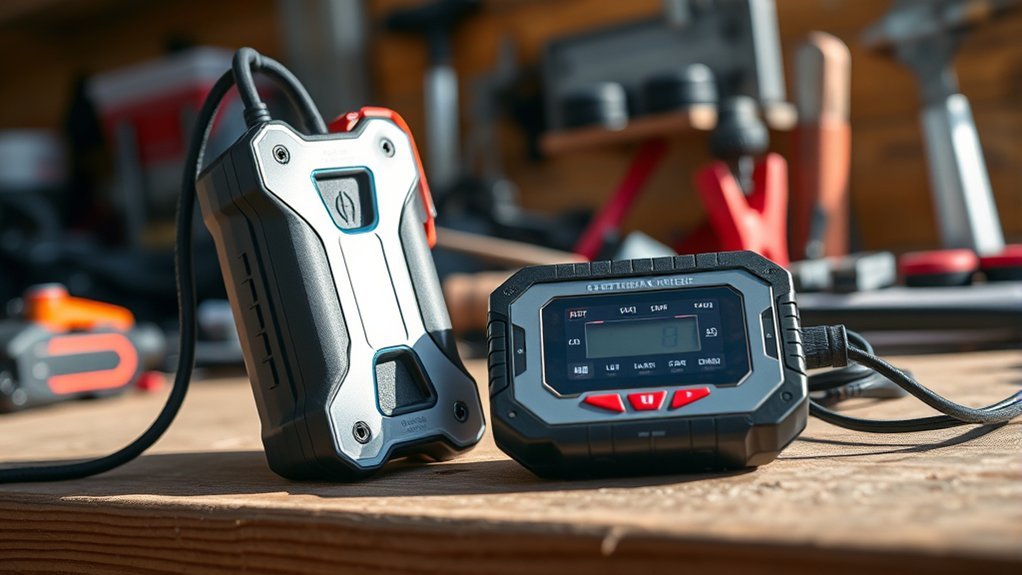
A car battery charger and a portable jump starter solve two different problems. Use a jump starter when the battery is too weak to crank the engine and you need immediate starting help. Use a charger when you have time to restore or maintain the battery’s charge. For many drivers, the best setup is both: a jump starter in the vehicle for emergencies and a smart charger or maintainer at home.
Last updated: August 31, 2026. Charging-time guidance, post-jump advice, safety sources, and charger-versus-jump-starter decision guidance were rechecked for this update.
Affiliate disclosure: If you buy through qualifying product links on this page, we may earn a commission at no extra cost to you.
Quick Answer
Use a portable jump starter when your car will not start and you need an immediate roadside boost. Use a car battery charger when you have time to recharge or maintain the battery. A jump starter helps get the engine running; a charger restores stored battery charge. If you want both roadside protection and long-term battery care, the two tools complement each other rather than replace each other.
Key Takeaways
- A jump starter is best for emergencies because it can help start the engine quickly without another vehicle.
- A battery charger is best for weak, stored, or deeply discharged batteries because it replenishes stored charge.
- A standard charger is not the same as a charger/engine-starter; only models with a rated engine-start or boost mode are designed to assist cranking.
- A successful jump does not mean the vehicle battery is fully recharged.
- Always match the tool to the battery voltage and chemistry, and follow the vehicle and device manuals before connecting clamps.
Key Differences Between Car Battery Chargers and Jump Starters
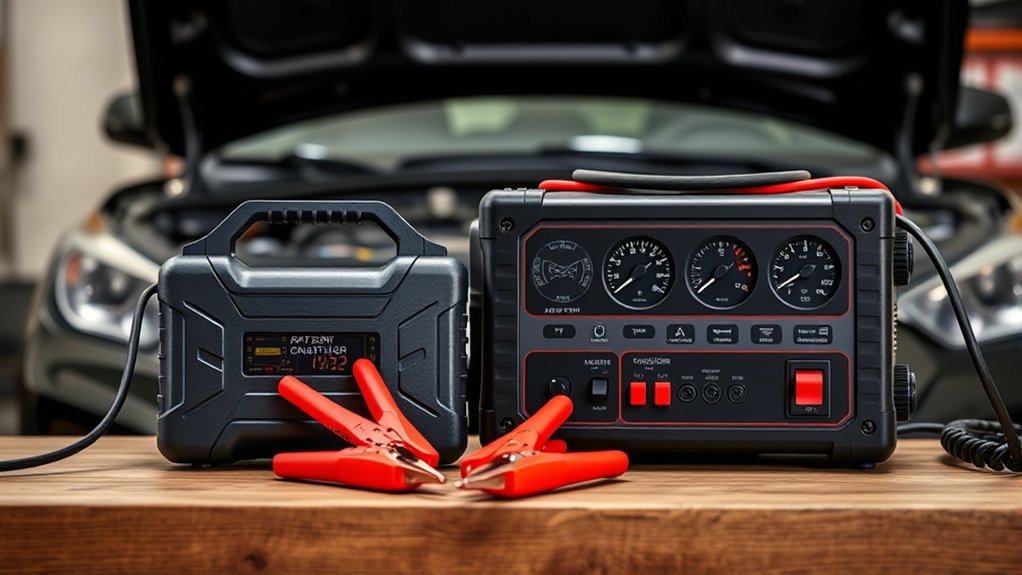
The easiest way to compare them is this: a car battery charger is for recovery and maintenance, while a jump starter is for immediate starting help. A charger normally uses an external power source and sends controlled charging current into the battery. A portable jump starter uses its own internal battery to supply a short high-current burst that helps the starter motor crank.
| Feature | Car Battery Charger | Portable Jump Starter |
|---|---|---|
| Main job | Recharges and maintains the battery | Helps crank the engine immediately |
| Power source | Usually a wall outlet or other external power source | Built-in rechargeable battery |
| Typical time | Hours, depending on battery size, condition, and charger output | Usually less than a minute once connected correctly |
| Best for | Storage, maintenance, weak batteries, deep-discharge recovery | Roadside emergencies, remote travel, cold-start problems |
| Recharges the car battery? | Yes, when compatible with the battery | No; its main purpose is starting assistance |
| Limit | Needs time and usually needs an external power source | Does not fully recharge the vehicle battery |
30-Second Decision Guide
- Car will not crank and you are stranded: Use a compatible portable jump starter if the battery and vehicle are safe to jump.
- Battery is weak and you are at home with time: Use a compatible battery charger.
- Vehicle sits unused for weeks or months: Use a smart charger or maintainer approved for long-term maintenance.
- Battery was deeply discharged: Recharge it with a proper charger instead of relying on repeated jump starts.
- Battery is cracked, swollen, leaking, frozen, smoking, or unusually hot: Use neither tool. Stop and get professional help.
- Battery keeps dying after being fully charged: Test the battery and charging system and check for an electrical draw instead of repeatedly jumping it.
For many drivers, the most useful setup is not one or the other. Keep a jump starter in the vehicle for emergencies and a compatible smart charger or maintainer at home for battery recovery and storage.
How Car Battery Chargers Work and Their Benefits
A car battery charger converts its input power into controlled DC charging output suitable for the selected battery. For a common 12-volt vehicle battery, a smart charger does not simply hold one output level throughout the whole process. Battery Tender describes a four-stage smart-charging sequence of initialization, bulk charging, absorption, and float maintenance: Battery Tender smart charger stages.
Charging Mechanism Explained
During charging, the charger controls current and voltage as the battery recovers. Interstate Batteries says a standard charger may need about 2–4 hours to restore enough charge for starting and around 10–24 hours to charge a car battery completely. Actual time varies, so the charger’s completion indicator and manual are more useful than a fixed clock time: Interstate Batteries charging FAQ.
The actual charging time depends mainly on:
- the battery’s amp-hour capacity,
- how deeply discharged the battery is,
- the charger’s output amperage,
- the battery’s age and condition,
- battery temperature and chemistry.
For storage vehicles, seasonal vehicles, motorcycles, boats, and rarely driven cars, a smart charger or maintainer can be more useful than waiting for a no-start situation. If the charger is intended for long-term float or maintenance operation, follow its instructions for how long it may remain connected.
Advantages of Regular Use
Regular use of the correct charger can help keep a battery ready between drives. This is especially useful if you make frequent short trips, store a vehicle for weeks at a time, or live in a cold climate. AAA reports that at 32°F a vehicle can require about 30% more energy to start, with the increase reaching about 50% at 0°F: AAA cold-weather battery guidance.
Pro Tip: If your car sits unused for weeks at a time, a compatible smart battery maintainer is usually more useful than repeatedly jump-starting the vehicle. Leave it connected long-term only if the charger’s manufacturer specifically approves that use for your battery type.
How Portable Jump Starters Work and Their Advantages
A portable jump starter, also called a jump box, booster pack, or jumper pack, contains its own rechargeable battery. When connected correctly, it supplies starting current that helps the starter motor crank the engine. Interstate Batteries describes portable jump starters as compact starting devices and notes that some models also include USB ports for charging phones and tablets: Interstate Batteries jump starter guide.
The biggest advantage is independence. You do not need another vehicle, traditional jumper cables, or a nearby wall outlet. That makes a jump starter useful in parking lots, remote areas, bad weather, and other roadside situations where outside help may not be nearby.
Jump Starter Specs That Matter
- Supported voltage: Match the jump starter to the vehicle electrical system specified by the vehicle and device manufacturers.
- Starting-current and peak-current ratings: These ratings can help, but do not compare jump starters by one amp figure alone.
- Engine-size rating: Follow the manufacturer’s gasoline and diesel engine-size limits.
- Cold-weather guidance: Confirm that the manufacturer rates the pack for the temperatures in which you expect to use it.
- Safety protections: Reverse-polarity warnings, protected clamps, short-circuit protection, and clear status indicators can make errors easier to identify.
- Extra features: USB charging, an LED light, air compressor, or accessory output can be useful, but vehicle compatibility and starting ability come first.
Note: A jump starter may get the engine running, but it does not restore the vehicle battery to full charge. If the battery was deeply discharged, recharge it with a compatible charger when you reach a safe location. If it dies again, have the battery and charging system tested.
Best Situations to Use a Car Battery Charger
A charger is the right tool when the battery needs actual stored energy restored, not just enough outside power to crank the engine. It is also the better choice when you have access to a suitable power source and enough time to let the charger complete its cycle.
[Products Worth Considering]

Adaptive Smart Charging: Our battery maintainer adapts to the needs of your 12V battery, ensuring optimal charging and extending battery life. Ideal for Automotive, Motorcycle, and Lawn Mowers.

Efficient, Energy-Saving, and Fast Charging: The TowerTop 12v battery charger offers 4 adjustable current settings (2A/10A/25A/AUTO) to meet your diverse needs. With a max charging current of 25A, you can fully charge a 100Ah battery in under 3.5 hours. Achieving an 85% charging efficiency (industry average 75%), this battery chargers is more efficient, increasing charging speed by 1640% compared to 2A car battery charger. Not only is it energy-efficient, but it also saves you a lot of wait time
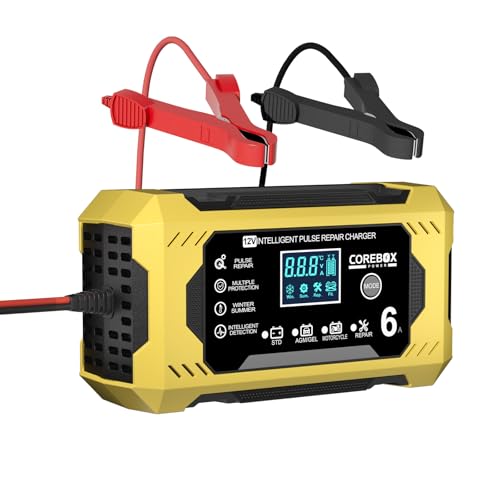
【THE PERFECT WINTER BATTERY CHARGING SOLUTION】Corebox automatic battery trickle charger with 8 charging protections is an all-in-one solution: charger, maintainer, trickle charger and desulfator. It ensures perfect maintenance of battery charging safety during the winter or vacation months, avoiding battery failure in advance. Temp compensation in hot or cold climates, reverse protection, cooling system, overcurrent, fireproof material, overcharge, short circuit.
Long-Term Vehicle Storage
Use a battery charger or maintainer when storing a vehicle for weeks or months. This applies to classic cars, seasonal vehicles, motorcycles, RVs, boats, lawn equipment, and spare vehicles. A smart maintainer designed for long-term connection can hold a compatible battery at its maintenance level instead of allowing normal self-discharge to continue unchecked.
Do not assume every charger can remain connected indefinitely. The charger must explicitly support automatic float or maintenance operation, and its selected mode must be compatible with the installed battery.
Weak Battery Maintenance
If the engine cranks slowly, the lights dim noticeably during starting, or a battery test shows low charge but the battery is otherwise serviceable, a charger can restore energy gradually. A charger is also useful after an accidental drain, such as leaving lights or accessories on while the engine was off.
Deeply Discharged Batteries
A very low battery usually needs proper charging rather than repeated jump starts. Some smart chargers will not begin a normal charging cycle when battery voltage is below their detection threshold. If that happens, follow the exact charger instructions. Do not defeat a safety lockout or force-charge a battery unless the manufacturer provides an approved procedure.
Never attempt to charge a battery that is cracked, leaking, swollen, frozen, smoking, or unusually hot.
When to Choose a Portable Jump Starter
Choose a portable jump starter when you need the vehicle started now and do not have time or access to perform a normal recharge. It is primarily an emergency starting tool, not a battery-maintenance tool.
- Immediate no-start situations: The battery is weak, the engine will not crank normally, and you need to get moving.
- Remote travel: You drive in rural areas, campgrounds, job sites, or places where another vehicle may not be nearby.
- Cold weather: Low temperatures increase starting demand while battery performance falls.
- Solo driving: A jump starter removes the need to find another driver and donor vehicle.
[Products Worth Considering]

START DEAD BATTERIES — Instantly start dead batteries with 1000 amps of peak lithium power. Up to 20 starts per charge on engines up to 6.0L gas and 3.0L diesel.

Powerful and Durable - Powered by GOOLOO JUMPCORE technology, this 3000 amp portable car battery jumper starter provides instant restart for your 12V dead vehicles, supporting engines up to 9.0L for gas and 6.5L for diesel . Even if the battery voltage is extremely low, simply press the "BOOST" button to forcefully jump start your car. With over 1000+ charge cycles, this jump box for car battery is built to withstand extreme weather conditions ranging from -4°F to 140°F.

【Powerful Battery Starter】The OXILAM car jump starter delivers a powerful peak current of 6000A, capable of quickly reviving a dead car battery in just seconds—even in extreme temperatures. A single full charge provides up to 60 jumpstarts. 2024 upgraded jumper cables can safely start all gas engines and 12L diesel engines, including 12v vehicles, motorcycles, pickups, RVs, tractors, trucks, vans, ATVs, snowmobiles, yachts, and many more. Say goodbye to being stranded due to a dead battery
What Should You Do After a Successful Jump-Start?
Do not assume a short drive has fully recharged the battery. Interstate Batteries says restoring a car battery through driving can take roughly four to eight hours at highway speeds, and the battery may still not reach 100% state of charge. A short drive may put some energy back into the battery, but a deeply discharged battery is better recovered with a compatible charger once you reach a safe location: Interstate Batteries guidance on charging while driving.
If the vehicle needs another jump soon after the battery has been properly recharged, have the battery and charging system tested. An aging battery, poor cable connection, charging-system fault, or parasitic electrical draw may be the real cause.
Can a Battery Charger Jump-Start a Dead Battery?
A standard battery charger or maintainer usually cannot jump-start a car because it is designed to recharge the battery over time. However, some products are specifically built as battery charger/engine starter units. Schumacher, for example, lists a 12V charger/engine-starter with a rated 100A engine-start function: Schumacher 100A charger/engine starter.
The label and manual determine what your charger can safely do. If the charger does not clearly state that it has an engine-start, crank-assist, or equivalent starting mode, treat it as a charger only.
Never use a charger or booster at an incompatible voltage. A service bulletin hosted by NHTSA warns that when a battery charger or booster is used for jump starting, it must be set to the same voltage as the vehicle electrical system and batteries; inappropriate voltage may cause equipment damage, fire, or explosion: NHTSA-hosted jump-start voltage bulletin.
Warning: Do not guess about voltage, battery chemistry, jump points, clamp order, or charging mode. Follow the instructions for your exact vehicle and device. Stop if the battery is cracked, leaking, swollen, frozen, smoking, or unusually hot.
Stay Safe: Tips for Using Battery Chargers and Jump Starters
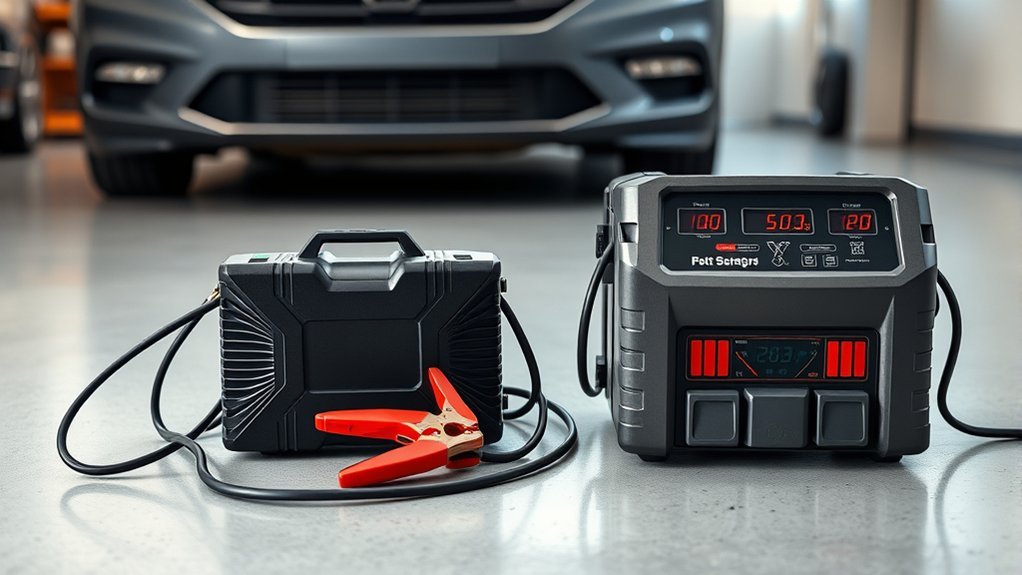
Battery work can be dangerous if you use the wrong voltage, reverse connections, create sparks near battery gases, or attempt to charge a damaged battery. OSHA rules for covered workplaces require ventilation to prevent explosive gas accumulation and protective provisions for workers handling batteries or acids: OSHA battery charging safety requirements. For personal vehicle work, also follow your vehicle and charger or jump-starter manuals.
Basic Safety Checklist
- Read both manuals first. Use the vehicle’s approved battery terminals or remote jump points and the connection procedure specified for your equipment.
- Match the voltage. Do not assume every vehicle or piece of equipment uses the same electrical-system voltage.
- Match the battery chemistry. Do not select AGM, gel, lithium, repair, or recondition modes unless they are approved for the installed battery.
- Check the battery condition. Do not charge or jump-start a cracked, leaking, swollen, frozen, smoking, unusually hot, or visibly damaged battery.
- Use eye and hand protection. Keep your face away from the battery while making connections.
- Work in a ventilated area. Keep flames, cigarettes, sparks, and loose metal objects away from batteries.
- Follow the specified clamp order. Do not assume the negative clamp always belongs directly on the battery terminal; some vehicles and devices specify a remote ground point.
- Keep cables away from moving parts. Secure the jump pack or charger leads before the engine is started.
- Remove clamps in the specified order. Follow your device and vehicle instructions rather than relying on one generic procedure.
How to Choose the Right Tool
The right choice depends on your driving habits, storage situation, climate, battery type, and whether your priority is emergency starting or battery recovery.
[Products Worth Considering]

Stay Charged: The powerful 3 amp charger provides a full charge to your automotive vehicle’s battery before automatically going into float mode to maintain proper voltage levels without overcharging. 5 amps 12 volt charger and maintainer

Charger, Maintainer & Desulfator - An all-weather battery charger, battery maintainer, trickle charger, and battery desulfator. Perfect for charging and maintaining all 12-volt lead-acid, flooded or sealed maintenance free batteries (AGM and gel cell).

Stay Charged: Battery Tender battery chargers and maintainers provide a full charge to your powersport vehicle’s battery before switching to float mode to maintain proper voltage levels for safe, long-term storage
Choose a Battery Charger If
- your vehicle sits unused for long periods,
- you take frequent short trips,
- you want to maintain a seasonal vehicle,
- your battery is discharged but still serviceable,
- you have access to a suitable external power source,
- you want to restore stored charge instead of only getting one start.
For many passenger-vehicle owners, a compatible smart charger/maintainer is the easiest option. Check the battery label and vehicle manual first, then make sure the charger supports the required voltage and chemistry, such as flooded lead-acid, AGM, gel, or an explicitly supported lithium battery.
Choose a Jump Starter If
- you want emergency starting power in the vehicle,
- you drive alone or in remote areas,
- you regularly face cold-weather starting conditions,
- you do not want to depend on another vehicle,
- you want emergency extras such as a flashlight or USB power bank.
Match the jump starter to your vehicle using the manufacturer’s voltage and gasoline/diesel engine-size guidance. If you expect to use it in winter, also check its specified operating-temperature range rather than assuming its warm-weather performance will be identical in severe cold.
Troubleshooting Common Problems
Jump Starter Will Not Start the Car
- The jump starter may not be sufficiently charged.
- The clamps may have a poor connection because of corrosion, dirt, or loose contact.
- The vehicle battery voltage may be too low for the jump starter’s normal detection system.
- The jump starter may not be rated for the vehicle or engine.
- The battery may be internally damaged or unable to conduct properly.
- The actual fault may involve the starter, cables, fuses, ignition system, or another vehicle system rather than low battery charge.
Battery Charger Shows an Error
- Check for reversed or loose connections.
- Confirm the charger is set for the correct voltage and battery chemistry.
- Clean accessible corrosion from the connection points and reconnect the charger as instructed.
- Allow an excessively cold or hot battery to return to the temperature range permitted by the charger and battery manufacturers.
- Follow the charger manual if voltage is too low for automatic battery detection.
- Have the battery professionally tested if it repeatedly refuses to accept or retain charge.
Battery Dies Again After a Jump
If the battery dies again soon after jump-starting, do not keep repeating the same jump-start cycle. Fully recharge the battery with a compatible charger when possible, then have the battery and charging system tested. A repeated no-start can point to a worn battery, poor cable connection, charging-system problem, or an electrical draw that continues while the vehicle is parked.
When Neither Tool Is the Right Fix
A charger and jump starter only address battery charge or temporary starting assistance. They do not repair an internally failed battery, broken starter, damaged cable, failed charging system, blown fuse, or parasitic electrical fault.
- Visible battery damage: Stop and seek professional assistance.
- Battery repeatedly goes flat after a proper recharge: Test the battery, charging system, and parasitic draw.
- Battery tests charged but the engine still will not crank: Diagnose the starter circuit and other no-crank causes.
- Charging-system warning appears while driving: Do not assume a jump starter will solve the underlying fault.
Frequently Asked Questions
Is charging a battery better than jumping it?
Charging is better when your goal is to restore stored battery energy. Jump-starting is better when you need immediate starting assistance. If you are stranded, a compatible jump starter may get the engine running, but a deeply discharged battery should still be properly recharged afterward.
Does a jump starter charge a car battery?
No. A portable jump starter is primarily designed to supply a short burst of current that helps crank the engine. It may transfer a small amount of energy while connected, but it is not a substitute for a battery charger and should not be relied on to restore a deeply discharged vehicle battery.
Can a battery charger jump-start a dead battery?
A regular charger or maintainer usually cannot jump-start a car. It is designed to recharge over time. A charger with a clearly rated engine-start or crank-assist mode can help start compatible vehicles, but only when used exactly as the manufacturer instructs.
Is it better to use a jump starter or jumper cables?
A portable jump starter is more independent because it does not require another vehicle. Jumper cables can also provide starting assistance when a suitable donor vehicle is available. Whichever method you use, follow the vehicle-specific connection procedure instead of assuming one generic clamp sequence applies to every vehicle.
How long does it take to charge a car battery?
Charging can take several hours or longer depending on battery capacity, state of charge, temperature, condition, and charger output. Interstate Batteries says a standard charger may take about 2–4 hours to restore enough charge for starting and roughly 10–24 hours for a complete charge. A low-output maintainer is intended more for gradual charging and long-term storage.
How long should I drive after jump-starting a car?
Do not rely on a short drive to fully recharge a deeply discharged battery. Interstate Batteries says restoring a battery through highway driving can take roughly four to eight hours and may still not bring it to 100% charge. After a jump, use a compatible charger when practical and have the battery tested if the problem returns.
Can I leave a smart battery charger connected overnight?
Only if the charger manufacturer says the model is designed for automatic maintenance or float operation and the selected mode matches your battery chemistry. Do not assume every charger is safe for unattended or long-term connection.
Should I buy a battery charger or a jump starter first?
Buy a jump starter first if your main concern is being stranded away from home. Buy a charger first if your vehicle sits unused or its battery regularly needs maintenance charging. For the broadest coverage, keep a compatible jump starter in the vehicle and a smart charger or maintainer at home.
Conclusion
A car battery charger and a portable jump starter are not interchangeable. A charger restores and maintains stored battery charge. A jump starter supplies immediate starting assistance when the vehicle battery cannot crank the engine normally.
If you mainly worry about roadside no-starts, keep a compatible jump starter in the vehicle. If your vehicle sits unused, makes frequent short trips, or needs recovery after a deep discharge, use a compatible smart charger or maintainer. If the battery repeatedly goes dead after proper charging, stop treating the symptom and have the battery and charging system diagnosed.
Sources
- Battery Tender smart charger stages — supports the four-stage initialization, bulk, absorption, and float charging sequence and chemistry-specific charging guidance.
- Interstate Batteries jump starter guide — supports portable jump-starter function, starting-current context, temporary-use guidance, and USB accessory features.
- Interstate Batteries charging FAQ — supports approximate charging-time ranges.
- Interstate Batteries charging-while-driving guidance — supports the warning that a short post-jump drive does not fully recharge a deeply discharged battery.
- AAA cold-weather battery guidance — supports cold-weather starting-demand and battery-performance cautions.
- OSHA battery charging safety requirements — supports ventilation and protective provisions for covered workplace battery handling and charging.
- NHTSA-hosted jump-start voltage bulletin — supports voltage-matching and manual-first warnings for jump starting.
- Schumacher 100A charger/engine starter — supports the distinction between standard chargers and charger/engine-starter units.


[…] listing details. If you’re not sure whether you need a jump starter, a charger or both, our jump starter vs. battery charger guide explains the […]
[…] it doesn’t recharge a weak battery. If you’re jumping the same car every week, read our battery charger vs. jump starter guide and test whether the battery or the charging system is at […]