
What’s in This Article
- How to Replace a Toyota Camry Serpentine Belt
- Before You Begin: Check Belt Fit and Routing
- Essential Tools for Replacing the Serpentine Belt
- How to Release the Camry Belt Tensioner
- Route and Install the New Serpentine Belt
- Final Checks After Installing the Serpentine Belt
- Toyota Camry Serpentine Belt Replacement Cost
- Common Replacement Problems and Solutions
- When to Get Professional Help
- Frequently Asked Questions
By Auto Review Nest Editorial Team · Last updated: August 19, 2026
To complete a Toyota Camry serpentine belt replacement, first confirm that your exact model year and engine have a serviceable accessory drive belt. Find the correct routing diagram, tensioner service point, tool size, and release direction before applying force. With the engine cold and off, photograph the old route, release the tensioner slowly, remove the belt from an easy-to-reach pulley, inspect the belt drive, and route the replacement exactly as shown for your engine. Seat the ribbed side in grooved pulleys, place the smooth side against smooth pulleys, release the tensioner slowly, and check every groove before startup.
Do not treat “14 mm and counterclockwise” as a universal Camry instruction. Tool size, direction, access, and pulley layout vary by engine and generation — and, as the section below shows, even documented professional procedures for the same generation don’t always agree.
Estimated total time: Plan about 30 to 90 minutes for a straightforward belt-only job. The repair can take longer if your procedure requires wheel-well access, splash-shield removal, or additional clearance.
Quick Answer
Confirm the exact belt and routing for your Camry, let the engine cool, and identify the designated tensioner service point. Rotate the tensioner only in the direction specified for your engine, remove the old belt, inspect the pulleys and tensioner, and route the replacement according to the correct diagram. Release the tensioner slowly and verify that every rib sits fully in its pulley before starting the engine.
Key Takeaways
- Match the belt to the exact model year, engine, and accessory layout.
- Do not assume every Camry uses a 14 mm tool or counterclockwise release direction — documented procedures for the same generation sometimes disagree.
- Check for a factory routing sticker before relying only on memory or a generic diagram.
- Use a routing diagram and take clear photos before removing the old belt.
- Inspect the tensioner, idlers, alignment, and fluid leaks before installing the replacement.
- The 2025 and 2026 U.S. Camry lineups are exclusively hybrid, so confirm the exact Toyota procedure before using an older gasoline-model guide.
- Never reach into or lean over a moving belt during the first startup check.
How to Replace a Toyota Camry Serpentine Belt
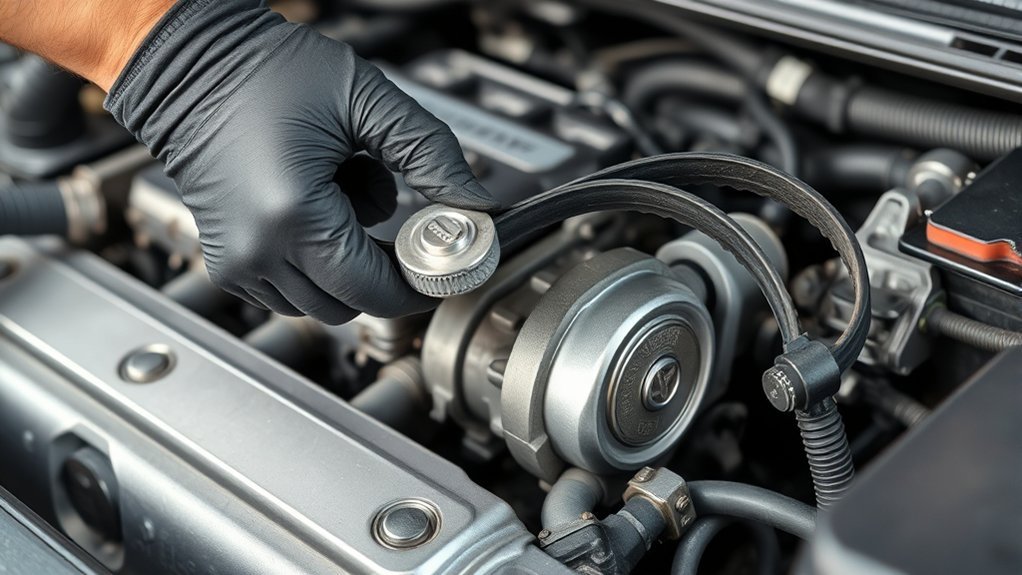
A Camry accessory-belt replacement follows the same general sequence across many engines, but the exact tool, release direction, access path, and routing can differ. Treat the following steps as a safe workflow, not as a substitute for the repair procedure for your vehicle identification number (VIN) and engine.
- Confirm applicability: Verify that the engine has a visible, serviceable accessory belt and identify the exact engine.
- Record the route: Check for a routing diagram sticker on the radiator support or underside of the hood — many Camrys have one printed at the factory. If it’s faded or missing, photograph the old belt from more than one angle and locate a reliable engine-specific procedure. If you can’t find either, stop and consult a dealership parts diagram or a qualified technician before removing the old belt.
- Identify the tensioner: Find the designated service hex, boss, or bolt head used to move the tensioner. Do not assume the pulley-retaining bolt is the release point.
- Release tension: Fit the correct tool fully and rotate the tensioner slowly in the specified direction.
- Remove and inspect: Slide the belt off an easy-to-reach pulley, release the tensioner slowly, and inspect the complete belt path.
- Route the new belt: Follow the exact diagram, with ribs in grooved pulleys and the smooth belt surface against smooth pulleys.
- Check and test: Release the tensioner slowly, check every pulley with the engine off, then perform a brief startup from a safe distance.
Inspect the old belt for frayed edges, missing rib material, glazing, exposed cords, oil or coolant contamination, and uneven wear. Cracks alone do not explain every modern belt failure. Off-center wear can point to pulley misalignment, while contamination may indicate a leak that must be repaired before the new belt is installed.
For inspection intervals, use the Toyota Camry maintenance schedule for your exact model year instead of relying on a universal replacement mileage.
[Products Worth Considering]

This A-Premium serpentine belt is designed to deliver dependable drive performance for a wide range of compatible Toyota, Hyundai, Kia, Lexus, and Scion vehicles. Built with EPDM construction and precision dimensions, it helps promote stable tension, reduced noise, and reliable operation in demanding driving conditions. It is a practical replacement choice for maintaining accessory system performance and long-term confidence.
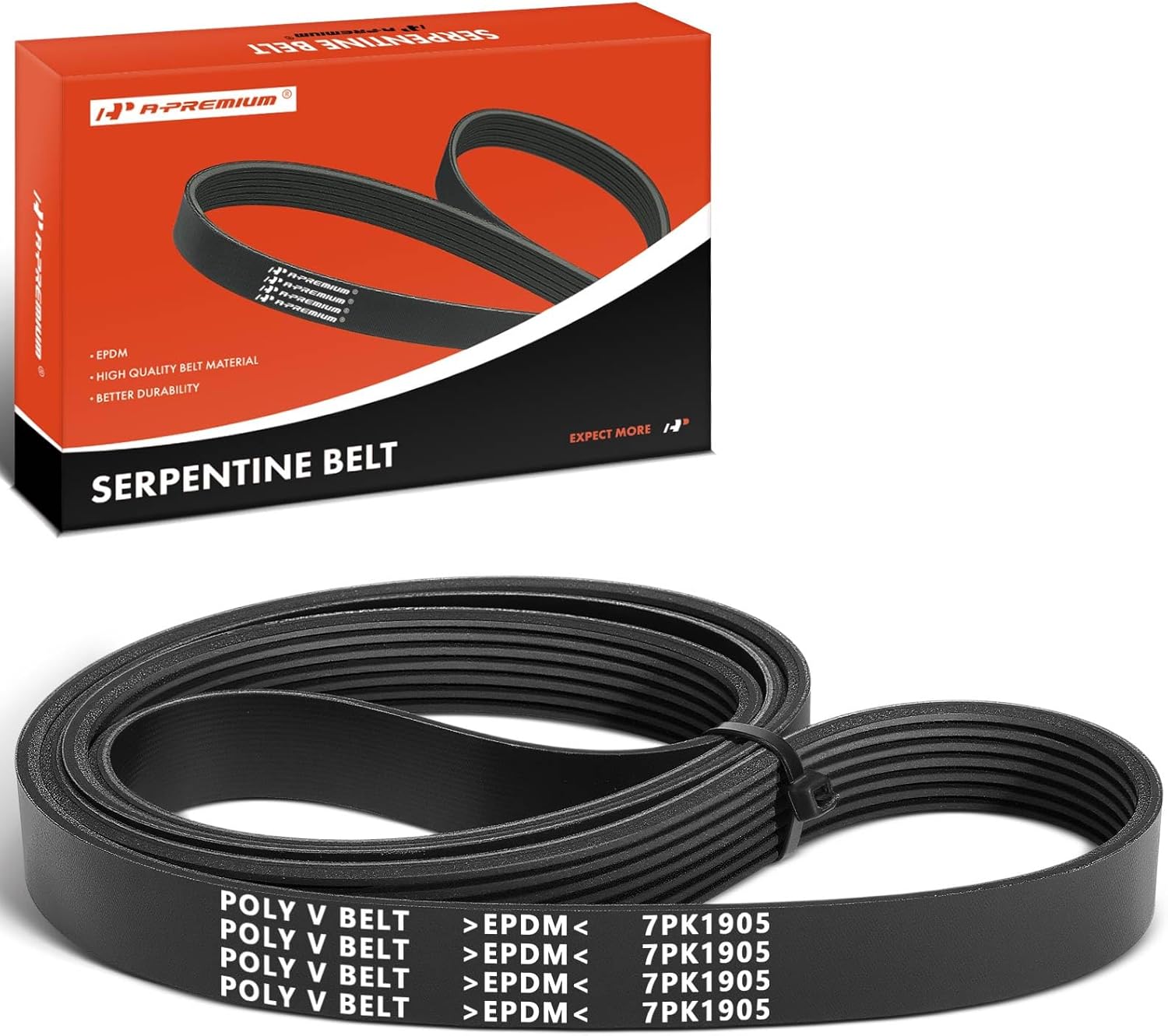
This A-Premium serpentine belt is engineered for select Toyota, Scion, and Pontiac vehicles with the L4 2.4L gas engine, delivering dependable air conditioning drive performance. Made with durable EPDM and precision dimensions, it helps resist cracking, reduce noise, and maintain stable tension for smooth operation. It's designed for straightforward installation and backed by a one-year unlimited-mileage guarantee for added confidence.

This A-Premium serpentine belt drive kit is designed for compatible Toyota Camry, RAV4, and Scion tC models with a DOHC 2.5L L4 engine. It includes a serpentine belt and belt tensioner to help maintain smooth engine operation, reduce noise, and support reliable power transfer. Built for dependable replacement performance, it also comes with a one-year unlimited-mileage guarantee for added peace of mind.
Before You Begin: Check Belt Fit and Routing
Confirm This Guide Applies to Your Camry
Camry belt procedures vary enough that you should identify the engine before buying a belt or placing a wrench on the tensioner. The examples below show why one universal direction is not safe.
| Documented Example | Commonly Shown Tensioner Method | What the Reader Should Do |
|---|---|---|
| 2002–2006 Camry 2.4L guide | 19 mm tensioner point turned clockwise | Do not use a later-model 14 mm instruction on this setup. |
| 2011–2017 Camry four-cylinder guide | 14 mm service point turned counterclockwise | Confirm the engine and access path before copying the procedure. |
| 2018–2022 Camry 2.5L guide | 14 mm service point moved upward and toward the rear of the engine bay | Use the illustrated movement for the exact engine rather than relying only on clock direction. |
| Other gasoline engines, Hybrid models, and other markets | Layout and service procedure may differ | Check Toyota service information or a verified engine-specific guide before applying force. |
The table gives examples, not a complete Camry application chart. A V6, an older two-belt layout, a Hybrid powertrain, or another market specification may use a different procedure.
Worth knowing: Documented professional procedures don’t always agree even within the same generation. Some published 2011–2017 four-cylinder guides show the 14 mm service point turning counterclockwise to release tension, while other sourced procedures for essentially the same engine family show it turning clockwise. This is exactly why the direction printed on your under-hood routing sticker, or your engine-specific service information, outranks any general instruction — including the examples in this table.
Buy the Correct Belt
Buy a belt that matches the model year, engine code, drivetrain, and accessory layout. A belt that looks close can still be wrong if its rib count or effective length differs. Confirm the part using the VIN, an official Toyota parts lookup, or a reputable catalog that asks for the exact engine.
Compare the old and new belts before installation. The rib count should match, and the belts should appear reasonably similar in length when laid side by side without stretching. Stop if the replacement is obviously longer, shorter, wider, or narrower.
Prepare the Work Area Safely
Let the engine and nearby exhaust and cooling parts cool fully. Park on level ground, set the parking brake, place the transmission in Park, and keep the key or smart-key fob away from the vehicle. On a Hybrid, never work in the engine bay while the READY indicator is on.
If the engine-specific procedure requires lifting the vehicle or removing a passenger-side wheel, use the factory lifting points, wheel chocks, and properly rated jack stands. Never work beneath a vehicle supported only by a hydraulic jack.
Warning: Keep your hands, hair, sleeves, jewelry, and tools away from the belt path. Never guide, touch, or closely inspect a belt while the engine is running.
Essential Tools for Replacing the Serpentine Belt
Gather the tools required by the procedure for your exact engine. A tool that fits one Camry generation may not fit another.
| Tool or Supply | Purpose | Important Note |
|---|---|---|
| Engine-specific tensioner tool | Moves the automatic tensioner | Published Camry procedures commonly show 14 mm or 19 mm service points, depending on engine. |
| Long-handled wrench, ratchet, or belt tool | Provides controlled leverage in a tight engine bay | Use only if it seats fully on the designated service point. |
| Flashlight and inspection mirror | Improves visibility around hidden pulleys | Check the crank pulley and lower belt path from more than one angle. |
| Ratchet and metric socket set | Removes an access cover or splash shield when required | Keep all clips and fasteners organized. |
| Correct replacement belt | Replaces the worn or damaged belt | Match the VIN, engine, rib count, and application. |
| Phone camera | Records the old belt route and pulley positions | Take wide and close photos before removal. |
| Safety glasses and gloves | Protects your eyes and hands | Gloves do not make it safe to touch a moving belt. |
| Wheel chocks, jack, and jack stands | Provides safe access when the verified procedure requires lifting | Do not lift the vehicle unless the engine-specific procedure requires it. |
Place tools where they cannot fall into the fan or belt path. Do not use a pry bar or screwdriver to stretch the belt over a pulley. A correctly matched belt should install when the tensioner reaches its proper release position.
[Products Worth Considering]
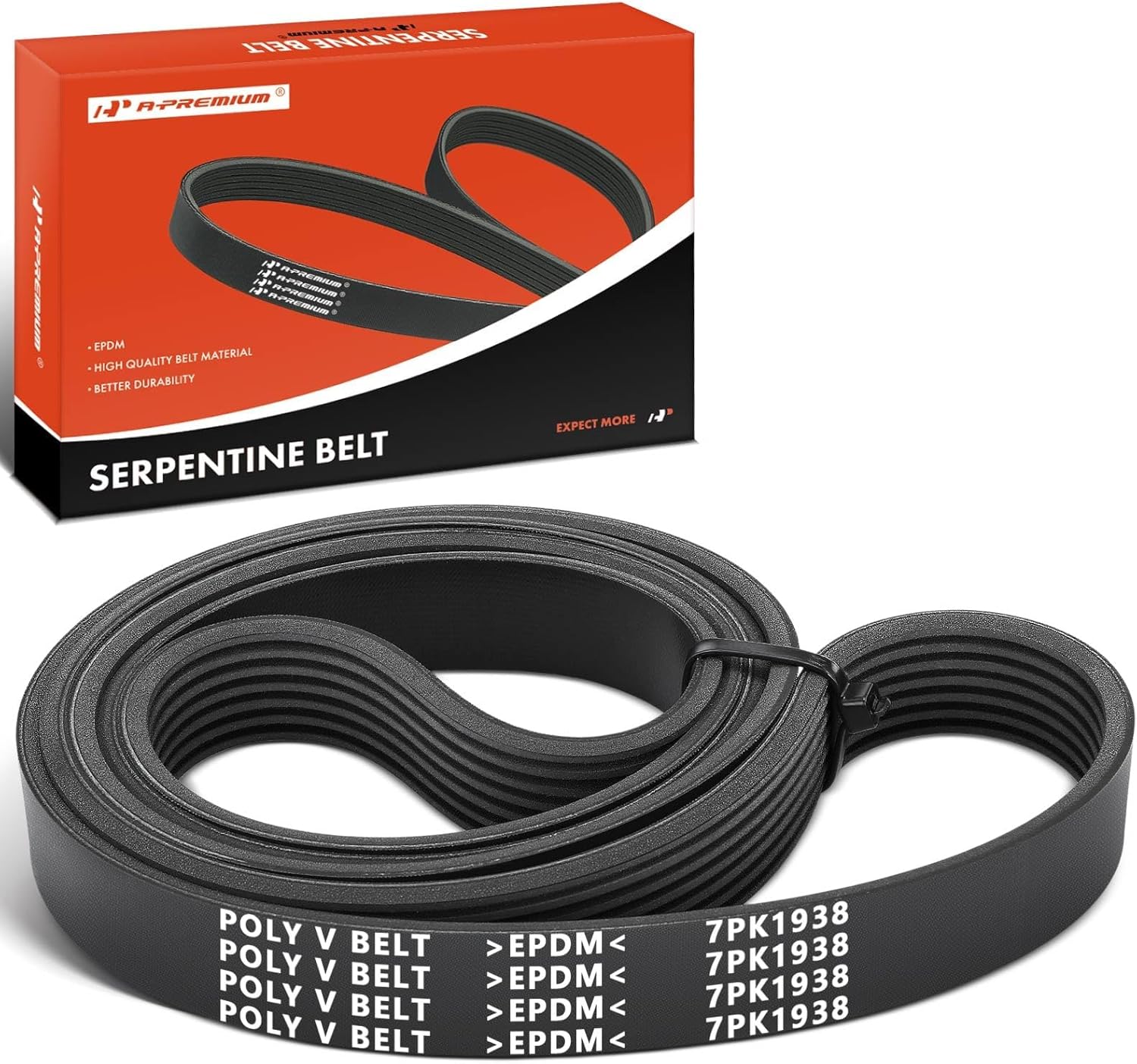
This A-Premium serpentine belt is designed to deliver dependable drive performance for compatible Toyota and Scion vehicles with exact-fit sizing for smooth operation. Built with premium EPDM and polyester cord construction, it helps resist cracking, reduce noise, and maintain stable tension in demanding engine conditions. It is a practical replacement choice for restoring reliable accessory drive performance and long-term confidence.

This reusable stretch belt installation and removal tool helps guide stretch-fit belts on and off pulleys with greater control during service. It is designed to improve alignment, reduce belt damage, and make installation easier on compatible vehicles. Built for repeated use, it offers a practical solution for mechanics and DIY repairs working with stretch belt systems.
This steering clock spring assembly is an OEM-style replacement designed to restore steering wheel controls and related electronic functions in compatible Nissan vehicles. It supports audio, cruise control, and multi-function button operation while matching multiple factory part numbers for a reliable fit. Built for direct installation with vehicle-specific connectors, it helps return steering column electronics to proper working order.
How to Release the Camry Belt Tensioner
Locate the automatic tensioner and identify the designated service point before placing a tool on it. Depending on the engine, this may be a cast hex, a bolt head intended for tensioner movement, or another clearly specified point. Do not loosen a pulley-retaining bolt or tensioner mounting bolt unless the repair procedure specifically tells you to remove that component.
- Confirm the release direction: Check the routing label, service information, or verified model-specific procedure.
- Seat the tool fully: Keep the wrench or socket square to the service point so it cannot slip.
- Apply slow pressure: Move the tensioner smoothly in the specified direction. Do not jerk a hydraulic or spring-loaded tensioner.
- Remove the belt from an accessible pulley: Choose a pulley you can reach without placing your fingers between the belt and pulley.
- Move the belt clear: Once the belt is off the pulley, keep it away from the tensioner arm.
- Release the tensioner slowly: Let it return to its resting position under control.
If the tensioner does not move with firm, controlled pressure, stop. Recheck the service point and direction. Excessive force can round the hex, break a cast arm, or damage the tensioner.
Keep the old belt until the replacement is fully installed. It provides a useful comparison for rib count, width, and general length, and its wear pattern may reveal the cause of the failure.
[Products Worth Considering]

This coolant electric water pump is designed as a replacement for select Toyota vehicles, helping maintain proper engine cooling performance and reliable temperature control. Built to OE specifications, it offers fitment support for compatible Avalon, Camry, and RAV4 models with 2.5L L4 engines. It also includes cross-reference part numbers for easier matching and comes with after-sales support for covered defects.
This AW6252 water pump is designed for a wide range of Toyota, Scion, and Lexus applications, helping maintain reliable engine cooling across compatible models. It features case hardened bearings for durability, a graphite-impregnated gasket for a secure seal, and 100% function and leakage testing for dependable performance. Built in TS16949 certified facilities, it offers a strong replacement option backed by service support.

This engine water pump kit is designed to help maintain reliable cooling performance across a wide range of compatible Toyota, Lexus, Scion, and Pontiac vehicles. Built with aluminum and tested for leak-free operation, it offers a direct replacement solution that supports engine efficiency and long-term service life. The kit includes a professional water pump and gasket for a convenient installation-ready repair.
Route and Install the New Serpentine Belt

Install the new serpentine belt only after confirming the exact route. The ribbed surface belongs in grooved pulleys. The smooth rear surface belongs against smooth idler or tensioner pulleys. Do not assume that the alternator, A/C compressor, crankshaft pulley, or tensioner appears in the same order on every Camry.
- Compare the belts: Confirm the new belt has the correct rib count, width, and application.
- Follow the diagram: Route the belt around the pulleys in the exact order shown for your engine.
- Check hidden pulleys: Use a flashlight or mirror to confirm the belt has not bypassed a lower idler or moved to the wrong side of a pulley.
- Leave an accessible pulley for last: Choose a pulley that allows the final belt loop to slide on without placing your fingers in a pinch point.
- Release the tensioner again: Move it slowly in the verified direction and hold it steady.
- Fit the final loop: Slide the belt onto the last pulley without prying or forcing it.
- Return the tensioner slowly: Keep control of the tool until the tensioner fully loads the belt.
Inspect the entire route before removing your tools. Every rib must sit inside a matching pulley groove. The belt should not hang over an edge, twist between pulleys, cross itself, or contact a cover, hose, bracket, or wiring harness.
Pro tip: If the final loop seems impossible to install, do not stretch or pry the belt. Recheck the part number, routing, and whether the tensioner has reached its proper release position.
Final Checks After Installing the Serpentine Belt
Separate the final inspection into an engine-off check and a brief startup test. Do every close inspection with the engine stopped.
Verify Belt Alignment With the Engine Off
- Check every grooved pulley: Confirm each belt rib sits inside a matching groove.
- Check smooth pulleys: Confirm the smooth rear surface of the belt is centered on each smooth pulley.
- Inspect the lower route: Use a flashlight or mirror around the crank pulley and any hidden idler.
- Check for twists: The belt must lie flat between every pair of pulleys.
- Look for interference: Confirm the belt cannot rub a cover, bracket, hose, engine mount, or wiring harness.
- Remove all tools: Count your tools and clear the engine bay before startup.
Check Tensioner and Pulley Condition
With the engine off and the belt removed or unloaded as required by the procedure, inspect the tensioner for binding, weak return, visible damage, and side-to-side pulley movement. Check accessible idler pulleys for roughness, looseness, wobble, or bearing noise. Do not force an accessory pulley that is not intended to rotate freely by hand.
Look for oil or coolant on the belt path. A leak can cause slipping, swelling, noise, and rapid belt deterioration. Repair the source of contamination instead of installing a clean belt onto a wet pulley system.
Perform a Brief Startup Test
- Stand clear: Keep your body, clothing, hair, and tools away from the engine bay.
- Start briefly: Let the engine run only long enough to listen for immediate squeal, chirp, slap, rubbing, or grinding.
- Watch from a safe distance: Do not lean over the belt or reach toward it.
- Shut the engine off: Stop immediately if you hear abnormal noise or see the belt walking toward a pulley edge.
- Reinspect closely: Wait for all moving parts to stop, then recheck seating and alignment with the engine off.
If the belt moves off center, makes new noise, or throws material, do not drive. Recheck the route, part number, tensioner, idlers, pulley alignment, and contamination.
For detailed symptom diagnosis, see the guide to Camry serpentine belt failure signs.
How Much Does a Toyota Camry Serpentine Belt Replacement Cost?
RepairPal listed an average Toyota Camry serpentine belt replacement estimate of $145 to $206 as of August 19, 2026. Its estimate included labor and parts costs that vary by location. Taxes, fees, local labor rates, model-year differences, and related repairs were not included.
Check the current RepairPal Toyota Camry serpentine belt estimate for updated location and model-year information.
A shop estimate can rise if the old belt failed because of a damaged tensioner, idler pulley, accessory bearing, misalignment, or an oil or coolant leak. Ask the shop to separate the belt, tensioner, pulleys, labor, taxes, and warranty terms on the written estimate.
Common Issues With Serpentine Belt Replacement and Solutions
Most immediate problems after installation come from an incorrect belt, wrong route, incomplete groove seating, pulley misalignment, contamination, or a worn tensioner. Shut the engine off before making corrections.
Why Does the New Belt Walk Off a Pulley?
A belt that moves toward a pulley edge is not normal. Common causes include one rib sitting outside its groove, a bent or misaligned pulley, a worn tensioner pivot, incorrect routing, or the wrong belt width.
- Shut the engine off: Do not wait to see whether the belt corrects itself.
- Check every groove: Look closely at the crank pulley and other lower pulleys.
- Compare belt width: Confirm the rib count and application against the old belt and catalog.
- Inspect pulley alignment: Look for wobble, tilt, or a tensioner arm that sits out of plane.
- Correct the root cause: Do not run the engine again until the belt remains centered.
What if the Tensioner Sticks or Feels Weak?
A worn tensioner can prevent a new belt from maintaining stable contact with the pulleys. Warning signs include rough or jerky travel, weak return, a tilted pulley, bearing noise, visible cracking, and excessive belt flutter.
Do not keep forcing a tensioner that binds. Confirm that you are using the designated service point and moving it in the correct direction. Replace the tensioner if inspection confirms mechanical damage, weak spring force, hydraulic leakage where applicable, or pulley play.
| Issue | Likely Causes | Corrective Action |
|---|---|---|
| The belt will not reach the final pulley | Wrong part, wrong route, missed tensioner travel, or belt on the wrong side of a pulley | Do not pry it on. Recheck the part number, routing diagram, and tensioner position. |
| Immediate squeal or chirp | Incomplete groove seating, contamination, weak tensioner, rough bearing, or misalignment | Shut off the engine and inspect the complete belt drive. |
| Belt flutter or slap | Weak tensioner, incorrect belt length, accessory fault, or routing error | Confirm the belt application and inspect tensioner movement. |
| Belt walks toward an edge | Pulley misalignment, one rib off, wrong width, or worn tensioner pivot | Stop the engine immediately and correct the alignment fault. |
| Tensioner will not move | Wrong service point, wrong direction, inadequate tool access, or seized tensioner | Stop applying force and verify the engine-specific procedure. |
| New belt becomes wet | Oil or coolant leak | Repair the leak and replace a belt that has been damaged or saturated. |
Note: Do not spray belt dressing as a substitute for correcting routing, contamination, tensioner, bearing, or alignment problems.
When to Get Professional Help
Stop the DIY repair and use a qualified technician when the job requires steps or equipment beyond a straightforward belt release and installation.
- You cannot identify the exact engine, belt route, tensioner service point, or release direction.
- The procedure requires engine-mount removal, engine support, or clearance work you are not equipped to perform.
- The tensioner service hex or bolt head is rounded, cracked, bent, or broken.
- The tensioner binds, leaks, does not return, or has visible pulley play.
- A pulley wobbles, grinds, sits out of alignment, or will not turn as its service procedure requires.
- Oil or coolant is leaking onto the belt path.
- The replacement belt does not match the route or will not fit without force.
- You are unsure whether a Hybrid component or high-voltage system affects the work area.
- The battery, charging, temperature, or other warning light remains on after installation.
- The belt comes off, shreds, or walks toward a pulley edge during the first test.
If a belt breaks while driving, pull over safely and shut the vehicle off. The affected accessories depend on the engine layout, so do not assume the car can be driven safely without the belt.
Frequently Asked Questions
Can I Replace My Serpentine Belt by Myself?
Yes, if your Camry has a straightforward serviceable belt, you can identify the exact routing and tensioner procedure, and you have safe access and the correct tools. Stop if the repair requires unfamiliar lifting, engine-mount support, damaged hardware, or Hybrid-system work.
Which Way Do I Turn a Toyota Camry Belt Tensioner?
There is no single direction for every Camry, and documented sources sometimes disagree even for the same generation. A 2002–2006 2.4L procedure uses a 19 mm point turned clockwise, while published 2011–2017 four-cylinder procedures show a 14 mm service point turned counterclockwise in some guides and clockwise in others for essentially the same engine family. Use the instruction on your own routing sticker or verified engine-specific procedure, and view the illustrated movement rather than relying only on a clock-direction description.
How Often Do You Change the Serpentine Belt on a Toyota Camry?
Toyota does not publish one replacement mileage for every Camry, and cited figures vary by source: some guides put typical belt life around 45,000 to 75,000 miles, while RepairPal reports commonly seeing replacements closer to 100,000 miles. Neither is a universal Toyota schedule. Use the maintenance guide for your exact model year, inspect the belt at its scheduled interval, and replace it based on condition — fraying, exposed cords, missing rib material, heavy glazing, fluid contamination, poor tracking, or a confirmed belt-drive fault — rather than mileage alone.
The site’s Camry serpentine belt inspection guide explains how inspection intervals can differ by model year.
Does This Guide Apply to a 2025 or 2026 Camry?
The 2025 and 2026 U.S. Camry lineups are exclusively hybrid. Do not assume that a procedure written around an older gasoline Camry’s accessory drive applies. Confirm the exact Toyota service information, accessory layout, and belt presence for the VIN before beginning. For the full breakdown of engine and drivetrain changes by model year, see the Toyota Camry engine options by model year guide.
What Happens if the Serpentine Belt Is Routed Wrong?
An incorrect route can spin an accessory the wrong way, leave a pulley undriven, reduce belt contact, create abnormal tension, or make the belt come off. Depending on the engine, you may see charging problems, weak A/C, belt noise, or another warning. Shut the engine off and correct the route before driving.
Should I Replace the Tensioner With the Serpentine Belt?
You do not need to replace a healthy tensioner automatically with every belt. Replace it when it binds, returns weakly, makes bearing noise, wobbles, leaks where applicable, sits out of alignment, or cannot hold the correct belt steadily.
How Do I Know if the New Belt Is Too Loose?
Most Camrys with an automatic tensioner do not have a normal manual belt-tension adjustment. A belt that flutters, squeals, slips, or appears loose usually points to the wrong belt, incorrect routing, an incomplete tensioner return, or a worn tensioner. Recheck those items instead of trying to tighten the belt by feel.
Can I Drive a Camry Without the Serpentine Belt?
Do not assume that driving is safe. Depending on the engine, the belt may drive the alternator, A/C compressor, water pump, hydraulic steering pump, or other accessories. If the belt breaks or comes off, pull over safely, shut the vehicle off, and arrange diagnosis or towing.
Safety Disclaimer: This article provides a cross-model overview, not a factory repair procedure for every Camry. Belt layout, tool size, release direction, access, and driven accessories vary by model year, engine, drivetrain, and market. Use Toyota service information for the exact vehicle or ask a qualified mechanic before applying force to a tensioner or lifting the vehicle.
Conclusion
A safe Toyota Camry serpentine belt replacement begins with identifying the exact engine and procedure. Confirm the belt, routing, tensioner service point, tool size, and release direction before applying force. Inspect the tensioner, pulleys, alignment, and leaks instead of replacing the belt alone without checking why the old one failed.
After installation, verify every groove with the engine off, perform only a brief startup from a safe distance, and shut the engine off before the close recheck. Do not drive if the belt squeals, walks off center, flutters, or triggers a warning light.
References
- What Are the Types of Belts in a Car? — Toyota, accessed July 31, 2026
- Toyota Manuals and Warranties — Toyota, accessed July 31, 2026
- Toyota Camry Goes Exclusively Hybrid — Toyota USA Newsroom
- 2026 Toyota Camry Lineup — Toyota USA Newsroom
- Toyota Camry Serpentine Belt Replacement Cost — RepairPal, estimate verified August 19, 2026
- 2002–2006 Toyota Camry Belt, Idler, and Tensioner Guide — CamryForums
- 2011–2017 Toyota Camry Serpentine Belt Guide — 1A Auto
- 2018–2022 Toyota Camry Serpentine Belt Replacement Guide — Paul’s Travel Pictures




[…] model-specific removal, routing, and installation details, see our Camry serpentine belt replacement guide. This article focuses on identifying failure signs and deciding what must be […]