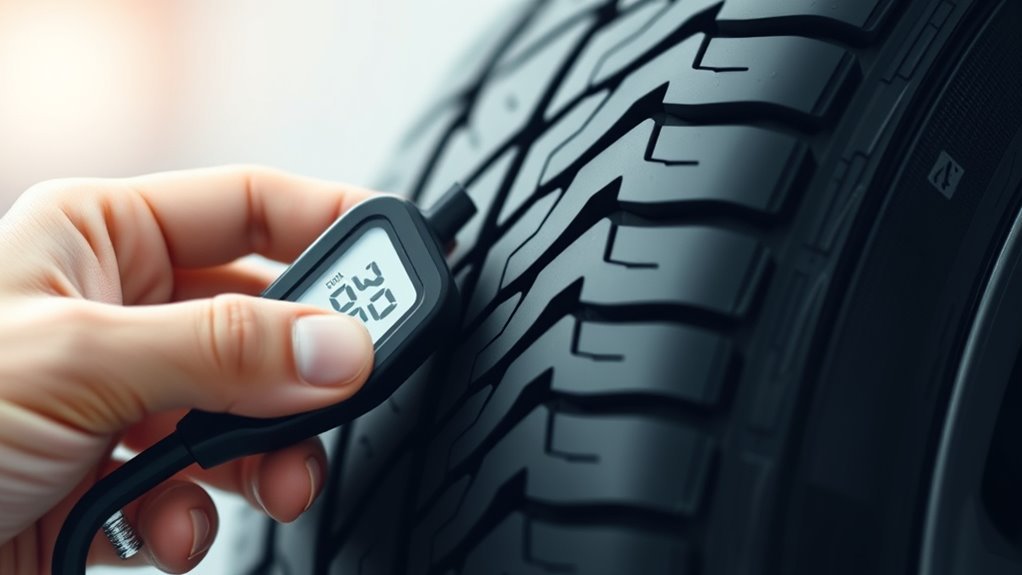
Reading a digital tire pressure gauge is simple, but the number on the screen only helps if you compare it with the correct PSI for your vehicle. For the most accurate result, check the tires when they are cold, press the gauge squarely onto the valve stem, wait for the display to stabilize, then compare the PSI reading with the pressure listed on your vehicle’s tire placard or owner’s manual.
Quick Answer
To read a digital tire pressure gauge, turn it on, choose PSI if the gauge has unit settings, remove the valve cap, press the gauge firmly and evenly onto the valve stem, and wait for the display to stop changing. Compare that number with the recommended cold PSI on your driver-side door placard, not the tire sidewall.
Key Takeaways
- The correct PSI is the vehicle manufacturer’s recommended cold tire pressure, usually found on the driver-side door placard or in the owner’s manual.
- Check pressure when tires are cold, ideally before driving or after the vehicle has been parked for at least three hours.
- A quick hiss usually means the gauge is not sealed squarely on the valve stem; reseat it and take the reading again.
- Do not rely only on TPMS. It warns when pressure is significantly low, but it does not replace monthly manual checks.
At a Glance
| Time Required | 3–5 minutes for all four tires |
| Difficulty | Easy |
| Tools Needed | Digital tire pressure gauge; air compressor if pressure is low |
| Cost | Usually free if you already own a gauge; gas-station air may cost a small fee |
The Impact of Tire Pressure on Vehicle Safety and Performance
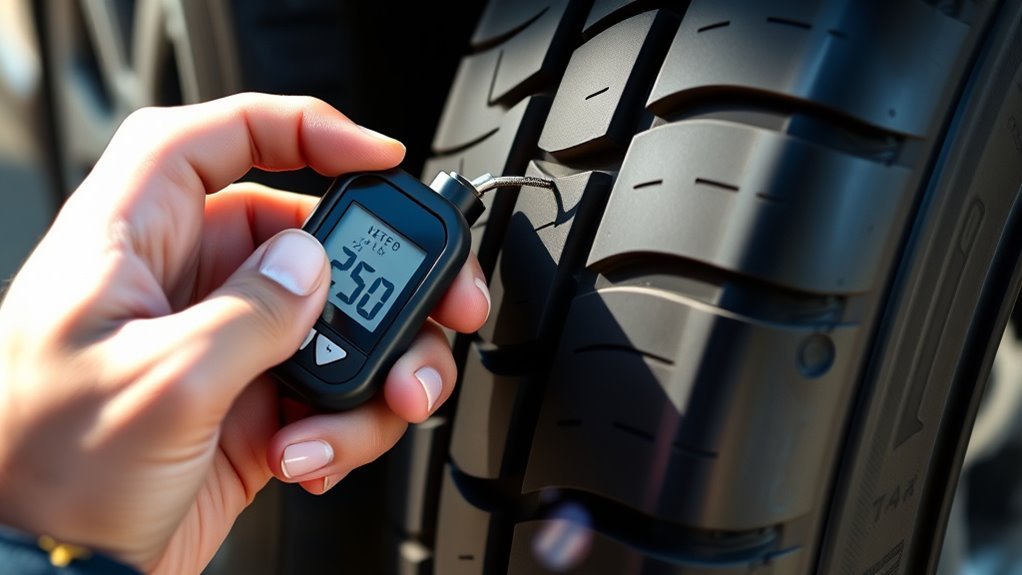
When you ignore tire pressure, you compromise both safety and performance. Under-inflated tires flex more than they should, which can increase heat, reduce fuel economy, shorten tire life, and raise the chance of tire failure. Over-inflated tires can also cause problems, including uneven wear and reduced ride comfort.
The National Highway Traffic Safety Administration says proper tire pressure affects safety, durability, and fuel consumption, and it recommends checking all tires, including the spare, at least once a month when the tires are cold. NHTSA also reports that 511 people died in tire-related crashes in 2024.
Keeping tires inflated to the proper pressure can improve gas mileage by 0.6% on average and up to 3% in some cases, according to FuelEconomy.gov.
That is why an accurate gauge reading matters. The goal is not simply to get “around 32 PSI.” The goal is to match the recommended cold PSI for your specific vehicle, tire size, and load condition.
Find the Correct PSI Before You Use the Gauge
Before using any tire pressure gauge, find your vehicle’s recommended cold tire pressure. In most vehicles, this information appears on the Tire and Loading Information Label on the driver-side door edge, door jamb, or B-pillar. You can also check the owner’s manual.
Warning: Do not use the maximum pressure printed on the tire sidewall as your normal inflation target. That number is the tire’s maximum cold pressure, not the recommended PSI for your vehicle.
Some vehicles list different recommended pressures for the front and rear tires. If yours does, write both numbers down before you begin so you do not accidentally set all four tires to the same PSI when the vehicle requires different settings.
[Products Worth Considering]
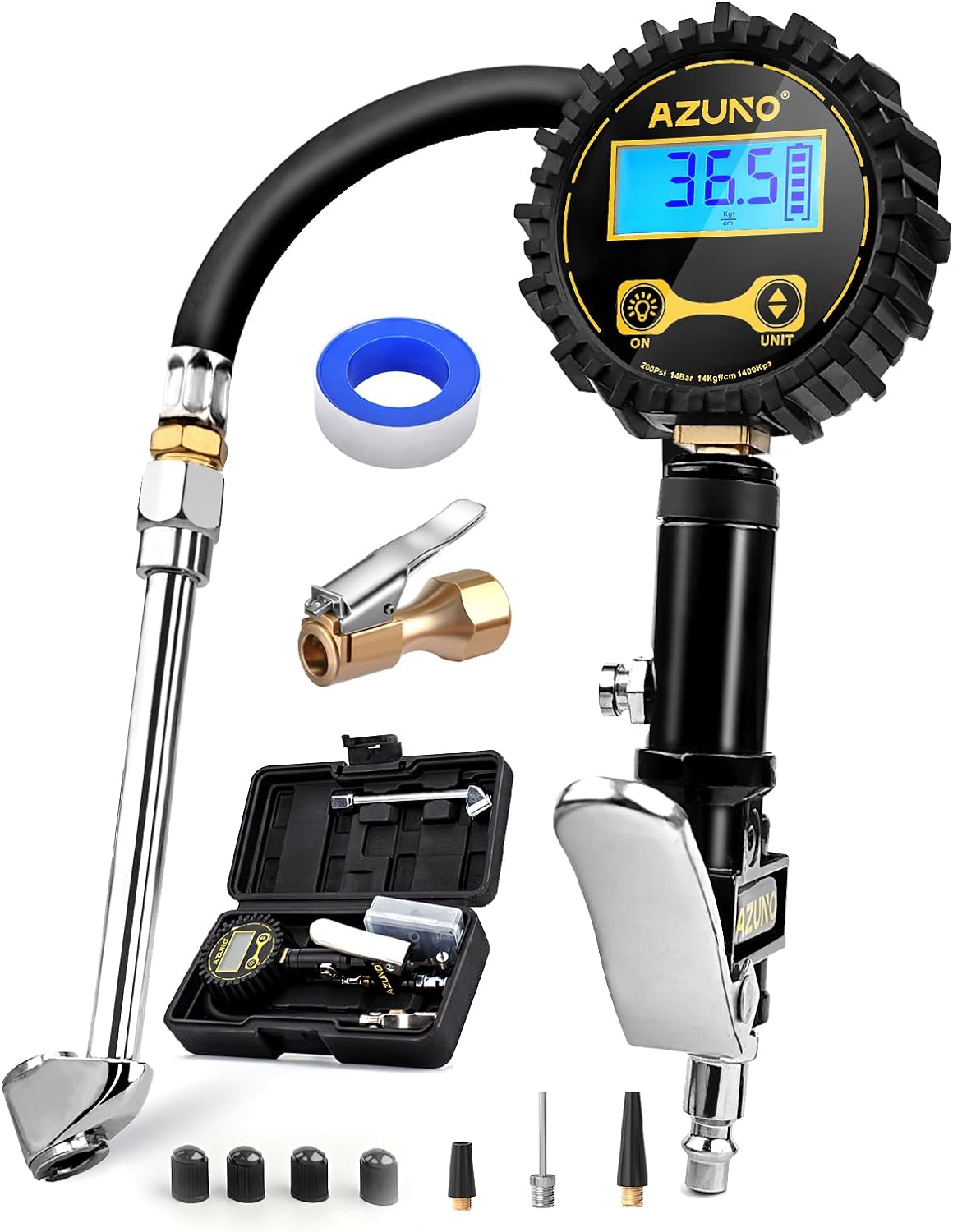
This digital tire inflator delivers accurate, easy-to-read pressure measurements with a bright backlit LCD and precise 0.1 resolution for confident inflation. Designed for single-handed use, it makes it simple to inflate or deflate tires while staying organized in the included portable carrying box. Built for a wide range of vehicles, it is a practical air compressor accessory for cars, trucks, SUVs, motorcycles, and more.

The JACO ElitePro Digital Tire Pressure Gauge delivers shop-grade accuracy with a clear digital readout, making it easy to maintain proper tire pressure for safer driving and better performance. Built with rugged brass and steel components, a protective guard, and a flexible air hose, it is designed for reliable use across cars, trucks, motorcycles, bikes, RVs, and trailers. The lock-on display, built-in bleeder valve, and bright backlit screen add convenience in any lighting condition.

The GOOLOO A3 combines a powerful portable jump starter with a cordless air compressor for convenient roadside emergencies and everyday inflation needs. It can restart 12V vehicles, inflate tires and sports gear, and serve as a portable power source for USB devices, all while adding smart protections, an easy-to-read display, and automatic shut-off for safer use.
How to Prepare Your Digital Tire Pressure Gauge for Use
A digital gauge is easy to read, but it still needs basic preparation. A weak battery, wrong unit setting, or damaged gauge can cause confusing readings.
[Products Worth Considering]

The ETENWOLF T300 digital tire pressure gauge delivers accurate readings for cars, trucks, RVs, bikes, and heavy-duty vehicles with a wide pressure range and reliable calibration. It is built to perform in extreme temperatures, includes an LED light for dark conditions, and uses replaceable AAA batteries for long-term convenience. Its durable design and automatic shut-off make it a practical, dependable tool for everyday tire maintenance.

This heavy-duty digital tire pressure gauge delivers quick, accurate readings with a clear backlit LCD and built-in flashlight for easy use in low light. Designed for RVs, trucks, cars, motorcycles, and bicycles, it features a durable stainless steel build, ergonomic grip, multiple unit options, and auto shut-off for convenience.
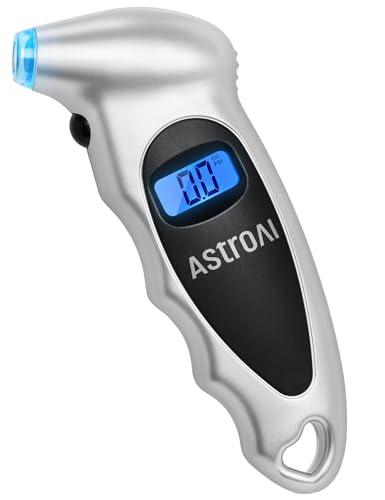
Accurate, Dependable Readings: Factory‑calibrated to ±1 PSI, so you can confidently match your vehicle’s recommended PSI (check the door jamb sticker). Ideal for monthly checks and road trips — consistent results every time, cold or warm.
Check Battery Status
Turn the gauge on before you crouch beside the tire. If the screen is blank, dim, flickering, or slow to respond, replace the battery according to the gauge manual. Battery type varies by model, so do not assume every gauge uses the same coin-cell battery.
- Look for a low-battery icon: Many digital gauges show a battery symbol when power is weak.
- Check the display: A faint or unstable display can lead to misread numbers.
- Store it properly: Keep the gauge in a dry case or glove box compartment so the screen and seal are protected.
Ensure Proper Calibration
Most consumer digital gauges do not have a simple user-calibration button. Instead, check accuracy by comparing your gauge with a reliable gauge at a tire shop, service center, or another trusted reference. If your gauge is consistently several PSI off, replace it or have it checked by a professional.
| Action | When to Do It |
|---|---|
| Compare with a trusted reference gauge | Every few months or before a long road trip |
| Check battery status | Before use |
| Inspect the nozzle seal | Any time the gauge hisses or gives inconsistent readings |
| Store in a protective case | After every use |
How to Read PSI on a Digital Tire Pressure Gauge
Follow these steps in order for the most reliable reading.
Step 1: Start With Cold Tires
Check tire pressure before driving, or after the vehicle has been parked for at least three hours. Driving warms the tires and raises pressure temporarily, which can make the reading higher than the true cold PSI.
Note: If you must add air while the tires are warm, treat it as a temporary adjustment. Recheck the pressure later when the tires are cold and correct it to the placard PSI.
Step 2: Prepare the Tire Valve
Remove the valve cap and place it somewhere safe, such as your pocket. Look at the valve stem for dirt, moisture, or obvious damage. If the valve is dirty, wipe it gently before pressing the gauge onto it.
Step 3: Press the Gauge Squarely Onto the Valve Stem
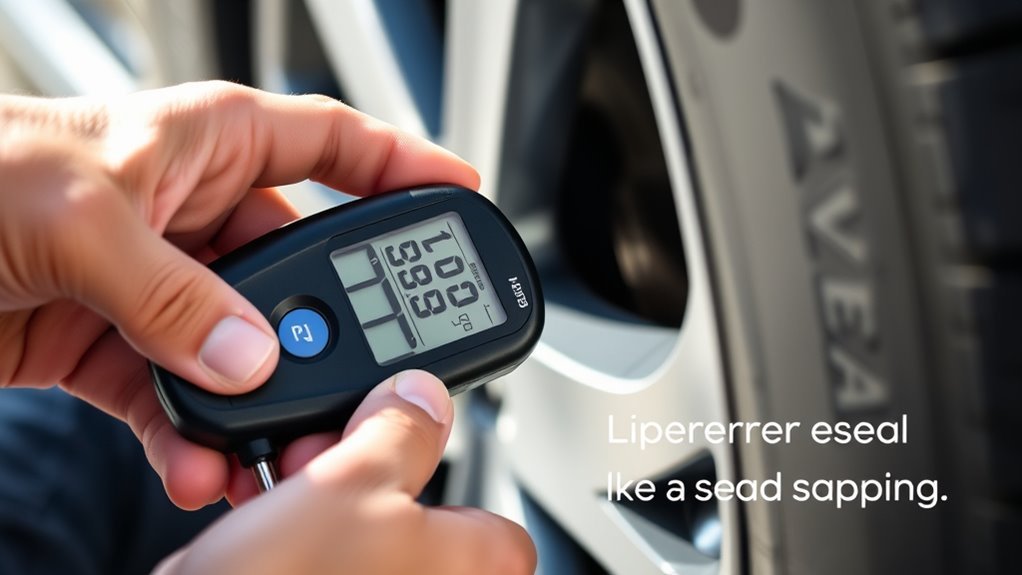
Place the gauge nozzle straight onto the valve stem and press firmly until the hissing stops. A brief hiss is normal when the gauge first touches the valve, but a continued hiss means air is leaking around the gauge. Lift the gauge off, realign it, and try again.
Step 4: Read the Digital Display
Wait a second or two for the display to stabilize. Read the number shown in PSI. If your gauge also displays kPa, bar, or kg/cm², make sure it is set to PSI unless your vehicle placard uses another unit.
| Digital Reading | What It Means | What to Do |
|---|---|---|
| Matches the placard PSI | Pressure is correct for that tire when cold. | Replace the valve cap and move to the next tire. |
| Below the placard PSI | The tire is under-inflated. | Add the missing PSI, then recheck. |
| Above the placard PSI when cold | The tire may be over-inflated for normal driving. | Release a small amount of air and recheck, but do not bleed pressure from a hot tire. |
| Changes each time you measure | The gauge may not be sealing, the battery may be weak, or the gauge may be inaccurate. | Reseat the gauge, check the battery, and compare with a trusted gauge. |
Step 5: Add or Release Air if Needed
If the tire is low, add air with a compressor. Add a little at a time, then recheck with your digital gauge. If the tire is high and still cold, release air slowly by pressing the center pin in the valve stem, then check again.
Pro Tip: Use your own gauge for the final reading after adding air. Gauges attached to public air hoses can be worn, weathered, or less accurate than a well-kept personal gauge.
Step 6: Replace the Cap and Repeat
Once the tire is set correctly, replace the valve cap. Repeat the process on all four tires. If your vehicle has a full-size or temporary spare, check that too, because spare tires can lose air while sitting unused.
Common Measurement Errors
Even a good digital gauge can give a bad reading if the process is rushed. The most common errors are easy to avoid:
- Checking warm tires: Heat from driving raises pressure temporarily.
- Using the wrong PSI target: Use the vehicle placard or owner’s manual, not the tire sidewall maximum.
- Pressing at an angle: A crooked connection lets air escape and can produce a low or inconsistent reading.
- Ignoring front/rear differences: Some vehicles call for different PSI in the front and rear tires.
- Trusting TPMS alone: TPMS usually warns only when pressure is significantly low; it does not replace manual checks.
Key Factors Influencing Digital Tire Pressure Gauge Accuracy
Several factors affect the accuracy of a digital tire pressure gauge. The most important are gauge quality, battery condition, nozzle seal, temperature, and how squarely the gauge sits on the valve stem.
Environmental conditions matter too. Extreme heat, moisture, dust, and repeated drops can damage a gauge over time. If you keep a gauge in your vehicle, store it in a case instead of letting it roll around loose in the trunk or glove box.
For best results, use the same reliable gauge each month and compare it with a trusted reference gauge occasionally. If one tire keeps losing pressure after being set correctly, the issue may be the tire, valve stem, wheel, or puncture—not the gauge.
Common Mistakes to Avoid With Digital Tire Pressure Gauges
When using a digital tire pressure gauge, avoiding a few common mistakes can greatly improve the accuracy of your readings.
- Removing the gauge too quickly: Wait until the digital display stabilizes before recording the PSI.
- Forgetting to check the unit: Make sure the gauge is showing PSI if that is the unit listed on your placard.
- Bleeding air from hot tires: A hot tire may read higher because of temperature, not because it is truly over-inflated when cold.
- Skipping the spare: A flat spare is useless when you need it most.
- Leaving valve caps off: Valve caps help keep dirt and moisture away from the valve core.
Tips for Maintaining Your Digital Tire Pressure Gauge
Maintaining your digital gauge helps keep readings consistent over time. A tire pressure gauge is a small tool, but it gets exposed to heat, moisture, drops, and battery drain.
| Maintenance Tip | Why It Helps |
|---|---|
| Store it in a protective case | Prevents cracked screens, damaged buttons, and nozzle wear. |
| Keep it dry | Moisture can affect electronics and seals. |
| Replace weak batteries promptly | Low power can cause dim displays or unstable readings. |
| Compare it with a trusted gauge | Helps catch accuracy drift before it becomes a safety issue. |
When You Might Need Professional Calibration for Your Gauge
You may need professional help—or a replacement gauge—if your digital tire pressure gauge keeps giving readings that do not match a trusted reference. Many inexpensive digital gauges are easier to replace than recalibrate, but a tire shop or service center can help you confirm whether the gauge is the problem.
Consider having the gauge checked if:
- Readings vary by several PSI: If the number changes every time you reseat the gauge, the nozzle seal or sensor may be unreliable.
- The gauge was dropped or crushed: Physical impact can damage the internal sensor or display.
- The display flickers even with a fresh battery: The electronics may be failing.
- Your TPMS and manual gauge strongly disagree: Check with another reliable gauge before assuming the TPMS or tire is wrong.
Troubleshooting Digital Tire Pressure Gauge Problems
| Problem | Likely Cause | Fix |
|---|---|---|
| Gauge hisses continuously | Nozzle is not sealed squarely on the valve stem. | Remove it, realign it, and press straight on. |
| Display is blank | Dead battery or damaged gauge. | Replace the battery according to the manual; replace the gauge if it still fails. |
| Reading seems too high | Tires may be warm, or gauge may be in the wrong unit. | Recheck cold and confirm the display is set to PSI. |
| Same tire is low every month | Possible slow leak, valve issue, wheel issue, or puncture. | Have the tire inspected by a qualified tire professional. |
Frequently Asked Questions
How do you get the most accurate tire pressure reading?
Use a reliable gauge, check the tires when they are cold, press the gauge firmly and squarely onto the valve stem, and compare the reading with the recommended PSI on the vehicle placard or owner’s manual. Recheck after adding or releasing air.
What is the 5 PSI rule?
The “5 PSI rule” is a common rule of thumb that says a tire more than about 5 PSI away from the recommended pressure needs attention. It is not a universal official standard. Always use your vehicle’s recommended cold PSI as the target, and correct any tire that is noticeably above or below that number.
Why does my tire pressure light keep coming on when my tires look fine?
Under-inflated tires can be hard to spot visually. The TPMS light may come on because one tire is significantly low, pressure dropped overnight in cold weather, a tire has a slow leak, or the TPMS has a sensor issue. Check all tires with a gauge as soon as possible.
Can you calibrate a digital tire pressure gauge?
Some professional gauges can be calibrated, but many consumer digital tire pressure gauges cannot be adjusted by the user. The practical approach is to compare your gauge with a trusted reference gauge. If it is consistently off, replace it or have it checked by a professional.
Should I check tire pressure before or after driving?
Check before driving whenever possible. Tire pressure should be measured cold, which generally means the vehicle has been parked for at least three hours. If you check after driving, the reading may be temporarily higher because the tires are warm.
Is a digital tire pressure gauge better than a pencil gauge?
A good digital gauge is easier to read because it shows the PSI directly on a screen, which reduces guesswork. A good pencil or dial gauge can also work well. The best gauge is the one that is accurate, easy for you to use, and kept in good condition.
Conclusion
Understanding how to read a digital tire pressure gauge accurately helps you protect your tires, improve fuel economy, and drive more safely. Start with cold tires, use the PSI listed on your vehicle placard or owner’s manual, press the gauge firmly onto the valve stem, and adjust pressure only after comparing the display with the correct target. If your readings are inconsistent or one tire keeps losing air, check the gauge against a trusted reference and have the tire inspected.
Sources
- NHTSA TireWise: Tire Safety Ratings and Awareness — cold tire pressure, placard PSI, TPMS guidance, monthly checks, and tire-related crash data.
- FuelEconomy.gov: Keeping Your Vehicle in Shape — fuel economy impact of proper tire inflation and warning not to use sidewall maximum pressure.
- Bridgestone: How to Check Tire Pressure With a Tire Pressure Gauge — practical gauge-use steps, cold tire definition, and digital gauge notes.
- Bridgestone Americas: How to Check and Inspect Your Tire Condition — valve-stem technique, cold tire pressure, and hot-tire caution.
- NHTSA Tire-Related Surveys: Results and Implications — TPMS effectiveness and severe underinflation context.