
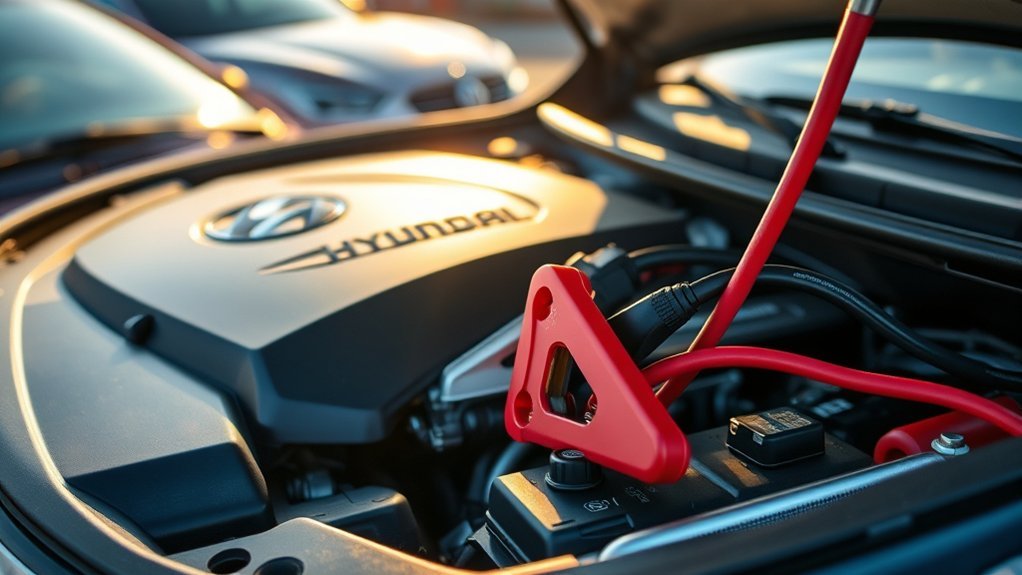
A dead battery can turn a normal Hyundai Sonata drive into a roadside problem fast. The safest fix is to use the correct 12-volt jump-start procedure, connect the clamps in the right order, and stop if the battery looks damaged, frozen, leaking, swollen, or unusually hot.
Last updated: August 20, 2026
Quick Answer
To jump-start a Hyundai Sonata, connect red to the Sonata’s positive terminal or jump terminal, red to the donor battery positive, black to the donor battery negative, and black to a clean chassis ground on the Sonata. Start the donor vehicle and let it run at about 2,000 RPM for a few minutes, then start the Sonata. Remove the cables in reverse order.
Key Takeaways
- Use only a 12-volt booster battery, donor vehicle, or automotive jump starter.
- Never let the jumper clamps touch each other once a cable is connected.
- Do not connect the final black clamp to the dead battery’s negative post unless your owner’s manual specifically tells you to.
- After the Sonata starts, keep it running or drive it for at least 30 minutes — a completely discharged battery may need up to 60 minutes — then test the battery if the cause is unclear.
At a Glance
| Time Required | 10–20 minutes to start; at least 30 minutes of running afterward |
| Difficulty | Easy, if the battery is not damaged and the terminals are accessible |
| Tools Needed | Jumper cables or 12V jump starter, safety glasses, gloves, flashlight, wheel chocks, emergency triangle |
| Cost | Free if you already have cables or a jump starter; battery testing is often low-cost or free at many service centers |
Why Jump-Starting Your Hyundai Sonata Is Essential
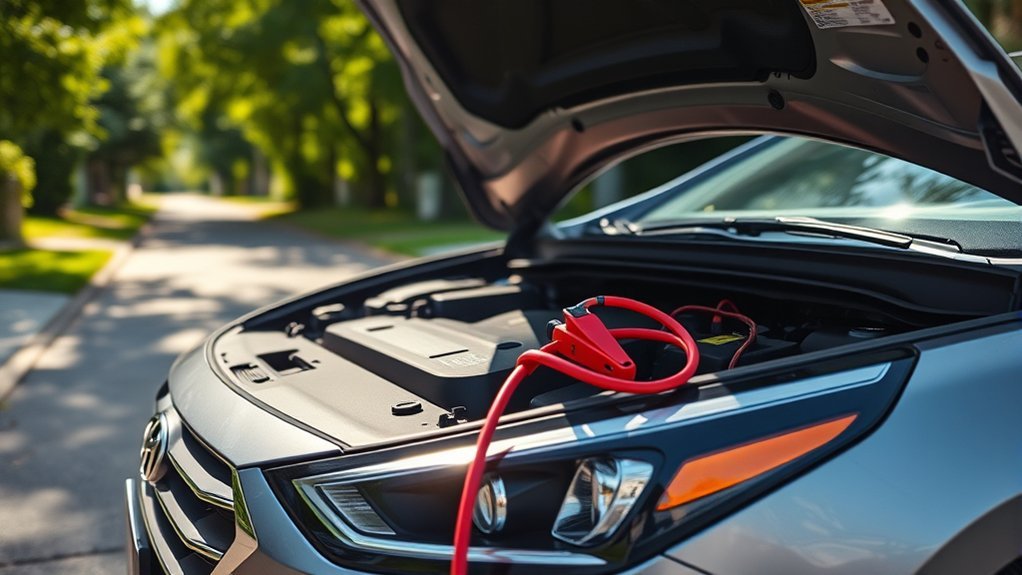
Knowing how to jump-start your Hyundai Sonata helps when the 12-volt battery is weak from lights left on, long storage, cold weather, short trips, or battery age. The goal is not just to get the engine started. The goal is to restart it without sparks near the battery, reversed polarity, damaged electronics, or personal injury.
Hyundai’s owner guidance warns that jump-starting can be dangerous if it is done incorrectly, especially because batteries can contain corrosive acid and flammable hydrogen gas. Use the procedure in your exact owner’s manual when it differs from general guidance, especially on newer Sonata or Sonata Hybrid models with dedicated jump terminals.
What Safety Checks Should You Do Before Jump-Starting a Hyundai Sonata?
Warning: Do not jump-start the Sonata if the battery is frozen, cracked, leaking, swollen, giving off a rotten-egg smell, or unusually hot. Move away from the battery and call roadside assistance or a qualified technician.
Before you connect anything, make the area safe:
- Park away from traffic if possible and set out an emergency triangle.
- Put both vehicles in Park and set the parking brakes.
- Turn off lights, climate control, radio, wipers, chargers, and other electrical accessories.
- Keep the vehicles close enough for the cables to reach, but do not let the vehicles touch.
- Keep hands, cables, clothing, and jewelry away from fans, belts, and other moving parts.
- Wear safety glasses and gloves if you have them.
- Use only a 12-volt jump source. Do not use a 24-volt source or an unapproved power supply.
Note: On Sonata Hybrid models, the 12-volt battery itself is mounted in the trunk, not the engine bay — so instead of clamping onto a battery post, you’ll typically use a red-capped positive jump terminal near the engine-compartment fuse box, with the negative clamp going to a clean chassis ground point nearby. Terminal placement can vary by model year, so check the jump-start diagram in your glovebox owner’s manual to confirm the exact layout for your Sonata. [VERIFY: confirm exact terminal cover color/position for current model-year Sonata Hybrid.]
Gather Essential Tools for Jump-Starting
For a safe jump-start, use automotive equipment designed for 12-volt vehicles. A general portable power station is not the same thing as a vehicle jump starter unless it specifically includes a 12V jump-start function and clamp leads.
| Tool | Purpose |
|---|---|
| Jumper Cables | Transfers power from a donor vehicle’s 12V battery |
| 12V portable jump starter | Starts the Sonata without another vehicle when used as directed |
| Safety Glasses and Gloves | Helps protect against sparks, acid, and sharp engine-bay edges |
| Wheel Chocks | Helps keep the vehicle from moving on a slope |
| Emergency Triangle or Road Flares | Alerts other drivers if you are stopped near traffic |
| Flashlight | Helps you identify positive and negative terminals in low light |
Pro Tip: Choose jumper cables long enough to reach without stretching across moving parts. Heavier-gauge cables are usually better for reliable current flow, but correct clamp placement matters more than cable size alone.
[Products Worth Considering]

The OXILAM jump starter delivers powerful emergency starting performance for gas engines and up to 12L diesel engines, helping revive dead batteries in seconds. It also doubles as a portable power bank and LED flashlight, with USB and Type-C ports for convenient device charging. Built with multiple safety protections, a clear LED display, and a rugged portable design, it is a reliable roadside companion for cars, trucks, motorcycles, and more.

This roadside emergency kit helps drivers handle common breakdowns and winter travel issues with confidence. It includes jumper cables, a shovel, tow rope, warning triangle, first aid kit, gloves, and repair tools in a compact bag that fits easily in a trunk or storage compartment. Designed for cars, trucks, SUVs, motorcycles, and RVs, it is a practical safety companion for commuting, road trips, and everyday preparedness.

The S ZEVZO ET03 is a powerful 12V jump starter designed to revive gas and diesel vehicles quickly, including cars, trucks, motorcycles, lawnmowers, and boats. It also doubles as a portable power bank with USB charging ports, a bright LED flashlight, and an LCD display for added convenience during roadside emergencies. Built with multiple safety protections and included carrying case, it offers dependable backup power whenever you need it.
How to Jump-Start a Hyundai Sonata With Jumper Cables
[Products Worth Considering]

The NOCO Boost GB70 is a compact yet powerful jump starter designed to safely revive dead 12V batteries in seconds. It combines UltraSafe spark-proof protection, a built-in power bank, and a bright LED flashlight in a rugged, portable design that fits easily in a glove box or emergency kit. Built for cars, trucks, SUVs, boats, motorcycles, and more, it delivers dependable emergency starting power whenever you need it.

NOONE jumper cables are designed to help get 12V and 24V vehicles back on the road with reliable boosting power. The 10-foot length, insulated rubber covering, and copper-clad aluminum conductors support dependable performance in extreme temperatures, while the strong clips help ensure a secure connection. Ideal for family cars and vehicles up to 3.0L gas engines, this kit offers a practical emergency starting solution backed by a two-year service promise.

This portable jumper cable adapter is designed for seamless compatibility with Milwaukee M18 batteries, helping you jump-start a dead or weak vehicle battery quickly and conveniently. Built with 8 AWG cables and simple clamp connections, it supports a range of vehicles including cars, SUVs, and trucks. It offers a practical, tool-battery-powered solution for emergency starting, with clear usage steps and safety guidance for dependable operation.
Step 1: Position Both Vehicles Safely
Park the assisting vehicle close enough for the jumper cables to reach the Sonata, but make sure the vehicles do not touch. Turn both vehicles off, shift to Park, and set both parking brakes. Open the hood and identify the positive and negative jump points before you connect the first clamp. Most Sonata model years route the jump terminals through the engine-compartment fuse box — you may need to unclip and lift the fuse box cover to reach the positive (+) jump terminal before connecting cables.
Step 2: Connect the Red Positive Cable
- Connect one red clamp to the Sonata’s positive (+) battery terminal or positive jump terminal.
- Connect the other red clamp to the positive (+) terminal on the assisting vehicle’s battery.
Step 3: Connect the Black Negative Cable
- Connect one black clamp to the negative (-) terminal on the assisting vehicle’s battery.
- Connect the final black clamp to a clean, solid, unpainted metal ground point on the Sonata’s chassis or engine ground point, away from the battery and fuel lines.
Warning: Do not attach the final black clamp to the discharged battery’s negative terminal unless your exact Hyundai manual tells you to. A spark near the battery can ignite hydrogen gas and cause injury or vehicle damage.
Step 4: Start the Donor Vehicle, Then the Sonata
Start the assisting vehicle and let it run at about 2,000 RPM for a few minutes. Then try to start your Hyundai Sonata. If the Sonata does not start after a few attempts, stop cranking and recheck the clamp connections. Do not keep turning the key or pressing the start button repeatedly, because that can overheat the starter or point to a deeper problem.
Step 5: Remove the Cables in Reverse Order
Once the Sonata is running, remove the jumper cables carefully in the opposite order:
- Remove the black clamp from the Sonata’s chassis ground.
- Remove the black clamp from the assisting vehicle’s negative terminal.
- Remove the red clamp from the assisting vehicle’s positive terminal.
- Remove the red clamp from the Sonata’s positive terminal or jump terminal.
Keep the clamp ends from touching each other or any metal surface while you remove and store the cables.
How to Use a Portable Jump Starter on a Hyundai Sonata
A 12V portable jump starter is useful when no donor vehicle is available. Read the jump starter’s manual first, because clamp order and power-button steps can vary by model.
- Turn the Sonata off and switch off all electrical accessories.
- Connect the red clamp to the positive (+) battery terminal or positive jump terminal.
- Connect the black clamp to the approved negative ground point or clean chassis ground.
- Turn on the jump starter if its instructions require it.
- Start the Sonata.
- After it starts, turn off the jump starter and remove the black clamp first, then the red clamp.
If the jump starter shows a reverse-polarity warning, low-charge warning, or fault light, stop and correct the problem before trying again.
[Products Worth Considering]

These heavy duty jumper cables are designed to help you get back on the road quickly with strong, insulated clamps and extended reach for easier battery access. The flexible cable jacket stays dependable in a wide range of temperatures, while the included storage bag keeps everything organized and ready for emergencies. Built for cars, SUVs, and trucks, they offer a practical roadside solution backed by quality assurance and after-sales support.

TOPDC jumper cables deliver dependable jump-start support for cars, SUVs, trucks, and other vehicles with a long reach that makes roadside connections easier. Built with strong clamps, insulated protection, and durable PVC construction, they are designed for safe use in extreme conditions and reliable performance when emergencies happen. A convenient carry bag and multi-year quality assurance add extra value for storage, transport, and peace of mind.

These Energizer jumper cables are built to help start dead or weak batteries quickly and safely for a wide range of vehicles, including cars, SUVs, and trucks. The 16-foot length and flexible cable design make it easier to reach battery connections, while the protective coating and sturdy handles support secure placement. A carrying bag is included for convenient transport and storage.
Post-Jump-Start Steps to Ensure Battery Health
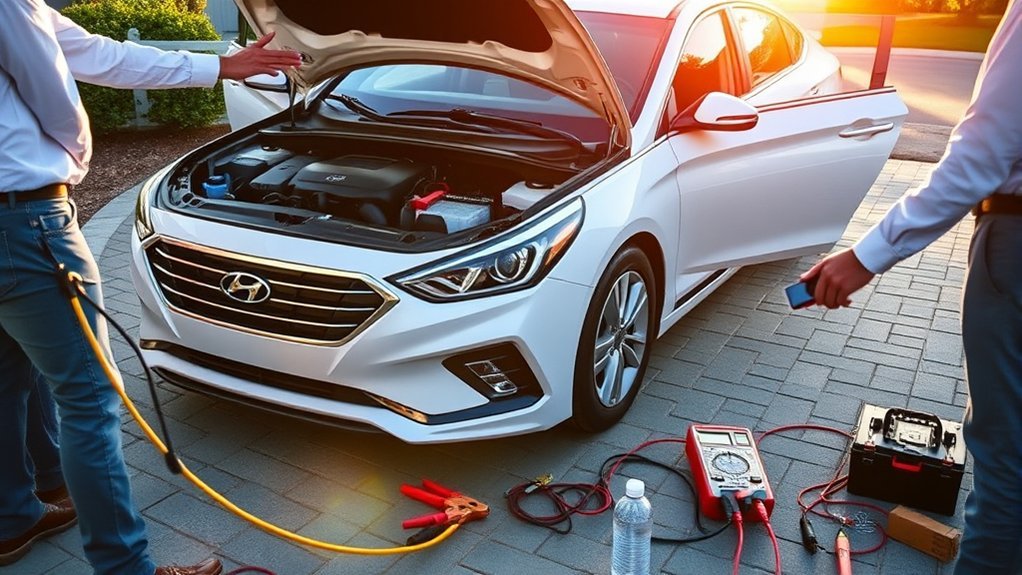
After your Hyundai Sonata starts, do not shut it off right away. Hyundai guidance says to keep the vehicle operating for at least 30 minutes at idle or by driving so the battery receives enough charge to restart on its own. A completely discharged battery may need up to 60 minutes of runtime, per Hyundai’s owner’s manual, or a full charge from an external battery charger.
- Let it run or drive for at least 30 minutes: This gives the charging system time to restore some charge.
- Watch for warning signs: Dimming lights, slow cranking, clicking, repeated no-starts, or battery warning lights can point to a weak battery, alternator issue, loose terminal, or parasitic drain.
- Get the battery tested: If the battery is more than three years old, has died more than once, or the cause of the drain is not obvious, have the battery and charging system tested.
- Clean and secure terminals: Corrosion or loose clamps can prevent a good charge and cause another no-start.
- Plan a real recharge if needed: A jump-start is a temporary fix. If the battery was deeply discharged, a smart battery charger or service-center charge may be better than relying only on the alternator.
A jump-start gets the engine running; it does not prove the battery is healthy. If the Sonata needs another jump soon after, test the battery, alternator, and charging system.
What If Your Hyundai Sonata Still Won’t Start?
If the Sonata does not start after the cables are connected correctly, use the symptoms to narrow the problem:
| Symptom | Possible Cause | What to Do |
|---|---|---|
| No lights or very dim lights | Extremely discharged battery, bad connection, or failed battery | Recheck clamps, wait a few minutes, then try again; call for service if unchanged |
| Rapid clicking | Weak battery or poor cable contact | Check the ground point and terminal contact; do not keep cranking |
| Engine cranks but will not start | Fuel, ignition, fuse, sensor, or immobilizer issue | Stop jump-start attempts — this points away from the battery. See our Sonata no-crank diagnostic guide for next steps |
| Starts, then dies later | Weak battery, alternator issue, loose connection, or parasitic drain | Have the battery and charging system tested before relying on the vehicle |
When to Call in the Experts for Battery Problems?
Call roadside assistance, a qualified technician, or a Hyundai service center if the Sonata will not start after a few careful attempts, if the battery is damaged, or if you are unsure where the correct jump points are. You should also get professional help if you smell sulfur or rotten eggs, see smoke, notice a bulging battery case, or find heavy corrosion around the terminals.
For a Sonata Hybrid, do not touch orange high-voltage cables or high-voltage battery components. Jump-start only the 12-volt system using the approved jump points shown in the owner’s manual. If you are not certain which circuit you are working with, stop and call a professional.
Battery age also matters. Many 12-volt car batteries begin to weaken after about three to five years, depending on heat, vibration, driving habits, and maintenance. If your Sonata battery is older than three years and has started slowly or died once already, a battery test is the smart next step.
Frequently Asked Questions
How do you jump-start a 2020 Hyundai Sonata?
For a 2020 Hyundai Sonata, use the positive jump terminal or battery positive post shown in the owner’s manual. Connect red to the Sonata positive, red to donor positive, black to donor negative, and black to a clean chassis ground on the Sonata. Start the donor vehicle at about 2,000 RPM, then the Sonata, and remove the cables in reverse order.
Can I connect the black clamp to the dead battery?
The safer general method is to connect the final black clamp to a clean chassis ground on the disabled vehicle, away from the battery. This keeps the final spark away from battery gases. Follow your exact Hyundai owner’s manual if it gives a model-specific jump point.
How long should I drive after jump-starting a Hyundai Sonata?
Keep the Sonata running or drive it for at least 30 minutes after a successful jump-start. If the battery was completely discharged, it may need up to 60 minutes of runtime or a proper battery charger. If it fails again, have the battery and charging system tested.
Can I jump-start a Hyundai Sonata with a portable jump starter?
Yes, if it is a 12-volt automotive jump starter rated for your vehicle. Connect the red clamp to the positive terminal or jump terminal and the black clamp to the approved ground point. Follow the jump starter’s instructions for power-on, starting, and disconnecting.
Why does my Sonata need another jump after I already drove it?
The battery may be too weak to hold a charge, the alternator may not be charging properly, a terminal may be loose or corroded, or the car may have an electrical drain. A battery and charging-system test is the best next step.
Conclusion
Jump-starting a Hyundai Sonata is straightforward when you slow down and follow the correct order: red to positive, black to the donor negative, final black clamp to a safe ground point, start the donor vehicle, then start the Sonata. The biggest mistakes are using the wrong power source, letting clamps touch, connecting the final black clamp near the dead battery, or shutting the Sonata off too soon afterward. If the battery is damaged, frozen, or repeatedly dead, skip the jump and call a professional.
Sources
- Hyundai Owner’s Manual — Jump Starting — cable order, 12V-only warning, battery hazards, disconnect sequence, and post-jump runtime guidance
- Hyundai Manuals & Warranties Resources — official owner manual lookup for model-specific Sonata guidance
- MyHyundai Battery Care Resource — battery care, maintenance-free battery explanation, and service guidance
- AAA — How to Jump a Battery — safe cable order and grounding explanation
- AAA — How Long Do Car Batteries Last — battery age, heat, vibration, and usage-pattern factors
- Interstate Batteries — The Official Way to Jump Start a Car — temporary-fix warning, battery testing, and safety checklist



[…] best towing solution depends on the problem. A dead battery in a parking lot, a disabled vehicle on the shoulder, and a car stuck in mud all require different equipment. The […]
[…] dead battery or jump-start, check battery voltage and connections as part of the diagnosis. See the Sonata jump-start guide for safe battery […]