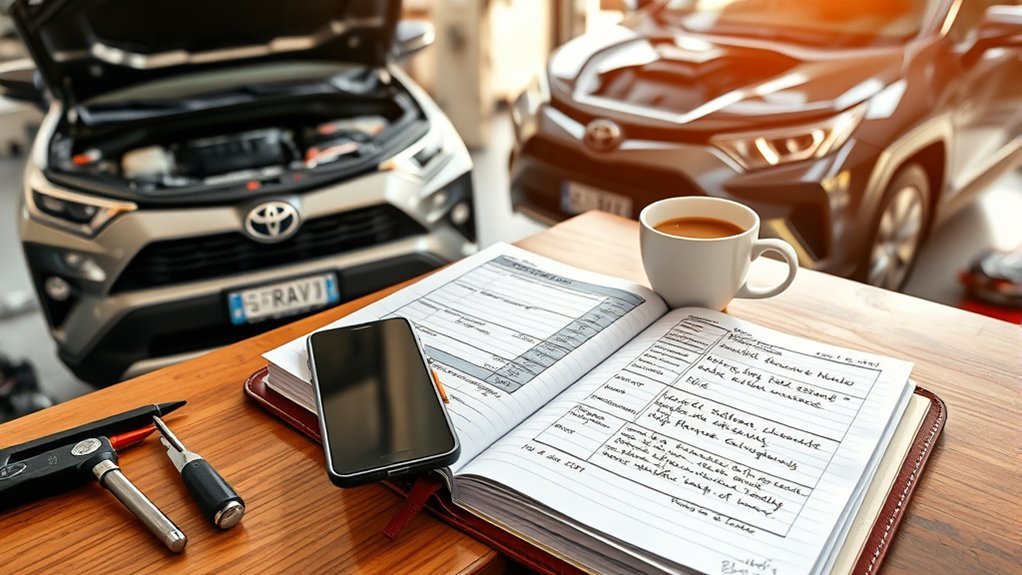
Checking your Toyota RAV4 tire pressure is a quick maintenance job that protects handling, braking, fuel economy, and tire life. Use the PSI listed on the driver’s door-jamb Tire and Loading Information Label, check the tires when they are cold, and verify the reading with a tire pressure gauge instead of relying only on the TPMS light.
Quick Answer
To check RAV4 tire pressure, park the vehicle, let the tires cool for at least 3 hours, remove each valve cap, press a tire pressure gauge firmly onto the valve stem, and compare the PSI to the driver’s door-jamb label. Inflate or release air until each tire matches the listed cold pressure.
Key Takeaways
- Use the RAV4’s driver-side door-jamb label, not the tire sidewall, for the correct cold PSI.
- Check pressure at least monthly, before long trips, and after big temperature changes.
- A TPMS warning means at least one tire may be low, but it does not replace checking with a gauge.
- Cold weather can lower pressure by about 1 to 2 PSI for every 10°F temperature drop.
- Get professional tire service if pressure keeps dropping, the TPMS light stays on, or you see cuts, bulges, cracks, punctures, or uneven wear.
At a Glance
| Time Required | 5–10 minutes |
| Difficulty | Easy |
| Tools Needed | Tire pressure gauge, air pump or portable inflator, valve-cap storage spot |
| Cost | Usually free at home if you already own a gauge; a basic gauge and inflator vary by brand |
Quick: Check Your RAV4 Tire Pressure Now

Grab a tire pressure gauge and check each wheel one at a time. Park on level ground, set the parking brake, and make sure the tires are cold. A cold tire is one that has not been driven for at least 3 hours, or has been driven less than about 1 mile.
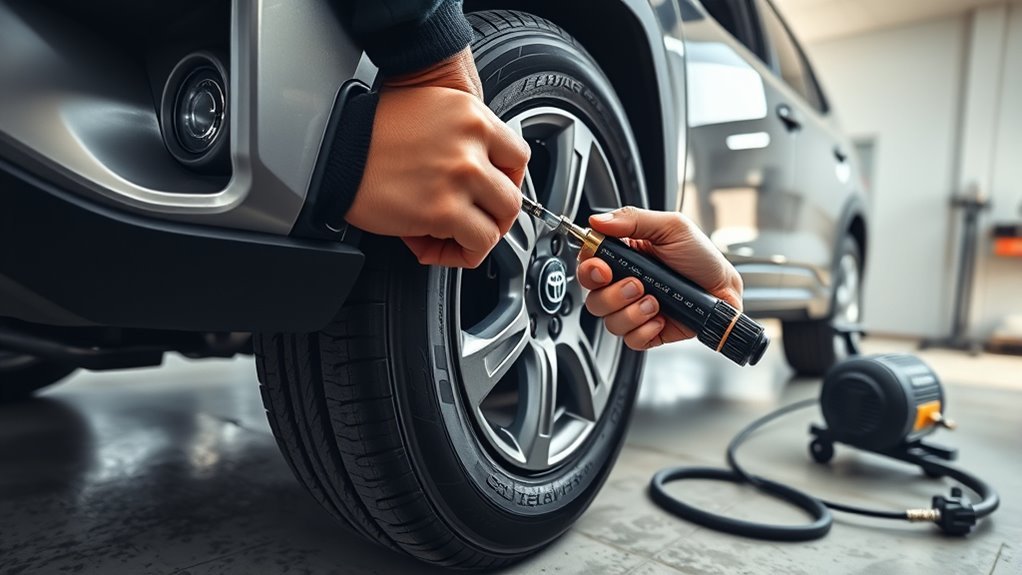
Remove the valve stem cap, press the gauge squarely onto the valve stem, and hold it firmly until the hissing stops. Read the PSI immediately and write it down. Repeat this for all four tires, and check the spare if your RAV4 is equipped with one.
Manual pressure checks matter because the TPMS warning light is not a full maintenance system. It warns you when pressure is significantly low, but a gauge gives you the actual PSI before the tire gets that far out of range.
Note: Check tire pressure at least once a month. Checking every two weeks is even better if temperatures swing sharply, you drive long distances, or you regularly carry passengers or cargo.
Find the Correct PSI on the Door-Jamb Sticker
Open the driver’s door and look for the Tire and Loading Information Label on the door edge or B-pillar. This label lists the correct cold tire inflation pressure for your RAV4, usually in PSI and kPa, along with the original tire size.
Do not use the number molded into the tire sidewall as your operating pressure. The sidewall number is the tire’s maximum pressure rating, not Toyota’s recommended pressure for your specific RAV4.
Check the Driver Door Jamb
The door-jamb label is the first place to look because it reflects your vehicle’s trim, tire size, and load rating. Many recent RAV4 models fall in the low-to-mid 30 PSI range, but exact pressure can vary by model year, drivetrain, wheel size, market, and tire package.
If the owner’s manual, tire label, or replacement tire size does not match what you expect, use the label and owner’s manual as your final references. For non-original tire sizes, ask a qualified tire shop to confirm the correct load and inflation setup.
Match the Tire Sidewall Size
Before you adjust PSI, compare the tire size on the sidewall with the size on the door-jamb label. Common RAV4 tire sizes include markings such as 225/65R17, 225/60R18, or 235/55R19, but your exact tire may differ.
If the tire size does not match the label, do not guess. The wrong tire size or load rating can change how much pressure is needed to support the vehicle safely.
Use the Manufacturer PSI Label
Set the pressure when the tires are cold. If you recently drove, the tires may read higher because heat temporarily raises pressure. In that case, wait until the tires cool or recheck the pressure later when the vehicle has been parked long enough.
Cold weather also affects the reading. According to tire-safety guidance, inflation pressure can change by about 1 to 2 PSI for every 10°F shift in temperature, which is why TPMS alerts often appear on cold mornings.
Step-by-Step: Check RAV4 Tire Pressure With a Gauge
Use these steps for a clean, repeatable check:
| Step | Action | Why It Matters |
|---|---|---|
| 1 | Park on level ground and let the tires cool | Cold readings match the door-jamb PSI specification |
| 2 | Find the recommended PSI on the driver’s door-jamb label | This is the correct vehicle-specific pressure |
| 3 | Remove the valve stem cap | This exposes the valve for the gauge |
| 4 | Press the gauge firmly onto the valve stem | A straight seal prevents false low readings |
| 5 | Read and record the PSI | Recording helps you spot slow leaks or uneven pressure loss |
| 6 | Replace the valve cap | The cap helps keep dirt and moisture away from the valve |
Pro Tip: Keep a small tire gauge in the glove box or center console. A gauge is faster and more reliable than waiting for the TPMS light to tell you something is already wrong.
[Products Worth Considering]

This smart color coded tire tread depth gauge makes it easy to check tread wear at a glance with clear red, yellow, and green ranges. Calibrated from 0 to 1 inch in 1/32 inch increments, it helps you quickly assess tire condition for safer driving and timely replacements. The pocket clip design makes it convenient to carry and use on trucks, motorcycles, cars, and other passenger vehicles.
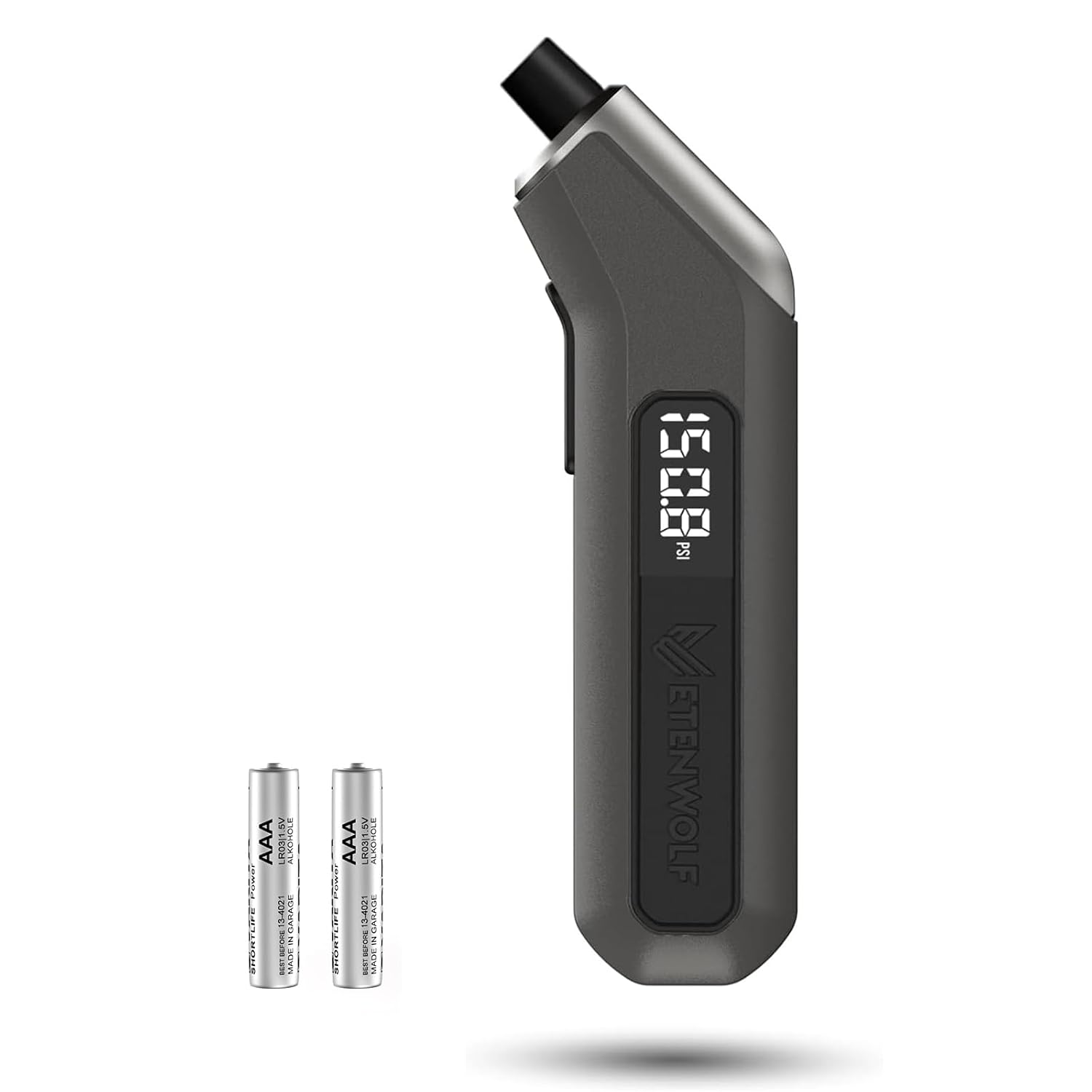
The ETENWOLF T300 digital tire pressure gauge delivers precise readings for cars, RVs, trucks, bikes, and heavy-duty vehicles with a wide measuring range and consistent accuracy. It is built to perform in extreme temperatures, includes a bright LED light for low-visibility use, and uses replaceable AAA batteries for convenient long-term operation. Durable enough to withstand rugged use, it is a practical tool for maintaining proper tire pressure across a variety of vehicles.
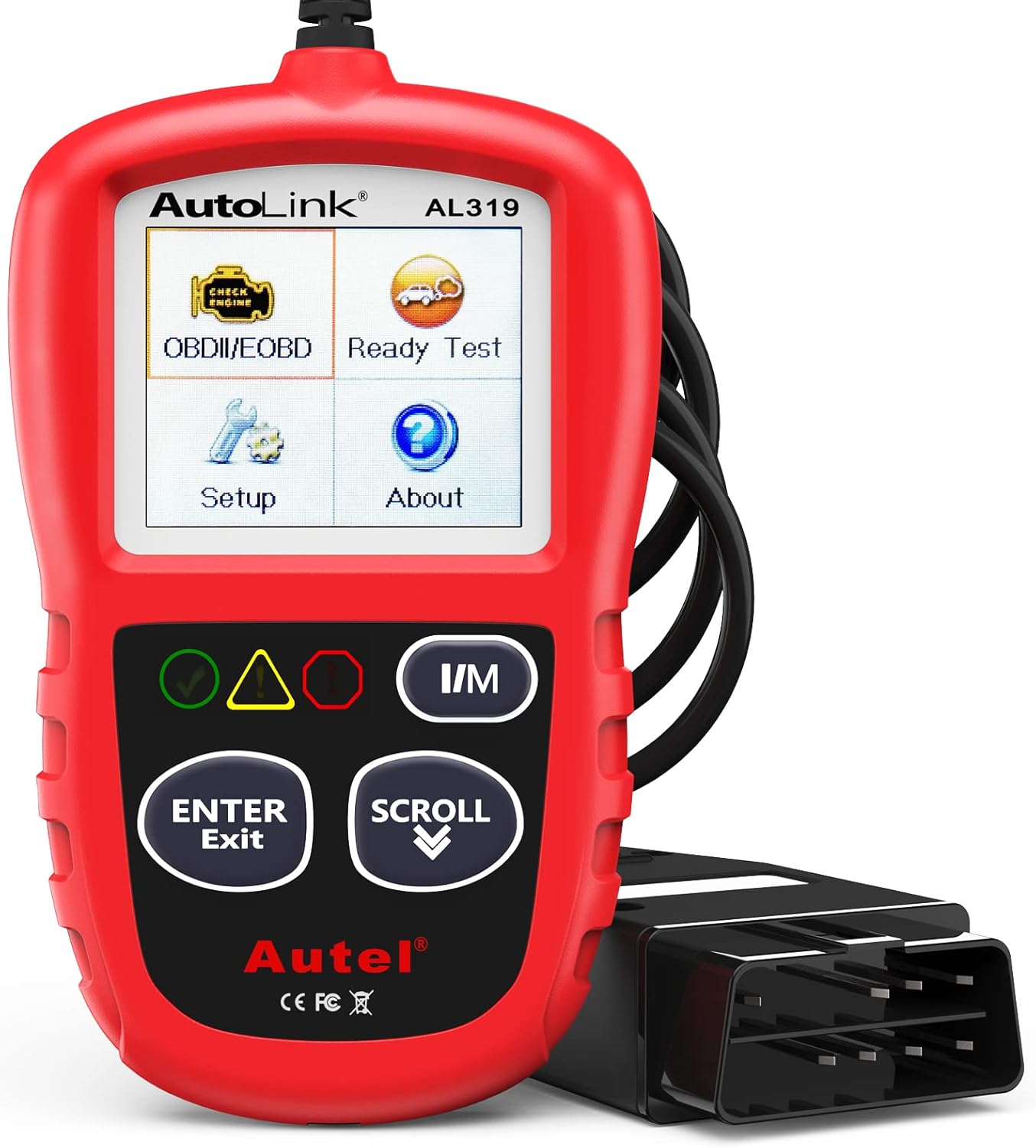
The Autel AL319 is a user-friendly OBD2 scan tool designed to help drivers quickly diagnose check engine light issues and understand vehicle fault codes. It supports reading and clearing DTCs, live data, freeze frame, I/M readiness, and vehicle information, making it a practical choice for DIYers and everyday car owners. With plug-and-play operation, a color display, built-in speaker, and broad vehicle compatibility, it delivers fast, reliable diagnostics without complicated setup.
Inflate or Deflate to the Right RAV4 Tire Pressure
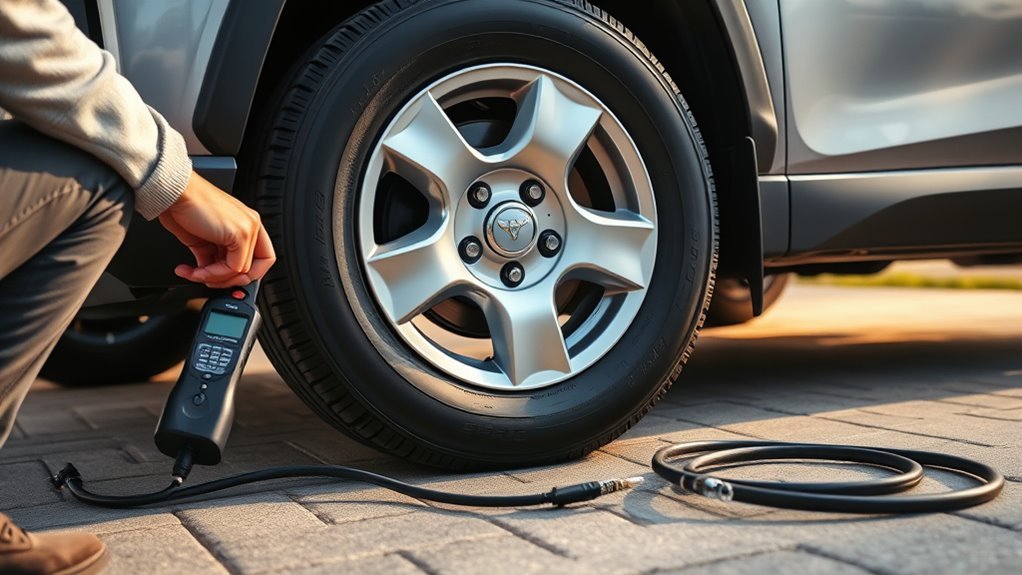
After you measure each tire, adjust any tire that is above or below the door-jamb specification. Use a portable inflator, a home compressor, or a gas-station air pump.
- Attach the air hose securely to the valve stem.
- Add air in short bursts so you do not overinflate the tire.
- Recheck with your gauge after each short fill.
- If the tire is too high, press the center pin in the valve stem briefly to release air.
- Recheck again and replace the valve cap when the tire matches the listed cold PSI.
Try to keep all tires at their specified pressures, not just “close enough.” Uneven pressure can affect handling, braking feel, tire wear, and fuel economy.
Warning: Never bleed air from a hot tire just because it reads above the cold PSI number. Driving heats tires and temporarily raises pressure. Recheck when the tires are cold.
Underinflated tires can lower gas mileage by about 0.2% for every 1 PSI drop in the average pressure of all tires, according to FuelEconomy.gov.
Responding to Your RAV4 TPMS Light
When the TPMS light comes on, check all tires with a gauge as soon as it is safe. Toyota says the low tire pressure icon appears when the Tire Pressure Monitor System senses seriously low pressure, and the vehicle may also show a warning message in the Multi-Information Display.
Inflate any low tire to the cold PSI listed on the door-jamb label, then recheck all four tires. On many vehicles, the warning light turns off after the tires are corrected and the vehicle is driven. If the light stays on, there may be a leak, sensor problem, or system issue.
Does the RAV4 Show Individual Tire Pressure?
Some RAV4 models and trims can show individual tire pressures in the Multi-Information Display or through Toyota connected features, while others only show a warning light. Availability depends on model year, trim, market, display type, and connected-service setup.
If your RAV4 does show individual PSI, still verify with a gauge during routine maintenance. If your RAV4 only shows a TPMS warning, the gauge is the only way to know which tire is low and how low it is.
If the TPMS Light Flashes
A TPMS light that flashes for about 60 to 90 seconds and then stays on can indicate a system malfunction. Check your tire pressures first. If the pressures are correct and the warning continues, schedule service with a Toyota dealer or qualified tire technician.
After Rotating or Replacing Tires
Some RAV4 models require TPMS initialization after tire rotation, tire replacement, wheel replacement, or pressure adjustment. Toyota’s procedure varies by model year and display type, so follow the owner’s manual for your specific RAV4 before resetting or initializing the system.
When to Get Professional Tire Service or Replacement
Do not keep adding air to a tire that repeatedly loses pressure. A slow leak can come from a puncture, valve stem, bead seal, cracked wheel, or tire damage. Have the tire inspected before the damage worsens.
Visible Tire Damage
Get professional help if you see cuts, bulges, sidewall cracks, exposed cords, embedded objects, or abnormal tread wear. A bulge or sidewall damage is especially serious because it can signal internal tire damage.
- Replace a tire with a sidewall bulge or exposed cords.
- Have punctures inspected before assuming they can be repaired.
- Do not repair punctures in the sidewall or shoulder area.
- Check for uneven tread wear that may point to alignment, suspension, or inflation problems.
- Stop driving if the tire looks unsafe or loses air quickly.
Frequent Pressure Loss
If one tire regularly drops faster than the others, inspect it for nails, screws, cracks, bead leaks, or valve-stem issues. A tire shop can perform leak detection and confirm whether the tire can be repaired safely.
A small pressure change from temperature is normal. A repeated drop in the same tire is not normal and should be treated as a leak until proven otherwise.
Tread Depth Concerns
Measure tread depth monthly while checking pressure. Tires are not safe and should be replaced when tread is worn to 2/32 inch. You can also use the penny test: place a penny into the tread with Lincoln’s head upside down. If you can see the top of Lincoln’s head, the tire is worn out.
- Tread at or below 2/32 inch means replacement is needed.
- Uneven wear can indicate alignment, suspension, rotation, or inflation problems.
- Vibration, humming, pulling, or shaking should be inspected by a technician.
- Rotate tires according to the owner’s manual schedule, or ask your service advisor if you are unsure.
- Replace tires in sets or pairs when recommended to protect handling and AWD performance.
Common RAV4 Tire Pressure Mistakes to Avoid
- Using the tire sidewall PSI: That number is not the recommended operating pressure for your RAV4.
- Checking only when the TPMS light comes on: TPMS is a warning system, not a replacement for monthly gauge checks.
- Adjusting hot tires to cold PSI: Hot readings are temporarily higher after driving.
- Forgetting the spare: If your RAV4 has a spare, inspect it periodically and follow the pressure listed for that spare.
- Ignoring repeated pressure loss: A slow leak can become a flat tire or tire failure.
Frequently Asked Questions
Does the Toyota RAV4 show tire pressure?
Some RAV4 models show individual tire pressure readings in the Multi-Information Display or through Toyota connected features, but others only show a TPMS warning light. Check your owner’s manual and display settings for your exact model year and trim.
Where can I find the correct Toyota RAV4 tire pressure?
The correct cold tire pressure is on the Tire and Loading Information Label on the driver’s door edge or door jamb. You can also check the owner’s manual. Do not use the maximum PSI printed on the tire sidewall as the normal operating pressure.
How do you know which tire is low on a Toyota RAV4?
If your RAV4 displays individual tire pressures, the low tire may appear on the screen. If it only shows a TPMS warning light, use a tire pressure gauge on each tire and compare the readings to the driver’s door-jamb PSI label.
Should I check RAV4 tire pressure hot or cold?
Check pressure when the tires are cold, meaning the vehicle has been parked for at least 3 hours. Hot tires can read several PSI higher, which can lead to incorrect adjustments if you treat that as the cold pressure.
Why does my RAV4 tire pressure light come on in cold weather?
Cold air lowers tire pressure. A drop of about 10°F can reduce tire pressure by about 1 to 2 PSI, which may be enough to trigger the TPMS light if the tires were already near the warning threshold.
Conclusion
Checking RAV4 tire pressure is simple: use the driver’s door-jamb PSI label, check tires cold with a gauge, adjust pressure carefully, and pay attention to repeated pressure loss or TPMS warnings. This small habit supports safer handling, better fuel economy, longer tire life, and fewer roadside surprises.
Sources
- NHTSA TireWise Tire Safety — supports cold tire checks, door-jamb label guidance, monthly tire pressure checks, TPMS warnings, and 2/32-inch tread replacement guidance.
- Toyota Support: How the Tire Pressure Monitor System Works — supports Toyota TPMS warning behavior and recommended response.
- Toyota Owners: 2024 RAV4 Tire Inflation Pressure — supports Toyota’s RAV4 tire inflation pressure reference and owner-manual guidance.
- U.S. Tire Manufacturers Association Tire Care Essentials — supports monthly checks, cold-pressure guidance, temperature-related PSI changes, TPMS limitations, and tread-depth guidance.
- FuelEconomy.gov Gas Mileage Tips — supports the fuel-economy effect of underinflated tires.