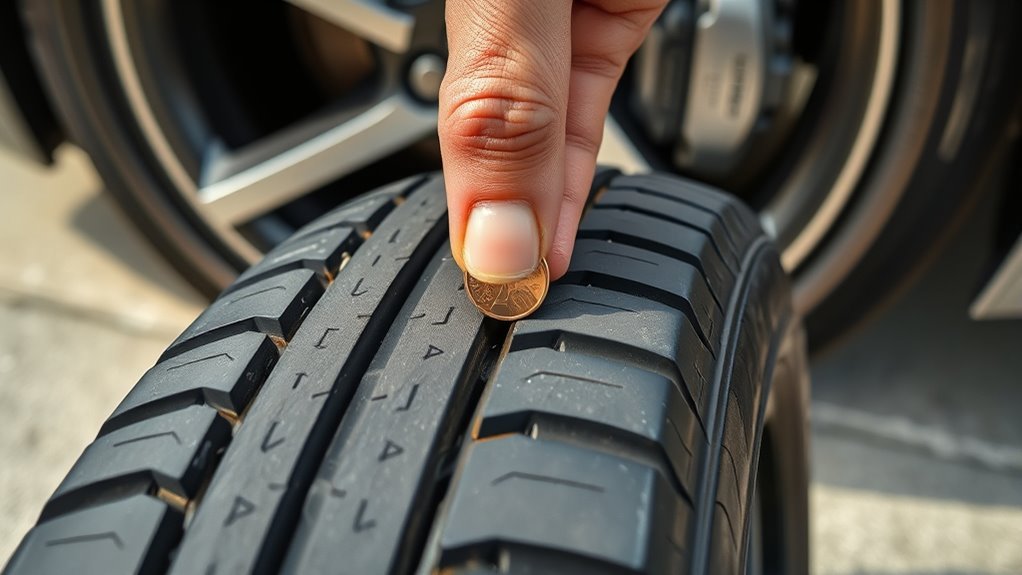
You can check your Toyota Camry’s tire tread in about five minutes with a penny, but the penny test should be treated as a minimum-depth warning—not a complete tire inspection. Use it monthly, before long trips, and any time you notice slipping, vibration, pulling, or uneven wear. For wet roads, snow, or borderline results, confirm the reading with a tread depth gauge.
Quick Answer
To do the penny test on a Camry, insert a penny into several tread grooves with Lincoln’s head upside down. If you can see the top of Lincoln’s head in any groove, that tire is at or near the 2/32-inch replacement point and should be inspected or replaced.
Key Takeaways
- The penny test is a quick pass/fail check for very low tread, not a precision measurement.
- Check the outer edge, center groove, inner edge, and a mid-rib groove on each tire to catch uneven wear.
- If Lincoln’s head is visible, schedule tire replacement or a professional inspection promptly.
- Use a tread gauge or quarter test for wet-weather and winter safety decisions before tires reach the legal minimum.
At a Glance
| Time Required | About 5 minutes for all four tires |
| Difficulty | Easy |
| Tools Needed | A penny; optional tread depth gauge and tire pressure gauge |
| Cost | Free with a penny; usually low-cost for a tread gauge |
Before You Start: What the Penny Test Tells You

The penny test tells you whether your Camry’s tread is approaching the common 2/32-inch replacement point. According to NHTSA tire safety guidance, place a penny in the tread with Lincoln’s head upside down; if you can see the top of Lincoln’s head, the vehicle needs new tires.
That does not mean a tire is ideal just because Lincoln’s head is partly covered. It only means the tread is above the minimum check point. Wet-road traction, hydroplaning resistance, and snow performance can decline before the tire reaches 2/32 inch, so borderline results deserve a tread gauge reading.
Warning: Do not rely on one groove or one tire. A Camry can have uneven wear from misalignment, incorrect tire pressure, worn suspension parts, or skipped rotations. If any checked spot fails, treat that tire as a safety concern.
How Tire Tread Depth Affects Camry Safety and Handling
Tire tread helps your Camry grip the road, channel water, and respond predictably when you brake or steer. As tread gets shallower, the tire has less room to move water away from the contact patch. That can increase stopping distance and raise the chance of hydroplaning in heavy rain.
Reduced Braking Performance
Low tread can make emergency stops less predictable, especially on wet pavement. A tire near the 2/32-inch point may still roll normally in dry conditions, but it has far less tread depth available to maintain grip when water, slush, or loose debris is present.
- Below about 4/32 inch: Wet-weather traction is a concern, and a quarter test or tread gauge is more useful than a penny alone.
- At about 2/32 inch: The tire is at the common replacement threshold, and treadwear bars may be visible.
- Uneven tread depth: One edge may lose grip sooner than the rest of the tire, which can affect braking and stability.
- Regular checks: Monthly tread and pressure checks help catch problems before they become roadside failures.
Increased Hydroplaning Risk
Hydroplaning happens when a tire rides on top of water instead of cutting through it. Deep grooves help move water away; worn grooves do not. If your Camry’s tread is low, slow down in rain, increase following distance, and inspect the tires before the next drive.
The penny test is useful because it is fast, but a tread depth gauge is better when you need an exact reading in 32nds of an inch.
Compromised Steering Response
Worn or uneven tires can make your Camry feel less settled during lane changes, cornering, and evasive maneuvers. If the car pulls to one side, vibrates, or feels unstable in rain, inspect tread depth and tire condition before assuming the issue is normal road feel.
When to Check Your Camry’s Tread: Frequency and Conditions
Check your Camry’s tread at least once a month and before long trips. NHTSA also recommends inspecting tires for cuts, punctures, bulges, scrapes, cracks, bumps, uneven wear, and insufficient tread before road trips. Toyota’s owner guidance says to check whether treadwear indicators are showing and to inspect for uneven wear, including excessive wear on one side of the tread.
Increase inspection frequency after heavy rain, snow, pothole impacts, or curb strikes. Also check tread if you notice vibration, pulling, longer stopping distance, or a tire pressure warning light.
Note: Tire pressure matters too. Check pressure when the tires are cold and use the PSI listed on your Camry’s driver-door placard or owner’s manual, not the maximum pressure printed on the tire sidewall.
Do the Penny Test: Step-by-Step for Camry Tires

Park your Camry on a level surface, set the parking brake, and turn the front wheels slightly if you need more room to inspect the front tires. Use good lighting so you can see the grooves clearly.
Position the Penny Correctly
- Hold the penny so Lincoln’s head points down toward the tire.
- Place the penny straight into a main tread groove, not sideways or at an angle.
- Push it down until the coin reaches the bottom of the groove.
- Look at the top of Lincoln’s head. If the top is visible, the tread is too low at that spot.
- Repeat the test across multiple grooves and on all four tires.
Inspect Multiple Tire Spots
Check at least four spots per tire: outer edge, center groove, inner edge, and a mid-rib groove. Then repeat around the tire if you see anything inconsistent. A single good spot does not make the whole tire safe if another part of the tread is badly worn.
Pro Tip: Keep a small tread depth gauge in your glove box. Write down each tire’s lowest reading once a month so you can spot fast wear before it becomes expensive or unsafe.
Which Grooves to Test on Each Camry Tire: 4 Spots to Check
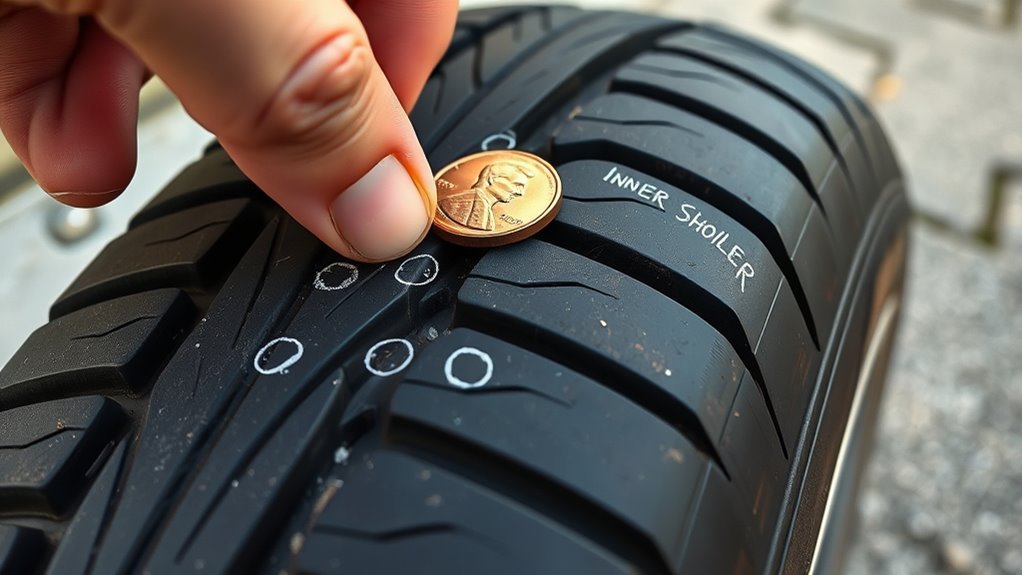
Testing several grooves helps you catch uneven wear that a single penny check can miss. Use the same four-point pattern on every tire so your results are consistent.
- Outer edge: Fast outer-edge wear can point to underinflation, hard cornering, or alignment problems.
- Center groove: Center wear may suggest overinflation or heavy wear in the main road-contact area.
- Inner edge: Excessive inner-edge wear often points to alignment or suspension issues.
- Mid-rib groove: A representative middle groove helps confirm whether wear is even across the tread face.
Compare front tires to rear tires and left-side tires to right-side tires. If one tire is wearing faster than the others, schedule an inspection before simply replacing one tire and ignoring the cause.
Read the Result: What Lincoln’s Head Covered or Visible Means
If part of Lincoln’s head is covered by tread, the tire is likely above the 2/32-inch penny-test threshold at that exact spot. If the top of Lincoln’s head is visible, the tire is worn to the point where replacement should be planned immediately.
Also look for built-in treadwear bars. Toyota explains that tires have treadwear indicators molded into the tread, and when the tread level becomes even with those bars at about 2/32 inch, it is most likely time to replace the tires.
| Result | What It Means | Next Step |
|---|---|---|
| Lincoln’s head partly covered | Tread is above the penny-test replacement point at that spot | Check other grooves and confirm with a gauge if driving in rain or snow |
| Top of Lincoln’s head visible | Tread is at or near the 2/32-inch replacement threshold | Schedule replacement or professional inspection |
| Mixed results across the tire | Uneven wear may be present | Check pressure, rotate if appropriate, and inspect alignment/suspension |
When the Penny Test Isn’t Enough: Use a Tread Gauge or Quarter
The penny test is best for identifying tires that are already very worn. A tread depth gauge gives a clearer reading because it measures tread depth in 32nds of an inch or millimeters. Use a gauge when results are borderline, when you drive often in rain, or when winter conditions are possible.
The quarter test can also help. Insert a quarter with Washington’s head upside down. If the top of Washington’s head is visible, the tire is around the 4/32-inch caution range. Tire Rack recommends considering replacement around 4/32 inch for wet roads and around 5/32 inch for snow, because performance needs change with road conditions.
[Products Worth Considering]

This color coded tire tread depth gauge helps you quickly check tire wear and monitor when replacement is needed. Calibrated in easy-to-read 32nds with clear red, yellow, and green ranges, it offers fast visual results for cars, trucks, motorcycles, and other passenger vehicles. The pocket clip makes it simple to keep on hand for routine maintenance and safety checks.

This digital tire tread depth gauge helps you check tire wear quickly and accurately with fractional inch, decimal inch, and millimeter readouts. Its large LCD screen, zero reset function, and automatic shutoff make it easy to use for cars, motorcycles, SUVs, trucks, and pickups. Designed for clear readings and dependable measurement, it is a practical tool for routine tire safety checks.

This 50-pack of tire tread depth gauges offers a simple way to check tire wear quickly and accurately. Color-coded reading zones make it easy to see tread condition at a glance, while the compact design and pocket clip support convenient everyday carry. Built for repeated use, these gauges help drivers monitor tire safety with confidence.
What Uneven Tread Wear on a Camry Indicates and Next Steps
Uneven tread wear is a warning sign, not just a cosmetic issue. It can reduce traction, shorten tire life, and point to a mechanical or maintenance problem.
Tire Inflation and Alignment
Incorrect inflation and poor alignment are two of the most common causes of uneven wear. Underinflation can wear both outer edges. Overinflation can wear the center. Misalignment often wears one edge faster than the rest of the tire.
- Measure tire pressure monthly with a reliable gauge when the tires are cold.
- Set pressure to the Camry’s door placard or owner’s manual specification.
- Rotate tires according to your maintenance schedule and tire pattern.
- Get an alignment check if one side wears faster, the steering wheel is off-center, or the car pulls.
Localized Damage or Defects
Look for punctures, cuts, cracks, sidewall bubbles, exposed cords, flat spots, and separated tread. A tire can pass the penny test in one groove and still be unsafe if it has sidewall damage or a bulge. Do not ignore vibration or thumping at speed; have the tire removed and inspected.
Warning: A sidewall bulge, visible cord, deep cut, or vibration after an impact can signal internal tire damage. Have the tire inspected before highway driving.
If Tires Fail: Replacement Options, Sizing, and Cost Basics for Camry
If your Camry fails the penny test, confirm the correct tire size before buying replacements. Tire size varies by model year, trim, wheel package, and tire type. The safest sources are the tire sidewall, the driver-door placard, and your Toyota owner’s manual.
- Verify size: Match the tire size, load rating, and speed rating recommended for your Camry.
- Choose the right type: All-season tires suit many drivers; winter tires are better for consistent snow and freezing conditions; performance tires may trade comfort or tread life for sharper handling.
- Replace in pairs or sets when needed: If one tire is worn far more than the others, ask a tire professional whether one, two, or four tires should be replaced for safe handling.
- Budget beyond the tire price: Mounting, balancing, valve stems, TPMS service, disposal fees, alignment, and road-hazard coverage can affect the final cost.
- Register the warranty: Keep receipts and warranty information in case a tire has a defect or road-hazard issue.
[Products Worth Considering]

This dial type tire tread depth gauge helps you quickly check tread wear on motorcycles, cars, trucks, and buses with easy-to-read 1/32-inch increments. Its colorful zone markings make it simple to assess tire condition for safer driving in different weather, while the durable zinc cast body and legible dial provide dependable everyday use.

This LUMITECO tire tread depth gauge set makes it easy to monitor tire wear and maintain safer driving performance. The color-coded scale provides quick, easy-to-read measurements, while the compact pocket-size design and included clip make it convenient to keep in your vehicle or toolbox. Suitable for cars, trucks, motorcycles, and more, it offers a simple reusable way to check tread depth whenever needed.

This smart tire tread depth gauge provides quick, accurate readings from 0 to 1 inch in 1/32-inch increments, helping drivers assess tire wear with confidence. Its color-coded display makes it easy to see tread condition at a glance, while the pocket clip adds convenient portability for garages, glove boxes, and on-the-go inspections. Designed for use on trucks, motorcycles, automobiles, and other passenger vehicles, it is a simple tool for safer tire maintenance.
When to See a Pro: Alignment, Inflation Checks, and Safety Inspections
See a licensed tire shop or mechanic if your Camry has uneven tread wear, vibration, pulling, repeated pressure loss, sidewall damage, or tread near the 2/32-inch threshold. A professional can measure tread depth, inspect the tire internally, check for leaks, balance the wheel, and identify alignment or suspension issues.
| Trigger | Likely Cause | Professional Action |
|---|---|---|
| Uneven wear | Alignment, inflation, rotation, or suspension issue | Alignment check, pressure correction, suspension inspection |
| Vibration | Imbalance, damaged tire, bent wheel, or internal separation | Balance, wheel inspection, tire removal and inspection |
| Repeated low PSI | Leak, puncture, valve issue, or bead leak | Leak test, repair if safe, valve or tire replacement |
| Tread at about 2/32 inch | Tire is worn to the replacement point | Replace tire and inspect alignment cause if wear is uneven |
[Products Worth Considering]

This smart color coded tire tread depth gauge makes it easy to check tread wear at a glance with clear red, yellow, and green ranges. Calibrated from 0 to 1 inch in 1/32 inch increments, it helps you quickly assess tire condition for safer driving and timely replacements. The pocket clip design makes it convenient to carry and use on trucks, motorcycles, cars, and other passenger vehicles.

This GM TPMS relearn tool helps reset tire sensors, clear warning lights, and match tire positions after rotation quickly at home. Designed for Chevrolet, GMC, Cadillac, and Buick vehicles, it offers one-button operation, fast activation, and broad compatibility with many GM models. It is best suited for OE/OEM sensors and includes paper instructions plus video guidance for easier DIY use.

The JACO ElitePro Digital Tire Pressure Gauge delivers shop-grade accuracy with a clear digital readout, making it easy to maintain proper tire pressure for safer driving and better performance. Built with rugged brass and steel components, a protective guard, and a flexible air hose, it is designed for reliable use across cars, trucks, motorcycles, bikes, RVs, and trailers. The lock-on display, built-in bleeder valve, and bright backlit screen add convenience in any lighting condition.
Frequently Asked Questions
Does the penny trick really work?
Yes. The penny test works as a quick warning that tread is at or near the 2/32-inch replacement point. It does not tell you whether the tire is ideal for wet roads, snow, or performance driving. Use a tread depth gauge for a precise measurement.
Where should I put the penny in a Camry tire?
Place the penny into a main tread groove with Lincoln’s head upside down. Check the outer edge, center groove, inner edge, and a mid-rib groove on every tire. Do not test only one spot.
Is 2/32 inch enough tread for rain?
It is the common minimum replacement threshold, but it is not ideal for rain. Wet traction can decline before 2/32 inch. If you drive often in heavy rain, use a tread gauge and consider replacement earlier, especially around the 4/32-inch caution range.
How often should I check Camry tire tread?
Check tread at least once a month, before long trips, after severe weather, and after hitting potholes or curbs. Also check anytime the car pulls, vibrates, slips, or shows a tire pressure warning.
Should I replace a tire if only one spot fails the penny test?
Yes, treat that tire as unsafe until inspected. A single low spot can mean uneven wear, alignment trouble, suspension issues, or localized damage. A professional can confirm whether the tire should be replaced and what caused the wear.
Conclusion
The penny test is a simple way to check whether your Camry’s tire tread is dangerously low. Insert Lincoln’s head upside down into several grooves on every tire. If the top of his head is visible anywhere, schedule replacement or a professional inspection. For better decisions in rain, snow, or borderline cases, use a tread depth gauge, keep tire pressure correct, rotate tires on schedule, and fix uneven wear before it damages another set of tires.
Sources
- NHTSA Summer Driving & Road Trip Tips — penny test instructions, monthly tire inspection, 2/32-inch tread guidance, and uneven-wear warning signs.
- Toyota Support: How do I know when my tires should be replaced? — Toyota guidance on treadwear indicators, wear bars, abnormal wear, and replacement signs.
- Toyota Owners: 2025 Camry Hybrid Tires — Camry tire inspection guidance, treadwear indicators, uneven wear, and tire rotation/replacement reminders.
- Tire Rack: When Should Tires Be Replaced? — tread depth recommendations for dry, wet, and snowy road conditions.
- Tire Rack Wet Braking Tread Depth Test — test-based explanation of how worn tread affects wet stopping performance.