Energy-efficient tire inflators help you top off tires without wasting time, battery power, or electricity. The best choice is not simply the model with the highest PSI number. Look for a reliable pressure gauge, automatic shut-off, the right power source for your vehicle, enough airflow for your tire size, and a duty cycle that matches how many tires you may need to inflate in one session.
Quick Answer
Choose an energy-efficient tire inflator with automatic shut-off, an accurate digital gauge, enough airflow for your tires, and a power source that fits your use. For most passenger cars, a compact 12V or rechargeable inflator rated at least 100 PSI is enough; larger SUV, truck, and RV tires need stronger airflow and longer run time.
Key Takeaways
- Automatic shut-off saves power and helps prevent over-inflation.
- Use the PSI on your vehicle’s door placard or owner’s manual, not the maximum PSI printed on the tire sidewall.
- PSI shows maximum pressure capability; CFM or airflow tells you more about how fast the inflator works.
- Corded 12V inflators are best for consistent emergency use, while cordless models are more convenient if you keep them charged.
- Duty cycle matters if you plan to inflate multiple tires, larger tires, or anything from very low pressure.
Why Choose Energy-Efficient Tire Inflators for Your Vehicle?

When you choose an energy-efficient tire inflator, you are investing in safer tire maintenance, lower waste, and more convenient roadside preparedness. Properly inflated tires can improve fuel economy, help tires last longer, and support safer handling. According to FuelEconomy.gov, keeping tires properly inflated can improve gas mileage by 0.6% on average and up to 3% in some cases.
For the inflator itself, “energy-efficient” usually means the unit gets the job done with less unnecessary run time. The most useful features are practical: automatic shut-off, a readable pressure display, a stable power source, and enough airflow for your tire size. A good inflator should reach the correct pressure quickly, stop when the preset PSI is reached, and avoid overheating during normal use.
Note: Tire inflators are not a substitute for tire inspection. If one tire repeatedly loses air, check for a nail, valve-stem leak, rim damage, or sidewall damage before relying on repeated inflation.
Essential Features of Energy-Efficient Tire Inflators
When shopping for an energy-efficient tire inflator, focus on features that reduce wasted run time and make inflation more accurate. A compact design is helpful, but performance and safety matter more than size alone.
[Products Worth Considering]
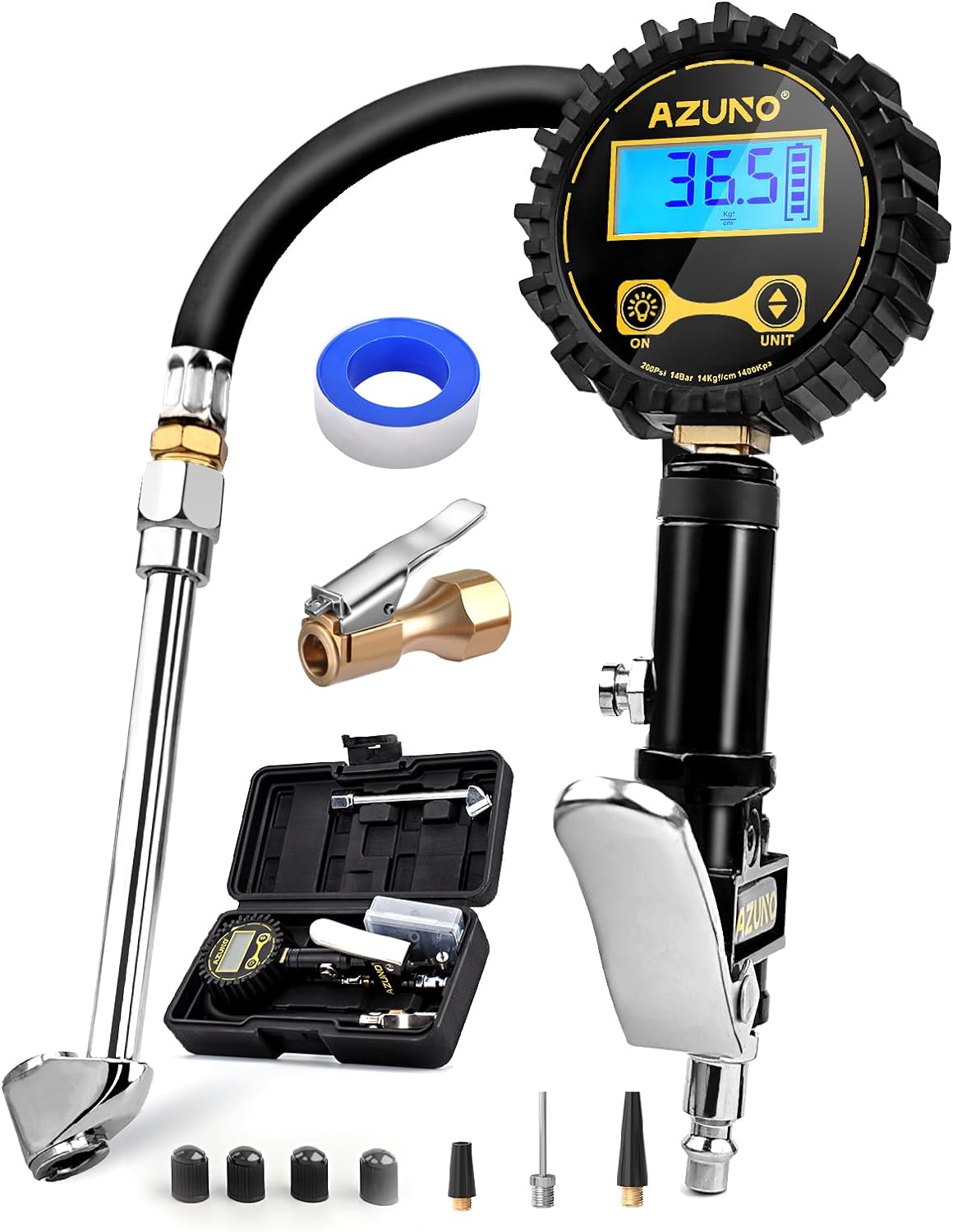
This digital tire inflator delivers accurate, easy-to-read pressure measurements with a bright backlit LCD and precise 0.1 resolution for confident inflation. Designed for single-handed use, it makes it simple to inflate or deflate tires while staying organized in the included portable carrying box. Built for a wide range of vehicles, it is a practical air compressor accessory for cars, trucks, SUVs, motorcycles, and more.

This portable tire inflator delivers fast, convenient inflation for cars, bikes, motorcycles, and balls with dual power options from a rechargeable battery or a 12V car cord. Its digital LCD pressure gauge and automatic shutoff help prevent over-inflation, while multiple preset modes and a custom setting make it easy to use for different inflation tasks. Built-in flashlight and USB power ports add extra emergency utility on the road.

The Drymate XL Oil Spill Mat is designed to trap and contain messy liquid leaks while protecting your garage floor from stains and damage. Its absorbent surface wicks away moisture, and the waterproof, slip-resistant backing helps keep motor oil, brake fluid, gasoline, and coolant from soaking through. Reusable, durable, and easy to clean, it offers a practical long-term solution for garage and shop spill protection.
Automatic Shut-Off
Automatic shut-off is one of the most important efficiency features. You set the target PSI, start the inflator, and the unit stops when the tire reaches the preset pressure. This reduces energy waste, prevents unnecessary motor wear, and lowers the risk of over-inflation.
Accurate Digital Gauge
A digital gauge makes it easier to read pressure in low light and helps you avoid guesswork. Look for a display that shows PSI clearly and allows simple preset adjustments. Even with a built-in digital gauge, it is smart to keep a separate tire pressure gauge in the vehicle for occasional cross-checks.
Pressure Range and Airflow
A high PSI rating does not always mean faster inflation. PSI tells you the maximum pressure the inflator can reach, while airflow tells you how quickly it can move air. For most passenger cars, a unit rated at least 100 PSI is usually enough. For SUVs, trucks, vans, trailers, and RVs, prioritize stronger airflow, a longer hose, and a longer duty cycle.
| Spec | What It Means | Why It Matters |
|---|---|---|
| PSI | Maximum pressure rating | Shows whether the inflator can reach your tire’s required pressure |
| CFM or L/min | Airflow rate | A better clue for inflation speed |
| Duty cycle | Run time before cooldown | Important for multiple tires or larger tires |
| Power draw | How much current the unit uses | Helps avoid blown fuses or weak battery performance |
Compact Design Benefits
Compact tire inflators are easier to store in a trunk, cargo area, or roadside emergency kit. Many portable inflators are small enough for daily drivers while still offering useful features such as LED lights, onboard hose storage, and adapters for balls or small inflatables.
| Feature | Benefits | Example |
|---|---|---|
| Small housing | Easy storage | Fits in a trunk organizer or emergency kit |
| Lightweight build | Better portability | Useful for roadside top-offs |
| Built-in LED light | Improved visibility | Helpful for nighttime emergencies |
Multi-Purpose Functionality
Many energy-efficient tire inflators are useful beyond tires. Multiple nozzles can handle sports balls, bike tires, air mattresses, and pool floats. Some cordless units also include a USB power bank or flashlight, making them more useful for camping, road trips, and emergency kits.
- Built-in LED lights for low-light visibility
- Adapters for balls, bicycle valves, and small inflatables
- Preset pressure controls for easier inflation
- Onboard hose and cord storage for less clutter
- Rechargeable battery or 12V backup cable on some models
How Fast Should Your Inflator Work?
The right inflation speed depends on your tire size and how low the tire is. Topping off a tire that is only 3–5 PSI low should take far less time than inflating a tire from nearly flat. Larger tires also take longer because they hold more air.
For everyday car use, a good portable inflator should handle a routine top-off in a few minutes per tire. If you drive a truck, SUV, off-road vehicle, trailer, or RV, look for a higher-airflow model instead of choosing based on PSI alone. Fast inflation saves energy because the motor runs for less time, but only if the unit can work without overheating.
Pro Tip: Check tire pressure when the tires are cold. NHTSA says the recommended tire pressure is the cold tire pressure listed by the vehicle manufacturer, usually on the driver-side door placard or in the owner’s manual.
Corded vs. Cordless Power Sources

When deciding between corded and cordless tire inflators, think about where you will use the unit and how often you will remember to charge it. Both styles can be efficient when matched to the right job.
- Corded 12V inflators: Plug into the vehicle’s 12V outlet and provide steady power as long as the vehicle battery is healthy. They are dependable for emergency kits, but the cord must be long enough to reach every tire.
- Cordless inflators: Offer excellent portability and are convenient for garages, bikes, sports equipment, and road trips. They depend on battery charge, so they need regular charging and proper storage.
- Hybrid inflators: Some models work from both a rechargeable battery and a 12V cable. This is often the most flexible choice if you want portability with a backup power option.
| Power Type | Best For | Main Tradeoff |
|---|---|---|
| 12V corded | Emergency car kits and longer sessions | Needs a vehicle outlet and enough cord length |
| Cordless | Convenience, bikes, sports gear, quick top-offs | Battery must be charged |
| 120V AC | Garage use at home | Not useful away from an outlet |
| Hybrid | Road trips and flexible use | Often costs more |
Warning: Do not exceed your vehicle outlet’s amperage rating. Some powerful inflators may require a direct battery connection instead of a standard 12V accessory socket.
[Products Worth Considering]

This mud flaps kit helps protect your Toyota Camry’s lower body panels from snow, salt, sand, rocks, and road debris thrown up by the wheels. Designed for SE and XSE Sport models, it offers a direct-fit install with included mounting hardware for a cleaner, more finished look. Built from durable ABS thermoplastic, it is made to handle harsh driving conditions while helping keep your vehicle cleaner.

This portable 12V tire inflator delivers fast, convenient inflation for cars, SUVs, trucks, motorcycles, and other inflatables. It features a digital display, bright LED lighting, auto shutoff, and multiple nozzle adapters to help you inflate accurately and safely, even in low-light situations. The long power cord and air hose make it easy to reach all tires and handle roadside emergencies or routine maintenance.

【Powerful Inflation】Delivers up to 150 PSI on CUSTOM MODE, inflating a 195/65 R15 tire from 30–36 PSI in under 1 minute—fast, reliable performance for roadside emergencies.
Why Do Duty Cycles Matter for Tire Inflators?
Duty cycle tells you how long an inflator can run before it needs a cooldown period. This matters because small compressors generate heat. Running an inflator longer than the manufacturer allows can shorten its life or cause it to shut down.
| Duty Cycle Rating | Typical Use Case |
|---|---|
| 10–15 minutes | Occasional top-offs for passenger cars |
| 20–25 minutes | Multiple tires or moderate SUV use |
| 30+ minutes | Larger tires, trailers, and frequent use |
| Continuous-rated | Heavy-duty or professional use |
If you only top off one tire at a time, a short duty cycle may be acceptable. If you regularly inflate multiple tires, air down for off-roading, tow trailers, or help other drivers, choose a stronger inflator with a longer run time and clear cooldown instructions.
How to Use a Tire Inflator Efficiently and Safely
At a Glance
| Time Required | 5–20 minutes, depending on tire size and pressure loss |
| Difficulty | Easy |
| Tools Needed | Tire inflator, tire pressure gauge, valve-cap storage spot |
| Cost | Usually free after buying the inflator |
- Find the correct PSI. Use the tire information placard on the driver-side door edge or doorpost, or check your owner’s manual.
- Check tires cold when possible. NHTSA defines cold tires as tires that have not been driven on for at least three hours.
- Attach the hose firmly. Press or lock the chuck onto the valve stem so air does not leak.
- Set the target pressure. Use the placard PSI, not the tire sidewall maximum.
- Start the inflator. Let automatic shut-off stop the unit if your model has that feature.
- Recheck with a gauge. Confirm the final pressure, especially if the inflator’s built-in gauge is new to you.
- Replace the valve cap. The cap helps keep dirt and moisture out of the valve.
- Let the inflator cool. Follow the manufacturer’s cooldown guidance before storing it.
The most efficient inflation is accurate inflation: fill to the vehicle manufacturer’s recommended cold pressure, then stop.
Energy-Efficient Tire Inflators: Multi-Purpose Functionality
Energy-efficient tire inflators often earn their place in a vehicle because they handle more than emergency tire top-offs. A compact inflator with the right adapters can support commuting, camping, biking, sports, and roadside safety.
- Built-in rechargeable batteries for cordless convenience
- Integrated flashlights for emergency situations
- Power-bank function on select models for charging small devices
- Automatic shut-off at preset pressures to prevent over-inflation
- Multiple nozzle attachments for inflating various items
These features are helpful, but do not let extras distract from the core job. A tire inflator should first be accurate, durable, and powerful enough for your tires. Flashlights and power banks are bonuses, not replacements for strong inflation performance.
Common Buying Mistakes to Avoid
Avoid these mistakes when comparing energy-efficient tire inflators:
- Choosing by PSI alone: A 150 PSI rating looks impressive, but airflow and duty cycle often matter more for real-world speed.
- Ignoring tire size: A tiny inflator that works for a compact car may be frustrating for truck, van, or RV tires.
- Forgetting cord and hose reach: The power cord and air hose must reach all four tires comfortably.
- Skipping gauge accuracy: An inaccurate gauge can lead to under-inflation or over-inflation.
- Not checking cooldown rules: Short duty cycles are fine for top-offs but poor for long inflation sessions.
- Letting cordless batteries sit empty: A cordless inflator is only useful in an emergency if it is charged.
[Products Worth Considering]

ADVANCED TRUEGAUGE SCREEN: This battery tire inflator includes updated sensor technology, capable of collecting pressure data from tire inflators at a frequency of 200 times per second. Its valid data rate is higher than 80%, which is 60% better than the market average. From routine maintenance to roadside emergencies, its accurate readings ensure confident pressure checks and a safer driving experience.Suitable as a Father's Day gift for your dad.

High-pressure inflation mode with automatic shutoff
Tips for Maintaining Your Tire Inflator for Long-Lasting Performance

To keep your tire inflator performing well, treat it like any other emergency tool: keep it clean, test it regularly, and store it properly. A neglected inflator may fail when you need it most.
Regular Cleaning and Maintenance
- Inspect the hose, fittings, power cord, and valve chuck for cracks, wear, or loose connections.
- Clean dust from vents so the motor can cool properly.
- Check the air filter if your model has one and follow the manufacturer’s maintenance instructions.
- Test the inflator occasionally by topping off a tire, not just by turning it on.
- Keep adapters together in the storage pouch or onboard compartment.
Proper Storage Techniques
Store your inflator in a cool, dry place away from direct sunlight and moisture. Avoid crushing or sharply bending the air hose, and disconnect the power cord before storage. If the inflator lives in your vehicle, keep it in a bag or case so it does not get damaged by cargo.
Battery Care and Charging
For cordless tire inflators, battery care is part of reliability. Charge the unit before long trips, avoid storing it fully drained, and follow the manufacturer’s charging instructions. If you store it for months at a time, check the battery level periodically so it is ready when needed.
Note: Rechargeable inflators lose charge over time. Add “check inflator battery” to your monthly tire-pressure routine so the tool is ready for emergencies.
Frequently Asked Questions
What should I look for in a tire inflator?
Look for automatic shut-off, an easy-to-read gauge, enough airflow for your tire size, a suitable power source, and a duty cycle that matches your use. For a daily-driver passenger car, a compact 12V or cordless model may be enough. For larger vehicles, choose a higher-airflow unit with longer run time.
How do I choose the right inflator?
Match the inflator to your tires and where you will use it. Choose corded 12V for a vehicle emergency kit, cordless for convenience, and a stronger high-airflow model for trucks, SUVs, trailers, and RVs. Also check hose length, power-cord length, gauge accuracy, and cooldown requirements.
What is a good PSI for a portable tire inflator?
For most passenger vehicles, a portable tire inflator rated at least 100 PSI is usually sufficient. The correct tire pressure, however, is not the inflator’s maximum rating. Always inflate to the vehicle manufacturer’s recommended cold PSI listed on the door placard or in the owner’s manual.
What is the 5 PSI rule?
The 5 PSI rule is a common reminder that you should add air when a tire is about 5 PSI below the recommended pressure. It is not a replacement for regular checks. Even a few PSI can affect fuel economy, tire wear, handling, and heat buildup, so check pressure monthly and before long trips.
Are cordless tire inflators as good as corded ones?
Cordless tire inflators are excellent for quick top-offs and portability, but they rely on battery charge. Corded 12V inflators are often more dependable for vehicle emergency kits because they draw power from the vehicle. Hybrid models offer the most flexibility if you want both options.
Can a tire inflator damage a tire?
A tire inflator can contribute to over-inflation if you use the wrong PSI or leave it running too long. Use automatic shut-off when available, inflate to the vehicle placard pressure, and recheck with a gauge. Do not use an inflator to keep driving on a tire with visible damage or a repeating leak.
Conclusion
An energy-efficient tire inflator should save time, reduce wasted power, and make proper tire pressure easier to maintain. Prioritize automatic shut-off, accurate pressure readings, adequate airflow, the right power source, and a duty cycle that fits your vehicle. With the right model and basic maintenance, you get a practical tool that supports safer driving, better fuel economy, and stronger roadside readiness.
Sources
- NHTSA TireWise — tire pressure, cold-pressure guidance, TPMS, tire safety, and maintenance basics
- FuelEconomy.gov Gas Mileage Tips — fuel economy effects of proper tire inflation
- U.S. Tire Manufacturers Association Tire Care Essentials — monthly pressure checks, cold tire checks, temperature effects, and TPMS reminders
- AAA: How to Check and Correct Tire Pressure — step-by-step tire pressure checking and filling guidance