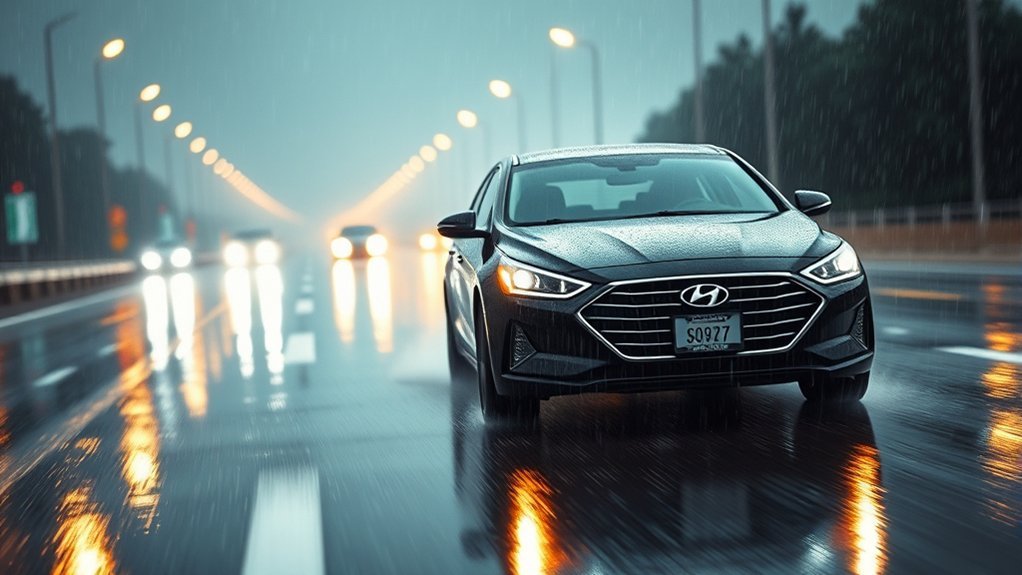
Driving your Hyundai Sonata safely in heavy rain starts before you leave the driveway. Rain reduces visibility, lowers tire traction, increases stopping distance, and can hide standing water deep enough to damage your vehicle or sweep it off the road. The safest approach is simple: prepare the car, slow down, increase space, keep your lights on, and never force your Sonata through flooded water.
Quick Answer
To drive a Hyundai Sonata safely in heavy rain, turn on your low-beam headlights, slow down, leave extra following distance, keep both hands steady on the wheel, avoid cruise control, and never drive through floodwater. Before driving, check tire tread, tire pressure, wipers, lights, washer fluid, and defrosters.
Key Takeaways
- Use low-beam headlights in rain so your Sonata is easier to see from the front and rear.
- Slow down early because wet pavement reduces tire grip and makes stopping take longer.
- Keep a 5- to 6-second following distance in heavy rain instead of the normal dry-road gap.
- Avoid cruise control, sudden braking, sharp steering, and hard acceleration on wet roads.
- If water covers the road and you cannot clearly judge its depth, turn around and choose another route.
At a Glance
| Time Required | 10–15 minutes before driving |
| Difficulty | Easy |
| Tools Needed | Tire pressure gauge, tread depth gauge or quarter, washer fluid, clean cloth |
| Cost | Usually $0–$25 unless tires, wipers, or lights need replacement |
Prepare Your Hyundai Sonata for Rainy Conditions
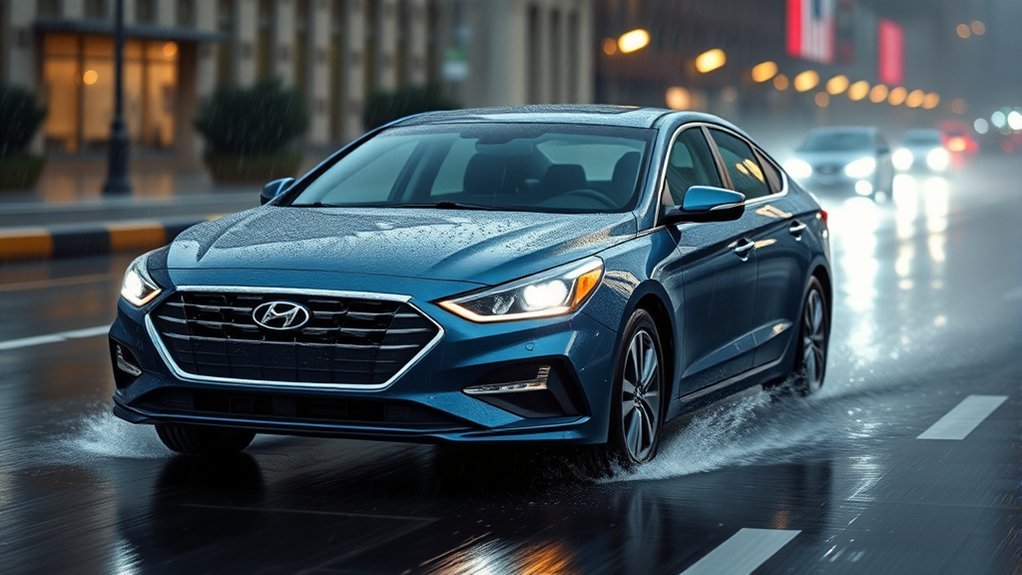
Good wet-weather driving begins with a quick safety check. Start with your windshield wipers. If the blades chatter, streak, skip, or leave cloudy patches, replace them before the next storm. Clear glass matters because heavy rain can reduce your view of lane lines, brake lights, pedestrians, and standing water.
Next, check your washer fluid and use a formula rated for your climate. Road spray can leave oily film on the windshield, and plain water may not clean it well. Wipe the inside of the windshield too; interior haze makes glare worse at night and during storms.
Inspect all exterior lights, including low beams, brake lights, turn signals, hazard lights, and taillights. Do not rely only on daytime running lights, because they may not illuminate the rear of the vehicle. In rain, the goal is not just seeing the road; it is making sure other drivers can see your Sonata.
Note: Hyundai recommends using the vehicle owner’s manual for model-specific operation, maintenance, and safety information. If your Sonata has features such as automatic headlights, rain-sensing wipers, drive modes, or HTRAC all-wheel drive, review how they work before bad weather hits.
[Products Worth Considering]

Rain-X WeatherBeater wiper blades are conventional replacement blades designed to meet or exceed OEM standards for quality, durability, and dependable performance. The pre-installed multi-adapter helps simplify installation on many vehicles, while the natural rubber squeegee and galvanized steel frame deliver a clean wipe, rust resistance, and long-lasting all-weather reliability.

Rain-X Repellency Water Repellent Wiper Blades help improve visibility by clearing your windshield while applying a water-repellent formula that makes rain, sleet, and snow bead and slide away. Built with beam blade technology for a smooth, streak-free wipe, they offer all-weather performance and a universal adapter for easy installation on most vehicles.

AUTOBOO windshield wiper blades are designed for dependable all-season visibility with smooth, streak-free wiping in rain, snow, and heat. The bracketless aerodynamic design helps reduce noise and drag while the memory spring steel structure delivers even pressure for consistent windshield contact. Built for quick installation on compatible U/J hook arms, these blades offer a quiet, reliable upgrade for everyday driving.
Ensure Your Tires Are Ready for Wet Weather
Your tires are the only part of your Hyundai Sonata that touches the road, so tire condition is one of the biggest safety factors in heavy rain. Check three things: tread depth, tire pressure, and visible damage.
Use a tread depth gauge for the most accurate reading. If you do not have one, use the quarter test as a quick check. Insert a quarter into the tread groove with Washington’s head facing down. If the top of his head is visible, your tread is roughly at or below 4/32 inch, which is a warning point for wet-weather performance. The legal wear indicator on many tires appears around 2/32 inch, but wet traction can become a concern before that point.
AAA wet-road testing found that new all-season tires stopped nearly 90 feet shorter, on average, than tires worn to 4/32 inch of tread.
Check tire pressure when the tires are cold, ideally before driving or after the car has been parked for at least a few hours. Use the pressure listed on the driver-side door placard or in your Sonata owner’s manual, not the maximum pressure stamped on the tire sidewall. Under-inflated tires can flex too much, wear unevenly, heat up, and reduce steering response in wet conditions.
Also inspect for cracks, bulges, cuts, exposed cords, uneven wear, or objects stuck in the tread. If you notice vibration, pulling, or uneven tread wear, have the alignment, balance, and suspension checked. Rotate tires on the maintenance schedule recommended for your model year so the Sonata keeps predictable grip at all four corners.
[Products Worth Considering]

This heavy-duty car ramp set provides a stable, reliable lift for routine maintenance like oil changes, tire rotations, brake work, and undercarriage inspections. Built from high-impact poly with a non-skid tread and rubber feet, it helps keep vehicles secure while offering a lightweight, corrosion-resistant alternative to steel ramps. The wide, gradual design supports a broad range of vehicles, from compact cars to trucks, SUVs, and vans.

This versatile valve core and stem removal kit is designed for maintenance and replacement across cars, trucks, motorcycles, bicycles, ATVs, lawn mowers, and more. It includes a dual-head stainless steel remover and a 3-in-1 valve tool for Presta and Schrader applications, making valve service quick, portable, and convenient.

1.Accurate and Efficient: Different colors on the bar represents different scopes, the red range on bar: 0 - 3/ 32; Yellow range on bar: 3/ 32 - 6/ 32; Green range on bar: 6/ 32 - 32/ 32, allowing you easy and fast to read and calibrated
Essential Driving Techniques for Heavy Rain
Once you are on the road, your main job is to make every input smoother and earlier than usual. Heavy rain rewards patience. Abrupt steering, late braking, and sudden acceleration can break traction quickly, especially on painted lines, metal bridge joints, wet leaves, or puddled pavement.
Visibility Enhancement Techniques
Use these visibility habits whenever rain becomes steady or heavy:
- Turn on low-beam headlights. Low beams help other drivers see your Sonata without the glare that high beams can create in rain, mist, or fog.
- Set the headlights to “on,” not just “auto.” Some automatic systems may not activate the taillights in daytime rain.
- Use the front and rear defrosters. Rain increases cabin humidity, and fogged glass can form quickly.
- Adjust wiper speed before visibility gets poor. Do not wait until the windshield is overwhelmed.
- Keep mirrors clear. Use mirror defrosters if equipped, and aim side mirrors properly before leaving.
Safe Speed Management Strategies
Speed is the biggest factor you control in a storm. According to the Federal Highway Administration, rain reduces traction and maneuverability, while heavy rain reduces visibility distance. That means the posted speed limit may be too fast for the conditions.
In heavy rain, reduce speed well before curves, exits, intersections, and traffic backups. If vehicles ahead are throwing large sheets of spray, slow down more. If you feel the steering get light, hear a change in tire noise, or see standing water across the lane, ease off the accelerator and avoid sudden movement.
Pro Tip: Turn off cruise control in wet weather. In a traction-loss situation, you need to reduce speed smoothly with your foot, not have the car trying to maintain a set speed.
How Visibility Affects Safe Driving in Rain
Visibility is not just about what you can see through the windshield. It also includes whether other drivers can identify your Sonata’s position, speed, brake lights, and lane changes. Heavy rain can blur mirrors, hide lane markings, and make dark-colored cars blend into the road spray.
Keep both hands on the wheel, scan farther ahead than usual, and look for clues such as brake lights reflecting on wet pavement, water collecting near curbs, or spray patterns from vehicles ahead. If you cannot see lane markings or the vehicle ahead clearly, slow down gradually and move to a safe place to stop.
Warning: Do not stop in a travel lane unless the car is disabled and there is no safer option. If rain becomes blinding, signal early, move fully off the roadway into a safe parking area, and use hazard lights while stopped.
Use Headlights Wisely to Enhance Safety
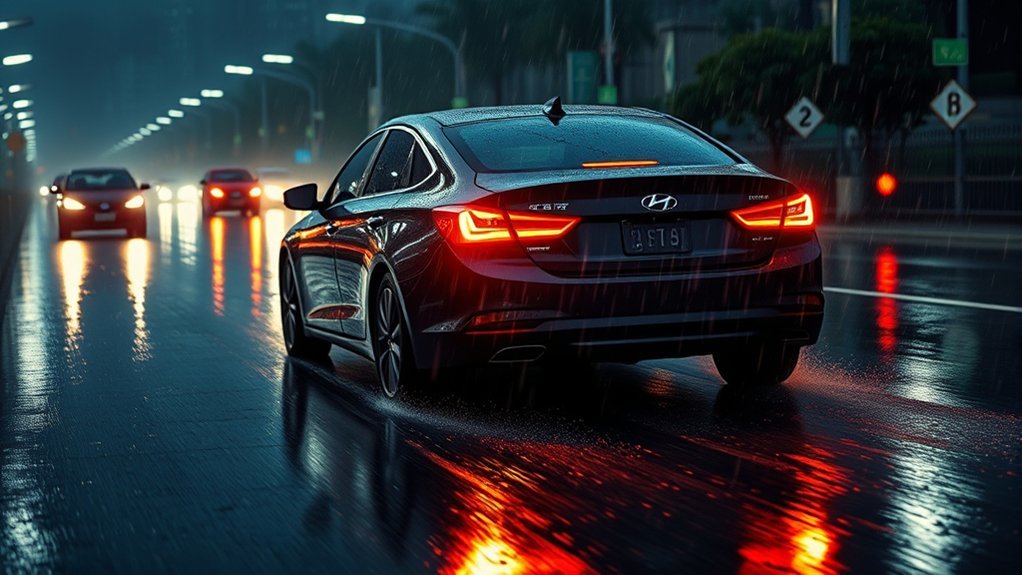
When driving your Hyundai Sonata in heavy rain, use low-beam headlights. Low beams improve your forward visibility and make your vehicle easier to spot in traffic. High beams may reflect off raindrops, mist, and road spray, creating glare instead of clarity.
Legal Headlight Requirements
Headlight laws vary by state. Some states require headlights whenever windshield wipers are in continuous use, while others require headlights during low visibility or adverse weather. The safest habit is easy to remember: wipers on, headlights on. Check local law if you drive across state lines, but do not wait for a legal requirement before making your vehicle visible.
Improved Visibility Benefits
Headlights help oncoming drivers, pedestrians, cyclists, and drivers behind you judge where your Sonata is in the lane. They are especially important during gray daylight storms, dusk, dawn, and highway driving where spray can hide vehicles in seconds.
If your Sonata has automatic headlights, confirm the taillights are on. In many vehicles, daytime running lights illuminate only the front. During heavy rain, you want the full lighting system active so drivers behind you can see your car through spray.
Managing Speed in Wet Conditions
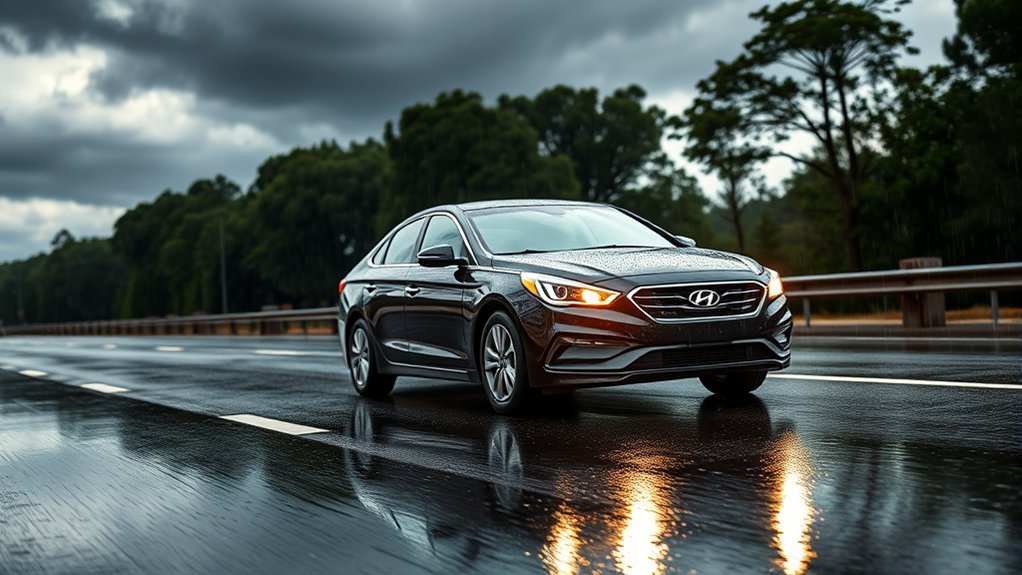
Wet pavement reduces the friction between your tires and the road. The faster you drive, the less time your tires have to push water out of the tread grooves. That is why hydroplaning risk rises as speed increases, especially with worn tires, improper tire pressure, or standing water.
Use these speed-management habits:
- Drive below the posted limit when conditions demand it. The speed limit is for ideal conditions, not heavy rain.
- Brake earlier than normal. Smooth, early braking gives the tires more time to grip.
- Avoid sudden lane changes. Signal early and steer gently.
- Leave extra travel time. Rushing in heavy rain often causes late braking and poor decisions.
- Let aggressive drivers pass. Do not match the speed of someone driving too fast for the weather.
Maintain Safe Following Distances on Slick Roads
In dry conditions, many drivers use a 3-second following distance. In heavy rain, increase that to 5 or 6 seconds. Pick a fixed object ahead, such as a sign or light pole. When the vehicle in front passes it, count slowly. If you reach the object before 5 or 6 seconds, back off.
Increase the gap even more behind motorcycles, large trucks, buses, vehicles towing trailers, and cars with dim or dirty brake lights. Also add more space when driving downhill because gravity lengthens stopping distance.
Following too closely is especially risky in a Sonata because modern brakes and safety systems cannot overcome physics. Anti-lock brakes, stability control, and traction control can help you maintain control, but they cannot create grip where the tires have none.
Navigate Standing Water With Care
Standing water is one of the biggest dangers in heavy rain. Even shallow-looking puddles can hide potholes, debris, washed-out pavement, or deeper water. The National Weather Service warns that it is never safe to drive into floodwater, and that moving water can carry vehicles away.
If you see water across the road, slow down early and assess the situation from a safe distance. If you cannot see the pavement, lane markings, curb, or the far side of the water, do not enter it. Turn around and use a different route.
If you must pass through a very shallow puddle that does not cover the roadway, drive slowly and steadily. Avoid hard braking before the water, avoid sudden steering, and do not accelerate aggressively while crossing. After passing through shallow water, lightly test the brakes when safe to make sure they respond normally.
Warning: Never drive through floodwater to “see if the Sonata can make it.” Water can enter the engine intake and cause severe damage, and moving water can take control away from the driver.
Effective Hydroplaning Responses
Hydroplaning happens when a layer of water builds between the tires and the road, causing the tires to lose contact with the pavement. It can feel like the steering suddenly becomes light, the car floats, the engine revs unexpectedly, or the vehicle does not respond normally to steering.
Recognizing Hydroplaning Signs
Watch for these signs:
- Light steering feel as if the front tires are no longer gripping.
- A floating or gliding sensation over the road surface.
- Sudden change in tire noise as the tires pass over water.
- Reduced braking or steering response even with normal inputs.
Maintaining Calm Control
If your Hyundai Sonata starts to hydroplane, stay calm and avoid the two most common mistakes: slamming the brakes and jerking the steering wheel. Keep your eyes pointed where you want the car to go, hold the wheel firmly, and make small corrections only.
Safe Recovery Techniques
Use this sequence:
- Ease off the accelerator. Let the car slow naturally.
- Do not brake hard. If braking is necessary after traction returns, apply gentle, steady pressure.
- Steer smoothly in your intended direction. Avoid sharp turns.
- Wait for tire grip to return. You may feel the steering become heavier and more responsive again.
- Resume speed gradually. Stay slower than before and look for more standing water ahead.
Proper Braking Techniques for Rainy Conditions
Modern Hyundai Sonata models are equipped with anti-lock braking systems, but wet-weather braking still requires smooth inputs. ABS helps prevent wheel lockup during hard braking, but it does not shorten every stop on every surface. Your best defense is braking earlier and more gently.
When approaching traffic, curves, intersections, or ramps, lift off the accelerator first. Then apply the brake smoothly and progressively. Avoid last-second panic stops whenever possible. If ABS activates, you may feel pulsing in the pedal. Keep firm pressure on the brake and steer where you need to go.
After driving through shallow water, your brakes may feel less responsive for a moment. When safe, lightly apply the brakes to help dry them. If braking feels abnormal, pull over safely and have the vehicle inspected.
What Drive Mode Is Best for Rain in a Hyundai Sonata?
Most Hyundai Sonata trims do not have a dedicated “Rain” mode. For wet roads, use Normal or Eco mode and avoid aggressive throttle inputs. Sport mode can make the car feel more responsive, but that sharper response is not helpful when traction is limited.
Leave traction control and electronic stability control enabled. If your Sonata has all-wheel drive, remember that AWD can help with acceleration traction, but it does not let the car stop faster on wet pavement. Braking and cornering still depend on tire grip.
If the road is flooded, no drive mode makes it safe. Turn around rather than trying to rely on electronics, tire type, or drivetrain layout.
When to Delay Driving or Pull Over
Sometimes the safest driving technique is not driving at all. Delay your trip if rainfall is severe, flash flood warnings are active, local roads are underwater, or visibility is so poor that traffic cannot maintain a steady flow.
Pull over only when you can reach a safe location such as a parking lot, rest area, or wide shoulder away from moving traffic. Signal early, slow gradually, and avoid stopping under trees, power lines, bridges with poor drainage, or low spots where water may rise.
Once stopped, keep your seat belt on, turn on hazard lights if appropriate, and wait for the worst rain to pass. Do not stand outside near traffic in low visibility unless there is an immediate emergency.
After Driving in Heavy Rain
After you arrive, take a minute to check your Sonata. Look for trapped debris around the grille, wheel wells, and underbody. Listen for unusual brake noise, tire noise, or scraping sounds. If you drove through water deeper than expected, watch for warning lights, rough running, damp carpets, or electrical issues.
If the engine stalls in water, do not keep trying to restart it. Restarting can worsen engine damage if water entered the intake. Have the vehicle towed and inspected instead.
Frequently Asked Questions
Can heavy rain damage a Hyundai Sonata engine while driving?
Heavy rain by itself usually will not damage the engine, but driving through deep standing water can. If water enters the engine air intake, it can cause hydrolock, which may severely damage internal engine parts. Avoid flooded roads and do not restart the engine if the car stalls in water.
What should a driver do when driving in heavy rain?
Turn on low-beam headlights, slow down, increase following distance, avoid cruise control, use smooth steering and braking, and stay out of standing water. If visibility becomes unsafe, move to a safe parking area and wait for conditions to improve.
How many inches of rain is bad for driving?
There is no single safe inch-of-rain number because risk depends on rainfall rate, drainage, road slope, speed, tire condition, and visibility. Treat any rain that causes standing water, poor visibility, or active flood warnings as dangerous. If water covers the road, turn around.
What drive mode is best for rain in a Hyundai Sonata?
Use Normal or Eco mode for smoother throttle response, and avoid Sport mode when traction is poor. Keep traction control and stability control on. If your Sonata has all-wheel drive, remember that AWD does not shorten braking distance on wet pavement.
Should I use hazard lights while driving in heavy rain?
Use hazard lights carefully because laws vary and flashing lights can confuse other drivers when the vehicle is moving. A safer habit is to slow down, use low-beam headlights, signal early, and pull fully off the road if visibility becomes too poor to continue.
Can a Hyundai Sonata hydroplane even with new tires?
Yes. New tires reduce hydroplaning risk, but they cannot eliminate it. Speed, water depth, tire pressure, road surface, and steering input all matter. Slow down whenever you see standing water or feel the steering become light.
Conclusion
Driving your Hyundai Sonata in heavy rain is not about being fearless; it is about being prepared and patient. Check the wipers, tires, lights, washer fluid, and defrosters before you go. Once you are moving, use low beams, slow down, leave a larger gap, avoid cruise control, and treat standing water with real caution.
The storm will pass. Your job is to avoid turning a rainy drive into a soggy roadside problem. Drive like the savvy road warrior you are: smooth, visible, calm, and never too proud to turn around.
Sources
- Federal Highway Administration: Rain and Flooding — backs up the effects of rain on traction, maneuverability, and visibility.
- AAA: Wet Weather Driving Tips — supports slowing down, avoiding cruise control, increasing following distance, and hydroplaning prevention.
- NHTSA Tire Safety — supports checking tire pressure, tread, wear, damage, rotation, and owner-manual pressure guidance.
- AAA: New Tires on Wet Roads Have Shorter, Safer Stopping Distance — supports wet braking differences between new tires and tires worn to 4/32 inch.
- National Weather Service: Turn Around Don’t Drown — supports floodwater warnings and the danger of driving into water-covered roads.
- Hyundai Manuals and Warranties — supports checking the model-specific Sonata owner’s manual for operation, maintenance, and safety information.