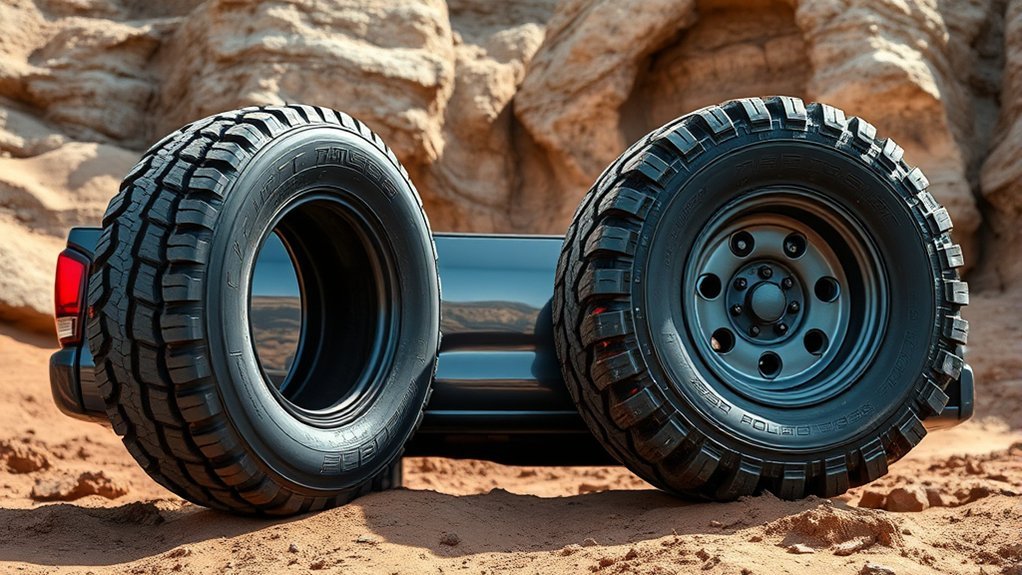
Choosing between all-terrain (A/T) and mud-terrain (M/T) tires for your Toyota Tacoma comes down to where the truck spends most of its time. A/T tires are usually the better match for mixed pavement, gravel, snow, light trails, and daily driving. M/T tires make more sense when deep mud, ruts, loose dirt, and aggressive off-road traction matter more than road noise, fuel economy, and long tread life.
Quick Answer
Most Tacoma owners should choose A/T tires because they balance highway comfort, trail traction, wet-road grip, snow capability, and tread life. Choose M/T tires only if your Tacoma regularly sees deep mud, loose dirt, ruts, or slow technical trails where maximum self-cleaning traction matters more than noise and pavement manners.
Key Takeaways
- A/T tires are the best all-around choice for Tacomas used as daily drivers, weekend trail trucks, overland rigs, or winter commuters.
- M/T tires provide stronger bite in deep mud and loose terrain but usually bring more road noise, faster wear, extra weight, and weaker wet-pavement manners.
- Load range, tire size, aspect ratio, sidewall strength, speed rating, and load index matter as much as tread pattern.
- For snow, look for a Three-Peak Mountain Snowflake rating on the sidewall rather than assuming every aggressive tire is winter-ready.
- Always confirm fitment, rubbing clearance, load capacity, and cold tire pressure using your Tacoma’s tire placard and owner’s manual.
Understanding A/T vs. M/T Tires: Which One Is Right for You?
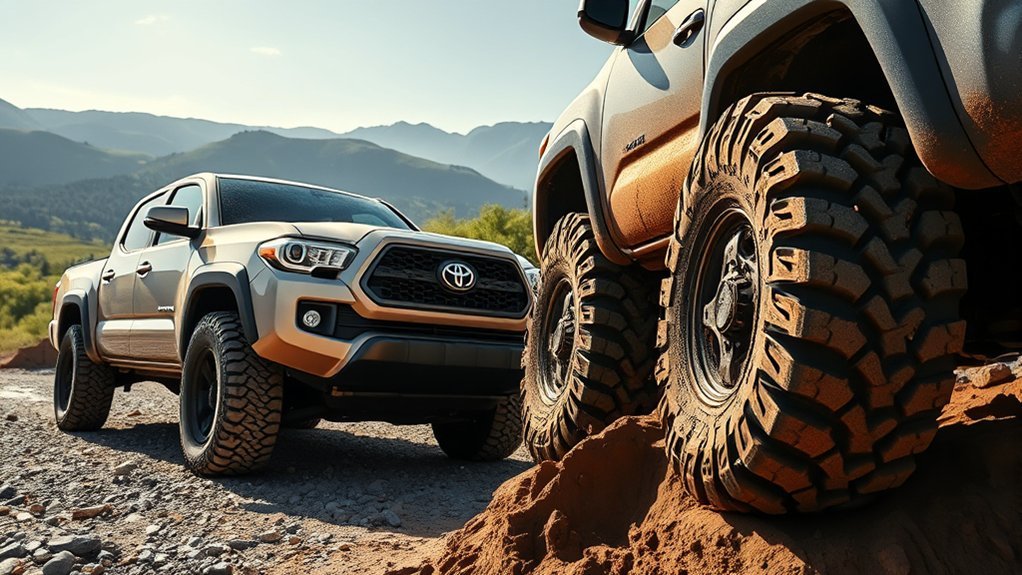
All-terrain tires are built to handle a wide mix of surfaces: pavement, gravel, dirt roads, light mud, snow, and mild-to-moderate trails. They usually use smaller tread blocks, more siping, tighter voids, and rubber compounds designed to balance grip with tread life. That makes them easier to live with if your Tacoma is also your commuter, family vehicle, or road-trip truck.
Mud-terrain tires are more specialized. Their large tread blocks, open voids, and aggressive shoulders help the tire clear mud and bite into soft terrain. That design can be excellent off-road, but it often sacrifices highway quietness, wet-road confidence, rolling efficiency, and long treadwear.
| Category | A/T Tires | M/T Tires |
|---|---|---|
| Best use | Daily driving, overlanding, gravel, snow, light-to-moderate trails | Deep mud, ruts, loose dirt, aggressive off-road use |
| Road noise | Usually quieter | Usually louder, especially as they wear |
| Wet pavement | Typically better due to siping and tighter tread blocks | Can be less predictable unless the tire is specifically designed for wet grip |
| Mud traction | Good in light mud, limited in deep sticky mud | Excellent when tread voids can self-clean |
| Tread life | Often longer | Often shorter on pavement |
Note: “A/T” and “M/T” are categories, not guarantees. A mild A/T, rugged A/T, hybrid terrain, and aggressive M/T can feel very different. Always compare the exact tire model, size, load index, speed rating, warranty, and winter rating before buying.
Essential Tire Specifications for A/T and M/T Tires
The tread pattern gets most of the attention, but the best Tacoma tire choice also depends on sizing, load range, aspect ratio, load index, speed rating, sidewall construction, and how much weight your truck carries. Before changing tire size or load range, check the tire placard on the driver-side door jamb and the Toyota Tacoma owner’s manual tire inflation guidance.
Tread Design Differences
A/T tires usually have staggered tread blocks, smaller voids, and more siping. That helps them stay stable on pavement, channel water, grip in light snow, and reduce tread squirm. Tires like the BFGoodrich All-Terrain T/A KO3, Falken Wildpeak A/T series, and Goodyear Wrangler DuraTrac-style tires are popular because they aim for that blend of daily comfort and trail capability.
M/T tires use bigger lugs, wider voids, and more open shoulders. Those features help the tire dig and clear mud, but they can create more vibration and noise on the highway. For example, the Cooper Discoverer STT Pro is marketed for rock, mud, and dirt, with deep mud-clearing features and added protection against sharp rocks and debris.
Performance Under Various Conditions
A/T tires are usually the better choice when your Tacoma sees changing weather and mixed surfaces. They tend to perform well on dry pavement, wet roads, gravel, dirt, light mud, and snow when properly rated. If winter driving matters, look for the Three-Peak Mountain Snowflake symbol on the sidewall, which the Tire Industry Association identifies as a marking used when a tire meets winter performance test requirements.
M/T tires shine in deep mud, loose soil, ruts, and slow off-road crawling. However, they may not stop, turn, or evacuate water as well as a good A/T tire on wet pavement. In snow, an aggressive M/T can look capable but still underperform if the compound hardens in cold weather or the tread lacks effective siping.
Warning: Do not choose a tire based on appearance alone. A tire that looks aggressive may still have the wrong load rating, weak wet-road manners, no severe-snow rating, or a size that rubs your Tacoma’s fenders, cab mount, or upper control arms.
Lifespan and Durability Comparison
In normal mixed driving, A/T tires often last longer than M/T tires because they usually have a more pavement-friendly tread design and compound. Many well-known A/T models carry mileage warranties; for example, the BFGoodrich All-Terrain T/A KO3 is listed with a 50,000-mile warranty, while many dedicated mud tires focus more on off-road durability than mileage coverage.
M/T tires can still be durable in the right environment. Their stronger shoulders and cut-resistant designs are useful on rocks, roots, and debris. The tradeoff is that pavement miles can wear the large tread blocks unevenly if the tires are not rotated, balanced, aligned, and inflated correctly.
- A/T tires usually provide better tread life for highway-heavy Tacoma owners.
- M/T tires usually provide better deep-mud and loose-terrain bite.
- Heavier LT tires may resist damage better but can reduce ride comfort and fuel economy.
- Rotation, alignment, and inflation matter more as the tread gets more aggressive.
Load Range Explained: Choosing the Right Fit for Your Tacoma
Load range describes a tire’s strength category, but it is not the same as the tire’s exact load capacity. The exact capacity comes from the tire’s load index and inflation pressure. For Tacoma owners shopping LT tires, common load ranges include C, D, and E. These are often described as 6-ply, 8-ply, and 10-ply ratings, but modern tires do not necessarily contain that exact number of physical plies.
| Load Range | Traditional Ply Rating Equivalent | Best For | Main Tradeoff |
|---|---|---|---|
| C | 6-ply rated | Daily driving, lighter trucks, mild trails | Less reserve strength than heavier LT options |
| D | 8-ply rated | Moderate off-roading, added gear, overlanding | Can ride firmer than C-load tires |
| E | 10-ply rated | Heavy gear, towing within ratings, rough trails, rocks | Heavier, firmer, and often less efficient |
Load Range E can be a smart choice for a Tacoma carrying armor, tools, campers, recovery gear, or frequent off-road loads. But it is not automatically the best choice for every Tacoma. An unloaded daily driver may ride better and feel more responsive on a lighter tire with an adequate load index.
Pro Tip: Match or exceed the original tire’s load capacity and speed rating unless a qualified tire professional confirms the replacement is appropriate. The U.S. Tire Manufacturers Association tire care guide stresses proper size, load rating, inflation, and vehicle load limits for safe tire service.
How Aspect Ratio Affects Your Tire Performance and Comfort
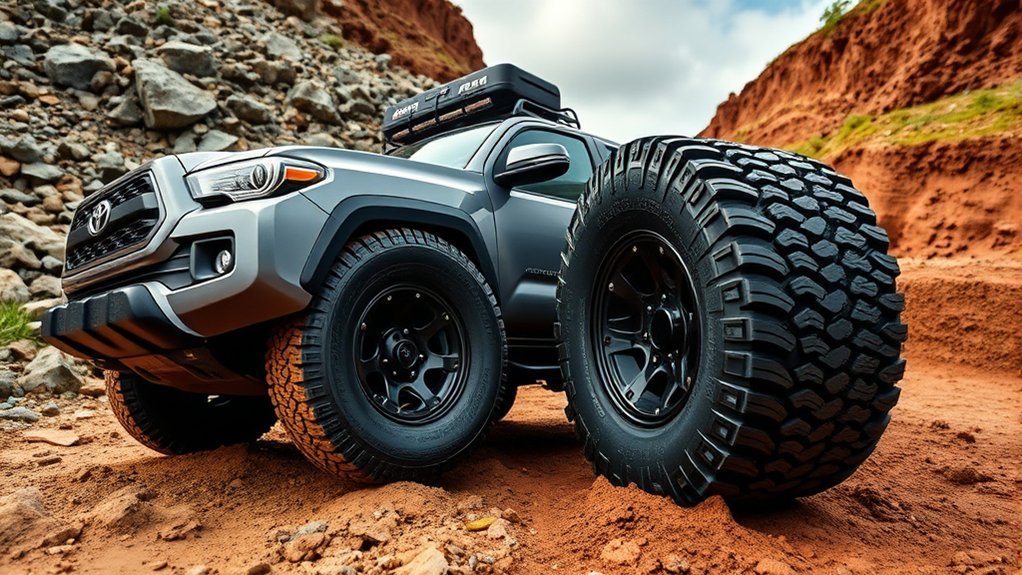
The aspect ratio is the tire’s sidewall height as a percentage of its width. In a size like 265/70R17, the “70” means the sidewall height is 70% of the tire’s width. A higher aspect ratio usually gives the tire more sidewall, which can improve ride comfort and allow more sidewall flex off-road. A lower aspect ratio generally sharpens steering response but can create a firmer ride.
Aspect Ratio Impact on Handling
For a Tacoma, aspect ratio affects steering feel, sidewall flex, wheel protection, and comfort. A tire with a taller sidewall can absorb bumps better on dirt roads and washboard surfaces. It also gives you more sidewall to work with when airing down off-road. A shorter sidewall can feel more planted on pavement but may be less forgiving over rocks, potholes, and trail chatter.
- Lower aspect ratio: Sharper steering response, less sidewall flex, firmer ride.
- Higher aspect ratio: More cushioning, more off-road flex, softer road feel.
- Larger overall diameter: More ground clearance, but possible rubbing and speedometer changes.
- Heavier tire construction: More durability, but slower acceleration and reduced fuel economy.
Comfort Level and Ride Quality
A/T tires usually offer a better comfort balance for Tacoma owners because they combine useful sidewall support with less tread noise and vibration. M/T tires can still ride well when properly balanced and inflated, but their blockier tread pattern often sends more vibration through the cabin.
If you drive long highway miles, commute daily, or carry passengers often, comfort should be part of the buying decision. A tire that performs well on one muddy trail may feel annoying for the next 30,000 miles if it drones on the highway or rides too stiffly.
How Siping Improves Traction in A/T and M/T Tires
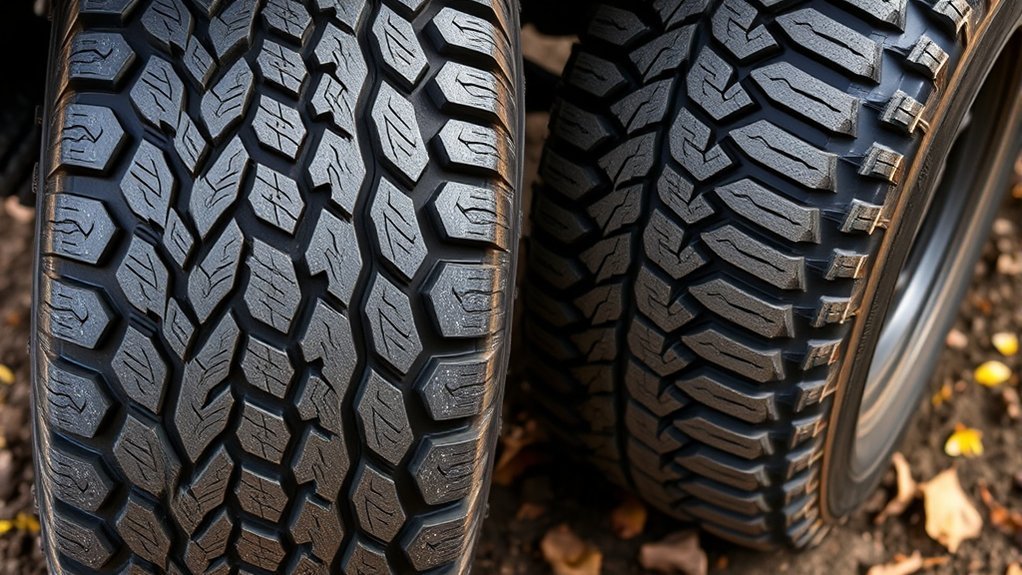
Siping refers to the small slits cut into tread blocks. These slits create extra biting edges and help the tread flex against the road surface. Siping is one reason many A/T tires feel more secure on wet pavement and light snow than a traditional open-lug mud tire.
- Wet roads: Sipes help create more edges for traction and support water evacuation.
- Snow: Siped tread blocks can grip packed snow better than large smooth lugs.
- Ice: More edges can help, but no A/T or M/T tire replaces a dedicated winter tire on ice.
- Mud: Wide voids matter more than siping because the tread needs to clear itself.
Some M/T tires include siping to improve wet and snow manners, but most still prioritize void space, shoulder bite, and self-cleaning. If you live where winter storms are common, choose an A/T or hybrid tire with a clear winter rating instead of relying on aggressive looks.
Road Noise: Comparing A/T and M/T Tire Quietness
Road noise is one of the biggest daily-driving differences between A/T and M/T tires. A/T tires usually use tighter tread spacing and more varied block shapes to reduce drone. M/T tires use larger, more open blocks that slap the road surface harder and create more air movement through the tread voids.
Noise also changes as tires wear. A mud tire that sounds acceptable when new may become louder if the tread cups, wears unevenly, or loses its sharp block edges. Proper rotation, balancing, alignment, and inflation help, but they cannot make a true M/T as quiet as a road-focused A/T.
For a Tacoma that spends most weekdays on pavement and weekends on trails, road noise is often the deciding factor. A good A/T tire usually delivers enough off-road grip without turning every commute into a tire hum test.
Maximizing Treadwear and Longevity for Your Tires
Good tire maintenance matters for both A/T and M/T tires, but it is especially important with aggressive tread patterns. The NHTSA TireWise program recommends paying attention to inflation pressure, treadwear, tire damage, load limits, and routine tire care because those factors affect safety, durability, and fuel consumption.
- Check cold tire pressure monthly: Use the Tacoma tire placard as your starting point, not the maximum PSI printed on the sidewall.
- Rotate regularly: Aggressive tread blocks can cup or feather if rotations are skipped.
- Inspect tread and sidewalls: Look for cuts, cracking, missing chunks, uneven wear, nails, and bulges.
- Align after suspension changes: Lifts, level kits, and new upper control arms can change tire wear patterns.
- Balance when vibration appears: Mud tires and heavy LT tires are more sensitive to imbalance.
- Avoid overloading: Respect the truck’s payload rating, tire load index, and inflation requirements.
Note: Airing down can improve off-road comfort and traction, but you need the right equipment, trail judgment, and a reliable way to air back up before highway driving. Driving fast on underinflated tires can overheat and damage them.
Off-Road Performance: A/T vs. M/T Tire Capabilities
Off-road performance depends on terrain. One tire does not win everywhere. A/T tires are usually better for long mixed-surface trips where the trail includes pavement, gravel, hardpack, rain, snow, and mild mud. M/T tires are better when the trail is soft, sticky, loose, rutted, or muddy enough that the tread needs to dig and clean itself repeatedly.
| Terrain | Better Choice | Why |
|---|---|---|
| Highway and commuting | A/T | Quieter, smoother, and usually longer-lasting |
| Gravel roads | A/T or rugged A/T | Good stability, chip resistance, and predictable braking |
| Light mud | A/T or hybrid | Enough void space without major road-noise penalties |
| Deep mud and ruts | M/T | Large lugs and open voids clear mud better |
| Snowy roads | 3PMSF-rated A/T | Siping and winter-rated compounds matter more than aggressive looks |
| Rocks | Rugged A/T, hybrid, or M/T | Depends on sidewall strength, load range, tread compound, and airing-down needs |
Real-World Applications: When to Choose A/T or M/T Tires?
Choose A/T tires if your Tacoma is a daily driver that also sees camping roads, forest roads, gravel, snow, and occasional trails. This is the most practical setup for most owners because it keeps the truck comfortable and predictable while still adding real off-road capability.
Choose M/T tires if your Tacoma is built mainly for trail use, deep mud, ruts, loose dirt, or technical terrain where traction matters more than long highway life. M/T tires also make sense if you run with groups that regularly tackle muddy parks, wet clay, or off-road routes where A/T tires pack up and spin.
Best Tire Type by Tacoma Owner
- Daily driver with occasional trails: Choose A/T tires.
- Overland Tacoma with camping gear: Choose A/T or rugged A/T tires with the right load index.
- Snowbelt commuter: Choose a 3PMSF-rated A/T, or use dedicated winter tires for severe ice and snow.
- Mud park or hunting truck: Choose M/T tires if deep mud traction is the priority.
- Rock-crawling Tacoma: Consider a rugged A/T, hybrid, or M/T with strong sidewalls and proper load capacity.
- Mostly highway Tacoma: Choose a mild A/T or highway-terrain tire instead of an aggressive M/T.
What to Check Before Buying Tacoma Tires
Before ordering new tires, confirm more than just the diameter. Tacoma fitment can change based on generation, trim, wheel width, offset, suspension lift, fender liner position, mud flaps, cab mount clearance, and upper control arm clearance.
- Factory placard: Check the original tire size and cold tire pressure on the driver-side door jamb.
- Load index: Make sure the replacement tire can safely carry the truck and its cargo.
- Speed rating: Do not downgrade unless a tire professional confirms it is appropriate for your use.
- Overall diameter: Larger tires can affect speedometer accuracy, gearing, braking, and transmission behavior.
- Wheel offset and width: These affect rubbing and sidewall clearance.
- Spare tire fitment: A larger tire may not fit in the factory spare location.
- TPMS compatibility: Make sure your tire shop handles sensors correctly during installation.
- Alignment: Plan for an alignment after suspension or tire-size changes.
Pro Tip: If you are torn between A/T and M/T tires, a rugged A/T or hybrid-terrain tire can be the sweet spot. It gives a more aggressive look and better trail bite than a mild A/T without the full noise and wear penalty of a dedicated M/T.
Frequently Asked Questions
Should I get all-terrain or mud-terrain tires for my Tacoma?
Get all-terrain tires if your Tacoma is driven on pavement, gravel, snow, rain, and moderate trails. Get mud-terrain tires if you regularly drive in deep mud, loose dirt, ruts, or aggressive off-road conditions and can accept more road noise, faster wear, and reduced pavement comfort.
What is a good tire for a Toyota Tacoma?
A good Tacoma tire depends on how you use the truck. For most owners, a quality A/T tire from a major brand is the safest all-around choice. Popular examples include the BFGoodrich All-Terrain T/A KO3, Falken Wildpeak A/T series, Goodyear Wrangler DuraTrac-style tires, Toyo Open Country A/T models, and Nitto Ridge Grappler-style hybrid tires. Always choose the correct size, load index, and rating for your truck.
Are mud-terrain tires bad on the highway?
They are not automatically bad, but they are usually louder, heavier, and less comfortable than A/T tires. Some M/T tires also wear faster on pavement and may feel less secure in heavy rain. If most of your driving is highway use, an A/T tire is usually the better Tacoma choice.
Do all-terrain tires work in snow?
Many A/T tires work well in light-to-moderate snow, especially if they carry the Three-Peak Mountain Snowflake symbol. However, icy roads and severe winter conditions still favor dedicated winter tires. Do not assume every A/T or M/T tire is snow-rated.
Is Load Range E too much for a Tacoma?
Load Range E is useful for Tacomas carrying heavy gear, armor, campers, tools, or frequent off-road loads. For a mostly stock daily driver, it may feel firmer and heavier than necessary. The right choice depends on tire size, load index, truck weight, terrain, and ride-comfort expectations.
Do bigger tires hurt Tacoma fuel economy?
Yes, they can. Bigger or heavier tires increase rotating weight and rolling resistance, which can reduce fuel economy, acceleration, braking response, and shift feel. Aggressive M/T tires usually have a larger impact than lighter, milder A/T tires.
Conclusion
For most Tacoma owners, all-terrain tires are the smarter choice because they deliver the best balance of comfort, durability, wet-road confidence, snow capability, and off-road traction. Mud-terrain tires are worth it when your truck regularly sees deep mud, loose terrain, and aggressive trails where self-cleaning tread and large lugs matter most.
The best answer is not simply A/T or M/T. It is the tire that matches your Tacoma’s real use, load, climate, wheel setup, and comfort expectations. Check the tire placard, confirm the correct load rating, compare winter ratings if you drive in snow, and choose the tread pattern that fits the miles you actually drive.
Sources
- NHTSA TireWise — tire safety, treadwear, inflation, load limits, and maintenance guidance.
- Toyota Tacoma Owner’s Manual: Tire Inflation Pressure — official Tacoma tire pressure and placard guidance.
- Tire Industry Association: Reading a Tire Sidewall — tire markings, sidewall information, and winter symbol explanation.
- U.S. Tire Manufacturers Association: Care and Service of Passenger and Light Truck Tires — load rating, inflation, inspection, and tire service best practices.
- Cooper Discoverer STT Pro — manufacturer description of mud-terrain off-road features.
- BFGoodrich All-Terrain T/A KO3 — manufacturer details for an all-terrain tire example and mileage warranty reference.