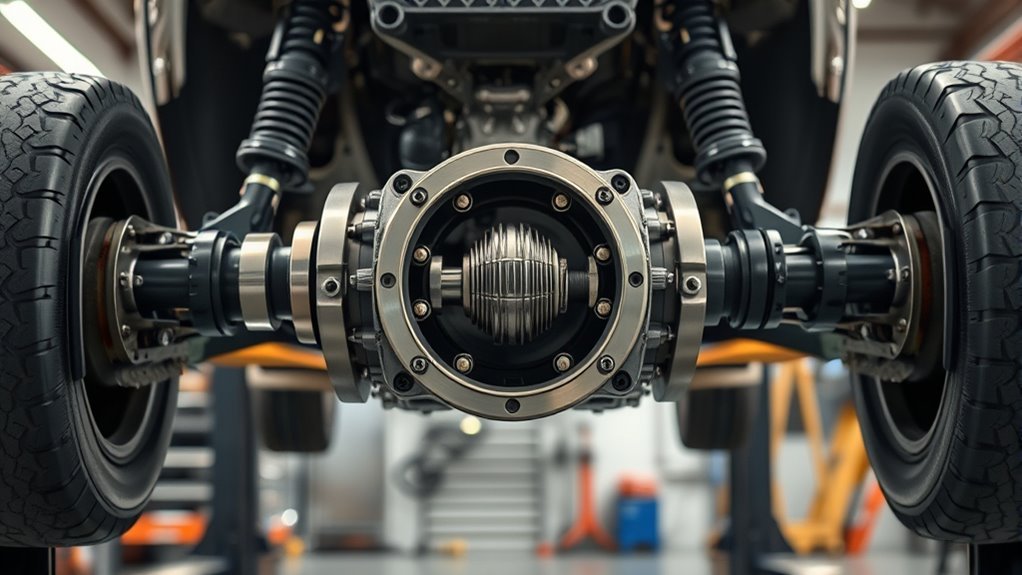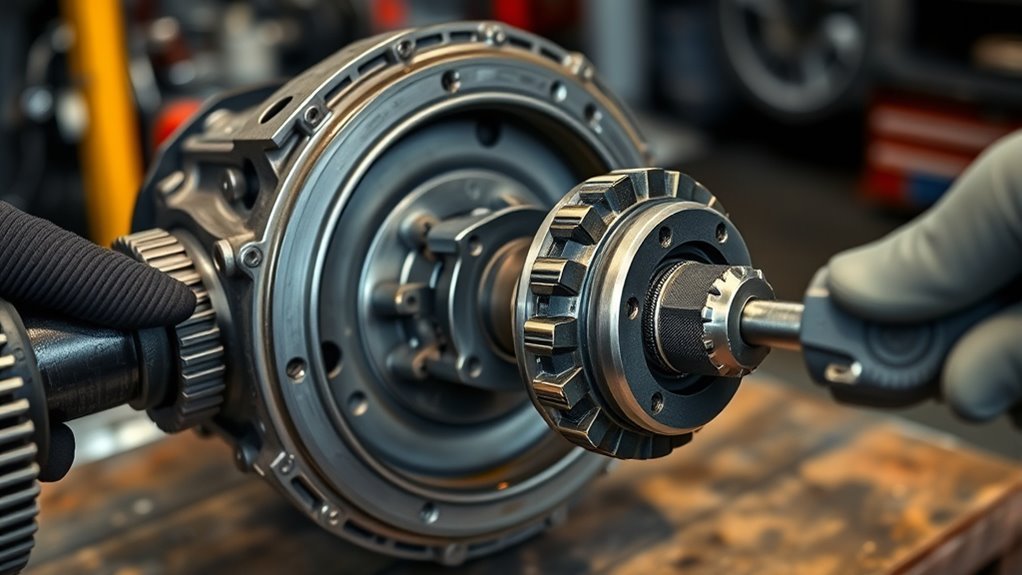
A locking differential forces both wheels on an axle to turn together, so if one wheel loses traction the other still propels the vehicle, preventing one-side spinouts and improving off‑road mobility. You’ll engage lockers manually or let them auto‑sense slip; types include selectable, mechanical, automatic, welded, and spool designs, each with tradeoffs in steering and drivetrain stress. Use lockers for low‑speed obstacles and loose terrain, avoid them on tight turns or ice, and continue for detailed operation, risks, and maintenance.
What a Locking Differential Does
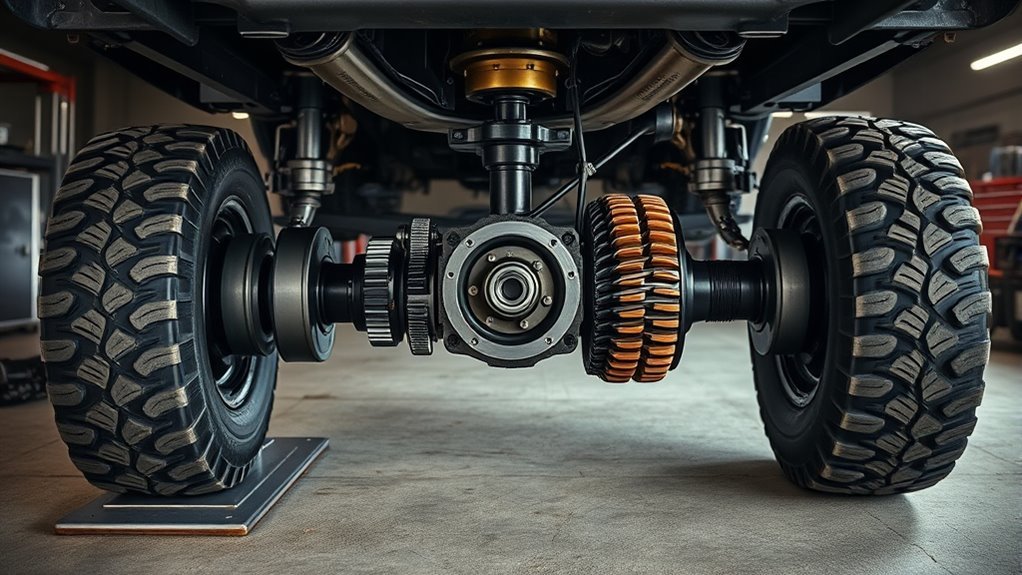
A locking differential forces both wheels on an axle to rotate at the same speed, so if one wheel loses traction in mud, snow, or on a steep incline the other wheel still propels the vehicle. You gain deliberate control: by disabling differential action you stop one wheel from spinning free while the other stalls, addressing the differential problem directly. Manual or automatic engagement gives you versatility—manual lets you choose when to assert traction; automatic responds to torque and speed for seamless intervention. In off-road, agricultural, and heavy-duty contexts, locking differential benefits are clear: increased mobility, predictable propulsion, and reduced likelihood of becoming immobilized. You should weigh trade-offs: engaged locks increase tire scrub and complicate tight turns, so use them strategically. Don’t accept locking differential myths that claim universal superiority; it’s a targeted tool for low-traction scenarios. Embrace its capacity to free you from terrain constraints while managing its mechanical limits with informed application.
How a Locking Differential Changes Traction
Having covered what a locking differential does, let’s examine how engaging one alters traction dynamics at each wheel. When you lock the axle, both wheels are forced to rotate at identical speed, eliminating differential slip that sends torque to the path of least resistance. This equalized rotation converts available torque into usable thrust across both contact patches, so a wheel in mud or on a rock still transmits drive rather than letting the axle free-wheel. The result: predictable traction dynamics that preserve forward momentum even if one wheel lifts or loses grip. You’ll distribute power uniformly, improving vehicle stability and control in steep, loose, or rutted terrain. Manual or automatic engagement gives you adaptability; you select locked behavior when necessary and return to open differential for steering and tire longevity on high-traction surfaces. For freedom-seeking drivers, this means enhanced off road performance and a higher likelihood of overcoming obstacles without becoming anchored by poor traction.
Types of Locking Differentials & How They Engage
While driving conditions dictate when you need locked traction, understanding the different locker types helps you pick the right tool for the job. You’ll evaluate locker technology by how it engages and how it alters differential design. Mechanical lockers engage via lever or cable, giving you positive, driver-controlled lock for maximum traction. Automatic lockers sense wheel-speed differences and lock when one wheel spins faster, delivering seamless intervention without input. Selectable lockers let you choose locked or open modes, balancing traction and drivability as conditions change. Spools remove differential action entirely, rigidly coupling axles for ultimate strength in competitive settings where tight cornering isn’t required. Welded diffs are a low-cost permanent lock—effective but inducing handling quirks that limit street use.
- Mechanical: manual engagement via lever/cable
- Automatic: speed-sensing, self-engaging
- Selectable: driver-controlled, switchable modes
- Spool: solid coupling, no differentiation
- Welded: permanent, cost-effective lock
When to Use a Locker: Real On- and Off-Road Scenarios
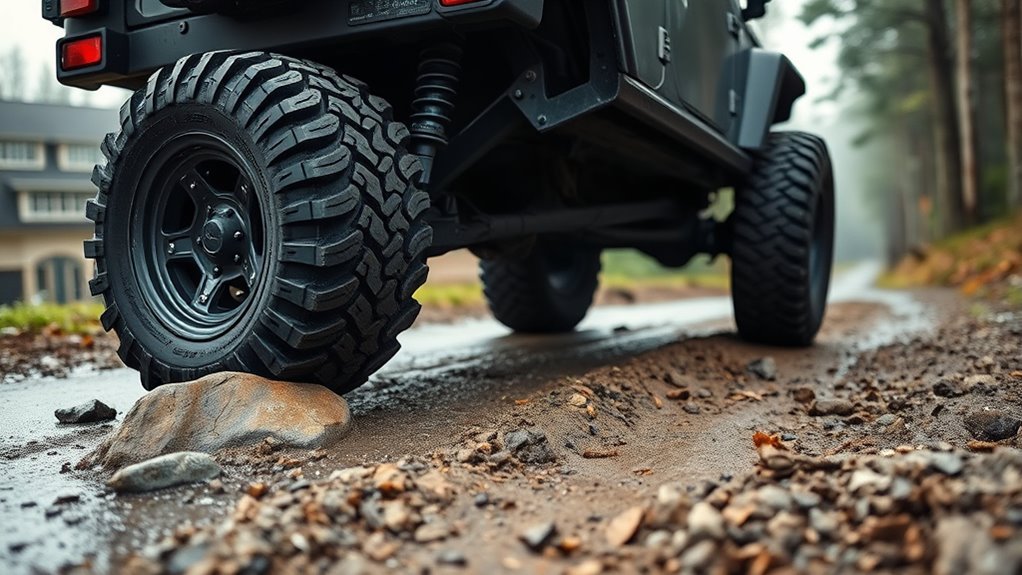
When you’re crawling low-speed over rocks, engage the locker to force equal torque to both wheels and maintain momentum over uneven contacts. Use it in muddy ruts and steep hill climbs or when one wheel is off the ground to prevent loss of drive, but select low-range first or second gear to control torque. Avoid lockers on icy side slopes, high-speed runs, or tight switchbacks where they increase turning radius and can destabilize steering.
Low-Speed Rock Crawling
If you’re crawling over low-speed rock obstacles, lock the differential to force both wheels on an axle to turn together, which maximizes traction on uneven contact patches and prevents a single wheel from spinning uselessly. You’ll use rock crawling techniques and targeted traction strategies to maintain momentum and vehicle control. Engage the locker when a wheel lifts or traction is asymmetric; it prevents power loss and stabilizes climbs. Don’t lock during tight steering inputs because it increases scrub and steering effort. Practice engagement timing so you liberate the vehicle’s capability without compromising maneuverability. Prioritize smooth throttle, line selection, and measured locker use to overcome obstacles efficiently while preserving drivetrain components.
- Use locker on steep, asymmetric contacts
- Avoid locking in tight turns
- Engage at low speeds
- Combine with deliberate throttle
- Monitor wheel lift
Muddy Ruts And Hills
Because mud and ruts create highly variable traction, engage the locker to force both wheels to turn together and prevent a single spinning tire from halting progress. You’ll use a locker in muddy ruts to deliver consistent torque to both wheels, avoiding loss of momentum when one wheel finds less grip. On steep climbs, activate the locker to preserve forward motion if one tire slips or sinks; it balances drive between wheels so you maintain ascent. When a wheel lifts or encounters an obstacle, the locker routes power to the grounded wheel, increasing obstacle-crossing ability. On descending rutted hills, a locked axle stabilizes rotation and reduces unexpected slips. Don’t use lockers on flat pavement or tight turns where equal traction exists; they’ll increase tire wear and reduce maneuverability.
Snow, Ice And Slopes
Muddy ruts and hills often mirror the grip challenges you’ll face on snow and ice, so adjust locker use accordingly: engage the locker to lock both wheels at the same speed whenever low-friction surfaces threaten individual-wheel slip. Use it on climbs to preserve forward momentum; lockers distribute torque evenly and prevent spin in snow traction and icy conditions. On side slopes, lockers help you resist lateral slide and retain control. During rutted descents, a locker stabilizes rotation across uneven contact patches.
- Engage on steep, snowy climbs to maintain momentum.
- Use on side slopes to reduce slide risk.
- Apply in rutted, icy terrain for consistent rotation.
- Avoid lockers on sharp turns or switchbacks.
- Disengage when maneuverability or differential action is required.
When Not to Use a Locker and Handling Risks
Don’t engage a locker on ice or uniformly slippery surfaces—you’ll lose the subtle differential action needed for safe, controllable steering. Never lock during turns or switchbacks, since the increased turning radius and resistance can induce crabbing, understeer, or rollovers. Also be aware of driveline shock when locking/unlocking under load; abrupt engagement can damage components and unsettle the vehicle.
Avoid Lockers On Ice
If you lock the differential on icy pavement, you’ll often lose directional control because both wheels on the axle are forced to turn at the same speed, which promotes skidding and unpredictable vehicle reactions. You should avoid lockers for ice handling and prioritize traction management systems or careful throttle modulation. A locked axle removes differential action, so sudden grip changes make the vehicle snap or understeer, and one wheel can dig in while the other spins on slippery inclines. Don’t rely on a locker when counter-steering or recovering from slides; it complicates predictable inputs. Choose open or limited-slip setups and electronic aids to preserve control and freedom of movement.
- Increased skidding risk
- Exacerbated understeer
- Single-wheel digging/spin
- Unpredictable reactions
- Compromised recovery options
Don’t Lock During Turns
Having covered why lockers are a poor choice on ice, next consider how they behave when you steer: engaging a locker during sharp turns forces both wheels to spin at the same rate, greatly increasing turning radius and promoting understeer, tire chirp, and accelerated wear on high-traction surfaces. You should disengage lockers for tight switchbacks, precise obstacle negotiation, or any situation with uneven weight distribution—side slopes or partial traction—because a locked axle reduces differential rotation needed for stability and can induce sudden loss of control. At higher speeds a locked axle yields jerky steering and stresses drivetrain components. To preserve maneuverability and limit tire wear, adopt a disciplined use pattern: engage lockers only where limited-slip of both wheels aids propulsion, disengage before technical turns, and regain freedom of control.
Watch For Driveline Shock
Any time you lock a differential on high-traction surfaces you risk driveline shock: sudden torque transfer between wheels can spike loads through axles, CV joints, and the transfer case, producing clunks, splines shear, or bearing failure. You’ll want to reserve lockers for low-traction scenarios and use disciplined torque management to preserve driveline safety. Avoid lockers on tight turns, switchbacks, high speeds, and side slopes; each condition amplifies binding, unpredictable handling, or roll risk. Sudden traction shifts on ice or uneven ground demand gradual inputs and quick disengagement when control degrades.
- Don’t lock during tight turns or switchbacks.
- Avoid lockers at highway or high speeds.
- Never engage on significant side slopes.
- Modulate throttle to prevent sudden torque spikes.
- Disengage if handling becomes unpredictable.
Pros & Cons: Automatic, Selectable, Welded/Spool Lockers
Four core locker types—automatic, selectable, welded, and spool—each trade traction, drivability, and durability differently. You’ll choose among differential types by weighing tire wear, handling, and control needs. Automatic lockers give hands-free engagement for off-road ease but can cause understeer and increased tire wear on turns. Selectable lockers let you control lock state, improving drivability and reducing on-road strain, though they add complexity and failure points. Welded differentials maximize traction by permanently locking axles; expect severe tire wear and poor pavement handling. Spools remove differential action altogether, delivering consistent torque but harsh corner behavior and constant stress on driveline components.
| Type | Traction | On-road impact |
|---|---|---|
| Automatic | High when engaged | Increased tire wear, tricky turns |
| Selectable | Variable | Better control, more systems |
| Welded/Spool | Max | Severe tire wear, rough handling |
Match locker choice to mission: liberate capability without sacrificing safety or longevity.
How Lockers Interact With ABS, Traction Control & AWD
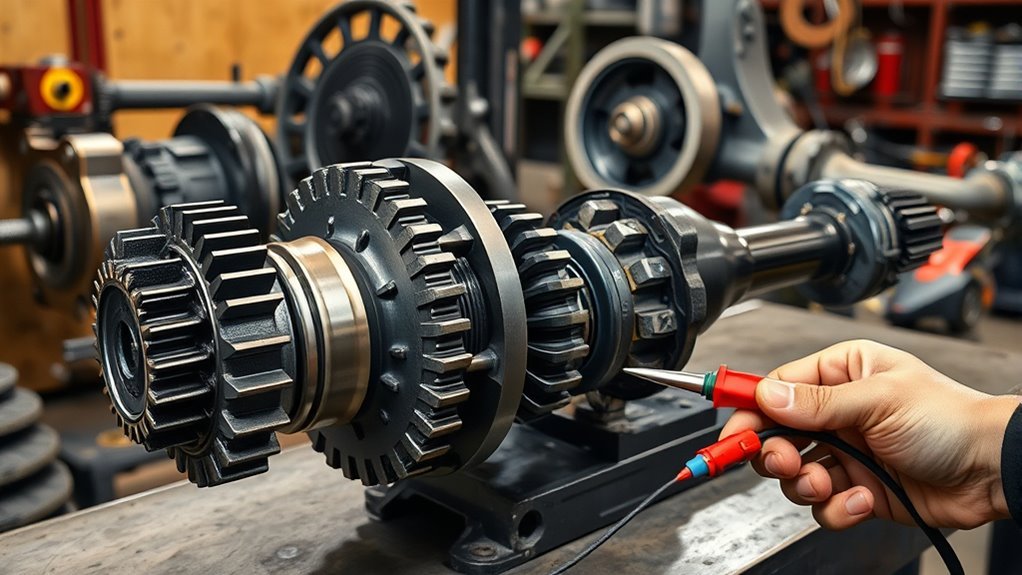
When you engage a locker it alters wheel-speed differentials and can trigger ABS to activate incorrectly on slippery surfaces. Traction control may be rendered less effective or require integration logic because it depends on individual-wheel slip sensing to modulate brakes or torque. In AWD systems, properly integrated lockers can force equal torque distribution for traction while electronic coordination handles seamless engagement and safety limits.
ABS Interaction Dynamics
Although engaging a locker gives you predictable wheel torque, it can confuse ABS and traction control because those systems depend on independent wheel-speed signals to modulate brake pressure and apply selective braking. You gain locking differential advantages—consistent torque to both wheels—but accept locking differential limitations when electronic controls lose accurate inputs.
- ABS may not detect wheel slip correctly with both wheels tied, reducing anti-lock effectiveness.
- Traction control can’t isolate a slipping wheel if speeds are equalized, so brake-based intervention is limited.
- AWD driveline stress increases when lockers force equal shaft speeds, risking binding.
- Some modern ECU strategies coordinate lockers with ABS/TC to mitigate conflicts.
- Off-road use demands understanding system interactions to preserve control and avoid mechanical damage.
You choose freedom; know the trade-offs.
Traction Control Synergy
Because lockers change how each wheel reports speed and torque, you need to understand how ABS, traction control, and AWD coordinate so the vehicle stays stable and uses grip efficiently. You’ll rely on traction control benefits when a locker forces equal wheel speeds; the system senses slip and applies brakes to the spinning wheel, preserving momentum and directional control. ABS keeps braking predictable despite altered wheel-speed signals from a locked axle. Automated integration lets systems engage or modulate lockers based on sensor fusion, minimizing human intervention and maximizing usable traction. Yet you must accept locking differential limitations: reduced differentiation on high-traction surfaces and potential sensor confusion. Know when to override automation to retain control and pursue liberated, confident driving.
AWD And Locker Integration
If you engage a locker in an AWD vehicle, the drivetrain and its electronic aids must re-evaluate wheel-speed and torque inputs to keep the car stable and efficient. You’ll notice ABS can receive conflicting wheel-speed signals when both wheels rotate together, reducing its predictive modulation. TCS may lose granularity in power distribution, struggling to brake or cut torque selectively. Electronic lockers in modern AWD systems mitigate these issues by communicating lock state to ABS/TCS, preserving lock performance while maintaining drive stability. You must use lockers judiciously: avoid prolonged engagement on high-traction surfaces to prevent driveline stress and control loss.
- Understand lock state communication
- Expect altered ABS inputs
- Anticipate reduced TCS resolution
- Prefer electronic lockers
- Prevent high-traction engagement
Aftermarket Fitment: Can You Install a Locking Differential?
Wondering whether you can fit a locking differential to your vehicle? You can—often—but expect installation challenges and plan for professional assistance. Aftermarket lockers from ARB, Eaton and others fit many popular off-road platforms as selectable or automatic units, yet compatibility checks are mandatory. Installation replaces the existing differential, may require ring-and-pinion re-setting, and sometimes demands axle housing or driveshaft modifications to maintain alignment and load paths.
You should evaluate vehicle-specific factors: axle type, clearance, and suspension geometry. Prioritize essential safety gear and drivetrain upgrades before investing in a locker, especially if you’re new to off-roading; a locked axle shifts forces and can expose weak components. Choose a reputable brand and have a certified mechanic verify gear patterns, preload, and torque specs. With proper planning and skilled installation, an aftermarket locking differential will expand your vehicle’s capability and freedom on demanding terrain while minimizing risk.
Locking Differential Maintenance & Troubleshooting
Start by making routine inspections part of your maintenance schedule: check for unusual noises, binding, or delayed engagement/disengagement and verify fluid level and condition in the differential housing to prevent overheating and premature wear. You’ll reduce failure risk by diagnosing differential noises early, monitoring for fluid contamination, and ensuring the engagement mechanism responds reliably. Perform engagement testing in a safe, controlled setting to confirm mechanical, hydraulic, or electric actuation. Watch tire alignment and wear patterns; uneven wear often signals differential or alignment faults. Follow the service manual for intervals and procedures.
- Inspect for unusual differential noises during idle, acceleration, and under load.
- Drain and inspect gear oil for fluid contamination and metal debris.
- Conduct controlled engagement testing to verify lock/unlock timing and torque transfer.
- Check tire alignment and rotate tires to reveal asymmetric wear.
- Tighten fasteners and replace seals per manufacturer torque and spec.
Maintain autonomy: act promptly on findings to preserve capability and avoid cascading failures.
Alternatives to Diff-Locks: LSD, EDL, Traction Control, IWD
While traditional diff-locks force equal wheel rotation, several alternative systems give you improved traction with less driver input by managing torque and wheel speed more subtly. You’ll find LSD advantages in mechanical designs that allow controlled slip, delivering smoother cornering and predictable traction without full lock. EDL mechanisms exploit ABS sensors and brake actuators to retard spinning wheels, restoring drive torque to grounded tires with no mechanical locker. Traction control complements both by continuously monitoring wheel speeds and intervening to prevent slip, freeing you from manual engagement. IWD benefits come from distributing torque independently to each wheel, maximizing contact and maneuverability on irregular terrain.
| System | Core function |
|---|---|
| LSD | Torque biasing, limited wheel-speed differential |
| EDL | Brake-based wheel-stop to simulate lock |
| Traction Control / IWD | Active wheel-speed control; independent torque allocation |
These alternatives demand less intervention than lockers, aligning technical liberation with user-friendly, automated traction management.
Frequently Asked Questions
Why Would You Lock Your Differential?
You lock your differential to force equal wheel rotation, maximizing traction control and improving off road performance when one wheel loses grip; you’ll maintain momentum, avoid getting stuck, and extend your freedom to traverse rough terrain.
Can You Engage Diff Lock While Moving?
Yes — you can engage diff lock while moving, depending on differential types; automatic lockers often engage under spin, manual locks need slow or stopped engagement. You’ll preserve off road performance by following vehicle-specific limits.
What Are the Disadvantages of Diff Lock?
By Jove, you’ll face increased tire wear, compromised traction control, trickier handling and turning, noise/vibration, possible over/understeer, higher mechanical complexity, and maintenance burdens—yet you’ll gain off road performance when you’ll strategically engage it.
What’s the Difference Between Locking and Non-Locking Differential?
You get different torque distribution: a locking differential forces equal torque to both wheels for maximum traction control in low-grip situations, while a non-locking differential lets wheels vary speed, optimizing cornering and efficiency.
Conclusion
You’ve seen how a locker turns two spinning wheels into one resolute axle, giving you grip where physics would otherwise let you down. Like switching from a compass to a locked bearing in rough terrain, a locker simplifies torque delivery so you can tackle mud, rocks, or deep snow with predictable intent. Use it deliberately, maintain it diligently, and know its limits with ABS, traction control and steering dynamics to stay safe and effective.